Opportunity Identification


                             FITT
(Fostering Interregional Exchange in ICT Technology Transfer)


                    www.FITT-for-Innovation.eu
Definition


 In the context of public service, technology transfer aims at bringing the results of
  research laboratories to public use and benefits. The conversion of scientific findings
  into useful commercial products or processes is a way to bring innovative technologies
  to the society.


 In the scope of technology transfer, the detection of opportunities is the way research
  organisations identify the technologies that could be successfully turned into
  commercial products.


2 | March 2010                       Opportunity Identification
Position in the valorisation chain

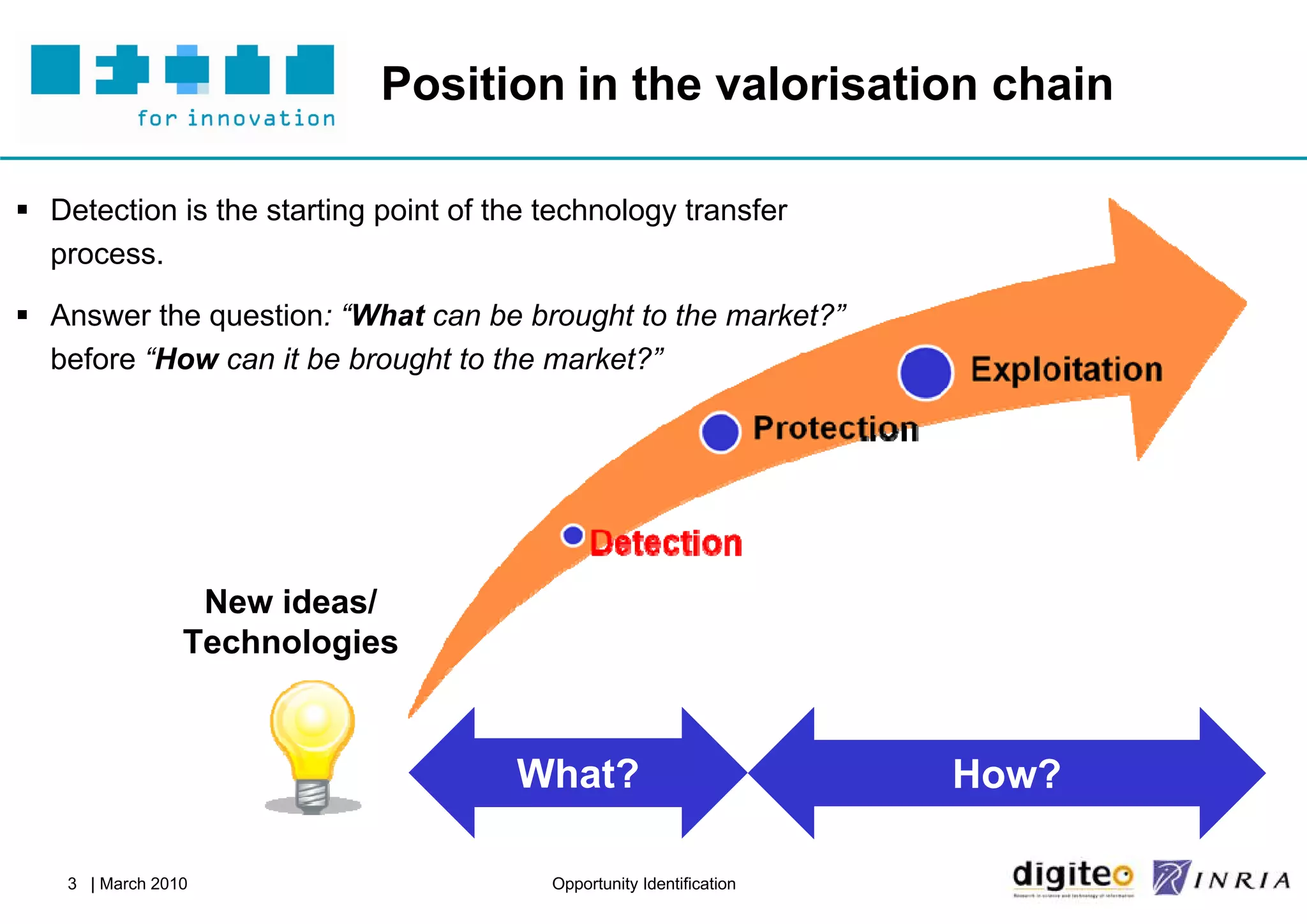
 Detection is the starting point of the technology transfer
  process.

 Answer the question: “What can be brought to the market?”
  before “How can it be brought to the market?”


                  New ideas/
                 Technologies


                                      What?                           How?

    3 | March 2010                       Opportunity Identification
Position in the valorisation chain

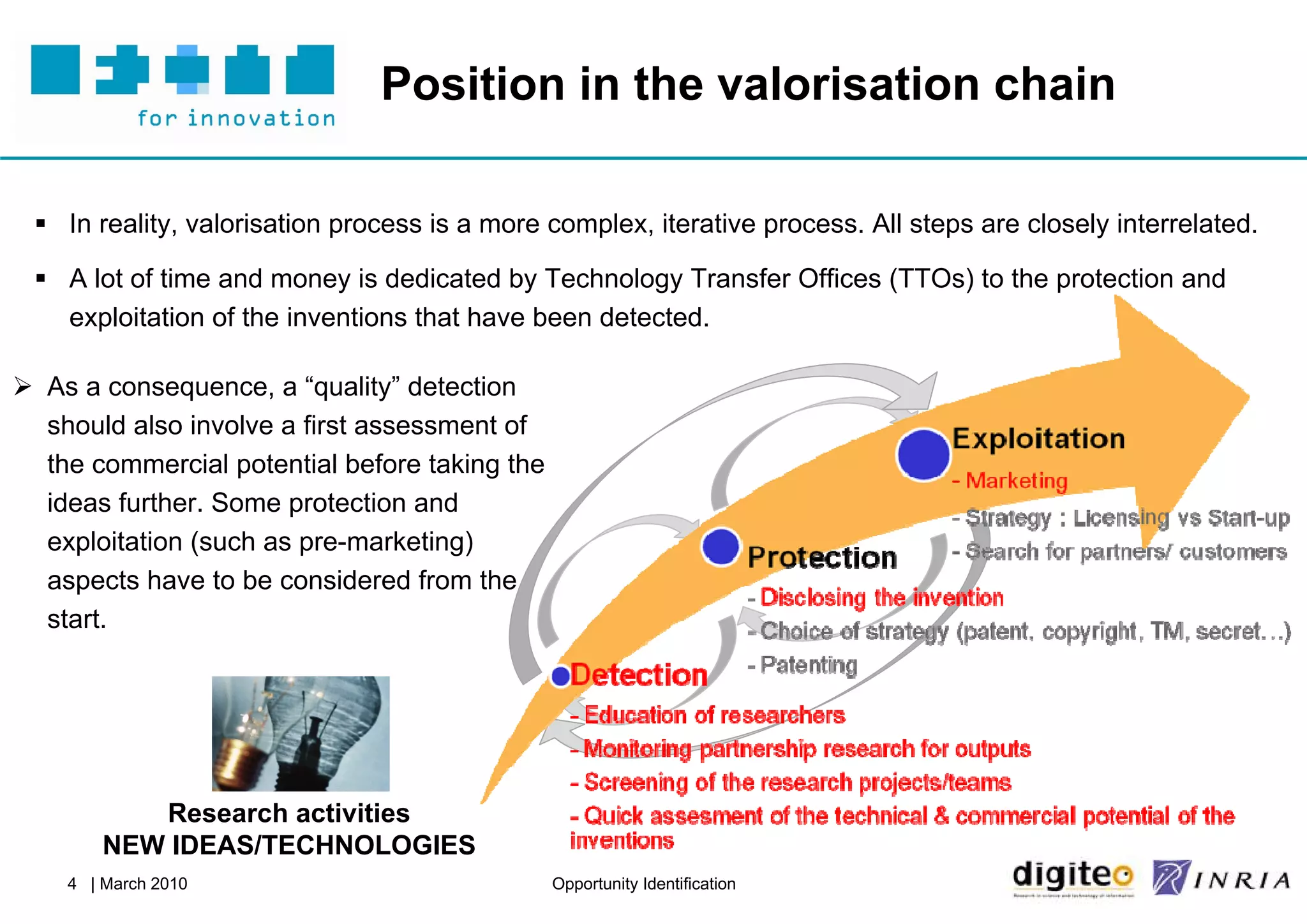
  In reality, valorisation process is a more complex, iterative process. All steps are closely interrelated.

  A lot of time and money is dedicated by Technology Transfer Offices (TTOs) to the protection and
   exploitation of the inventions that have been detected.

 As a consequence, a “quality” detection
  should also involve a first assessment of
  the commercial potential before taking the
  ideas further. Some protection and
  exploitation (such as pre-marketing)
  aspects have to be considered from the
  start.


           Research activities
        NEW IDEAS/TECHNOLOGIES
    4 | March 2010                             Opportunity Identification
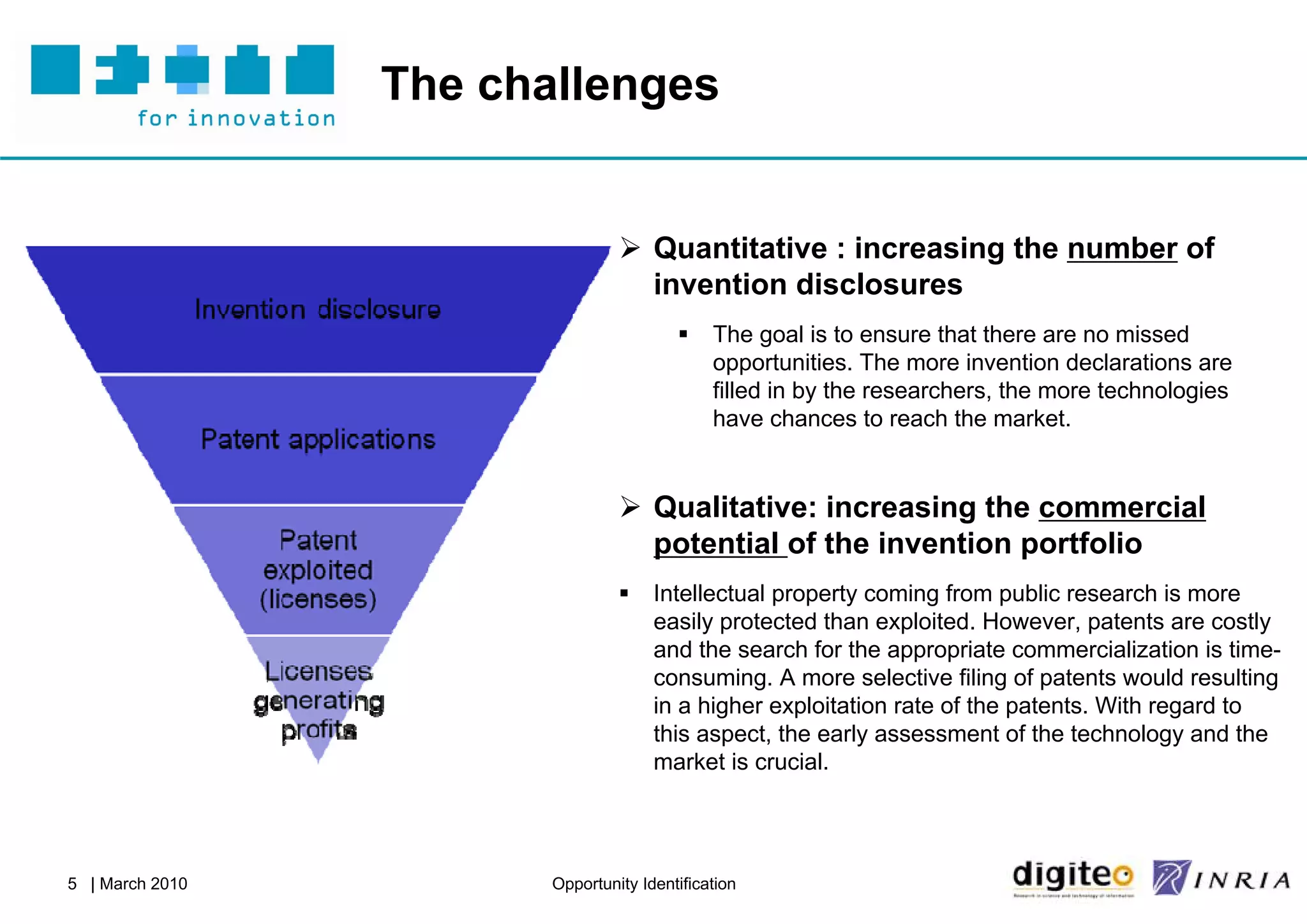
The challenges


                                  Quantitative : increasing the number of
                                   invention disclosures
                                             The goal is to ensure that there are no missed
                                              opportunities. The more invention declarations are
                                              filled in by the researchers, the more technologies
                                              have chances to reach the market.


                                  Qualitative: increasing the commercial
                                   potential of the invention portfolio
                                     Intellectual property coming from public research is more
                                      easily protected than exploited. However, patents are costly
                                      and the search for the appropriate commercialization is time-
                                      consuming. A more selective filing of patents would resulting
                                      in a higher exploitation rate of the patents. With regard to
                                      this aspect, the early assessment of the technology and the
                                      market is crucial.


5 | March 2010          Opportunity Identification
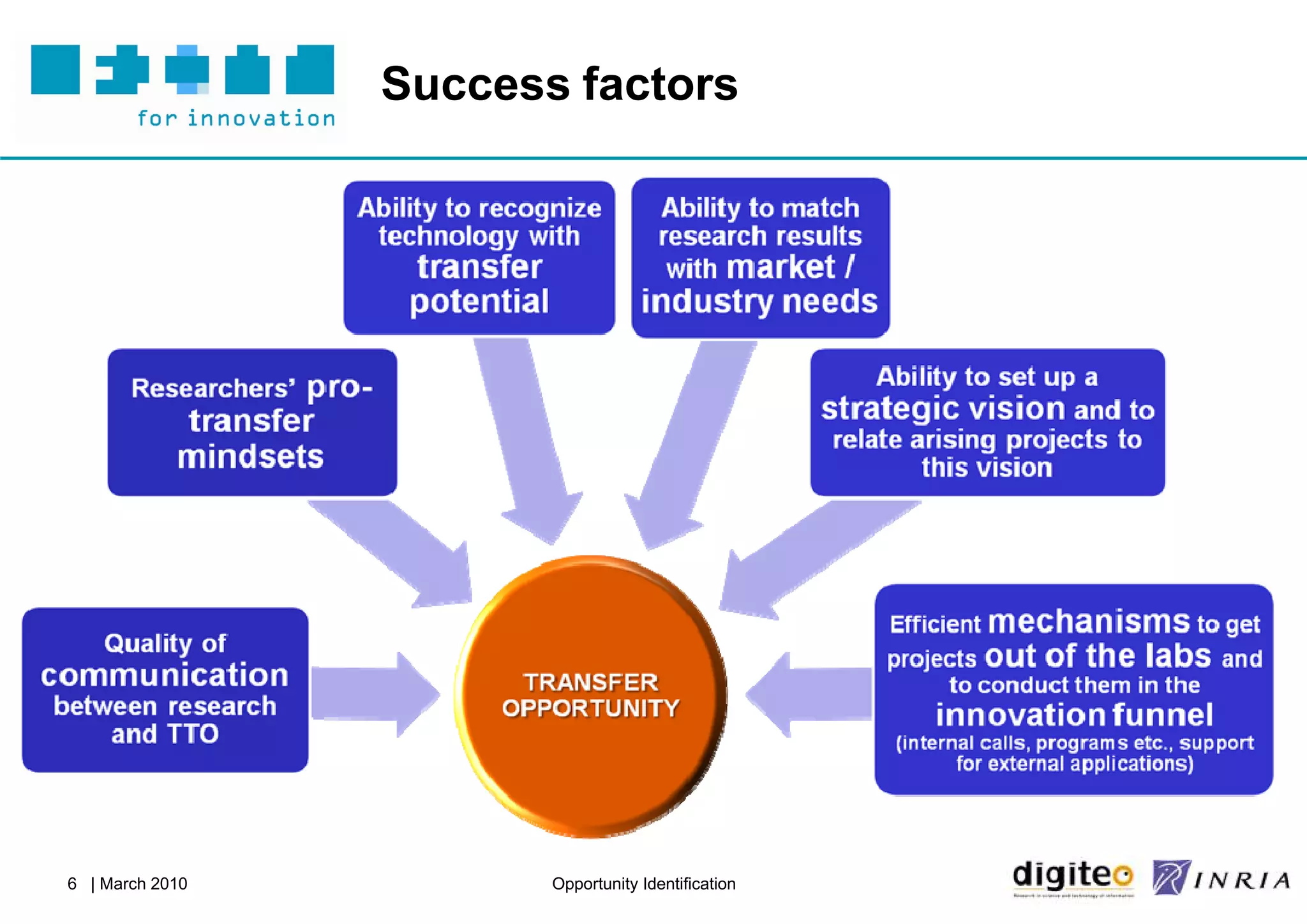
Success factors


6 | March 2010          Opportunity Identification
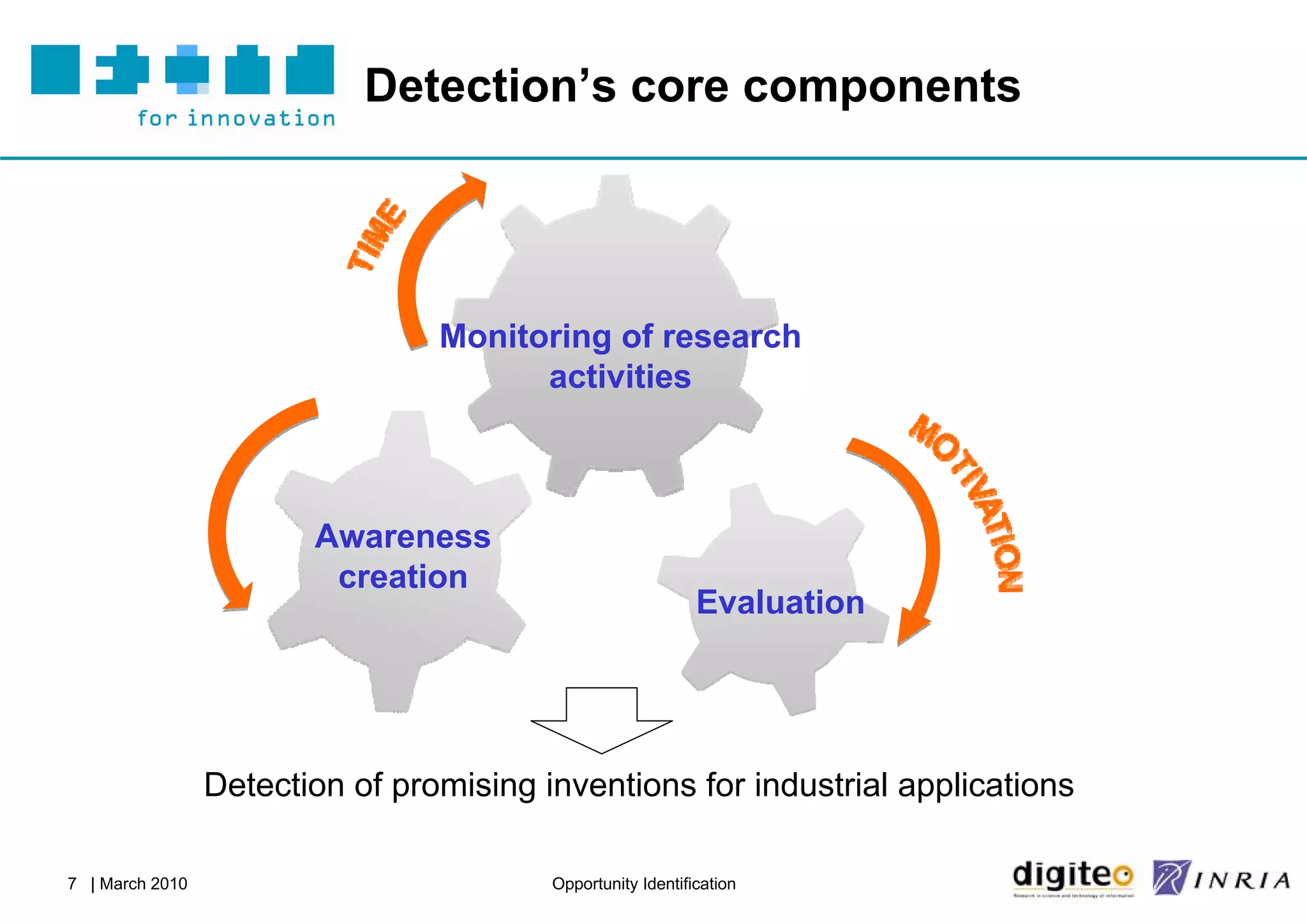
Detection’s core components


                                 Monitoring of research
                                       activities


                        Awareness
                         creation
                                                             Evaluation


                 Detection of promising inventions for industrial applications

7 | March 2010                           Opportunity Identification
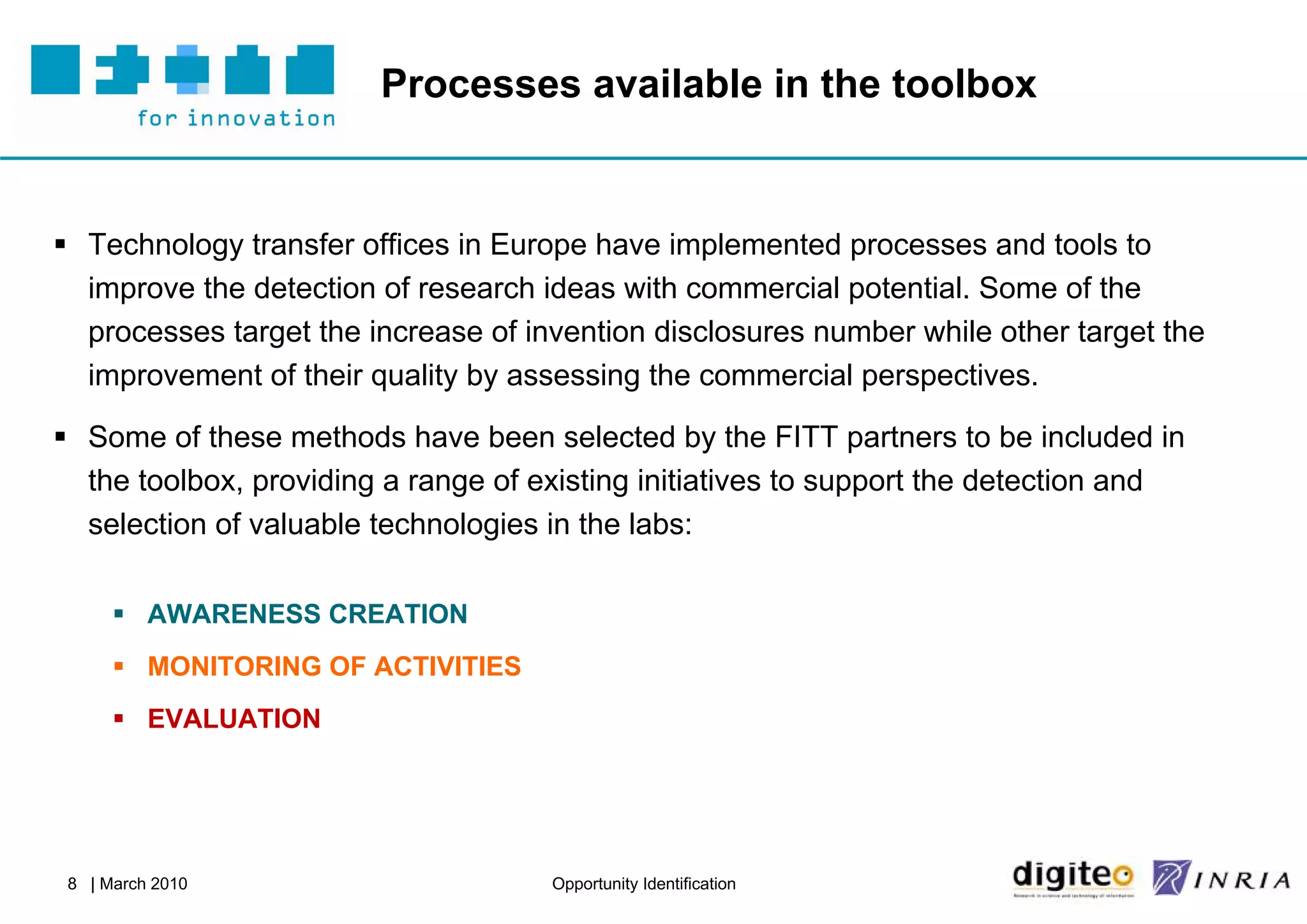
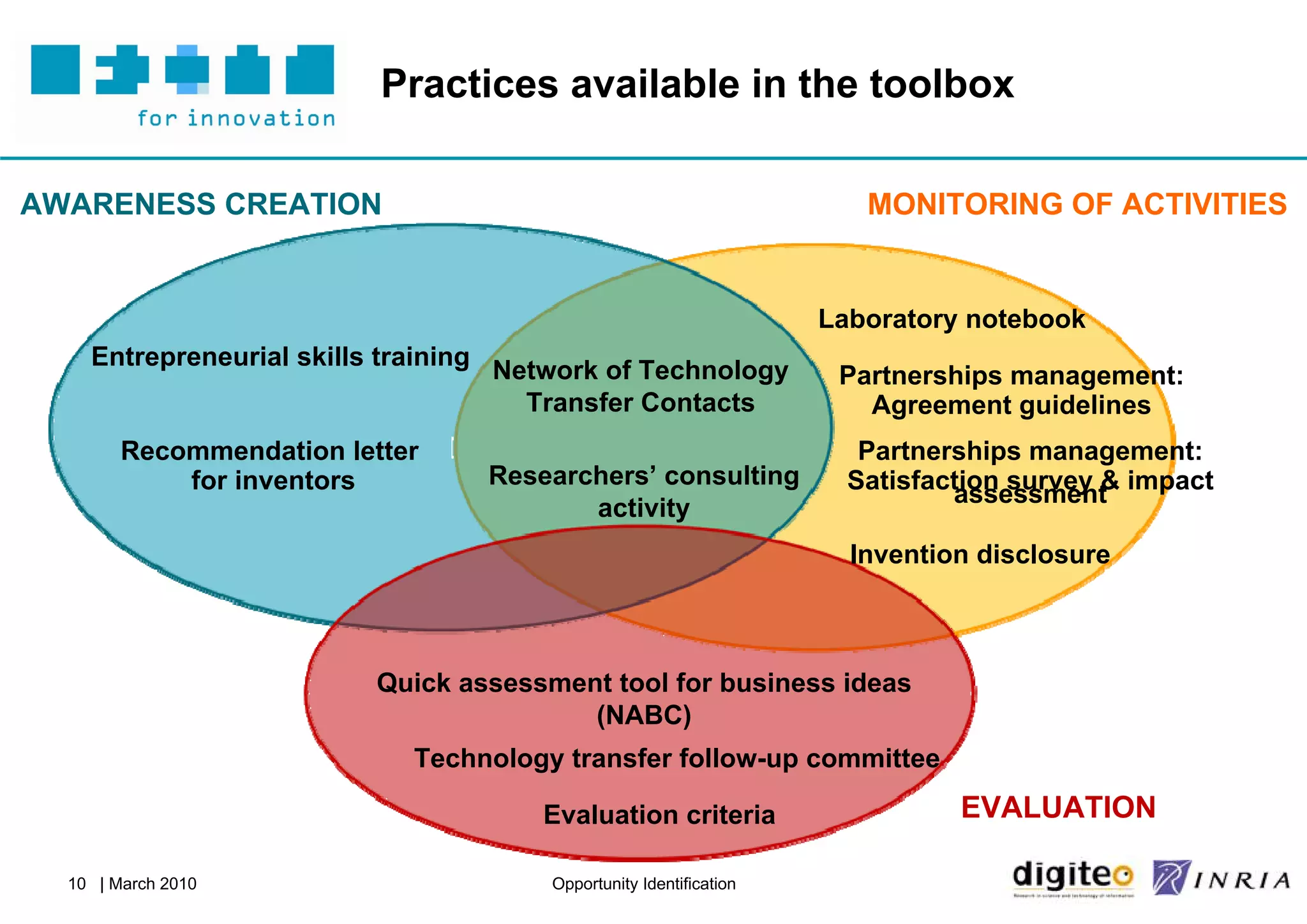
Processes available in the toolbox


 Technology transfer offices in Europe have implemented processes and tools to
  improve the detection of research ideas with commercial potential. Some of the
  processes target the increase of invention disclosures number while other target the
  improvement of their quality by assessing the commercial perspectives.

 Some of these methods have been selected by the FITT partners to be included in
  the toolbox, providing a range of existing initiatives to support the detection and
  selection of valuable technologies in the labs:

       AWARENESS CREATION
       MONITORING OF ACTIVITIES
       EVALUATION


 8 | March 2010                      Opportunity Identification
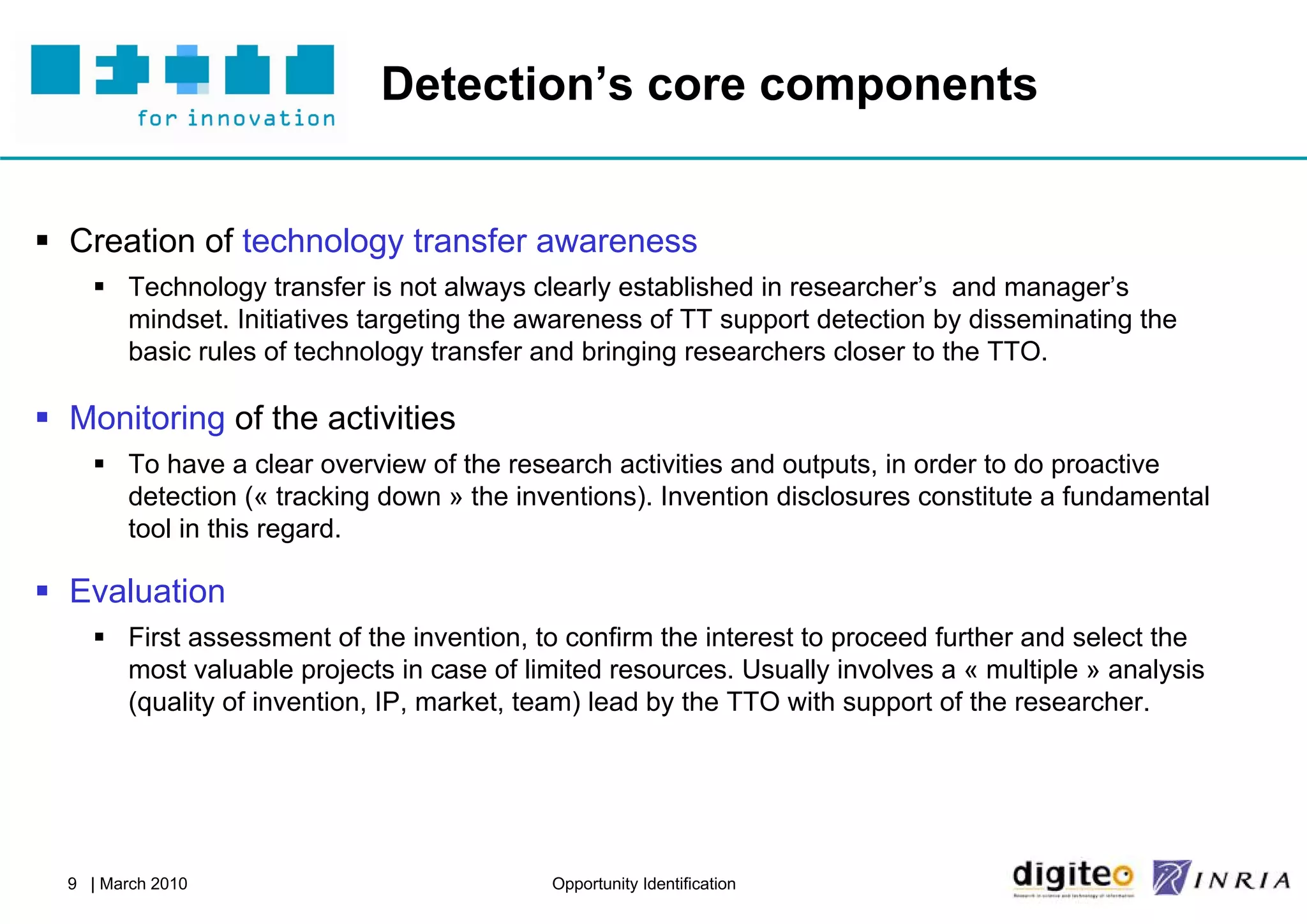
Detection’s core components


 Creation of technology transfer awareness
     Technology transfer is not always clearly established in researcher’s and manager’s
      mindset. Initiatives targeting the awareness of TT support detection by disseminating the
      basic rules of technology transfer and bringing researchers closer to the TTO.

 Monitoring of the activities
     To have a clear overview of the research activities and outputs, in order to do proactive
      detection (« tracking down » the inventions). Invention disclosures constitute a fundamental
      tool in this regard.

 Evaluation
     First assessment of the invention, to confirm the interest to proceed further and select the
      most valuable projects in case of limited resources. Usually involves a « multiple » analysis
      (quality of invention, IP, market, team) lead by the TTO with support of the researcher.


  9 | March 2010                           Opportunity Identification
Practices available in the toolbox

AWARENESS CREATION                                                        MONITORING OF ACTIVITIES


                                                                       Laboratory notebook
    Entrepreneurial skills training
                                      Network of Technology             Partnerships management:
                                        Transfer Contacts                 Agreement guidelines
        Recommendation letter                                             Partnerships management:
            for inventors             Researchers’ consulting            Satisfaction survey & impact
                                                                                 assessment
                                             activity
                                                                         Invention disclosure


                           Quick assessment tool for business ideas
                                          (NABC)
                              Technology transfer follow-up committee

                                          Evaluation criteria                    EVALUATION

  10 | March 2010                         Opportunity Identification
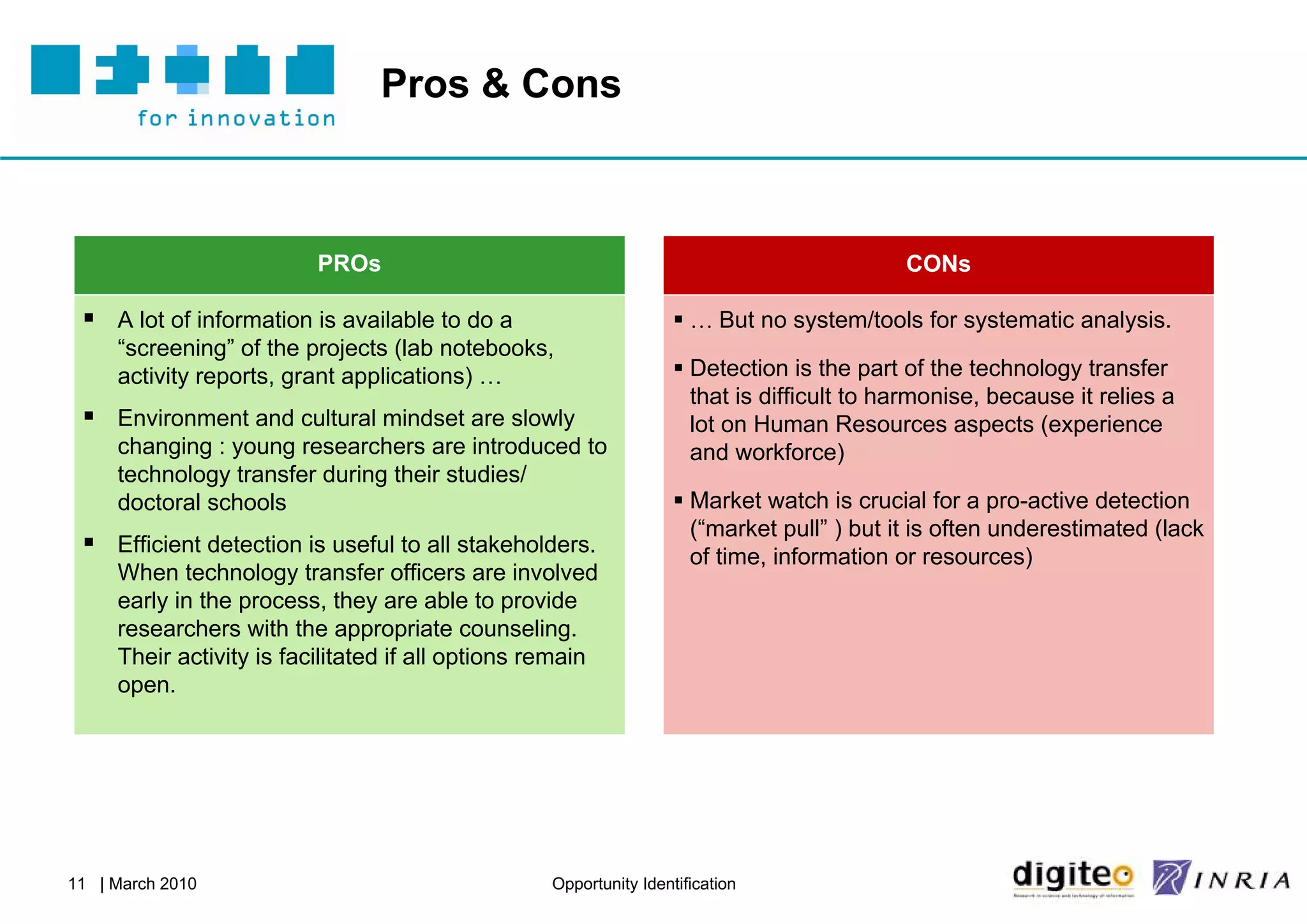
Pros & Cons


                          PROs                                                              CONs

  A lot of information is available to do a                         … But no system/tools for systematic analysis.
     “screening” of the projects (lab notebooks,
     activity reports, grant applications) …                         Detection is the part of the technology transfer
                                                                      that is difficult to harmonise, because it relies a
  Environment and cultural mindset are slowly                        lot on Human Resources aspects (experience
     changing : young researchers are introduced to                   and workforce)
     technology transfer during their studies/
     doctoral schools                                                Market watch is crucial for a pro-active detection
                                                                      (“market pull” ) but it is often underestimated (lack
  Efficient detection is useful to all stakeholders.                 of time, information or resources)
     When technology transfer officers are involved
     early in the process, they are able to provide
     researchers with the appropriate counseling.
     Their activity is facilitated if all options remain
     open.


11 | March 2010                                    Opportunity Identification

Opportunities Identification Ppt Final

  • 1.
    Opportunity Identification FITT (Fostering Interregional Exchange in ICT Technology Transfer) www.FITT-for-Innovation.eu
  • 2.
    Definition  In thecontext of public service, technology transfer aims at bringing the results of research laboratories to public use and benefits. The conversion of scientific findings into useful commercial products or processes is a way to bring innovative technologies to the society.  In the scope of technology transfer, the detection of opportunities is the way research organisations identify the technologies that could be successfully turned into commercial products. 2 | March 2010 Opportunity Identification
  • 3.
    Position in thevalorisation chain  Detection is the starting point of the technology transfer process.  Answer the question: “What can be brought to the market?” before “How can it be brought to the market?” New ideas/ Technologies What? How? 3 | March 2010 Opportunity Identification
  • 4.
    Position in thevalorisation chain  In reality, valorisation process is a more complex, iterative process. All steps are closely interrelated.  A lot of time and money is dedicated by Technology Transfer Offices (TTOs) to the protection and exploitation of the inventions that have been detected.  As a consequence, a “quality” detection should also involve a first assessment of the commercial potential before taking the ideas further. Some protection and exploitation (such as pre-marketing) aspects have to be considered from the start. Research activities NEW IDEAS/TECHNOLOGIES 4 | March 2010 Opportunity Identification
  • 5.
    The challenges  Quantitative : increasing the number of invention disclosures  The goal is to ensure that there are no missed opportunities. The more invention declarations are filled in by the researchers, the more technologies have chances to reach the market.  Qualitative: increasing the commercial potential of the invention portfolio  Intellectual property coming from public research is more easily protected than exploited. However, patents are costly and the search for the appropriate commercialization is time- consuming. A more selective filing of patents would resulting in a higher exploitation rate of the patents. With regard to this aspect, the early assessment of the technology and the market is crucial. 5 | March 2010 Opportunity Identification
  • 6.
    Success factors 6 |March 2010 Opportunity Identification
  • 7.
    Detection’s core components Monitoring of research activities Awareness creation Evaluation Detection of promising inventions for industrial applications 7 | March 2010 Opportunity Identification
  • 8.
    Processes available inthe toolbox  Technology transfer offices in Europe have implemented processes and tools to improve the detection of research ideas with commercial potential. Some of the processes target the increase of invention disclosures number while other target the improvement of their quality by assessing the commercial perspectives.  Some of these methods have been selected by the FITT partners to be included in the toolbox, providing a range of existing initiatives to support the detection and selection of valuable technologies in the labs:  AWARENESS CREATION  MONITORING OF ACTIVITIES  EVALUATION 8 | March 2010 Opportunity Identification
  • 9.
    Detection’s core components Creation of technology transfer awareness  Technology transfer is not always clearly established in researcher’s and manager’s mindset. Initiatives targeting the awareness of TT support detection by disseminating the basic rules of technology transfer and bringing researchers closer to the TTO.  Monitoring of the activities  To have a clear overview of the research activities and outputs, in order to do proactive detection (« tracking down » the inventions). Invention disclosures constitute a fundamental tool in this regard.  Evaluation  First assessment of the invention, to confirm the interest to proceed further and select the most valuable projects in case of limited resources. Usually involves a « multiple » analysis (quality of invention, IP, market, team) lead by the TTO with support of the researcher. 9 | March 2010 Opportunity Identification
  • 10.
    Practices available inthe toolbox AWARENESS CREATION MONITORING OF ACTIVITIES Laboratory notebook Entrepreneurial skills training Network of Technology Partnerships management: Transfer Contacts Agreement guidelines Recommendation letter Partnerships management: for inventors Researchers’ consulting Satisfaction survey & impact assessment activity Invention disclosure Quick assessment tool for business ideas (NABC) Technology transfer follow-up committee Evaluation criteria EVALUATION 10 | March 2010 Opportunity Identification
  • 11.
    Pros & Cons PROs CONs  A lot of information is available to do a  … But no system/tools for systematic analysis. “screening” of the projects (lab notebooks, activity reports, grant applications) …  Detection is the part of the technology transfer that is difficult to harmonise, because it relies a  Environment and cultural mindset are slowly lot on Human Resources aspects (experience changing : young researchers are introduced to and workforce) technology transfer during their studies/ doctoral schools  Market watch is crucial for a pro-active detection (“market pull” ) but it is often underestimated (lack  Efficient detection is useful to all stakeholders. of time, information or resources) When technology transfer officers are involved early in the process, they are able to provide researchers with the appropriate counseling. Their activity is facilitated if all options remain open. 11 | March 2010 Opportunity Identification