OOPS
                           PRESENTATION
                            OPERATOR OVERLOADING


By:-
Aditi Chauhan     (013)
Akhilesh kr Jha   (029)
Arpan Rathi       (056)
Chandan Kumar     (078)
Vikas Verma       (L.E.)
Overloading Operator

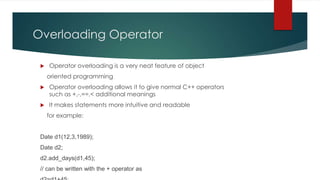
    Operator overloading is a very neat feature of object
     oriented programming
    Operator overloading allows it to give normal C++ operators
     such as +,-,==,< additional meanings
    It makes statements more intuitive and readable
     for example:


 Date d1(12,3,1989);
 Date d2;
 d2.add_days(d1,45);
 // can be written with the + operator as
3
C++ Philosophy (continued)


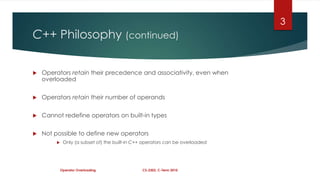
   Operators retain their precedence and associativity, even when
    overloaded


   Operators retain their number of operands


   Cannot redefine operators on built-in types


   Not possible to define new operators
             Only (a subset of) the built-in C++ operators can be overloaded


             Operator Overloading               CS-2303, C-Term 2010
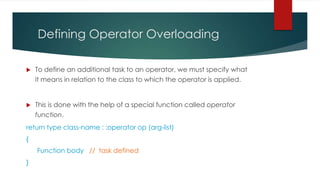
Defining Operator Overloading

   To define an additional task to an operator, we must specify what
    it means in relation to the class to which the operator is applied.


   This is done with the help of a special function called operator
    function.
return type class-name : :operator op (arg-list)
{
    Function body // task defined
}
5
Operators that Can and Cannot be
Overloaded
    Operators that can be overloaded

    +         -                *       /           %               ^         &     |
    ~         !                =       <           >               +=        -=    *=
    /=        %=               ^=      &=          |=              <<        >>    >>=
    <<=       ==               !=      <=          >=              &&        ||    ++
    --        ->*              ,       ->          []              ()        new   delete
    new[]     delete[]


                           Operators that cannot be overloaded

                           .          .*            ::                  ?:


    Operator Overloading                    CS-2303, C-Term 2010
6
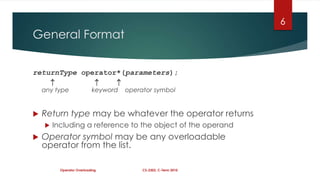
General Format


returnType operator*(parameters);
                 
    any type               keyword   operator symbol


   Return type may be whatever the operator returns
       Including a reference to the object of the operand
   Operator symbol may be any overloadable
    operator from the list.

          Operator Overloading            CS-2303, C-Term 2010
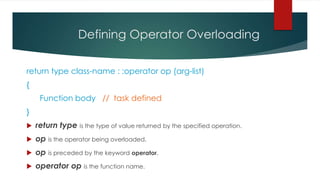
Defining Operator Overloading

return type class-name : :operator op (arg-list)
{
     Function body // task defined
}
   return type is the type of value returned by the specified operation.
   op is the operator being overloaded.
   op is preceded by the keyword operator.
   operator op is the function name.
continue…

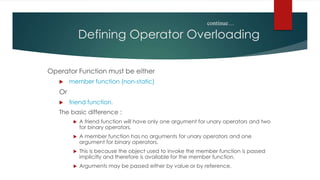
             Defining Operator Overloading

Operator Function must be either
       member function (non-static)
   Or
       friend function.
   The basic difference :
            A friend function will have only one argument for unary operators and two
             for binary operators.
            A member function has no arguments for unary operators and one
             argument for binary operators.
            This is because the object used to invoke the member function is passed
             implicitly and therefore is available for the member function.
            Arguments may be passed either by value or by reference.
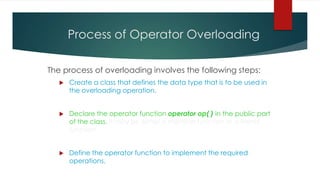
Process of Operator Overloading

The process of overloading involves the following steps:
      Create a class that defines the data type that is to be used in
       the overloading operation.


      Declare the operator function operator op( ) in the public part
       of the class. It may be either a member function or a friend
       function.


      Define the operator function to implement the required
       operations.
Process of Operator Overloading

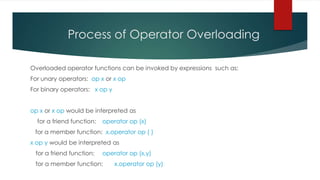
Overloaded operator functions can be invoked by expressions such as:
For unary operators: op x or x op
For binary operators: x op y


op x or x op would be interpreted as
  for a friend function:   operator op (x)
 for a member function: x.operator op ( )
x op y would be interpreted as
 for a friend function:    operator op (x,y)
 for a member function:        x.operator op (y)
Overloading Unary Operators


Consider a unary minus operator:
     It takes just one operand.


     It changes the sign of an operand when applied to a basic
      data item.


     The unary minus when applied to an object should change
      the sign of each of its data items.
Overloading Binary Operators

As a rule, in overloading binary operators,


     the left-hand operand is used to invoke the
      operator function and


     the right-hand operand is passed as an argument.
Overloading Binary Operators

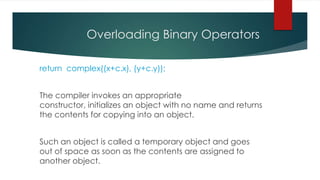
return complex((x+c.x), (y+c.y));


The compiler invokes an appropriate
constructor, initializes an object with no name and returns
the contents for copying into an object.


Such an object is called a temporary object and goes
out of space as soon as the contents are assigned to
another object.
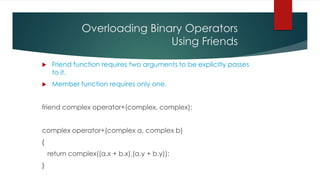
Overloading Binary Operators
                               Using Friends

    Friend function requires two arguments to be explicitly passes
     to it.
    Member function requires only one.


friend complex operator+(complex, complex);


complex operator+(complex a, complex b)
{
    return complex((a.x + b.x),(a.y + b.y));
}
Overloading Binary Operators
                            Using Friends


   We can use a friend function with built-in type
    data as the left-hand operand and an object as
    the right-hand operand.
Rules For Overloading Operators

   Only existing operators can be overloaded. New operators cannot
    be created.


   The overloaded operator must have at least one operand that is of
    user-defined type.


   We cannot change the basic meaning of an operator.


   Overloaded operators follow the syntax rules of the original operators.
continue…
Rules For Overloading Operators


   The following operators that cannot be
    overloaded:
    Size    of Size of operator
       .      Membership operator
       .*     Pointer-to-member operator
       ::     Scope resolution operator
       ?;     Conditional operator
continue…

    Rules For Overloading Operators

   The following operators can be over loaded with the use of member
    functions and not by the use of friend functions:

        Assignment operator =

        Function call operator( )

        Subscripting operator [ ]

        Class member access operator ->

   Unary operators, overloaded by means of a member function, take
    no explicit arguments and return no explicit values, but, those
    overloaded by means of a friend function, take one reference
    argument.
continue…
Rules For Overloading Operators


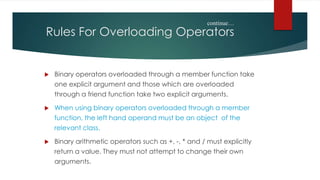
   Binary operators overloaded through a member function take
    one explicit argument and those which are overloaded
    through a friend function take two explicit arguments.

   When using binary operators overloaded through a member
    function, the left hand operand must be an object of the
    relevant class.

   Binary arithmetic operators such as +, -, * and / must explicitly
    return a value. They must not attempt to change their own
    arguments.
Overloading Unary Operators
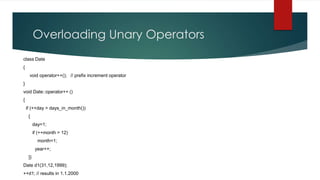
class Date
{
     void operator++(); // prefix increment operator
}
void Date::operator++ ()
{
    if (++day > days_in_month())
     {
          day=1;
          if (++month > 12)
            month=1;
           year++;
     }}
Date d1(31,12,1999);
++d1; // results in 1.1.2000
Overloading Unary Operators
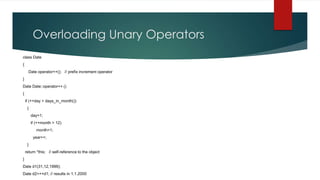
class Date
{
      Date operator++(); // prefix increment operator
}
Date Date::operator++ ()
{
    if (++day > days_in_month())
     {
         day=1;
         if (++month > 12)
            month=1;
          year++;
     }
    return *this; // self-reference to the object
}
Date d1(31,12,1999);
Date d2=++d1; // results in 1.1.2000
Overloading Unary Operators
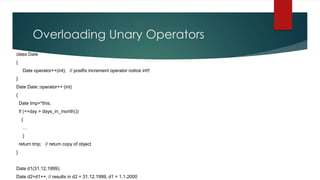
class Date
{
     Date operator++(int); // postfix increment operator notice int!!
}
Date Date::operator++ (int)
{
    Date tmp=*this;
    if (++day > days_in_month())
     {
     …
     }
    return tmp; // return copy of object
}


Date d1(31,12,1999);
Date d2=d1++; // results in d2 = 31.12.1999, d1 = 1.1.2000
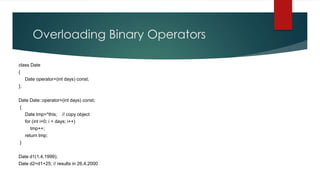
Overloading Binary Operators

class Date
{
     Date operator+(int days) const;
};


Date Date::operator+(int days) const;
{
     Date tmp=*this;     // copy object
     for (int i=0; i < days; i++)
       tmp++;
     return tmp;
}


Date d1(1,4,1999);
Date d2=d1+25; // results in 26.4.2000
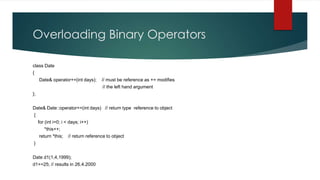
Overloading Binary Operators

class Date
{
     Date& operator+=(int days);      // must be reference as += modifies
                                      // the left hand argument
};


Date& Date::operator+=(int days) // return type reference to object
{
     for (int i=0; i < days; i++)
        *this++;
     return *this;   // return reference to object
}


Date d1(1,4,1999);
d1+=25; // results in 26.4.2000
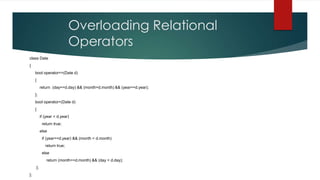
Overloading Relational
                            Operators
class Date
{
     bool operator==(Date d)
     {
          return (day==d.day) && (month=d.month) && (year==d.year);
     };
     bool operator<(Date d)
     {
          if (year < d.year)
           return true;
          else
           if (year==d.year) && (month < d.month)
             return true;
           else
              return (month==d.month) && (day < d.day);
     };
};
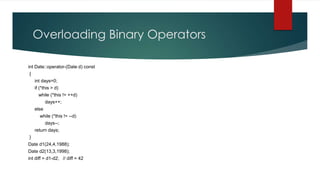
Overloading Binary Operators

int Date::operator-(Date d) const
{
    int days=0;
    if (*this > d)
      while (*this != ++d)
           days++;
    else
       while (*this != --d)
           days--;
    return days;
}
Date d1(24,4,1988);
Date d2(13,3,1998);
int diff = d1-d2; // diff = 42
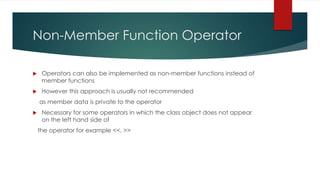
Non-Member Function Operator

    Operators can also be implemented as non-member functions instead of
     member functions
    However this approach is usually not recommended
    as member data is private to the operator
    Necessary for some operators in which the class object does not appear
     on the left hand side of
    the operator for example <<, >>
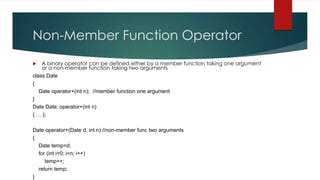
Non-Member Function Operator
   A binary operator can be defined either by a member function taking one argument
    or a non-member function taking two arguments
class Date
{
   Date operator+(int n); //member function one argument
}
Date Date::operator+(int n)
{ … };

Date operator+(Date d, int n) //non-member func two arguments
{
  Date temp=d;
  for (int i=0; i<n; i++)
     temp++;
  return temp;
}
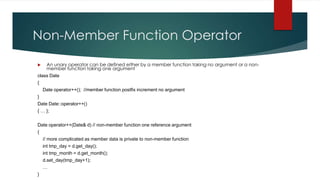
Non-Member Function Operator
    An unary operator can be defined either by a member function taking no argument or a non-
     member function taking one argument
class Date
{
    Date operator++(); //member function postfix increment no argument
}
Date Date::operator++()
{ … };


Date operator++(Date& d) // non-member function one reference argument
{
    // more complicated as member data is private to non-member function
    int tmp_day = d.get_day();
    int tmp_month = d.get_month();
    d.set_day(tmp_day+1);
    …
}
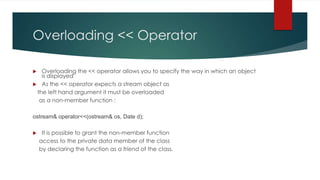
Overloading << Operator

  Overloading the << operator allows you to specify the way in which an object
   is displayed
 As the << operator expects a stream object as
 the left hand argument it must be overloaded
  as a non-member function :

ostream& operator<<(ostream& os, Date d);

    It is possible to grant the non-member function
    access to the private data member of the class
    by declaring the function as a friend of the class.
Overloading << Operator

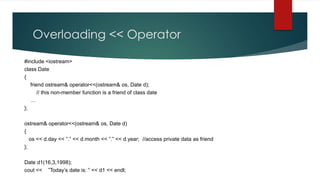
#include <iostream>
class Date
{
   friend ostream& operator<<(ostream& os, Date d);
       // this non-member function is a friend of class date
   …
};

ostream& operator<<(ostream& os, Date d)
{
   os << d.day << ”.” << d.month << ”.” << d.year; //access private data as friend
};

Date d1(16,3,1998);
cout << ”Today’s date is: ” << d1 << endl;
Thank You !!

Oops

  • 1.
    OOPS PRESENTATION OPERATOR OVERLOADING By:- Aditi Chauhan (013) Akhilesh kr Jha (029) Arpan Rathi (056) Chandan Kumar (078) Vikas Verma (L.E.)
  • 2.
    Overloading Operator  Operator overloading is a very neat feature of object oriented programming  Operator overloading allows it to give normal C++ operators such as +,-,==,< additional meanings  It makes statements more intuitive and readable for example: Date d1(12,3,1989); Date d2; d2.add_days(d1,45); // can be written with the + operator as
  • 3.
    3 C++ Philosophy (continued)  Operators retain their precedence and associativity, even when overloaded  Operators retain their number of operands  Cannot redefine operators on built-in types  Not possible to define new operators  Only (a subset of) the built-in C++ operators can be overloaded Operator Overloading CS-2303, C-Term 2010
  • 4.
    Defining Operator Overloading  To define an additional task to an operator, we must specify what it means in relation to the class to which the operator is applied.  This is done with the help of a special function called operator function. return type class-name : :operator op (arg-list) { Function body // task defined }
  • 5.
    5 Operators that Canand Cannot be Overloaded Operators that can be overloaded + - * / % ^ & | ~ ! = < > += -= *= /= %= ^= &= |= << >> >>= <<= == != <= >= && || ++ -- ->* , -> [] () new delete new[] delete[] Operators that cannot be overloaded . .* :: ?: Operator Overloading CS-2303, C-Term 2010
  • 6.
    6 General Format returnType operator*(parameters);    any type keyword operator symbol  Return type may be whatever the operator returns  Including a reference to the object of the operand  Operator symbol may be any overloadable operator from the list. Operator Overloading CS-2303, C-Term 2010
  • 7.
    Defining Operator Overloading returntype class-name : :operator op (arg-list) { Function body // task defined }  return type is the type of value returned by the specified operation.  op is the operator being overloaded.  op is preceded by the keyword operator.  operator op is the function name.
  • 8.
    continue… Defining Operator Overloading Operator Function must be either  member function (non-static) Or  friend function. The basic difference :  A friend function will have only one argument for unary operators and two for binary operators.  A member function has no arguments for unary operators and one argument for binary operators.  This is because the object used to invoke the member function is passed implicitly and therefore is available for the member function.  Arguments may be passed either by value or by reference.
  • 9.
    Process of OperatorOverloading The process of overloading involves the following steps:  Create a class that defines the data type that is to be used in the overloading operation.  Declare the operator function operator op( ) in the public part of the class. It may be either a member function or a friend function.  Define the operator function to implement the required operations.
  • 10.
    Process of OperatorOverloading Overloaded operator functions can be invoked by expressions such as: For unary operators: op x or x op For binary operators: x op y op x or x op would be interpreted as for a friend function: operator op (x) for a member function: x.operator op ( ) x op y would be interpreted as for a friend function: operator op (x,y) for a member function: x.operator op (y)
  • 11.
    Overloading Unary Operators Considera unary minus operator:  It takes just one operand.  It changes the sign of an operand when applied to a basic data item.  The unary minus when applied to an object should change the sign of each of its data items.
  • 12.
    Overloading Binary Operators Asa rule, in overloading binary operators,  the left-hand operand is used to invoke the operator function and  the right-hand operand is passed as an argument.
  • 13.
    Overloading Binary Operators returncomplex((x+c.x), (y+c.y)); The compiler invokes an appropriate constructor, initializes an object with no name and returns the contents for copying into an object. Such an object is called a temporary object and goes out of space as soon as the contents are assigned to another object.
  • 14.
    Overloading Binary Operators Using Friends  Friend function requires two arguments to be explicitly passes to it.  Member function requires only one. friend complex operator+(complex, complex); complex operator+(complex a, complex b) { return complex((a.x + b.x),(a.y + b.y)); }
  • 15.
    Overloading Binary Operators Using Friends  We can use a friend function with built-in type data as the left-hand operand and an object as the right-hand operand.
  • 16.
    Rules For OverloadingOperators  Only existing operators can be overloaded. New operators cannot be created.  The overloaded operator must have at least one operand that is of user-defined type.  We cannot change the basic meaning of an operator.  Overloaded operators follow the syntax rules of the original operators.
  • 17.
    continue… Rules For OverloadingOperators  The following operators that cannot be overloaded: Size of Size of operator  . Membership operator  .* Pointer-to-member operator  :: Scope resolution operator  ?; Conditional operator
  • 18.
    continue… Rules For Overloading Operators  The following operators can be over loaded with the use of member functions and not by the use of friend functions:  Assignment operator =  Function call operator( )  Subscripting operator [ ]  Class member access operator ->  Unary operators, overloaded by means of a member function, take no explicit arguments and return no explicit values, but, those overloaded by means of a friend function, take one reference argument.
  • 19.
    continue… Rules For OverloadingOperators  Binary operators overloaded through a member function take one explicit argument and those which are overloaded through a friend function take two explicit arguments.  When using binary operators overloaded through a member function, the left hand operand must be an object of the relevant class.  Binary arithmetic operators such as +, -, * and / must explicitly return a value. They must not attempt to change their own arguments.
  • 20.
    Overloading Unary Operators classDate { void operator++(); // prefix increment operator } void Date::operator++ () { if (++day > days_in_month()) { day=1; if (++month > 12) month=1; year++; }} Date d1(31,12,1999); ++d1; // results in 1.1.2000
  • 21.
    Overloading Unary Operators classDate { Date operator++(); // prefix increment operator } Date Date::operator++ () { if (++day > days_in_month()) { day=1; if (++month > 12) month=1; year++; } return *this; // self-reference to the object } Date d1(31,12,1999); Date d2=++d1; // results in 1.1.2000
  • 22.
    Overloading Unary Operators classDate { Date operator++(int); // postfix increment operator notice int!! } Date Date::operator++ (int) { Date tmp=*this; if (++day > days_in_month()) { … } return tmp; // return copy of object } Date d1(31,12,1999); Date d2=d1++; // results in d2 = 31.12.1999, d1 = 1.1.2000
  • 23.
    Overloading Binary Operators classDate { Date operator+(int days) const; }; Date Date::operator+(int days) const; { Date tmp=*this; // copy object for (int i=0; i < days; i++) tmp++; return tmp; } Date d1(1,4,1999); Date d2=d1+25; // results in 26.4.2000
  • 24.
    Overloading Binary Operators classDate { Date& operator+=(int days); // must be reference as += modifies // the left hand argument }; Date& Date::operator+=(int days) // return type reference to object { for (int i=0; i < days; i++) *this++; return *this; // return reference to object } Date d1(1,4,1999); d1+=25; // results in 26.4.2000
  • 25.
    Overloading Relational Operators class Date { bool operator==(Date d) { return (day==d.day) && (month=d.month) && (year==d.year); }; bool operator<(Date d) { if (year < d.year) return true; else if (year==d.year) && (month < d.month) return true; else return (month==d.month) && (day < d.day); }; };
  • 26.
    Overloading Binary Operators intDate::operator-(Date d) const { int days=0; if (*this > d) while (*this != ++d) days++; else while (*this != --d) days--; return days; } Date d1(24,4,1988); Date d2(13,3,1998); int diff = d1-d2; // diff = 42
  • 27.
    Non-Member Function Operator  Operators can also be implemented as non-member functions instead of member functions  However this approach is usually not recommended as member data is private to the operator  Necessary for some operators in which the class object does not appear on the left hand side of the operator for example <<, >>
  • 28.
    Non-Member Function Operator  A binary operator can be defined either by a member function taking one argument or a non-member function taking two arguments class Date { Date operator+(int n); //member function one argument } Date Date::operator+(int n) { … }; Date operator+(Date d, int n) //non-member func two arguments { Date temp=d; for (int i=0; i<n; i++) temp++; return temp; }
  • 29.
    Non-Member Function Operator  An unary operator can be defined either by a member function taking no argument or a non- member function taking one argument class Date { Date operator++(); //member function postfix increment no argument } Date Date::operator++() { … }; Date operator++(Date& d) // non-member function one reference argument { // more complicated as member data is private to non-member function int tmp_day = d.get_day(); int tmp_month = d.get_month(); d.set_day(tmp_day+1); … }
  • 30.
    Overloading << Operator  Overloading the << operator allows you to specify the way in which an object is displayed  As the << operator expects a stream object as the left hand argument it must be overloaded as a non-member function : ostream& operator<<(ostream& os, Date d);  It is possible to grant the non-member function access to the private data member of the class by declaring the function as a friend of the class.
  • 31.
    Overloading << Operator #include<iostream> class Date { friend ostream& operator<<(ostream& os, Date d); // this non-member function is a friend of class date … }; ostream& operator<<(ostream& os, Date d) { os << d.day << ”.” << d.month << ”.” << d.year; //access private data as friend }; Date d1(16,3,1998); cout << ”Today’s date is: ” << d1 << endl;
  • 32.