CHEN Zhi Wuhan University School of Stomatology Operative Dentistry 3
Indication of Operative Dentistry Caries ; Malformed, discolored,  or  fractured teeth; Restoration replacement.
Tooth-colored restoration For Class Ⅲ ,Ⅳ  and Ⅴ , Esthetic Dentistry For Class Ⅰand Ⅱ ,
What are Tooth-colored materials? What is their working mechanism? What are the cavity preparation futures for tooth-colored restoration?
What are steps for tooth-colored restoration? What are the advantage & disadvantage of tooth-colored restoration?
Tooth-Colored Materials  Composite resin Glass ionomer cement Compomer
Composite Resin Traditional composites Hybird composites Flowable composites Condensable composites Packable Universal composites
Glass Ionomer Chemical adhesion to dentin Release Fluoride
Compomer Compomer = Compo site + Ion omer
Dental Adhesion or  Dental Bonding Adhesion is a process of solid and/or liquid interaction of one material with another at a single interface.
Enamel bonding system Enamel bongding depends on resin tags becoming interlocked with the surface irregularities created by etching.
Macrotags: form between enamel rod peripheries. Microtags: smaller tags form across  the end of each rod. Macrotags and microtags are the basis for micro-mechanical bonding.
Dentin bonding system The difficulties of dentin bonding: More water---wet bonding Lower calcification Richer organic---collagen network Smear layer
The bond strength is primarily related to micro-mechanical bonding to the intertubular dentin which occures  between tubules along the cut dentin surface.
Dentin Bonding Agent, DBA Early DBA were hydrophobic, bonded  directly to the dentin smear layer.  Bond strengths < 6MPa. Later DBA removed the smear layer but tended to over-etch dentin. Bond strengths≈10~12MPa.
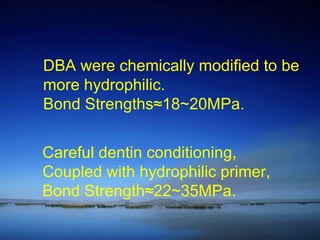
DBA were chemically modified to be  more hydrophilic. Bond Strengths≈18~20MPa. Careful dentin conditioning, Coupled with hydrophilic primer, Bond Strength≈22~35MPa.
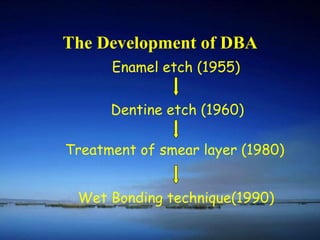
The Development of DBA Enamel etch (1955) Dentine etch (1960) Treatment of smear layer (1980) Wet Bonding technique(1990)
First generation Second generation Third generation Fourth generation: Total etch technique Fifth generation: One bottle system Sixth generation: All in one,2000 Seventh generation
Cavity Preparation Three designs of cavity preparation:  1.Conventional  2.Beveled conventional 3.Modified
Beveled conventional cavity preparations are similar to conventional preparation, in that the outline form has external, “ box-like” walls, but with  beveled   enamel margin.
Beveled enamel margin
Beveled conventional cavity designs for  Class Ⅲ, Ⅳ and Ⅴ preparations
The advantages : The ends of enamel rods are more etched The increase in etched surface results in a stronger bond Increase the retention and reduce marginal leakage and discoloration.  More esthtically
Modified cavity preparation Have neither specified cavity wall structure nor specified pulpal depth, and have enamel margins. Conserve more tooth structure.
Modified cavity preparation
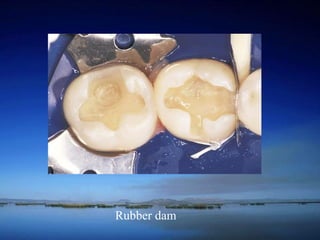
Initial Clinical Procedure Local anesthesia Preparation of the operating site Shade selection Isolation of the operating site with rubber dam or cotton rolls
 
Rubber dam
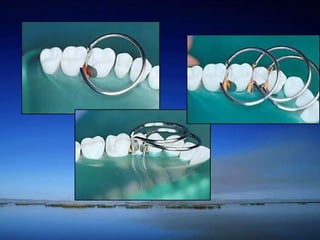
Clinical Procedure Cavity preparation Acid etching enamel & conditioning dentin Matrix application Application of bonding agent Insertion of composite Finishing procedures
 
Matrix application


Final procedures
 
Cases
 
 
Conservative Operative Dentistry Minimal intervention dentistry is regards as a main stream in caries treatment in the 21 st  century.
Principles of Minimal Intervention dentistry Remineralization of early lesions Reduction in cariogenic bacteria, to elminate the risk of further demi-neralization and cavitation Minimum surgical intervention of ca-vitated lesions Repair rather than replacement of defective restorations
“ The day is surely coming, and perhaps within the lifetime of you young men before me, when we will be engaged in practicing preventive, rather than reparative, dentistry. ” GV Black in 1896
University  Minnisota  School of Dentistry
http://202.114.104.243/jpkc/ysysbx/index.html
Thanks

Operative Dentistry 3

  • 1.
    CHEN Zhi WuhanUniversity School of Stomatology Operative Dentistry 3
  • 2.
    Indication of OperativeDentistry Caries ; Malformed, discolored, or fractured teeth; Restoration replacement.
  • 3.
    Tooth-colored restoration ForClass Ⅲ ,Ⅳ and Ⅴ , Esthetic Dentistry For Class Ⅰand Ⅱ ,
  • 4.
    What are Tooth-coloredmaterials? What is their working mechanism? What are the cavity preparation futures for tooth-colored restoration?
  • 5.
    What are stepsfor tooth-colored restoration? What are the advantage & disadvantage of tooth-colored restoration?
  • 6.
    Tooth-Colored Materials Composite resin Glass ionomer cement Compomer
  • 7.
    Composite Resin Traditionalcomposites Hybird composites Flowable composites Condensable composites Packable Universal composites
  • 8.
    Glass Ionomer Chemicaladhesion to dentin Release Fluoride
  • 9.
    Compomer Compomer =Compo site + Ion omer
  • 10.
    Dental Adhesion or Dental Bonding Adhesion is a process of solid and/or liquid interaction of one material with another at a single interface.
  • 11.
    Enamel bonding systemEnamel bongding depends on resin tags becoming interlocked with the surface irregularities created by etching.
  • 12.
    Macrotags: form betweenenamel rod peripheries. Microtags: smaller tags form across the end of each rod. Macrotags and microtags are the basis for micro-mechanical bonding.
  • 13.
    Dentin bonding systemThe difficulties of dentin bonding: More water---wet bonding Lower calcification Richer organic---collagen network Smear layer
  • 14.
    The bond strengthis primarily related to micro-mechanical bonding to the intertubular dentin which occures between tubules along the cut dentin surface.
  • 15.
    Dentin Bonding Agent,DBA Early DBA were hydrophobic, bonded directly to the dentin smear layer. Bond strengths < 6MPa. Later DBA removed the smear layer but tended to over-etch dentin. Bond strengths≈10~12MPa.
  • 16.
    DBA were chemicallymodified to be more hydrophilic. Bond Strengths≈18~20MPa. Careful dentin conditioning, Coupled with hydrophilic primer, Bond Strength≈22~35MPa.
  • 17.
    The Development ofDBA Enamel etch (1955) Dentine etch (1960) Treatment of smear layer (1980) Wet Bonding technique(1990)
  • 18.
    First generation Secondgeneration Third generation Fourth generation: Total etch technique Fifth generation: One bottle system Sixth generation: All in one,2000 Seventh generation
  • 19.
    Cavity Preparation Threedesigns of cavity preparation: 1.Conventional 2.Beveled conventional 3.Modified
  • 20.
    Beveled conventional cavitypreparations are similar to conventional preparation, in that the outline form has external, “ box-like” walls, but with beveled enamel margin.
  • 21.
  • 22.
    Beveled conventional cavitydesigns for Class Ⅲ, Ⅳ and Ⅴ preparations
  • 23.
    The advantages :The ends of enamel rods are more etched The increase in etched surface results in a stronger bond Increase the retention and reduce marginal leakage and discoloration. More esthtically
  • 24.
    Modified cavity preparationHave neither specified cavity wall structure nor specified pulpal depth, and have enamel margins. Conserve more tooth structure.
  • 25.
  • 26.
    Initial Clinical ProcedureLocal anesthesia Preparation of the operating site Shade selection Isolation of the operating site with rubber dam or cotton rolls
  • 27.
  • 28.
  • 29.
    Clinical Procedure Cavitypreparation Acid etching enamel & conditioning dentin Matrix application Application of bonding agent Insertion of composite Finishing procedures
  • 30.
  • 31.
  • 32.
  • 33.
  • 34.
  • 35.
  • 36.
  • 37.
  • 38.
  • 39.
  • 40.
  • 41.
  • 42.
  • 43.
    Conservative Operative DentistryMinimal intervention dentistry is regards as a main stream in caries treatment in the 21 st century.
  • 44.
    Principles of MinimalIntervention dentistry Remineralization of early lesions Reduction in cariogenic bacteria, to elminate the risk of further demi-neralization and cavitation Minimum surgical intervention of ca-vitated lesions Repair rather than replacement of defective restorations
  • 45.
    “ The dayis surely coming, and perhaps within the lifetime of you young men before me, when we will be engaged in practicing preventive, rather than reparative, dentistry. ” GV Black in 1896
  • 46.
    University Minnisota School of Dentistry
  • 47.
  • 48.