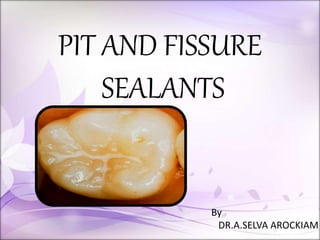
PIT AND FISSURE
SEALANTS
By
DR.A.SELVA AROCKIAM
INTRODUCTION:
⋇ High caries susceptibility of pit & fissure is a major dental
problem and provides the rationale for caries control of these
areas.
⋇ It accounts for 50% of caries in human dentition.
CARIES OF PIT & FISSURE:
⋇ Caries process particularly in 1st & 2nd molar starts as soon
as it erupts. Pit and fissure is an important factor in determining
the presence of caries.
⋇ According to BLACK - P&F don’t cause caries instead provide
a sanctuary to caries causing agents.
⋇ P&F caries follows the direction of the enamel rods & forms
a shaped lesion with its apex at the outer surface and its base
towards DEJ.
⋇ It produces greater cavitations than proximal caries.
MILESTONES OF PIT AND FISSURE:
⋇ HYATT – Prophylactic odontotomy – fissures filled with silver
or copper oxy phosphate cement . (1923)
⋇ BODECKER – Fissure eradication – deep retentive fissure into
self cleansable one.(1929)
⋇ BUNOCORE - Acid etching – phosphoric acid for 30 seconds.
(1955)
⋇ BOWEN – BISGMA – base resin for sealants.(1965)
PIT & FISSURE:
 PIT: Small pin point depression located at the junction of developmental
grooves.
 FISSURE: Deep clefts between adjoining cusps.
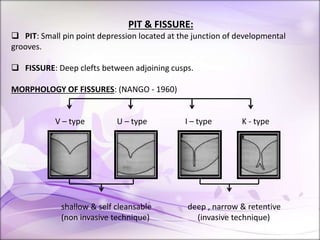
MORPHOLOGY OF FISSURES: (NANGO - 1960)
V – type U – type I – type K - type
shallow & self cleansable deep , narrow & retentive
(non invasive technique) (invasive technique)
PIT & FISSURE SEALANTS
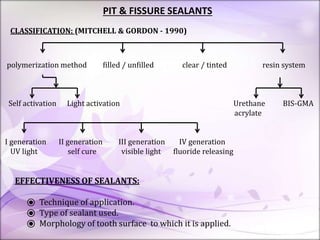
CLASSIFICATION: (MITCHELL & GORDON - 1990)
polymerization method filled / unfilled clear / tinted resin system
Self activation Light activation Urethane BIS-GMA
acrylate
I generation II generation III generation IV generation
UV light self cure visible light fluoride releasing
EFFECTIVENESS OF SEALANTS:
⦿ Technique of application.
⦿ Type of sealant used.
⦿ Morphology of tooth surface to which it is applied.
REQUISITES OF AN EFFICIENT SEALANT:
 Viscous enough to penetrate into deep pit & fissures
 Adequate working time
 Rapid cure
 Good & prolonged adhesion to enamel
 Low sorption & solubility
 Resistance to wear
 Minimum irritation to tissues
 Cariostatic action
CASE SELECTION:
 AGE RANGE: 3-4 yrs for primary molar, 6-7yrs for I permanent
molar, 11-13yrs for II permanent molar.
 GROUP 2: Moderate caries risk patients.
 CLINICAL JUGDEMENT CRITERIA:
 Age
 Oral hygiene
 Dietary habits
 Tooth type & morphology
 Familial & individual history of dental caries
 Fluoride environment & history
INDICATIONS
 Newly erupted 1⁰ M & permanent PM & M – with
complete recession of pericoronal operculum & with
open / sticky P&F.
 Stained P&F with minimum decalcification / opacification
& no softness at the base of the fissure.
 Tooth in ? – erupted less than 4 yrs
CONTRAINDICATIONS
 No previous caries experience , coalesced P&F.
 Proximal caries – clinically & radiographically
 Wide & self cleansable P&F
 Partially erupted tooth / that which cant be isolated.
 P&F caries free for > 4 yrs.
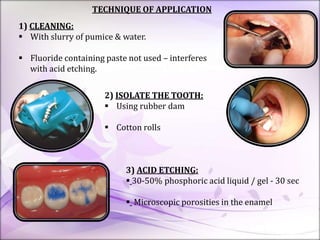
TECHNIQUE OF APPLICATION
1) CLEANING:
 With slurry of pumice & water.
 Fluoride containing paste not used – interferes
with acid etching.
2) ISOLATE THE TOOTH:
 Using rubber dam
 Cotton rolls
3) ACID ETCHING:
 30-50% phosphoric acid liquid / gel - 30 sec
 Microscopic porosities in the enamel
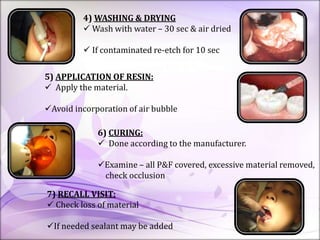
4) WASHING & DRYING
 Wash with water – 30 sec & air dried
 If contaminated re-etch for 10 sec
5) APPLICATION OF RESIN:
 Apply the material.
Avoid incorporation of air bubble
6) CURING:
 Done according to the manufacturer.
Examine – all P&F covered, excessive material removed,
check occlusion
7) RECALL VISIT:
 Check loss of material
If needed sealant may be added
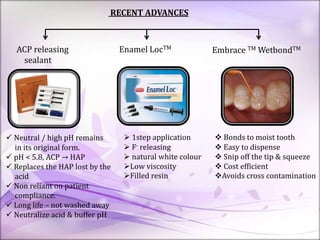
RECENT ADVANCES
ACP releasing Enamel LocTM
sealant
Embrace TM WetbondTM
 1step application
 F- releasing
 natural white colour
Low viscosity
Filled resin
 Bonds to moist tooth
 Easy to dispense
 Snip off the tip & squeeze
 Cost efficient
Avoids cross contamination
 Neutral / high pH remains
in its original form.
 pH < 5.8, ACP → HAP
 Replaces the HAP lost by the
acid
 Non reliant on patient
compliance.
 Long life – not washed away
 Neutralize acid & buffer pH
THANK
U

Pit and fissure

  • 1.
  • 2.
    INTRODUCTION: ⋇ High cariessusceptibility of pit & fissure is a major dental problem and provides the rationale for caries control of these areas. ⋇ It accounts for 50% of caries in human dentition. CARIES OF PIT & FISSURE: ⋇ Caries process particularly in 1st & 2nd molar starts as soon as it erupts. Pit and fissure is an important factor in determining the presence of caries. ⋇ According to BLACK - P&F don’t cause caries instead provide a sanctuary to caries causing agents. ⋇ P&F caries follows the direction of the enamel rods & forms a shaped lesion with its apex at the outer surface and its base towards DEJ. ⋇ It produces greater cavitations than proximal caries.
  • 3.
    MILESTONES OF PITAND FISSURE: ⋇ HYATT – Prophylactic odontotomy – fissures filled with silver or copper oxy phosphate cement . (1923) ⋇ BODECKER – Fissure eradication – deep retentive fissure into self cleansable one.(1929) ⋇ BUNOCORE - Acid etching – phosphoric acid for 30 seconds. (1955) ⋇ BOWEN – BISGMA – base resin for sealants.(1965)
  • 4.
    PIT & FISSURE: PIT: Small pin point depression located at the junction of developmental grooves.  FISSURE: Deep clefts between adjoining cusps. MORPHOLOGY OF FISSURES: (NANGO - 1960) V – type U – type I – type K - type shallow & self cleansable deep , narrow & retentive (non invasive technique) (invasive technique)
  • 5.
    PIT & FISSURESEALANTS CLASSIFICATION: (MITCHELL & GORDON - 1990) polymerization method filled / unfilled clear / tinted resin system Self activation Light activation Urethane BIS-GMA acrylate I generation II generation III generation IV generation UV light self cure visible light fluoride releasing EFFECTIVENESS OF SEALANTS: ⦿ Technique of application. ⦿ Type of sealant used. ⦿ Morphology of tooth surface to which it is applied.
  • 6.
    REQUISITES OF ANEFFICIENT SEALANT:  Viscous enough to penetrate into deep pit & fissures  Adequate working time  Rapid cure  Good & prolonged adhesion to enamel  Low sorption & solubility  Resistance to wear  Minimum irritation to tissues  Cariostatic action CASE SELECTION:  AGE RANGE: 3-4 yrs for primary molar, 6-7yrs for I permanent molar, 11-13yrs for II permanent molar.  GROUP 2: Moderate caries risk patients.  CLINICAL JUGDEMENT CRITERIA:  Age  Oral hygiene  Dietary habits  Tooth type & morphology  Familial & individual history of dental caries  Fluoride environment & history
  • 7.
    INDICATIONS  Newly erupted1⁰ M & permanent PM & M – with complete recession of pericoronal operculum & with open / sticky P&F.  Stained P&F with minimum decalcification / opacification & no softness at the base of the fissure.  Tooth in ? – erupted less than 4 yrs CONTRAINDICATIONS  No previous caries experience , coalesced P&F.  Proximal caries – clinically & radiographically  Wide & self cleansable P&F  Partially erupted tooth / that which cant be isolated.  P&F caries free for > 4 yrs.
  • 8.
    TECHNIQUE OF APPLICATION 1)CLEANING:  With slurry of pumice & water.  Fluoride containing paste not used – interferes with acid etching. 2) ISOLATE THE TOOTH:  Using rubber dam  Cotton rolls 3) ACID ETCHING:  30-50% phosphoric acid liquid / gel - 30 sec  Microscopic porosities in the enamel
  • 9.
    4) WASHING &DRYING  Wash with water – 30 sec & air dried  If contaminated re-etch for 10 sec 5) APPLICATION OF RESIN:  Apply the material. Avoid incorporation of air bubble 6) CURING:  Done according to the manufacturer. Examine – all P&F covered, excessive material removed, check occlusion 7) RECALL VISIT:  Check loss of material If needed sealant may be added
  • 10.
    RECENT ADVANCES ACP releasingEnamel LocTM sealant Embrace TM WetbondTM  1step application  F- releasing  natural white colour Low viscosity Filled resin  Bonds to moist tooth  Easy to dispense  Snip off the tip & squeeze  Cost efficient Avoids cross contamination  Neutral / high pH remains in its original form.  pH < 5.8, ACP → HAP  Replaces the HAP lost by the acid  Non reliant on patient compliance.  Long life – not washed away  Neutralize acid & buffer pH
  • 11.