Sanjeev Rampal
Principal Engineer
Cisco Systems
Adrian Ludwin
Google Cloud
Secure Multitenancy
In Kubernetes
• Overview and Architecture
• What is Kubernetes Multitenancy ?
• Architectural models for Multitenancy
• Community initiatives: Multitenancy control plane
• Tenant controller & namespace grouping
• Hierarchical namespaces
• Virtual clusters
• Community initiatives: Data plane and benchmarking
• Benchmarking
• Data plane models
• Demo
• Q & A
Agenda
Overview & Architecture
• What is it ?
• Ability to share a Kubernetes cluster between multiple independent teams
• Why is it useful ?
• Improved resource efficiencies (esp when move to containers on BM)
• Reduced cluster sprawl
• Lower capex and opex for the cluster operator
• Resource usage burstability -> Higher application performance
• Essentially a bin-packing & statistical multiplexing problem
• Potential challenges
• Kubernetes not designed for Multitenancy at its core
• Unlike say Openstack, there are no core K8s resources for ”Users”, “Tenants”, “Projects”
• Wide spectrum of loosely defined scenarios and potential use case
• Defining “Standardization” vs best practice vs implementation choice
What is Kubernetes Multitenancy ?
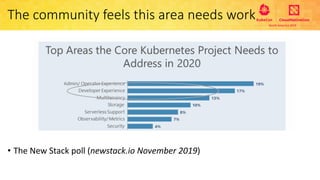
The community feels this area needs work
• The New Stack poll (newstack.io November 2019)
• Categories of Multitenancy (high level use cases)
• “Soft” Multitenancy
• Ex. Multiple teams within the same enterprise sharing a K8S cluster
• “Hard” Multitenancy
• Ex. Service provider hosting multiple independent tenants on a shared cluster
• “Coke & Pepsi on the same K8s cluster”
• Other
• SaaS multitenancy
What is Kubernetes Multitenancy ? …
• Available solutions
1. Community Kubernetes + DIY solution using namespaces, network
policies etc
2. Vendor/ commercial distributions with features built on these
• E.g. Openshift “Projects”, Rancher “Projects”
3. Emerging community initiatives tracked within K8s Multitenancy
Working group & others
What is Kubernetes Multitenancy ? …
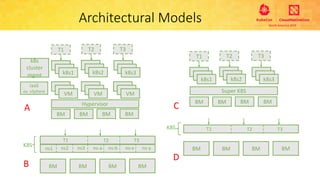
Architectural Models
VM VM VM
Hypervisor
k8s1 k8s2 k8s3
IaaS
ex. vSphere
k8s
cluster
mgmt
T1 T2 T3
BM BM BM BM
BM BMBMBM
ns1 ns2 ns3 ns-a ns-b ns-x ns-y
K8S
T1 T2 T3
Super K8S
BM BM BM BM
k8s1 k8s2 k8s3
T1 T2 T3
BM BMBMBM
K8S T1 T2 T3
A
B
C
D
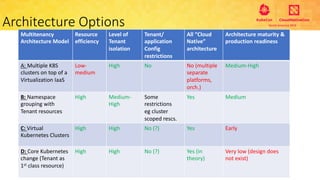
Architecture Options
Multitenancy
Architecture Model
Resource
efficiency
Level of
Tenant
isolation
Tenant/
application
Config
restrictions
All “Cloud
Native”
architecture
Architecture maturity &
production readiness
A: Multiple K8S
clusters on top of a
Virtualization IaaS
Low-
medium
High No No (multiple
separate
platforms,
orch.)
Medium-High
B: Namespace
grouping with
Tenant resources
High Medium-
High
Some
restrictions
eg cluster
scoped rescs.
Yes Medium
C: Virtual
Kubernetes Clusters
High High No (?) Yes Early
D: Core Kubernetes
change (Tenant as
1st class resource)
High High No (?) Yes (in
theory)
Very low (design does
not exist)
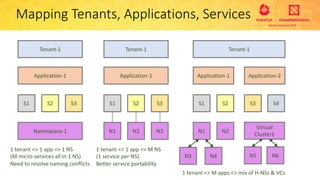
Mapping Tenants, Applications, Services
Tenant-1
Application-1
Namespace-1
S1 S2 S3
Tenant-1
Application-1
N1
S1 S2 S3
N2 N3
Tenant-1
Application-1
N1
S1 S2 S3
N2
Virtual
Cluster1
Application-2
S4
N3 N4 N5 N6
1 tenant <> 1 app <> 1 NS
(M micro-services all in 1 NS)
Need to resolve naming conflicts
1 tenant <> 1 app <> M NS
(1 service per NS)
Better service portability
1 tenant <> M apps <> mix of H-NSs & VCs
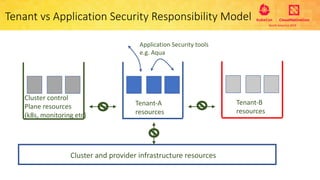
Tenant vs Application Security Responsibility Model
Tenant-A
resources
Tenant-B
resources
Cluster control
Plane resources
(k8s, monitoring etc)
Cluster and provider infrastructure resources
Application Security tools
e.g. Aqua
Community Initiatives: Multitenancy
Control Plane
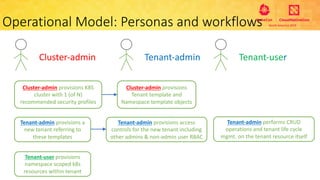
Operational Model: Personas and workflows
Cluster-admin provisions K8S
cluster with 1 (of N)
recommended security profiles
Cluster-admin provisions
Tenant template and
Namespace template objects
Cluster-admin Tenant-admin Tenant-user
Tenant-admin provisions a
new tenant referring to
these templates
Tenant-admin provisions access
controls for the new tenant including
other admins & non-admin user RBAC
Tenant-user provisions
namespace scoped k8s
resources within tenant
Tenant-admin performs CRUD
operations and tenant life cycle
mgmt. on the tenant resource itself
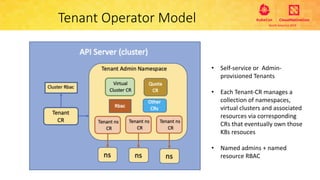
Tenant Operator Model
• Self-service or Admin-
provisioned Tenants
• Each Tenant-CR manages a
collection of namespaces,
virtual clusters and associated
resources via corresponding
CRs that eventually own those
K8s resouces
• Named admins + named
resource RBAC
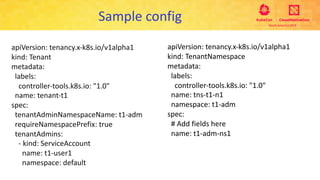
apiVersion: tenancy.x-k8s.io/v1alpha1
kind: Tenant
metadata:
labels:
controller-tools.k8s.io: "1.0"
name: tenant-t1
spec:
tenantAdminNamespaceName: t1-adm
requireNamespacePrefix: true
tenantAdmins:
- kind: ServiceAccount
name: t1-user1
namespace: default
apiVersion: tenancy.x-k8s.io/v1alpha1
kind: TenantNamespace
metadata:
labels:
controller-tools.k8s.io: "1.0"
name: tns-t1-n1
namespace: t1-adm
spec:
# Add fields here
name: t1-adm-ns1
Sample config
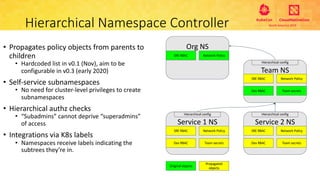
Team NS
Hierarchical Namespace Controller
• Propagates policy objects from parents to
children
• Hardcoded list in v0.1 (Nov), aim to be
configurable in v0.3 (early 2020)
• Self-service subnamespaces
• No need for cluster-level privileges to create
subnamespaces
• Hierarchical authz checks
• “Subadmins” cannot deprive “superadmins”
of access
• Integrations via K8s labels
• Namespaces receive labels indicating the
subtrees they’re in.
Org NS
Service 1 NS Service 2 NS
SRE RBAC Network Policy
Dev RBAC Team secrets
SRE RBAC Network Policy
Dev RBAC Team secrets
SRE RBAC Network Policy
Dev RBAC Team secrets
Original objects
Propagated
objects
Hierarchical config
Hierarchical configHierarchical config
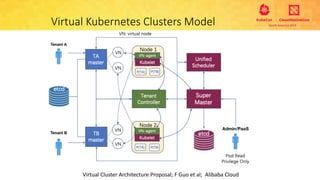
Virtual Kubernetes Clusters Model
Virtual Cluster Architecture Proposal; F Guo et al; Alibaba Cloud
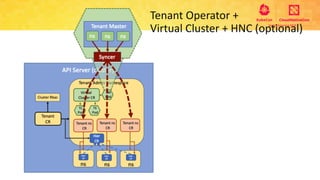
Tenant Operator +
Virtual Cluster + HNC (optional)
Data plane and Benchmarking
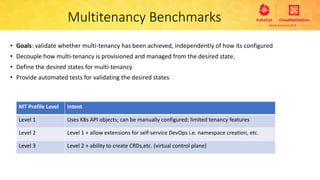
Multitenancy Benchmarks
• Goals: validate whether multi-tenancy has been achieved, independently of how its configured
• Decouple how multi-tenancy is provisioned and managed from the desired state.
• Define the desired states for multi-tenancy
• Provide automated tests for validating the desired states
MT Profile Level Intent
Level 1 Uses K8s API objects; can be manually configured; limited tenancy features
Level 2 Level 1 + allow extensions for self-service DevOps i.e. namespace creation, etc.
Level 3 Level 2 + ability to create CRDs,etc. (virtual control plane)
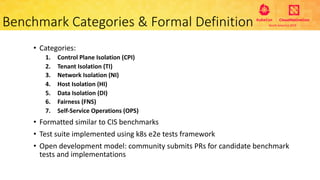
• Categories:
1. Control Plane Isolation (CPI)
2. Tenant Isolation (TI)
3. Network Isolation (NI)
4. Host Isolation (HI)
5. Data Isolation (DI)
6. Fairness (FNS)
7. Self-Service Operations (OPS)
• Formatted similar to CIS benchmarks
• Test suite implemented using k8s e2e tests framework
• Open development model: community submits PRs for candidate benchmark
tests and implementations
Benchmark Categories & Formal Definition
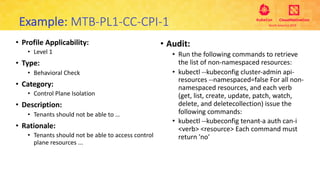
• Profile Applicability:
• Level 1
• Type:
• Behavioral Check
• Category:
• Control Plane Isolation
• Description:
• Tenants should not be able to …
• Rationale:
• Tenants should not be able to access control
plane resources ...
Example: MTB-PL1-CC-CPI-1
• Audit:
• Run the following commands to retrieve
the list of non-namespaced resources:
• kubectl --kubeconfig cluster-admin api-
resources --namespaced=false For all non-
namespaced resources, and each verb
(get, list, create, update, patch, watch,
delete, and deletecollection) issue the
following commands:
• kubectl --kubeconfig tenant-a auth can-i
<verb> <resource> Each command must
return 'no'
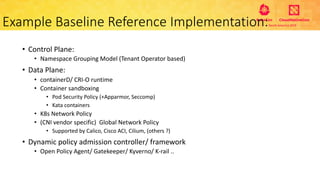
Example Baseline Reference Implementation:
• Control Plane:
• Namespace Grouping Model (Tenant Operator based)
• Data Plane:
• containerD/ CRI-O runtime
• Container sandboxing
• Pod Security Policy (+Apparmor, Seccomp)
• Kata containers
• K8s Network Policy
• (CNI vendor specific) Global Network Policy
• Supported by Calico, Cisco ACI, Cilium, (others ?)
• Dynamic policy admission controller/ framework
• Open Policy Agent/ Gatekeeper/ Kyverno/ K-rail ..
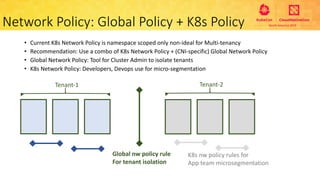
Network Policy: Global Policy + K8s Policy
• Current K8s Network Policy is namespace scoped only non-ideal for Multi-tenancy
• Recommendation: Use a combo of K8s Network Policy + (CNI-specific) Global Network Policy
• Global Network Policy: Tool for Cluster Admin to isolate tenants
• K8s Network Policy: Developers, Devops use for micro-segmentation
Tenant-1 Tenant-2
Global nw policy rule
For tenant isolation
K8s nw policy rules for
App team microsegmentation
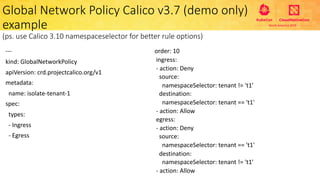
---
kind: GlobalNetworkPolicy
apiVersion: crd.projectcalico.org/v1
metadata:
name: isolate-tenant-1
spec:
types:
- Ingress
- Egress
Global Network Policy Calico v3.7 (demo only)
example
(ps. use Calico 3.10 namespaceselector for better rule options)
order: 10
ingress:
- action: Deny
source:
namespaceSelector: tenant != 't1'
destination:
namespaceSelector: tenant == 't1'
- action: Allow
egress:
- action: Deny
source:
namespaceSelector: tenant == 't1'
destination:
namespaceSelector: tenant != 't1'
- action: Allow
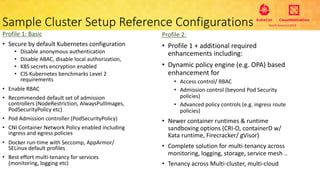
Profile 1: Basic
• Secure by default Kubernetes configuration
• Disable anonymous authentication
• Disable ABAC, disable local authorization,
• K8S secrets encryption enabled
• CIS Kubernetes benchmarks Level 2
requirements
• Enable RBAC
• Recommended default set of admission
controllers (NodeRestriction, AlwaysPullImages,
PodSecurityPolicy etc)
• Pod Admission controller (PodSecurityPolicy)
• CNI Container Network Policy enabled including
ingress and egress policies
• Docker run-time with Seccomp, AppArmor/
SELinux default profiles
• Best effort multi-tenancy for services
(monitoring, logging etc)
Sample Cluster Setup Reference Configurations
Profile 2:
• Profile 1 + additional required
enhancements including:
• Dynamic policy engine (e.g. OPA) based
enhancement for
• Access control/ RBAC
• Admission control (beyond Pod Security
policies)
• Advanced policy controls (e.g. ingress route
policies)
• Newer container runtimes & runtime
sandboxing options (CRI-O, containerD w/
Kata runtime, Firecracker/ gVisor)
• Complete solution for multi-tenancy across
monitoring, logging, storage, service mesh ..
• Tenancy across Multi-cluster, multi-cloud
Demo
Where to find us
• Home page: https://github.com/kubernetes-sigs/multi-tenancy/
• https://github.com/kubernetes/community/tree/master/wg-
multitenancy
• Slack channel: Kubernetes Slack, #wg-multitenancy
• Google Group: https://groups.google.com/forum/#!forum/kubernetes-
wg-multitenancy
• Bi-weekly meeting (join google group for invite)
• Tuesday 11am Pacific Time
WG leads
• Project leads
• @Adrian Ludwin
• Hierarchical Namespace Controller (“HNC,”)
• Software Engineer @ Google
• @Fei Guo
• Virtual Clusters, Tenant Controller
• Software Engineer @ Alibaba
• @Jim Bugwadia
• Multi-tenancy Benchmarks
• Founder & CEO at Nirmata
• Chairs
• @tasha
• Tasha Drew, Product Line Manager @ VMware
• @srampal
• Sanjeev Rampal, Principal Engineer @ Cisco

Kubecon US 2019: Kubernetes Multitenancy WG Deep Dive

  • 2.
    Sanjeev Rampal Principal Engineer CiscoSystems Adrian Ludwin Google Cloud Secure Multitenancy In Kubernetes
  • 3.
    • Overview andArchitecture • What is Kubernetes Multitenancy ? • Architectural models for Multitenancy • Community initiatives: Multitenancy control plane • Tenant controller & namespace grouping • Hierarchical namespaces • Virtual clusters • Community initiatives: Data plane and benchmarking • Benchmarking • Data plane models • Demo • Q & A Agenda
  • 4.
  • 5.
    • What isit ? • Ability to share a Kubernetes cluster between multiple independent teams • Why is it useful ? • Improved resource efficiencies (esp when move to containers on BM) • Reduced cluster sprawl • Lower capex and opex for the cluster operator • Resource usage burstability -> Higher application performance • Essentially a bin-packing & statistical multiplexing problem • Potential challenges • Kubernetes not designed for Multitenancy at its core • Unlike say Openstack, there are no core K8s resources for ”Users”, “Tenants”, “Projects” • Wide spectrum of loosely defined scenarios and potential use case • Defining “Standardization” vs best practice vs implementation choice What is Kubernetes Multitenancy ?
  • 6.
    The community feelsthis area needs work • The New Stack poll (newstack.io November 2019)
  • 7.
    • Categories ofMultitenancy (high level use cases) • “Soft” Multitenancy • Ex. Multiple teams within the same enterprise sharing a K8S cluster • “Hard” Multitenancy • Ex. Service provider hosting multiple independent tenants on a shared cluster • “Coke & Pepsi on the same K8s cluster” • Other • SaaS multitenancy What is Kubernetes Multitenancy ? …
  • 8.
    • Available solutions 1.Community Kubernetes + DIY solution using namespaces, network policies etc 2. Vendor/ commercial distributions with features built on these • E.g. Openshift “Projects”, Rancher “Projects” 3. Emerging community initiatives tracked within K8s Multitenancy Working group & others What is Kubernetes Multitenancy ? …
  • 9.
    Architectural Models VM VMVM Hypervisor k8s1 k8s2 k8s3 IaaS ex. vSphere k8s cluster mgmt T1 T2 T3 BM BM BM BM BM BMBMBM ns1 ns2 ns3 ns-a ns-b ns-x ns-y K8S T1 T2 T3 Super K8S BM BM BM BM k8s1 k8s2 k8s3 T1 T2 T3 BM BMBMBM K8S T1 T2 T3 A B C D
  • 10.
    Architecture Options Multitenancy Architecture Model Resource efficiency Levelof Tenant isolation Tenant/ application Config restrictions All “Cloud Native” architecture Architecture maturity & production readiness A: Multiple K8S clusters on top of a Virtualization IaaS Low- medium High No No (multiple separate platforms, orch.) Medium-High B: Namespace grouping with Tenant resources High Medium- High Some restrictions eg cluster scoped rescs. Yes Medium C: Virtual Kubernetes Clusters High High No (?) Yes Early D: Core Kubernetes change (Tenant as 1st class resource) High High No (?) Yes (in theory) Very low (design does not exist)
  • 11.
    Mapping Tenants, Applications,Services Tenant-1 Application-1 Namespace-1 S1 S2 S3 Tenant-1 Application-1 N1 S1 S2 S3 N2 N3 Tenant-1 Application-1 N1 S1 S2 S3 N2 Virtual Cluster1 Application-2 S4 N3 N4 N5 N6 1 tenant <> 1 app <> 1 NS (M micro-services all in 1 NS) Need to resolve naming conflicts 1 tenant <> 1 app <> M NS (1 service per NS) Better service portability 1 tenant <> M apps <> mix of H-NSs & VCs
  • 12.
    Tenant vs ApplicationSecurity Responsibility Model Tenant-A resources Tenant-B resources Cluster control Plane resources (k8s, monitoring etc) Cluster and provider infrastructure resources Application Security tools e.g. Aqua
  • 13.
  • 14.
    Operational Model: Personasand workflows Cluster-admin provisions K8S cluster with 1 (of N) recommended security profiles Cluster-admin provisions Tenant template and Namespace template objects Cluster-admin Tenant-admin Tenant-user Tenant-admin provisions a new tenant referring to these templates Tenant-admin provisions access controls for the new tenant including other admins & non-admin user RBAC Tenant-user provisions namespace scoped k8s resources within tenant Tenant-admin performs CRUD operations and tenant life cycle mgmt. on the tenant resource itself
  • 15.
    Tenant Operator Model •Self-service or Admin- provisioned Tenants • Each Tenant-CR manages a collection of namespaces, virtual clusters and associated resources via corresponding CRs that eventually own those K8s resouces • Named admins + named resource RBAC
  • 16.
    apiVersion: tenancy.x-k8s.io/v1alpha1 kind: Tenant metadata: labels: controller-tools.k8s.io:"1.0" name: tenant-t1 spec: tenantAdminNamespaceName: t1-adm requireNamespacePrefix: true tenantAdmins: - kind: ServiceAccount name: t1-user1 namespace: default apiVersion: tenancy.x-k8s.io/v1alpha1 kind: TenantNamespace metadata: labels: controller-tools.k8s.io: "1.0" name: tns-t1-n1 namespace: t1-adm spec: # Add fields here name: t1-adm-ns1 Sample config
  • 17.
    Team NS Hierarchical NamespaceController • Propagates policy objects from parents to children • Hardcoded list in v0.1 (Nov), aim to be configurable in v0.3 (early 2020) • Self-service subnamespaces • No need for cluster-level privileges to create subnamespaces • Hierarchical authz checks • “Subadmins” cannot deprive “superadmins” of access • Integrations via K8s labels • Namespaces receive labels indicating the subtrees they’re in. Org NS Service 1 NS Service 2 NS SRE RBAC Network Policy SRE RBAC Network Policy Dev RBAC Team secrets SRE RBAC Network Policy Dev RBAC Team secrets SRE RBAC Network Policy Dev RBAC Team secrets Original objects Propagated objects Hierarchical config Hierarchical configHierarchical config
  • 18.
    Virtual Kubernetes ClustersModel Virtual Cluster Architecture Proposal; F Guo et al; Alibaba Cloud
  • 19.
    Tenant Operator + VirtualCluster + HNC (optional)
  • 20.
    Data plane andBenchmarking
  • 21.
    Multitenancy Benchmarks • Goals:validate whether multi-tenancy has been achieved, independently of how its configured • Decouple how multi-tenancy is provisioned and managed from the desired state. • Define the desired states for multi-tenancy • Provide automated tests for validating the desired states MT Profile Level Intent Level 1 Uses K8s API objects; can be manually configured; limited tenancy features Level 2 Level 1 + allow extensions for self-service DevOps i.e. namespace creation, etc. Level 3 Level 2 + ability to create CRDs,etc. (virtual control plane)
  • 22.
    • Categories: 1. ControlPlane Isolation (CPI) 2. Tenant Isolation (TI) 3. Network Isolation (NI) 4. Host Isolation (HI) 5. Data Isolation (DI) 6. Fairness (FNS) 7. Self-Service Operations (OPS) • Formatted similar to CIS benchmarks • Test suite implemented using k8s e2e tests framework • Open development model: community submits PRs for candidate benchmark tests and implementations Benchmark Categories & Formal Definition
  • 23.
    • Profile Applicability: •Level 1 • Type: • Behavioral Check • Category: • Control Plane Isolation • Description: • Tenants should not be able to … • Rationale: • Tenants should not be able to access control plane resources ... Example: MTB-PL1-CC-CPI-1 • Audit: • Run the following commands to retrieve the list of non-namespaced resources: • kubectl --kubeconfig cluster-admin api- resources --namespaced=false For all non- namespaced resources, and each verb (get, list, create, update, patch, watch, delete, and deletecollection) issue the following commands: • kubectl --kubeconfig tenant-a auth can-i <verb> <resource> Each command must return 'no'
  • 24.
    Example Baseline ReferenceImplementation: • Control Plane: • Namespace Grouping Model (Tenant Operator based) • Data Plane: • containerD/ CRI-O runtime • Container sandboxing • Pod Security Policy (+Apparmor, Seccomp) • Kata containers • K8s Network Policy • (CNI vendor specific) Global Network Policy • Supported by Calico, Cisco ACI, Cilium, (others ?) • Dynamic policy admission controller/ framework • Open Policy Agent/ Gatekeeper/ Kyverno/ K-rail ..
  • 25.
    Network Policy: GlobalPolicy + K8s Policy • Current K8s Network Policy is namespace scoped only non-ideal for Multi-tenancy • Recommendation: Use a combo of K8s Network Policy + (CNI-specific) Global Network Policy • Global Network Policy: Tool for Cluster Admin to isolate tenants • K8s Network Policy: Developers, Devops use for micro-segmentation Tenant-1 Tenant-2 Global nw policy rule For tenant isolation K8s nw policy rules for App team microsegmentation
  • 26.
    --- kind: GlobalNetworkPolicy apiVersion: crd.projectcalico.org/v1 metadata: name:isolate-tenant-1 spec: types: - Ingress - Egress Global Network Policy Calico v3.7 (demo only) example (ps. use Calico 3.10 namespaceselector for better rule options) order: 10 ingress: - action: Deny source: namespaceSelector: tenant != 't1' destination: namespaceSelector: tenant == 't1' - action: Allow egress: - action: Deny source: namespaceSelector: tenant == 't1' destination: namespaceSelector: tenant != 't1' - action: Allow
  • 27.
    Profile 1: Basic •Secure by default Kubernetes configuration • Disable anonymous authentication • Disable ABAC, disable local authorization, • K8S secrets encryption enabled • CIS Kubernetes benchmarks Level 2 requirements • Enable RBAC • Recommended default set of admission controllers (NodeRestriction, AlwaysPullImages, PodSecurityPolicy etc) • Pod Admission controller (PodSecurityPolicy) • CNI Container Network Policy enabled including ingress and egress policies • Docker run-time with Seccomp, AppArmor/ SELinux default profiles • Best effort multi-tenancy for services (monitoring, logging etc) Sample Cluster Setup Reference Configurations Profile 2: • Profile 1 + additional required enhancements including: • Dynamic policy engine (e.g. OPA) based enhancement for • Access control/ RBAC • Admission control (beyond Pod Security policies) • Advanced policy controls (e.g. ingress route policies) • Newer container runtimes & runtime sandboxing options (CRI-O, containerD w/ Kata runtime, Firecracker/ gVisor) • Complete solution for multi-tenancy across monitoring, logging, storage, service mesh .. • Tenancy across Multi-cluster, multi-cloud
  • 28.
  • 29.
    Where to findus • Home page: https://github.com/kubernetes-sigs/multi-tenancy/ • https://github.com/kubernetes/community/tree/master/wg- multitenancy • Slack channel: Kubernetes Slack, #wg-multitenancy • Google Group: https://groups.google.com/forum/#!forum/kubernetes- wg-multitenancy • Bi-weekly meeting (join google group for invite) • Tuesday 11am Pacific Time
  • 30.
    WG leads • Projectleads • @Adrian Ludwin • Hierarchical Namespace Controller (“HNC,”) • Software Engineer @ Google • @Fei Guo • Virtual Clusters, Tenant Controller • Software Engineer @ Alibaba • @Jim Bugwadia • Multi-tenancy Benchmarks • Founder & CEO at Nirmata • Chairs • @tasha • Tasha Drew, Product Line Manager @ VMware • @srampal • Sanjeev Rampal, Principal Engineer @ Cisco