





OPERATIONAL RESEARCH
Department of Community Medicine
Chhattisgarh Institute of Medical Sciences , Bilaspur (C.G.).
CONTENTS
1. Overview.
2. History.
3. Definitions.
4. Objectives of Operational Research.
5. Scope of Operational Research.
6. Methods of Operational Research.
7. Operational Research process.
8. Operational Research in Public Health.
9. Societies and Journals of Operational Research.
10. Conclusions.
OVERVIEW
Overview
Operational Research is the
scientific study of operations
for the purpose of making
better decisions.
Overview
 It is a discipline that deals with application
of advanced analytical methods to
facilitate better decisions .
 It represents the study of optimal resource
allocation.
Overview
In simple terms, it is described as
“the science of better”.
Overview
 Modern synonyms for Operational Research are
Management Science or Decision Science.
 It is often considered to be a sub-field of
mathematics.
But now a days the principles and
techniques of Operational Research
are being applied in every field of
human research and development
including Health Care Sciences.
HISTORY
History
 Operational Research has been existed as a
science since 1930‘s.
 But as a formal discipline
Operational Research originated
by the efforts of military planner
during WorldWar II .
History
The analytical study of military
problems was undertaken to
provide scientific basis for
decisions to improve military
operations.
History
In the decade after WorldWar-II the
techniques began to be applied more
widely in problems of
business, industries and societies.
History
 Since the time Operational Research
has expanded into a field widely used
in industries ranging from petro-
chemical to airlines, finances, logistics
and government.
 Now it has become an area of active
academic and industrial research.
History
The techniques of Operational Research have
been applied and proven in many industries
under different names.
For instance :-
- ‘Lean’ in manufacturing.
- ‘Supply Chain’ in logistics and
- ‘Yield Management’ in airlines.
Origin of Operational Research
in Medicine and Public Heath
Operational Research has been
studied in Health Care settings
since 1952.
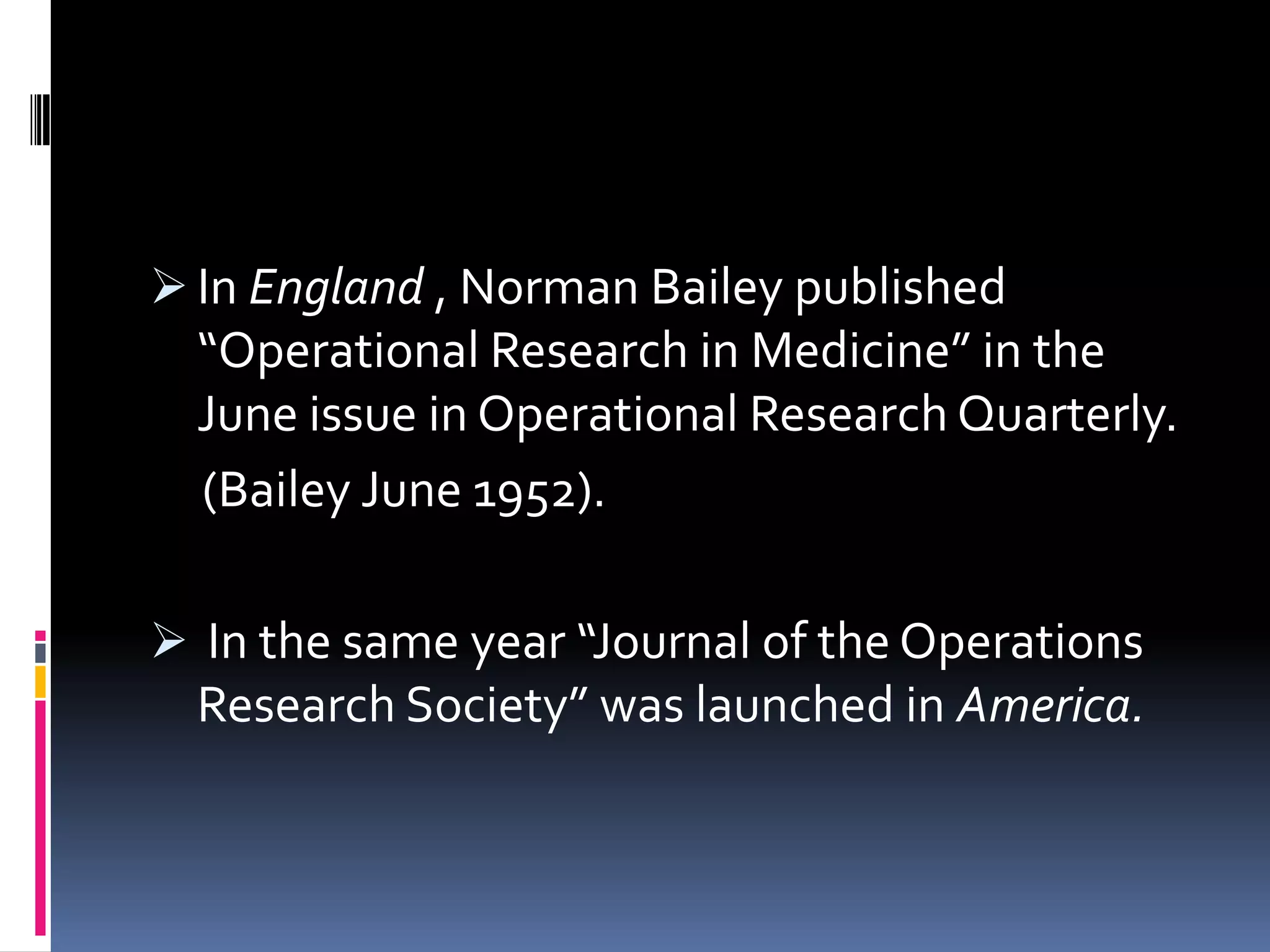
 In England , Norman Bailey published
“Operational Research in Medicine” in the
June issue in Operational Research Quarterly.
(Bailey June 1952).
 In the same year “Journal of the Operations
Research Society” was launched in America.
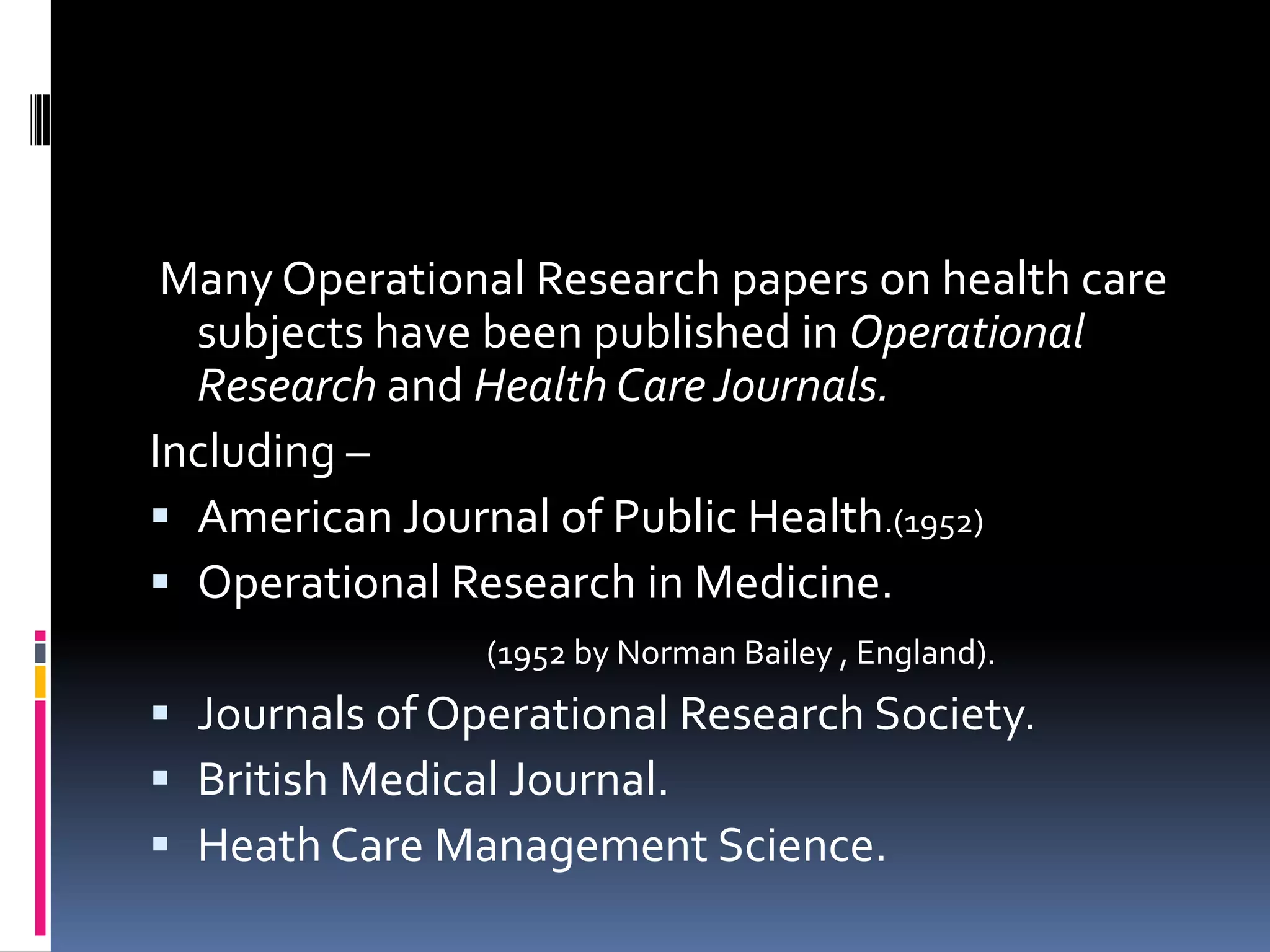
Many Operational Research papers on health care
subjects have been published in Operational
Research and Health CareJournals.
Including –
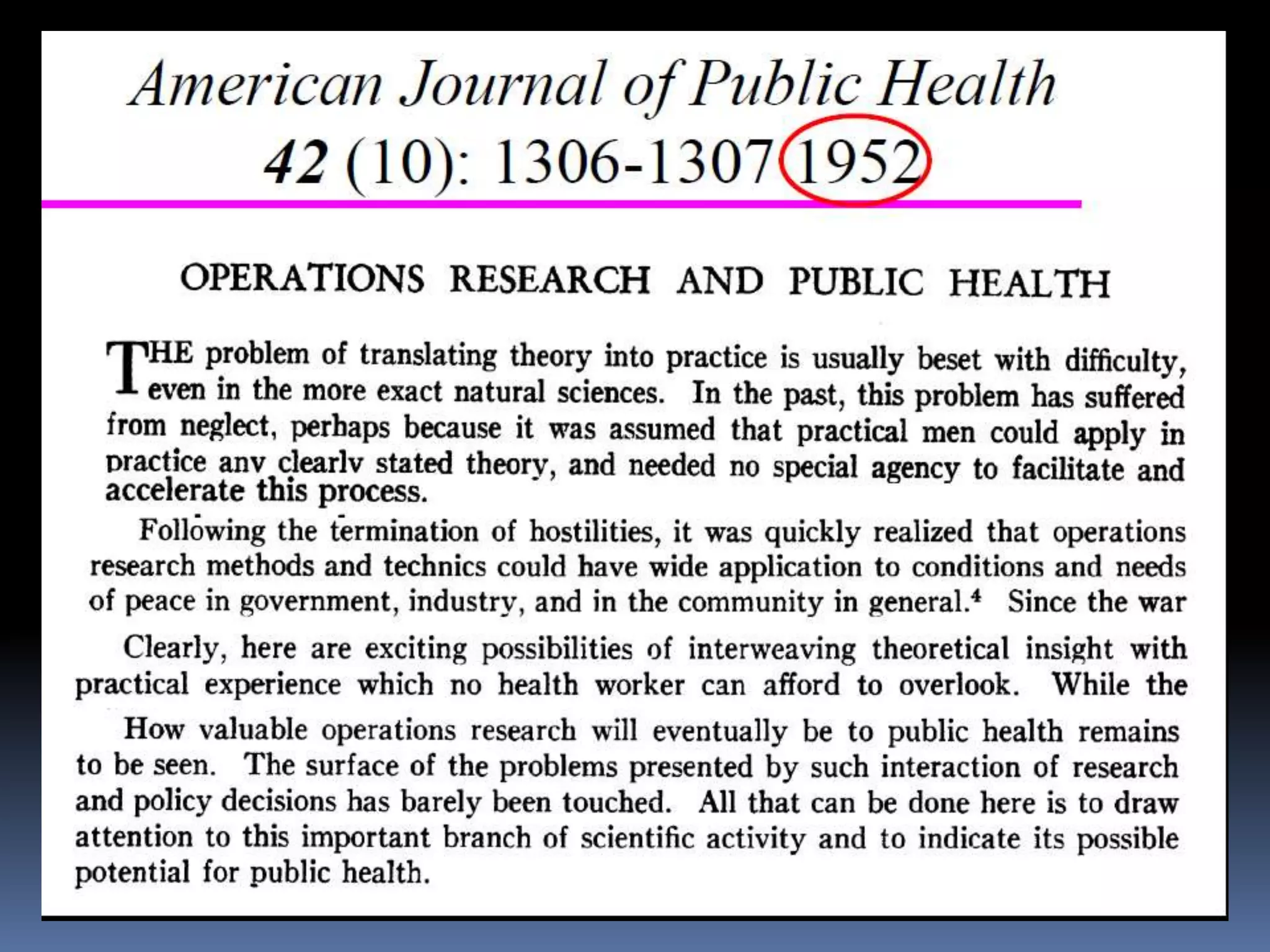
 American Journal of Public Health.(1952)
 Operational Research in Medicine.
(1952 by Norman Bailey , England).
 Journals of Operational Research Society.
 British Medical Journal.
 Heath Care Management Science.
Despite the proliferation of papers in
the academic literature there are still
major issues around getting
Operational Research models widely
accepted as part of mainstream
decision making by health
managers, policy makers and
clinicians.
DEFINITIONS
DEFINITION
“Operational Research is the scientific
study of operations for the purpose of
making better decisions.”
Definition by WHO (2003)
“The use of systematic research techniques
for program decision making to achieve a
specific outcome.”
A working meeting in Geneva on -
“Framework for Operation and Implementation Research in Health and
Diseases Control Program”
All participant were agreed on -
“Any research producing practically
usable knowledge ( evidence , finding ,
information) which can improve program
implementation (effectiveness , efficiency ,
quality , access , scale-up, sustainability)
regardless the type of research (design,
method, approach) falls within the
boundaries of Operational Research.”
OBJECTIVES
OF
OPERATIONAL RESEARCH
Objectives
 Decision making and improve its quality.
 Identify optimum solution.
 Integrating the systems.
 Improve the objectivity of analysis.
 Minimize the cost and maximize the profit.
 Improve the productivity.
 Success in competition and market
leadership.
Objectives
The intent of Operational Research is
 to learn about management and
administration of socio-cultural behavior and
economic factors that exist as bottleneck to
effective implementation and
 to develop more effective approaches to the
programming.
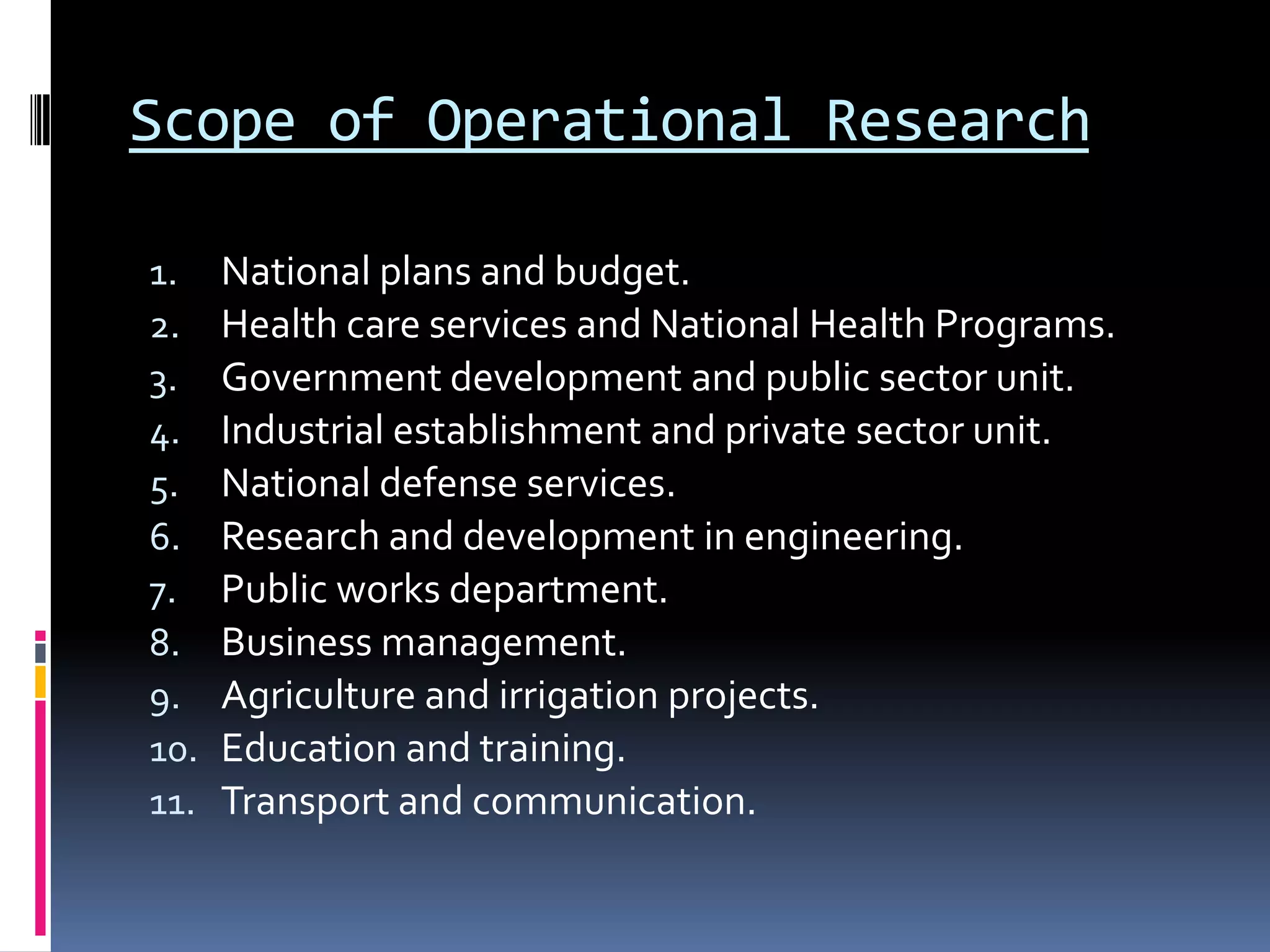
SCOPE OF OPERATIONAL RESEARCH
Scope of Operational Research
1. National plans and budget.
2. Health care services and National Health Programs.
3. Government development and public sector unit.
4. Industrial establishment and private sector unit.
5. National defense services.
6. Research and development in engineering.
7. Public works department.
8. Business management.
9. Agriculture and irrigation projects.
10. Education and training.
11. Transport and communication.
METHODS OF OPERATIONAL RESEARCH
Methods
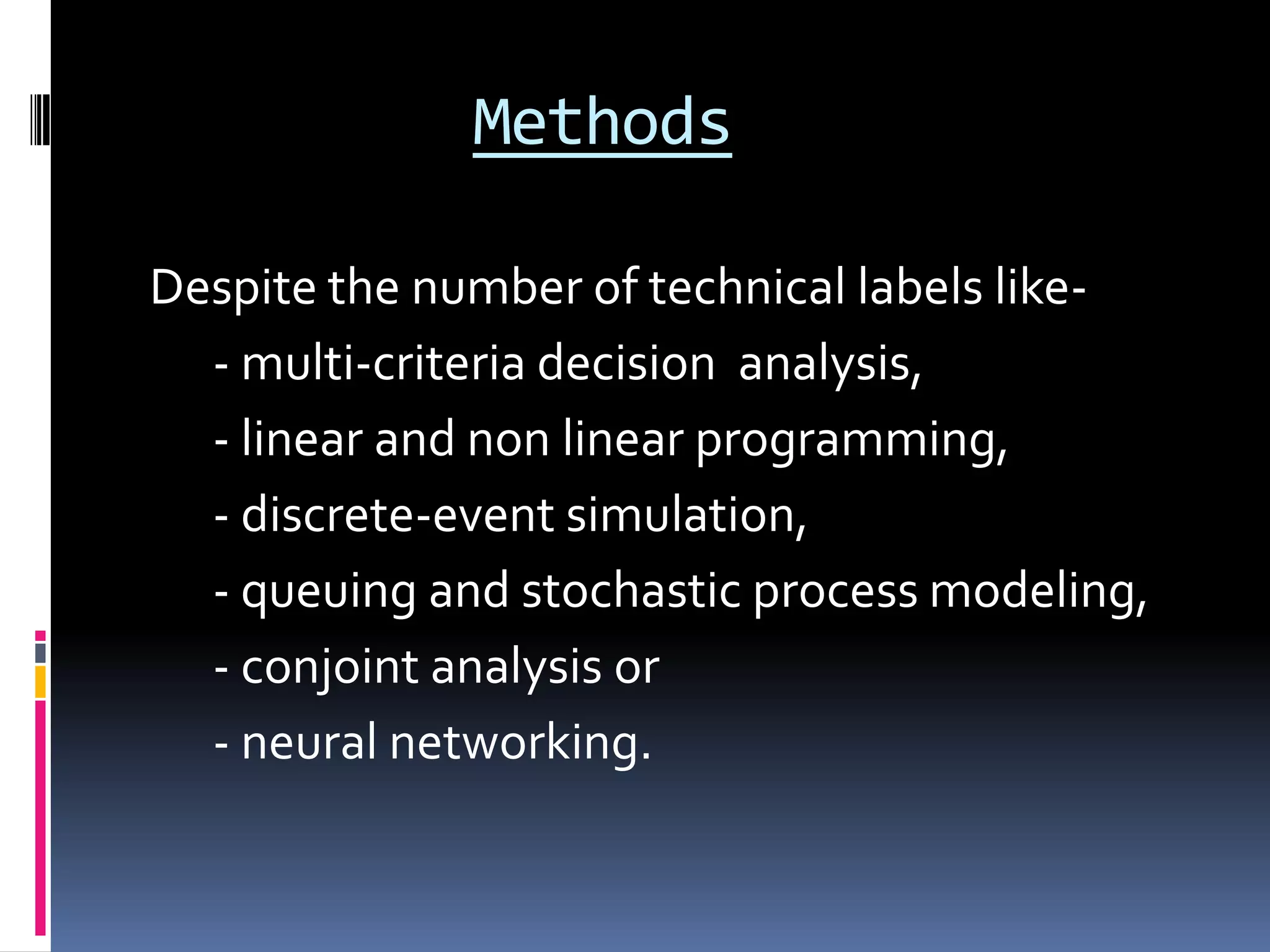
Despite the number of technical labels like-
- multi-criteria decision analysis,
- linear and non linear programming,
- discrete-event simulation,
- queuing and stochastic process modeling,
- conjoint analysis or
- neural networking.
METHODS
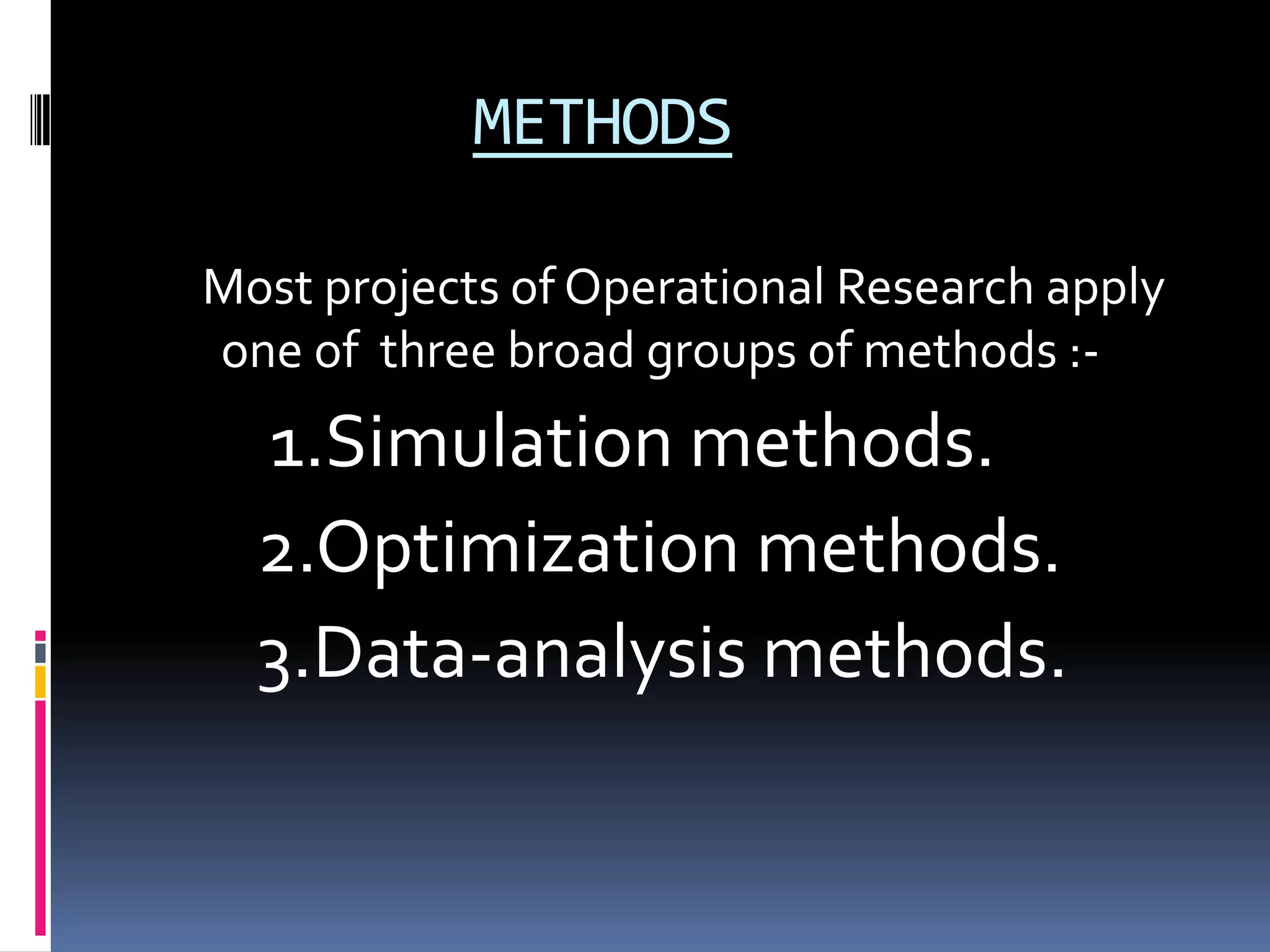
Most projects of Operational Research apply
one of three broad groups of methods :-
1.Simulation methods.
2.Optimization methods.
3.Data-analysis methods.
1.Simulation method
It gives ability to conduct sensitive
study to -
(a). search for improvements and
(b). test the improvement ideas
that are being made.
2.Optimization methods
 Here goal is to enable the decision
makers to identify and locate the
very best choice, where innumerable
feasible choices are available and
comparing them is difficult.
3.Data-analysis methods
 The goal is to aid the decision-maker in
detecting actual patterns and inter-
connections in the data set and
 Use of this analysis for making solutions.
 This method is very useful in Public Health.
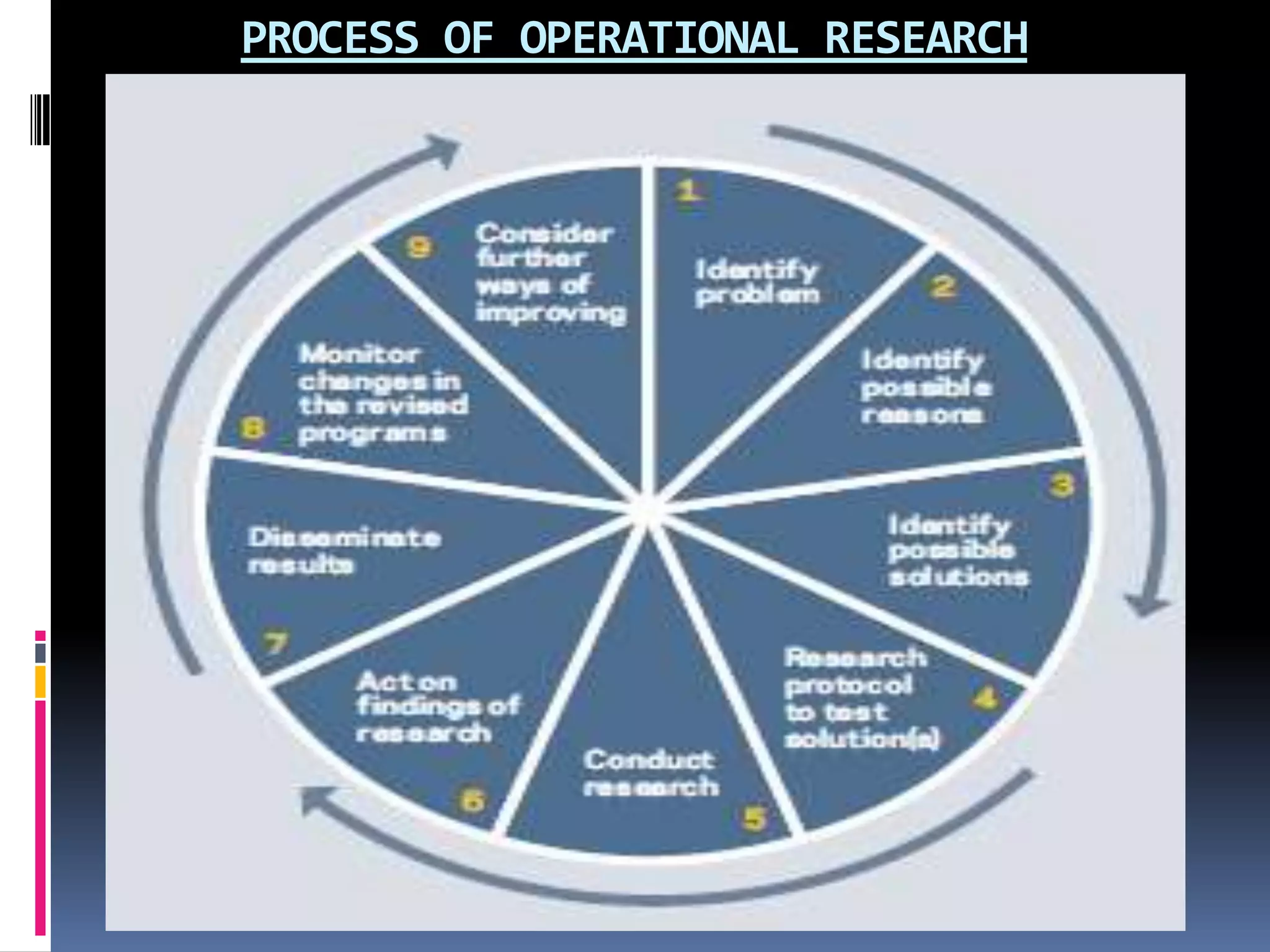
OPERATIONAL RESEARCH PROCESS
Process
1. Identification of program problem.
2. Identification of possible reasons and
solutions .
3. Testing of potential solution.
4. Results utilization.
5. Results dissemination.
1.Identification of the program problem
 Most critical step in the process.
 Unless problem is clearly defined it is
impossible to develop good solutions.
2.Identification of possible
reasons and solutions
 Once the problem has been identified , it is
the job of the program implementer and
researcher to determine the reasons for the
problem and generate possible solutions.
3.Testing of potential solution
 A good solution must be measurable, easy to
implement and sustainable.
 To determine effectiveness of proposed
solution two designs are used-
(a) quasi-experimental design.
- comparison of situations before and after the
solution.
(b) true experiment.
- comparison of outcome between experimental and
control groups.
4.Result utilization
 It is necessary to decide how its results are
meant to be used.
 This determine to some extent that what
information should be collected.
5.Results dissemination
Results dissemination are done in the
form of seminars or by meeting with
decision makers.
PROCESS OF OPERATIONAL RESEARCH
OPERATIONAL RESEARCH
IN
PUBLIC HEALTH
“The mission of public health
is to assure the conditions in
which people can be healthy.”
This mission is accomplished
by the application of
Public Health Science in
operations of Public Health
Services.
Operational Research ( management
principles and techniques) can be applied in
both of these areas of the Public Health.
1. Public Health Science.
2. Public Heath Services.
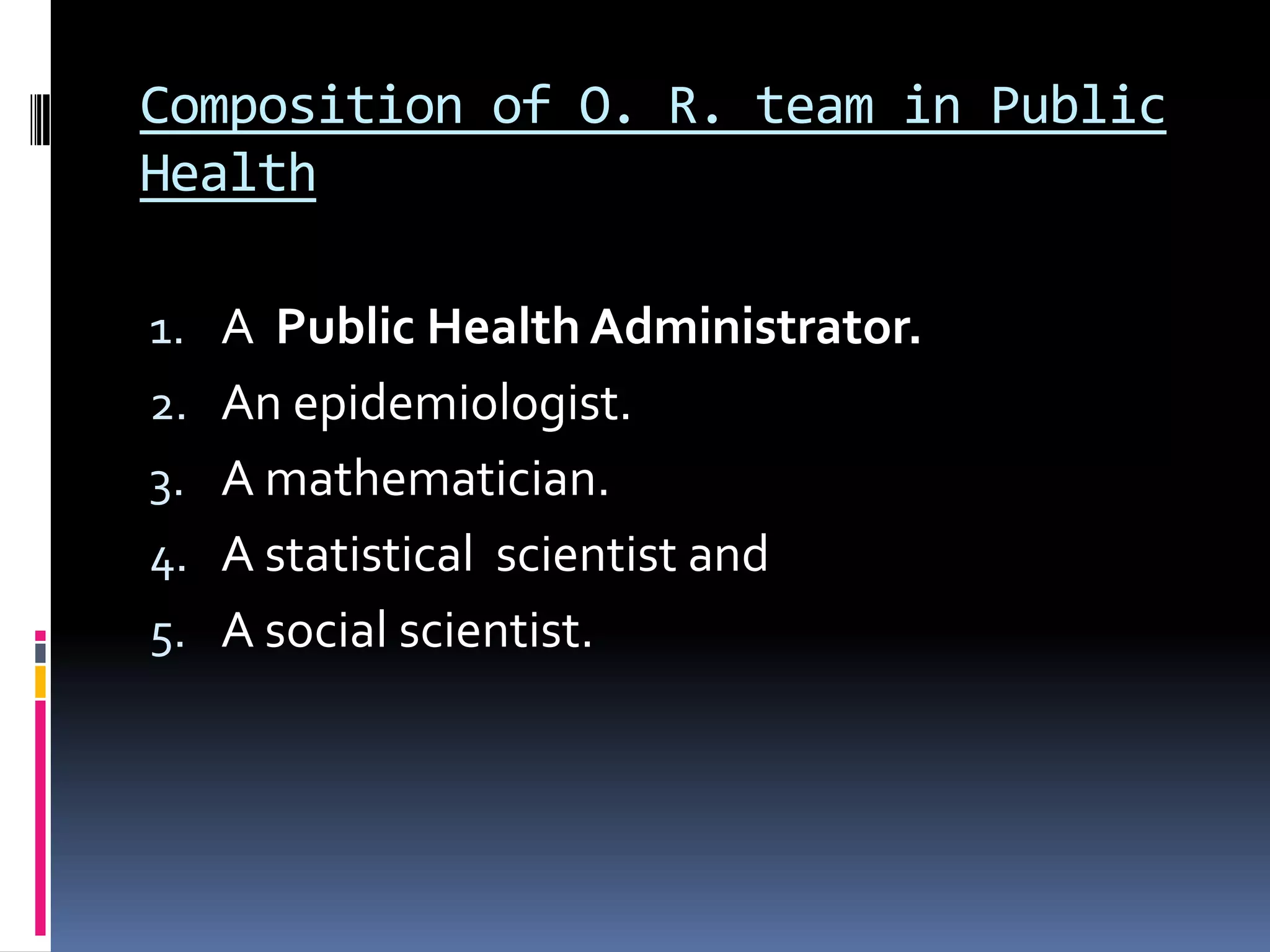
Composition of O. R. team in Public
Health
1. A Public Health Administrator.
2. An epidemiologist.
3. A mathematician.
4. A statistical scientist and
5. A social scientist.
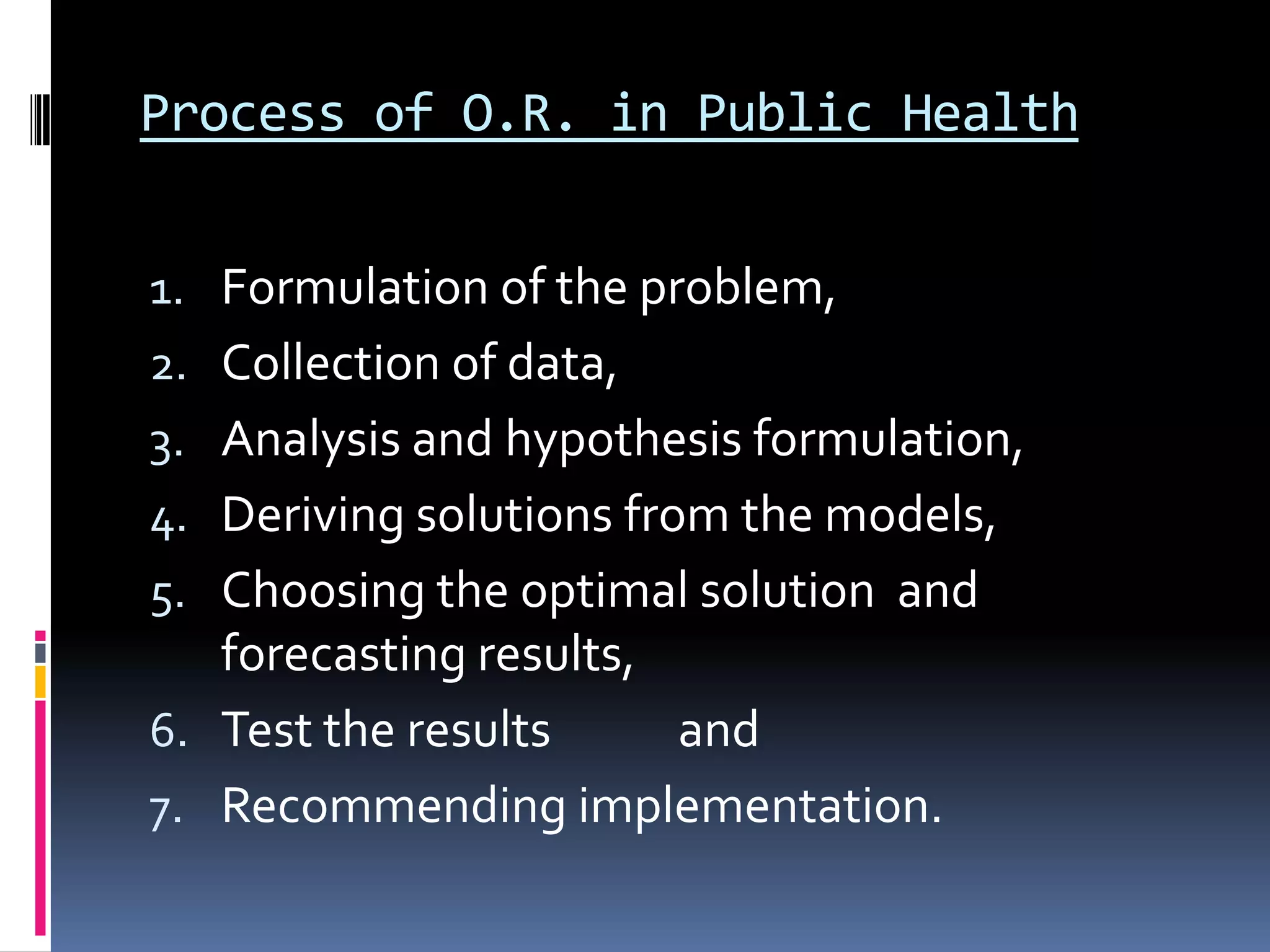
Process of O.R. in Public Health
1. Formulation of the problem,
2. Collection of data,
3. Analysis and hypothesis formulation,
4. Deriving solutions from the models,
5. Choosing the optimal solution and
forecasting results,
6. Test the results and
7. Recommending implementation.
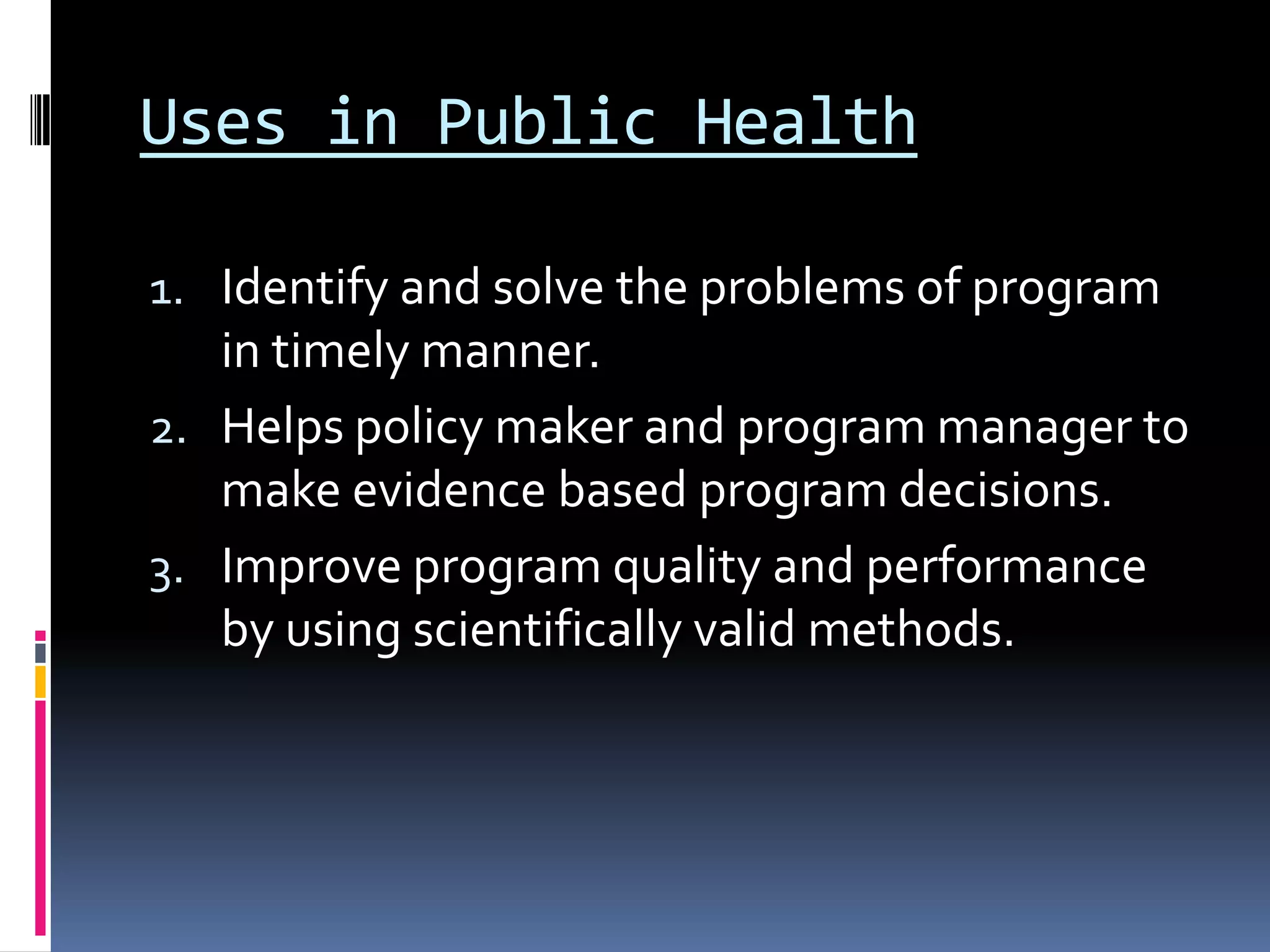
Uses in Public Health
1. Identify and solve the problems of program
in timely manner.
2. Helps policy maker and program manager to
make evidence based program decisions.
3. Improve program quality and performance
by using scientifically valid methods.
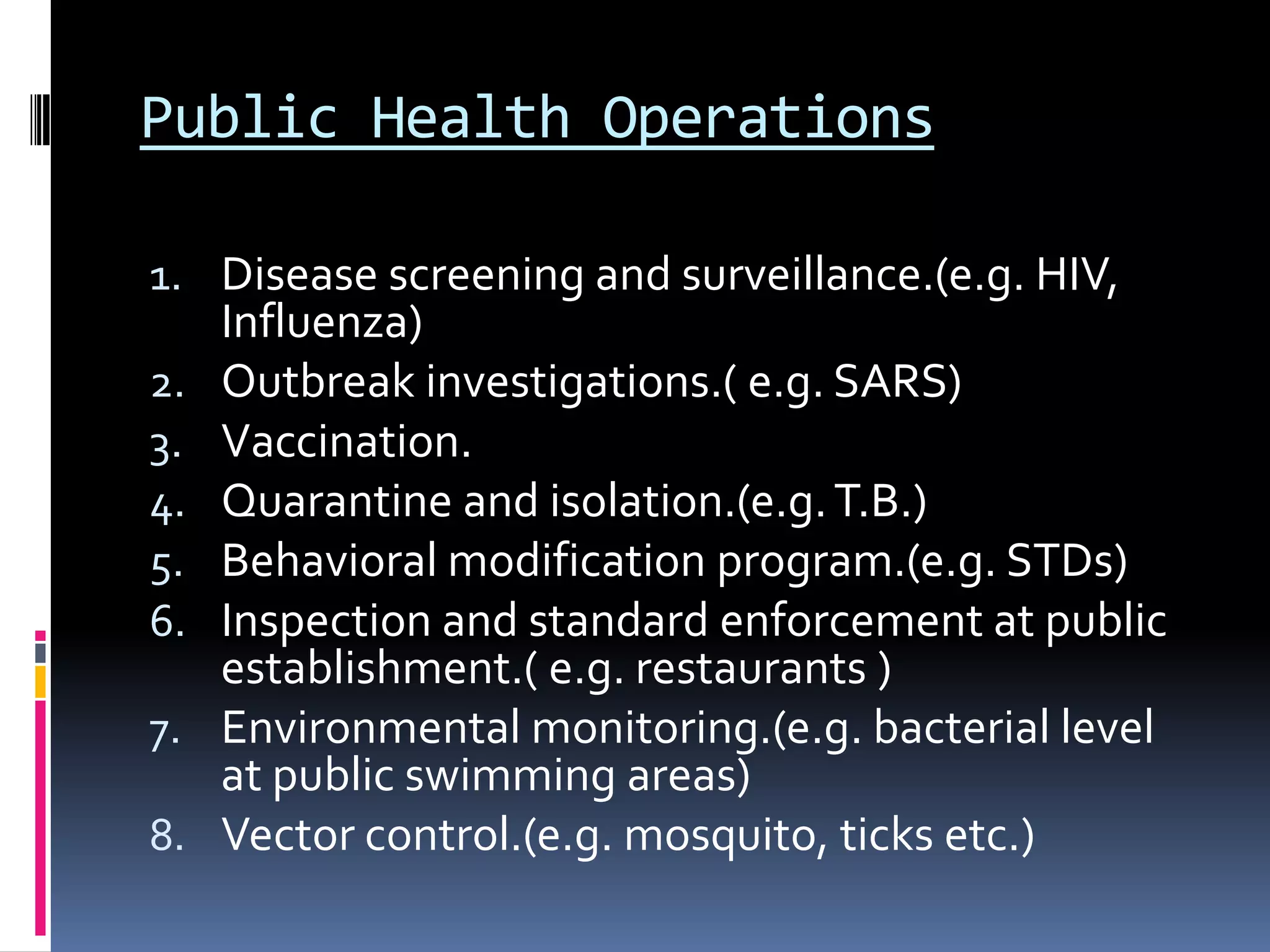
Public Health Operations
1. Disease screening and surveillance.(e.g. HIV,
Influenza)
2. Outbreak investigations.( e.g. SARS)
3. Vaccination.
4. Quarantine and isolation.(e.g.T.B.)
5. Behavioral modification program.(e.g. STDs)
6. Inspection and standard enforcement at public
establishment.( e.g. restaurants )
7. Environmental monitoring.(e.g. bacterial level
at public swimming areas)
8. Vector control.(e.g. mosquito, ticks etc.)
SOCIETIES AND JOURNALS
OF
OPERATIONAL RESEARCH
IFORS
International Federation of Operational Research Society
 IFORS is an umbrella organization for
Operational Research societies world-wide .
 It represents 50 national societies including
those in US, UK , France , Germany, Canada
, Australia , New Zealand, Philippines , India
, Japan and South-Africa.
ORSI
Operational Research Society of India
 founded in 1957.
 the society is affiliated to the IFORS.
 Head quarter of ORSI is located in Kolkata
at 39, Mahanirvan Road , Kolkata 700029.
 The society publishes a quarterly journal
OPSEARCH.
OPSEARCH
INFORMS
Institute for Operations Research and the Management Sciences
 US–based organization.
 INFORMS started an initiative to market the
Operations Research profession better.
 website : ”The Science of Better”.
 This initiative has been adopted by Operational
Research Society in UK.
 website : “Learn about OR” .
INFORMS publishes twelve Scholarly journals
about Operational Research.
Including-
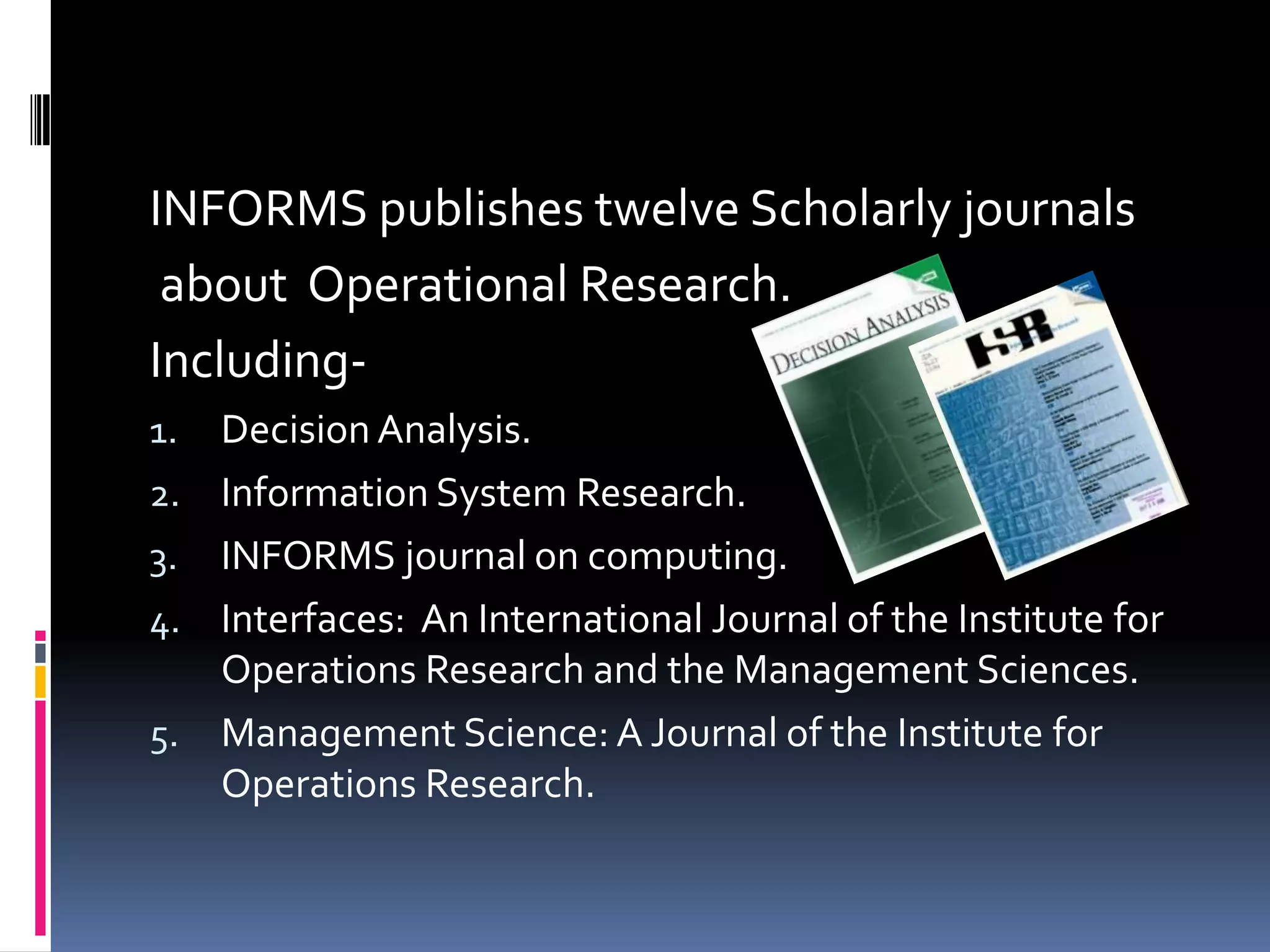
1. Decision Analysis.
2. Information System Research.
3. INFORMS journal on computing.
4. Interfaces: An International Journal of the Institute for
Operations Research and the Management Sciences.
5. Management Science: A Journal of the Institute for
Operations Research.
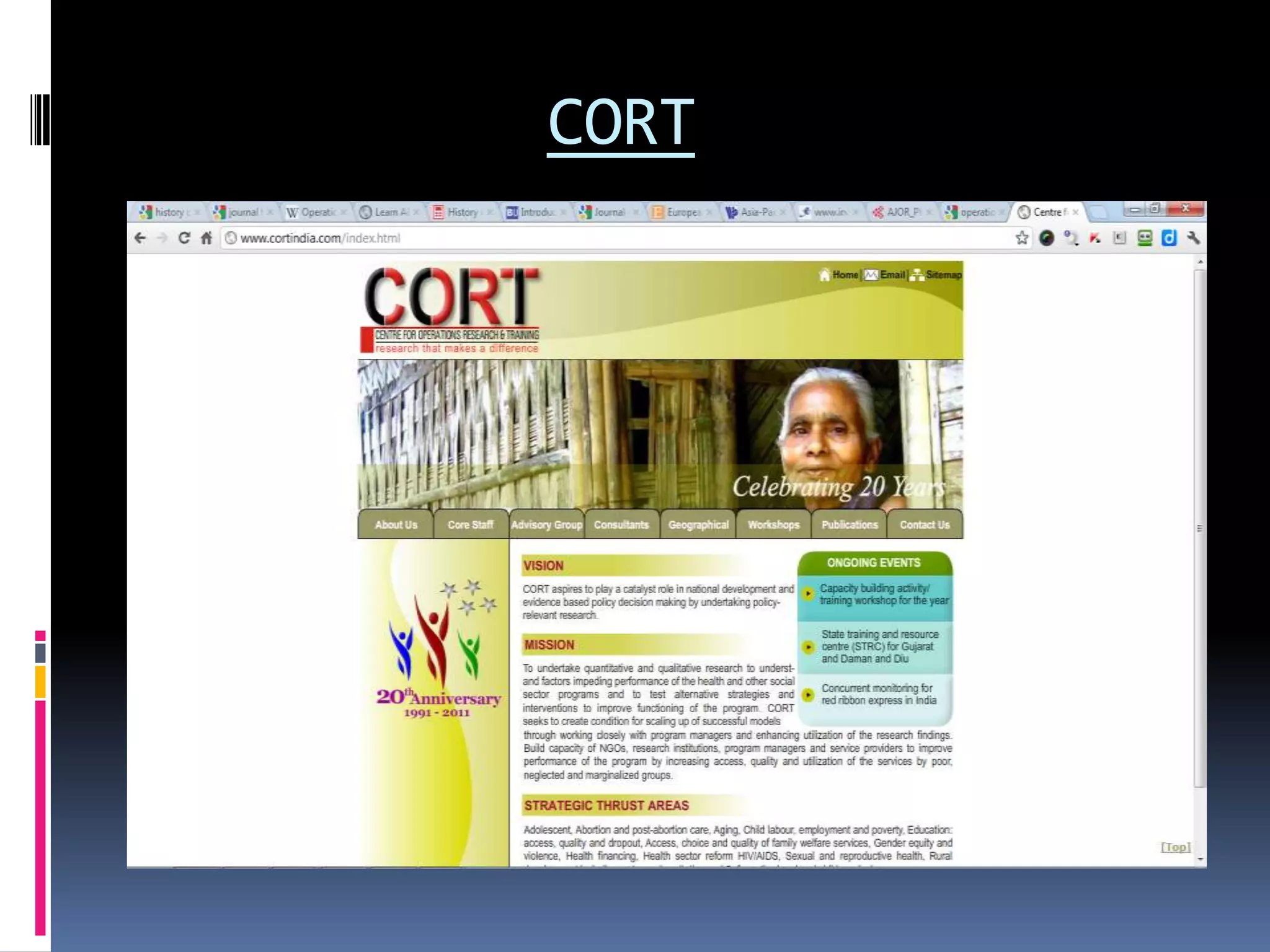
C.O.R.T.
Center for Operations Research and Training
 CORT established in 1991 is one of the
leading research and training organization in
India.
 Its headquarter is inVarodara ,Gujarat.
 Broadly it covers area of health , demography
and social and development issues.
CORT
 CORT is responsible for running State
Training and Resource Center (STRC) in the
state of Gujarat.
 CORT is actively involved in building research
capacity of NGOs by organizing training
workshops
CORT
CONCLUSIONS
Conclusions
 Operational Research needs to be integrated
as an essential part of monitoring and
evaluation efforts in Public Heath.
 Thus concept of M’OR’E could become a new
paradigm for enhancing the practice of
integrated monitoring and evaluation
dimensions as one common component into
program management system.
THANK YOU

Operational reseach

  • 1.
    OPERATIONAL RESEARCH Department ofCommunity Medicine Chhattisgarh Institute of Medical Sciences , Bilaspur (C.G.).
  • 2.
    CONTENTS 1. Overview. 2. History. 3.Definitions. 4. Objectives of Operational Research. 5. Scope of Operational Research. 6. Methods of Operational Research. 7. Operational Research process. 8. Operational Research in Public Health. 9. Societies and Journals of Operational Research. 10. Conclusions.
  • 3.
  • 4.
    Overview Operational Research isthe scientific study of operations for the purpose of making better decisions.
  • 5.
    Overview  It isa discipline that deals with application of advanced analytical methods to facilitate better decisions .  It represents the study of optimal resource allocation.
  • 6.
    Overview In simple terms,it is described as “the science of better”.
  • 7.
    Overview  Modern synonymsfor Operational Research are Management Science or Decision Science.  It is often considered to be a sub-field of mathematics.
  • 8.
    But now adays the principles and techniques of Operational Research are being applied in every field of human research and development including Health Care Sciences.
  • 9.
  • 10.
    History  Operational Researchhas been existed as a science since 1930‘s.  But as a formal discipline Operational Research originated by the efforts of military planner during WorldWar II .
  • 11.
    History The analytical studyof military problems was undertaken to provide scientific basis for decisions to improve military operations.
  • 12.
    History In the decadeafter WorldWar-II the techniques began to be applied more widely in problems of business, industries and societies.
  • 13.
    History  Since thetime Operational Research has expanded into a field widely used in industries ranging from petro- chemical to airlines, finances, logistics and government.  Now it has become an area of active academic and industrial research.
  • 14.
    History The techniques ofOperational Research have been applied and proven in many industries under different names. For instance :- - ‘Lean’ in manufacturing. - ‘Supply Chain’ in logistics and - ‘Yield Management’ in airlines.
  • 15.
    Origin of OperationalResearch in Medicine and Public Heath Operational Research has been studied in Health Care settings since 1952.
  • 16.
     In England, Norman Bailey published “Operational Research in Medicine” in the June issue in Operational Research Quarterly. (Bailey June 1952).  In the same year “Journal of the Operations Research Society” was launched in America.
  • 17.
    Many Operational Researchpapers on health care subjects have been published in Operational Research and Health CareJournals. Including –  American Journal of Public Health.(1952)  Operational Research in Medicine. (1952 by Norman Bailey , England).  Journals of Operational Research Society.  British Medical Journal.  Heath Care Management Science.
  • 19.
    Despite the proliferationof papers in the academic literature there are still major issues around getting Operational Research models widely accepted as part of mainstream decision making by health managers, policy makers and clinicians.
  • 20.
  • 21.
    DEFINITION “Operational Research isthe scientific study of operations for the purpose of making better decisions.”
  • 22.
    Definition by WHO(2003) “The use of systematic research techniques for program decision making to achieve a specific outcome.”
  • 23.
    A working meetingin Geneva on - “Framework for Operation and Implementation Research in Health and Diseases Control Program” All participant were agreed on - “Any research producing practically usable knowledge ( evidence , finding , information) which can improve program implementation (effectiveness , efficiency , quality , access , scale-up, sustainability) regardless the type of research (design, method, approach) falls within the boundaries of Operational Research.”
  • 24.
  • 25.
    Objectives  Decision makingand improve its quality.  Identify optimum solution.  Integrating the systems.  Improve the objectivity of analysis.  Minimize the cost and maximize the profit.  Improve the productivity.  Success in competition and market leadership.
  • 26.
    Objectives The intent ofOperational Research is  to learn about management and administration of socio-cultural behavior and economic factors that exist as bottleneck to effective implementation and  to develop more effective approaches to the programming.
  • 27.
  • 28.
    Scope of OperationalResearch 1. National plans and budget. 2. Health care services and National Health Programs. 3. Government development and public sector unit. 4. Industrial establishment and private sector unit. 5. National defense services. 6. Research and development in engineering. 7. Public works department. 8. Business management. 9. Agriculture and irrigation projects. 10. Education and training. 11. Transport and communication.
  • 29.
  • 30.
    Methods Despite the numberof technical labels like- - multi-criteria decision analysis, - linear and non linear programming, - discrete-event simulation, - queuing and stochastic process modeling, - conjoint analysis or - neural networking.
  • 31.
    METHODS Most projects ofOperational Research apply one of three broad groups of methods :- 1.Simulation methods. 2.Optimization methods. 3.Data-analysis methods.
  • 32.
    1.Simulation method It givesability to conduct sensitive study to - (a). search for improvements and (b). test the improvement ideas that are being made.
  • 33.
    2.Optimization methods  Heregoal is to enable the decision makers to identify and locate the very best choice, where innumerable feasible choices are available and comparing them is difficult.
  • 34.
    3.Data-analysis methods  Thegoal is to aid the decision-maker in detecting actual patterns and inter- connections in the data set and  Use of this analysis for making solutions.  This method is very useful in Public Health.
  • 35.
  • 36.
    Process 1. Identification ofprogram problem. 2. Identification of possible reasons and solutions . 3. Testing of potential solution. 4. Results utilization. 5. Results dissemination.
  • 37.
    1.Identification of theprogram problem  Most critical step in the process.  Unless problem is clearly defined it is impossible to develop good solutions.
  • 38.
    2.Identification of possible reasonsand solutions  Once the problem has been identified , it is the job of the program implementer and researcher to determine the reasons for the problem and generate possible solutions.
  • 39.
    3.Testing of potentialsolution  A good solution must be measurable, easy to implement and sustainable.  To determine effectiveness of proposed solution two designs are used- (a) quasi-experimental design. - comparison of situations before and after the solution. (b) true experiment. - comparison of outcome between experimental and control groups.
  • 40.
    4.Result utilization  Itis necessary to decide how its results are meant to be used.  This determine to some extent that what information should be collected.
  • 41.
    5.Results dissemination Results disseminationare done in the form of seminars or by meeting with decision makers.
  • 42.
  • 43.
  • 44.
    “The mission ofpublic health is to assure the conditions in which people can be healthy.”
  • 45.
    This mission isaccomplished by the application of Public Health Science in operations of Public Health Services.
  • 46.
    Operational Research (management principles and techniques) can be applied in both of these areas of the Public Health. 1. Public Health Science. 2. Public Heath Services.
  • 47.
    Composition of O.R. team in Public Health 1. A Public Health Administrator. 2. An epidemiologist. 3. A mathematician. 4. A statistical scientist and 5. A social scientist.
  • 48.
    Process of O.R.in Public Health 1. Formulation of the problem, 2. Collection of data, 3. Analysis and hypothesis formulation, 4. Deriving solutions from the models, 5. Choosing the optimal solution and forecasting results, 6. Test the results and 7. Recommending implementation.
  • 49.
    Uses in PublicHealth 1. Identify and solve the problems of program in timely manner. 2. Helps policy maker and program manager to make evidence based program decisions. 3. Improve program quality and performance by using scientifically valid methods.
  • 50.
    Public Health Operations 1.Disease screening and surveillance.(e.g. HIV, Influenza) 2. Outbreak investigations.( e.g. SARS) 3. Vaccination. 4. Quarantine and isolation.(e.g.T.B.) 5. Behavioral modification program.(e.g. STDs) 6. Inspection and standard enforcement at public establishment.( e.g. restaurants ) 7. Environmental monitoring.(e.g. bacterial level at public swimming areas) 8. Vector control.(e.g. mosquito, ticks etc.)
  • 51.
  • 52.
    IFORS International Federation ofOperational Research Society  IFORS is an umbrella organization for Operational Research societies world-wide .  It represents 50 national societies including those in US, UK , France , Germany, Canada , Australia , New Zealand, Philippines , India , Japan and South-Africa.
  • 53.
    ORSI Operational Research Societyof India  founded in 1957.  the society is affiliated to the IFORS.  Head quarter of ORSI is located in Kolkata at 39, Mahanirvan Road , Kolkata 700029.  The society publishes a quarterly journal OPSEARCH.
  • 54.
  • 55.
    INFORMS Institute for OperationsResearch and the Management Sciences  US–based organization.  INFORMS started an initiative to market the Operations Research profession better.  website : ”The Science of Better”.  This initiative has been adopted by Operational Research Society in UK.  website : “Learn about OR” .
  • 56.
    INFORMS publishes twelveScholarly journals about Operational Research. Including- 1. Decision Analysis. 2. Information System Research. 3. INFORMS journal on computing. 4. Interfaces: An International Journal of the Institute for Operations Research and the Management Sciences. 5. Management Science: A Journal of the Institute for Operations Research.
  • 57.
    C.O.R.T. Center for OperationsResearch and Training  CORT established in 1991 is one of the leading research and training organization in India.  Its headquarter is inVarodara ,Gujarat.  Broadly it covers area of health , demography and social and development issues.
  • 58.
    CORT  CORT isresponsible for running State Training and Resource Center (STRC) in the state of Gujarat.  CORT is actively involved in building research capacity of NGOs by organizing training workshops
  • 59.
  • 60.
  • 61.
    Conclusions  Operational Researchneeds to be integrated as an essential part of monitoring and evaluation efforts in Public Heath.  Thus concept of M’OR’E could become a new paradigm for enhancing the practice of integrated monitoring and evaluation dimensions as one common component into program management system.
  • 62.