

PROCESS SYNCHRONIZATION BY R DEEPA LAKSHMI
CONTENTS Background The Critical-Section Problem Peterson’s Solution Synchronization Hardware
Background Concurrent access to shared data may result in data inconsistency Maintaining data consistency requires mechanisms to ensure the orderly execution of cooperating processes Suppose that we wanted to provide a solution to the consumer-producer problem that fills  all  the buffers. We can do so by having an integer  count  that keeps track of the number of full buffers.  Initially, count is set to 0. It is incremented by the producer after it produces a new buffer and is decremented by the consumer after it consumes a buffer.
Producer-Consumer Example
Producer  while (true)  { /* produce an item and put in nextProduced*/ while (count == BUFFER_SIZE) ; // do nothing buffer [in] = nextProduced; in = (in + 1) % BUFFER_SIZE; count++; }
Consumer while (1)  { while (count == 0) ; // do nothing nextConsumed =  buffer[out]; out = (out + 1) % BUFFER_SIZE; count--; /*  consume the item in nextConsumed*/   }
Race Condition count++ could be implemented as   register1 = count   register1 = register1 + 1   count = register1 count-- could be implemented as   register2 = count   register2 = register2 - 1   count = register2 Consider this execution interleaving with “count = 5” initially: S0: producer execute register1 = count  {register1 = 5} S1: producer execute register1 = register1 + 1  {register1 = 6}  S2: consumer execute register2 = count  {register2 = 5}  S3: consumer execute register2 = register2 - 1  {register2 = 4}  S4: producer execute count = register1  {count = 6 }  S5: consumer execute count = register2  {count = 4}
Solution to Critical-Section Problem 1 . Mutual Exclusion  - If process  P i  is executing in its critical section, then no other processes can be executing in their critical sections 2. Progress  - If no process is executing in its critical section and there exist some processes that wish to enter their critical section, then the selection of the processes that will enter the critical section next cannot be postponed indefinitely 3. Bounded Waiting  -  A bound must exist on the number of times that other processes are allowed to enter their critical sections after a process has made a request to enter its critical section and before that request is granted Assume that each process executes at a nonzero speed  No assumption concerning relative speed of the  N  processes
Critical-Section Problem Race Condition  - When there is concurrent access to shared data and the final outcome depends upon order of execution. Critical Section  - Section of code where shared data is accessed.  Entry Section  -  Code that requests permission to enter its critical section. Exit Section  - Code that is run after exiting the critical section
Structure of a Typical Process While (true) { Entry section CRITICAL SECTION Exit section REMAINDER SECTION }
Peterson’s Solution
Algorithm 1 do { While (turn != i); critical section Turn = j; remainder section } while(1);
Algorithm 2 do { Flag[i] = true; While(flag[j]); critical section Flag[i] = flase; remainder section } while(1);
Algorithm 3 Two process solution Assume that the LOAD and STORE instructions are atomic; that is, cannot be interrupted. The two processes share two variables: int  turn ;  Boolean  flag[2] The variable  turn  indicates whose turn it is to enter the critical section.  The  flag  array is used to indicate if a process is ready to enter the critical section.  flag[i]  = true implies that process  P i  is ready!
Algorithm for Process P i do { flag[i] = TRUE; turn = j; while ( flag[j] && turn == j); CRITICAL SECTION flag[i] = FALSE; REMAINDER SECTION } while (TRUE);
Synchronization Hardware Many systems provide hardware support for critical section code Uniprocessors – could disable interrupts Currently running code would execute without preemption Generally too inefficient on multiprocessor systems Operating systems using this not broadly scalable Modern machines provide special atomic hardware instructions Atomic = non-interruptable Either test memory word and set value Or swap contents of two memory words
TestAndndSet Instruction   Definition: boolean TestAndSet (boolean *target) { boolean rv = *target; *target = TRUE; return rv: }
Mutual exclusion implemention with TestAndSet Shared boolean variable lock., initialized to false. Solution: do { while ( TestAndSet (&lock )) ;  /* do nothing //  critical section lock = FALSE; //  remainder section  } while ( TRUE);
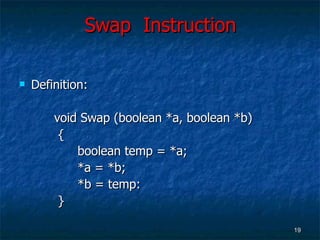
Swap  Instruction Definition: void Swap (boolean *a, boolean *b) { boolean temp = *a; *a = *b; *b = temp: }
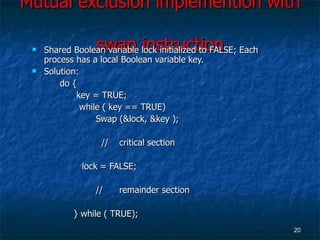
Mutual exclusion implemention with  swap instruction Shared Boolean variable lock initialized to FALSE; Each process has a local Boolean variable key. Solution: do { key = TRUE; while ( key == TRUE) Swap (&lock, &key ); //  critical section lock = FALSE; //  remainder section  } while ( TRUE);
Bounded-waiting Mutual Exclusion with TestAndSet() do {  waiting[i] = TRUE;  key = TRUE;  while (waiting[i] && key)  key = TestAndSet(&lock);  waiting[i] = FALSE;  // critical section  j = (i + 1) % n;  while ((j != i) && !waiting[j])  j = (j + 1) % n;  if (j == i)  lock = FALSE;  else  waiting[j] = FALSE;  // remainder section  } while (TRUE);
REFERENCES BOOK Operating Systems Concepts - Silberschatz, Galvin, Gagne WEBSITE www.en.wikipedia.org
THANK YOU

Process synchronization(deepa)

  • 1.
  • 2.
    CONTENTS Background TheCritical-Section Problem Peterson’s Solution Synchronization Hardware
  • 3.
    Background Concurrent accessto shared data may result in data inconsistency Maintaining data consistency requires mechanisms to ensure the orderly execution of cooperating processes Suppose that we wanted to provide a solution to the consumer-producer problem that fills all the buffers. We can do so by having an integer count that keeps track of the number of full buffers. Initially, count is set to 0. It is incremented by the producer after it produces a new buffer and is decremented by the consumer after it consumes a buffer.
  • 4.
  • 5.
    Producer while(true) { /* produce an item and put in nextProduced*/ while (count == BUFFER_SIZE) ; // do nothing buffer [in] = nextProduced; in = (in + 1) % BUFFER_SIZE; count++; }
  • 6.
    Consumer while (1) { while (count == 0) ; // do nothing nextConsumed = buffer[out]; out = (out + 1) % BUFFER_SIZE; count--; /* consume the item in nextConsumed*/ }
  • 7.
    Race Condition count++could be implemented as register1 = count register1 = register1 + 1 count = register1 count-- could be implemented as register2 = count register2 = register2 - 1 count = register2 Consider this execution interleaving with “count = 5” initially: S0: producer execute register1 = count {register1 = 5} S1: producer execute register1 = register1 + 1 {register1 = 6} S2: consumer execute register2 = count {register2 = 5} S3: consumer execute register2 = register2 - 1 {register2 = 4} S4: producer execute count = register1 {count = 6 } S5: consumer execute count = register2 {count = 4}
  • 8.
    Solution to Critical-SectionProblem 1 . Mutual Exclusion - If process P i is executing in its critical section, then no other processes can be executing in their critical sections 2. Progress - If no process is executing in its critical section and there exist some processes that wish to enter their critical section, then the selection of the processes that will enter the critical section next cannot be postponed indefinitely 3. Bounded Waiting - A bound must exist on the number of times that other processes are allowed to enter their critical sections after a process has made a request to enter its critical section and before that request is granted Assume that each process executes at a nonzero speed No assumption concerning relative speed of the N processes
  • 9.
    Critical-Section Problem RaceCondition - When there is concurrent access to shared data and the final outcome depends upon order of execution. Critical Section - Section of code where shared data is accessed. Entry Section - Code that requests permission to enter its critical section. Exit Section - Code that is run after exiting the critical section
  • 10.
    Structure of aTypical Process While (true) { Entry section CRITICAL SECTION Exit section REMAINDER SECTION }
  • 11.
  • 12.
    Algorithm 1 do{ While (turn != i); critical section Turn = j; remainder section } while(1);
  • 13.
    Algorithm 2 do{ Flag[i] = true; While(flag[j]); critical section Flag[i] = flase; remainder section } while(1);
  • 14.
    Algorithm 3 Twoprocess solution Assume that the LOAD and STORE instructions are atomic; that is, cannot be interrupted. The two processes share two variables: int turn ; Boolean flag[2] The variable turn indicates whose turn it is to enter the critical section. The flag array is used to indicate if a process is ready to enter the critical section. flag[i] = true implies that process P i is ready!
  • 15.
    Algorithm for ProcessP i do { flag[i] = TRUE; turn = j; while ( flag[j] && turn == j); CRITICAL SECTION flag[i] = FALSE; REMAINDER SECTION } while (TRUE);
  • 16.
    Synchronization Hardware Manysystems provide hardware support for critical section code Uniprocessors – could disable interrupts Currently running code would execute without preemption Generally too inefficient on multiprocessor systems Operating systems using this not broadly scalable Modern machines provide special atomic hardware instructions Atomic = non-interruptable Either test memory word and set value Or swap contents of two memory words
  • 17.
    TestAndndSet Instruction Definition: boolean TestAndSet (boolean *target) { boolean rv = *target; *target = TRUE; return rv: }
  • 18.
    Mutual exclusion implementionwith TestAndSet Shared boolean variable lock., initialized to false. Solution: do { while ( TestAndSet (&lock )) ; /* do nothing // critical section lock = FALSE; // remainder section } while ( TRUE);
  • 19.
    Swap InstructionDefinition: void Swap (boolean *a, boolean *b) { boolean temp = *a; *a = *b; *b = temp: }
  • 20.
    Mutual exclusion implementionwith swap instruction Shared Boolean variable lock initialized to FALSE; Each process has a local Boolean variable key. Solution: do { key = TRUE; while ( key == TRUE) Swap (&lock, &key ); // critical section lock = FALSE; // remainder section } while ( TRUE);
  • 21.
    Bounded-waiting Mutual Exclusionwith TestAndSet() do { waiting[i] = TRUE; key = TRUE; while (waiting[i] && key) key = TestAndSet(&lock); waiting[i] = FALSE; // critical section j = (i + 1) % n; while ((j != i) && !waiting[j]) j = (j + 1) % n; if (j == i) lock = FALSE; else waiting[j] = FALSE; // remainder section } while (TRUE);
  • 22.
    REFERENCES BOOK OperatingSystems Concepts - Silberschatz, Galvin, Gagne WEBSITE www.en.wikipedia.org
  • 23.