Process Synchronization
RACE CONDITION
 Imagine a bank account shared between two processes: one process handles deposits,
and the other handles withdrawals. The balance is stored in a variable balance.
 Process A wants to deposit $100 into the account. It reads the current balance, which is
$500. It then adds $100 to the balance and updates it to $600.
 Meanwhile, Process B wants to withdraw $50 from the same account. It reads the
current balance, which is still $500 (since Process A hasn't finished updating yet). It
subtracts $50 from the balance and updates it to $450.
 Now, Process A completes its update, setting the balance to $600. However, it doesn't
know that Process B has already read the old balance and subtracted $50 from it. So,
the final balance is incorrect. It should be $550 ($500 + $100 - $50), but due to the race
condition, it's $600.
 This is a classic example of a race condition. The outcome of the program depends on
the timing of events (the interleaving of instructions between Process A and Process B),
leading to incorrect behavior. In this case, the incorrect behavior arises from concurrent
access to shared resources (the balance variable) without proper synchronization.
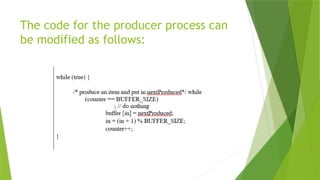
The code for the producer process can
be modified as follows:
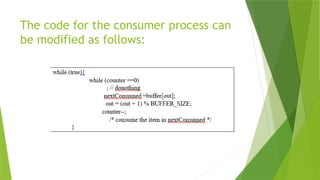
The code for the consumer process can
be modified as follows:
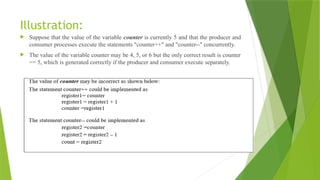
Illustration:
 Suppose that the value of the variable counter is currently 5 and that the producer and
consumer processes execute the statements "counter++" and "counter--" concurrently.
 The value of the variable counter may be 4, 5, or 6 but the only correct result is counter
== 5, which is generated correctly if the producer and consumer execute separately.
 The concurrent execution of "counter++" and "counter--" is equivalent to a
sequential execution in which the lower-level statements presented previously
are interleaved in some arbitrary order. One such interleaving is
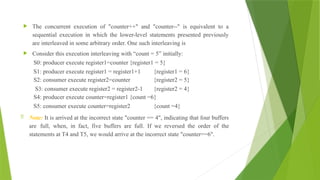
 Consider this execution interleaving with “count = 5” initially:
S0: producer execute register1=counter {register1 = 5}
S1: producer execute register1 = register1+1 {register1 = 6}
S2: consumer execute register2=counter {register2 = 5}
S3: consumer execute register2 = register2-1 {register2 = 4}
S4: producer execute counter=register1 {count =6}
S5: consumer execute counter=register2 {count =4}
 Note: It is arrived at the incorrect state "counter == 4", indicating that four buffers
are full, when, in fact, five buffers are full. If we reversed the order of the
statements at T4 and T5, we would arrive at the incorrect state "counter==6".
 We would arrive at this incorrect state because we allowed both processes to
manipulate the variable counter concurrently.
 A situation like this, where several processes access and manipulate the same
data concurrently and the outcome of the execution depends on the particular
order in which the access takes place, is called a Race Condition.
 To guard against the race condition above, we need to ensure that only one
process at a time can be manipulating the variable counter.
 To make such a guarantee, we require that the processes be synchronized in
some way.
The Critical Section Problems
 Consider a system consisting of n processes {Po, P1 , ... ,Pn-1}.
 Each process has a segment of code, called a critical section in which the process may
be changing common variables, updating a table, writing a file, and soon
 The important feature of the system is that, when one process is executing in its critical
section, no other process is to be allowed to execute in its critical section.
 That is, no two processes are executing in their critical sections at the same time.
 The critical-section problem is to design a protocol that the processes can use to
cooperate.
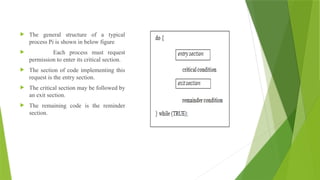
 The general structure of a typical
process Pi is shown in below figure
 Each process must request
permission to enter its critical section.
 The section of code implementing this
request is the entry section.
 The critical section may be followed by
an exit section.
 The remaining code is the reminder
section.
 A solution to the critical-section problem must satisfy the following three
requirements:
1. Mutual exclusion: If process Pi is executing in its critical section, then no other
processes can be executing in their critical sections.
2. Progress: If no process is executing in its critical section and some processes wish
to enter their critical sections, then only those processes that are not executing in
their remainder sections can participate in deciding which will enter its critical
section next, and this selection cannot be postponed indefinitely.
3. Bounded waiting: There exists a bound, or limit, on the number of times that
other processes are allowed to enter their critical sections after a process has made
a request to enter its critical section and before that request is granted.
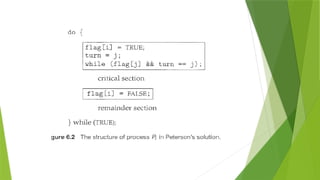
PETERSON'S SOLUTION
 This is a classic software-based solution to the critical-section problem.
 Peterson's solution provides a good algorithmic description of solving the critical-
section problem and illustrates some of the complexities involved in designing software
that addresses the requirements of mutual exclusion, progress, and bounded waiting.
 Peterson's solution is restricted to two processes that alternate execution between their
critical sections and remainder sections.
 The processes are numbered Po and P1 or Pi and Pj where j = 1-i
 Peterson's solution requires the two processes to share two data items:
 int turn;
 boolean flag[2];
 turn: The variable turn indicates whose turn it is to enter its critical section.
 Ex: if turn == i, then process Pi is allowed to execute in its critical section
 flag: The flag array is used to indicate if a process is ready to enter its critical section.
 Ex: if flag [i] is true, this value indicates that Pi is ready to enter its critical section.
bool flag[2] = {false, false};
int turn;
 P0: flag[0] = true;
 P0_gate: turn = 1;
 while (flag[1] && turn == 1)
 {
 // busy wait
 }
 // critical section
 ...
 // end of critical section
 flag[0] = false;
 P1: flag[1] = true;
 P1_gate: turn = 0;
 while (flag[0] && turn == 0)
 {
 // busy wait
 }
 // critical section
 ...
 // end of critical section
 flag[1] = false;
1. To prove Mutual exclusion
 Each pi enters its critical section only if either flag [j] == false or turn ==i.
 If both processes can be executing in their critical sections at the same
time, then flag [0] == flag [1]==true.
 These two observations imply that Pi and Pj could not have successfully
executed their while statements at about the same time, since the value of turn
can be either 0 or 1 but cannot be both.
 Hence, one of the processes (Pj) must have successfully executed the while
statement, whereas Pi had to execute at least one additional statement
("turn==j").
 However, at that time, flag [j] == true and turn == j, and this condition will
persist as long as Pi is in its critical section, as a result, mutual exclusion is
preserved.
Progress & bounded waiting
 To prove properties 2 and 3, we note that a process Pi can be prevented from entering the critical
section only if it is stuck in the while loop with the condition
flag [j] ==true and turn=== j; this loop is the only one possible.
 If Pj is not ready to enter the critical section, then flag [j] ==false, and Pi can enter its critical
section.
 If Pj has set flag [j] to true and is also executing in its while statement, then either turn === i or
turn === j.
 If turn == i, then Pi will enter the critical section.
 If turn== j, then Pj will enter the critical section.
 However, once Pj exits its critical section, it will reset flag [j] to false, allowing Pi to enter its
critical section.
 If Pj resets flag [j] to true, it must also set turn to i.
 Thus, since Pi does not change the value of the variable turn while executing the while
statement, Pi will enter the critical section (progress) after at most one entry by Pj(bounded
waiting).
SYNCHRONIZATION HARDWARE
 We have just described one software-based solution to the critical-section problem.
 However, as mentioned, software-based solutions such as Peterson’s are not guaranteed
to work on modern computer architectures.
 Instead, we can generally state that any solution to the critical-section problem requires
a simple tool-a lock.
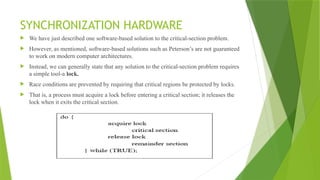
 Race conditions are prevented by requiring that critical regions be protected by locks.
 That is, a process must acquire a lock before entering a critical section; it releases the
lock when it exits the critical section.
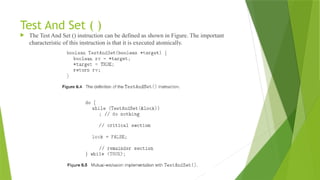
Test And Set ( )
 The Test And Set () instruction can be defined as shown in Figure. The important
characteristic of this instruction is that it is executed atomically.
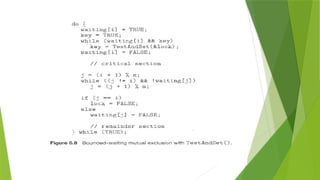
 Below algorithm using the TestAndSet () instruction that satisfies all the
critical- section requirements. The common data structures are
 boolean waiting[n];
 boolean lock;
 These data structures are initialized to false.
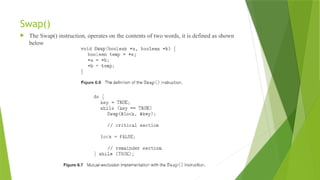
Swap()
 The Swap() instruction, operates on the contents of two words, it is defined as shown
below
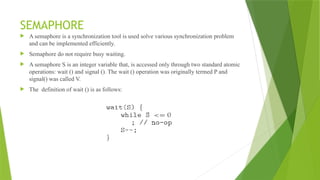
SEMAPHORE
 A semaphore is a synchronization tool is used solve various synchronization problem
and can be implemented efficiently.
 Semaphore do not require busy waiting.
 A semaphore S is an integer variable that, is accessed only through two standard atomic
operations: wait () and signal (). The wait () operation was originally termed P and
signal() was called V.
 The definition of wait () is as follows:
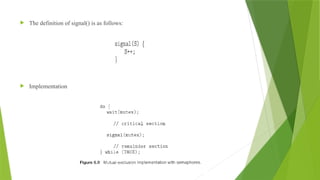
 The definition of signal() is as follows:
 Implementation
Binary semaphore
 The value of a binary semaphore can range only between 0 and1.
 Binary semaphores are known as mutex locks, as they are locks that provide mutual
exclusion.
 Binary semaphores to deal with the critical-section problem for multiple processes.
Then processes share a semaphore, mutex, initialized to1
 Counting semaphore
 The value of a counting semaphore can range over an unrestricted domain.
 Counting semaphores can be used to control access to a given resource consisting
of a finite number of instances.
 The semaphore is initialized to the number of resources available. Each process
that wishes to use a resource performs a wait() operation on the semaphore.
When a process releases a resource, it performs a signal()operation.
 When the count for the semaphore goes to 0, all resources are being used. After
that, processes that wish to use a resource will block until the count becomes
greater than 0.
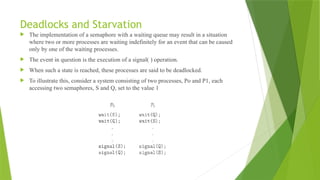
Deadlocks and Starvation
 The implementation of a semaphore with a waiting queue may result in a situation
where two or more processes are waiting indefinitely for an event that can be caused
only by one of the waiting processes.
 The event in question is the execution of a signal( ) operation.
 When such a state is reached, these processes are said to be deadlocked.
 To illustrate this, consider a system consisting of two processes, Po and P1, each
accessing two semaphores, S and Q, set to the value 1
CLASSICAL PROBLEMS OF
SYNCHRONIZATION
 Bounded-Buffer Problem
 Readers and Writers Problem
 Dining-Philosophers Problem
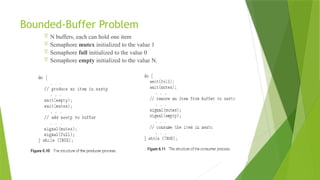
Bounded-Buffer Problem
 N buffers, each can hold one item
 Semaphore mutex initialized to the value 1
 Semaphore full initialized to the value 0
 Semaphore empty initialized to the value N.
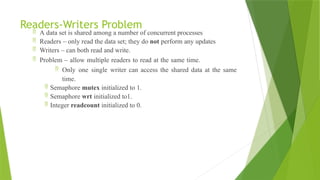
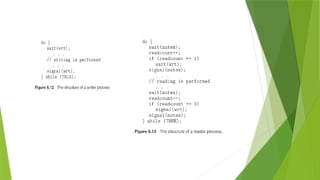
Readers-Writers Problem
 A data set is shared among a number of concurrent processes
 Readers – only read the data set; they do not perform any updates
 Writers – can both read and write.
 Problem – allow multiple readers to read at the same time.
 Only one single writer can access the shared data at the same
time.
 Semaphore mutex initialized to 1.
 Semaphore wrt initialized to1.
 Integer readcount initialized to 0.
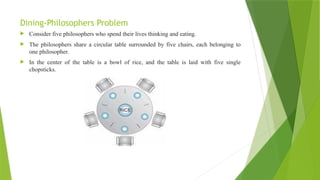
Dining-Philosophers Problem
 Consider five philosophers who spend their lives thinking and eating.
 The philosophers share a circular table surrounded by five chairs, each belonging to
one philosopher.
 In the center of the table is a bowl of rice, and the table is laid with five single
chopsticks.
 A philosopher gets hungry and tries to pick up the two chopsticks that are closest to
her (the chopsticks that are between her and her left and right neighbors).
 A philosopher may pick up only one chopstick at a time.
 When a hungry philosopher has both her chopsticks at the same time, she eats
without releasing the chopsticks.
 When she is finished eating, she puts down both chopsticks and starts thinking again.
 It is a simple representation of the need to allocate several resources among several
processes in a deadlock-free and starvation-free manner.
 Solution:One simple solution is to represent each chopstick with a semaphore.
 A philosopher tries to grab a chopstick by executing a wait() operation on that
semaphore.
 She releases her chopsticks by executing the signal() operation on the appropriate
semaphores.
 Thus, the shared data are
semaphore chopstick[5];
 where all the elements of chopstick are initialized to 1. The structure of
philosopher i is shown
Several possible remedies to the deadlock problem are
replaced by:
 Allow at most four philosophers to be sitting simultaneously at the table.
 Allow a philosopher to pickup her chopsticks only if both chopsticks are available.
 Use an asymmetric solution—that is, an odd-numbered philosopher picks up first her
left chopstick and then her right chopstick,
 whereas an even numbered philosopher picks up her right chopstick and then her left
chopstick.
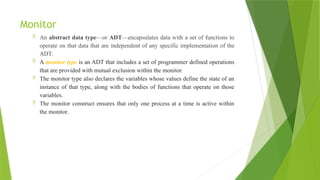
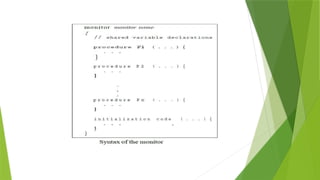
Monitor
 An abstract data type—or ADT—encapsulates data with a set of functions to
operate on that data that are independent of any specific implementation of the
ADT.
 A monitor type is an ADT that includes a set of programmer defined operations
that are provided with mutual exclusion within the monitor.
 The monitor type also declares the variables whose values define the state of an
instance of that type, along with the bodies of functions that operate on those
variables.
 The monitor construct ensures that only one process at a time is active within
the monitor.
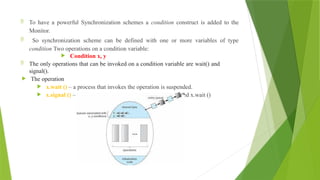
 To have a powerful Synchronization schemes a condition construct is added to the
Monitor.
 So synchronization scheme can be defined with one or more variables of type
condition Two operations on a condition variable:
 Condition x, y
 The only operations that can be invoked on a condition variable are wait() and
signal().
 The operation
 x.wait () – a process that invokes the operation is suspended.
 x.signal () – resumes one of processes (if any) that invoked x.wait ()
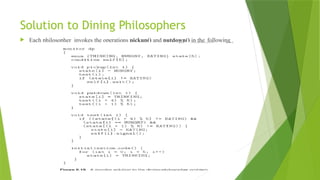
Solution to Dining Philosophers
 Each philosopher invokes the operations pickup() and putdown() in the following
DEADLOCK
Deadlock
 A process requests resources, if the resources are not available at that time, the process
enters a waiting state.
 Sometimes, a waiting process is never again able to change state, because the resources
it has requested are held by other waiting processes.
 This situation is called a Deadlock.
 System model
 A system may consist of finite number of resources and is distributed among number of
processes. There resources are partitioned into several instances each with identical
instances.
 A process must request a resource before using it and must release the resource after
using it.
 A process may request as many resources as it requires carrying out its designated task.
The number of resources requested may not exceed the total number of resources
available in the system.
Under the normal mode of operation, a process may utilize a resource in only the
following sequence:
1. Request: The process requests the resource. If the request cannot be granted
immediately, then the requesting process must wait until it can acquire the resource.
2. Use: The process can operate on the resource.
3. Release: The process releases the resource.
 A set of processes is in a deadlocked state when every process in the set is waiting for
an event that can be caused only by another process in the set.
 The events with which we are mainly concerned here are resource acquisition and
release.
 The resources may be either physical resources or logical resources
DEADLOCK CHARACTERIZATION
A deadlock situation can arise if the following four conditions hold simultaneously in a
system:
1. Mutual exclusion: At least one resource must be held in a non-sharable mode, that is,
only one process at a time can use the resource. If another process requests that
resource, the requesting process must be delayed until the resource has been released
2. Hold and wait: A process must be holding at least one resource and waiting to acquire
additional resources that are currently being held by other processes.
3. No preemption: Resources cannot be preempted; that is, a resource can be released
only voluntarily by the process holding it, after that process has completed its task.
4. Circular wait: A set {P0, Pl, ... , Pn} of waiting processes must exist such that Po is
waiting for a resource held by P1, P1 is waiting for a resource held by P2, ... , Pn-1 is
waiting for a resource held by Pn and Pn is waiting for a resource held by Po.
Resource-Allocation Graph
 Deadlocks can be described in terms of a directed graph called System Resource-
Allocation Graph
 The graph consists of a set of vertices V and a set of edges E.
 The set of vertices V is partitioned into two different types of nodes:
 P = {P1, P2, ...,Pn}, the set consisting of all the active processes in the system.
 R = {R1, R2, ..., Rm} the set consisting of all resource types in the system.
 A directed edge from process Pi to resource type Rj is denoted by Pi → Rj it
signifies that process Pi has requested an instance of resource type Rj and is
currently waiting for that resource.
 A directed edge from resource type Rj to process Pi is denoted by Rj → Pi it
signifies that an instance of resource type Rj has been allocated to process Pi.
 • A directed edge Pi → Rj is called a Request Edge.
 • A directed edge Rj → Pi is called an Assignment Edge.
 Pictorially each process Pi as a circle and each resource type Rj as a rectangle.
 Since resource type Rj may have more than one instance, each instance is represented
as a dot within the rectangle.
 A request edge points to only the rectangle Rj, whereas an assignment edge must also
designate one of the dots in the rectangle.
 When process Pi requests an instance of resource type Rj, a request edge is inserted in
the resource-allocation graph.
 When this request can be fulfilled, the request edge is instantaneously transformed to
an assignment edge.
 When the process no longer needs access to the resource, it releases the resource; as a
result, the assignment edge is deleted.
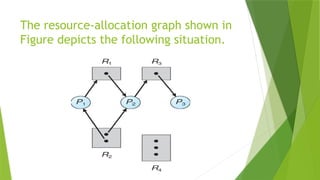
The resource-allocation graph shown in
Figure depicts the following situation.
 The sets P, K and E:
 P = {P1, P2, P3}
 R= {R1, R2, R3, R4}
 E = {Pl →Rl, P2 → R3, Rl → P2, R2 → P2, R2 → P1, R3 → P3 }
 Resource instances:
 One instance of resource type R1
 Two instances of resource type R2
 One instance of resource type R3
 Three instances of resource type R4
 Process states:
 Process P1 is holding an instance of resource type R2 and is waiting for an instance
of resource type R1.
 Process P2 is holding an instance of R1 and an instance of R2 and is
waiting for an instance of R3.
 Process P3 is holding an instance of R3.
 If the graph does contain a cycle, then a deadlock may exist.
 If each resource type has exactly one instance, then a cycle implies that a deadlock has
occurred.
 If the cycle involves only a set of resource types, each of which has only a single
instance, then a deadlock has occurred.
 Each process involved in the cycle is deadlocked.
 If each resource type has several instances, then a cycle does not necessarily imply that
a deadlock has occurred.
 In this case, a cycle in the graph is a necessary but not a sufficient condition for the
existence of deadlock.
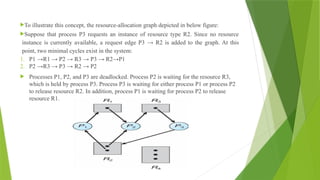
To illustrate this concept, the resource-allocation graph depicted in below figure:
Suppose that process P3 requests an instance of resource type R2. Since no resource
instance is currently available, a request edge P3 → R2 is added to the graph. At this
point, two minimal cycles exist in the system:
1. P1 →R1 → P2 → R3 → P3 → R2→P1
2. P2 →R3 → P3 → R2 → P2
 Processes P1, P2, and P3 are deadlocked. Process P2 is waiting for the resource R3,
which is held by process P3. Process P3 is waiting for either process P1 or process P2
to release resource R2. In addition, process P1 is waiting for process P2 to release
resource R1.
DEADLOACK PREVENTION
Deadlock can be prevented by ensuring that at least one of the four necessary conditions
cannot hold.
Mutual Exclusion
 The mutual-exclusion condition must hold for non-sharable resources. Sharable
resources, do not require mutually exclusive access and thus cannot be involved in a
deadlock.
 Ex: Read-only files are example of a sharable resource. If several processes attempt to
open a read-only file at the same time, they can be granted simultaneous access to the
file. A process never needs to wait for a sharable resource.
 Deadlocks cannot prevent by denying the mutual-exclusion condition, because some
resources are intrinsically non-sharable.
Hold and Wait
To ensure that the hold-and-wait condition never occurs in the system, then guarantee that,
whenever a process requests a resource, it does not hold any other resources.
 One protocol that can be used requires each process to request and be allocated all its resources
before it begins execution.
 Another protocol allows a process to request resources only when it has none. A process may
request some resources and use them. Before it can request any additional resources, it must
release all the resources that it is currently allocated.
Ex:
 Consider a process that copies data from a DVD drive to a file on disk, sorts the file, and then
prints the results to a printer. If all resources must be requested at the beginning of the process,
then the process must initially request the DVD drive, disk file, and printer. It will hold the
printer for its entire execution, even though it needs the printer only at the end.
 The second method allows the process to request initially only the DVD drive and disk file. It
copies from the DVD drive to the disk and then releases both the DVD drive and the disk file.
The process must then again request the disk file and the printer. After copying the disk file to
the printer, it releases these two resources and terminates.
No Preemption
The third necessary condition for deadlocks is that there be no preemption of resources that have
already been allocated.
To ensure that this condition does not hold, the following protocols can be used:
 If a process is holding some resources and requests another resource that cannot be
immediately allocated to it, then all resources the process is currently holding are preempted.
 The preempted resources are added to the list of resources for which the process is waiting.
The process will be restarted only when it can regain its old resources, as well as the new
ones that it is requesting.
If a process requests some resources, first check whether they are available. If they are, allocate
them.
If they are not available, check whether they are allocated to some other process that is waiting for
additional resources. If so, preempt the desired resources from the waiting process and allocate them
to the requesting process.
If the resources are neither available nor held by a waiting process, the requesting process must wait.
While it is waiting, some of its resources may be preempted, but only if another process requests
them.
A process can be restarted only when it is allocated the new resources it is requesting and recovers
any resources that were preempted while it was waiting.
Circular Wait
One way to ensure that this condition never holds is to impose a total ordering of all resource types
and to require that each process requests resources in an increasing order of enumeration.
To illustrate, let R = {R1, R2, ... , Rm} be the set of resource types. Assign a unique integer number
to each resource type, which allows to compare two resources and to determine whether one precedes
another in ordering. Formally, it defined as a one-to-one function
F: R ->N, where N is the set of natural numbers.
Example: if the set of resource types R includes tape drives, disk drives, and printers, then the
function F might be defined as follows:
 F (tape drive) = 1
 F (disk drive) = 5
 F (printer) = 12
Now consider the following protocol to prevent deadlocks. Each process can request resources only
in an increasing order of enumeration. That is, a process can initially request any number of instances
of a resource type -Ri. After that, the process can request instances of resource type Rj if and only if
F(Rj) > F(Ri).
METHODS FOR HANDLING DEADLOCKS
 We can deal with the deadlock problem in one of three ways:
1. We can use a protocol to prevent or avoid deadlocks, ensuring that the system will never enter a
deadlocked state.
2. We can allow the system to enter a deadlocked state, detect it, and recover.
3. We can ignore the problem altogether and pretend that deadlocks never occur in the system.
To ensure that deadlocks never occur, the system can use either deadlock prevention or a deadlock-
avoidance scheme.
Deadlock prevention provides a set of methods for ensuring that at least one of the necessary
conditions cannot hold. These methods prevent deadlocks by constraining how requests for resources
can be made.
 Deadlock-avoidance requires that the operating system be given in advance additional information
concerning which resources a process will request and use during its lifetime.
 With this additional knowledge, it can decide for each request whether or not the process should
wait.
 To decide whether the current request can be satisfied or must be delayed, the system must consider
the resources currently available, the resources currently allocated to each process, and the future
requests and releases of each process
If a system does not employ either a deadlock-prevention or a deadlock avoidance
algorithm, then a deadlock situation may arise.
In this environment, the system can provide an algorithm that examines the state of the
system to determine whether a deadlock has occurred and an algorithm to recover from
the deadlock.
In the absence of algorithms to detect and recover from deadlocks, then the system is in
a deadlock state yet has no way of recognizing what has happened.
 In this case, the undetected deadlock will result in deterioration of the system's
performance, because resources are being held by processes that cannot run and because
more and more processes, as they make requests for resources, will enter a deadlocked
state.
Eventually, the system will stop functioning and will need to be restarted manually.
DEADLOCK AVOIDANCE
 To avoid deadlocks an additional information is required about how resources are to be
requested.
 With the knowledge of the complete sequence of requests and releases for each process,
the system can decide for each request whether or not the process should wait in order to
avoid a possible future deadlock
 Each request requires that in making this decision the system consider the resources
currently available, the resources currently allocated to each process, and the future
requests and releases of each process.
 The various algorithms that use this approach differ in the amount and type of information
required.
 The simplest model requires that each process declare the maximum number of resources
of each type that it may need.
 Given this a priori information, it is possible to construct an algorithm that ensures that the
system will never enter a deadlocked state. Such an algorithm defines the deadlock-
avoidance approach.
Safe State
 Safe state: A state is safe if the system can allocate resources to each process (up to its
maximum) in some order and still avoid a deadlock. A system is in a safe state only if there
exists a safe sequence.
 Safe sequence: A sequence of processes <P1, P2, ... , Pn> is a safe sequence for the current
allocation state if, for each Pi, the resource requests that Pi can still make can be satisfied by
the currently available resources plus the resources held by all Pj, with j <i.
In this situation, if the resources that Pi needs are not immediately available, then Pi can wait until all
Pj have finished.
When they have finished, Pi can obtain all of its needed resources, complete its designated task, return
its allocated resources, and terminate.
When Pi terminates, Pi+1 can obtain its needed resources, and so on. If no such sequence exists, then
the system state is said to be unsafe.
A safe state is not a deadlocked state.
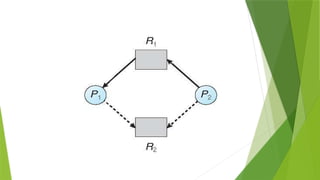
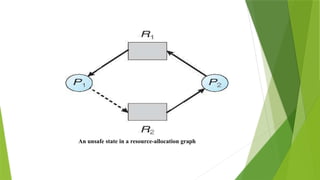
Conversely, a deadlocked state is an unsafe state. Not all unsafe states are deadlocks as shown in
figure.
An unsafe state may lead to a deadlock.
As long as the state is safe, the operating system can avoid unsafe states
Resource-Allocation-Graph Algorithm
 If a resource-allocation system has only one instance of each resource type,
then a variant of the resource-allocation graph is used for deadlock
avoidance.
 In addition to the request and assignment edges, a new type of edge is introduced,
called a claim edge.
 A claim edge Pi ->Rj indicates that process Pi may request resource Rj at some
time in the future. This edge resembles a request edge in direction but is
represented in the graph by a dashed line.
 When process Pi requests resource Rj, the claim edge Pi ->Rj is converted to a
request edge.
 When a resource Rj is released by Pi the assignment edge Rj->Pi is reconverted
to a claim edge Pi->Rj.
Note that the resources must be claimed a priori in the system.
That is, before process Pi starts executing, all its claim edges must already appear in the
resource-allocation graph.
We can relax this condition by allowing a claim edge Pi ->Rj to be added to the graph
only if all the edges associated with process Pi are claim edges.
 Now suppose that process Pi requests resource Rj. The request can be granted only if
converting the request edge Pi ->Rj to an assignment edge Rj->Pi does not result in the
formation of a cycle in the resource-allocation graph.
There is need to check for safety by using a cycle-detection algorithm.
An algorithm for detecting a cycle in this graph requires an order of n2
operations, where
n is the number of processes in the system.
 If no cycle exists, then the allocation of the resource will leave the system in a
safe state.
 If a cycle is found, then the allocation will put the system in an unsafe state. In
that case, process Pi will have to wait for its requests to be satisfied.
An unsafe state in a resource-allocation graph
Banker's Algorithm
The Banker’s algorithm is applicable to a resource allocation
system with multiple instances of each resource type.
 When a new process enters the system, it must declare the
maximum number of instances of each resource type that it
may need. This number may not exceed the total number of
resources in the system.
 When a user requests a set of resources, the system must
determine whether the allocation of these resources will leave
the system in a safe state. If it will, the resources are
allocated; otherwise, the process must wait until some other
process releases enough resources.
To implement the banker's algorithm the following data structures are used.
Let n = number of processes, and m = number of resources types
Available: A vector of length m indicates the number of available resources of each type.
If available [j] = k, there are k instances of resource type Rj available.
Max: An n x m matrix defines the maximum demand of each process. If Max [i,j] = k,
then process Pi may request at most k instances of resource type Rj
Allocation: An n x m matrix defines the number of resources of each type currently
allocated to each process. If Allocation[i,j] = k then Pi is currently allocated k instances of
Rj
Need: An n x m matrix indicates the remaining resource need of each process. If
Need[i,j] = k, then Pi may need k more instances of Rj to complete its task.
 Need [i,j] = Max[i,j] – Allocation [i,j]
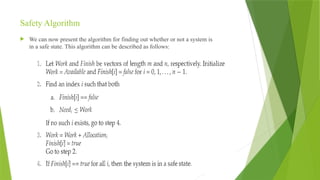
Safety Algorithm
 We can now present the algorithm for finding out whether or not a system is
in a safe state. This algorithm can be described as follows:
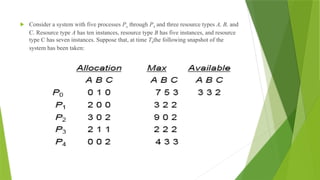
 Consider a system with five processes Po through P4 and three resource types A, B, and
C. Resource type A has ten instances, resource type B has five instances, and resource
type C has seven instances. Suppose that, at time T0the following snapshot of the
system has been taken:
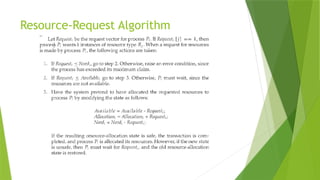
Resource-Request Algorithm
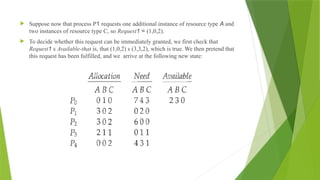
 Suppose now that process P1 requests one additional instance of resource type A and
two instances of resource type C, so Request1 = (1,0,2).
 To decide whether this request can be immediately granted, we first check that
Request1 s Available-that is, that (1,0,2) s (3,3,2), which is true. We then pretend that
this request has been fulfilled, and we arrive at the following new state:
DEADLOCK DETECTION
If a system does not employ either a deadlock-prevention or a deadlock avoidance
algorithm, then a deadlock situation may occur. In this environment, the system may
provide:
 An algorithm that examines the state of the system to determine whether a deadlock
has occurred
 An algorithm to recover from the deadlock
 Single Instance of Each Resource Type
 If all resources have only a single instance, then define a deadlock detection algorithm
that uses a variant of the resource-allocation graph, called a wait-for graph.
 This graph is obtained from the resource-allocation graph by removing the resource
nodes and collapsing the appropriate edges.
 An edge from Pi to Pj in a wait-for graph implies that process Pi is waiting for process
Pj to release a resource that Pi needs. An edge Pi → Pj exists in a wait-for graph if and
only if the corresponding resource allocation graph contains two edges Pi →Rq and
Rq→Pi for some resource Rq.
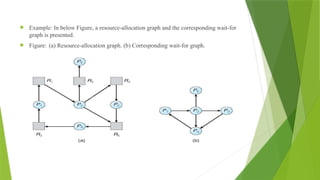
 Example: In below Figure, a resource-allocation graph and the corresponding wait-for
graph is presented.
 Figure: (a) Resource-allocation graph. (b) Corresponding wait-for graph.
Several Instances of a Resource Type
A deadlock detection algorithm that is applicable to several instances of a
resource type. The algorithm employs several time-varying data structures that
are similar to those used in the banker's algorithm.
 Available: A vector of length m indicates the number of available resources
of each type.
 Allocation: Ann x m matrix defines the number of resources of each type
currently allocated to each process.
 Request: An n x m matrix indicates the current request of each process. If
Request[i][j]equals k, then process P; is requesting k more instances of
resource type Rj.
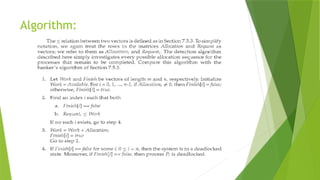
Algorithm:
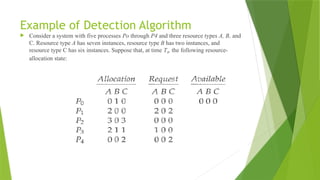
Example of Detection Algorithm
 Consider a system with five processes Po through P4 and three resource types A, B, and
C. Resource type A has seven instances, resource type B has two instances, and
resource type C has six instances. Suppose that, at time T0, the following resource-
allocation state:
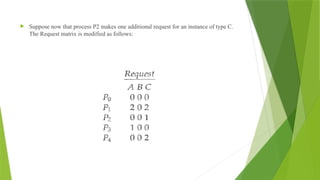
 Suppose now that process P2 makes one additional request for an instance of type C.
The Request matrix is modified as follows:
Detection-Algorithm Usage
The detection algorithm can be invoked on two factors:
1. How often is a deadlock likely to occur?
2. How many processes will be affected by deadlock when it happens?
If deadlocks occur frequently, then the detection algorithm should be invoked frequently.
Resources allocated to deadlocked processes will be idle until the deadlock can be
broken.
If detection algorithm is invoked arbitrarily, there may be many cycles in the resource
graph and so we would not be able to tell which of the many deadlocked processes
“caused” the deadlock.
RECOVERY FROM DEADLOCK
The system recovers from the deadlock automatically. There are two options for breaking
a deadlock one is simply to abort one or more processes to break the circular wait. The
other is to preempt some resources from one or more of the deadlocked processes.
Process Termination
To eliminate deadlocks by aborting a process, use one of two methods. In both methods,
the system reclaims all resources allocated to the terminated processes.
1. Abort all deadlocked processes: This method clearly will break the deadlock cycle,
but at great expense; the deadlocked processes may have computed for a long time,
and the results of these partial computations must be discarded and probably will have
to be recomputed later.
2. Abort one process at a time until the deadlock cycle is eliminated: This method
incurs considerable overhead, since after each process is aborted, a deadlock-
detection algorithm must be invoked to determine whether any processes are still
deadlocked.
Resource Pre-emption
 Selecting a victim. Which resources and which processes are to be preempted? As in
process termination, we must determine the order of preemption to minimize cost. Cost
factors may include such parameters as the number of resources a deadlocked process
is holding and the amount of time the process has thus far consumed during its
execution.
 Rollback. If we preempt a resource from a process, what should be done with that
process? Clearly, it cannot continue with its normal execution; it is missing some
needed resource. We must roll back the process to some safe state and restart it from
that state.
 Since, in general, it is difficult to determine what a safe state is, the simplest solution is a total
rollback: abort the process and then restart it. Although it is more effective to roll back the
process only as far as necessary to break the deadlock, this method requires the system to
keep more information about the state of all running processes.
 Starvation. How do we ensure that starvation will not occur? That is, how can we
guarantee that resources will not always be preempted from the same process?

operating system notes about deadlock 3.pptx

  • 1.
  • 2.
    RACE CONDITION  Imaginea bank account shared between two processes: one process handles deposits, and the other handles withdrawals. The balance is stored in a variable balance.  Process A wants to deposit $100 into the account. It reads the current balance, which is $500. It then adds $100 to the balance and updates it to $600.  Meanwhile, Process B wants to withdraw $50 from the same account. It reads the current balance, which is still $500 (since Process A hasn't finished updating yet). It subtracts $50 from the balance and updates it to $450.  Now, Process A completes its update, setting the balance to $600. However, it doesn't know that Process B has already read the old balance and subtracted $50 from it. So, the final balance is incorrect. It should be $550 ($500 + $100 - $50), but due to the race condition, it's $600.  This is a classic example of a race condition. The outcome of the program depends on the timing of events (the interleaving of instructions between Process A and Process B), leading to incorrect behavior. In this case, the incorrect behavior arises from concurrent access to shared resources (the balance variable) without proper synchronization.
  • 3.
    The code forthe producer process can be modified as follows:
  • 4.
    The code forthe consumer process can be modified as follows:
  • 5.
    Illustration:  Suppose thatthe value of the variable counter is currently 5 and that the producer and consumer processes execute the statements "counter++" and "counter--" concurrently.  The value of the variable counter may be 4, 5, or 6 but the only correct result is counter == 5, which is generated correctly if the producer and consumer execute separately.
  • 6.
     The concurrentexecution of "counter++" and "counter--" is equivalent to a sequential execution in which the lower-level statements presented previously are interleaved in some arbitrary order. One such interleaving is  Consider this execution interleaving with “count = 5” initially: S0: producer execute register1=counter {register1 = 5} S1: producer execute register1 = register1+1 {register1 = 6} S2: consumer execute register2=counter {register2 = 5} S3: consumer execute register2 = register2-1 {register2 = 4} S4: producer execute counter=register1 {count =6} S5: consumer execute counter=register2 {count =4}  Note: It is arrived at the incorrect state "counter == 4", indicating that four buffers are full, when, in fact, five buffers are full. If we reversed the order of the statements at T4 and T5, we would arrive at the incorrect state "counter==6".
  • 7.
     We wouldarrive at this incorrect state because we allowed both processes to manipulate the variable counter concurrently.  A situation like this, where several processes access and manipulate the same data concurrently and the outcome of the execution depends on the particular order in which the access takes place, is called a Race Condition.  To guard against the race condition above, we need to ensure that only one process at a time can be manipulating the variable counter.  To make such a guarantee, we require that the processes be synchronized in some way.
  • 8.
    The Critical SectionProblems  Consider a system consisting of n processes {Po, P1 , ... ,Pn-1}.  Each process has a segment of code, called a critical section in which the process may be changing common variables, updating a table, writing a file, and soon  The important feature of the system is that, when one process is executing in its critical section, no other process is to be allowed to execute in its critical section.  That is, no two processes are executing in their critical sections at the same time.  The critical-section problem is to design a protocol that the processes can use to cooperate.
  • 9.
     The generalstructure of a typical process Pi is shown in below figure  Each process must request permission to enter its critical section.  The section of code implementing this request is the entry section.  The critical section may be followed by an exit section.  The remaining code is the reminder section.
  • 10.
     A solutionto the critical-section problem must satisfy the following three requirements: 1. Mutual exclusion: If process Pi is executing in its critical section, then no other processes can be executing in their critical sections. 2. Progress: If no process is executing in its critical section and some processes wish to enter their critical sections, then only those processes that are not executing in their remainder sections can participate in deciding which will enter its critical section next, and this selection cannot be postponed indefinitely. 3. Bounded waiting: There exists a bound, or limit, on the number of times that other processes are allowed to enter their critical sections after a process has made a request to enter its critical section and before that request is granted.
  • 11.
    PETERSON'S SOLUTION  Thisis a classic software-based solution to the critical-section problem.  Peterson's solution provides a good algorithmic description of solving the critical- section problem and illustrates some of the complexities involved in designing software that addresses the requirements of mutual exclusion, progress, and bounded waiting.  Peterson's solution is restricted to two processes that alternate execution between their critical sections and remainder sections.  The processes are numbered Po and P1 or Pi and Pj where j = 1-i  Peterson's solution requires the two processes to share two data items:  int turn;  boolean flag[2];  turn: The variable turn indicates whose turn it is to enter its critical section.  Ex: if turn == i, then process Pi is allowed to execute in its critical section  flag: The flag array is used to indicate if a process is ready to enter its critical section.  Ex: if flag [i] is true, this value indicates that Pi is ready to enter its critical section.
  • 13.
    bool flag[2] ={false, false}; int turn;  P0: flag[0] = true;  P0_gate: turn = 1;  while (flag[1] && turn == 1)  {  // busy wait  }  // critical section  ...  // end of critical section  flag[0] = false;  P1: flag[1] = true;  P1_gate: turn = 0;  while (flag[0] && turn == 0)  {  // busy wait  }  // critical section  ...  // end of critical section  flag[1] = false;
  • 14.
    1. To proveMutual exclusion  Each pi enters its critical section only if either flag [j] == false or turn ==i.  If both processes can be executing in their critical sections at the same time, then flag [0] == flag [1]==true.  These two observations imply that Pi and Pj could not have successfully executed their while statements at about the same time, since the value of turn can be either 0 or 1 but cannot be both.  Hence, one of the processes (Pj) must have successfully executed the while statement, whereas Pi had to execute at least one additional statement ("turn==j").  However, at that time, flag [j] == true and turn == j, and this condition will persist as long as Pi is in its critical section, as a result, mutual exclusion is preserved.
  • 15.
    Progress & boundedwaiting  To prove properties 2 and 3, we note that a process Pi can be prevented from entering the critical section only if it is stuck in the while loop with the condition flag [j] ==true and turn=== j; this loop is the only one possible.  If Pj is not ready to enter the critical section, then flag [j] ==false, and Pi can enter its critical section.  If Pj has set flag [j] to true and is also executing in its while statement, then either turn === i or turn === j.  If turn == i, then Pi will enter the critical section.  If turn== j, then Pj will enter the critical section.  However, once Pj exits its critical section, it will reset flag [j] to false, allowing Pi to enter its critical section.  If Pj resets flag [j] to true, it must also set turn to i.  Thus, since Pi does not change the value of the variable turn while executing the while statement, Pi will enter the critical section (progress) after at most one entry by Pj(bounded waiting).
  • 16.
    SYNCHRONIZATION HARDWARE  Wehave just described one software-based solution to the critical-section problem.  However, as mentioned, software-based solutions such as Peterson’s are not guaranteed to work on modern computer architectures.  Instead, we can generally state that any solution to the critical-section problem requires a simple tool-a lock.  Race conditions are prevented by requiring that critical regions be protected by locks.  That is, a process must acquire a lock before entering a critical section; it releases the lock when it exits the critical section.
  • 17.
    Test And Set( )  The Test And Set () instruction can be defined as shown in Figure. The important characteristic of this instruction is that it is executed atomically.
  • 18.
     Below algorithmusing the TestAndSet () instruction that satisfies all the critical- section requirements. The common data structures are  boolean waiting[n];  boolean lock;  These data structures are initialized to false.
  • 20.
    Swap()  The Swap()instruction, operates on the contents of two words, it is defined as shown below
  • 21.
    SEMAPHORE  A semaphoreis a synchronization tool is used solve various synchronization problem and can be implemented efficiently.  Semaphore do not require busy waiting.  A semaphore S is an integer variable that, is accessed only through two standard atomic operations: wait () and signal (). The wait () operation was originally termed P and signal() was called V.  The definition of wait () is as follows:
  • 22.
     The definitionof signal() is as follows:  Implementation
  • 23.
    Binary semaphore  Thevalue of a binary semaphore can range only between 0 and1.  Binary semaphores are known as mutex locks, as they are locks that provide mutual exclusion.  Binary semaphores to deal with the critical-section problem for multiple processes. Then processes share a semaphore, mutex, initialized to1  Counting semaphore  The value of a counting semaphore can range over an unrestricted domain.  Counting semaphores can be used to control access to a given resource consisting of a finite number of instances.  The semaphore is initialized to the number of resources available. Each process that wishes to use a resource performs a wait() operation on the semaphore. When a process releases a resource, it performs a signal()operation.  When the count for the semaphore goes to 0, all resources are being used. After that, processes that wish to use a resource will block until the count becomes greater than 0.
  • 24.
    Deadlocks and Starvation The implementation of a semaphore with a waiting queue may result in a situation where two or more processes are waiting indefinitely for an event that can be caused only by one of the waiting processes.  The event in question is the execution of a signal( ) operation.  When such a state is reached, these processes are said to be deadlocked.  To illustrate this, consider a system consisting of two processes, Po and P1, each accessing two semaphores, S and Q, set to the value 1
  • 25.
    CLASSICAL PROBLEMS OF SYNCHRONIZATION Bounded-Buffer Problem  Readers and Writers Problem  Dining-Philosophers Problem
  • 26.
    Bounded-Buffer Problem  Nbuffers, each can hold one item  Semaphore mutex initialized to the value 1  Semaphore full initialized to the value 0  Semaphore empty initialized to the value N.
  • 27.
    Readers-Writers Problem  Adata set is shared among a number of concurrent processes  Readers – only read the data set; they do not perform any updates  Writers – can both read and write.  Problem – allow multiple readers to read at the same time.  Only one single writer can access the shared data at the same time.  Semaphore mutex initialized to 1.  Semaphore wrt initialized to1.  Integer readcount initialized to 0.
  • 29.
    Dining-Philosophers Problem  Considerfive philosophers who spend their lives thinking and eating.  The philosophers share a circular table surrounded by five chairs, each belonging to one philosopher.  In the center of the table is a bowl of rice, and the table is laid with five single chopsticks.
  • 30.
     A philosophergets hungry and tries to pick up the two chopsticks that are closest to her (the chopsticks that are between her and her left and right neighbors).  A philosopher may pick up only one chopstick at a time.  When a hungry philosopher has both her chopsticks at the same time, she eats without releasing the chopsticks.  When she is finished eating, she puts down both chopsticks and starts thinking again.  It is a simple representation of the need to allocate several resources among several processes in a deadlock-free and starvation-free manner.
  • 31.
     Solution:One simplesolution is to represent each chopstick with a semaphore.  A philosopher tries to grab a chopstick by executing a wait() operation on that semaphore.  She releases her chopsticks by executing the signal() operation on the appropriate semaphores.  Thus, the shared data are semaphore chopstick[5];  where all the elements of chopstick are initialized to 1. The structure of philosopher i is shown
  • 32.
    Several possible remediesto the deadlock problem are replaced by:  Allow at most four philosophers to be sitting simultaneously at the table.  Allow a philosopher to pickup her chopsticks only if both chopsticks are available.  Use an asymmetric solution—that is, an odd-numbered philosopher picks up first her left chopstick and then her right chopstick,  whereas an even numbered philosopher picks up her right chopstick and then her left chopstick.
  • 33.
    Monitor  An abstractdata type—or ADT—encapsulates data with a set of functions to operate on that data that are independent of any specific implementation of the ADT.  A monitor type is an ADT that includes a set of programmer defined operations that are provided with mutual exclusion within the monitor.  The monitor type also declares the variables whose values define the state of an instance of that type, along with the bodies of functions that operate on those variables.  The monitor construct ensures that only one process at a time is active within the monitor.
  • 35.
     To havea powerful Synchronization schemes a condition construct is added to the Monitor.  So synchronization scheme can be defined with one or more variables of type condition Two operations on a condition variable:  Condition x, y  The only operations that can be invoked on a condition variable are wait() and signal().  The operation  x.wait () – a process that invokes the operation is suspended.  x.signal () – resumes one of processes (if any) that invoked x.wait ()
  • 36.
    Solution to DiningPhilosophers  Each philosopher invokes the operations pickup() and putdown() in the following
  • 37.
  • 38.
    Deadlock  A processrequests resources, if the resources are not available at that time, the process enters a waiting state.  Sometimes, a waiting process is never again able to change state, because the resources it has requested are held by other waiting processes.  This situation is called a Deadlock.  System model  A system may consist of finite number of resources and is distributed among number of processes. There resources are partitioned into several instances each with identical instances.  A process must request a resource before using it and must release the resource after using it.  A process may request as many resources as it requires carrying out its designated task. The number of resources requested may not exceed the total number of resources available in the system.
  • 39.
    Under the normalmode of operation, a process may utilize a resource in only the following sequence: 1. Request: The process requests the resource. If the request cannot be granted immediately, then the requesting process must wait until it can acquire the resource. 2. Use: The process can operate on the resource. 3. Release: The process releases the resource.  A set of processes is in a deadlocked state when every process in the set is waiting for an event that can be caused only by another process in the set.  The events with which we are mainly concerned here are resource acquisition and release.  The resources may be either physical resources or logical resources
  • 40.
    DEADLOCK CHARACTERIZATION A deadlocksituation can arise if the following four conditions hold simultaneously in a system: 1. Mutual exclusion: At least one resource must be held in a non-sharable mode, that is, only one process at a time can use the resource. If another process requests that resource, the requesting process must be delayed until the resource has been released 2. Hold and wait: A process must be holding at least one resource and waiting to acquire additional resources that are currently being held by other processes. 3. No preemption: Resources cannot be preempted; that is, a resource can be released only voluntarily by the process holding it, after that process has completed its task. 4. Circular wait: A set {P0, Pl, ... , Pn} of waiting processes must exist such that Po is waiting for a resource held by P1, P1 is waiting for a resource held by P2, ... , Pn-1 is waiting for a resource held by Pn and Pn is waiting for a resource held by Po.
  • 41.
    Resource-Allocation Graph  Deadlockscan be described in terms of a directed graph called System Resource- Allocation Graph  The graph consists of a set of vertices V and a set of edges E.  The set of vertices V is partitioned into two different types of nodes:  P = {P1, P2, ...,Pn}, the set consisting of all the active processes in the system.  R = {R1, R2, ..., Rm} the set consisting of all resource types in the system.  A directed edge from process Pi to resource type Rj is denoted by Pi → Rj it signifies that process Pi has requested an instance of resource type Rj and is currently waiting for that resource.  A directed edge from resource type Rj to process Pi is denoted by Rj → Pi it signifies that an instance of resource type Rj has been allocated to process Pi.  • A directed edge Pi → Rj is called a Request Edge.  • A directed edge Rj → Pi is called an Assignment Edge.
  • 42.
     Pictorially eachprocess Pi as a circle and each resource type Rj as a rectangle.  Since resource type Rj may have more than one instance, each instance is represented as a dot within the rectangle.  A request edge points to only the rectangle Rj, whereas an assignment edge must also designate one of the dots in the rectangle.  When process Pi requests an instance of resource type Rj, a request edge is inserted in the resource-allocation graph.  When this request can be fulfilled, the request edge is instantaneously transformed to an assignment edge.  When the process no longer needs access to the resource, it releases the resource; as a result, the assignment edge is deleted.
  • 43.
    The resource-allocation graphshown in Figure depicts the following situation.
  • 44.
     The setsP, K and E:  P = {P1, P2, P3}  R= {R1, R2, R3, R4}  E = {Pl →Rl, P2 → R3, Rl → P2, R2 → P2, R2 → P1, R3 → P3 }  Resource instances:  One instance of resource type R1  Two instances of resource type R2  One instance of resource type R3  Three instances of resource type R4  Process states:  Process P1 is holding an instance of resource type R2 and is waiting for an instance of resource type R1.  Process P2 is holding an instance of R1 and an instance of R2 and is waiting for an instance of R3.  Process P3 is holding an instance of R3.
  • 45.
     If thegraph does contain a cycle, then a deadlock may exist.  If each resource type has exactly one instance, then a cycle implies that a deadlock has occurred.  If the cycle involves only a set of resource types, each of which has only a single instance, then a deadlock has occurred.  Each process involved in the cycle is deadlocked.  If each resource type has several instances, then a cycle does not necessarily imply that a deadlock has occurred.  In this case, a cycle in the graph is a necessary but not a sufficient condition for the existence of deadlock.
  • 46.
    To illustrate thisconcept, the resource-allocation graph depicted in below figure: Suppose that process P3 requests an instance of resource type R2. Since no resource instance is currently available, a request edge P3 → R2 is added to the graph. At this point, two minimal cycles exist in the system: 1. P1 →R1 → P2 → R3 → P3 → R2→P1 2. P2 →R3 → P3 → R2 → P2  Processes P1, P2, and P3 are deadlocked. Process P2 is waiting for the resource R3, which is held by process P3. Process P3 is waiting for either process P1 or process P2 to release resource R2. In addition, process P1 is waiting for process P2 to release resource R1.
  • 47.
    DEADLOACK PREVENTION Deadlock canbe prevented by ensuring that at least one of the four necessary conditions cannot hold. Mutual Exclusion  The mutual-exclusion condition must hold for non-sharable resources. Sharable resources, do not require mutually exclusive access and thus cannot be involved in a deadlock.  Ex: Read-only files are example of a sharable resource. If several processes attempt to open a read-only file at the same time, they can be granted simultaneous access to the file. A process never needs to wait for a sharable resource.  Deadlocks cannot prevent by denying the mutual-exclusion condition, because some resources are intrinsically non-sharable.
  • 48.
    Hold and Wait Toensure that the hold-and-wait condition never occurs in the system, then guarantee that, whenever a process requests a resource, it does not hold any other resources.  One protocol that can be used requires each process to request and be allocated all its resources before it begins execution.  Another protocol allows a process to request resources only when it has none. A process may request some resources and use them. Before it can request any additional resources, it must release all the resources that it is currently allocated. Ex:  Consider a process that copies data from a DVD drive to a file on disk, sorts the file, and then prints the results to a printer. If all resources must be requested at the beginning of the process, then the process must initially request the DVD drive, disk file, and printer. It will hold the printer for its entire execution, even though it needs the printer only at the end.  The second method allows the process to request initially only the DVD drive and disk file. It copies from the DVD drive to the disk and then releases both the DVD drive and the disk file. The process must then again request the disk file and the printer. After copying the disk file to the printer, it releases these two resources and terminates.
  • 49.
    No Preemption The thirdnecessary condition for deadlocks is that there be no preemption of resources that have already been allocated. To ensure that this condition does not hold, the following protocols can be used:  If a process is holding some resources and requests another resource that cannot be immediately allocated to it, then all resources the process is currently holding are preempted.  The preempted resources are added to the list of resources for which the process is waiting. The process will be restarted only when it can regain its old resources, as well as the new ones that it is requesting. If a process requests some resources, first check whether they are available. If they are, allocate them. If they are not available, check whether they are allocated to some other process that is waiting for additional resources. If so, preempt the desired resources from the waiting process and allocate them to the requesting process. If the resources are neither available nor held by a waiting process, the requesting process must wait. While it is waiting, some of its resources may be preempted, but only if another process requests them. A process can be restarted only when it is allocated the new resources it is requesting and recovers any resources that were preempted while it was waiting.
  • 50.
    Circular Wait One wayto ensure that this condition never holds is to impose a total ordering of all resource types and to require that each process requests resources in an increasing order of enumeration. To illustrate, let R = {R1, R2, ... , Rm} be the set of resource types. Assign a unique integer number to each resource type, which allows to compare two resources and to determine whether one precedes another in ordering. Formally, it defined as a one-to-one function F: R ->N, where N is the set of natural numbers. Example: if the set of resource types R includes tape drives, disk drives, and printers, then the function F might be defined as follows:  F (tape drive) = 1  F (disk drive) = 5  F (printer) = 12 Now consider the following protocol to prevent deadlocks. Each process can request resources only in an increasing order of enumeration. That is, a process can initially request any number of instances of a resource type -Ri. After that, the process can request instances of resource type Rj if and only if F(Rj) > F(Ri).
  • 51.
    METHODS FOR HANDLINGDEADLOCKS  We can deal with the deadlock problem in one of three ways: 1. We can use a protocol to prevent or avoid deadlocks, ensuring that the system will never enter a deadlocked state. 2. We can allow the system to enter a deadlocked state, detect it, and recover. 3. We can ignore the problem altogether and pretend that deadlocks never occur in the system. To ensure that deadlocks never occur, the system can use either deadlock prevention or a deadlock- avoidance scheme. Deadlock prevention provides a set of methods for ensuring that at least one of the necessary conditions cannot hold. These methods prevent deadlocks by constraining how requests for resources can be made.  Deadlock-avoidance requires that the operating system be given in advance additional information concerning which resources a process will request and use during its lifetime.  With this additional knowledge, it can decide for each request whether or not the process should wait.  To decide whether the current request can be satisfied or must be delayed, the system must consider the resources currently available, the resources currently allocated to each process, and the future requests and releases of each process
  • 52.
    If a systemdoes not employ either a deadlock-prevention or a deadlock avoidance algorithm, then a deadlock situation may arise. In this environment, the system can provide an algorithm that examines the state of the system to determine whether a deadlock has occurred and an algorithm to recover from the deadlock. In the absence of algorithms to detect and recover from deadlocks, then the system is in a deadlock state yet has no way of recognizing what has happened.  In this case, the undetected deadlock will result in deterioration of the system's performance, because resources are being held by processes that cannot run and because more and more processes, as they make requests for resources, will enter a deadlocked state. Eventually, the system will stop functioning and will need to be restarted manually.
  • 53.
    DEADLOCK AVOIDANCE  Toavoid deadlocks an additional information is required about how resources are to be requested.  With the knowledge of the complete sequence of requests and releases for each process, the system can decide for each request whether or not the process should wait in order to avoid a possible future deadlock  Each request requires that in making this decision the system consider the resources currently available, the resources currently allocated to each process, and the future requests and releases of each process.  The various algorithms that use this approach differ in the amount and type of information required.  The simplest model requires that each process declare the maximum number of resources of each type that it may need.  Given this a priori information, it is possible to construct an algorithm that ensures that the system will never enter a deadlocked state. Such an algorithm defines the deadlock- avoidance approach.
  • 54.
    Safe State  Safestate: A state is safe if the system can allocate resources to each process (up to its maximum) in some order and still avoid a deadlock. A system is in a safe state only if there exists a safe sequence.  Safe sequence: A sequence of processes <P1, P2, ... , Pn> is a safe sequence for the current allocation state if, for each Pi, the resource requests that Pi can still make can be satisfied by the currently available resources plus the resources held by all Pj, with j <i. In this situation, if the resources that Pi needs are not immediately available, then Pi can wait until all Pj have finished. When they have finished, Pi can obtain all of its needed resources, complete its designated task, return its allocated resources, and terminate. When Pi terminates, Pi+1 can obtain its needed resources, and so on. If no such sequence exists, then the system state is said to be unsafe. A safe state is not a deadlocked state. Conversely, a deadlocked state is an unsafe state. Not all unsafe states are deadlocks as shown in figure. An unsafe state may lead to a deadlock. As long as the state is safe, the operating system can avoid unsafe states
  • 55.
    Resource-Allocation-Graph Algorithm  Ifa resource-allocation system has only one instance of each resource type, then a variant of the resource-allocation graph is used for deadlock avoidance.  In addition to the request and assignment edges, a new type of edge is introduced, called a claim edge.  A claim edge Pi ->Rj indicates that process Pi may request resource Rj at some time in the future. This edge resembles a request edge in direction but is represented in the graph by a dashed line.  When process Pi requests resource Rj, the claim edge Pi ->Rj is converted to a request edge.  When a resource Rj is released by Pi the assignment edge Rj->Pi is reconverted to a claim edge Pi->Rj.
  • 57.
    Note that theresources must be claimed a priori in the system. That is, before process Pi starts executing, all its claim edges must already appear in the resource-allocation graph. We can relax this condition by allowing a claim edge Pi ->Rj to be added to the graph only if all the edges associated with process Pi are claim edges.  Now suppose that process Pi requests resource Rj. The request can be granted only if converting the request edge Pi ->Rj to an assignment edge Rj->Pi does not result in the formation of a cycle in the resource-allocation graph. There is need to check for safety by using a cycle-detection algorithm. An algorithm for detecting a cycle in this graph requires an order of n2 operations, where n is the number of processes in the system.  If no cycle exists, then the allocation of the resource will leave the system in a safe state.  If a cycle is found, then the allocation will put the system in an unsafe state. In that case, process Pi will have to wait for its requests to be satisfied.
  • 58.
    An unsafe statein a resource-allocation graph
  • 59.
    Banker's Algorithm The Banker’salgorithm is applicable to a resource allocation system with multiple instances of each resource type.  When a new process enters the system, it must declare the maximum number of instances of each resource type that it may need. This number may not exceed the total number of resources in the system.  When a user requests a set of resources, the system must determine whether the allocation of these resources will leave the system in a safe state. If it will, the resources are allocated; otherwise, the process must wait until some other process releases enough resources.
  • 60.
    To implement thebanker's algorithm the following data structures are used. Let n = number of processes, and m = number of resources types Available: A vector of length m indicates the number of available resources of each type. If available [j] = k, there are k instances of resource type Rj available. Max: An n x m matrix defines the maximum demand of each process. If Max [i,j] = k, then process Pi may request at most k instances of resource type Rj Allocation: An n x m matrix defines the number of resources of each type currently allocated to each process. If Allocation[i,j] = k then Pi is currently allocated k instances of Rj Need: An n x m matrix indicates the remaining resource need of each process. If Need[i,j] = k, then Pi may need k more instances of Rj to complete its task.  Need [i,j] = Max[i,j] – Allocation [i,j]
  • 61.
    Safety Algorithm  Wecan now present the algorithm for finding out whether or not a system is in a safe state. This algorithm can be described as follows:
  • 62.
     Consider asystem with five processes Po through P4 and three resource types A, B, and C. Resource type A has ten instances, resource type B has five instances, and resource type C has seven instances. Suppose that, at time T0the following snapshot of the system has been taken:
  • 63.
  • 64.
     Suppose nowthat process P1 requests one additional instance of resource type A and two instances of resource type C, so Request1 = (1,0,2).  To decide whether this request can be immediately granted, we first check that Request1 s Available-that is, that (1,0,2) s (3,3,2), which is true. We then pretend that this request has been fulfilled, and we arrive at the following new state:
  • 65.
    DEADLOCK DETECTION If asystem does not employ either a deadlock-prevention or a deadlock avoidance algorithm, then a deadlock situation may occur. In this environment, the system may provide:  An algorithm that examines the state of the system to determine whether a deadlock has occurred  An algorithm to recover from the deadlock  Single Instance of Each Resource Type  If all resources have only a single instance, then define a deadlock detection algorithm that uses a variant of the resource-allocation graph, called a wait-for graph.  This graph is obtained from the resource-allocation graph by removing the resource nodes and collapsing the appropriate edges.  An edge from Pi to Pj in a wait-for graph implies that process Pi is waiting for process Pj to release a resource that Pi needs. An edge Pi → Pj exists in a wait-for graph if and only if the corresponding resource allocation graph contains two edges Pi →Rq and Rq→Pi for some resource Rq.
  • 66.
     Example: Inbelow Figure, a resource-allocation graph and the corresponding wait-for graph is presented.  Figure: (a) Resource-allocation graph. (b) Corresponding wait-for graph.
  • 67.
    Several Instances ofa Resource Type A deadlock detection algorithm that is applicable to several instances of a resource type. The algorithm employs several time-varying data structures that are similar to those used in the banker's algorithm.  Available: A vector of length m indicates the number of available resources of each type.  Allocation: Ann x m matrix defines the number of resources of each type currently allocated to each process.  Request: An n x m matrix indicates the current request of each process. If Request[i][j]equals k, then process P; is requesting k more instances of resource type Rj.
  • 68.
  • 69.
    Example of DetectionAlgorithm  Consider a system with five processes Po through P4 and three resource types A, B, and C. Resource type A has seven instances, resource type B has two instances, and resource type C has six instances. Suppose that, at time T0, the following resource- allocation state:
  • 70.
     Suppose nowthat process P2 makes one additional request for an instance of type C. The Request matrix is modified as follows:
  • 71.
    Detection-Algorithm Usage The detectionalgorithm can be invoked on two factors: 1. How often is a deadlock likely to occur? 2. How many processes will be affected by deadlock when it happens? If deadlocks occur frequently, then the detection algorithm should be invoked frequently. Resources allocated to deadlocked processes will be idle until the deadlock can be broken. If detection algorithm is invoked arbitrarily, there may be many cycles in the resource graph and so we would not be able to tell which of the many deadlocked processes “caused” the deadlock.
  • 72.
    RECOVERY FROM DEADLOCK Thesystem recovers from the deadlock automatically. There are two options for breaking a deadlock one is simply to abort one or more processes to break the circular wait. The other is to preempt some resources from one or more of the deadlocked processes. Process Termination To eliminate deadlocks by aborting a process, use one of two methods. In both methods, the system reclaims all resources allocated to the terminated processes. 1. Abort all deadlocked processes: This method clearly will break the deadlock cycle, but at great expense; the deadlocked processes may have computed for a long time, and the results of these partial computations must be discarded and probably will have to be recomputed later. 2. Abort one process at a time until the deadlock cycle is eliminated: This method incurs considerable overhead, since after each process is aborted, a deadlock- detection algorithm must be invoked to determine whether any processes are still deadlocked.
  • 73.
    Resource Pre-emption  Selectinga victim. Which resources and which processes are to be preempted? As in process termination, we must determine the order of preemption to minimize cost. Cost factors may include such parameters as the number of resources a deadlocked process is holding and the amount of time the process has thus far consumed during its execution.  Rollback. If we preempt a resource from a process, what should be done with that process? Clearly, it cannot continue with its normal execution; it is missing some needed resource. We must roll back the process to some safe state and restart it from that state.  Since, in general, it is difficult to determine what a safe state is, the simplest solution is a total rollback: abort the process and then restart it. Although it is more effective to roll back the process only as far as necessary to break the deadlock, this method requires the system to keep more information about the state of all running processes.  Starvation. How do we ensure that starvation will not occur? That is, how can we guarantee that resources will not always be preempted from the same process?

Editor's Notes