OpenStack Overview
Compiled by Rajdeep Dua
What is OpenStack
Provide scalable, elastic cloud
computing for both public and
private clouds, large and small
Defining OpenStack
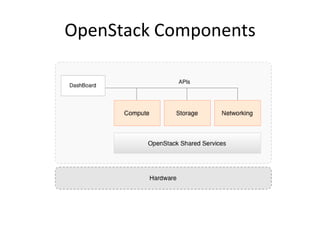
• OpenStack is a virtualization platform
which abstracts out Compute, Storage and
Networking from the underlying Hardware
• All the components are managed through
a central Dashboard
OpenStack Components
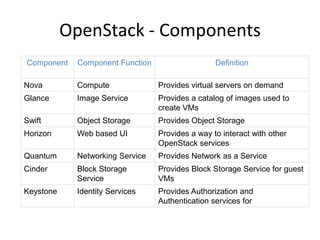
OpenStack - Components
Component Component Function Definition
Nova Compute Provides virtual servers on demand
Glance Image Service Provides a catalog of images used to
create VMs
Swift Object Storage Provides Object Storage
Horizon Web based UI Provides a way to interact with other
OpenStack services
Quantum Networking Service Provides Network as a Service
Cinder Block Storage
Service
Provides Block Storage Service for guest
VMs
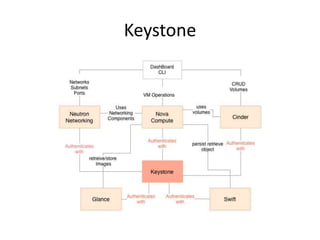
Keystone Identity Services Provides Authorization and
Authentication services for
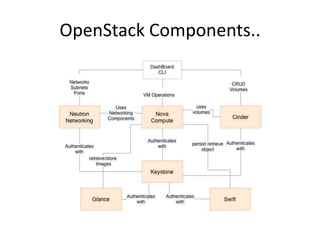
OpenStack Components..
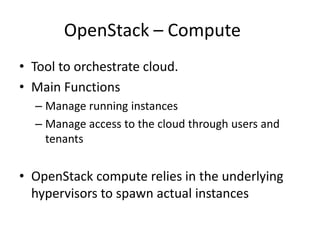
OpenStack – Compute
• Tool to orchestrate cloud.
• Main Functions
– Manage running instances
– Manage access to the cloud through users and
tenants
• OpenStack compute relies in the underlying
hypervisors to spawn actual instances
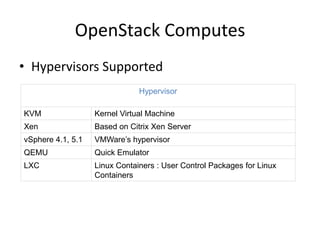
OpenStack Computes
• Hypervisors Supported
Hypervisor
KVM Kernel Virtual Machine
Xen Based on Citrix Xen Server
vSphere 4.1, 5.1 VMWare’s hypervisor
QEMU Quick Emulator
LXC Linux Containers : User Control Packages for Linux
Containers
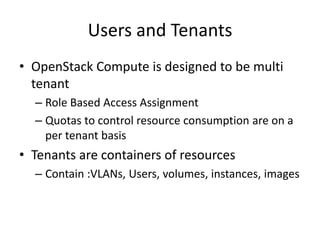
Users and Tenants
• OpenStack Compute is designed to be multi
tenant
– Role Based Access Assignment
– Quotas to control resource consumption are on a
per tenant basis
• Tenants are containers of resources
– Contain :VLANs, Users, volumes, instances, images
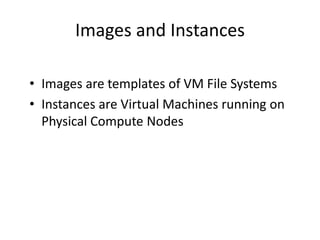
Images and Instances
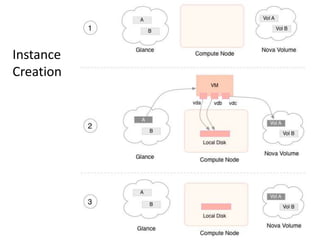
• Images are templates of VM File Systems
• Instances are Virtual Machines running on
Physical Compute Nodes
Instance
Creation
Storage Types in Compute
• Ephemeral Storage
– Persistent storage on a local Compute Node
– Deleted with the instance
– Persisted across reboots of the VM
• Volume Storage
– Independent of the Instance
– Block Storage
– Attached to an instance
– Not shared among instances
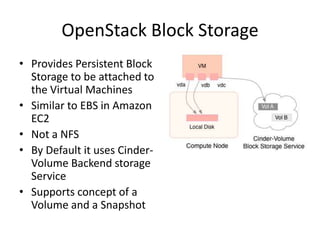
OpenStack Block Storage
• Provides Persistent Block
Storage to be attached to
the Virtual Machines
• Similar to EBS in Amazon
EC2
• Not a NFS
• By Default it uses Cinder-
Volume Backend storage
Service
• Supports concept of a
Volume and a Snapshot
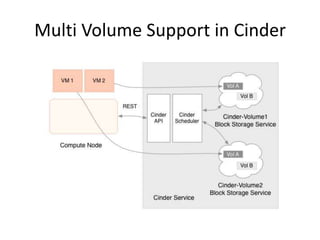
Multi Volume Support in Cinder
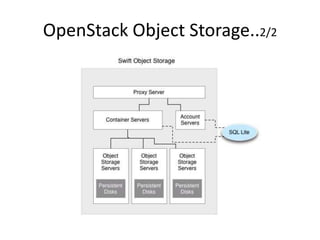
OpenStack Object Storage..1/2
• Provides a mechanism to store Object in
Containers
• Accounts and Account Servers
• Container Servers
• Object Storage Servers
OpenStack Object Storage..2/2
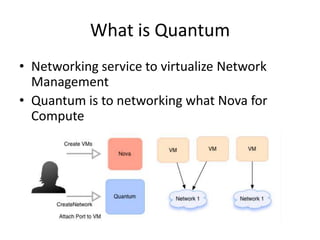
What is Quantum
• Networking service to virtualize Network
Management
• Quantum is to networking what Nova for
Compute
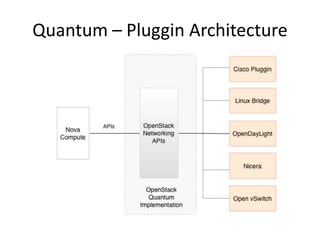
Pluggin Architecture of OpenStack
Networking
• Open Stack Networking Follows a Pluggin
approach for the implementation of the APIs.
• Default implementation is with Open vSwitch
but there a host of implementations from
third party vendors
Quantum – Pluggin Architecture
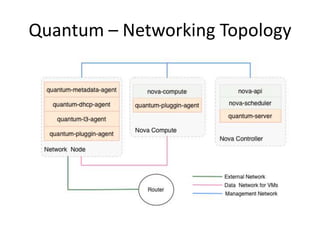
Quantum – Networking Topology
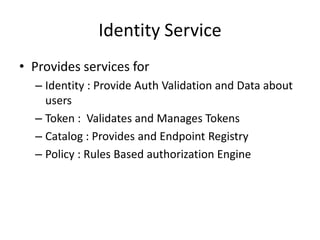
Identity Service
• Provides services for
– Identity : Provide Auth Validation and Data about
users
– Token : Validates and Manages Tokens
– Catalog : Provides and Endpoint Registry
– Policy : Rules Based authorization Engine
Keystone
Summary
• Open Stack is a hypervisor agnostic cloud
management software which can help
implement public and private clouds
Quantum - Overview
Compiled by Rajdeep Dua
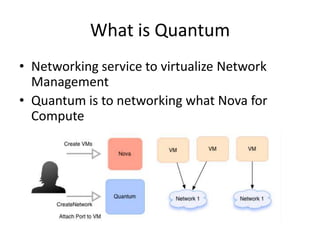
What is Quantum
• Networking service to virtualize Network
Management
• Quantum is to networking what Nova for
Compute
Why Quantum
• Enterprise Networks are complex
• Traditional Open Stack Networking has
limitations
• New Concepts like SDN and Tunneling
protocols need a more extendible model
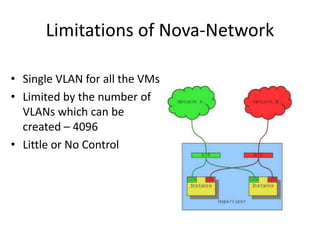
Limitations of Nova-Network
• Single VLAN for all the VMs
• Limited by the number of
VLANs which can be
created – 4096
• Little or No Control
Quantum
• Provides tools and control for Enterprise class
Networking
– Services Firewalls, Load Balancers, Virtual Routers
• Provide APIs to build advanced network
Configurations
Challenges from Cloud on Networking
• Massive Scale
• Cost Effective
• Vendor Agnostic
• Dynamic and programmatic configuration
Quantum
• Embrace New technologies like SDN / Open
Flow
• Programmable Network
• Overcome limitation of Nova-Network
• Pluggin mechanism for multiple downstream
APIs
Quantum Basics
• Provides API for configuration of Virtual
Networks and connecting VMs
• Connect Virtual and Physical Switches
• Provide Pluggin mechanism for different
control components.
Quantum API Abstractions
• Network
• Subnet
• Ports
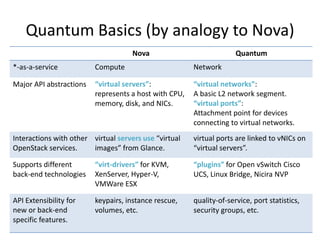
Quantum Basics (by analogy to Nova)
Nova Quantum
*-as-a-service Compute Network
Major API abstractions “virtual servers”:
represents a host with CPU,
memory, disk, and NICs.
“virtual networks”:
A basic L2 network segment.
“virtual ports”:
Attachment point for devices
connecting to virtual networks.
Interactions with other
OpenStack services.
virtual servers use “virtual
images” from Glance.
virtual ports are linked to vNICs on
“virtual servers”.
Supports different
back-end technologies
“virt-drivers” for KVM,
XenServer, Hyper-V,
VMWare ESX
“plugins” for Open vSwitch Cisco
UCS, Linux Bridge, Nicira NVP
API Extensibility for
new or back-end
specific features.
keypairs, instance rescue,
volumes, etc.
quality-of-service, port statistics,
security groups, etc.
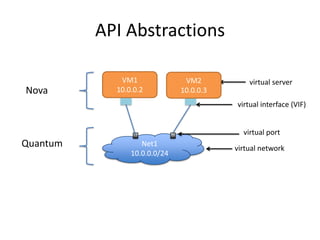
API Abstractions
Net1
10.0.0.0/24
Nova
Quantum virtual network
virtual port
virtual server
virtual interface (VIF)
VM1
10.0.0.2
VM2
10.0.0.3
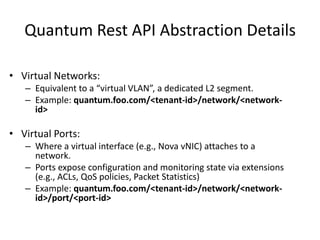
Quantum Rest API Abstraction Details
• Virtual Networks:
– Equivalent to a “virtual VLAN”, a dedicated L2 segment.
– Example: quantum.foo.com/<tenant-id>/network/<network-
id>
• Virtual Ports:
– Where a virtual interface (e.g., Nova vNIC) attaches to a
network.
– Ports expose configuration and monitoring state via extensions
(e.g., ACLs, QoS policies, Packet Statistics)
– Example: quantum.foo.com/<tenant-id>/network/<network-
id>/port/<port-id>
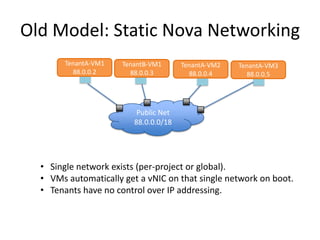
Old Model: Static Nova Networking
Public Net
88.0.0.0/18
• Single network exists (per-project or global).
• VMs automatically get a vNIC on that single network on boot.
• Tenants have no control over IP addressing.
TenantA-VM1
88.0.0.2
TenantB-VM1
88.0.0.3
TenantA-VM2
88.0.0.4
TenantA-VM3
88.0.0.5
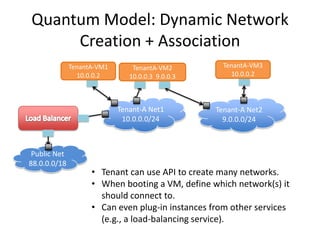
Quantum Model: Dynamic Network
Creation + Association
• Tenant can use API to create many networks.
• When booting a VM, define which network(s) it
should connect to.
• Can even plug-in instances from other services
(e.g., a load-balancing service).
Public Net
88.0.0.0/18
Tenant-A Net1
10.0.0.0/24
Tenant-A Net2
9.0.0.0/24
TenantA-VM1
10.0.0.2
TenantA-VM2
10.0.0.3 9.0.0.3
TenantA-VM3
10.0.0.2
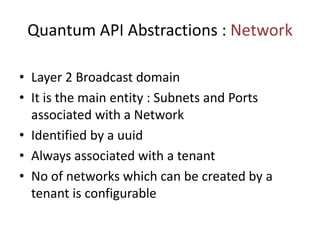
Quantum API Abstractions : Network
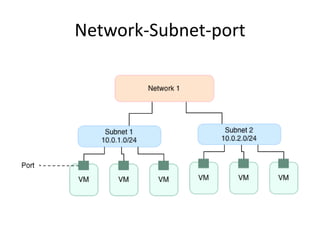
• Layer 2 Broadcast domain
• It is the main entity : Subnets and Ports
associated with a Network
• Identified by a uuid
• Always associated with a tenant
• No of networks which can be created by a
tenant is configurable
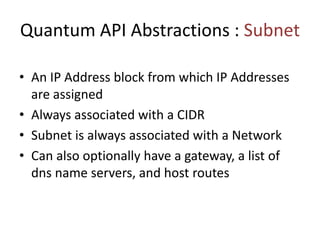
Quantum API Abstractions : Subnet
• An IP Address block from which IP Addresses
are assigned
• Always associated with a CIDR
• Subnet is always associated with a Network
• Can also optionally have a gateway, a list of
dns name servers, and host routes
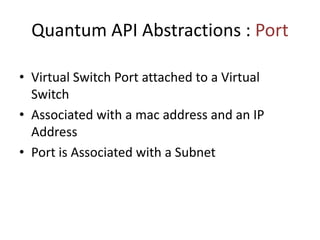
Quantum API Abstractions : Port
• Virtual Switch Port attached to a Virtual
Switch
• Associated with a mac address and an IP
Address
• Port is Associated with a Subnet
Network-Subnet-port
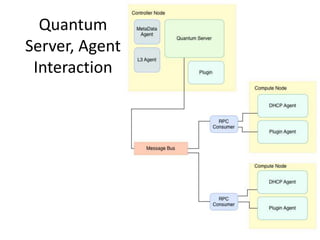
Quantum
Server, Agent
Interaction
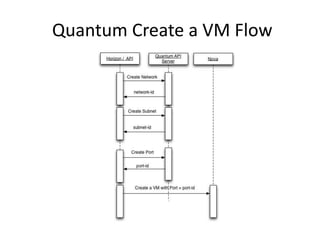
Quantum Create a VM Flow
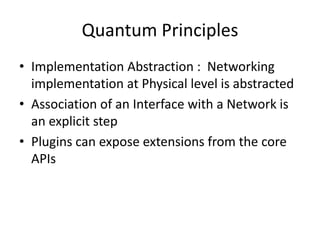
Quantum Principles
• Implementation Abstraction : Networking
implementation at Physical level is abstracted
• Association of an Interface with a Network is
an explicit step
• Plugins can expose extensions from the core
APIs
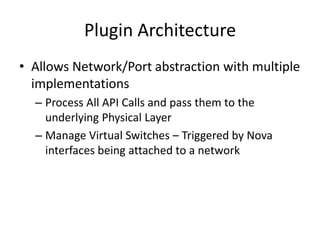
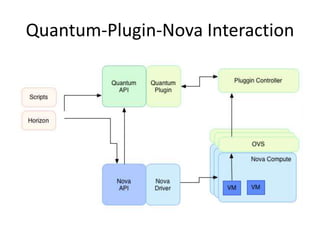
Plugin Architecture
• Allows Network/Port abstraction with multiple
implementations
– Process All API Calls and pass them to the
underlying Physical Layer
– Manage Virtual Switches – Triggered by Nova
interfaces being attached to a network
Quantum-Plugin-Nova Interaction
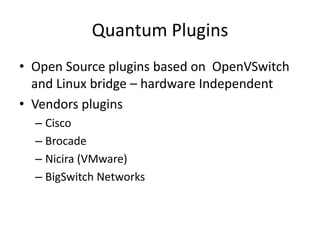
Quantum Plugins
• Open Source plugins based on OpenVSwitch
and Linux bridge – hardware Independent
• Vendors plugins
– Cisco
– Brocade
– Nicira (VMware)
– BigSwitch Networks
Key Takeaways
• Quantum enables advanced networking in
Open Stack
– APIs to configure advanced network topologies
– Pluggin architecture for extensibility
Key Takeaways
• Quantum enables advanced networking in
Open Stack
– APIs to configure advanced network topologies
– Pluggin architecture for extensibility

Openstack meetup-pune-aug22-overview

  • 1.
  • 2.
    What is OpenStack Providescalable, elastic cloud computing for both public and private clouds, large and small
  • 3.
    Defining OpenStack • OpenStackis a virtualization platform which abstracts out Compute, Storage and Networking from the underlying Hardware • All the components are managed through a central Dashboard
  • 4.
  • 5.
    OpenStack - Components ComponentComponent Function Definition Nova Compute Provides virtual servers on demand Glance Image Service Provides a catalog of images used to create VMs Swift Object Storage Provides Object Storage Horizon Web based UI Provides a way to interact with other OpenStack services Quantum Networking Service Provides Network as a Service Cinder Block Storage Service Provides Block Storage Service for guest VMs Keystone Identity Services Provides Authorization and Authentication services for
  • 6.
  • 7.
    OpenStack – Compute •Tool to orchestrate cloud. • Main Functions – Manage running instances – Manage access to the cloud through users and tenants • OpenStack compute relies in the underlying hypervisors to spawn actual instances
  • 8.
    OpenStack Computes • HypervisorsSupported Hypervisor KVM Kernel Virtual Machine Xen Based on Citrix Xen Server vSphere 4.1, 5.1 VMWare’s hypervisor QEMU Quick Emulator LXC Linux Containers : User Control Packages for Linux Containers
  • 9.
    Users and Tenants •OpenStack Compute is designed to be multi tenant – Role Based Access Assignment – Quotas to control resource consumption are on a per tenant basis • Tenants are containers of resources – Contain :VLANs, Users, volumes, instances, images
  • 10.
    Images and Instances •Images are templates of VM File Systems • Instances are Virtual Machines running on Physical Compute Nodes
  • 11.
  • 12.
    Storage Types inCompute • Ephemeral Storage – Persistent storage on a local Compute Node – Deleted with the instance – Persisted across reboots of the VM • Volume Storage – Independent of the Instance – Block Storage – Attached to an instance – Not shared among instances
  • 13.
    OpenStack Block Storage •Provides Persistent Block Storage to be attached to the Virtual Machines • Similar to EBS in Amazon EC2 • Not a NFS • By Default it uses Cinder- Volume Backend storage Service • Supports concept of a Volume and a Snapshot
  • 14.
  • 15.
    OpenStack Object Storage..1/2 •Provides a mechanism to store Object in Containers • Accounts and Account Servers • Container Servers • Object Storage Servers
  • 16.
  • 17.
    What is Quantum •Networking service to virtualize Network Management • Quantum is to networking what Nova for Compute
  • 18.
    Pluggin Architecture ofOpenStack Networking • Open Stack Networking Follows a Pluggin approach for the implementation of the APIs. • Default implementation is with Open vSwitch but there a host of implementations from third party vendors
  • 19.
    Quantum – PlugginArchitecture
  • 20.
  • 21.
    Identity Service • Providesservices for – Identity : Provide Auth Validation and Data about users – Token : Validates and Manages Tokens – Catalog : Provides and Endpoint Registry – Policy : Rules Based authorization Engine
  • 22.
  • 23.
    Summary • Open Stackis a hypervisor agnostic cloud management software which can help implement public and private clouds
  • 24.
  • 25.
    What is Quantum •Networking service to virtualize Network Management • Quantum is to networking what Nova for Compute
  • 26.
    Why Quantum • EnterpriseNetworks are complex • Traditional Open Stack Networking has limitations • New Concepts like SDN and Tunneling protocols need a more extendible model
  • 27.
    Limitations of Nova-Network •Single VLAN for all the VMs • Limited by the number of VLANs which can be created – 4096 • Little or No Control
  • 28.
    Quantum • Provides toolsand control for Enterprise class Networking – Services Firewalls, Load Balancers, Virtual Routers • Provide APIs to build advanced network Configurations
  • 29.
    Challenges from Cloudon Networking • Massive Scale • Cost Effective • Vendor Agnostic • Dynamic and programmatic configuration
  • 30.
    Quantum • Embrace Newtechnologies like SDN / Open Flow • Programmable Network • Overcome limitation of Nova-Network • Pluggin mechanism for multiple downstream APIs
  • 31.
    Quantum Basics • ProvidesAPI for configuration of Virtual Networks and connecting VMs • Connect Virtual and Physical Switches • Provide Pluggin mechanism for different control components.
  • 32.
    Quantum API Abstractions •Network • Subnet • Ports
  • 33.
    Quantum Basics (byanalogy to Nova) Nova Quantum *-as-a-service Compute Network Major API abstractions “virtual servers”: represents a host with CPU, memory, disk, and NICs. “virtual networks”: A basic L2 network segment. “virtual ports”: Attachment point for devices connecting to virtual networks. Interactions with other OpenStack services. virtual servers use “virtual images” from Glance. virtual ports are linked to vNICs on “virtual servers”. Supports different back-end technologies “virt-drivers” for KVM, XenServer, Hyper-V, VMWare ESX “plugins” for Open vSwitch Cisco UCS, Linux Bridge, Nicira NVP API Extensibility for new or back-end specific features. keypairs, instance rescue, volumes, etc. quality-of-service, port statistics, security groups, etc.
  • 34.
    API Abstractions Net1 10.0.0.0/24 Nova Quantum virtualnetwork virtual port virtual server virtual interface (VIF) VM1 10.0.0.2 VM2 10.0.0.3
  • 35.
    Quantum Rest APIAbstraction Details • Virtual Networks: – Equivalent to a “virtual VLAN”, a dedicated L2 segment. – Example: quantum.foo.com/<tenant-id>/network/<network- id> • Virtual Ports: – Where a virtual interface (e.g., Nova vNIC) attaches to a network. – Ports expose configuration and monitoring state via extensions (e.g., ACLs, QoS policies, Packet Statistics) – Example: quantum.foo.com/<tenant-id>/network/<network- id>/port/<port-id>
  • 36.
    Old Model: StaticNova Networking Public Net 88.0.0.0/18 • Single network exists (per-project or global). • VMs automatically get a vNIC on that single network on boot. • Tenants have no control over IP addressing. TenantA-VM1 88.0.0.2 TenantB-VM1 88.0.0.3 TenantA-VM2 88.0.0.4 TenantA-VM3 88.0.0.5
  • 37.
    Quantum Model: DynamicNetwork Creation + Association • Tenant can use API to create many networks. • When booting a VM, define which network(s) it should connect to. • Can even plug-in instances from other services (e.g., a load-balancing service). Public Net 88.0.0.0/18 Tenant-A Net1 10.0.0.0/24 Tenant-A Net2 9.0.0.0/24 TenantA-VM1 10.0.0.2 TenantA-VM2 10.0.0.3 9.0.0.3 TenantA-VM3 10.0.0.2
  • 38.
    Quantum API Abstractions: Network • Layer 2 Broadcast domain • It is the main entity : Subnets and Ports associated with a Network • Identified by a uuid • Always associated with a tenant • No of networks which can be created by a tenant is configurable
  • 39.
    Quantum API Abstractions: Subnet • An IP Address block from which IP Addresses are assigned • Always associated with a CIDR • Subnet is always associated with a Network • Can also optionally have a gateway, a list of dns name servers, and host routes
  • 40.
    Quantum API Abstractions: Port • Virtual Switch Port attached to a Virtual Switch • Associated with a mac address and an IP Address • Port is Associated with a Subnet
  • 41.
  • 42.
  • 43.
  • 44.
    Quantum Principles • ImplementationAbstraction : Networking implementation at Physical level is abstracted • Association of an Interface with a Network is an explicit step • Plugins can expose extensions from the core APIs
  • 45.
    Plugin Architecture • AllowsNetwork/Port abstraction with multiple implementations – Process All API Calls and pass them to the underlying Physical Layer – Manage Virtual Switches – Triggered by Nova interfaces being attached to a network
  • 46.
  • 47.
    Quantum Plugins • OpenSource plugins based on OpenVSwitch and Linux bridge – hardware Independent • Vendors plugins – Cisco – Brocade – Nicira (VMware) – BigSwitch Networks
  • 48.
    Key Takeaways • Quantumenables advanced networking in Open Stack – APIs to configure advanced network topologies – Pluggin architecture for extensibility
  • 49.
    Key Takeaways • Quantumenables advanced networking in Open Stack – APIs to configure advanced network topologies – Pluggin architecture for extensibility

Editor's Notes

  • #34 Common to run both Quantum and Nova on the same set of controller hosts.