Intro to OpenStack Quantum for
         Cloud Operators
 Dan Wendlandt – Quantum Hacker & PTL
           dan@nicira.com
        twitter - danwendlandt
Caveats
• Quantum is young: there are lots of things
  that it WILL do, but doesn’t yet.

• Target of talk is Cloud Operators that would
  deploy Quantum.
Outline
•   Why Quantum?
•   What is Quantum?
•   Current Project Status
•   Demo!
•   Future Directions
•   Questions
Why Quantum?
What is OpenStack?
• Open Source Cloud Software…
• A collection of “cloud services”
• Each service includes:
  – A tenant-facing API that exposes
    logical abstractions for consuming
    the service.
  – One or more backend
    implementations of that API
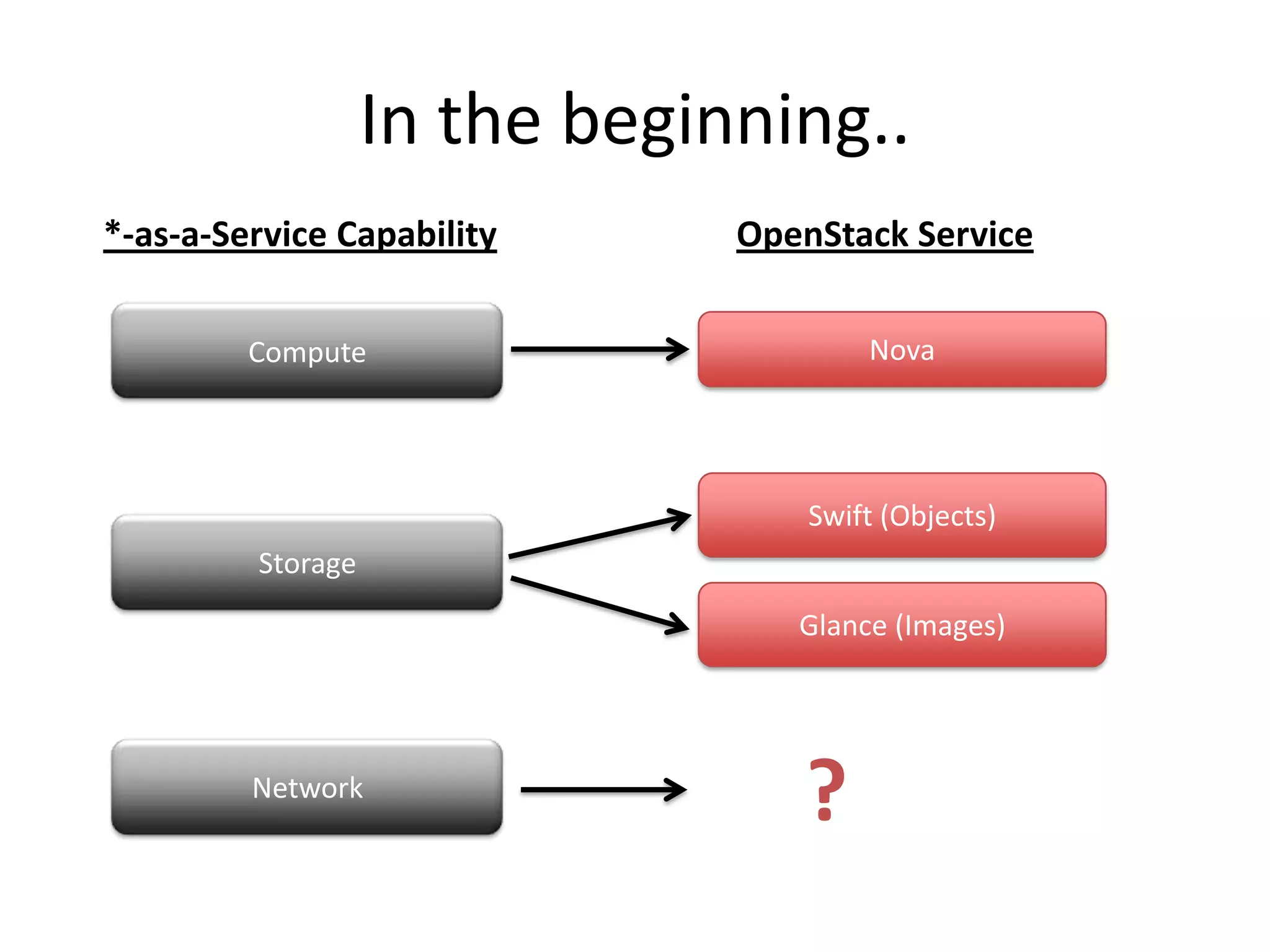
In the beginning..
*-as-a-Service Capability      OpenStack Service

         Compute                       Nova


                                   Swift (Objects)
         Storage
                                  Glance (Images)


         Network
                                  ?
Why Quantum?
• Networking was sub-component of Nova
• Two Key Problems:
  #1: Limited technology “baked in” to design.
  #2: No tenant control of networking.
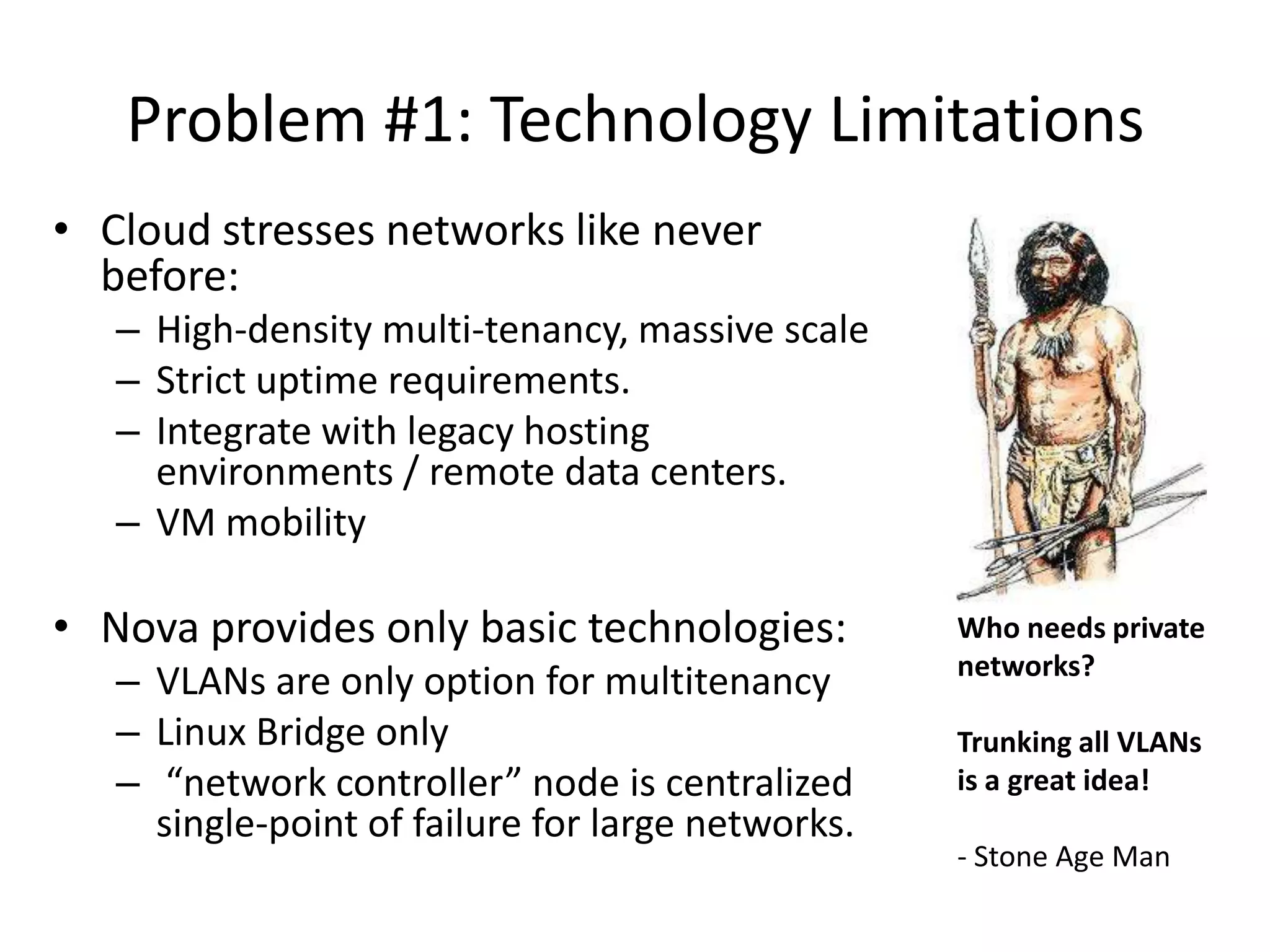
Problem #1: Technology Limitations
• Cloud stresses networks like never
  before:
   – High-density multi-tenancy, massive scale
   – Strict uptime requirements.
   – Integrate with legacy hosting
     environments / remote data centers.
   – VM mobility

• Nova provides only basic technologies:           Who needs private
                                                   networks?
   – VLANs are only option for multitenancy
   – Linux Bridge only                             Trunking all VLANs
   – “network controller” node is centralized      is a great idea!
     single-point of failure for large networks.
                                                   - Stone Age Man
Why Quantum?
         #1: Leveraging Advanced Technologies
• New networking technologies are emerging to try and
  tackle these challenges.
   –   Software-defined Networking (SDN) / OpenFlow
   –   Overlay tunneling: VXLAN, NVGRE, STT
   –   Fabric solutions: FabricPath, Qfabric, etc.
   –   [ insert other solution here ]

• Quantum provides a “plugin” mechanism to enable
  different technologies implement calls made via the
  Quantum API.

• Choice is a good thing!
Problem #2: No Tenant Control
• Cloud tenants want to replicate rich
  enterprise network topologies:
   – Ability to create “multi-tier” networks
     (e.g., web tier, app tier, db tier)
   – Control over IP addressing.
   – Ability to insert and configure your
     own services (e.g., firewall, IPS)
   – VPN/Bridge to remote physical hosting
     or customer premises
     (“cloudbursting”).
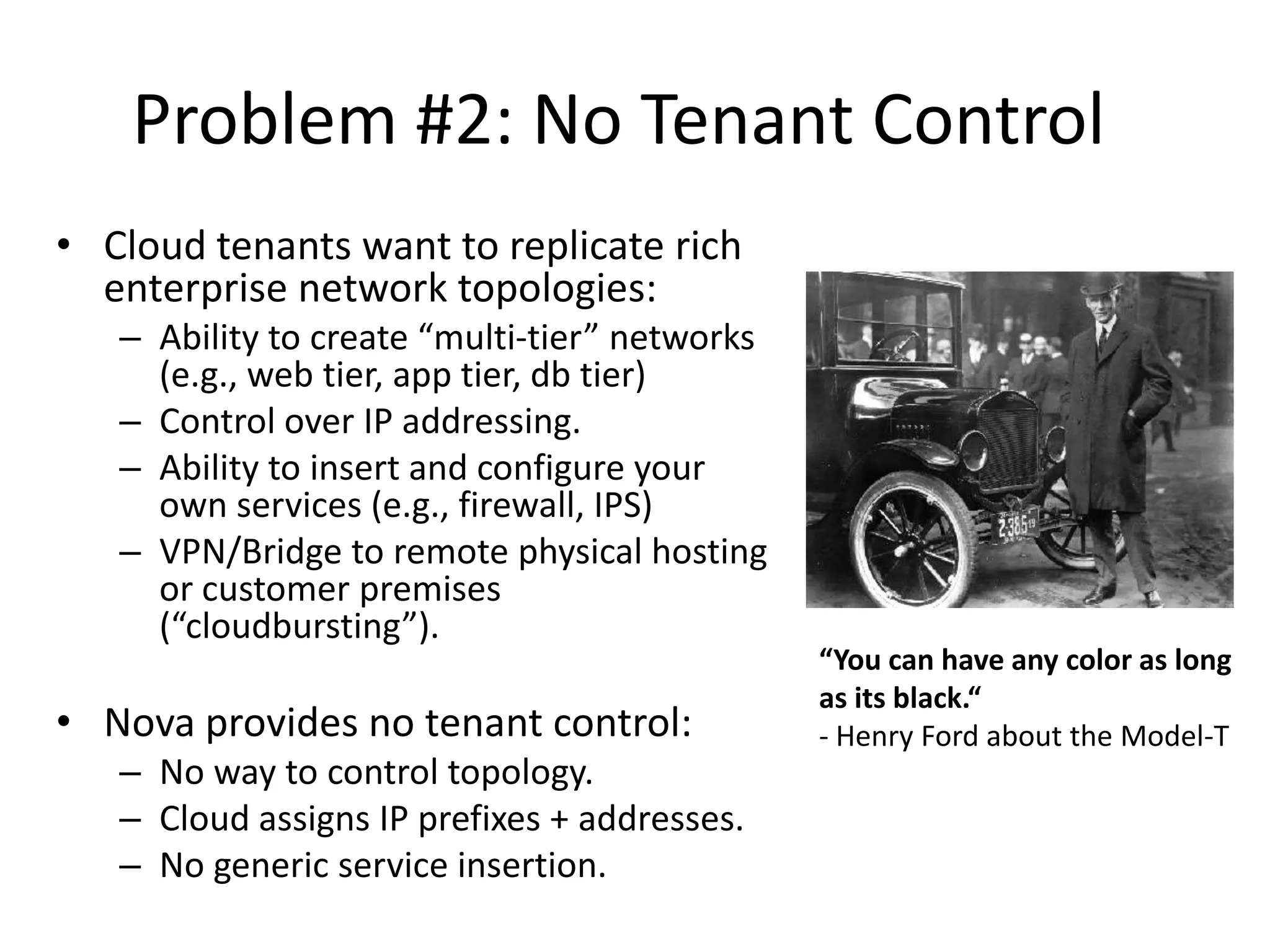
                                               “You can have any color as long
                                               as its black.“
• Nova provides no tenant control:             - Henry Ford about the Model-T
   – No way to control topology.
   – Cloud assigns IP prefixes + addresses.
   – No generic service insertion.
Why Quantum? Reason #2
     On-demand Enterprise-Class Networking
• Tenants can:
  – create multiple private networks
  – control IP addressing (bring your own!).

• Quantum API extensions enable additional
  control:
  – Security, Quality-of-Service, Monitoring +
    Troubleshooting.

• “Advanced Network Services”
  – Routers, Firewalls, VPN, IDS, etc.
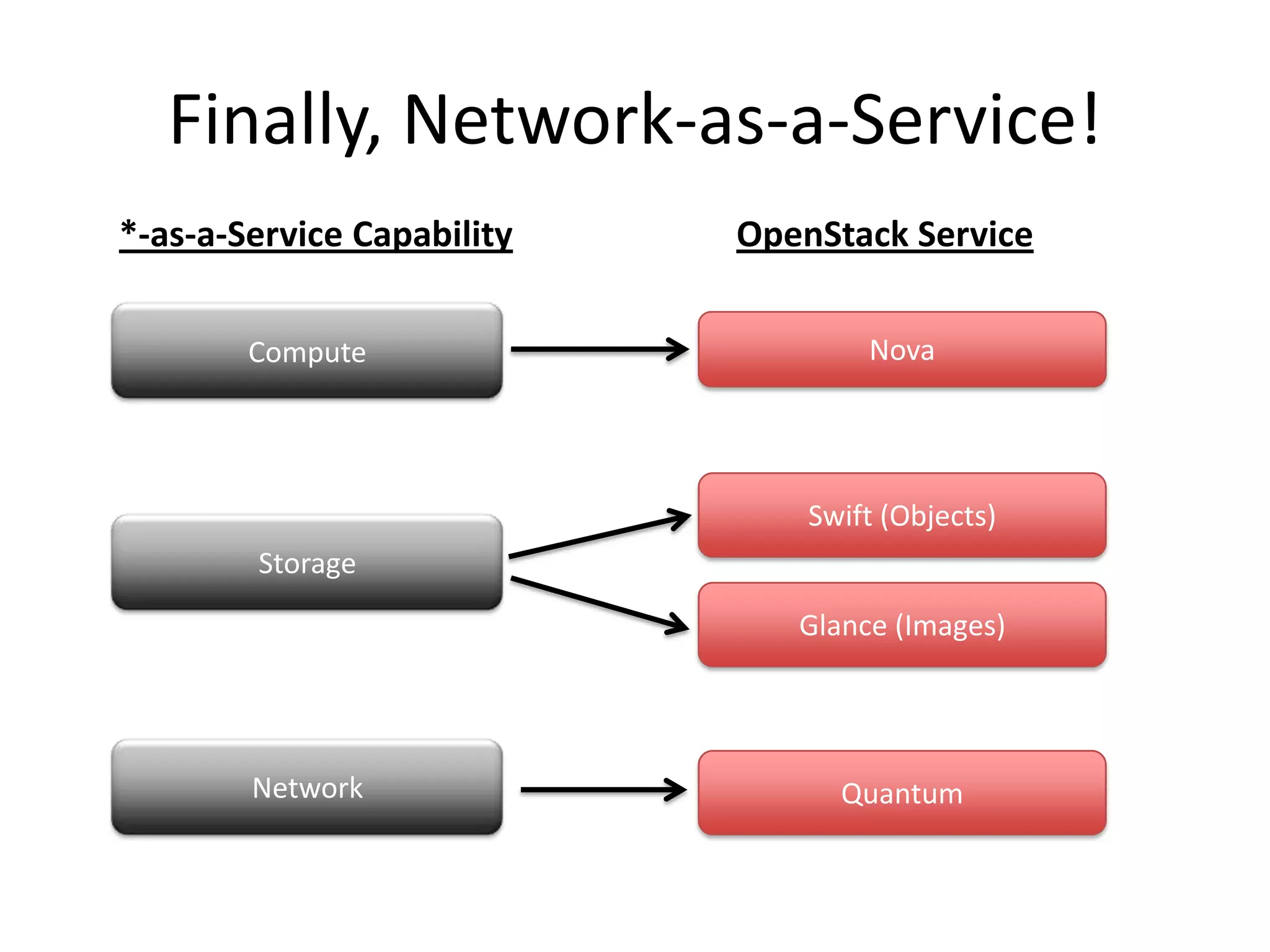
Finally, Network-as-a-Service!
*-as-a-Service Capability   OpenStack Service

        Compute                     Nova


                                Swift (Objects)
        Storage
                               Glance (Images)


        Network                   Quantum
Why Quantum?
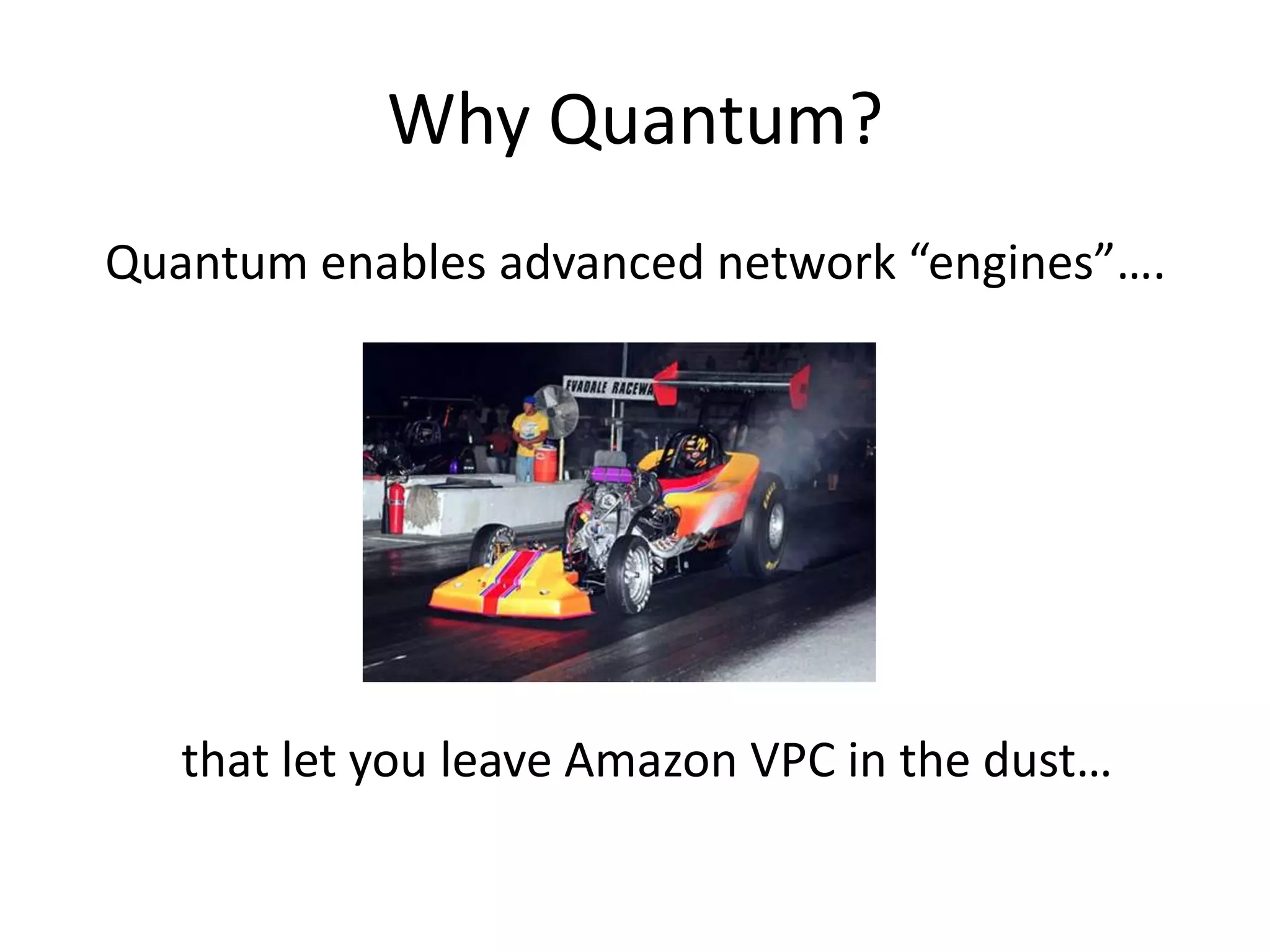
Quantum enables advanced network “engines”….


   that let you leave Amazon VPC in the dust…
Why Quantum?

 Questions?
What is Quantum?
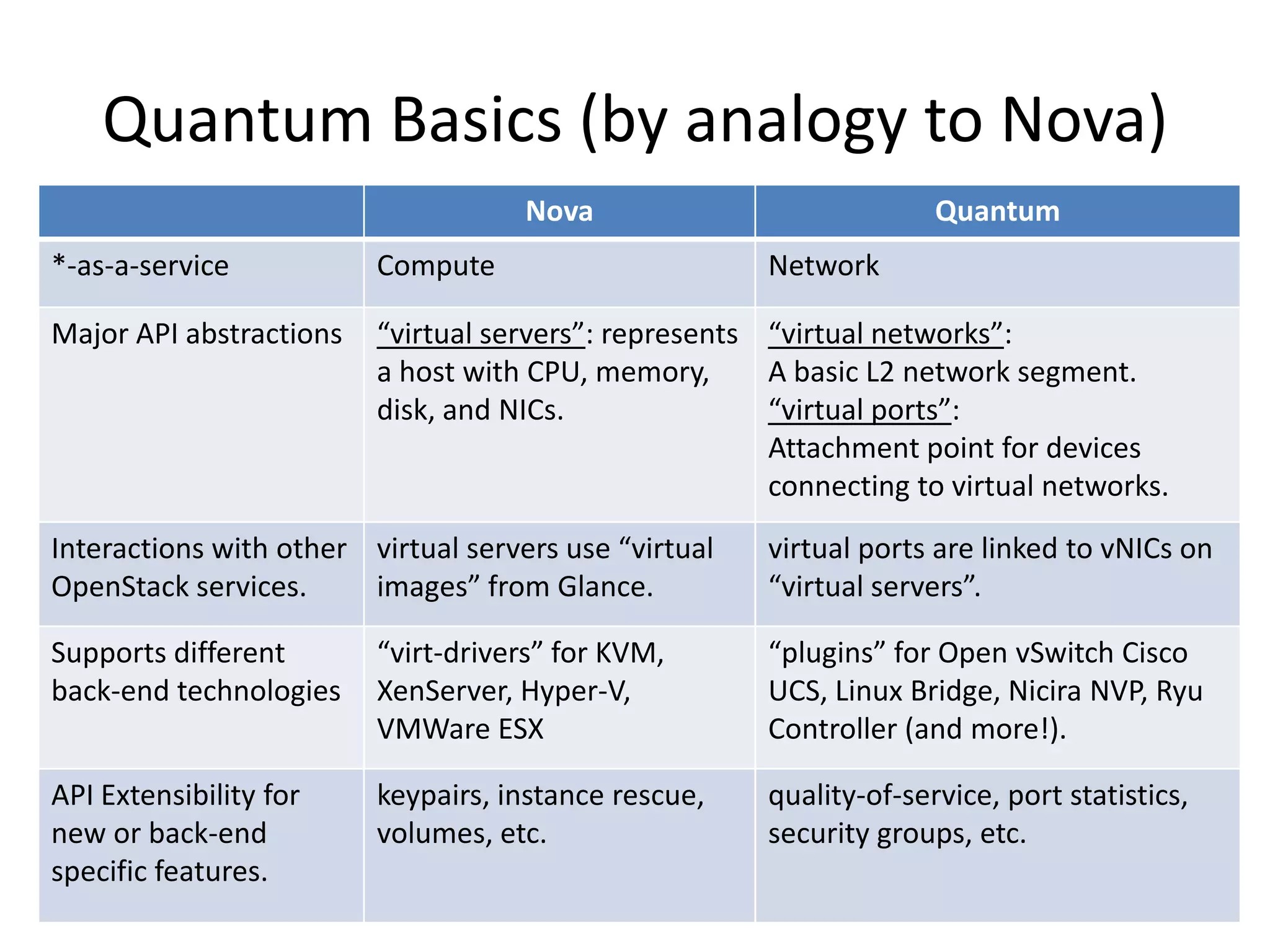
Quantum Basics (by analogy to Nova)
                                     Nova                            Quantum
*-as-a-service           Compute                       Network

Major API abstractions   “virtual servers”: represents “virtual networks”:
                         a host with CPU, memory,      A basic L2 network segment.
                         disk, and NICs.               “virtual ports”:
                                                       Attachment point for devices
                                                       connecting to virtual networks.
Interactions with other virtual servers use “virtual   virtual ports are linked to vNICs on
OpenStack services.     images” from Glance.           “virtual servers”.

Supports different       “virt-drivers” for KVM,       “plugins” for Open vSwitch Cisco
back-end technologies    XenServer, Hyper-V,           UCS, Linux Bridge, Nicira NVP, Ryu
                         VMWare ESX                    Controller (and more!).

API Extensibility for    keypairs, instance rescue,    quality-of-service, port statistics,
new or back-end          volumes, etc.                 security groups, etc.
specific features.
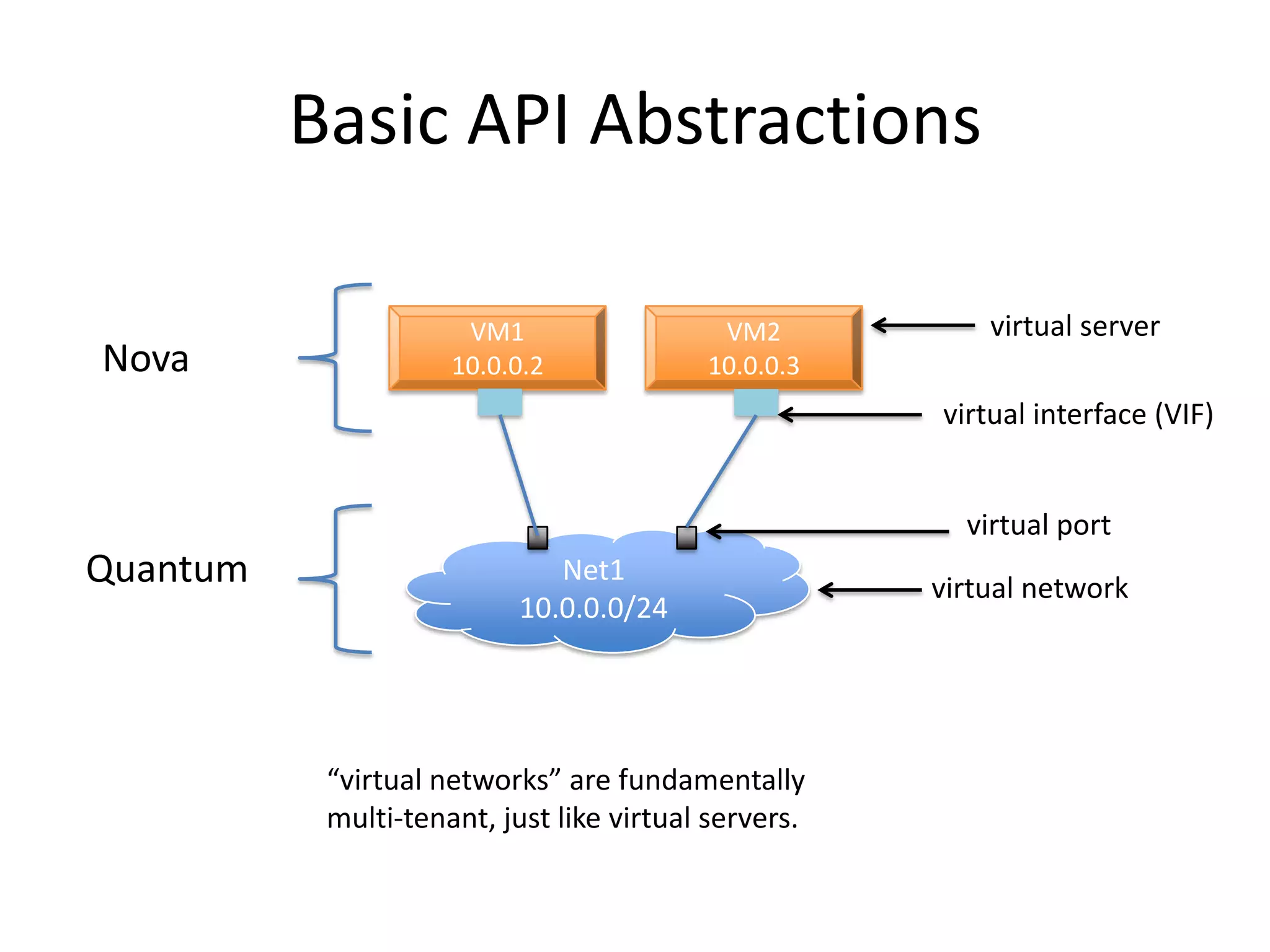
Basic API Abstractions

                      VM1                  VM2            virtual server
Nova                 10.0.0.2             10.0.0.3
                                                      virtual interface (VIF)


                                                        virtual port
Quantum                       Net1
                                                      virtual network
                           10.0.0.0/24


           “virtual networks” are fundamentally
           multi-tenant, just like virtual servers.
Quantum API Extensions
• Enables innovation in virtual networking.

• Add properties to existing network/port
  abstractions (e.g., QoS settings on virtual
  port, port statistics).

• Can introduce new API entities (e.g., Security
  Groups that are linked to ports).
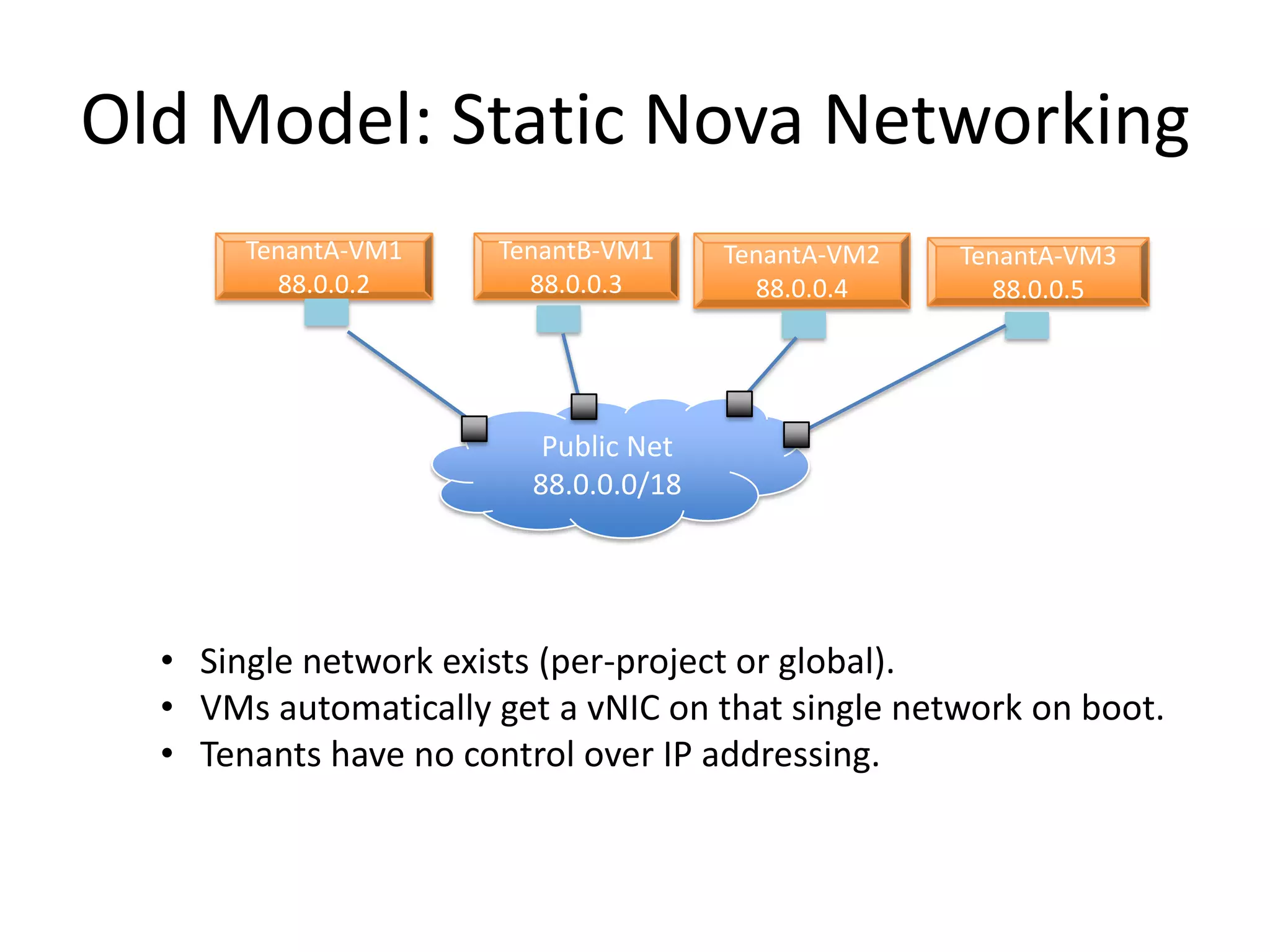
Old Model: Static Nova Networking
       TenantA-VM1    TenantB-VM1     TenantA-VM2   TenantA-VM3
         88.0.0.2       88.0.0.3        88.0.0.4      88.0.0.5


                         Public Net
                        88.0.0.0/18


  • Single network exists (per-project or global).
  • VMs automatically get a vNIC on that single network on boot.
  • Tenants have no control over IP addressing.
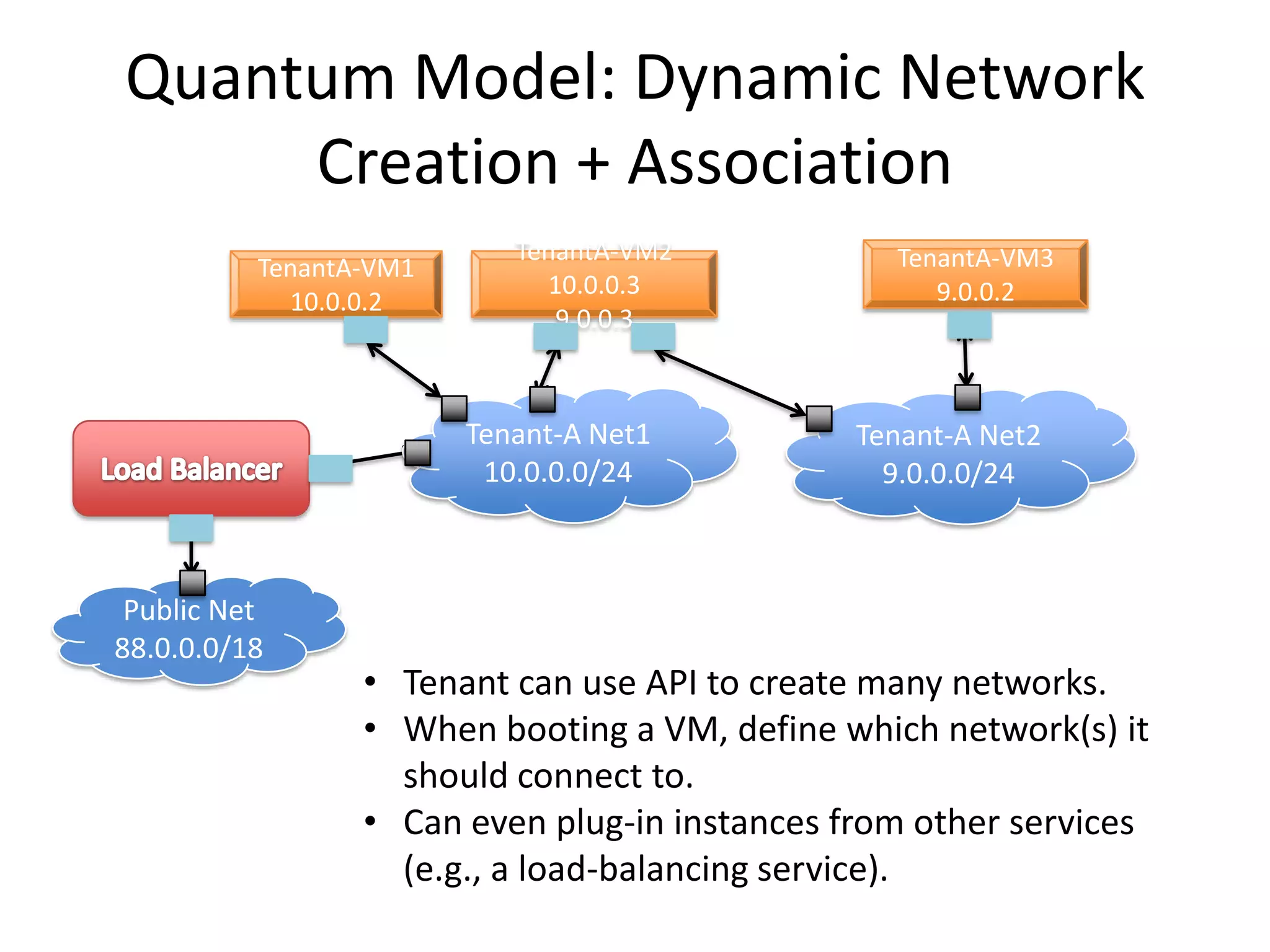
Quantum Model: Dynamic Network
     Creation + Association
                           TenantA-VM2           TenantA-VM3
          TenantA-VM1
                             10.0.0.3               9.0.0.2
            10.0.0.2
                              9.0.0.3


                        Tenant-A Net1          Tenant-A Net2
                         10.0.0.0/24             9.0.0.0/24


 Public Net
88.0.0.0/18
                 • Tenant can use API to create many networks.
                 • When booting a VM, define which network(s) it
                   should connect to.
                 • Can even plug-in instances from other services
                   (e.g., a load-balancing service).
Quantum “Plugins”
• “Plugin” model give cloud operators choices:
   –   Advanced Features (exposed as API extensions)
   –   Cost / open vs. propriety
   –   Scale
   –   High Availability
   –   Hypervisor + Network HW Compatibility
   –   Manageability / Polish

• Abstract logical API
   – tenants don’t see underlying technologies
   – Example: VLANs vs. tunneling
Current Project Status
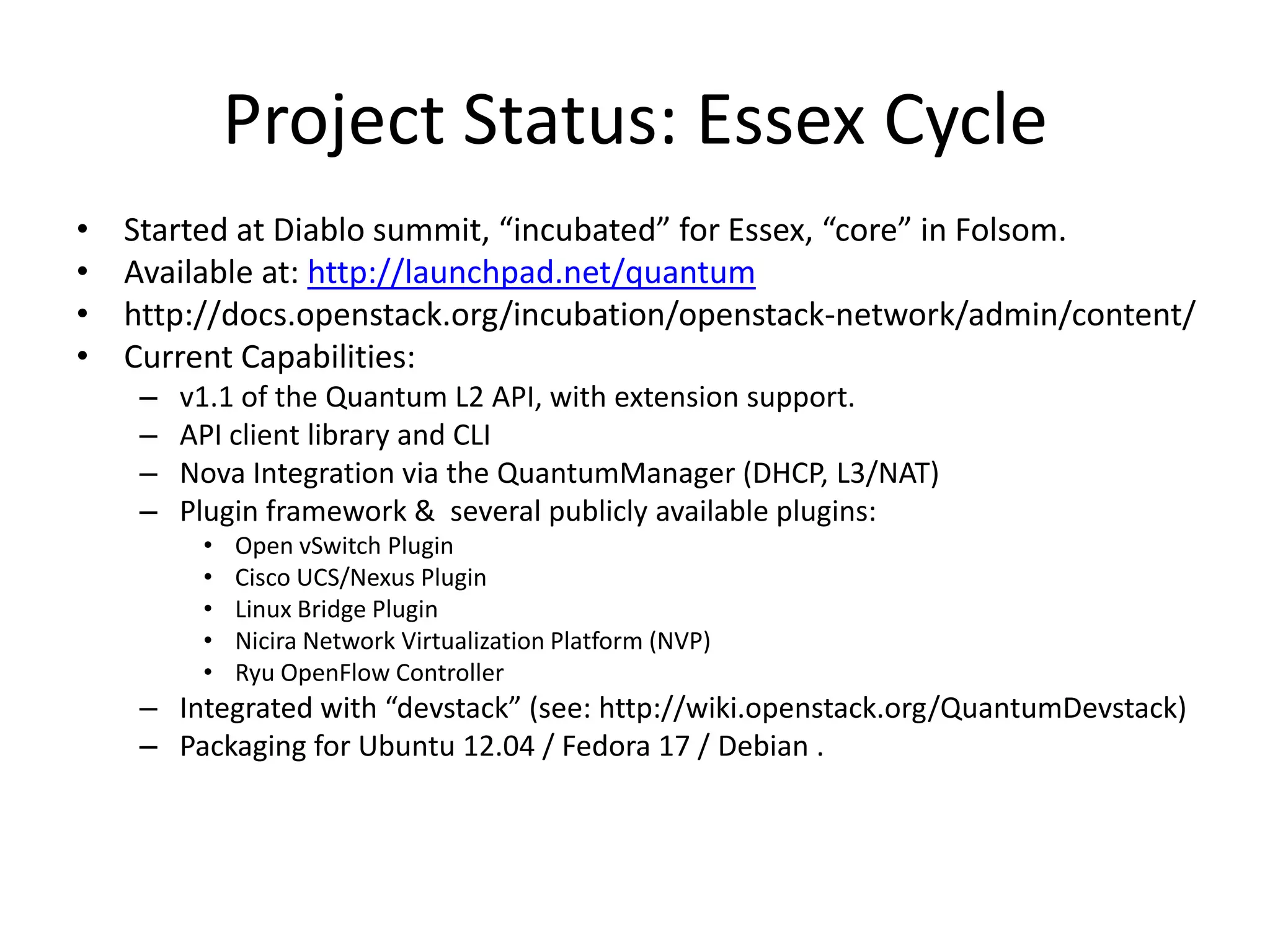
Project Status: Essex Cycle
•   Started at Diablo summit, “incubated” for Essex, “core” in Folsom.
•   Available at: http://launchpad.net/quantum
•   http://docs.openstack.org/incubation/openstack-network/admin/content/
•   Current Capabilities:
     –   v1.1 of the Quantum L2 API, with extension support.
     –   API client library and CLI
     –   Nova Integration via the QuantumManager (DHCP, L3/NAT)
     –   Plugin framework & several publicly available plugins:
          •   Open vSwitch Plugin
          •   Cisco UCS/Nexus Plugin
          •   Linux Bridge Plugin
          •   Nicira Network Virtualization Platform (NVP)
          •   Ryu OpenFlow Controller
     – Integrated with “devstack” (see: http://wiki.openstack.org/QuantumDevstack)
     – Packaging for Ubuntu 12.04 / Fedora 17 / Debian .
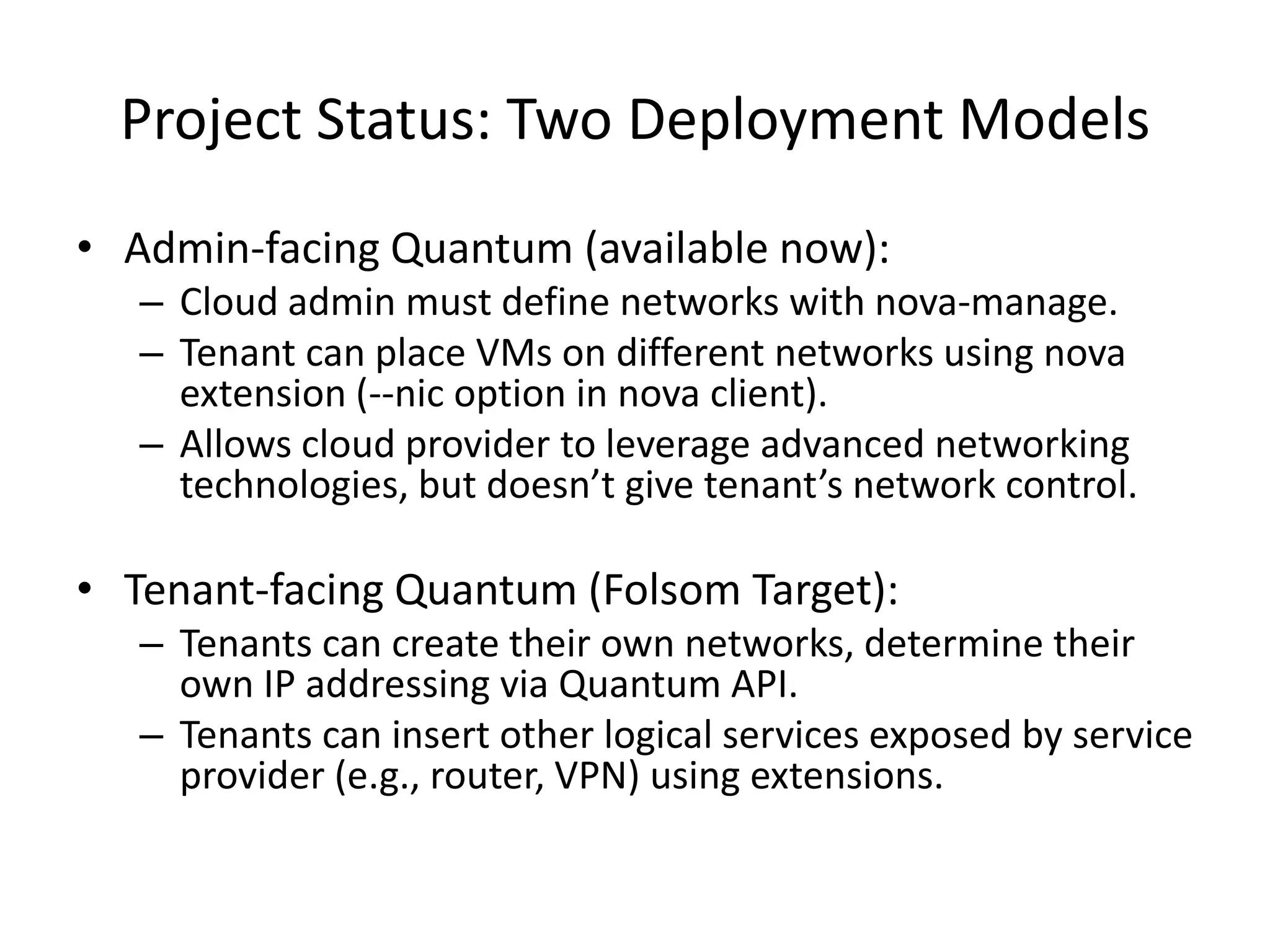
Project Status: Two Deployment Models
• Admin-facing Quantum (available now):
   – Cloud admin must define networks with nova-manage.
   – Tenant can place VMs on different networks using nova
     extension (--nic option in nova client).
   – Allows cloud provider to leverage advanced networking
     technologies, but doesn’t give tenant’s network control.

• Tenant-facing Quantum (Folsom Target):
   – Tenants can create their own networks, determine their
     own IP addressing via Quantum API.
   – Tenants can insert other logical services exposed by service
     provider (e.g., router, VPN) using extensions.
Project Status: Is Quantum “Ready”?

• “Early adopters” already putting
                                            OpenStack
  Quantum into production                networking Panel
  deployments (using Essex).              today @ 3:50 in
                                            Seacliff AB


• Many more are testing it out.
                                           Interested in a

• Folsom release is target for general     demo? Let me
                                               know!
  adoption. Planned to be default
  networking option.
Future Directions
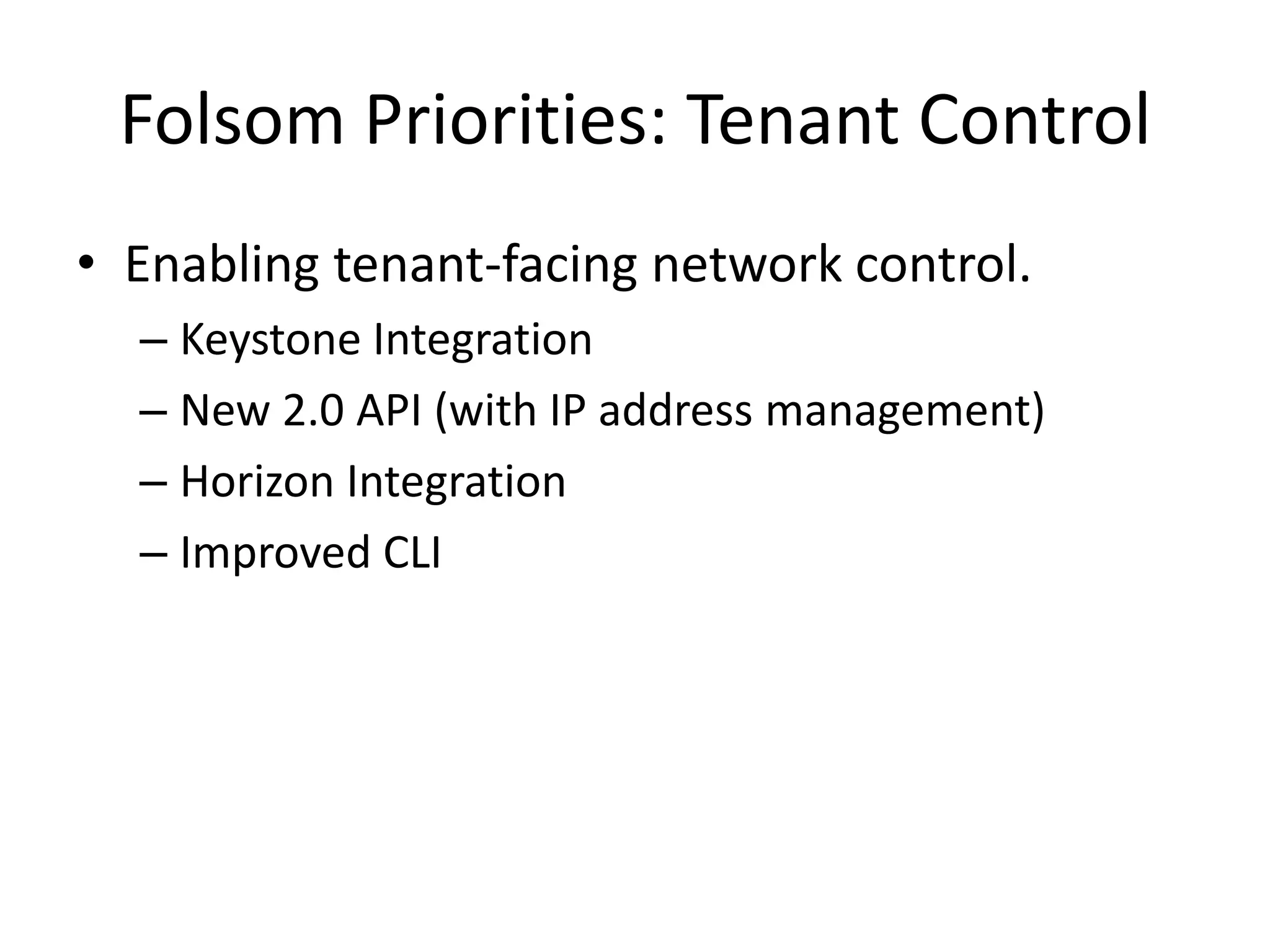
Folsom Priorities: Tenant Control
• Enabling tenant-facing network control.
  – Keystone Integration
  – New 2.0 API (with IP address management)
  – Horizon Integration
  – Improved CLI
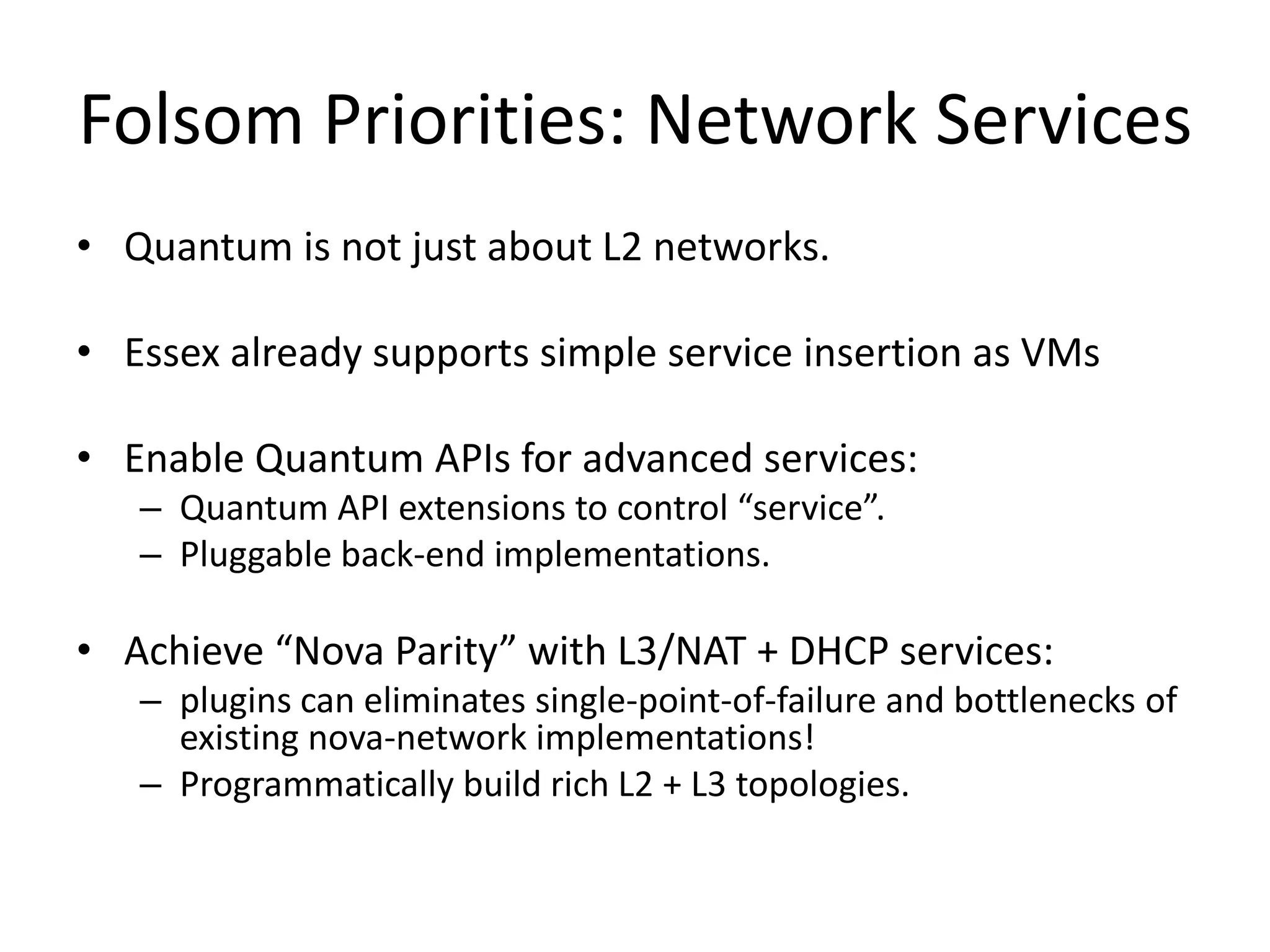
Folsom Priorities: Network Services
• Quantum is not just about L2 networks.

• Essex already supports simple service insertion as VMs

• Enable Quantum APIs for advanced services:
   – Quantum API extensions to control “service”.
   – Pluggable back-end implementations.

• Achieve “Nova Parity” with L3/NAT + DHCP services:
   – plugins can eliminates single-point-of-failure and bottlenecks of
     existing nova-network implementations!
   – Programmatically build rich L2 + L3 topologies.
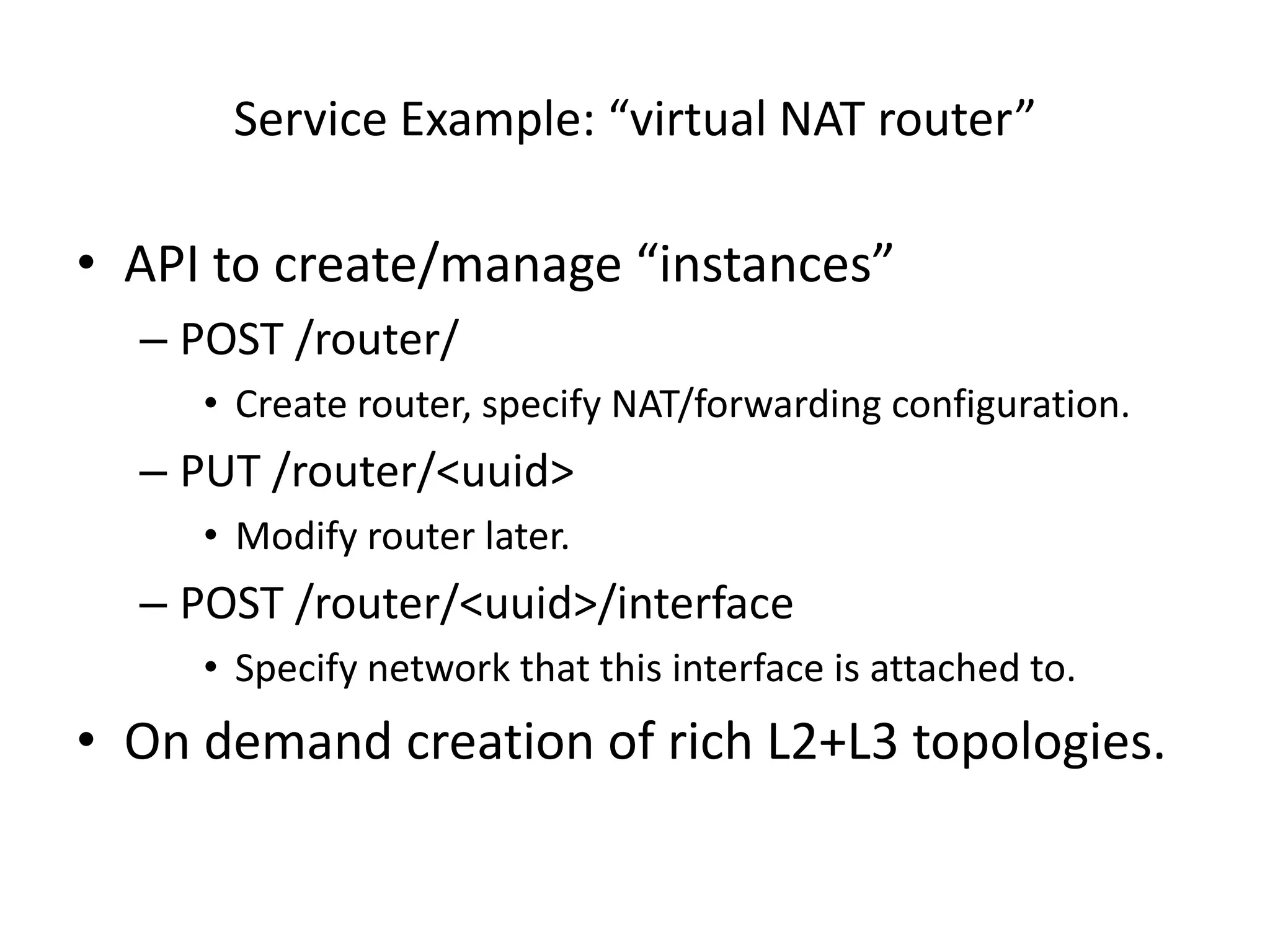
Service Example: “virtual NAT router”

• API to create/manage “instances”
  – POST /router/
     • Create router, specify NAT/forwarding configuration.
  – PUT /router/<uuid>
     • Modify router later.
  – POST /router/<uuid>/interface
     • Specify network that this interface is attached to.
• On demand creation of rich L2+L3 topologies.
Folsom Priorities: Growing the
          Quantum Community
• Growing Development team

• Networking Vendors:
   – Many planning new plugins.

• OpenStack Integrators/Distros:
   – Get them up to speed on Quantum early.
   – Improve packaging, install processes.

• OpenStack Users/Operators:
   – Improving documentation, help + support channels.
   – Let’s work together to stand it up!
Key Takeaways
• Enterprise-class OpenStack networking is here:
  – Leveraging advanced technologies.
  – Tenant control of networking.

• Enable you as a cloud operator to not just copy
  Amazon VPC, but to innovate beyond that.

• Quantum is in production today at early adopters.

• Folsom is target for widespread deployment.
Thanks!
           Questions?

Dan Wendlandt – Quantum Hacker & PTL
          dan@nicira.com
       twitter - danwendlandt
Bonus Slides
Frequently Asked Questions
• Is OpenFlow required for Quantum
  – A: Nope! OpenFlow is just one technology that
    Quantum enables.
• Is Quantum “software-defined networking”?
  – It depends…
• How does Quantum compare to Amazon VPC?
  – A: Have similar goal of enabling advanced networking
    in cloud. Quantum will give cloud operators ability to
    compete with (and go beyond) VPC feature-set.
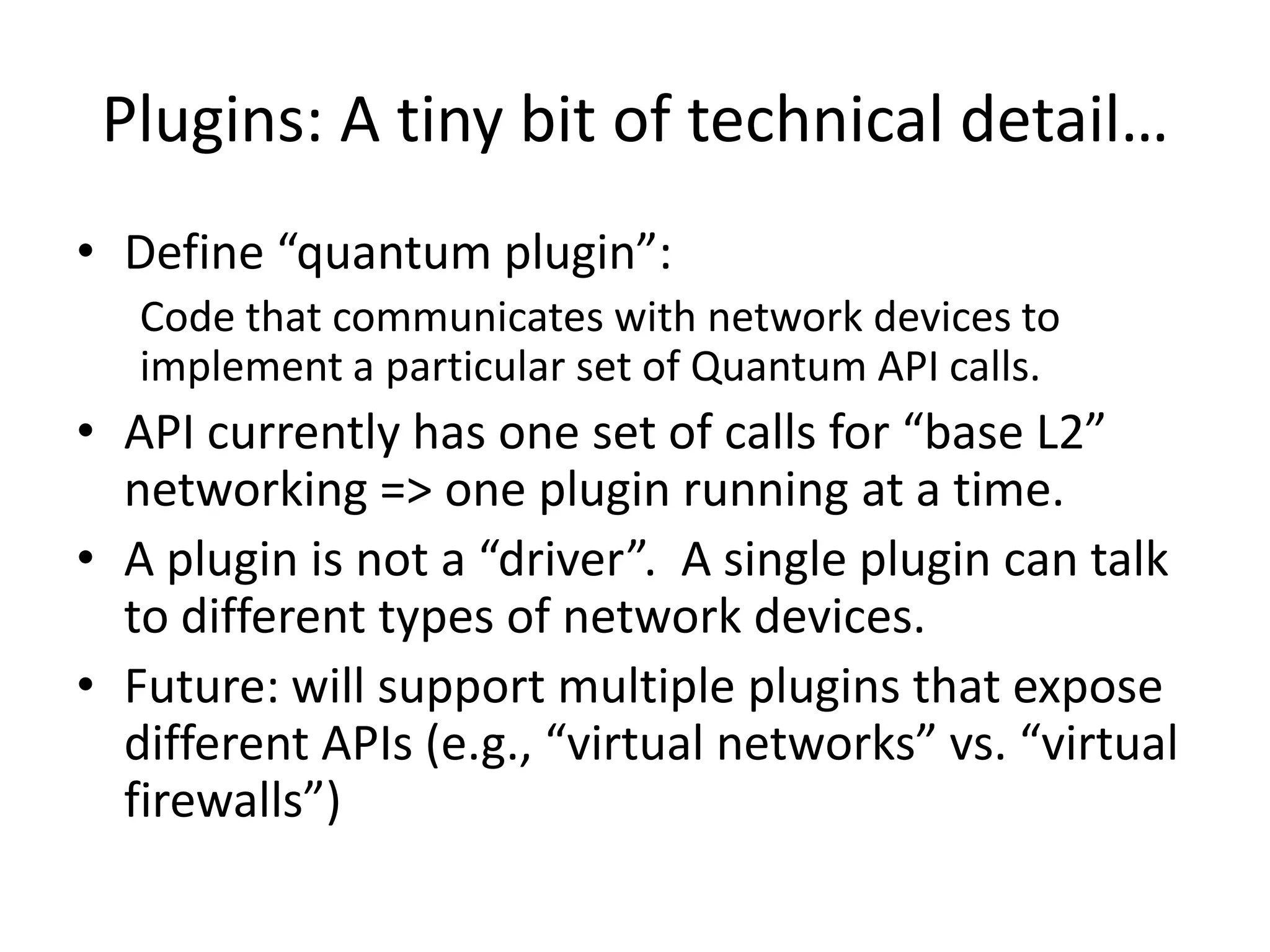
Plugins: A tiny bit of technical detail…
• Define “quantum plugin”:
   Code that communicates with network devices to
   implement a particular set of Quantum API calls.
• API currently has one set of calls for “base L2”
  networking => one plugin running at a time.
• A plugin is not a “driver”. A single plugin can talk
  to different types of network devices.
• Future: will support multiple plugins that expose
  different APIs (e.g., “virtual networks” vs. “virtual
  firewalls”)
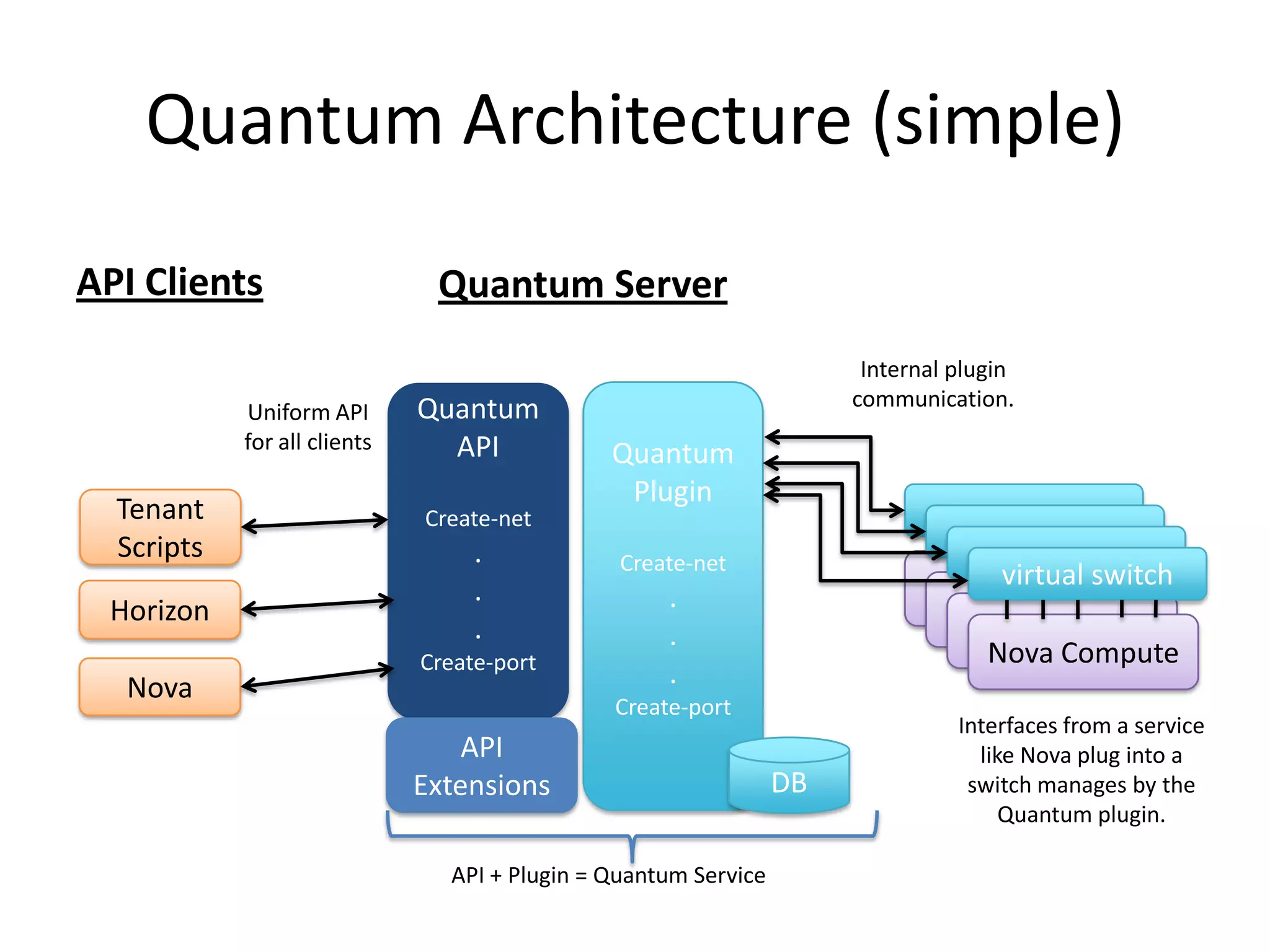
Quantum Architecture (simple)
API Clients                    Quantum Server
                                                                       Internal plugin
                              Quantum                                 communication.
            Uniform API
            for all clients     API            Quantum
                                                Plugin
  Tenant                      Create-net
  Scripts                          .            Create-net
                                                                                  virtual switch
                                                                             Nova Compute
                                   .                .
 Horizon                                                                      Nova Compute
                                   .                .                          Nova Compute
                              Create-port                                        Nova Compute
  Nova                                              .
                                               Create-port
                                                                                Interfaces from a service
                                  API                                             like Nova plug into a
                              Extensions                         DB              switch manages by the
                                                                                     Quantum plugin.

                                API + Plugin = Quantum Service
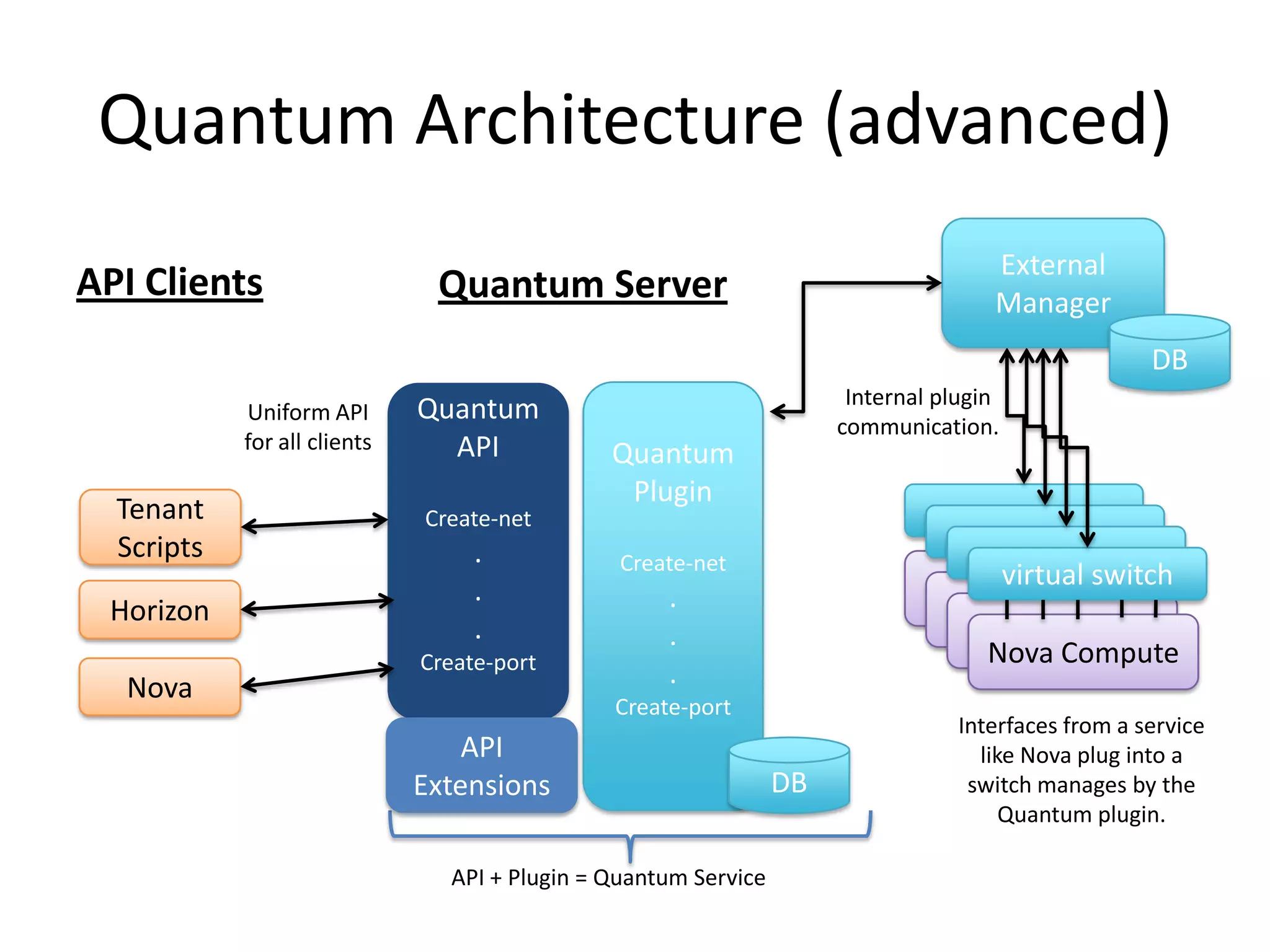
Quantum Architecture (advanced)
                                                                                     External
API Clients                    Quantum Server                                        Manager
                                                                                                    DB
                                                                       Internal plugin
            Uniform API       Quantum
                                                                      communication.
            for all clients     API            Quantum
                                                Plugin
  Tenant                      Create-net
  Scripts                          .            Create-net
                                                                                   virtual switch
                                                                              Nova Compute
                                   .                .
 Horizon                                                                       Nova Compute
                                   .                .                           Nova Compute
                              Create-port                                         Nova Compute
  Nova                                              .
                                               Create-port
                                                                                 Interfaces from a service
                                  API                                              like Nova plug into a
                              Extensions                         DB               switch manages by the
                                                                                      Quantum plugin.

                                API + Plugin = Quantum Service
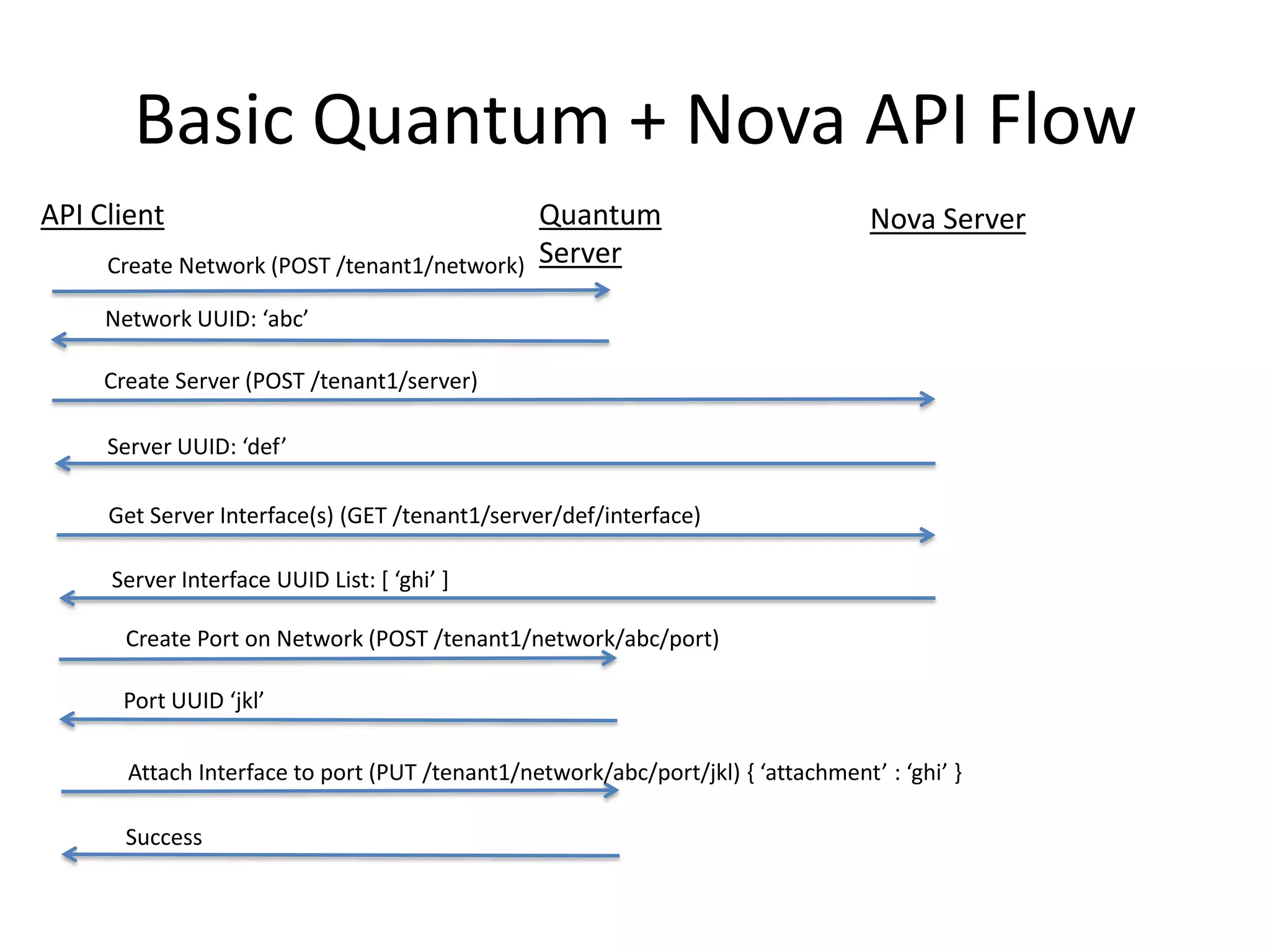
Basic Quantum + Nova API Flow
API Client                                      Quantum                           Nova Server
     Create Network (POST /tenant1/network)     Server

     Network UUID: ‘abc’

     Create Server (POST /tenant1/server)

     Server UUID: ‘def’

     Get Server Interface(s) (GET /tenant1/server/def/interface)

     Server Interface UUID List: * ‘ghi’ +

       Create Port on Network (POST /tenant1/network/abc/port)

      Port UUID ‘jkl’

       Attach Interface to port (PUT /tenant1/network/abc/port/jkl) , ‘attachment’ : ‘ghi’ -

       Success
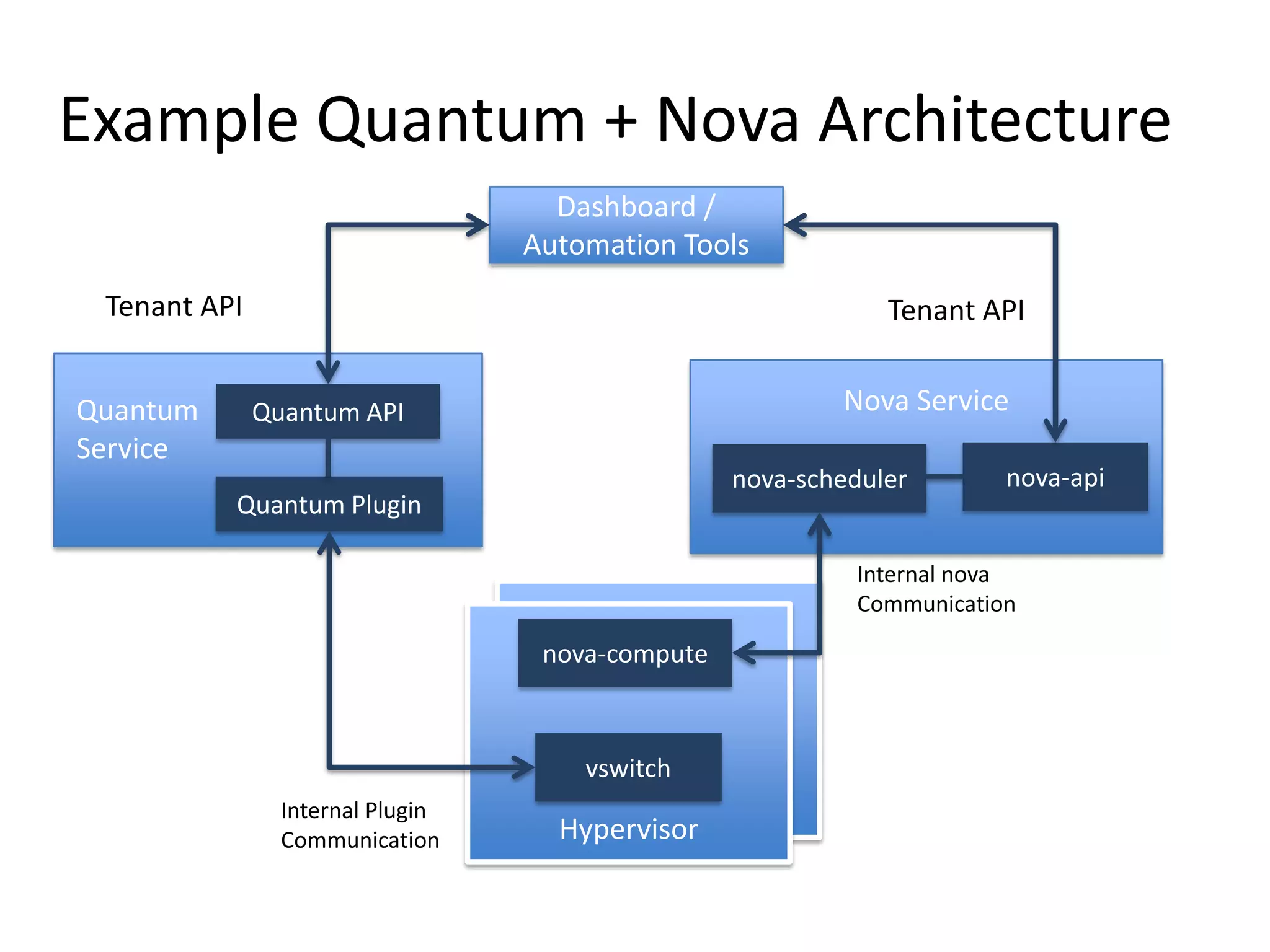
Example Quantum + Nova Architecture
                                    Dashboard /
                                  Automation Tools
 Tenant API                                                   Tenant API


Quantum       Quantum API                                 Nova Service
Service
                                                  nova-scheduler       nova-api
          Quantum Plugin

                                                           Internal nova
                                                           Communication

                                   nova-compute


                                      vswitch
                                     XenServer #1
                Internal Plugin
                Communication       Hypervisor
A plugin is not a driver
• A plugin registers to handle all Quantum API
  calls in a “group” (e.g., all network/port calls).
• Because Quantum only has one “group” of API
  calls right now, only one plugin runs at a time
  (this will change as APIs expand beyond L2).
• A single plugin may talk to multiple types of
  switches (i.e., it may have multiple “drivers”)
• “driver” code can be shared across plugins.

Quantum for Cloud Operators - Folsom Conference

  • 1.
    Intro to OpenStackQuantum for Cloud Operators Dan Wendlandt – Quantum Hacker & PTL dan@nicira.com twitter - danwendlandt
  • 2.
    Caveats • Quantum isyoung: there are lots of things that it WILL do, but doesn’t yet. • Target of talk is Cloud Operators that would deploy Quantum.
  • 3.
    Outline • Why Quantum? • What is Quantum? • Current Project Status • Demo! • Future Directions • Questions
  • 4.
  • 5.
    What is OpenStack? •Open Source Cloud Software… • A collection of “cloud services” • Each service includes: – A tenant-facing API that exposes logical abstractions for consuming the service. – One or more backend implementations of that API
  • 6.
    In the beginning.. *-as-a-ServiceCapability OpenStack Service Compute Nova Swift (Objects) Storage Glance (Images) Network ?
  • 7.
    Why Quantum? • Networkingwas sub-component of Nova • Two Key Problems: #1: Limited technology “baked in” to design. #2: No tenant control of networking.
  • 8.
    Problem #1: TechnologyLimitations • Cloud stresses networks like never before: – High-density multi-tenancy, massive scale – Strict uptime requirements. – Integrate with legacy hosting environments / remote data centers. – VM mobility • Nova provides only basic technologies: Who needs private networks? – VLANs are only option for multitenancy – Linux Bridge only Trunking all VLANs – “network controller” node is centralized is a great idea! single-point of failure for large networks. - Stone Age Man
  • 9.
    Why Quantum? #1: Leveraging Advanced Technologies • New networking technologies are emerging to try and tackle these challenges. – Software-defined Networking (SDN) / OpenFlow – Overlay tunneling: VXLAN, NVGRE, STT – Fabric solutions: FabricPath, Qfabric, etc. – [ insert other solution here ] • Quantum provides a “plugin” mechanism to enable different technologies implement calls made via the Quantum API. • Choice is a good thing!
  • 10.
    Problem #2: NoTenant Control • Cloud tenants want to replicate rich enterprise network topologies: – Ability to create “multi-tier” networks (e.g., web tier, app tier, db tier) – Control over IP addressing. – Ability to insert and configure your own services (e.g., firewall, IPS) – VPN/Bridge to remote physical hosting or customer premises (“cloudbursting”). “You can have any color as long as its black.“ • Nova provides no tenant control: - Henry Ford about the Model-T – No way to control topology. – Cloud assigns IP prefixes + addresses. – No generic service insertion.
  • 11.
    Why Quantum? Reason#2 On-demand Enterprise-Class Networking • Tenants can: – create multiple private networks – control IP addressing (bring your own!). • Quantum API extensions enable additional control: – Security, Quality-of-Service, Monitoring + Troubleshooting. • “Advanced Network Services” – Routers, Firewalls, VPN, IDS, etc.
  • 12.
    Finally, Network-as-a-Service! *-as-a-Service Capability OpenStack Service Compute Nova Swift (Objects) Storage Glance (Images) Network Quantum
  • 13.
    Why Quantum? Quantum enablesadvanced network “engines”…. that let you leave Amazon VPC in the dust…
  • 14.
  • 15.
  • 16.
    Quantum Basics (byanalogy to Nova) Nova Quantum *-as-a-service Compute Network Major API abstractions “virtual servers”: represents “virtual networks”: a host with CPU, memory, A basic L2 network segment. disk, and NICs. “virtual ports”: Attachment point for devices connecting to virtual networks. Interactions with other virtual servers use “virtual virtual ports are linked to vNICs on OpenStack services. images” from Glance. “virtual servers”. Supports different “virt-drivers” for KVM, “plugins” for Open vSwitch Cisco back-end technologies XenServer, Hyper-V, UCS, Linux Bridge, Nicira NVP, Ryu VMWare ESX Controller (and more!). API Extensibility for keypairs, instance rescue, quality-of-service, port statistics, new or back-end volumes, etc. security groups, etc. specific features.
  • 17.
    Basic API Abstractions VM1 VM2 virtual server Nova 10.0.0.2 10.0.0.3 virtual interface (VIF) virtual port Quantum Net1 virtual network 10.0.0.0/24 “virtual networks” are fundamentally multi-tenant, just like virtual servers.
  • 18.
    Quantum API Extensions •Enables innovation in virtual networking. • Add properties to existing network/port abstractions (e.g., QoS settings on virtual port, port statistics). • Can introduce new API entities (e.g., Security Groups that are linked to ports).
  • 19.
    Old Model: StaticNova Networking TenantA-VM1 TenantB-VM1 TenantA-VM2 TenantA-VM3 88.0.0.2 88.0.0.3 88.0.0.4 88.0.0.5 Public Net 88.0.0.0/18 • Single network exists (per-project or global). • VMs automatically get a vNIC on that single network on boot. • Tenants have no control over IP addressing.
  • 20.
    Quantum Model: DynamicNetwork Creation + Association TenantA-VM2 TenantA-VM3 TenantA-VM1 10.0.0.3 9.0.0.2 10.0.0.2 9.0.0.3 Tenant-A Net1 Tenant-A Net2 10.0.0.0/24 9.0.0.0/24 Public Net 88.0.0.0/18 • Tenant can use API to create many networks. • When booting a VM, define which network(s) it should connect to. • Can even plug-in instances from other services (e.g., a load-balancing service).
  • 21.
    Quantum “Plugins” • “Plugin”model give cloud operators choices: – Advanced Features (exposed as API extensions) – Cost / open vs. propriety – Scale – High Availability – Hypervisor + Network HW Compatibility – Manageability / Polish • Abstract logical API – tenants don’t see underlying technologies – Example: VLANs vs. tunneling
  • 22.
  • 23.
    Project Status: EssexCycle • Started at Diablo summit, “incubated” for Essex, “core” in Folsom. • Available at: http://launchpad.net/quantum • http://docs.openstack.org/incubation/openstack-network/admin/content/ • Current Capabilities: – v1.1 of the Quantum L2 API, with extension support. – API client library and CLI – Nova Integration via the QuantumManager (DHCP, L3/NAT) – Plugin framework & several publicly available plugins: • Open vSwitch Plugin • Cisco UCS/Nexus Plugin • Linux Bridge Plugin • Nicira Network Virtualization Platform (NVP) • Ryu OpenFlow Controller – Integrated with “devstack” (see: http://wiki.openstack.org/QuantumDevstack) – Packaging for Ubuntu 12.04 / Fedora 17 / Debian .
  • 24.
    Project Status: TwoDeployment Models • Admin-facing Quantum (available now): – Cloud admin must define networks with nova-manage. – Tenant can place VMs on different networks using nova extension (--nic option in nova client). – Allows cloud provider to leverage advanced networking technologies, but doesn’t give tenant’s network control. • Tenant-facing Quantum (Folsom Target): – Tenants can create their own networks, determine their own IP addressing via Quantum API. – Tenants can insert other logical services exposed by service provider (e.g., router, VPN) using extensions.
  • 25.
    Project Status: IsQuantum “Ready”? • “Early adopters” already putting OpenStack Quantum into production networking Panel deployments (using Essex). today @ 3:50 in Seacliff AB • Many more are testing it out. Interested in a • Folsom release is target for general demo? Let me know! adoption. Planned to be default networking option.
  • 26.
  • 27.
    Folsom Priorities: TenantControl • Enabling tenant-facing network control. – Keystone Integration – New 2.0 API (with IP address management) – Horizon Integration – Improved CLI
  • 28.
    Folsom Priorities: NetworkServices • Quantum is not just about L2 networks. • Essex already supports simple service insertion as VMs • Enable Quantum APIs for advanced services: – Quantum API extensions to control “service”. – Pluggable back-end implementations. • Achieve “Nova Parity” with L3/NAT + DHCP services: – plugins can eliminates single-point-of-failure and bottlenecks of existing nova-network implementations! – Programmatically build rich L2 + L3 topologies.
  • 29.
    Service Example: “virtualNAT router” • API to create/manage “instances” – POST /router/ • Create router, specify NAT/forwarding configuration. – PUT /router/<uuid> • Modify router later. – POST /router/<uuid>/interface • Specify network that this interface is attached to. • On demand creation of rich L2+L3 topologies.
  • 30.
    Folsom Priorities: Growingthe Quantum Community • Growing Development team • Networking Vendors: – Many planning new plugins. • OpenStack Integrators/Distros: – Get them up to speed on Quantum early. – Improve packaging, install processes. • OpenStack Users/Operators: – Improving documentation, help + support channels. – Let’s work together to stand it up!
  • 31.
    Key Takeaways • Enterprise-classOpenStack networking is here: – Leveraging advanced technologies. – Tenant control of networking. • Enable you as a cloud operator to not just copy Amazon VPC, but to innovate beyond that. • Quantum is in production today at early adopters. • Folsom is target for widespread deployment.
  • 32.
    Thanks! Questions? Dan Wendlandt – Quantum Hacker & PTL dan@nicira.com twitter - danwendlandt
  • 33.
  • 34.
    Frequently Asked Questions •Is OpenFlow required for Quantum – A: Nope! OpenFlow is just one technology that Quantum enables. • Is Quantum “software-defined networking”? – It depends… • How does Quantum compare to Amazon VPC? – A: Have similar goal of enabling advanced networking in cloud. Quantum will give cloud operators ability to compete with (and go beyond) VPC feature-set.
  • 35.
    Plugins: A tinybit of technical detail… • Define “quantum plugin”: Code that communicates with network devices to implement a particular set of Quantum API calls. • API currently has one set of calls for “base L2” networking => one plugin running at a time. • A plugin is not a “driver”. A single plugin can talk to different types of network devices. • Future: will support multiple plugins that expose different APIs (e.g., “virtual networks” vs. “virtual firewalls”)
  • 36.
    Quantum Architecture (simple) APIClients Quantum Server Internal plugin Quantum communication. Uniform API for all clients API Quantum Plugin Tenant Create-net Scripts . Create-net virtual switch Nova Compute . . Horizon Nova Compute . . Nova Compute Create-port Nova Compute Nova . Create-port Interfaces from a service API like Nova plug into a Extensions DB switch manages by the Quantum plugin. API + Plugin = Quantum Service
  • 37.
    Quantum Architecture (advanced) External API Clients Quantum Server Manager DB Internal plugin Uniform API Quantum communication. for all clients API Quantum Plugin Tenant Create-net Scripts . Create-net virtual switch Nova Compute . . Horizon Nova Compute . . Nova Compute Create-port Nova Compute Nova . Create-port Interfaces from a service API like Nova plug into a Extensions DB switch manages by the Quantum plugin. API + Plugin = Quantum Service
  • 38.
    Basic Quantum +Nova API Flow API Client Quantum Nova Server Create Network (POST /tenant1/network) Server Network UUID: ‘abc’ Create Server (POST /tenant1/server) Server UUID: ‘def’ Get Server Interface(s) (GET /tenant1/server/def/interface) Server Interface UUID List: * ‘ghi’ + Create Port on Network (POST /tenant1/network/abc/port) Port UUID ‘jkl’ Attach Interface to port (PUT /tenant1/network/abc/port/jkl) , ‘attachment’ : ‘ghi’ - Success
  • 39.
    Example Quantum +Nova Architecture Dashboard / Automation Tools Tenant API Tenant API Quantum Quantum API Nova Service Service nova-scheduler nova-api Quantum Plugin Internal nova Communication nova-compute vswitch XenServer #1 Internal Plugin Communication Hypervisor
  • 40.
    A plugin isnot a driver • A plugin registers to handle all Quantum API calls in a “group” (e.g., all network/port calls). • Because Quantum only has one “group” of API calls right now, only one plugin runs at a time (this will change as APIs expand beyond L2). • A single plugin may talk to multiple types of switches (i.e., it may have multiple “drivers”) • “driver” code can be shared across plugins.

Editor's Notes

  • #17 Common to run both Quantum and Nova on the same set of controller hosts.