OpenStack Quantum Meetup:
Grizzly Status and Blueprint Discussion
                 Dan Wendlandt
                dan@nicira.com
  Openstack Quantum Hacker & Project Team Lead
             twitter - danwendlandt
Why Quantum?
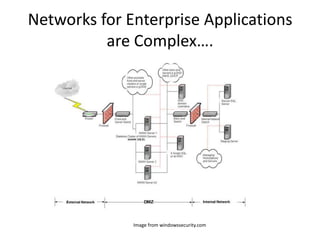
Networks for Enterprise Applications
          are Complex….


              Image from windowssecurity.com
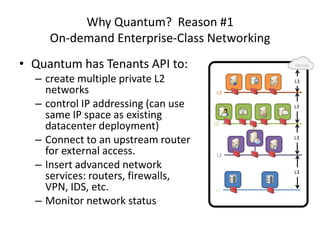
Why Quantum? Reason #1
     On-demand Enterprise-Class Networking
• Quantum has Tenants API to:                Internet


  – create multiple private L2               L3
    networks                          L2

  – control IP addressing (can use           L3
    same IP space as existing
    datacenter deployment)           L2


  – Connect to an upstream router            L3

    for external access.              L2

  – Insert advanced network                  L3
    services: routers, firewalls,
    VPN, IDS, etc.                   L2

  – Monitor network status
Cloud Stresses the Network….


• High-density multi-tenancy
   – But VLANs have trouble scaling
• On-demand provisioning
   – But traditional network solutions have interfaces designed for
     manual configuration.
• Need to place / move workloads were capacity exists
   – But network state (e.g., IP address) is tied to a particular location
Why Quantum?
          #2: Leveraging Advanced Technologies
• New networking technologies are
  emerging to try and tackle these
  challenges.
   – Network virtualization
   – Overlay tunneling: VXLAN, NVGRE, STT
   – Software-defined Networking (SDN) /
     OpenFlow
   – L2 Fabric solutions: FabricPath, Qfabric,
     etc.
   – [ insert other solution here ]

• Quantum provides a “plugin”
  mechanism to enable different
  technologies.
What is Quantum?
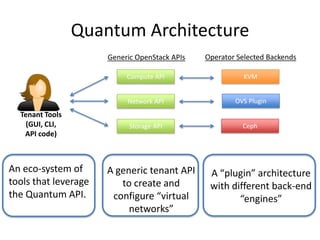
Quantum Architecture
                      Generic OpenStack APIs   Operator Selected Backends

                           Compute API                   KVM


                           Network API                 OVS Plugin
  Tenant Tools
    (GUI, CLI,              Storage API                  Ceph
   API code)


An eco-system of      A generic tenant API      A “plugin” architecture
tools that leverage      to create and          with different back-end
the Quantum API.       configure “virtual              “engines”
                           networks”
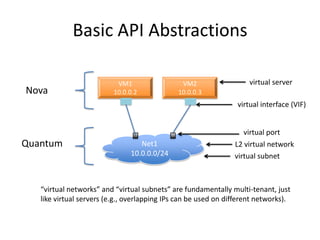
Basic API Abstractions

                           VM1                 VM2                   virtual server
Nova                      10.0.0.2            10.0.0.3
                                                                 virtual interface (VIF)


                                                                   virtual port
Quantum                           Net1                          L2 virtual network
                               10.0.0.0/24                      virtual subnet


   “virtual networks” and “virtual subnets” are fundamentally multi-tenant, just
   like virtual servers (e.g., overlapping IPs can be used on different networks).
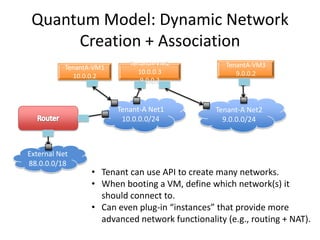
Quantum Model: Dynamic Network
      Creation + Association
                            TenantA-VM2            TenantA-VM3
           TenantA-VM1
                              10.0.0.3                9.0.0.2
             10.0.0.2
                               9.0.0.3


                         Tenant-A Net1           Tenant-A Net2
                          10.0.0.0/24              9.0.0.0/24


External Net
88.0.0.0/18
                  • Tenant can use API to create many networks.
                  • When booting a VM, define which network(s) it
                    should connect to.
                  • Can even plug-in “instances” that provide more
                    advanced network functionality (e.g., routing + NAT).
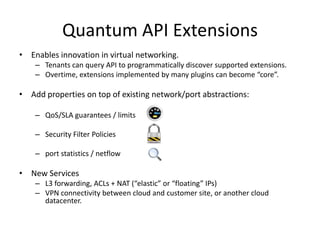
Quantum API Extensions
• Enables innovation in virtual networking.
    – Tenants can query API to programmatically discover supported extensions.
    – Overtime, extensions implemented by many plugins can become “core”.

• Add properties on top of existing network/port abstractions:

    – QoS/SLA guarantees / limits

    – Security Filter Policies

    – port statistics / netflow

• New Services
    – L3 forwarding, ACLs + NAT (“elastic” or “floating” IPs)
    – VPN connectivity between cloud and customer site, or another cloud
      datacenter.
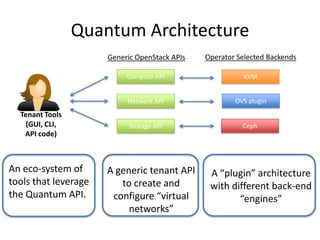
Quantum Architecture
                      Generic OpenStack APIs   Operator Selected Backends

                           Compute API                   KVM


                           Network API                 OVS plugin
  Tenant Tools
    (GUI, CLI,              Storage API                  Ceph
   API code)


An eco-system of      A generic tenant API      A “plugin” architecture
tools that leverage      to create and          with different back-end
the Quantum API.       configure “virtual              “engines”
                           networks”
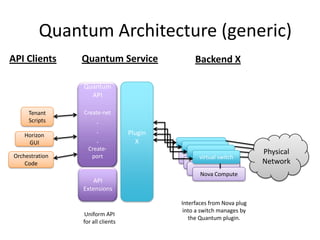
Quantum Architecture (generic)
API Clients      Quantum Service                 Backend X

                 Quantum
                   API

      Tenant     Create-net
      Scripts          .
     Horizon
                       .           Plugin
      GUI              .             X
                   Create-
 Orchestration
                                                                        Physical
                    port                          virtual switch
     Code                                                               Network
                                                   Nova Compute
                    API
                 Extensions

                                            Interfaces from Nova plug
                                             into a switch manages by
                 Uniform API
                                               the Quantum plugin.
                 for all clients
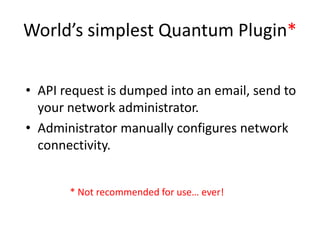
World’s simplest Quantum Plugin*

• API request is dumped into an email, send to
  your network administrator.
• Administrator manually configures network
  connectivity.


       * Not recommended for use… ever!
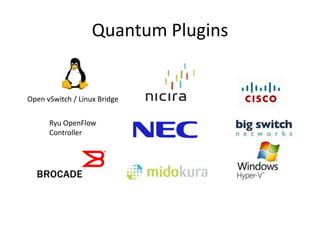
Quantum Plugins


Open vSwitch / Linux Bridge

      Ryu OpenFlow
      Controller
Quantum Plugins Trade-offs
• Different back-end “engines” present different trade-offs:
    –   Scalability
    –   Forwarding performance
    –   Hypervisor Compatibility
    –   Network HW Compat (vendor specific? Allow L3 scale-out?)
    –   Manageability / troubleshooting
    –   Advanced Features (exposed as API extensions)
    –   Production testing
    –   High Availability (control & data plane)
    –   Open source vs. Free vs. Paid

• Cloud Operators weigh trade-offs, choose a plugin.

• Note: Back-end technology hidden behind logical core API
    – Example: VLANs vs. tunneling
Project Status
A Growing Team…
Folsom
• First “core” release (Folsom, Oct. ‘12)
   – v2 API, with L2 + IP address mgmt (IPAM)
   – Tenant API with Keystone + Horizon Integration
   – Updated CLI
   – Extensions:
      •   L3 “routers” w/floating IPs
      •   “provider networks” mapped to specific VLANs
      •   Tenant quotas
      •   Notifications
Grizzly Release
       http://wiki.openstack.org/GrizzlyReleaseSchedule


• Release on April 4th.
• We are already near the end of the Grizzly
  development cycle (G-3 freeze is Feb 19th)
• Expect release candidates in March.
Grizzly Features
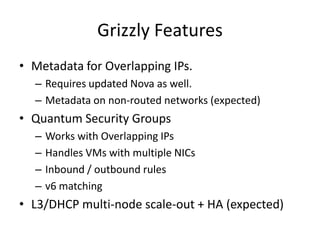
• Metadata for Overlapping IPs.
  – Requires updated Nova as well.
  – Metadata on non-routed networks (expected)
• Quantum Security Groups
  –   Works with Overlapping IPs
  –   Handles VMs with multiple NICs
  –   Inbound / outbound rules
  –   v6 matching
• L3/DHCP multi-node scale-out + HA (expected)
Grizzly Features
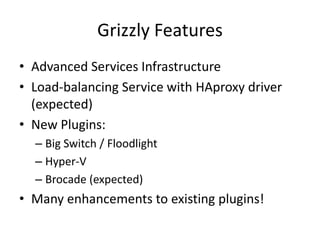
• Advanced Services Infrastructure
• Load-balancing Service with HAproxy driver
  (expected)
• New Plugins:
  – Big Switch / Floodlight
  – Hyper-V
  – Brocade (expected)
• Many enhancements to existing plugins!
Grizzly Changes in Other Projects
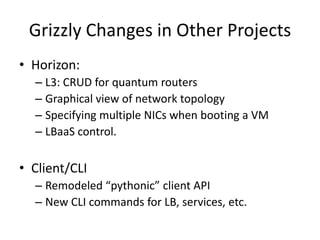
• Horizon:
  – L3: CRUD for quantum routers
  – Graphical view of network topology
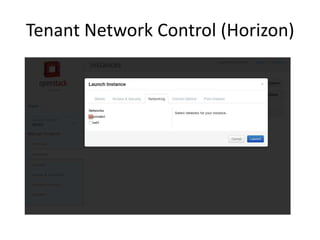
  – Specifying multiple NICs when booting a VM
  – LBaaS control.

• Client/CLI
  – Remodeled “pythonic” client API
  – New CLI commands for LB, services, etc.
Grizzly Non-Feature Improvements
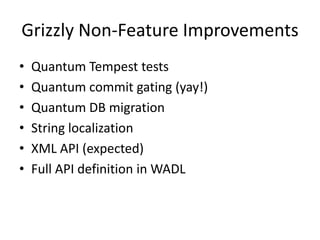
•   Quantum Tempest tests
•   Quantum commit gating (yay!)
•   Quantum DB migration
•   String localization
•   XML API (expected)
•   Full API definition in WADL
How Can You Help?
• Grab open blueprint or bug.
• http://wiki.openstack.org/QuantumStarterBugs
• Some specific highlights:
  – Vif hot plugging (Nova)
  – Auto-assign floating-ips.
  – Make sure euca-* network calls are proxied to
    Quantum (Nova)
Thanks! Questions?
            Discussion Topics?
  Slides available at: http://www.slideshare.net/danwent

               Dan Wendlandt
              dan@nicira.com
OpenStack Quantum Hacker & Project Team Lead
           twitter - danwendlandt
Backup Slides
How Can You Help?
• Test G-3 milestone and release candidates
  (Feb/March)
• Help write and validate documentation.
  – https://bugs.launchpad.net/openstack-
    manuals/+bugs?field.tag=quantum
  – https://bugs.launchpad.net/openstack-api-
    site/+bugs?field.tag=netconn-api
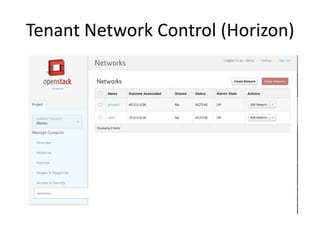
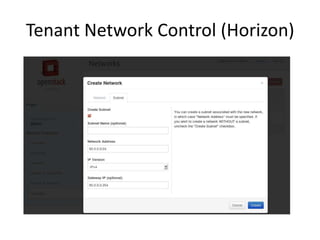
Tenant Network Control (Horizon)
Taking Quantum for a spin..
• Admin Documentation:
  – http://docs.openstack.org/trunk/openstack-
    network/admin/content/
  – Ubuntu and Red Hat deployments covered.
  – Please read the entire doc… if something is still
    unclear, send email to the list
• Or use Devstack
  – http://wiki.openstack.org/QuantumDevstack
Deployment Use Cases
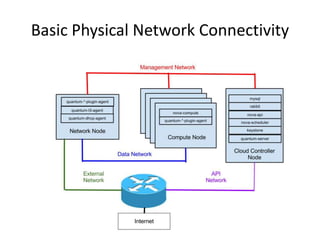
Basic Physical Network Connectivity
Two API Deployment Models
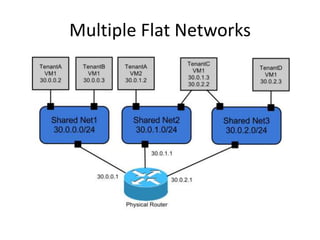
• Cloud Operator creates networks for tenants
   – Quantum API is admin only, tenants do not use it.
   – Similar to nova-network model, but with flexibility around
     network topology, IP addressing, etc.

• Expose API to tenants directly
   – True “self-service networking”.
   – Tenants use scripts, CLI, or web GUI to manage networks &
     subnets.

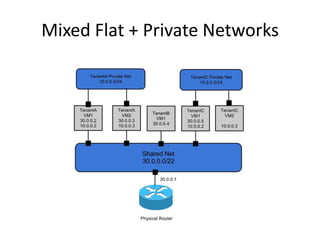
• Can also mix-and-match strategies
   – Provider creates default network connectivity, tenants can
     choose to extend.
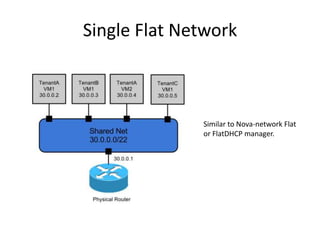
Single Flat Network


              Similar to Nova-network Flat
              or FlatDHCP manager.
Multiple Flat Networks
Mixed Flat + Private Networks
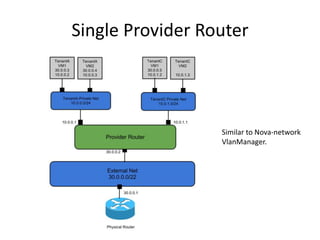
Single Provider Router


                  Similar to Nova-network
                  VlanManager.
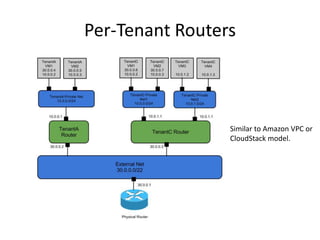
Per-Tenant Routers


                 Similar to Amazon VPC or
                 CloudStack model.

Openstack Quantum yahoo meetup 1 23-13

  • 1.
    OpenStack Quantum Meetup: GrizzlyStatus and Blueprint Discussion Dan Wendlandt dan@nicira.com Openstack Quantum Hacker & Project Team Lead twitter - danwendlandt
  • 2.
  • 3.
    Networks for EnterpriseApplications are Complex…. Image from windowssecurity.com
  • 4.
    Why Quantum? Reason#1 On-demand Enterprise-Class Networking • Quantum has Tenants API to: Internet – create multiple private L2 L3 networks L2 – control IP addressing (can use L3 same IP space as existing datacenter deployment) L2 – Connect to an upstream router L3 for external access. L2 – Insert advanced network L3 services: routers, firewalls, VPN, IDS, etc. L2 – Monitor network status
  • 5.
    Cloud Stresses theNetwork…. • High-density multi-tenancy – But VLANs have trouble scaling • On-demand provisioning – But traditional network solutions have interfaces designed for manual configuration. • Need to place / move workloads were capacity exists – But network state (e.g., IP address) is tied to a particular location
  • 6.
    Why Quantum? #2: Leveraging Advanced Technologies • New networking technologies are emerging to try and tackle these challenges. – Network virtualization – Overlay tunneling: VXLAN, NVGRE, STT – Software-defined Networking (SDN) / OpenFlow – L2 Fabric solutions: FabricPath, Qfabric, etc. – [ insert other solution here ] • Quantum provides a “plugin” mechanism to enable different technologies.
  • 7.
  • 8.
    Quantum Architecture Generic OpenStack APIs Operator Selected Backends Compute API KVM Network API OVS Plugin Tenant Tools (GUI, CLI, Storage API Ceph API code) An eco-system of A generic tenant API A “plugin” architecture tools that leverage to create and with different back-end the Quantum API. configure “virtual “engines” networks”
  • 9.
    Basic API Abstractions VM1 VM2 virtual server Nova 10.0.0.2 10.0.0.3 virtual interface (VIF) virtual port Quantum Net1 L2 virtual network 10.0.0.0/24 virtual subnet “virtual networks” and “virtual subnets” are fundamentally multi-tenant, just like virtual servers (e.g., overlapping IPs can be used on different networks).
  • 10.
    Quantum Model: DynamicNetwork Creation + Association TenantA-VM2 TenantA-VM3 TenantA-VM1 10.0.0.3 9.0.0.2 10.0.0.2 9.0.0.3 Tenant-A Net1 Tenant-A Net2 10.0.0.0/24 9.0.0.0/24 External Net 88.0.0.0/18 • Tenant can use API to create many networks. • When booting a VM, define which network(s) it should connect to. • Can even plug-in “instances” that provide more advanced network functionality (e.g., routing + NAT).
  • 11.
    Quantum API Extensions •Enables innovation in virtual networking. – Tenants can query API to programmatically discover supported extensions. – Overtime, extensions implemented by many plugins can become “core”. • Add properties on top of existing network/port abstractions: – QoS/SLA guarantees / limits – Security Filter Policies – port statistics / netflow • New Services – L3 forwarding, ACLs + NAT (“elastic” or “floating” IPs) – VPN connectivity between cloud and customer site, or another cloud datacenter.
  • 12.
    Quantum Architecture Generic OpenStack APIs Operator Selected Backends Compute API KVM Network API OVS plugin Tenant Tools (GUI, CLI, Storage API Ceph API code) An eco-system of A generic tenant API A “plugin” architecture tools that leverage to create and with different back-end the Quantum API. configure “virtual “engines” networks”
  • 13.
    Quantum Architecture (generic) APIClients Quantum Service Backend X Quantum API Tenant Create-net Scripts . Horizon . Plugin GUI . X Create- Orchestration Physical port virtual switch Code Network Nova Compute API Extensions Interfaces from Nova plug into a switch manages by Uniform API the Quantum plugin. for all clients
  • 14.
    World’s simplest QuantumPlugin* • API request is dumped into an email, send to your network administrator. • Administrator manually configures network connectivity. * Not recommended for use… ever!
  • 15.
    Quantum Plugins Open vSwitch/ Linux Bridge Ryu OpenFlow Controller
  • 16.
    Quantum Plugins Trade-offs •Different back-end “engines” present different trade-offs: – Scalability – Forwarding performance – Hypervisor Compatibility – Network HW Compat (vendor specific? Allow L3 scale-out?) – Manageability / troubleshooting – Advanced Features (exposed as API extensions) – Production testing – High Availability (control & data plane) – Open source vs. Free vs. Paid • Cloud Operators weigh trade-offs, choose a plugin. • Note: Back-end technology hidden behind logical core API – Example: VLANs vs. tunneling
  • 17.
  • 18.
  • 19.
    Folsom • First “core”release (Folsom, Oct. ‘12) – v2 API, with L2 + IP address mgmt (IPAM) – Tenant API with Keystone + Horizon Integration – Updated CLI – Extensions: • L3 “routers” w/floating IPs • “provider networks” mapped to specific VLANs • Tenant quotas • Notifications
  • 20.
    Grizzly Release http://wiki.openstack.org/GrizzlyReleaseSchedule • Release on April 4th. • We are already near the end of the Grizzly development cycle (G-3 freeze is Feb 19th) • Expect release candidates in March.
  • 21.
    Grizzly Features • Metadatafor Overlapping IPs. – Requires updated Nova as well. – Metadata on non-routed networks (expected) • Quantum Security Groups – Works with Overlapping IPs – Handles VMs with multiple NICs – Inbound / outbound rules – v6 matching • L3/DHCP multi-node scale-out + HA (expected)
  • 22.
    Grizzly Features • AdvancedServices Infrastructure • Load-balancing Service with HAproxy driver (expected) • New Plugins: – Big Switch / Floodlight – Hyper-V – Brocade (expected) • Many enhancements to existing plugins!
  • 23.
    Grizzly Changes inOther Projects • Horizon: – L3: CRUD for quantum routers – Graphical view of network topology – Specifying multiple NICs when booting a VM – LBaaS control. • Client/CLI – Remodeled “pythonic” client API – New CLI commands for LB, services, etc.
  • 24.
    Grizzly Non-Feature Improvements • Quantum Tempest tests • Quantum commit gating (yay!) • Quantum DB migration • String localization • XML API (expected) • Full API definition in WADL
  • 25.
    How Can YouHelp? • Grab open blueprint or bug. • http://wiki.openstack.org/QuantumStarterBugs • Some specific highlights: – Vif hot plugging (Nova) – Auto-assign floating-ips. – Make sure euca-* network calls are proxied to Quantum (Nova)
  • 26.
    Thanks! Questions? Discussion Topics? Slides available at: http://www.slideshare.net/danwent Dan Wendlandt dan@nicira.com OpenStack Quantum Hacker & Project Team Lead twitter - danwendlandt
  • 27.
  • 28.
    How Can YouHelp? • Test G-3 milestone and release candidates (Feb/March) • Help write and validate documentation. – https://bugs.launchpad.net/openstack- manuals/+bugs?field.tag=quantum – https://bugs.launchpad.net/openstack-api- site/+bugs?field.tag=netconn-api
  • 29.
  • 30.
  • 31.
  • 32.
    Taking Quantum fora spin.. • Admin Documentation: – http://docs.openstack.org/trunk/openstack- network/admin/content/ – Ubuntu and Red Hat deployments covered. – Please read the entire doc… if something is still unclear, send email to the list • Or use Devstack – http://wiki.openstack.org/QuantumDevstack
  • 33.
  • 34.
  • 35.
    Two API DeploymentModels • Cloud Operator creates networks for tenants – Quantum API is admin only, tenants do not use it. – Similar to nova-network model, but with flexibility around network topology, IP addressing, etc. • Expose API to tenants directly – True “self-service networking”. – Tenants use scripts, CLI, or web GUI to manage networks & subnets. • Can also mix-and-match strategies – Provider creates default network connectivity, tenants can choose to extend.
  • 36.
    Single Flat Network Similar to Nova-network Flat or FlatDHCP manager.
  • 37.
  • 38.
    Mixed Flat +Private Networks
  • 39.
    Single Provider Router Similar to Nova-network VlanManager.
  • 40.
    Per-Tenant Routers Similar to Amazon VPC or CloudStack model.