Use Cases and Reference Architectures
Laying Cinder Blocks (Volumes)
#rackstackatl
Introductions
Aaron Delp
James Ruddy
Office of the CTO
EMC
John Griffith
John Griffith
OpenStack PTL for Cinder
Solutions Architect
SolidFire
Kenneth H
Kenneth Hui
OpenStack Ambassador
Technology Evangelist
Rackspace
#rackstackatl
Agenda • Introductions
• Cinder: OpenStack Block Storage
• Cinder with Commodity Storage
• Cinder with Enterprise Storage
• SolidFire Integration
• EMC Integration
#rackstackatl
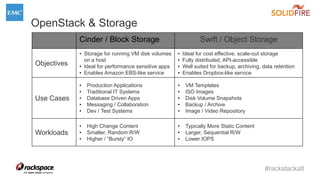
OpenStack & Storage
Cinder / Block Storage Swift / Object Storage
Objectives
• Storage for running VM disk volumes
on a host
• Ideal for performance sensitive apps
• Enables Amazon EBS-like service
• Ideal for cost effective, scale-out storage
• Fully distributed, API-accessible
• Well suited for backup, archiving, data retention
• Enables Dropbox-like service
Use Cases
• Production Applications
• Traditional IT Systems
• Database Driven Apps
• Messaging / Collaboration
• Dev / Test Systems
• VM Templates
• ISO Images
• Disk Volume Snapshots
• Backup / Archive
• Image / Video Repository
Workloads
• High Change Content
• Smaller, Random R/W
• Higher / “Bursty” IO
• Typically More Static Content
• Larger, Sequential R/W
• Lower IOPS
#rackstackatl
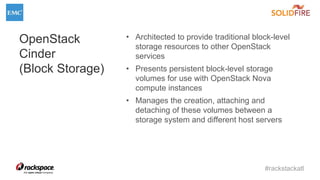
OpenStack
Cinder
(Block Storage)
• Architected to provide traditional block-level
storage resources to other OpenStack
services
• Presents persistent block-level storage
volumes for use with OpenStack Nova
compute instances
• Manages the creation, attaching and
detaching of these volumes between a
storage system and different host servers
#rackstackatl
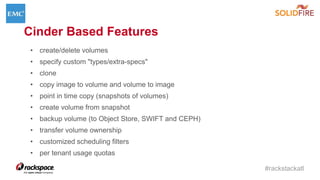
Cinder Based Features
• create/delete volumes
• specify custom "types/extra-specs"
• clone
• copy image to volume and volume to image
• point in time copy (snapshots of volumes)
• create volume from snapshot
• backup volume (to Object Store, SWIFT and CEPH)
• transfer volume ownership
• customized scheduling filters
• per tenant usage quotas
#rackstackatl
Graphic Source: http://crystaltec.com.au/services/virtualization
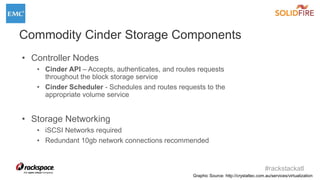
Commodity Cinder Storage Components
• Controller Nodes
• Cinder API – Accepts, authenticates, and routes requests
throughout the block storage service
• Cinder Scheduler - Schedules and routes requests to the
appropriate volume service
• Storage Networking
• iSCSI Networks required
• Redundant 10gb network connections recommended
#rackstackatl
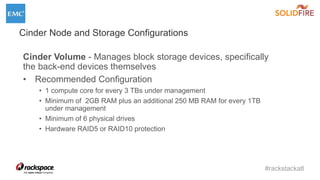
Cinder Volume - Manages block storage devices, specifically
the back-end devices themselves
• Recommended Configuration
• 1 compute core for every 3 TBs under management
• Minimum of 2GB RAM plus an additional 250 MB RAM for every 1TB
under management
• Minimum of 6 physical drives
• Hardware RAID5 or RAID10 protection
Cinder Node and Storage Configurations
#rackstackatl
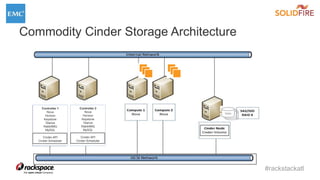
Commodity Cinder Storage Architecture
Controller 1
Nova
Horizon
Keystone
Glance
RabbitMQ
MySQL
Cinder-API
Cinder-Scheduler
Controller 2
Nova
Horizon
Keystone
Glance
RabbitMQ
MySQL
Cinder-API
Cinder-Scheduler
#rackstackatl
Graphic Source: http://crystaltec.com.au/services/virtualization
Commodity Storage Advantages
• Low initial cost during exploratory phase of deployment
• Typically very little change in procurement with known vendors
• Basic storage infrastructure knowledge
#rackstackatl
Graphic Source: http://crystaltec.com.au/services/virtualization
Commodity Storage Limitations
• Commodity storage does not support cinder node redundancy
• Commodity storage has limited or no capacity scaling
• By definition, commodity storage is basic block-storage that is
missing value-added services like:
• Advanced Quality of Service (QoS)
• Auto-tiering
• De-duplication/Compression
• Replication
#rackstackatl
Graphic Source: http://crystaltec.com.au/services/virtualization
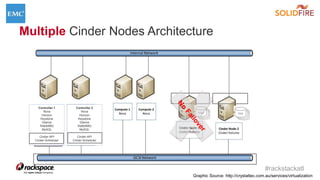
Multiple Cinder Nodes Architecture
Controller 1
Nova
Horizon
Keystone
Glance
RabbitMQ
MySQL
Cinder-API
Cinder-Scheduler
Controller 2
Nova
Horizon
Keystone
Glance
RabbitMQ
MySQL
Cinder-API
Cinder-Scheduler
#rackstackatl
Graphic Source: http://crystaltec.com.au/services/virtualization
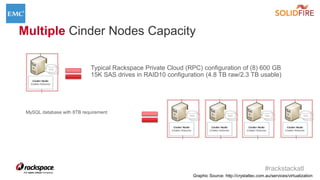
Multiple Cinder Nodes Capacity
Typical Rackspace Private Cloud (RPC) configuration of (8) 600 GB
15K SAS drives in RAID10 configuration (4.8 TB raw/2.3 TB usable)
MySQL database with 8TB requirement
#rackstackatl
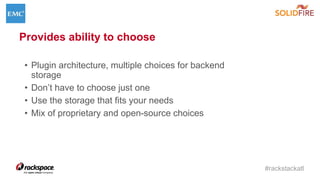
Provides ability to choose
• Plugin architecture, multiple choices for backend
storage
• Don’t have to choose just one
• Use the storage that fits your needs
• Mix of proprietary and open-source choices
#rackstackatl
Graphic Source: http://crystaltec.com.au/services/virtualization
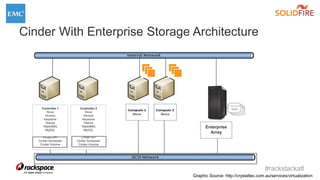
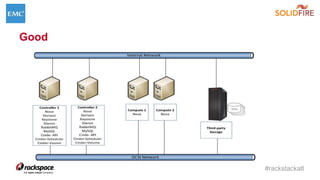
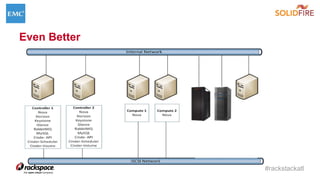
Cinder With Enterprise Storage Architecture
Enterprise
Array
Controller 1
Nova
Horizon
Keystone
Glance
RabbitMQ
MySQL
Cinder-API
Cinder-Scheduler
Cinder-Volume
Controller 2
Nova
Horizon
Keystone
Glance
RabbitMQ
MySQL
Cinder-API
Cinder-Scheduler
Cinder-Volume
#rackstackatl
Good
#rackstackatl
Even Better
#rackstackatl
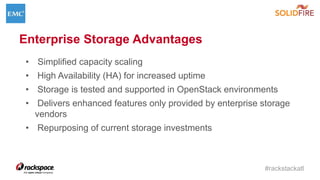
Enterprise Storage Advantages
• Simplified capacity scaling
• High Availability (HA) for increased uptime
• Storage is tested and supported in OpenStack environments
• Delivers enhanced features only provided by enterprise storage
vendors
• Repurposing of current storage investments
#rackstackatl
Proprietary/Vendors they’re not evil
• Having Vendor support in the community is good
• Choices are good
• More participation is good
• Everybody wins
• Sometimes combining Open Source and
proprietary results in best of both worlds
#rackstackatl
So how do I choose
#rackstackatl
There’s a lot to choose from
• Over two dozen backend drivers in Cinder (and
growing with each release)
• Strive for consistency (they should all work)
• Features and characteristics are what sets them
apart
#rackstackatl
Cinder Backend Devices, use what fits
#rackstackatl
Considerations Based on Experience
• High-level of integration and support with OpenStack
• Flexible scalability for ever-changing environments
• Automation integration via APIs
• Resiliency for increased reliability and uptime
• Predictable performance (not just fast)
• What will I be using it for
• What *might* I be using it for
#rackstackatl
You’re not locked in
• The intent of the Cinder design is to keep you
from being locked in
• You can easily change the backend
• Migrate the data
• Expect the same base level of functionality
#rackstackatl
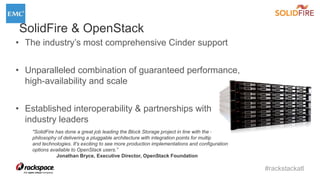
SolidFire & OpenStack
"SolidFire has done a great job leading the Block Storage project in line with the OpenStack
philosophy of delivering a pluggable architecture with integration points for multiple vendors
and technologies. It's exciting to see more production implementations and configuration
options available to OpenStack users.”
Jonathan Bryce, Executive Director, OpenStack Foundation
• The industry’s most comprehensive Cinder support
• Unparalleled combination of guaranteed performance,
high-availability and scale
• Established interoperability & partnerships with
industry leaders
#rackstackatl
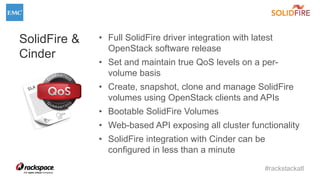
SolidFire &
Cinder
• Full SolidFire driver integration with latest
OpenStack software release
• Set and maintain true QoS levels on a per-
volume basis
• Create, snapshot, clone and manage SolidFire
volumes using OpenStack clients and APIs
• Bootable SolidFire Volumes
• Web-based API exposing all cluster functionality
• SolidFire integration with Cinder can be
configured in less than a minute
#rackstackatl
SolidFire & Cinder
• Demo of Integration
#rackstackatl
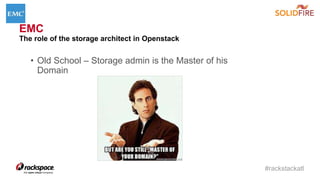
EMC
The role of the storage architect in Openstack
• Old School – Storage admin is the Master of his
Domain
#rackstackatl
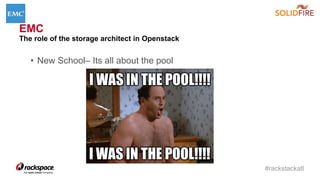
EMC
The role of the storage architect in Openstack
• New School– Its all about the pool
#rackstackatl
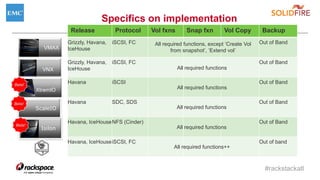
Specifics on implementation
VMAX
VNX
Isilon
ScaleIO
Beta!
XtremIO
Release Protocol Vol fxns Snap fxn Vol Copy Backup
Grizzly, Havana,
IceHouse
iSCSI, FC Out of Band
Grizzly, Havana,
IceHouse
iSCSI, FC Out of Band
Havana iSCSI Out of Band
Havana SDC, SDS Out of Band
Havana, IceHouseNFS (Cinder) Out of Band
Havana, IceHouseiSCSI, FC Out of band
Beta!
Beta!
All required functions, except ‘Create Vol
from snapshot’, ‘Extend vol’
All required functions
All required functions++
#rackstackatl
EMC & Cinder
• Demo of the new consumption model
#rackstackatl
Resources
• http://www.rackspace.com/cloud/private/
• www.solidfire.com/solutions/cloud-orchestration/openstack/
• http://theruddyduck.typepad.com/theruddyduck/2013/11/deploy-opensatck-cinder-
with-emc-vipr-part-1.html
• Podcasts: The Cloudcast.net https://itunes.apple.com/us/podcast/cloudcast-.net-
weekly-cloud/id417826820?mt=2
#rackstackatl
RACKSPACE® HOSTING | 5000 WALZEM ROAD | SAN ANTONIO, TX 78218
US SALES: 1-800-961-2888 | US SUPPORT: 1-800-961-4454 | WWW.RACKSPACE.COM
RACKSPACE® HOSTING | © RACKSPACE US, INC. | RACKSPACE® AND FANATICAL SUPPORT® ARE SERVICE MARKS OF RACKSPACE US, INC. REGISTERED IN TH E UNITED STATES AND OTHER COUNTRIES. | WWW.RACKSPACE.COMRACKSPACE® HOSTING | © RACKSPACE US, INC. | RACKSPACE® AND FANATICAL SUPPORT® ARE SERVICE MARKS OF RACKSPACE US, INC. REGISTERED IN TH E UNITED STATES AND OTHER COUNTRIES. | WWW.RACKSPACE.COM

Laying OpenStack Cinder Block Services

  • 1.
    Use Cases andReference Architectures Laying Cinder Blocks (Volumes)
  • 2.
    #rackstackatl Introductions Aaron Delp James Ruddy Officeof the CTO EMC John Griffith John Griffith OpenStack PTL for Cinder Solutions Architect SolidFire Kenneth H Kenneth Hui OpenStack Ambassador Technology Evangelist Rackspace
  • 3.
    #rackstackatl Agenda • Introductions •Cinder: OpenStack Block Storage • Cinder with Commodity Storage • Cinder with Enterprise Storage • SolidFire Integration • EMC Integration
  • 4.
    #rackstackatl OpenStack & Storage Cinder/ Block Storage Swift / Object Storage Objectives • Storage for running VM disk volumes on a host • Ideal for performance sensitive apps • Enables Amazon EBS-like service • Ideal for cost effective, scale-out storage • Fully distributed, API-accessible • Well suited for backup, archiving, data retention • Enables Dropbox-like service Use Cases • Production Applications • Traditional IT Systems • Database Driven Apps • Messaging / Collaboration • Dev / Test Systems • VM Templates • ISO Images • Disk Volume Snapshots • Backup / Archive • Image / Video Repository Workloads • High Change Content • Smaller, Random R/W • Higher / “Bursty” IO • Typically More Static Content • Larger, Sequential R/W • Lower IOPS
  • 5.
    #rackstackatl OpenStack Cinder (Block Storage) • Architectedto provide traditional block-level storage resources to other OpenStack services • Presents persistent block-level storage volumes for use with OpenStack Nova compute instances • Manages the creation, attaching and detaching of these volumes between a storage system and different host servers
  • 6.
    #rackstackatl Cinder Based Features •create/delete volumes • specify custom "types/extra-specs" • clone • copy image to volume and volume to image • point in time copy (snapshots of volumes) • create volume from snapshot • backup volume (to Object Store, SWIFT and CEPH) • transfer volume ownership • customized scheduling filters • per tenant usage quotas
  • 7.
    #rackstackatl Graphic Source: http://crystaltec.com.au/services/virtualization CommodityCinder Storage Components • Controller Nodes • Cinder API – Accepts, authenticates, and routes requests throughout the block storage service • Cinder Scheduler - Schedules and routes requests to the appropriate volume service • Storage Networking • iSCSI Networks required • Redundant 10gb network connections recommended
  • 8.
    #rackstackatl Cinder Volume -Manages block storage devices, specifically the back-end devices themselves • Recommended Configuration • 1 compute core for every 3 TBs under management • Minimum of 2GB RAM plus an additional 250 MB RAM for every 1TB under management • Minimum of 6 physical drives • Hardware RAID5 or RAID10 protection Cinder Node and Storage Configurations
  • 9.
    #rackstackatl Commodity Cinder StorageArchitecture Controller 1 Nova Horizon Keystone Glance RabbitMQ MySQL Cinder-API Cinder-Scheduler Controller 2 Nova Horizon Keystone Glance RabbitMQ MySQL Cinder-API Cinder-Scheduler
  • 10.
    #rackstackatl Graphic Source: http://crystaltec.com.au/services/virtualization CommodityStorage Advantages • Low initial cost during exploratory phase of deployment • Typically very little change in procurement with known vendors • Basic storage infrastructure knowledge
  • 11.
    #rackstackatl Graphic Source: http://crystaltec.com.au/services/virtualization CommodityStorage Limitations • Commodity storage does not support cinder node redundancy • Commodity storage has limited or no capacity scaling • By definition, commodity storage is basic block-storage that is missing value-added services like: • Advanced Quality of Service (QoS) • Auto-tiering • De-duplication/Compression • Replication
  • 12.
    #rackstackatl Graphic Source: http://crystaltec.com.au/services/virtualization MultipleCinder Nodes Architecture Controller 1 Nova Horizon Keystone Glance RabbitMQ MySQL Cinder-API Cinder-Scheduler Controller 2 Nova Horizon Keystone Glance RabbitMQ MySQL Cinder-API Cinder-Scheduler
  • 13.
    #rackstackatl Graphic Source: http://crystaltec.com.au/services/virtualization MultipleCinder Nodes Capacity Typical Rackspace Private Cloud (RPC) configuration of (8) 600 GB 15K SAS drives in RAID10 configuration (4.8 TB raw/2.3 TB usable) MySQL database with 8TB requirement
  • 14.
    #rackstackatl Provides ability tochoose • Plugin architecture, multiple choices for backend storage • Don’t have to choose just one • Use the storage that fits your needs • Mix of proprietary and open-source choices
  • 15.
    #rackstackatl Graphic Source: http://crystaltec.com.au/services/virtualization CinderWith Enterprise Storage Architecture Enterprise Array Controller 1 Nova Horizon Keystone Glance RabbitMQ MySQL Cinder-API Cinder-Scheduler Cinder-Volume Controller 2 Nova Horizon Keystone Glance RabbitMQ MySQL Cinder-API Cinder-Scheduler Cinder-Volume
  • 16.
  • 17.
  • 18.
    #rackstackatl Enterprise Storage Advantages •Simplified capacity scaling • High Availability (HA) for increased uptime • Storage is tested and supported in OpenStack environments • Delivers enhanced features only provided by enterprise storage vendors • Repurposing of current storage investments
  • 19.
    #rackstackatl Proprietary/Vendors they’re notevil • Having Vendor support in the community is good • Choices are good • More participation is good • Everybody wins • Sometimes combining Open Source and proprietary results in best of both worlds
  • 20.
  • 21.
    #rackstackatl There’s a lotto choose from • Over two dozen backend drivers in Cinder (and growing with each release) • Strive for consistency (they should all work) • Features and characteristics are what sets them apart
  • 22.
  • 23.
    #rackstackatl Considerations Based onExperience • High-level of integration and support with OpenStack • Flexible scalability for ever-changing environments • Automation integration via APIs • Resiliency for increased reliability and uptime • Predictable performance (not just fast) • What will I be using it for • What *might* I be using it for
  • 24.
    #rackstackatl You’re not lockedin • The intent of the Cinder design is to keep you from being locked in • You can easily change the backend • Migrate the data • Expect the same base level of functionality
  • 25.
    #rackstackatl SolidFire & OpenStack "SolidFirehas done a great job leading the Block Storage project in line with the OpenStack philosophy of delivering a pluggable architecture with integration points for multiple vendors and technologies. It's exciting to see more production implementations and configuration options available to OpenStack users.” Jonathan Bryce, Executive Director, OpenStack Foundation • The industry’s most comprehensive Cinder support • Unparalleled combination of guaranteed performance, high-availability and scale • Established interoperability & partnerships with industry leaders
  • 26.
    #rackstackatl SolidFire & Cinder • FullSolidFire driver integration with latest OpenStack software release • Set and maintain true QoS levels on a per- volume basis • Create, snapshot, clone and manage SolidFire volumes using OpenStack clients and APIs • Bootable SolidFire Volumes • Web-based API exposing all cluster functionality • SolidFire integration with Cinder can be configured in less than a minute
  • 27.
  • 28.
    #rackstackatl EMC The role ofthe storage architect in Openstack • Old School – Storage admin is the Master of his Domain
  • 29.
    #rackstackatl EMC The role ofthe storage architect in Openstack • New School– Its all about the pool
  • 30.
    #rackstackatl Specifics on implementation VMAX VNX Isilon ScaleIO Beta! XtremIO ReleaseProtocol Vol fxns Snap fxn Vol Copy Backup Grizzly, Havana, IceHouse iSCSI, FC Out of Band Grizzly, Havana, IceHouse iSCSI, FC Out of Band Havana iSCSI Out of Band Havana SDC, SDS Out of Band Havana, IceHouseNFS (Cinder) Out of Band Havana, IceHouseiSCSI, FC Out of band Beta! Beta! All required functions, except ‘Create Vol from snapshot’, ‘Extend vol’ All required functions All required functions All required functions All required functions All required functions++
  • 31.
    #rackstackatl EMC & Cinder •Demo of the new consumption model
  • 32.
    #rackstackatl Resources • http://www.rackspace.com/cloud/private/ • www.solidfire.com/solutions/cloud-orchestration/openstack/ •http://theruddyduck.typepad.com/theruddyduck/2013/11/deploy-opensatck-cinder- with-emc-vipr-part-1.html • Podcasts: The Cloudcast.net https://itunes.apple.com/us/podcast/cloudcast-.net- weekly-cloud/id417826820?mt=2
  • 33.
    #rackstackatl RACKSPACE® HOSTING |5000 WALZEM ROAD | SAN ANTONIO, TX 78218 US SALES: 1-800-961-2888 | US SUPPORT: 1-800-961-4454 | WWW.RACKSPACE.COM RACKSPACE® HOSTING | © RACKSPACE US, INC. | RACKSPACE® AND FANATICAL SUPPORT® ARE SERVICE MARKS OF RACKSPACE US, INC. REGISTERED IN TH E UNITED STATES AND OTHER COUNTRIES. | WWW.RACKSPACE.COMRACKSPACE® HOSTING | © RACKSPACE US, INC. | RACKSPACE® AND FANATICAL SUPPORT® ARE SERVICE MARKS OF RACKSPACE US, INC. REGISTERED IN TH E UNITED STATES AND OTHER COUNTRIES. | WWW.RACKSPACE.COM