OpenSSH: keep your secrets safe
Giovanni Bechis
<giovanni@openbsd.org>
OpenSourceDay 2015
About Me
sys admin and developer @SNB
OpenBSD developer
Open Source developer in several other projects
What is OpenSSH ?
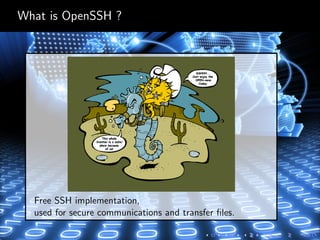
Free SSH implementation,
used for secure communications and transfer files.
What is OpenSSH ?
free license
strong crypto inside (3Des, Blowfish, AES, Arcfour)
X11 forwarding
port forwarding (cryptography for plain text
protocols)
strong authentication (Public key, One time
password, Kerberos)
file transfer
data compression
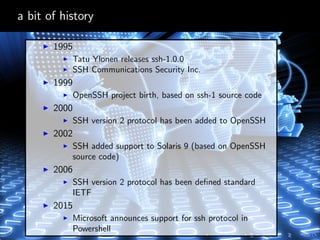
a bit of history
1995
Tatu Ylonen releases ssh-1.0.0
SSH Communications Security Inc.
1999
OpenSSH project birth, based on ssh-1 source code
2000
SSH version 2 protocol has been added to OpenSSH
2002
SSH added support to Solaris 9 (based on OpenSSH
source code)
2006
SSH version 2 protocol has been defined standard
IETF
2015
Microsoft announces support for ssh protocol in
Powershell
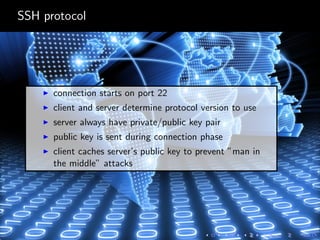
SSH protocol
connection starts on port 22
client and server determine protocol version to use
server always have private/public key pair
public key is sent during connection phase
client caches server’s public key to prevent ”man in
the middle” attacks
SSH protocol
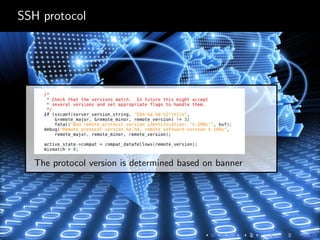
The protocol version is determined based on banner
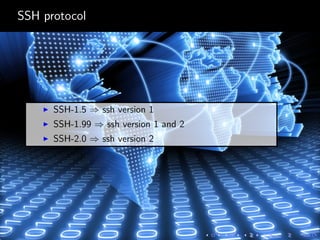
SSH protocol
SSH-1.5 ⇒ ssh version 1
SSH-1.99 ⇒ ssh version 1 and 2
SSH-2.0 ⇒ ssh version 2
SSH version 1
do not use it !!
version 1 is the original protocol version as released
by Tatu Ylonen
modified between 1995 and 1997
final version is 1.5
it has never become a standard
monolithic structure
SSH version 2, modular structure
transport protocol
manages cryptography, compression and integrity
provides ”services”
authentication protocol
permits the authentication of the client
supports many authentication methods
Password
Public key
Challenge-response
Host based
connection protocol
interactive logins
command execution
port forwarding
X11 forwarding
SSH versions
weak integrity checks in ssh 1.x crc
packets can be spoofed
lot of complex tricks to detect attacks
attacks cannot be prevented, only checked
man in the middle attacks are easier with ssh 1.x
the problem is before public key exchange phase
key exchange with D-H in ssh 2.x removes this
problem if publick keys are used
SSH 2.x is recommended because:
a lot more secure
the protocol is an IETF standard
extensible protocol
but it has more per packet overhead
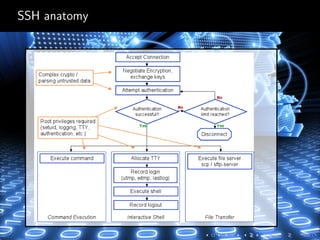
SSH anatomy
SSH code security
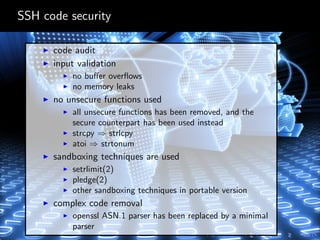
code audit
input validation
no buffer overflows
no memory leaks
no unsecure functions used
all unsecure functions has been removed, and the
secure counterpart has been used instead
strcpy ⇒ strlcpy
atoi ⇒ strtonum
sandboxing techniques are used
setrlimit(2)
pledge(2)
other sandboxing techniques in portable version
complex code removal
openssl ASN.1 parser has been replaced by a minimal
parser
SSH code security
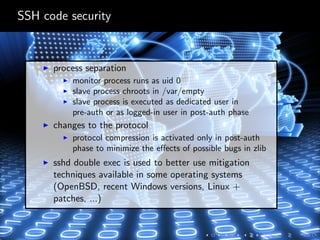
process separation
monitor process runs as uid 0
slave process chroots in /var/empty
slave process is executed as dedicated user in
pre-auth or as logged-in user in post-auth phase
changes to the protocol
protocol compression is activated only in post-auth
phase to minimize the effects of possible bugs in zlib
sshd double exec is used to better use mitigation
techniques available in some operating systems
(OpenBSD, recent Windows versions, Linux +
patches, ...)
OpenSSH configuration
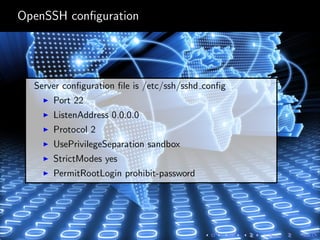
Server configuration file is /etc/ssh/sshd config
Port 22
ListenAddress 0.0.0.0
Protocol 2
UsePrivilegeSeparation sandbox
StrictModes yes
PermitRootLogin prohibit-password
OpenSSH configuration
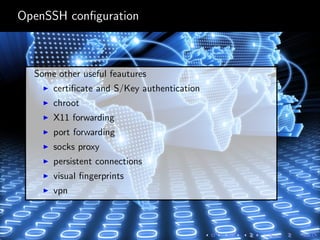
Some other useful feautures
certificate and S/Key authentication
chroot
X11 forwarding
port forwarding
socks proxy
persistent connections
visual fingerprints
vpn
Using certificates
$ ssh-keygen
Generating public/private rsa key pair.
Enter passphrase (empty for no passphrase):
Enter same passphrase again:
Your identification has been saved in id_rsa.
Your public key has been saved in id_rsa.pub.
The key fingerprint is:
SHA256:uuNH/ECxy0i1T19EHXovdbfs3e134b4Yv++PpB1dPtc giovanni@ssh-test.org
The key’s randomart image is:
+---[RSA 2048]----+
| ..o.|
| o o .|
| . + o .+|
| . + . +.=|
| . =S+ . ..oo|
| ..* . . .=*|
| .. o .+oE|
| ... . ++==|
| .oo ..+*%|
+----[SHA256]-----+
$ ssh-add
Enter passphrase for /home/giovanni/.ssh/id_rsa:
Identity added: /home/giovanni/.ssh/id_rsa (/home/giovanni/.ssh/id_rsa)
$
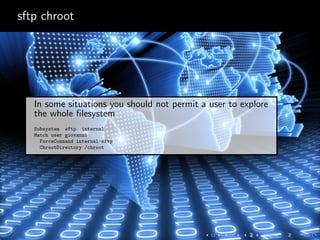
sftp chroot
In some situations you should not permit a user to explore
the whole filesystem
Subsystem sftp internal
Match user giovanni
ForceCommand internal-sftp
ChrootDirectory /chroot
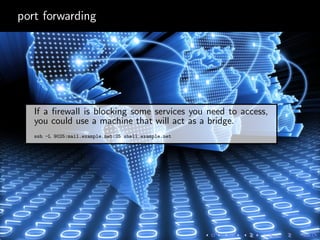
port forwarding
If a firewall is blocking some services you need to access,
you could use a machine that will act as a bridge.
ssh -L 9025:mail.example.net:25 shell.example.net
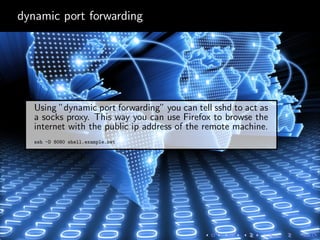
dynamic port forwarding
Using ”dynamic port forwarding” you can tell sshd to act as
a socks proxy. This way you can use Firefox to browse the
internet with the public ip address of the remote machine.
ssh -D 8080 shell.example.net
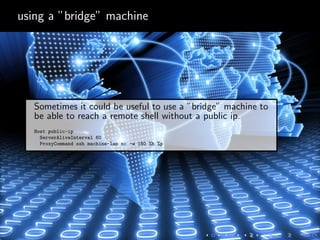
using a ”bridge” machine
Sometimes it could be useful to use a ”bridge” machine to
be able to reach a remote shell without a public ip.
Host public-ip
ServerAliveInterval 60
ProxyCommand ssh machine-lan nc -w 180 %h %p
persistent connections
If you connect more than a time to the same machine you
can avoid typing the same password all the times.
Host *
ControlMaster auto
ControlPath /tmp/%r@%h:%p
visual fingerprints
Using the visualfingerprint parameter in /etc/ssh/ssh config
you a visual fingerprint of the server you connect to will be
printed.
$ ssh shell.example.net
+---[RSA 2048]----+
| ..o.|
| o o .|
| . + o .+|
| . + . +.=|
| . =S+ . ..oo|
| ..* . . .=*|
| .. o .+oE|
| ... . ++==|
| .oo ..+*%|
+----[SHA256]-----+
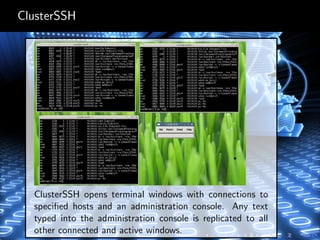
ClusterSSH
ClusterSSH opens terminal windows with connections to
specified hosts and an administration console. Any text
typed into the administration console is replicated to all
other connected and active windows.
OpenSSH: keep your secrets safe

OpenSSH: keep your secrets safe

  • 1.
    OpenSSH: keep yoursecrets safe Giovanni Bechis <giovanni@openbsd.org> OpenSourceDay 2015
  • 2.
    About Me sys adminand developer @SNB OpenBSD developer Open Source developer in several other projects
  • 3.
    What is OpenSSH? Free SSH implementation, used for secure communications and transfer files.
  • 4.
    What is OpenSSH? free license strong crypto inside (3Des, Blowfish, AES, Arcfour) X11 forwarding port forwarding (cryptography for plain text protocols) strong authentication (Public key, One time password, Kerberos) file transfer data compression
  • 5.
    a bit ofhistory 1995 Tatu Ylonen releases ssh-1.0.0 SSH Communications Security Inc. 1999 OpenSSH project birth, based on ssh-1 source code 2000 SSH version 2 protocol has been added to OpenSSH 2002 SSH added support to Solaris 9 (based on OpenSSH source code) 2006 SSH version 2 protocol has been defined standard IETF 2015 Microsoft announces support for ssh protocol in Powershell
  • 6.
    SSH protocol connection startson port 22 client and server determine protocol version to use server always have private/public key pair public key is sent during connection phase client caches server’s public key to prevent ”man in the middle” attacks
  • 7.
    SSH protocol The protocolversion is determined based on banner
  • 8.
    SSH protocol SSH-1.5 ⇒ssh version 1 SSH-1.99 ⇒ ssh version 1 and 2 SSH-2.0 ⇒ ssh version 2
  • 9.
    SSH version 1 donot use it !! version 1 is the original protocol version as released by Tatu Ylonen modified between 1995 and 1997 final version is 1.5 it has never become a standard monolithic structure
  • 10.
    SSH version 2,modular structure transport protocol manages cryptography, compression and integrity provides ”services” authentication protocol permits the authentication of the client supports many authentication methods Password Public key Challenge-response Host based connection protocol interactive logins command execution port forwarding X11 forwarding
  • 11.
    SSH versions weak integritychecks in ssh 1.x crc packets can be spoofed lot of complex tricks to detect attacks attacks cannot be prevented, only checked man in the middle attacks are easier with ssh 1.x the problem is before public key exchange phase key exchange with D-H in ssh 2.x removes this problem if publick keys are used SSH 2.x is recommended because: a lot more secure the protocol is an IETF standard extensible protocol but it has more per packet overhead
  • 12.
  • 13.
    SSH code security codeaudit input validation no buffer overflows no memory leaks no unsecure functions used all unsecure functions has been removed, and the secure counterpart has been used instead strcpy ⇒ strlcpy atoi ⇒ strtonum sandboxing techniques are used setrlimit(2) pledge(2) other sandboxing techniques in portable version complex code removal openssl ASN.1 parser has been replaced by a minimal parser
  • 14.
    SSH code security processseparation monitor process runs as uid 0 slave process chroots in /var/empty slave process is executed as dedicated user in pre-auth or as logged-in user in post-auth phase changes to the protocol protocol compression is activated only in post-auth phase to minimize the effects of possible bugs in zlib sshd double exec is used to better use mitigation techniques available in some operating systems (OpenBSD, recent Windows versions, Linux + patches, ...)
  • 15.
    OpenSSH configuration Server configurationfile is /etc/ssh/sshd config Port 22 ListenAddress 0.0.0.0 Protocol 2 UsePrivilegeSeparation sandbox StrictModes yes PermitRootLogin prohibit-password
  • 16.
    OpenSSH configuration Some otheruseful feautures certificate and S/Key authentication chroot X11 forwarding port forwarding socks proxy persistent connections visual fingerprints vpn
  • 17.
    Using certificates $ ssh-keygen Generatingpublic/private rsa key pair. Enter passphrase (empty for no passphrase): Enter same passphrase again: Your identification has been saved in id_rsa. Your public key has been saved in id_rsa.pub. The key fingerprint is: SHA256:uuNH/ECxy0i1T19EHXovdbfs3e134b4Yv++PpB1dPtc giovanni@ssh-test.org The key’s randomart image is: +---[RSA 2048]----+ | ..o.| | o o .| | . + o .+| | . + . +.=| | . =S+ . ..oo| | ..* . . .=*| | .. o .+oE| | ... . ++==| | .oo ..+*%| +----[SHA256]-----+ $ ssh-add Enter passphrase for /home/giovanni/.ssh/id_rsa: Identity added: /home/giovanni/.ssh/id_rsa (/home/giovanni/.ssh/id_rsa) $
  • 18.
    sftp chroot In somesituations you should not permit a user to explore the whole filesystem Subsystem sftp internal Match user giovanni ForceCommand internal-sftp ChrootDirectory /chroot
  • 19.
    port forwarding If afirewall is blocking some services you need to access, you could use a machine that will act as a bridge. ssh -L 9025:mail.example.net:25 shell.example.net
  • 20.
    dynamic port forwarding Using”dynamic port forwarding” you can tell sshd to act as a socks proxy. This way you can use Firefox to browse the internet with the public ip address of the remote machine. ssh -D 8080 shell.example.net
  • 21.
    using a ”bridge”machine Sometimes it could be useful to use a ”bridge” machine to be able to reach a remote shell without a public ip. Host public-ip ServerAliveInterval 60 ProxyCommand ssh machine-lan nc -w 180 %h %p
  • 22.
    persistent connections If youconnect more than a time to the same machine you can avoid typing the same password all the times. Host * ControlMaster auto ControlPath /tmp/%r@%h:%p
  • 23.
    visual fingerprints Using thevisualfingerprint parameter in /etc/ssh/ssh config you a visual fingerprint of the server you connect to will be printed. $ ssh shell.example.net +---[RSA 2048]----+ | ..o.| | o o .| | . + o .+| | . + . +.=| | . =S+ . ..oo| | ..* . . .=*| | .. o .+oE| | ... . ++==| | .oo ..+*%| +----[SHA256]-----+
  • 24.
    ClusterSSH ClusterSSH opens terminalwindows with connections to specified hosts and an administration console. Any text typed into the administration console is replicated to all other connected and active windows.