Parallel Computing


                      Submitted by:
              •Virendra Singh Yadav
•
Overview
 What is Parallel Computing
 Why Use Parallel Computing
 Concepts and Terminology
 Parallel Computer Memory Architectures
 Parallel Programming Models
 Examples
 Conclusion
What is Parallel Computing?

 Parallel computing is the simultaneous use of multiple
 compute resources to solve a computational problem.
Why Use Parallel Computing?
 Saves time

 Solve larger problems

 Cost savings

 Provide concurrency
Concepts and Terminology:
           Types Of Parallelism

   Data Parallelism


   Task Parallelism
Concepts and Terminology:
    Flynn’s Classical Taxonomy
 Distinguishes multi-processor architecture by
 instruction and data

 SISD – Single Instruction, Single Data

 SIMD – Single Instruction, Multiple Data

 MISD – Multiple Instruction, Single Data

 MIMD – Multiple Instruction, Multiple Data
Flynn’s Classical Taxonomy:
            SISD
               Serial

               Only one instruction
               and data stream is
               acted on during any
               one clock cycle
Flynn’s Classical Taxonomy:
           SIMD
               All processing units
                execute the same
                instruction at any given
                clock cycle.
               Each processing unit
                operates on a different
                data element.
Flynn’s Classical Taxonomy:
               MISD
 Different instructions operated on a single data
 element.

 Example: Multiple cryptography algorithms
 attempting to crack a single coded message.
Flynn’s Classical Taxonomy:
           MIMD
               Can execute different
                instructions on
                different data
                elements.
               Most common type of
                parallel computer.
Parallel Computer Memory Architectures:
        Shared Memory Architecture
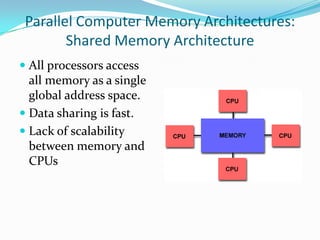
 All processors access
  all memory as a single
  global address space.
 Data sharing is fast.
 Lack of scalability
  between memory and
  CPUs
Parallel Computer Memory Architectures:
            Distributed Memory
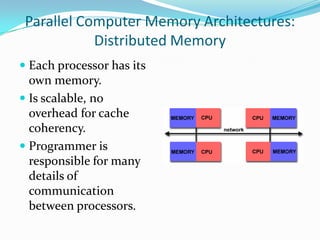
 Each processor has its
  own memory.
 Is scalable, no
  overhead for cache
  coherency.
 Programmer is
  responsible for many
  details of
  communication
  between processors.
Parallel Programming Models
  Shared Memory Model


  Messaging Passing Model


  Data Parallel Model
Parallel Programming Models:
Shared Memory Model
 In the shared-memory programming model, tasks
 share a common address space, which they read and
 write asynchronously.
 Locks may be used to control shared memory access.

 Program development can be simplified since there is
 no need to explicitly specify communication between
 tasks.
Parallel Programming Models:
   Message Passing Model
Parallel Programming Models:
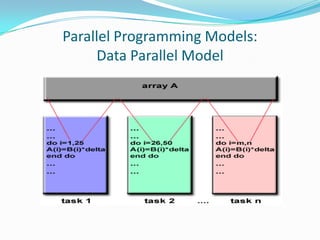
     Data Parallel Model
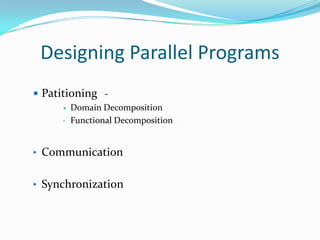
Designing Parallel Programs
 Patitioning -
         Domain Decomposition
      •   Functional Decomposition


• Communication


• Synchronization
Partition :
            Domain Decomposition
 Each task handles a portion of the data set.
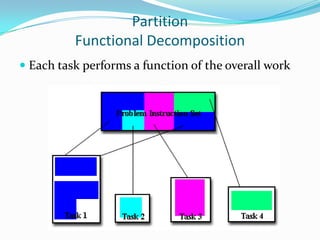
Partition
          Functional Decomposition
 Each task performs a function of the overall work
Designing Parallel Programs
              Communication

 Synchronous communications are often referred to as
 blocking communications since other work must wait
 until the communications have completed.

 Asynchronous communications allow tasks to transfer
 data independently from one another.
Designing Parallel Programs
                 Synchronization
Types of Synchronization:

 Barrier

 Lock / semaphore

 Synchronous communication operations
Example:
 As a simple example, if we are running code on a 2-
 processor system (CPUs "a" & "b") in a parallel
 environment and we wish to do tasks "A" and "B" , it is
 possible to tell CPU "a" to do task "A" and CPU "b" to
 do task 'B" simultaneously, thereby reducing the
 runtime of the execution.
Example:
Array Processing
 Serial Solution
    Perform a function on a 2D array.
    Single processor iterates through each element in the
     array
 Possible Parallel Solution
    Assign each processor a partition of the array.
    Each process iterates through its own partition.
Conclusion
 Parallel computing is fast.
 There are many different approaches and models of
  parallel computing.
References
 https://computing.llnl.gov/tutorials/parallel_comp
 Introduction to Parallel
  Computing, www.llnl.gov/computing/tutorials/paralle
  l_comp/#Whatis
 www.cs.berkeley.edu/~yelick/cs267-
  sp04/lectures/01/lect01-intro

 http://www-users.cs.umn.edu/~karypis/parbook/
Thank You

Parallel computing

  • 1.
    Parallel Computing Submitted by: •Virendra Singh Yadav •
  • 2.
    Overview  What isParallel Computing  Why Use Parallel Computing  Concepts and Terminology  Parallel Computer Memory Architectures  Parallel Programming Models  Examples  Conclusion
  • 3.
    What is ParallelComputing?  Parallel computing is the simultaneous use of multiple compute resources to solve a computational problem.
  • 5.
    Why Use ParallelComputing?  Saves time  Solve larger problems  Cost savings  Provide concurrency
  • 6.
    Concepts and Terminology: Types Of Parallelism  Data Parallelism  Task Parallelism
  • 7.
    Concepts and Terminology: Flynn’s Classical Taxonomy  Distinguishes multi-processor architecture by instruction and data  SISD – Single Instruction, Single Data  SIMD – Single Instruction, Multiple Data  MISD – Multiple Instruction, Single Data  MIMD – Multiple Instruction, Multiple Data
  • 8.
    Flynn’s Classical Taxonomy: SISD  Serial  Only one instruction and data stream is acted on during any one clock cycle
  • 9.
    Flynn’s Classical Taxonomy: SIMD  All processing units execute the same instruction at any given clock cycle.  Each processing unit operates on a different data element.
  • 10.
    Flynn’s Classical Taxonomy: MISD  Different instructions operated on a single data element.  Example: Multiple cryptography algorithms attempting to crack a single coded message.
  • 11.
    Flynn’s Classical Taxonomy: MIMD  Can execute different instructions on different data elements.  Most common type of parallel computer.
  • 12.
    Parallel Computer MemoryArchitectures: Shared Memory Architecture  All processors access all memory as a single global address space.  Data sharing is fast.  Lack of scalability between memory and CPUs
  • 13.
    Parallel Computer MemoryArchitectures: Distributed Memory  Each processor has its own memory.  Is scalable, no overhead for cache coherency.  Programmer is responsible for many details of communication between processors.
  • 14.
    Parallel Programming Models  Shared Memory Model  Messaging Passing Model  Data Parallel Model
  • 15.
    Parallel Programming Models: SharedMemory Model  In the shared-memory programming model, tasks share a common address space, which they read and write asynchronously.  Locks may be used to control shared memory access.  Program development can be simplified since there is no need to explicitly specify communication between tasks.
  • 16.
    Parallel Programming Models: Message Passing Model
  • 17.
    Parallel Programming Models: Data Parallel Model
  • 18.
    Designing Parallel Programs Patitioning -  Domain Decomposition • Functional Decomposition • Communication • Synchronization
  • 19.
    Partition : Domain Decomposition  Each task handles a portion of the data set.
  • 20.
    Partition Functional Decomposition  Each task performs a function of the overall work
  • 21.
    Designing Parallel Programs Communication  Synchronous communications are often referred to as blocking communications since other work must wait until the communications have completed.  Asynchronous communications allow tasks to transfer data independently from one another.
  • 22.
    Designing Parallel Programs Synchronization Types of Synchronization:  Barrier  Lock / semaphore  Synchronous communication operations
  • 23.
    Example:  As asimple example, if we are running code on a 2- processor system (CPUs "a" & "b") in a parallel environment and we wish to do tasks "A" and "B" , it is possible to tell CPU "a" to do task "A" and CPU "b" to do task 'B" simultaneously, thereby reducing the runtime of the execution.
  • 24.
    Example: Array Processing  SerialSolution  Perform a function on a 2D array.  Single processor iterates through each element in the array  Possible Parallel Solution  Assign each processor a partition of the array.  Each process iterates through its own partition.
  • 25.
    Conclusion  Parallel computingis fast.  There are many different approaches and models of parallel computing.
  • 26.
    References  https://computing.llnl.gov/tutorials/parallel_comp  Introductionto Parallel Computing, www.llnl.gov/computing/tutorials/paralle l_comp/#Whatis  www.cs.berkeley.edu/~yelick/cs267- sp04/lectures/01/lect01-intro  http://www-users.cs.umn.edu/~karypis/parbook/
  • 27.