OpenID for SSI
Kristina Yasuda, Microsoft
Dr. Torsten Lodderstedt, yes.com
OpenID for SSI
• Aims at specifying a set of protocols based on OpenID
Connect and OAuth2.0 to enable SSI applications
• Initiative conducted at OpenID Foundation in liaison with the
Decentralized Identity Foundation (DIF)
• One of the specifications is built up on DID-SIOP in DIDAuth
WG in DIF and SIOPv1 chapter 7 in OIDC Core
- Self-Issued OP (SIOP) already provides good starting point
- Leveraging the simplicity and security of OpenID Connect and
OAuth2.0 for SSI applications
- Existing libraries, only HTTPS communication, developer familiarity
- Great for mobile applications, no firewall hassles
- Security of OpenID Connect has been tested and formally analysed
- Allow existing OpenID Connect RPs to access SSI credentials and
existing OpenID Connect OPs to issue credentials
Why use OpenID Connect/OAuth2.0 as basis?
③ OpenID Connect for Verifiable Credential Issuance
(Issuance of Verifiable Credentials)
OpenID Connect for SSI Components
Issuer
(Website)
Verifier
(Website)
Holder
(Digital Wallet)
Issue
Credentials
Present
Credentials
① Self-Issued OP v2
(key exchange and authentication)
② OpenID Connect for Verifiable Presentations
(Presentation of Verifiable Credentials)
Can be hosted locally on the
user’s device, have cloud
components, or be entirely
hosted in the cloud
Using OIDC4SSI as an authentication protocol to present and issue credentials allows implementers to
choose a combination of DID methods, credential formats and other components of the SSI tech stack.
OIDC4SSI allows variety of choices in the SSI tech stack
SSI Tech Stack component Implementer’s choices when using OIDC4SSI as a protocol
Identifiers Any DID method
- user’s identifier can also be a JWK Thumbprint (`sub` in the ID Token)
- verifier’s identifier can also be a unique string (`client_id` in the request)
Credential Format Any credential format (AnonCreds, LDP-VC, JWT-VC, ISO mDL, etc.)
Revocation Any mechanism (Status List 2021, etc.)
additional trust
mechanisms
Any mechanism (.well-known DID configuration, etc.)
Cryptography Any cryptosuite (EdDSA, ES256K, etc.)
some use-cases…
SIOPv2
Standard OpenID Connect vs SIOP v2
Self-Issued OP model
⓪ User tries to get
access to a resource
Website (RP)
User
Agent
OP
Trust in cryptographically
verifiable identifier
② OP on the user
device issues
subject-signed ID Token
Alice
User-controlled OpenID Connect OP is able to self-sign ID
Tokens and authenticate using the user-controlled key
material (raw public keys or Decentralized identifiers (DIDs))
① RP requests ID Token
OpenID Connect standard model
⓪ User tries to log in
Website (RP)
User
Agent
OP
(3P OpenID Provider)
Trust in 3rd party
Alice ② 3rd Party OP
issues an ID Token
① RP requests ID
Token
OpenID Connect for Verifiable Presentations
Credential
Issuer
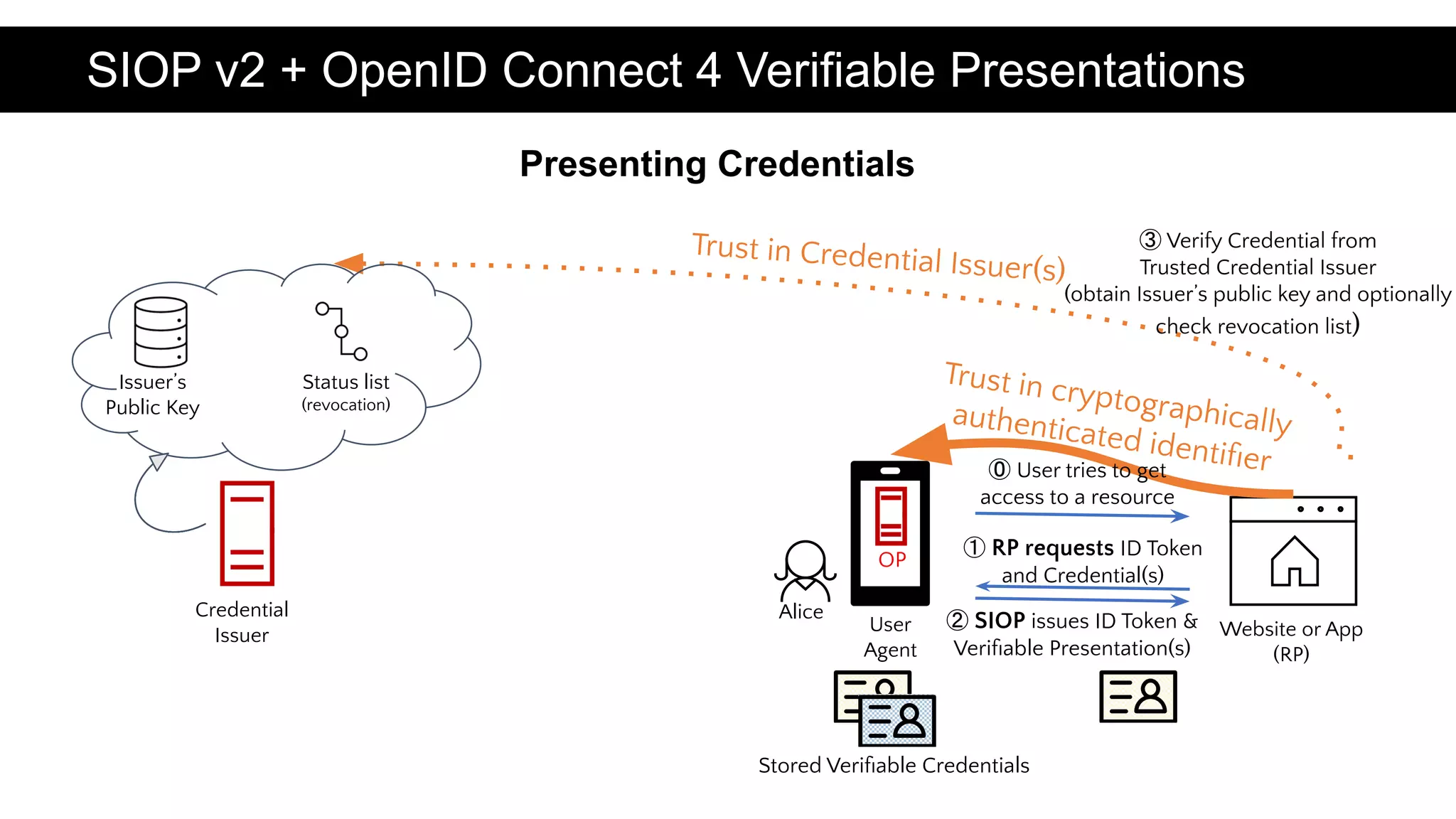
③ Verify Credential from
Trusted Credential Issuer
(obtain Issuer’s public key and optionally
check revocation list)
SIOP v2 + OpenID Connect 4 Verifiable Presentations
Presenting Credentials
Website or App
(RP)
User
Agent
OP
Alice
Trust in cryptographically
authenticated identifier
⓪ User tries to get
access to a resource
Stored Verifiable Credentials
Trust in Credential Issuer(s)
② SIOP issues ID Token &
Verifiable Presentation(s)
① RP requests ID Token
and Credential(s)
Status list
(revocation)
Issuer’s
Public Key
- Protocol is credential/presentation format agnostic
- Examples for AnonCreds and mDL in OIDC4VP spec
- passing `presentation_definition` PE object by value or by reference
- Support for Trust Schemes
- for example, request credentials issued by an issuer that is part of a Trust Framework
- Dynamic SIOP discovery and invocation via HTTPS URLs
- enables use of app/universal links and web wallets
- Leverages all OpenID Connect Flows
- SIOP can be entirely locally hosted, have cloud components, be entirely cloud-based
- Cross Device Flow enabled
- Leverages OpenID Connect Metadata for verifiers and wallet management
- Clarify that the key feature of SIOP is ability to sign ID Token using a subject-controlled key material
(iss==sub in ID Token)
- Ongoing: wallet & key attestation
Credentials Presentation (Key & New Features)
- First Implementer’s Drafts of OpenID Connect SIOPV2 and OIDC4VP approved.
Targeting Second Implementer’s Draft by the end of 2022
- Latest Editor’s drafts can be published at:
- https://openid.net/specs/openid-connect-self-issued-v2-1_0.html
- https://openid.net/specs/openid-connect-4-verifiable-presentations-1_0.html
- Existing & ongoing Implementations:
- The European Blockchain Services Infrastructure (EBSI)
- Microsoft
- Workday
- Ping Identity
- Convergence.Tech
- IDunion
- walt.id (eSSIF-Lab)*
- Sphereon
- Gimly
*Some ESSIF projects already utilizes SIOP (based on DID-SIOP & OpenID Connect 4 Identity Assurance)
Credential Presentation (Status)
Demo
Credential Presentation
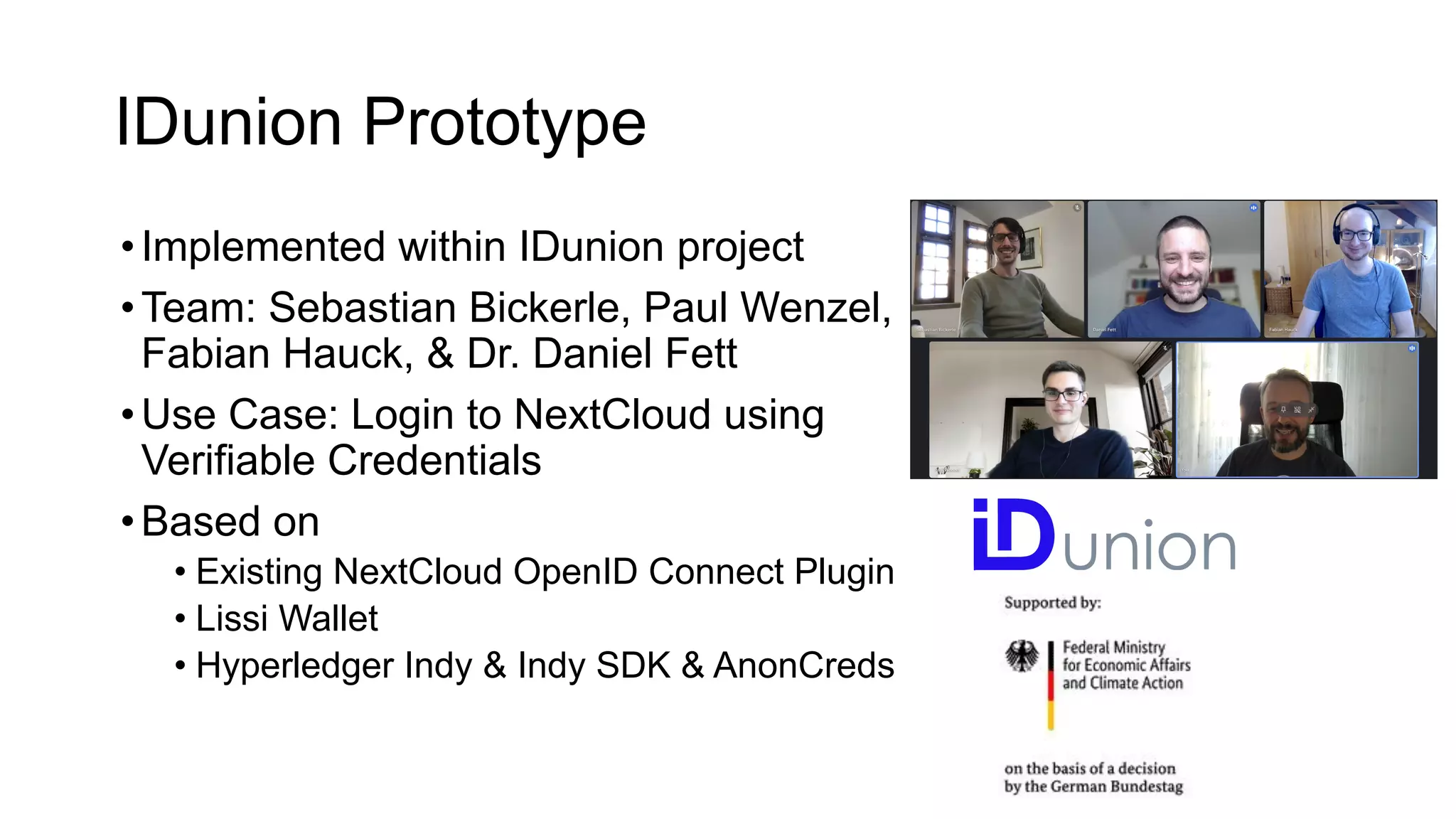
IDunion Prototype
•Implemented within IDunion project
•Team: Sebastian Bickerle, Paul Wenzel,
Fabian Hauck, & Dr. Daniel Fett
•Use Case: Login to NextCloud using
Verifiable Credentials
•Based on
• Existing NextCloud OpenID Connect Plugin
• Lissi Wallet
• Hyperledger Indy & Indy SDK & AnonCreds
European Banking Identity Prototype
•eSSIF-Lab founded project
•Team: yes.com & walt.id
• Presentation & Issuance via OIDC4SSI
•Based on
• walt.id Wallet (Web Wallet)
• JSON LD based credentials
• did:key (did:ebsi)
eSSIF-Lab is funded by the European Commission, as
part of the Horizon 2020 Research and Innovation
Programme, under Grant Agreement Nº 871932 and it's
framed under Next Generation Internet Initiative.
Architecture
Verifier
Ledger
Frontend Wallet
redirects (HTTPS GET)
(3) “response”
(HTTPS POST)
Backend
polling
on device
cross device
ledger access
(1) QR Code
e.g. DID resolution, revocation info, schema and credential definition
(2) Request payload
(GET request_uri)
Request Example ESSIF Lab (W3C VC)
{
"response_type"
:"id_token",
"client_id":"https://example.com/callback"
,
"scope":"openid",
"redirect_uri"
:"https://example.com/callback"
,
"nonce":"67473895393019470130"
,
...
"claims":{
"vp_token":{
"presentation_definition"
:{
"id":"1",
"input_descriptors"
:[
{
"id":"1",
"schema":{
"uri":"https://raw.githubusercontent.com/…/EuropeanBankIdentity.json"
}
}
]
}
}
}
}
Response Example ESSIF Lab (W3C VC)
{
"iss": "https://self-issued.me/v2",
"aud": "https://example.com/callback",
"sub": "did:key:z6MkqUDiu3MHxAm...mscLT8E9R5CKdbtr7gwR8",
"exp": 1645469476,
"iat": 1645465876,
"nonce": "cdb97870-a3be-49b4-aa55-8c7c7122178a",
"_vp_token": {
"presentation_submission": {
"descriptor_map": [
{
"path": "$",
"format": "ldp_vp",
"path_nested": {
"path": "$.verifiableCredential[0]",
"format": "ldp_vc"
}
],
"definition_id": "1",
"id": "1"
}
}
}
{
"@context" :[
"https://www.w3.org/2018/credentials/v1"
],
"holder" :"did:key:z6MkqUDiu3MHxAmuMQ8jjkLiUu1mscLT8E9R5CKdbtr7gwR8" ,
"id":"urn:uuid:04816f2a-85f1-45d7-a66d-51764d39a569" ,
"proof":{
"domain" :"https://example.com/callback" ,
"jws" :"...",
"nonce":"cdb97870-a3be-49b4-aa55-8c7c7122178a" ,
"proofPurpose" :"authentication" ,
"type":"Ed25519Signature2018" ,
"verificationMethod" :"did:key:z6MkqUDiu3 ..."
},
"type":[
"VerifiablePresentation"
],
"verifiableCredential" :[
{
…
"type":[
"VerifiableCredential" ,
"EuropeanBankIdentity"
],
"credentialSubject" :{
"id":"did:key:z6MkqUDiu3MHxAmuMQ8jjkLiUu1mscLT8E9R5CKdbtr7gwR8" ,
"familyName" :"Family001" ,
"givenName" :"Given001" ,
"birthDate" :"1950-01-01" ,
"placeOfBirth" :{
"country" :"DE",
"locality" :"Berlin"
}
},
ID Token VP Token
Request Example IDunion (AnonCred)
{
"response_type" :"id_token" ,
"client_id" :"https://example.com/callback" ,
"scope":"openid" ,
"redirect_uri" :"https://example.com/callback ",
"nonce":"67473895393019470130" ,
...
"claims" :{
"vp_token" :{
"presentation_definition" :{
"id":"NextcloudLogin" ,
"input_descriptors" :[
{
"id":"ref2",
"name":"NextcloudCredential" ,
"format" : {
"ac_vc": {
"proof_type" : ["CLSignature2019" ]
}
},
"constraints" :{
"limit_disclosure" :"required" ,
"fields":[{
"path": [
"$.schema_id"
],
"filter": {
"type": "string" ,
"pattern": "did:indy:idu:test:3QowxFtwciWceMFr7WbwnM:2:BasicScheme:0.1"
}
},
{"path":[ "$.values.email" ]},
{ "path":["$.values.first_name" ]},
{ "path":["$.values.last_name" ]}]
}
}
Response Example IDunion (AnonCred)
{
"aud": "https://example.com/callback ",
"sub": "9wgU5CR6PdgGmvBfgz_CqAtBxJ33ckMEwvij-gC6Bcw" ,
"auth_time" : 1638483344 ,
"iss": "https://self-issued.me/v2" ,
"sub_jwk" : {
"x": "cQ5fu5VmG…dA_5lTMGcoyQE78RrqQ6" ,
"kty": "EC",
"y": "XHpi27YMA…rnF_-f_ASULPTmUmTS" ,
"crv": "P-384"
},
"exp": 1638483944 ,
"iat": 1638483344 ,
"nonce": "67473895393019470130 ",
"_vp_token" : {
"presentation_submission" : {
"descriptor_map" : [
{
"id": "ref2",
"path": "$",
"format" : "ac_vp",
"path_nested" : {
"path":
"$.requested_proof.revealed_attr_groups.ref2",
"format" : "ac_vc"
}
}
],
"definition_id" : "NextcloudLogin" ,
"id": "NexcloudCredentialPresentationSubmission"
}
}
}
{
"proof": {...},
"requested_proof": {
"revealed_attrs" : {},
"revealed_attr_groups": {
"ref2": {
"sub_proof_index" : 0,
"values" : {
"email": {
"raw": "alice@example.com" ,
"encoded" : "115589951…83915671017846"
},
"last_name" : {
"raw": "Wonderland" ,
"encoded" : "167908493…94017654562035"
},
"first_name" : {
"raw": "Alice",
"encoded" : "270346400…99344178781507"
}
}
}
},
…
},
"identifiers" : [
{
"schema_id" : "3QowxFtwciWceMFr7WbwnM:2:BasicScheme:0.1" ,
"cred_def_id" : "CsiDLAiFkQb9N4NDJKUagd:3:CL:4687:awesome_cred" ,
"rev_reg_id" : null,
"timestamp" : null
}
]
}
ID Token VP Token
OpenID for Credential Issuance
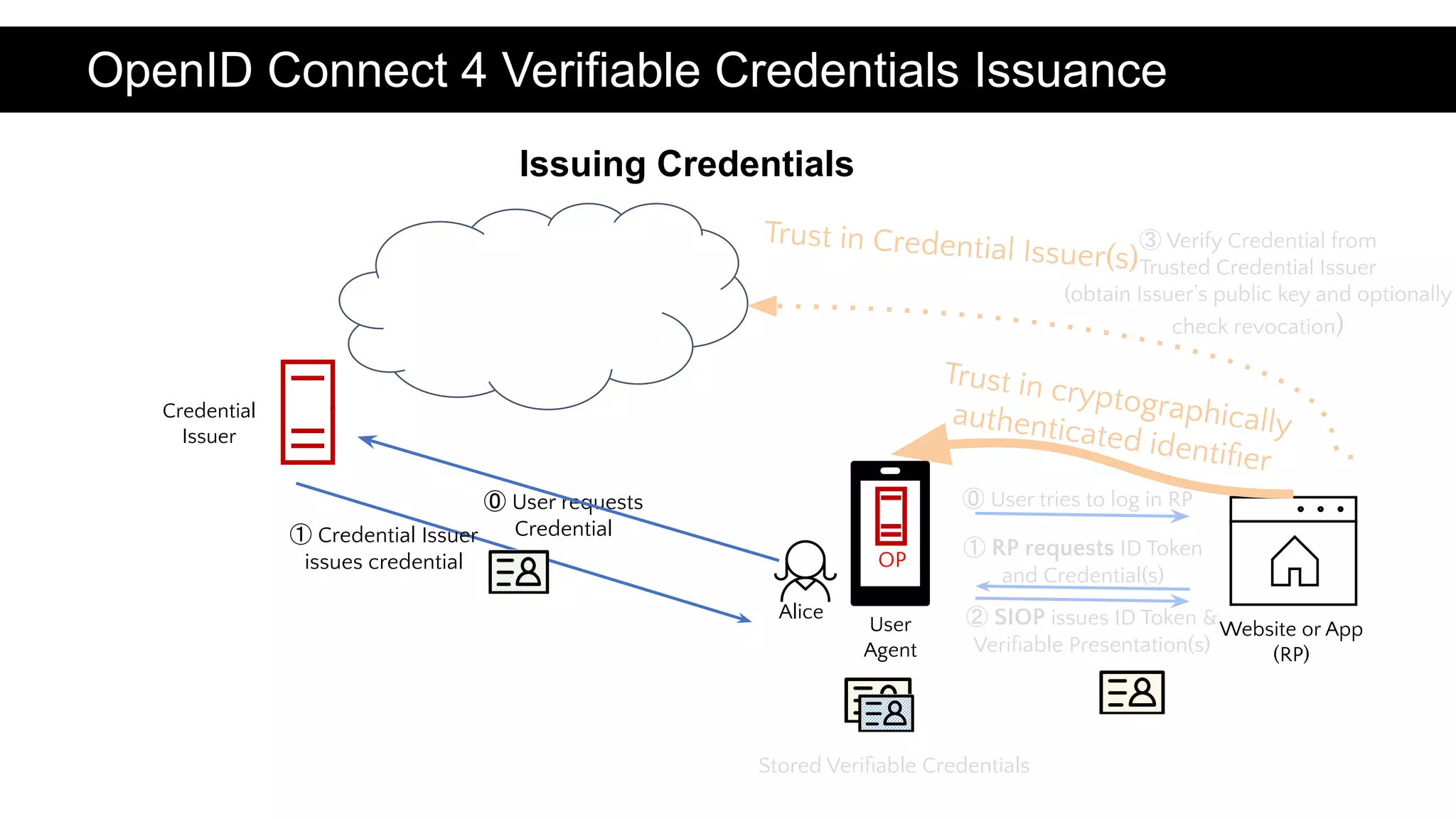
Credential
Issuer
③ Verify Credential from
Trusted Credential Issuer
(obtain Issuer’s public key and optionally
check revocation)
OpenID Connect 4 Verifiable Credentials Issuance
Issuing Credentials
Website or App
(RP)
User
Agent
OP
Alice
Trust in cryptographically
authenticated identifier
⓪ User tries to log in RP
Stored Verifiable Credentials
Trust in Credential Issuer(s)
② SIOP issues ID Token &
Verifiable Presentation(s)
① RP requests ID Token
and Credential(s)
⓪ User requests
Credential
① Credential Issuer
issues credential
- Issuance via OAuth-protected Credential Endpoint
- Currently two authorization flows:
- Code flow (others possible)
■ invoked by Wallet requesting authorization for one or more credentials at
the Authorization Endpoint (may trigger by presentation request during
the issuance)
■ Issuer takes screen control and can authenticate/identify user with
means at Issuer’s discretion
- Pre-authorized code flow (new grant type)
■ Wallet is invoked after completion of process with the Issuer (QR Code
or redirect)
Design Principles
- Protocol is credential format agnostic
- W3C Verifiable Credentials, ISO mobile Driving Licence/electronic ID, SMART Health Cards
- Can be customized to use different methods for proofs of possession of key material
- for example, `jwt` proof type that includes a signature by a key material tied to a DID
- Allows Credential Issuance during Presentation Request (inline issuance)
- Requested credential not found in the wallet
- Allows just-in-time and batch credential issuance as well as credential refresh
- Allows Presentation Request during Credential Issuance
- Issuer is requesting to present a VC as a way to identify a user during Issuance
- Can be built on top of existing OAuth/OpenID implementations
- Leverages OpenID Connect Metadata for wallet & issuer management
- Ongoing: wallet & key attestation to build Issuer’s trust in the wallet
Credential Issuance (Key Features)
- Specification adopted by the working group. Targeting First Implementer’s draft
by the end of 2022.
- https://openid.net/specs/openid-connect-4-verifiable-credential-issuance-1_0.html
- Planned and ongoing implementations:
- The European Blockchain Services Infrastructure (EBSI)
- Microsoft
- Mattr
- IDunion
- walt.id & yes.com & BCDiploma (eSSIF-Lab)
- Sphereon
- Talao.io
- Convergence.Tech
Credential Issuance (Status)
Demo
Credential Issuance
European Banking Identity Prototype
•eSSIF-Lab founded project
•Team: yes.com & walt.id
• Presentation & Issuance via OIDC4SSI
•Based on
• walt.id Wallet (Web Wallet)
• JSON LD based credentials
• did:key (did:ebsi)
eSSIF-Lab is funded by the European Commission, as
part of the Horizon 2020 Research and Innovation
Programme, under Grant Agreement Nº 871932 and it's
framed under Next Generation Internet Initiative.
Authorization Request
HTTP/1.1 302 Found
Location: https://server.example.com/authorize?
response_type=code
&client_id=s6BhdRkqt3
&code_challenge=E9Melhoa2OwvFrEMTJguCHaoeK1t8URWbuGJSstw-cM
&code_challenge_method=S256
&scope=openid_credential:ttps://…/EuropeanBankIdentity.json
&redirect_uri=https://client.example.org/cb
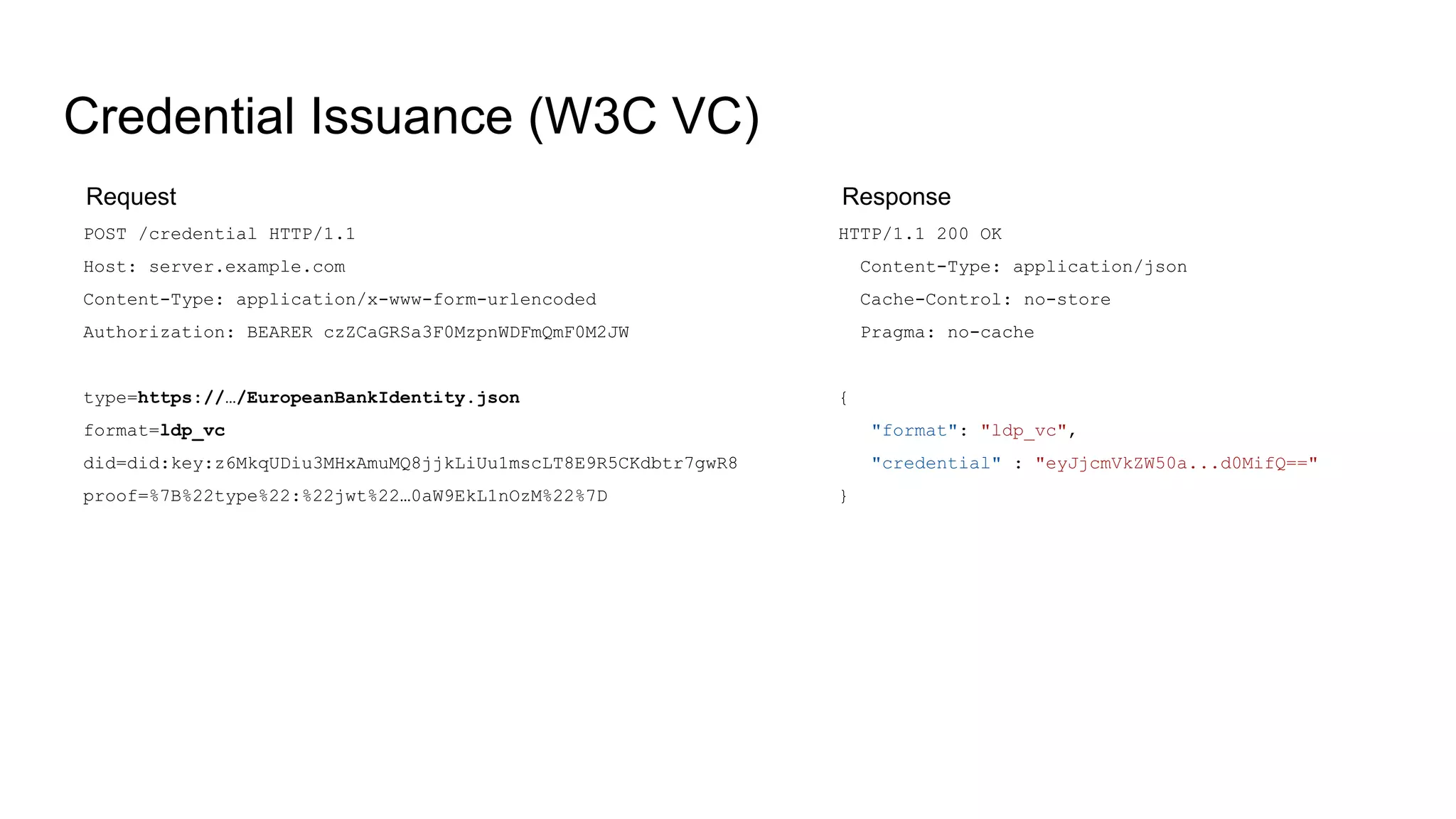
Credential Issuance (W3C VC)
HTTP/1.1 200 OK
Content-Type: application/json
Cache-Control: no-store
Pragma: no-cache
{
"format": "ldp_vc",
"credential" : "eyJjcmVkZW50a...d0MifQ=="
}
POST /credential HTTP/1.1
Host: server.example.com
Content-Type: application/x-www-form-urlencoded
Authorization: BEARER czZCaGRSa3F0MzpnWDFmQmF0M2JW
type=https://…/EuropeanBankIdentity.json
format=ldp_vc
did=did:key:z6MkqUDiu3MHxAmuMQ8jjkLiUu1mscLT8E9R5CKdbtr7gwR8
proof=%7B%22type%22:%22jwt%22…0aW9EkL1nOzM%22%7D
Request Response
Issued Credential
{
...
"issuer": "did:key:z6MkgF2pvVNEFXCksupWKrdPhL6ubecis3AWbWVsr9bNAbwC",
"type": [
"VerifiableCredential",
"EuropeanBankIdentity"
],
"credentialSchema": {
"id": "https://raw.githubusercontent.com/…/EuropeanBankIdentity.json",
},
"credentialSubject": {
"placeOfBirth": {
"country": "DE",
"locality": "Berlin"
},
"familyName": "Family001",
"givenName": "Given001",
"id": "did:key:z6MkmY9NFeyqNTS6nYN1tSeuxg6Sbxi7ntt2wR4Upy9HHSDS",
"birthDate": "1950-01-01"
}
...
}
- Interoperability profile relying on SIOP v2 and OIDC4VP
- Microsoft
- Workday
- Ping Identity
- (Mattr)
- (IBM)
Demo 2
Using OIDC4SSI as an authentication protocol to present and issue credentials allows implementers to
choose a combination of DID methods, credential formats and other components of the SSI tech stack.
OIDC4SSI allows variety of choices in the SSI tech stack
SSI Tech Stack component Implementer’s choices when using OIDC4SSI as a protocol
Identifiers Any DID method
- user’s identifier can also be a JWK Thumbprint (`sub` in the ID Token)
- verifier’s identifier can also be a unique string (`client_id` in the request)
Credential Format Any credential format (AnonCreds, LDP-VC, JWT-VC, ISO mDL, etc.)
Revocation Any mechanism (Status List 2021, etc.)
additional trust
mechanisms
Any mechanism (.well-known DID configuration, etc.)
Cryptography Any cryptosuite (EdDSA, ES256K, etc.)
Announcements
- OIDF Slack channel #wg-connect
Q&A

OpenID for SSI

  • 1.
    OpenID for SSI KristinaYasuda, Microsoft Dr. Torsten Lodderstedt, yes.com
  • 2.
    OpenID for SSI •Aims at specifying a set of protocols based on OpenID Connect and OAuth2.0 to enable SSI applications • Initiative conducted at OpenID Foundation in liaison with the Decentralized Identity Foundation (DIF) • One of the specifications is built up on DID-SIOP in DIDAuth WG in DIF and SIOPv1 chapter 7 in OIDC Core
  • 3.
    - Self-Issued OP(SIOP) already provides good starting point - Leveraging the simplicity and security of OpenID Connect and OAuth2.0 for SSI applications - Existing libraries, only HTTPS communication, developer familiarity - Great for mobile applications, no firewall hassles - Security of OpenID Connect has been tested and formally analysed - Allow existing OpenID Connect RPs to access SSI credentials and existing OpenID Connect OPs to issue credentials Why use OpenID Connect/OAuth2.0 as basis?
  • 4.
    ③ OpenID Connectfor Verifiable Credential Issuance (Issuance of Verifiable Credentials) OpenID Connect for SSI Components Issuer (Website) Verifier (Website) Holder (Digital Wallet) Issue Credentials Present Credentials ① Self-Issued OP v2 (key exchange and authentication) ② OpenID Connect for Verifiable Presentations (Presentation of Verifiable Credentials) Can be hosted locally on the user’s device, have cloud components, or be entirely hosted in the cloud
  • 5.
    Using OIDC4SSI asan authentication protocol to present and issue credentials allows implementers to choose a combination of DID methods, credential formats and other components of the SSI tech stack. OIDC4SSI allows variety of choices in the SSI tech stack SSI Tech Stack component Implementer’s choices when using OIDC4SSI as a protocol Identifiers Any DID method - user’s identifier can also be a JWK Thumbprint (`sub` in the ID Token) - verifier’s identifier can also be a unique string (`client_id` in the request) Credential Format Any credential format (AnonCreds, LDP-VC, JWT-VC, ISO mDL, etc.) Revocation Any mechanism (Status List 2021, etc.) additional trust mechanisms Any mechanism (.well-known DID configuration, etc.) Cryptography Any cryptosuite (EdDSA, ES256K, etc.)
  • 6.
  • 7.
  • 8.
    Standard OpenID Connectvs SIOP v2 Self-Issued OP model ⓪ User tries to get access to a resource Website (RP) User Agent OP Trust in cryptographically verifiable identifier ② OP on the user device issues subject-signed ID Token Alice User-controlled OpenID Connect OP is able to self-sign ID Tokens and authenticate using the user-controlled key material (raw public keys or Decentralized identifiers (DIDs)) ① RP requests ID Token OpenID Connect standard model ⓪ User tries to log in Website (RP) User Agent OP (3P OpenID Provider) Trust in 3rd party Alice ② 3rd Party OP issues an ID Token ① RP requests ID Token
  • 9.
    OpenID Connect forVerifiable Presentations
  • 10.
    Credential Issuer ③ Verify Credentialfrom Trusted Credential Issuer (obtain Issuer’s public key and optionally check revocation list) SIOP v2 + OpenID Connect 4 Verifiable Presentations Presenting Credentials Website or App (RP) User Agent OP Alice Trust in cryptographically authenticated identifier ⓪ User tries to get access to a resource Stored Verifiable Credentials Trust in Credential Issuer(s) ② SIOP issues ID Token & Verifiable Presentation(s) ① RP requests ID Token and Credential(s) Status list (revocation) Issuer’s Public Key
  • 11.
    - Protocol iscredential/presentation format agnostic - Examples for AnonCreds and mDL in OIDC4VP spec - passing `presentation_definition` PE object by value or by reference - Support for Trust Schemes - for example, request credentials issued by an issuer that is part of a Trust Framework - Dynamic SIOP discovery and invocation via HTTPS URLs - enables use of app/universal links and web wallets - Leverages all OpenID Connect Flows - SIOP can be entirely locally hosted, have cloud components, be entirely cloud-based - Cross Device Flow enabled - Leverages OpenID Connect Metadata for verifiers and wallet management - Clarify that the key feature of SIOP is ability to sign ID Token using a subject-controlled key material (iss==sub in ID Token) - Ongoing: wallet & key attestation Credentials Presentation (Key & New Features)
  • 12.
    - First Implementer’sDrafts of OpenID Connect SIOPV2 and OIDC4VP approved. Targeting Second Implementer’s Draft by the end of 2022 - Latest Editor’s drafts can be published at: - https://openid.net/specs/openid-connect-self-issued-v2-1_0.html - https://openid.net/specs/openid-connect-4-verifiable-presentations-1_0.html - Existing & ongoing Implementations: - The European Blockchain Services Infrastructure (EBSI) - Microsoft - Workday - Ping Identity - Convergence.Tech - IDunion - walt.id (eSSIF-Lab)* - Sphereon - Gimly *Some ESSIF projects already utilizes SIOP (based on DID-SIOP & OpenID Connect 4 Identity Assurance) Credential Presentation (Status)
  • 13.
  • 14.
    IDunion Prototype •Implemented withinIDunion project •Team: Sebastian Bickerle, Paul Wenzel, Fabian Hauck, & Dr. Daniel Fett •Use Case: Login to NextCloud using Verifiable Credentials •Based on • Existing NextCloud OpenID Connect Plugin • Lissi Wallet • Hyperledger Indy & Indy SDK & AnonCreds
  • 15.
    European Banking IdentityPrototype •eSSIF-Lab founded project •Team: yes.com & walt.id • Presentation & Issuance via OIDC4SSI •Based on • walt.id Wallet (Web Wallet) • JSON LD based credentials • did:key (did:ebsi) eSSIF-Lab is funded by the European Commission, as part of the Horizon 2020 Research and Innovation Programme, under Grant Agreement Nº 871932 and it's framed under Next Generation Internet Initiative.
  • 16.
    Architecture Verifier Ledger Frontend Wallet redirects (HTTPSGET) (3) “response” (HTTPS POST) Backend polling on device cross device ledger access (1) QR Code e.g. DID resolution, revocation info, schema and credential definition (2) Request payload (GET request_uri)
  • 17.
    Request Example ESSIFLab (W3C VC) { "response_type" :"id_token", "client_id":"https://example.com/callback" , "scope":"openid", "redirect_uri" :"https://example.com/callback" , "nonce":"67473895393019470130" , ... "claims":{ "vp_token":{ "presentation_definition" :{ "id":"1", "input_descriptors" :[ { "id":"1", "schema":{ "uri":"https://raw.githubusercontent.com/…/EuropeanBankIdentity.json" } } ] } } } }
  • 18.
    Response Example ESSIFLab (W3C VC) { "iss": "https://self-issued.me/v2", "aud": "https://example.com/callback", "sub": "did:key:z6MkqUDiu3MHxAm...mscLT8E9R5CKdbtr7gwR8", "exp": 1645469476, "iat": 1645465876, "nonce": "cdb97870-a3be-49b4-aa55-8c7c7122178a", "_vp_token": { "presentation_submission": { "descriptor_map": [ { "path": "$", "format": "ldp_vp", "path_nested": { "path": "$.verifiableCredential[0]", "format": "ldp_vc" } ], "definition_id": "1", "id": "1" } } } { "@context" :[ "https://www.w3.org/2018/credentials/v1" ], "holder" :"did:key:z6MkqUDiu3MHxAmuMQ8jjkLiUu1mscLT8E9R5CKdbtr7gwR8" , "id":"urn:uuid:04816f2a-85f1-45d7-a66d-51764d39a569" , "proof":{ "domain" :"https://example.com/callback" , "jws" :"...", "nonce":"cdb97870-a3be-49b4-aa55-8c7c7122178a" , "proofPurpose" :"authentication" , "type":"Ed25519Signature2018" , "verificationMethod" :"did:key:z6MkqUDiu3 ..." }, "type":[ "VerifiablePresentation" ], "verifiableCredential" :[ { … "type":[ "VerifiableCredential" , "EuropeanBankIdentity" ], "credentialSubject" :{ "id":"did:key:z6MkqUDiu3MHxAmuMQ8jjkLiUu1mscLT8E9R5CKdbtr7gwR8" , "familyName" :"Family001" , "givenName" :"Given001" , "birthDate" :"1950-01-01" , "placeOfBirth" :{ "country" :"DE", "locality" :"Berlin" } }, ID Token VP Token
  • 19.
    Request Example IDunion(AnonCred) { "response_type" :"id_token" , "client_id" :"https://example.com/callback" , "scope":"openid" , "redirect_uri" :"https://example.com/callback ", "nonce":"67473895393019470130" , ... "claims" :{ "vp_token" :{ "presentation_definition" :{ "id":"NextcloudLogin" , "input_descriptors" :[ { "id":"ref2", "name":"NextcloudCredential" , "format" : { "ac_vc": { "proof_type" : ["CLSignature2019" ] } }, "constraints" :{ "limit_disclosure" :"required" , "fields":[{ "path": [ "$.schema_id" ], "filter": { "type": "string" , "pattern": "did:indy:idu:test:3QowxFtwciWceMFr7WbwnM:2:BasicScheme:0.1" } }, {"path":[ "$.values.email" ]}, { "path":["$.values.first_name" ]}, { "path":["$.values.last_name" ]}] } }
  • 20.
    Response Example IDunion(AnonCred) { "aud": "https://example.com/callback ", "sub": "9wgU5CR6PdgGmvBfgz_CqAtBxJ33ckMEwvij-gC6Bcw" , "auth_time" : 1638483344 , "iss": "https://self-issued.me/v2" , "sub_jwk" : { "x": "cQ5fu5VmG…dA_5lTMGcoyQE78RrqQ6" , "kty": "EC", "y": "XHpi27YMA…rnF_-f_ASULPTmUmTS" , "crv": "P-384" }, "exp": 1638483944 , "iat": 1638483344 , "nonce": "67473895393019470130 ", "_vp_token" : { "presentation_submission" : { "descriptor_map" : [ { "id": "ref2", "path": "$", "format" : "ac_vp", "path_nested" : { "path": "$.requested_proof.revealed_attr_groups.ref2", "format" : "ac_vc" } } ], "definition_id" : "NextcloudLogin" , "id": "NexcloudCredentialPresentationSubmission" } } } { "proof": {...}, "requested_proof": { "revealed_attrs" : {}, "revealed_attr_groups": { "ref2": { "sub_proof_index" : 0, "values" : { "email": { "raw": "alice@example.com" , "encoded" : "115589951…83915671017846" }, "last_name" : { "raw": "Wonderland" , "encoded" : "167908493…94017654562035" }, "first_name" : { "raw": "Alice", "encoded" : "270346400…99344178781507" } } } }, … }, "identifiers" : [ { "schema_id" : "3QowxFtwciWceMFr7WbwnM:2:BasicScheme:0.1" , "cred_def_id" : "CsiDLAiFkQb9N4NDJKUagd:3:CL:4687:awesome_cred" , "rev_reg_id" : null, "timestamp" : null } ] } ID Token VP Token
  • 21.
  • 22.
    Credential Issuer ③ Verify Credentialfrom Trusted Credential Issuer (obtain Issuer’s public key and optionally check revocation) OpenID Connect 4 Verifiable Credentials Issuance Issuing Credentials Website or App (RP) User Agent OP Alice Trust in cryptographically authenticated identifier ⓪ User tries to log in RP Stored Verifiable Credentials Trust in Credential Issuer(s) ② SIOP issues ID Token & Verifiable Presentation(s) ① RP requests ID Token and Credential(s) ⓪ User requests Credential ① Credential Issuer issues credential
  • 23.
    - Issuance viaOAuth-protected Credential Endpoint - Currently two authorization flows: - Code flow (others possible) ■ invoked by Wallet requesting authorization for one or more credentials at the Authorization Endpoint (may trigger by presentation request during the issuance) ■ Issuer takes screen control and can authenticate/identify user with means at Issuer’s discretion - Pre-authorized code flow (new grant type) ■ Wallet is invoked after completion of process with the Issuer (QR Code or redirect) Design Principles
  • 24.
    - Protocol iscredential format agnostic - W3C Verifiable Credentials, ISO mobile Driving Licence/electronic ID, SMART Health Cards - Can be customized to use different methods for proofs of possession of key material - for example, `jwt` proof type that includes a signature by a key material tied to a DID - Allows Credential Issuance during Presentation Request (inline issuance) - Requested credential not found in the wallet - Allows just-in-time and batch credential issuance as well as credential refresh - Allows Presentation Request during Credential Issuance - Issuer is requesting to present a VC as a way to identify a user during Issuance - Can be built on top of existing OAuth/OpenID implementations - Leverages OpenID Connect Metadata for wallet & issuer management - Ongoing: wallet & key attestation to build Issuer’s trust in the wallet Credential Issuance (Key Features)
  • 25.
    - Specification adoptedby the working group. Targeting First Implementer’s draft by the end of 2022. - https://openid.net/specs/openid-connect-4-verifiable-credential-issuance-1_0.html - Planned and ongoing implementations: - The European Blockchain Services Infrastructure (EBSI) - Microsoft - Mattr - IDunion - walt.id & yes.com & BCDiploma (eSSIF-Lab) - Sphereon - Talao.io - Convergence.Tech Credential Issuance (Status)
  • 26.
  • 27.
    European Banking IdentityPrototype •eSSIF-Lab founded project •Team: yes.com & walt.id • Presentation & Issuance via OIDC4SSI •Based on • walt.id Wallet (Web Wallet) • JSON LD based credentials • did:key (did:ebsi) eSSIF-Lab is funded by the European Commission, as part of the Horizon 2020 Research and Innovation Programme, under Grant Agreement Nº 871932 and it's framed under Next Generation Internet Initiative.
  • 28.
    Authorization Request HTTP/1.1 302Found Location: https://server.example.com/authorize? response_type=code &client_id=s6BhdRkqt3 &code_challenge=E9Melhoa2OwvFrEMTJguCHaoeK1t8URWbuGJSstw-cM &code_challenge_method=S256 &scope=openid_credential:ttps://…/EuropeanBankIdentity.json &redirect_uri=https://client.example.org/cb
  • 29.
    Credential Issuance (W3CVC) HTTP/1.1 200 OK Content-Type: application/json Cache-Control: no-store Pragma: no-cache { "format": "ldp_vc", "credential" : "eyJjcmVkZW50a...d0MifQ==" } POST /credential HTTP/1.1 Host: server.example.com Content-Type: application/x-www-form-urlencoded Authorization: BEARER czZCaGRSa3F0MzpnWDFmQmF0M2JW type=https://…/EuropeanBankIdentity.json format=ldp_vc did=did:key:z6MkqUDiu3MHxAmuMQ8jjkLiUu1mscLT8E9R5CKdbtr7gwR8 proof=%7B%22type%22:%22jwt%22…0aW9EkL1nOzM%22%7D Request Response
  • 30.
    Issued Credential { ... "issuer": "did:key:z6MkgF2pvVNEFXCksupWKrdPhL6ubecis3AWbWVsr9bNAbwC", "type":[ "VerifiableCredential", "EuropeanBankIdentity" ], "credentialSchema": { "id": "https://raw.githubusercontent.com/…/EuropeanBankIdentity.json", }, "credentialSubject": { "placeOfBirth": { "country": "DE", "locality": "Berlin" }, "familyName": "Family001", "givenName": "Given001", "id": "did:key:z6MkmY9NFeyqNTS6nYN1tSeuxg6Sbxi7ntt2wR4Upy9HHSDS", "birthDate": "1950-01-01" } ... }
  • 31.
    - Interoperability profilerelying on SIOP v2 and OIDC4VP - Microsoft - Workday - Ping Identity - (Mattr) - (IBM) Demo 2
  • 32.
    Using OIDC4SSI asan authentication protocol to present and issue credentials allows implementers to choose a combination of DID methods, credential formats and other components of the SSI tech stack. OIDC4SSI allows variety of choices in the SSI tech stack SSI Tech Stack component Implementer’s choices when using OIDC4SSI as a protocol Identifiers Any DID method - user’s identifier can also be a JWK Thumbprint (`sub` in the ID Token) - verifier’s identifier can also be a unique string (`client_id` in the request) Credential Format Any credential format (AnonCreds, LDP-VC, JWT-VC, ISO mDL, etc.) Revocation Any mechanism (Status List 2021, etc.) additional trust mechanisms Any mechanism (.well-known DID configuration, etc.) Cryptography Any cryptosuite (EdDSA, ES256K, etc.)
  • 33.
    Announcements - OIDF Slackchannel #wg-connect
  • 34.