February 2021
Verifiable Credentials
Flavors Explained
Verifiable Credentials
Flavors Explained
by Kaliya Young “Identity Woman”
Ecosystems Director at Covid Credentials Initiative
Blog Post - PDF Document
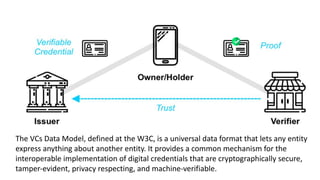
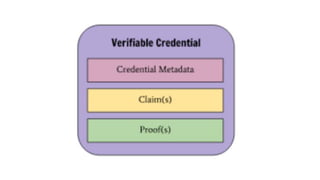
The VCs Data Model, defined at the W3C, is a universal data format that lets any entity
express anything about another entity. It provides a common mechanism for the
interoperable implementation of digital credentials that are cryptographically secure,
tamper-evident, privacy respecting, and machine-verifiable.
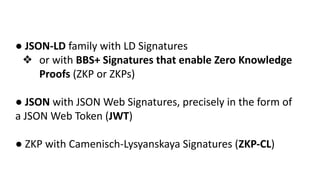
● JSON-LD family with LD Signatures
❖ or with BBS+ Signatures that enable Zero Knowledge
Proofs (ZKP or ZKPs)
● JSON with JSON Web Signatures, precisely in the form of
a JSON Web Token (JWT)
● ZKP with Camenisch-Lysyanskaya Signatures (ZKP-CL)
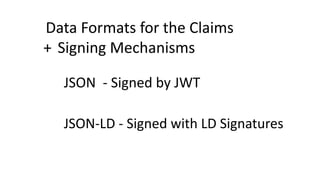
Data Formats for the Claims
+ Signing Mechanisms
JSON - Signed by JWT
JSON-LD - Signed with LD Signatures
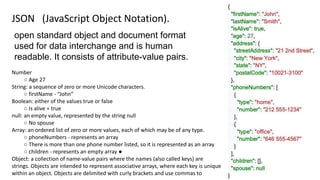
JSON (JavaScript Object Notation).
open standard object and document format
used for data interchange and is human
readable. It consists of attribute-value pairs.
Number
○ Age 27
String: a sequence of zero or more Unicode characters.
○ firstName - “John”
Boolean: either of the values true or false
○ Is alive = true
null: an empty value, represented by the string null
○ No spouse
Array: an ordered list of zero or more values, each of which may be of any type.
○ phoneNumbers - represents an array
○ There is more than one phone number listed, so it is represented as an array
○ children - represents an empty array ●
Object: a collection of name-value pairs where the names (also called keys) are
strings. Objects are intended to represent associative arrays, where each key is unique
within an object. Objects are delimited with curly brackets and use commas to
What is JWT Claim?
JWT approach to determining the meaning of claim terms in credentials.
There is an IANA registry for JWT claims as a first place to look for JWT claim
definitions.
If the claim name isn’t in the IANA register, then the claim can be given a “give it a
public name (i.e., a URI), [or] a local name (i.e., any string)”. The meaning of the
terms is guessed at or decided between the issuers and verifiers.
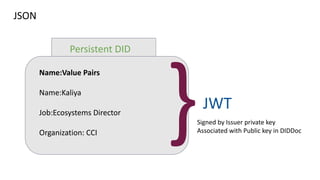
JSON
Persistent DID
Name:Value Pairs
Name:Kaliya
Job:Ecosystems Director
Organization: CCI
}JWT
Signed by Issuer private key
Associated with Public key in DIDDoc
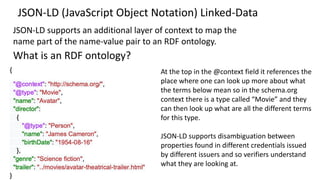
JSON-LD (JavaScript Object Notation) Linked-Data
JSON-LD supports an additional layer of context to map the
name part of the name-value pair to an RDF ontology.
What is an RDF ontology?
At the top in the @context field it references the
place where one can look up more about what
the terms below mean so in the schema.org
context there is a type called “Movie” and they
can then look up what are all the different terms
for this type.
JSON-LD supports disambiguation between
properties found in different credentials issued
by different issuers and so verifiers understand
what they are looking at.
In addition to all the features JSON provides, JSON-LD introduces:
● a universal identifier mechanism for JSON objects via the use of IRIs,
● a way to disambiguate keys shared among different JSON documents by
mapping them to IRIs via a context,
● a mechanism in which a value in a JSON object may refer to a resource on a
different site on the Web giving the ability to annotate strings with their
language,
● a way to associate data types with values such as dates and times,
● and a facility to express one or more directed graphs, such as a social
network, in a single document.
JSON-LD canonicalizes the attribute-value pairs in a predictable way
based on the information model being processed.
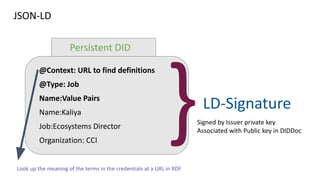
JSON-LD
Persistent DID
@Context: URL to find definitions
@Type: Job
Name:Value Pairs
Name:Kaliya
Job:Ecosystems Director
Organization: CCI
}LD-Signature
Signed by Issuer private key
Associated with Public key in DIDDoc
Look up the meaning of the terms in the credentials at a URL in RDF
Neither of these formats easily supports selective disclosure and
ZKPs, but both claim they can.
If an issuer puts each attribute in its own VC, then this is possible.
It isn’t possible for a holder to separate out VC claims when they
are bundled together within one VC.
Both JSON-JWT credentials and JSON-LD LD-Signature credentials
require that the holder share the whole credential with verifiers -
there is no partial share/show. This makes it harder to support
selective disclosure.
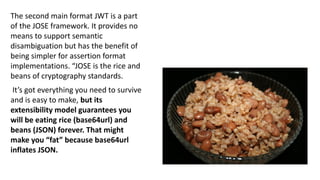
The second main format JWT is a part
of the JOSE framework. It provides no
means to support semantic
disambiguation but has the benefit of
being simpler for assertion format
implementations. “JOSE is the rice and
beans of cryptography standards.
It’s got everything you need to survive
and is easy to make, but its
extensibility model guarantees you
will be eating rice (base64url) and
beans (JSON) forever. That might
make you “fat” because base64url
inflates JSON.
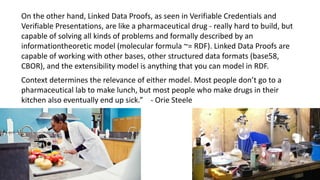
On the other hand, Linked Data Proofs, as seen in Verifiable Credentials and
Verifiable Presentations, are like a pharmaceutical drug - really hard to build, but
capable of solving all kinds of problems and formally described by an
informationtheoretic model (molecular formula ~= RDF). Linked Data Proofs are
capable of working with other bases, other structured data formats (base58,
CBOR), and the extensibility model is anything that you can model in RDF.
Context determines the relevance of either model. Most people don’t go to a
pharmaceutical lab to make lunch, but most people who make drugs in their
kitchen also eventually end up sick.” - Orie Steele
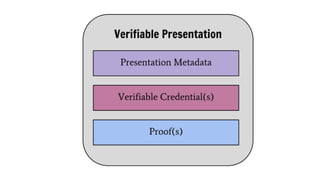
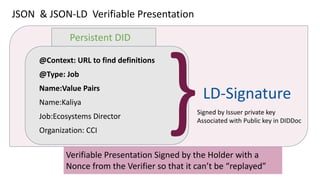
JSON & JSON-LD Verifiable Presentation
Persistent DID
@Context: URL to find definitions
@Type: Job
Name:Value Pairs
Name:Kaliya
Job:Ecosystems Director
Organization: CCI
}LD-Signature
Signed by Issuer private key
Associated with Public key in DIDDoc
Verifiable Presentation Signed by the Holder with a
Nonce from the Verifier so that it can’t be “replayed”
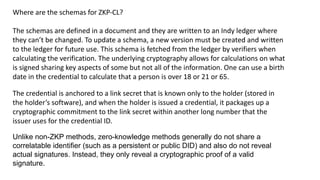
Where are the schemas for ZKP-CL?
The schemas are defined in a document and they are written to an Indy ledger where
they can’t be changed. To update a schema, a new version must be created and written
to the ledger for future use. This schema is fetched from the ledger by verifiers when
calculating the verification. The underlying cryptography allows for calculations on what
is signed sharing key aspects of some but not all of the information. One can use a birth
date in the credential to calculate that a person is over 18 or 21 or 65.
The credential is anchored to a link secret that is known only to the holder (stored in
the holder’s software), and when the holder is issued a credential, it packages up a
cryptographic commitment to the link secret within another long number that the
issuer uses for the credential ID.
Unlike non-ZKP methods, zero-knowledge methods generally do not share a
correlatable identifier (such as a persistent or public DID) and also do not reveal
actual signatures. Instead, they only reveal a cryptographic proof of a valid
signature.
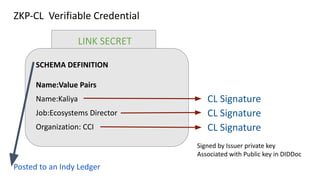
ZKP-CL Verifiable Credential
LINK SECRET
SCHEMA DEFINITION
Name:Value Pairs
Name:Kaliya
Job:Ecosystems Director
Organization: CCI
Signed by Issuer private key
Associated with Public key in DIDDoc
Posted to an Indy Ledger
CL Signature
CL Signature
CL Signature
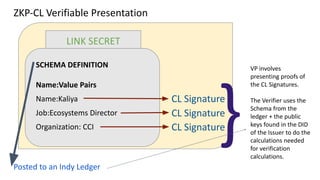
ZKP-CL Verifiable Presentation
LINK SECRET
SCHEMA DEFINITION
Name:Value Pairs
Name:Kaliya
Job:Ecosystems Director
Organization: CCI
Posted to an Indy Ledger
CL Signature
CL Signature
CL Signature
}
VP involves
presenting proofs of
the CL Signatures.
The Verifier uses the
Schema from the
ledger + the public
keys found in the DID
of the Issuer to do the
calculations needed
for verification
calculations.
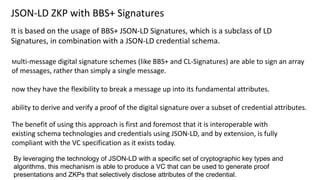
JSON-LD ZKP with BBS+ Signatures
It is based on the usage of BBS+ JSON-LD Signatures, which is a subclass of LD
Signatures, in combination with a JSON-LD credential schema.
By leveraging the technology of JSON-LD with a specific set of cryptographic key types and
algorithms, this mechanism is able to produce a VC that can be used to generate proof
presentations and ZKPs that selectively disclose attributes of the credential.
Multi-message digital signature schemes (like BBS+ and CL-Signatures) are able to sign an array
of messages, rather than simply a single message.
now they have the flexibility to break a message up into its fundamental attributes.
ability to derive and verify a proof of the digital signature over a subset of credential attributes.
The benefit of using this approach is first and foremost that it is interoperable with
existing schema technologies and credentials using JSON-LD, and by extension, is fully
compliant with the VC specification as it exists today.
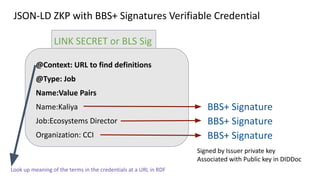
JSON-LD ZKP with BBS+ Signatures Verifiable Credential
LINK SECRET or BLS Sig
@Context: URL to find definitions
@Type: Job
Name:Value Pairs
Name:Kaliya
Job:Ecosystems Director
Organization: CCI
Signed by Issuer private key
Associated with Public key in DIDDoc
BBS+ Signature
BBS+ Signature
BBS+ Signature
Look up meaning of the terms in the credentials at a URL in RDF
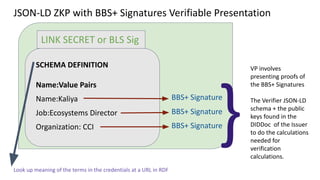
JSON-LD ZKP with BBS+ Signatures Verifiable Presentation
LINK SECRET or BLS Sig
SCHEMA DEFINITION
Name:Value Pairs
Name:Kaliya
Job:Ecosystems Director
Organization: CCI
BBS+ Signature
BBS+ Signature
BBS+ Signature
}
VP involves
presenting proofs of
the BBS+ Signatures
The Verifier JSON-LD
schema + the public
keys found in the
DIDDoc of the Issuer
to do the calculations
needed for
verification
calculations.
Look up meaning of the terms in the credentials at a URL in RDF
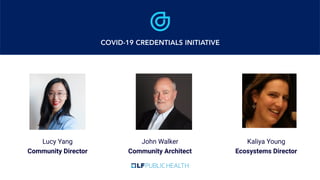
Lucy Yang
Community Director
John Walker
Community Architect
Kaliya Young
Ecosystems Director
The COVID-19 Credentials Initiative (CCI) is an open global community
whose purpose is to help deploy and help deploy privacy-preserving
verifiable credential projects in order to mitigate the spread of COVID-19
and strengthen our societies and economies.
● Formed in April 2020
● 400 participants who are active in standardizing and productizing VCs
● representing over 100 companies from all over the world.
CCI joined Linux Foundation Public Health (LFPH) in December 2020.
LFPH builds, secures, and sustains open source software to help public
health authorities (PHAs) combat COVID-19 and future epidemics. LFPH
has developed a relationship with a range of public health authorities as a
trusted partner in discerning emerging technology.
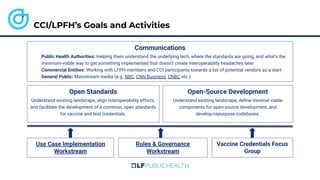
CCI/LPFH’s Goals and Activities
Open-Source Development
Understand existing landscape, define minimal viable
components for open-source development, and
develop/repurpose codebases.
Open Standards
Understand existing landscape, align interoperability efforts,
and facilitate the development of a common, open standards
for vaccine and test credentials.
Communications
● Public Health Authorities: Helping them understand the underlying tech, where the standards are going, and what's the
minimum-viable way to get something implemented that doesn't create interoperability headaches later.
Commercial Entities: Working with LFPH members and CCI participants towards a list of potential vendors as a start
● General Public: Mainstream media (e.g. NBC, CNN Business, CNBC etc.)
Use Case Implementation
Workstream
Rules & Governance
Workstream
Vaccine Credentials Focus
Group
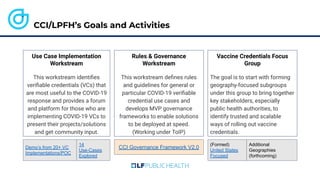
CCI/LPFH’s Goals and Activities
Use Case Implementation
Workstream
This workstream identifies
verifiable credentials (VCs) that
are most useful to the COVID-19
response and provides a forum
and platform for those who are
implementing COVID-19 VCs to
present their projects/solutions
and get community input.
Rules & Governance
Workstream
This workstream defines rules
and guidelines for general or
particular COVID-19 verifiable
credential use cases and
develops MVP governance
frameworks to enable solutions
to be deployed at speed.
(Working under ToIP)
Vaccine Credentials Focus
Group
The goal is to start with forming
geography-focused subgroups
under this group to bring together
key stakeholders, especially
public health authorities, to
identify trusted and scalable
ways of rolling out vaccine
credentials.
(Formed)
United States
Focused
Additional
Geographies
(forthcoming)
CCI Governance Framework V2.0
14
Use-Cases
Explored
Demo’s from 20+ VC
Implementations/POC
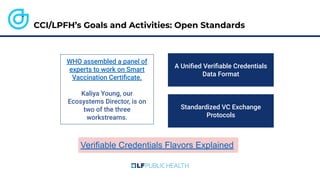
CCI/LPFH’s Goals and Activities: Open Standards
A Unified Verifiable Credentials
Data Format
Standardized VC Exchange
Protocols
WHO assembled a panel of
experts to work on Smart
Vaccination Certificate.
Kaliya Young, our
Ecosystems Director, is on
two of the three
workstreams.
Verifiable Credentials Flavors Explained
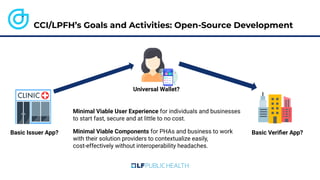
CCI/LPFH’s Goals and Activities: Open-Source Development
Verifiable Data Registry
Universal Wallet?
Basic Verifier App?
Basic Issuer App?
Minimal Viable User Experience for individuals and businesses
to start fast, secure and at little to no cost.
Minimal Viable Components for PHAs and business to work
with their solution providers to contextualize easily,
cost-effectively without interoperability headaches.
Community Venues
CCI Main E-mail Group - To receive regular CCI-wide announcements and news
CCI Sub-Groups - To receive regular activity notifications and start/join group discussions
● Use Case Implementation Workstream
● Rules & Governance Workstream
● Vaccine Credentials Focus Group
● Future groups...
Bi-weekly Community Newsletter - To receive high-level CCI updates and related news
(Automatic subscription if you join the above groups)
Social Media presence : Twitter, Linkedin, Medium
LFPH Slack Ongoing activity: Relevant channels #cci #vaccines #cci-vaccinecredentialsfg-us
Extra Slides Below
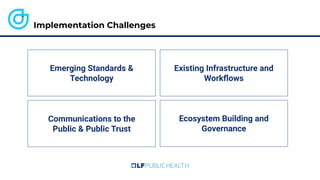
Implementation Challenges
Emerging Standards &
Technology
Communications to the
Public & Public Trust
Existing Infrastructure and
Workflows
Ecosystem Building and
Governance
Communications to the
Public & Public Trust
Existing Infrastructure and
Workflows
Ecosystem Building and
Governance
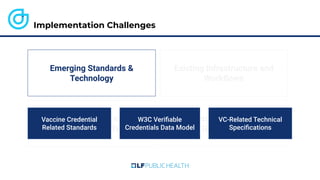
Implementation Challenges
Emerging Standards &
Technology
W3C Verifiable
Credentials Data Model
VC-Related Technical
Specifications
Vaccine Credential
Related Standards
Communications to the
Public & Public Trust
Ecosystem Building and
Governance
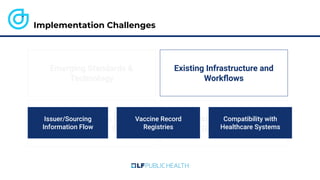
Implementation Challenges
Existing Infrastructure and
Workflows
Issuer/Sourcing
Information Flow
Vaccine Record
Registries
Compatibility with
Healthcare Systems
Emerging Standards &
Technology
Existing Infrastructure and
Workflows
Emerging Standards &
Technology
Ecosystem Building and
Governance
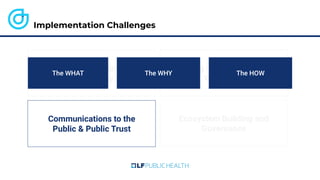
Implementation Challenges
Communications to the
Public & Public Trust
The WHAT The WHY The HOW
Existing Infrastructure and
Workflows
Emerging Standards &
Technology
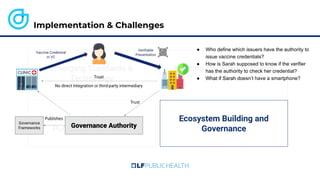
Implementation & Challenges
Communications to the
Public & Public Trust
Ecosystem Building and
Governance
Governance Authority
Trust
Publishes
Governance
Frameworks
● Who define which issuers have the authority to
issue vaccine credentials?
● How is Sarah supposed to know if the verifier
has the authority to check her credential?
● What if Sarah doesn’t have a smartphone?
Thank you! Questions?
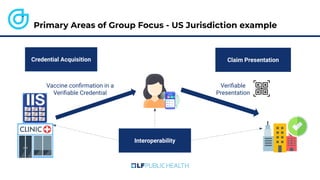
Vaccine confirmation in a
Verifiable Credential
Verifiable
Presentation
Primary Areas of Group Focus - US Jurisdiction example
Credential Acquisition Claim Presentation
Interoperability
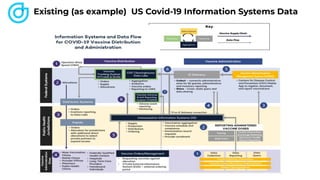
Existing (as example) US Covid-19 Information Systems Data
Flow
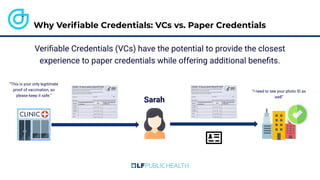
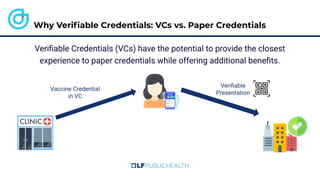
Why Verifiable Credentials: VCs vs. Paper Credentials
Verifiable Credentials (VCs) have the potential to provide the closest
experience to paper credentials while offering additional benefits.
“I need to see your photo ID as
well”
“This is your only legitimate
proof of vaccination, so
please keep it safe.”
Sarah
• What if Sarah lost her only card?
• What if Sarah fabricated her card? How was the verifier supposed to know?
• What if Sarah accidentally dropped the card in the water and the text went blurry?
• Did Sarah want the verifier to see all her information on the driver’s license and
vaccination record card?
Verifiable Credentials (VCs) have the potential to provide the closest
experience to paper credentials while offering additional benefits.
Why Verifiable Credentials: VCs vs. Paper Credentials
Vaccine Credential
in VC
Verifiable
Presentation
Verifiable Credentials (VCs) have the potential to provide the closest
experience to paper credentials while offering additional benefits.
Why Verifiable Credentials: VCs vs. Paper Credentials
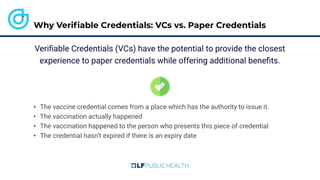
• The vaccine credential comes from a place which has the authority to issue it.
• The vaccination actually happened
• The vaccination happened to the person who presents this piece of credential
• The credential hasn’t expired if there is an expiry date
Verifiable Credentials (VCs) have the potential to provide the closest
experience to paper credentials while offering additional benefits.
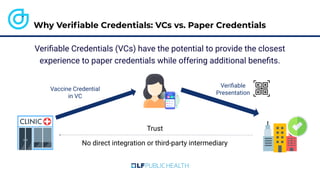
Why Verifiable Credentials: VCs vs. Paper Credentials
No direct integration or third-party intermediary
Vaccine Credential
in VC
Verifiable
Presentation
Trust
Verifiable Credentials (VCs) have the potential to provide the closest
experience to paper credentials while offering additional benefits.
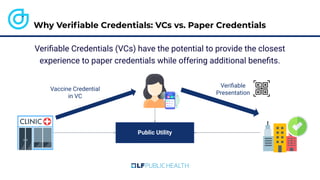
Why Verifiable Credentials: VCs vs. Paper Credentials
Vaccine Credential
in VC
Verifiable
Presentation
Public Utility
Why Verifiable Credentials: VCs vs. Paper Credentials
Verifiable Credentials (VCs) have the potential to provide the closest
experience to paper credentials while offering additional benefits.
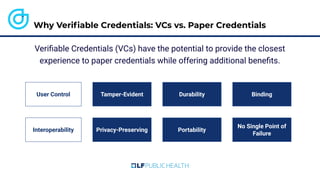
User Control
Interoperability Privacy-Preserving
Tamper-Evident Durability
Portability
Why Verifiable Credentials: VCs vs. Paper Credentials
Verifiable Credentials (VCs) have the potential to provide the closest
experience to paper credentials while offering additional benefits.
Binding
No Single Point of
Failure
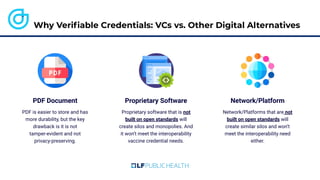
PDF Document Proprietary Software Network/Platform
PDF is easier to store and has
more durability, but the key
drawback is it is not
tamper-evident and not
privacy-preserving.
Proprietary software that is not
built on open standards will
create silos and monopolies. And
it won’t meet the interoperability
vaccine credential needs.
Network/Platforms that are not
built on open standards will
create similar silos and won’t
meet the interoperability need
either.
Why Verifiable Credentials: VCs vs. Other Digital Alternatives
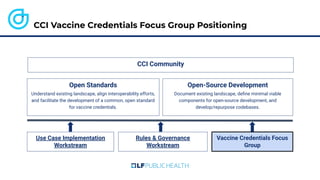
CCI Vaccine Credentials Focus Group Positioning
Open-Source Development
Document existing landscape, define minimal viable
components for open-source development, and
develop/repurpose codebases.
Open Standards
Understand existing landscape, align interoperability efforts,
and facilitate the development of a common, open standard
for vaccine credentials.
CCI Community
●
Use Case Implementation
Workstream
Rules & Governance
Workstream
Vaccine Credentials Focus
Group

Verifiable credentials explained by CCI

  • 1.
  • 2.
    Verifiable Credentials Flavors Explained byKaliya Young “Identity Woman” Ecosystems Director at Covid Credentials Initiative Blog Post - PDF Document
  • 3.
    The VCs DataModel, defined at the W3C, is a universal data format that lets any entity express anything about another entity. It provides a common mechanism for the interoperable implementation of digital credentials that are cryptographically secure, tamper-evident, privacy respecting, and machine-verifiable.
  • 4.
    ● JSON-LD familywith LD Signatures ❖ or with BBS+ Signatures that enable Zero Knowledge Proofs (ZKP or ZKPs) ● JSON with JSON Web Signatures, precisely in the form of a JSON Web Token (JWT) ● ZKP with Camenisch-Lysyanskaya Signatures (ZKP-CL)
  • 6.
    Data Formats forthe Claims + Signing Mechanisms JSON - Signed by JWT JSON-LD - Signed with LD Signatures
  • 7.
    JSON (JavaScript ObjectNotation). open standard object and document format used for data interchange and is human readable. It consists of attribute-value pairs. Number ○ Age 27 String: a sequence of zero or more Unicode characters. ○ firstName - “John” Boolean: either of the values true or false ○ Is alive = true null: an empty value, represented by the string null ○ No spouse Array: an ordered list of zero or more values, each of which may be of any type. ○ phoneNumbers - represents an array ○ There is more than one phone number listed, so it is represented as an array ○ children - represents an empty array ● Object: a collection of name-value pairs where the names (also called keys) are strings. Objects are intended to represent associative arrays, where each key is unique within an object. Objects are delimited with curly brackets and use commas to
  • 8.
    What is JWTClaim? JWT approach to determining the meaning of claim terms in credentials. There is an IANA registry for JWT claims as a first place to look for JWT claim definitions. If the claim name isn’t in the IANA register, then the claim can be given a “give it a public name (i.e., a URI), [or] a local name (i.e., any string)”. The meaning of the terms is guessed at or decided between the issuers and verifiers.
  • 9.
    JSON Persistent DID Name:Value Pairs Name:Kaliya Job:EcosystemsDirector Organization: CCI }JWT Signed by Issuer private key Associated with Public key in DIDDoc
  • 10.
    JSON-LD (JavaScript ObjectNotation) Linked-Data JSON-LD supports an additional layer of context to map the name part of the name-value pair to an RDF ontology. What is an RDF ontology? At the top in the @context field it references the place where one can look up more about what the terms below mean so in the schema.org context there is a type called “Movie” and they can then look up what are all the different terms for this type. JSON-LD supports disambiguation between properties found in different credentials issued by different issuers and so verifiers understand what they are looking at.
  • 11.
    In addition toall the features JSON provides, JSON-LD introduces: ● a universal identifier mechanism for JSON objects via the use of IRIs, ● a way to disambiguate keys shared among different JSON documents by mapping them to IRIs via a context, ● a mechanism in which a value in a JSON object may refer to a resource on a different site on the Web giving the ability to annotate strings with their language, ● a way to associate data types with values such as dates and times, ● and a facility to express one or more directed graphs, such as a social network, in a single document. JSON-LD canonicalizes the attribute-value pairs in a predictable way based on the information model being processed.
  • 12.
    JSON-LD Persistent DID @Context: URLto find definitions @Type: Job Name:Value Pairs Name:Kaliya Job:Ecosystems Director Organization: CCI }LD-Signature Signed by Issuer private key Associated with Public key in DIDDoc Look up the meaning of the terms in the credentials at a URL in RDF
  • 13.
    Neither of theseformats easily supports selective disclosure and ZKPs, but both claim they can. If an issuer puts each attribute in its own VC, then this is possible. It isn’t possible for a holder to separate out VC claims when they are bundled together within one VC. Both JSON-JWT credentials and JSON-LD LD-Signature credentials require that the holder share the whole credential with verifiers - there is no partial share/show. This makes it harder to support selective disclosure.
  • 14.
    The second mainformat JWT is a part of the JOSE framework. It provides no means to support semantic disambiguation but has the benefit of being simpler for assertion format implementations. “JOSE is the rice and beans of cryptography standards. It’s got everything you need to survive and is easy to make, but its extensibility model guarantees you will be eating rice (base64url) and beans (JSON) forever. That might make you “fat” because base64url inflates JSON.
  • 15.
    On the otherhand, Linked Data Proofs, as seen in Verifiable Credentials and Verifiable Presentations, are like a pharmaceutical drug - really hard to build, but capable of solving all kinds of problems and formally described by an informationtheoretic model (molecular formula ~= RDF). Linked Data Proofs are capable of working with other bases, other structured data formats (base58, CBOR), and the extensibility model is anything that you can model in RDF. Context determines the relevance of either model. Most people don’t go to a pharmaceutical lab to make lunch, but most people who make drugs in their kitchen also eventually end up sick.” - Orie Steele
  • 17.
    JSON & JSON-LDVerifiable Presentation Persistent DID @Context: URL to find definitions @Type: Job Name:Value Pairs Name:Kaliya Job:Ecosystems Director Organization: CCI }LD-Signature Signed by Issuer private key Associated with Public key in DIDDoc Verifiable Presentation Signed by the Holder with a Nonce from the Verifier so that it can’t be “replayed”
  • 18.
    Where are theschemas for ZKP-CL? The schemas are defined in a document and they are written to an Indy ledger where they can’t be changed. To update a schema, a new version must be created and written to the ledger for future use. This schema is fetched from the ledger by verifiers when calculating the verification. The underlying cryptography allows for calculations on what is signed sharing key aspects of some but not all of the information. One can use a birth date in the credential to calculate that a person is over 18 or 21 or 65. The credential is anchored to a link secret that is known only to the holder (stored in the holder’s software), and when the holder is issued a credential, it packages up a cryptographic commitment to the link secret within another long number that the issuer uses for the credential ID. Unlike non-ZKP methods, zero-knowledge methods generally do not share a correlatable identifier (such as a persistent or public DID) and also do not reveal actual signatures. Instead, they only reveal a cryptographic proof of a valid signature.
  • 19.
    ZKP-CL Verifiable Credential LINKSECRET SCHEMA DEFINITION Name:Value Pairs Name:Kaliya Job:Ecosystems Director Organization: CCI Signed by Issuer private key Associated with Public key in DIDDoc Posted to an Indy Ledger CL Signature CL Signature CL Signature
  • 20.
    ZKP-CL Verifiable Presentation LINKSECRET SCHEMA DEFINITION Name:Value Pairs Name:Kaliya Job:Ecosystems Director Organization: CCI Posted to an Indy Ledger CL Signature CL Signature CL Signature } VP involves presenting proofs of the CL Signatures. The Verifier uses the Schema from the ledger + the public keys found in the DID of the Issuer to do the calculations needed for verification calculations.
  • 21.
    JSON-LD ZKP withBBS+ Signatures It is based on the usage of BBS+ JSON-LD Signatures, which is a subclass of LD Signatures, in combination with a JSON-LD credential schema. By leveraging the technology of JSON-LD with a specific set of cryptographic key types and algorithms, this mechanism is able to produce a VC that can be used to generate proof presentations and ZKPs that selectively disclose attributes of the credential. Multi-message digital signature schemes (like BBS+ and CL-Signatures) are able to sign an array of messages, rather than simply a single message. now they have the flexibility to break a message up into its fundamental attributes. ability to derive and verify a proof of the digital signature over a subset of credential attributes. The benefit of using this approach is first and foremost that it is interoperable with existing schema technologies and credentials using JSON-LD, and by extension, is fully compliant with the VC specification as it exists today.
  • 22.
    JSON-LD ZKP withBBS+ Signatures Verifiable Credential LINK SECRET or BLS Sig @Context: URL to find definitions @Type: Job Name:Value Pairs Name:Kaliya Job:Ecosystems Director Organization: CCI Signed by Issuer private key Associated with Public key in DIDDoc BBS+ Signature BBS+ Signature BBS+ Signature Look up meaning of the terms in the credentials at a URL in RDF
  • 23.
    JSON-LD ZKP withBBS+ Signatures Verifiable Presentation LINK SECRET or BLS Sig SCHEMA DEFINITION Name:Value Pairs Name:Kaliya Job:Ecosystems Director Organization: CCI BBS+ Signature BBS+ Signature BBS+ Signature } VP involves presenting proofs of the BBS+ Signatures The Verifier JSON-LD schema + the public keys found in the DIDDoc of the Issuer to do the calculations needed for verification calculations. Look up meaning of the terms in the credentials at a URL in RDF
  • 24.
    Lucy Yang Community Director JohnWalker Community Architect Kaliya Young Ecosystems Director
  • 25.
    The COVID-19 CredentialsInitiative (CCI) is an open global community whose purpose is to help deploy and help deploy privacy-preserving verifiable credential projects in order to mitigate the spread of COVID-19 and strengthen our societies and economies. ● Formed in April 2020 ● 400 participants who are active in standardizing and productizing VCs ● representing over 100 companies from all over the world.
  • 26.
    CCI joined LinuxFoundation Public Health (LFPH) in December 2020. LFPH builds, secures, and sustains open source software to help public health authorities (PHAs) combat COVID-19 and future epidemics. LFPH has developed a relationship with a range of public health authorities as a trusted partner in discerning emerging technology.
  • 27.
    CCI/LPFH’s Goals andActivities Open-Source Development Understand existing landscape, define minimal viable components for open-source development, and develop/repurpose codebases. Open Standards Understand existing landscape, align interoperability efforts, and facilitate the development of a common, open standards for vaccine and test credentials. Communications ● Public Health Authorities: Helping them understand the underlying tech, where the standards are going, and what's the minimum-viable way to get something implemented that doesn't create interoperability headaches later. Commercial Entities: Working with LFPH members and CCI participants towards a list of potential vendors as a start ● General Public: Mainstream media (e.g. NBC, CNN Business, CNBC etc.) Use Case Implementation Workstream Rules & Governance Workstream Vaccine Credentials Focus Group
  • 28.
    CCI/LPFH’s Goals andActivities Use Case Implementation Workstream This workstream identifies verifiable credentials (VCs) that are most useful to the COVID-19 response and provides a forum and platform for those who are implementing COVID-19 VCs to present their projects/solutions and get community input. Rules & Governance Workstream This workstream defines rules and guidelines for general or particular COVID-19 verifiable credential use cases and develops MVP governance frameworks to enable solutions to be deployed at speed. (Working under ToIP) Vaccine Credentials Focus Group The goal is to start with forming geography-focused subgroups under this group to bring together key stakeholders, especially public health authorities, to identify trusted and scalable ways of rolling out vaccine credentials. (Formed) United States Focused Additional Geographies (forthcoming) CCI Governance Framework V2.0 14 Use-Cases Explored Demo’s from 20+ VC Implementations/POC
  • 29.
    CCI/LPFH’s Goals andActivities: Open Standards A Unified Verifiable Credentials Data Format Standardized VC Exchange Protocols WHO assembled a panel of experts to work on Smart Vaccination Certificate. Kaliya Young, our Ecosystems Director, is on two of the three workstreams. Verifiable Credentials Flavors Explained
  • 30.
    CCI/LPFH’s Goals andActivities: Open-Source Development Verifiable Data Registry Universal Wallet? Basic Verifier App? Basic Issuer App? Minimal Viable User Experience for individuals and businesses to start fast, secure and at little to no cost. Minimal Viable Components for PHAs and business to work with their solution providers to contextualize easily, cost-effectively without interoperability headaches.
  • 31.
    Community Venues CCI MainE-mail Group - To receive regular CCI-wide announcements and news CCI Sub-Groups - To receive regular activity notifications and start/join group discussions ● Use Case Implementation Workstream ● Rules & Governance Workstream ● Vaccine Credentials Focus Group ● Future groups... Bi-weekly Community Newsletter - To receive high-level CCI updates and related news (Automatic subscription if you join the above groups) Social Media presence : Twitter, Linkedin, Medium LFPH Slack Ongoing activity: Relevant channels #cci #vaccines #cci-vaccinecredentialsfg-us
  • 36.
  • 37.
    Implementation Challenges Emerging Standards& Technology Communications to the Public & Public Trust Existing Infrastructure and Workflows Ecosystem Building and Governance
  • 38.
    Communications to the Public& Public Trust Existing Infrastructure and Workflows Ecosystem Building and Governance Implementation Challenges Emerging Standards & Technology W3C Verifiable Credentials Data Model VC-Related Technical Specifications Vaccine Credential Related Standards
  • 39.
    Communications to the Public& Public Trust Ecosystem Building and Governance Implementation Challenges Existing Infrastructure and Workflows Issuer/Sourcing Information Flow Vaccine Record Registries Compatibility with Healthcare Systems Emerging Standards & Technology
  • 40.
    Existing Infrastructure and Workflows EmergingStandards & Technology Ecosystem Building and Governance Implementation Challenges Communications to the Public & Public Trust The WHAT The WHY The HOW
  • 41.
    Existing Infrastructure and Workflows EmergingStandards & Technology Implementation & Challenges Communications to the Public & Public Trust Ecosystem Building and Governance Governance Authority Trust Publishes Governance Frameworks ● Who define which issuers have the authority to issue vaccine credentials? ● How is Sarah supposed to know if the verifier has the authority to check her credential? ● What if Sarah doesn’t have a smartphone?
  • 42.
  • 43.
    Vaccine confirmation ina Verifiable Credential Verifiable Presentation Primary Areas of Group Focus - US Jurisdiction example Credential Acquisition Claim Presentation Interoperability
  • 44.
    Existing (as example)US Covid-19 Information Systems Data Flow
  • 45.
    Why Verifiable Credentials:VCs vs. Paper Credentials Verifiable Credentials (VCs) have the potential to provide the closest experience to paper credentials while offering additional benefits. “I need to see your photo ID as well” “This is your only legitimate proof of vaccination, so please keep it safe.” Sarah
  • 46.
    • What ifSarah lost her only card? • What if Sarah fabricated her card? How was the verifier supposed to know? • What if Sarah accidentally dropped the card in the water and the text went blurry? • Did Sarah want the verifier to see all her information on the driver’s license and vaccination record card? Verifiable Credentials (VCs) have the potential to provide the closest experience to paper credentials while offering additional benefits. Why Verifiable Credentials: VCs vs. Paper Credentials
  • 47.
    Vaccine Credential in VC Verifiable Presentation VerifiableCredentials (VCs) have the potential to provide the closest experience to paper credentials while offering additional benefits. Why Verifiable Credentials: VCs vs. Paper Credentials
  • 48.
    • The vaccinecredential comes from a place which has the authority to issue it. • The vaccination actually happened • The vaccination happened to the person who presents this piece of credential • The credential hasn’t expired if there is an expiry date Verifiable Credentials (VCs) have the potential to provide the closest experience to paper credentials while offering additional benefits. Why Verifiable Credentials: VCs vs. Paper Credentials
  • 49.
    No direct integrationor third-party intermediary Vaccine Credential in VC Verifiable Presentation Trust Verifiable Credentials (VCs) have the potential to provide the closest experience to paper credentials while offering additional benefits. Why Verifiable Credentials: VCs vs. Paper Credentials
  • 50.
    Vaccine Credential in VC Verifiable Presentation PublicUtility Why Verifiable Credentials: VCs vs. Paper Credentials Verifiable Credentials (VCs) have the potential to provide the closest experience to paper credentials while offering additional benefits.
  • 51.
    User Control Interoperability Privacy-Preserving Tamper-EvidentDurability Portability Why Verifiable Credentials: VCs vs. Paper Credentials Verifiable Credentials (VCs) have the potential to provide the closest experience to paper credentials while offering additional benefits. Binding No Single Point of Failure
  • 52.
    PDF Document ProprietarySoftware Network/Platform PDF is easier to store and has more durability, but the key drawback is it is not tamper-evident and not privacy-preserving. Proprietary software that is not built on open standards will create silos and monopolies. And it won’t meet the interoperability vaccine credential needs. Network/Platforms that are not built on open standards will create similar silos and won’t meet the interoperability need either. Why Verifiable Credentials: VCs vs. Other Digital Alternatives
  • 53.
    CCI Vaccine CredentialsFocus Group Positioning Open-Source Development Document existing landscape, define minimal viable components for open-source development, and develop/repurpose codebases. Open Standards Understand existing landscape, align interoperability efforts, and facilitate the development of a common, open standard for vaccine credentials. CCI Community ● Use Case Implementation Workstream Rules & Governance Workstream Vaccine Credentials Focus Group