OpenID Connect for SSI
Kristina Yasuda, Microsoft
Dr. Torsten Lodderstedt, yes.com
OpenID Connect for SSI
• Aims at specifying a set of protocols based on OpenID
Connect to enable SSI applications
• Initiative conducted at OpenID Foundation in liaison with the
Decentralized Identity Foundation (DIF)
• One of the specifications is built up on DID-SIOP in DIDAuth
WG in DIF and SIOP v1 in OIDC Core
- Self-Issued OP (SIOP) already provides good starting point
- Leveraging the simplicity and security of OpenID Connect for SSI
applications
- Existing libraries, only HTTPS communication, developer familiarity
- Great for mobile applications, no firewall hassles
- Security of OpenID Connect has been tested and formally analysed
- Allow existing OpenID Connect RPs to access SSI credentials and
existing OpenID Connect OPs to issue credentials
Why use OpenID Connect as basis?
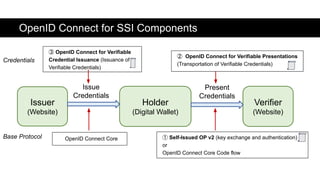
③ OpenID Connect for Verifiable
Credential Issuance (Issuance of
Verifiable Credentials)
OpenID Connect for SSI Components
Issuer
(Website)
Verifier
(Website)
Holder
(Digital Wallet)
Issue
Credentials
Present
Credentials
OpenID Connect Core
② OpenID Connect for Verifiable Presentations
(Transportation of Verifiable Credentials)
① Self-Issued OP v2 (key exchange and authentication)
or
OpenID Connect Core Code flow
Base Protocol
Credentials
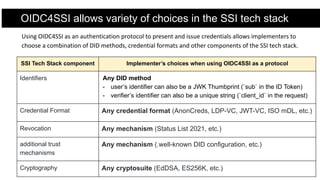
Using OIDC4SSI as an authentication protocol to present and issue credentials allows implementers to
choose a combination of DID methods, credential formats and other components of the SSI tech stack.
OIDC4SSI allows variety of choices in the SSI tech stack
SSI Tech Stack component Implementer’s choices when using OIDC4SSI as a protocol
Identifiers Any DID method
- user’s identifier can also be a JWK Thumbprint (`sub` in the ID Token)
- verifier’s identifier can also be a unique string (`client_id` in the request)
Credential Format Any credential format (AnonCreds, LDP-VC, JWT-VC, ISO mDL, etc.)
Revocation Any mechanism (Status List 2021, etc.)
additional trust
mechanisms
Any mechanism (.well-known DID configuration, etc.)
Cryptography Any cryptosuite (EdDSA, ES256K, etc.)
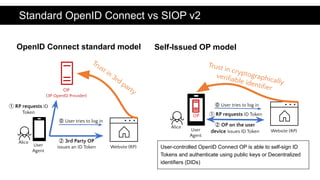
Standard OpenID Connect vs SIOP v2
Self-Issued OP model
⓪ User tries to log in
Website (RP)
User
Agent
OP
Trust in cryptographically
verifiable identifier
② OP on the user
device issues ID Token
Alice
User-controlled OpenID Connect OP is able to self-sign ID
Tokens and authenticate using public keys or Decentralized
identifiers (DIDs)
① RP requests ID Token
OpenID Connect standard model
⓪ User tries to log in
Website (RP)
User
Agent
OP
(3P OpenID Provider)
Trust in 3rd party
Alice ② 3rd Party OP
issues an ID Token
① RP requests ID
Token
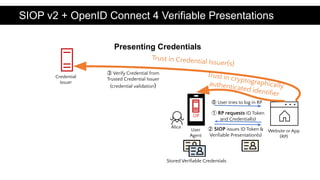
Credential
Issuer
③ Verify Credential from
Trusted Credential Issuer
(credential validation)
SIOP v2 + OpenID Connect 4 Verifiable Presentations
Presenting Credentials
Website or App
(RP)
User
Agent
OP
Alice
Trust in cryptographically
authenticated identifier
⓪ User tries to log in RP
Stored Verifiable Credentials
Trust in Credential Issuer(s)
② SIOP issues ID Token &
Verifiable Presentation(s)
① RP requests ID Token
and Credential(s)
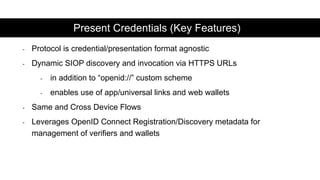
- Protocol is credential/presentation format agnostic
- Dynamic SIOP discovery and invocation via HTTPS URLs
- in addition to “openid://” custom scheme
- enables use of app/universal links and web wallets
- Same and Cross Device Flows
- Leverages OpenID Connect Registration/Discovery metadata for
management of verifiers and wallets
Present Credentials (Key Features)
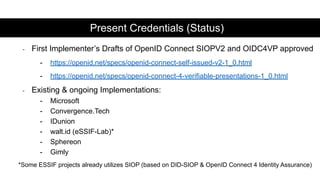
- First Implementer’s Drafts of OpenID Connect SIOPV2 and OIDC4VP approved
- https://openid.net/specs/openid-connect-self-issued-v2-1_0.html
- https://openid.net/specs/openid-connect-4-verifiable-presentations-1_0.html
- Existing & ongoing Implementations:
- Microsoft
- Convergence.Tech
- IDunion
- walt.id (eSSIF-Lab)*
- Sphereon
- Gimly
*Some ESSIF projects already utilizes SIOP (based on DID-SIOP & OpenID Connect 4 Identity Assurance)
Present Credentials (Status)
Demo
Credential Presentation
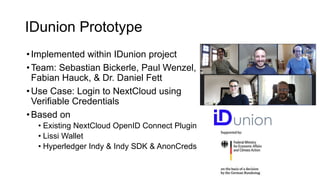
IDunion Prototype
•Implemented within IDunion project
•Team: Sebastian Bickerle, Paul Wenzel,
Fabian Hauck, & Dr. Daniel Fett
•Use Case: Login to NextCloud using
Verifiable Credentials
•Based on
• Existing NextCloud OpenID Connect Plugin
• Lissi Wallet
• Hyperledger Indy & Indy SDK & AnonCreds
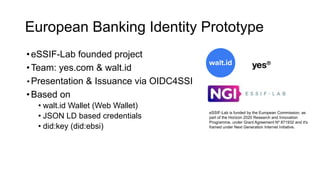
European Banking Identity Prototype
•eSSIF-Lab founded project
•Team: yes.com & walt.id
• Presentation & Issuance via OIDC4SSI
•Based on
• walt.id Wallet (Web Wallet)
• JSON LD based credentials
• did:key (did:ebsi)
eSSIF-Lab is funded by the European Commission, as
part of the Horizon 2020 Research and Innovation
Programme, under Grant Agreement Nº 871932 and it's
framed under Next Generation Internet Initiative.
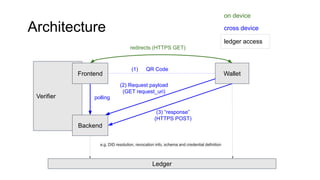
Architecture
Verifier
Ledger
Frontend Wallet
redirects (HTTPS GET)
(3) “response”
(HTTPS POST)
Backend
polling
on device
cross device
ledger access
(1) QR Code
e.g. DID resolution, revocation info, schema and credential definition
(2) Request payload
(GET request_uri)
Request Example ESSIF Lab (W3C VC)
{
"response_type"
:"id_token",
"client_id":"https://example.com/callback"
,
"scope":"openid",
"redirect_uri"
:"https://example.com/callback"
,
"nonce":"67473895393019470130"
,
...
"claims":{
"vp_token":{
"presentation_definition"
:{
"id":"1",
"input_descriptors"
:[
{
"id":"1",
"schema":{
"uri":"https://raw.githubusercontent.com/…/EuropeanBankIdentity.json"
}
}
]
}
}
}
}
Response Example ESSIF Lab (W3C VC)
{
"iss": "https://self-issued.me/v2",
"aud": "https://example.com/callback",
"sub": "did:key:z6MkqUDiu3MHxAm...mscLT8E9R5CKdbtr7gwR8",
"exp": 1645469476,
"iat": 1645465876,
"nonce": "cdb97870-a3be-49b4-aa55-8c7c7122178a",
"_vp_token": {
"presentation_submission": {
"descriptor_map": [
{
"path": "$",
"format": "ldp_vp",
"path_nested": {
"path": "$.verifiableCredential[0]",
"format": "ldp_vc"
}
],
"definition_id": "1",
"id": "1"
}
}
}
{
"@context" :[
"https://www.w3.org/2018/credentials/v1"
],
"holder" :"did:key:z6MkqUDiu3MHxAmuMQ8jjkLiUu1mscLT8E9R5CKdbtr7gwR8" ,
"id":"urn:uuid:04816f2a-85f1-45d7-a66d-51764d39a569" ,
"proof":{
"domain" :"https://example.com/callback" ,
"jws" :"...",
"nonce":"cdb97870-a3be-49b4-aa55-8c7c7122178a" ,
"proofPurpose" :"authentication" ,
"type":"Ed25519Signature2018" ,
"verificationMethod" :"did:key:z6MkqUDiu3 ..."
},
"type":[
"VerifiablePresentation"
],
"verifiableCredential" :[
{
…
"type":[
"VerifiableCredential" ,
"EuropeanBankIdentity"
],
"credentialSubject" :{
"id":"did:key:z6MkqUDiu3MHxAmuMQ8jjkLiUu1mscLT8E9R5CKdbtr7gwR8" ,
"familyName" :"Family001" ,
"givenName" :"Given001" ,
"birthDate" :"1950-01-01" ,
"placeOfBirth" :{
"country" :"DE",
"locality" :"Berlin"
}
},
ID Token VP Token
Request Example IDunion (AnonCred)
{
"response_type" :"id_token" ,
"client_id" :"https://example.com/callback" ,
"scope":"openid" ,
"redirect_uri" :"https://example.com/callback ",
"nonce":"67473895393019470130" ,
...
"claims" :{
"vp_token" :{
"presentation_definition" :{
"id":"NextcloudLogin" ,
"input_descriptors" :[
{
"id":"ref2",
"name":"NextcloudCredential" ,
"format" : {
"ac_vc": {
"proof_type" : ["CLSignature2019" ]
}
},
"schema" :[{
"uri":"did:indy:idu:test:3QowxFtwciWceMFr7WbwnM:2:BasicScheme:0.1",
"required" :true}],
"constraints" :{
"limit_disclosure" :"required" ,
"fields" :[{"path":["$.values.email" ]},
{ "path":["$.values.first_name" ]},
{ "path":["$.values.last_name" ]}]
}
}
]
}
}
}
}
Response Example IDunion (AnonCred)
{
"aud": "https://example.com/callback ",
"sub": "9wgU5CR6PdgGmvBfgz_CqAtBxJ33ckMEwvij-gC6Bcw" ,
"auth_time" : 1638483344 ,
"iss": "https://self-issued.me/v2" ,
"sub_jwk" : {
"x": "cQ5fu5VmG…dA_5lTMGcoyQE78RrqQ6" ,
"kty": "EC",
"y": "XHpi27YMA…rnF_-f_ASULPTmUmTS" ,
"crv": "P-384"
},
"exp": 1638483944 ,
"iat": 1638483344 ,
"nonce": "67473895393019470130 ",
"_vp_token" : {
"presentation_submission" : {
"descriptor_map" : [
{
"id": "ref2",
"path": "$",
"format" : "ac_vp",
"path_nested" : {
"path":
"$.requested_proof.revealed_attr_groups.ref2",
"format" : "ac_vc"
}
}
],
"definition_id" : "NextcloudLogin" ,
"id": "NexcloudCredentialPresentationSubmission"
}
}
}
{
"proof": {...},
"requested_proof": {
"revealed_attrs" : {},
"revealed_attr_groups": {
"ref2": {
"sub_proof_index" : 0,
"values" : {
"email": {
"raw": "alice@example.com" ,
"encoded" : "115589951…83915671017846"
},
"last_name" : {
"raw": "Wonderland" ,
"encoded" : "167908493…94017654562035"
},
"first_name" : {
"raw": "Alice",
"encoded" : "270346400…99344178781507"
}
}
}
},
…
},
"identifiers" : [
{
"schema_id" : "3QowxFtwciWceMFr7WbwnM:2:BasicScheme:0.1" ,
"cred_def_id" : "CsiDLAiFkQb9N4NDJKUagd:3:CL:4687:awesome_cred" ,
"rev_reg_id" : null,
"timestamp" : null
}
]
}
ID Token VP Token
⓪ User tries to log in, RP
requests a VC
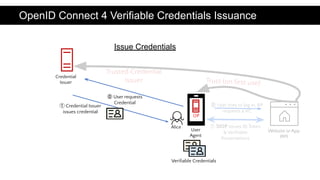
OpenID Connect 4 Verifiable Credentials Issuance
Issue Credentials
Website or App
(RP)
User
Agent
OP
Alice
Credential
Issuer
Trusted Credential
Issuer Trust (on first use)
⓪ User requests
Credential
① Credential Issuer
issues credential
Verifiable Credentials
① SIOP issues ID Token
& Verifiable
Presentations
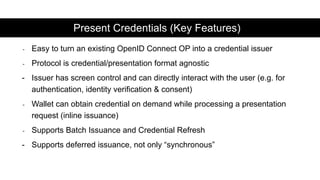
- Easy to turn an existing OpenID Connect OP into a credential issuer
- Protocol is credential/presentation format agnostic
- Issuer has screen control and can directly interact with the user (e.g. for
authentication, identity verification & consent)
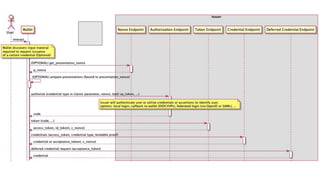
- Wallet can obtain credential on demand while processing a presentation
request (inline issuance)
- Supports Batch Issuance and Credential Refresh
- Supports deferred issuance, not only “synchronous”
Present Credentials (Key Features)
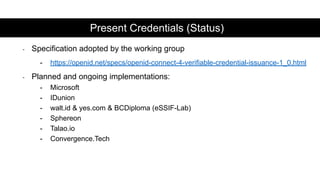
- Specification adopted by the working group
- https://openid.net/specs/openid-connect-4-verifiable-credential-issuance-1_0.html
- Planned and ongoing implementations:
- Microsoft
- IDunion
- walt.id & yes.com & BCDiploma (eSSIF-Lab)
- Sphereon
- Talao.io
- Convergence.Tech
Present Credentials (Status)
Demo
Credential Presentation
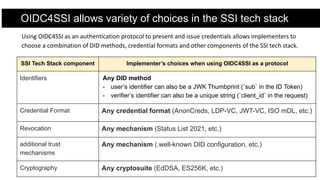
Using OIDC4SSI as an authentication protocol to present and issue credentials allows implementers to
choose a combination of DID methods, credential formats and other components of the SSI tech stack.
OIDC4SSI allows variety of choices in the SSI tech stack
SSI Tech Stack component Implementer’s choices when using OIDC4SSI as a protocol
Identifiers Any DID method
- user’s identifier can also be a JWK Thumbprint (`sub` in the ID Token)
- verifier’s identifier can also be a unique string (`client_id` in the request)
Credential Format Any credential format (AnonCreds, LDP-VC, JWT-VC, ISO mDL, etc.)
Revocation Any mechanism (Status List 2021, etc.)
additional trust
mechanisms
Any mechanism (.well-known DID configuration, etc.)
Cryptography Any cryptosuite (EdDSA, ES256K, etc.)
Q&A

OpenID Connect 4 SSI (DIFCon F2F)

  • 1.
    OpenID Connect forSSI Kristina Yasuda, Microsoft Dr. Torsten Lodderstedt, yes.com
  • 2.
    OpenID Connect forSSI • Aims at specifying a set of protocols based on OpenID Connect to enable SSI applications • Initiative conducted at OpenID Foundation in liaison with the Decentralized Identity Foundation (DIF) • One of the specifications is built up on DID-SIOP in DIDAuth WG in DIF and SIOP v1 in OIDC Core
  • 3.
    - Self-Issued OP(SIOP) already provides good starting point - Leveraging the simplicity and security of OpenID Connect for SSI applications - Existing libraries, only HTTPS communication, developer familiarity - Great for mobile applications, no firewall hassles - Security of OpenID Connect has been tested and formally analysed - Allow existing OpenID Connect RPs to access SSI credentials and existing OpenID Connect OPs to issue credentials Why use OpenID Connect as basis?
  • 4.
    ③ OpenID Connectfor Verifiable Credential Issuance (Issuance of Verifiable Credentials) OpenID Connect for SSI Components Issuer (Website) Verifier (Website) Holder (Digital Wallet) Issue Credentials Present Credentials OpenID Connect Core ② OpenID Connect for Verifiable Presentations (Transportation of Verifiable Credentials) ① Self-Issued OP v2 (key exchange and authentication) or OpenID Connect Core Code flow Base Protocol Credentials
  • 5.
    Using OIDC4SSI asan authentication protocol to present and issue credentials allows implementers to choose a combination of DID methods, credential formats and other components of the SSI tech stack. OIDC4SSI allows variety of choices in the SSI tech stack SSI Tech Stack component Implementer’s choices when using OIDC4SSI as a protocol Identifiers Any DID method - user’s identifier can also be a JWK Thumbprint (`sub` in the ID Token) - verifier’s identifier can also be a unique string (`client_id` in the request) Credential Format Any credential format (AnonCreds, LDP-VC, JWT-VC, ISO mDL, etc.) Revocation Any mechanism (Status List 2021, etc.) additional trust mechanisms Any mechanism (.well-known DID configuration, etc.) Cryptography Any cryptosuite (EdDSA, ES256K, etc.)
  • 6.
    Standard OpenID Connectvs SIOP v2 Self-Issued OP model ⓪ User tries to log in Website (RP) User Agent OP Trust in cryptographically verifiable identifier ② OP on the user device issues ID Token Alice User-controlled OpenID Connect OP is able to self-sign ID Tokens and authenticate using public keys or Decentralized identifiers (DIDs) ① RP requests ID Token OpenID Connect standard model ⓪ User tries to log in Website (RP) User Agent OP (3P OpenID Provider) Trust in 3rd party Alice ② 3rd Party OP issues an ID Token ① RP requests ID Token
  • 7.
    Credential Issuer ③ Verify Credentialfrom Trusted Credential Issuer (credential validation) SIOP v2 + OpenID Connect 4 Verifiable Presentations Presenting Credentials Website or App (RP) User Agent OP Alice Trust in cryptographically authenticated identifier ⓪ User tries to log in RP Stored Verifiable Credentials Trust in Credential Issuer(s) ② SIOP issues ID Token & Verifiable Presentation(s) ① RP requests ID Token and Credential(s)
  • 8.
    - Protocol iscredential/presentation format agnostic - Dynamic SIOP discovery and invocation via HTTPS URLs - in addition to “openid://” custom scheme - enables use of app/universal links and web wallets - Same and Cross Device Flows - Leverages OpenID Connect Registration/Discovery metadata for management of verifiers and wallets Present Credentials (Key Features)
  • 9.
    - First Implementer’sDrafts of OpenID Connect SIOPV2 and OIDC4VP approved - https://openid.net/specs/openid-connect-self-issued-v2-1_0.html - https://openid.net/specs/openid-connect-4-verifiable-presentations-1_0.html - Existing & ongoing Implementations: - Microsoft - Convergence.Tech - IDunion - walt.id (eSSIF-Lab)* - Sphereon - Gimly *Some ESSIF projects already utilizes SIOP (based on DID-SIOP & OpenID Connect 4 Identity Assurance) Present Credentials (Status)
  • 10.
  • 11.
    IDunion Prototype •Implemented withinIDunion project •Team: Sebastian Bickerle, Paul Wenzel, Fabian Hauck, & Dr. Daniel Fett •Use Case: Login to NextCloud using Verifiable Credentials •Based on • Existing NextCloud OpenID Connect Plugin • Lissi Wallet • Hyperledger Indy & Indy SDK & AnonCreds
  • 12.
    European Banking IdentityPrototype •eSSIF-Lab founded project •Team: yes.com & walt.id • Presentation & Issuance via OIDC4SSI •Based on • walt.id Wallet (Web Wallet) • JSON LD based credentials • did:key (did:ebsi) eSSIF-Lab is funded by the European Commission, as part of the Horizon 2020 Research and Innovation Programme, under Grant Agreement Nº 871932 and it's framed under Next Generation Internet Initiative.
  • 13.
    Architecture Verifier Ledger Frontend Wallet redirects (HTTPSGET) (3) “response” (HTTPS POST) Backend polling on device cross device ledger access (1) QR Code e.g. DID resolution, revocation info, schema and credential definition (2) Request payload (GET request_uri)
  • 14.
    Request Example ESSIFLab (W3C VC) { "response_type" :"id_token", "client_id":"https://example.com/callback" , "scope":"openid", "redirect_uri" :"https://example.com/callback" , "nonce":"67473895393019470130" , ... "claims":{ "vp_token":{ "presentation_definition" :{ "id":"1", "input_descriptors" :[ { "id":"1", "schema":{ "uri":"https://raw.githubusercontent.com/…/EuropeanBankIdentity.json" } } ] } } } }
  • 15.
    Response Example ESSIFLab (W3C VC) { "iss": "https://self-issued.me/v2", "aud": "https://example.com/callback", "sub": "did:key:z6MkqUDiu3MHxAm...mscLT8E9R5CKdbtr7gwR8", "exp": 1645469476, "iat": 1645465876, "nonce": "cdb97870-a3be-49b4-aa55-8c7c7122178a", "_vp_token": { "presentation_submission": { "descriptor_map": [ { "path": "$", "format": "ldp_vp", "path_nested": { "path": "$.verifiableCredential[0]", "format": "ldp_vc" } ], "definition_id": "1", "id": "1" } } } { "@context" :[ "https://www.w3.org/2018/credentials/v1" ], "holder" :"did:key:z6MkqUDiu3MHxAmuMQ8jjkLiUu1mscLT8E9R5CKdbtr7gwR8" , "id":"urn:uuid:04816f2a-85f1-45d7-a66d-51764d39a569" , "proof":{ "domain" :"https://example.com/callback" , "jws" :"...", "nonce":"cdb97870-a3be-49b4-aa55-8c7c7122178a" , "proofPurpose" :"authentication" , "type":"Ed25519Signature2018" , "verificationMethod" :"did:key:z6MkqUDiu3 ..." }, "type":[ "VerifiablePresentation" ], "verifiableCredential" :[ { … "type":[ "VerifiableCredential" , "EuropeanBankIdentity" ], "credentialSubject" :{ "id":"did:key:z6MkqUDiu3MHxAmuMQ8jjkLiUu1mscLT8E9R5CKdbtr7gwR8" , "familyName" :"Family001" , "givenName" :"Given001" , "birthDate" :"1950-01-01" , "placeOfBirth" :{ "country" :"DE", "locality" :"Berlin" } }, ID Token VP Token
  • 16.
    Request Example IDunion(AnonCred) { "response_type" :"id_token" , "client_id" :"https://example.com/callback" , "scope":"openid" , "redirect_uri" :"https://example.com/callback ", "nonce":"67473895393019470130" , ... "claims" :{ "vp_token" :{ "presentation_definition" :{ "id":"NextcloudLogin" , "input_descriptors" :[ { "id":"ref2", "name":"NextcloudCredential" , "format" : { "ac_vc": { "proof_type" : ["CLSignature2019" ] } }, "schema" :[{ "uri":"did:indy:idu:test:3QowxFtwciWceMFr7WbwnM:2:BasicScheme:0.1", "required" :true}], "constraints" :{ "limit_disclosure" :"required" , "fields" :[{"path":["$.values.email" ]}, { "path":["$.values.first_name" ]}, { "path":["$.values.last_name" ]}] } } ] } } } }
  • 17.
    Response Example IDunion(AnonCred) { "aud": "https://example.com/callback ", "sub": "9wgU5CR6PdgGmvBfgz_CqAtBxJ33ckMEwvij-gC6Bcw" , "auth_time" : 1638483344 , "iss": "https://self-issued.me/v2" , "sub_jwk" : { "x": "cQ5fu5VmG…dA_5lTMGcoyQE78RrqQ6" , "kty": "EC", "y": "XHpi27YMA…rnF_-f_ASULPTmUmTS" , "crv": "P-384" }, "exp": 1638483944 , "iat": 1638483344 , "nonce": "67473895393019470130 ", "_vp_token" : { "presentation_submission" : { "descriptor_map" : [ { "id": "ref2", "path": "$", "format" : "ac_vp", "path_nested" : { "path": "$.requested_proof.revealed_attr_groups.ref2", "format" : "ac_vc" } } ], "definition_id" : "NextcloudLogin" , "id": "NexcloudCredentialPresentationSubmission" } } } { "proof": {...}, "requested_proof": { "revealed_attrs" : {}, "revealed_attr_groups": { "ref2": { "sub_proof_index" : 0, "values" : { "email": { "raw": "alice@example.com" , "encoded" : "115589951…83915671017846" }, "last_name" : { "raw": "Wonderland" , "encoded" : "167908493…94017654562035" }, "first_name" : { "raw": "Alice", "encoded" : "270346400…99344178781507" } } } }, … }, "identifiers" : [ { "schema_id" : "3QowxFtwciWceMFr7WbwnM:2:BasicScheme:0.1" , "cred_def_id" : "CsiDLAiFkQb9N4NDJKUagd:3:CL:4687:awesome_cred" , "rev_reg_id" : null, "timestamp" : null } ] } ID Token VP Token
  • 18.
    ⓪ User triesto log in, RP requests a VC OpenID Connect 4 Verifiable Credentials Issuance Issue Credentials Website or App (RP) User Agent OP Alice Credential Issuer Trusted Credential Issuer Trust (on first use) ⓪ User requests Credential ① Credential Issuer issues credential Verifiable Credentials ① SIOP issues ID Token & Verifiable Presentations
  • 20.
    - Easy toturn an existing OpenID Connect OP into a credential issuer - Protocol is credential/presentation format agnostic - Issuer has screen control and can directly interact with the user (e.g. for authentication, identity verification & consent) - Wallet can obtain credential on demand while processing a presentation request (inline issuance) - Supports Batch Issuance and Credential Refresh - Supports deferred issuance, not only “synchronous” Present Credentials (Key Features)
  • 21.
    - Specification adoptedby the working group - https://openid.net/specs/openid-connect-4-verifiable-credential-issuance-1_0.html - Planned and ongoing implementations: - Microsoft - IDunion - walt.id & yes.com & BCDiploma (eSSIF-Lab) - Sphereon - Talao.io - Convergence.Tech Present Credentials (Status)
  • 22.
  • 23.
    Using OIDC4SSI asan authentication protocol to present and issue credentials allows implementers to choose a combination of DID methods, credential formats and other components of the SSI tech stack. OIDC4SSI allows variety of choices in the SSI tech stack SSI Tech Stack component Implementer’s choices when using OIDC4SSI as a protocol Identifiers Any DID method - user’s identifier can also be a JWK Thumbprint (`sub` in the ID Token) - verifier’s identifier can also be a unique string (`client_id` in the request) Credential Format Any credential format (AnonCreds, LDP-VC, JWT-VC, ISO mDL, etc.) Revocation Any mechanism (Status List 2021, etc.) additional trust mechanisms Any mechanism (.well-known DID configuration, etc.) Cryptography Any cryptosuite (EdDSA, ES256K, etc.)
  • 24.