Your panelists for today’s webinar:
• Dan Meyer, Editor-in-Chief, RCR Wireless News
• Dana Cooperson, Research Director, Analysys
Mason
• John Isch, Network and Voice Center of Excellence,
Orange Business Services
• Suzanne Kelliher, Product Line Manager, Radisys
• Bryan Hill, VP of Engineering, Sonus
About RCR Wireless News:
• RCR Wireless News is the premier news source for the
wireless communications industry and is first with carrier,
distributor, network, handset and mobile content news.
• Published since 1981, RCR Wireless News keeps our
subscribers engaged and informed with breaking stories,
enlightened features and invaluable industry insight.
• RCR Wireless News target audience is executive-level
employees at leading wireless companies, and volume buyers
at enterprise-class organizations.
• RCRWireless.com
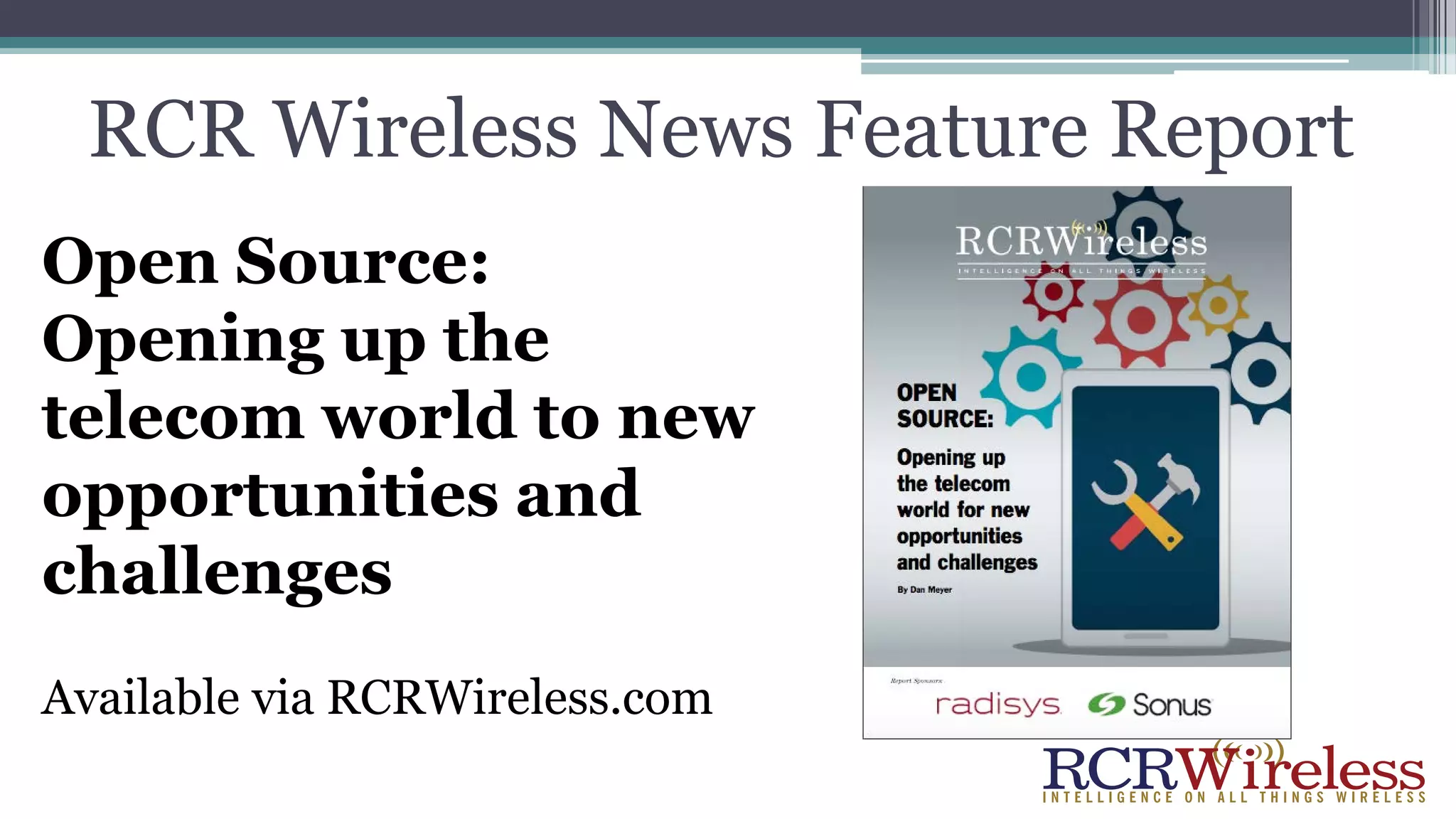
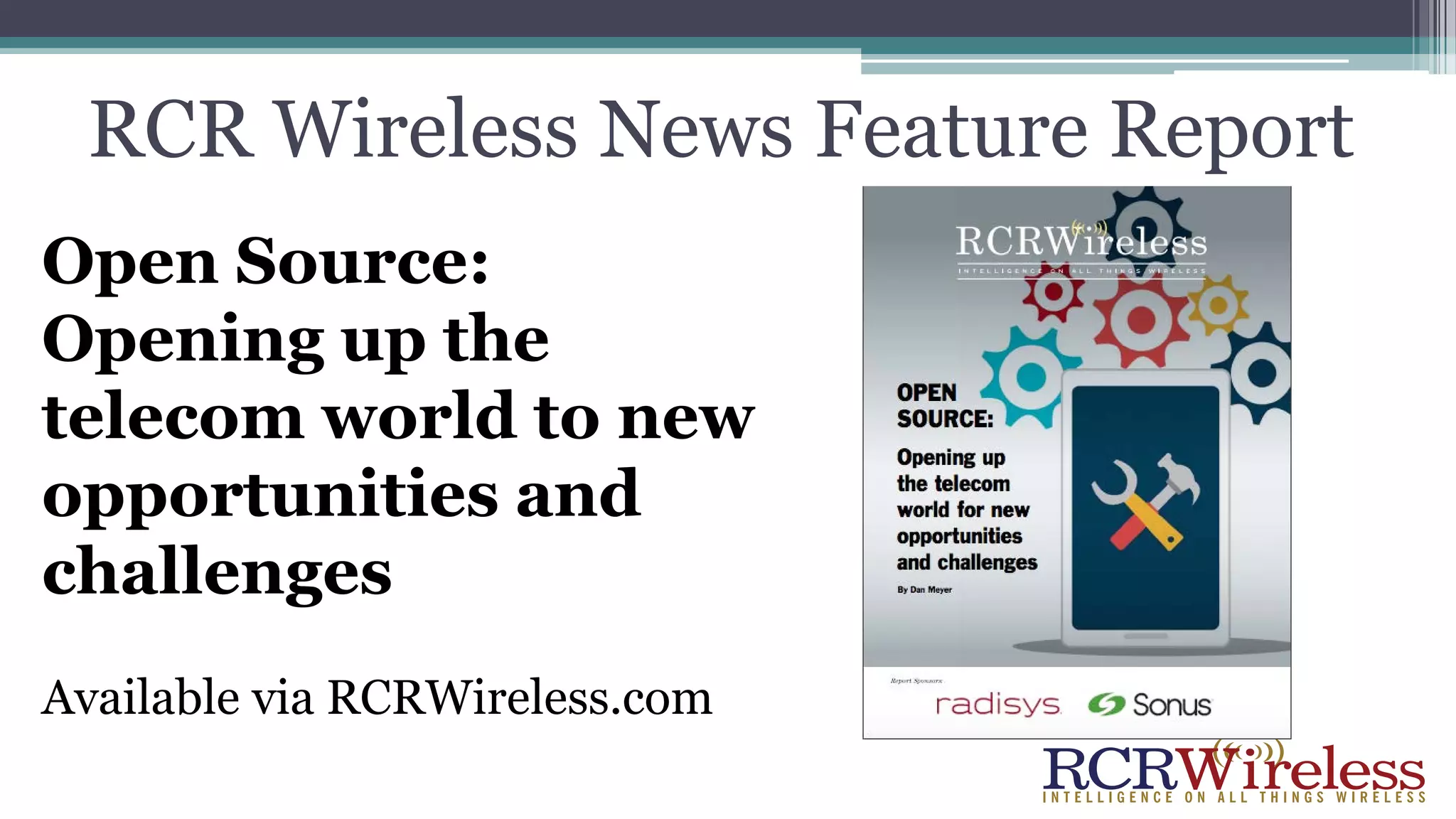
RCR Wireless News Feature Report
Open Source:
Opening up the
telecom world to new
opportunities and
challenges
Available via RCRWireless.com
Dan Meyer
Editor-in-Chief
RCR Wireless News
What is open source?
• Most often linked to a model in which source
code for an application or architecture is
available to others to alter or help in developing.
• Term coined in the late 1990s, with the Open
Source Initiative noting the label was created at
a “strategy session” surrounding the Netscape
web browser held on Feb. 3, 1998, in Palo Alto,
California.
What is open source?
• By early 2000, open source received a boost
from the formation of the Open Source
Development Labs, which focused on the
deployment of the Linux platform for enterprise
computing.
• The OSDL merged with the Free Standards
Group in 2007 to form the Linux Foundation.
Open source in telecom
• The traditional telecommunications space has a history
of using hardware and software systems that are
proprietary to a specific vendor, though are in some
cases geared towards using similar technology standards
– such as GSM, TDMA and CDMA – making sure
telecom operators can deploy solutions from different
vendors and have them work across their network.
• This approach to using multiple vendors allowed telecom
operators to an extent to open source some of their
network operations, though not to the degree typically
connected with open source software.
Open source in telecom
• The telecom space has more recently begun to
take a more computing view of the open source
space, highlighted by growing operator and
vendors moves towards deployment plans using
cloud, NFV and SDN technologies.
• This is being helped by a rapidly maturing
ecosystem surrounding telecom-focused open
source platforms.
Open source in telecom
• Operators are also on board with the new wave
of vendors the open source world is bringing to
the market.
▫ AT&T Domain 2.0
• This ability to reach outside the traditional
vendor model was echoed by a number of
operators, who cited a chance to bring new
players and better platforms into their
operations.
Growing support for open source
• One key challenge for growing the support of
open source into the telecommunications space
is through various organizations that are looking
to either bolster the use of open source or build
platforms based on open source specifications.
• These efforts are seen as beneficial to operators
and vendors looking to take advantage of open
source platforms.
Growing support for open source
• ETSI’s recent Open Source MANO initiative
launched its OSM Release One stack.
• Work has also flourished under The Linux
Foundation umbrella with highly touted work
through OPNFV and OpenDaylight.
• In general, telecom operators seem to welcome
the help from open source organizations, noting
their ability to provide a level of stability
assurance for platforms.
Open source challenges
• Operators have for years denounced the dreaded
vendor lock scenario that has shackled them to a
dwindling equipment vendor community.
• But, those vendors are exceedingly familiar with
the needs of telecommunication operators and
have built a level of trust with the network
operations folks in terms of comfort with
equipment deployments.
Open source challenges
• The new world of open source and software is
bringing with it the web-based mindset of “fast
fail,” which is similar to the application model
where software can just be updated after it’s
released.
• That might be a good model for “Angry Birds,”
but is a different story for operators dealing with
specific and expensive service level agreements.
Vendor challenges
• The move towards open source has had a
somewhat divisive impact on the vendor
community, with established telecom suppliers
now having to share the attention – and budgets
– of operators with new entrants.
• One of the most cited challenges for established
vendors is the obliteration of past business
models that has come with the move towards
open source platforms.
Vendor challenges
• Established vendors are taking on the challenge,
with all of the big names having joined various
open source industry groups and implemented
open source platforms to some extent into their
operations.
• Established vendors can also take some solace in
the history they have with telecommunication
operators.
RCRwireless webinar, January 18, 2017
© Analysys Mason Limited 2017
RCR Wireless Webinar
#AMTMT
Open source:
virtualization platforms, standards,
deployments
DANA COOPERSON
January 18, 2017
RCRwireless webinar, January 18, 2017
© Analysys Mason Limited 2017 18
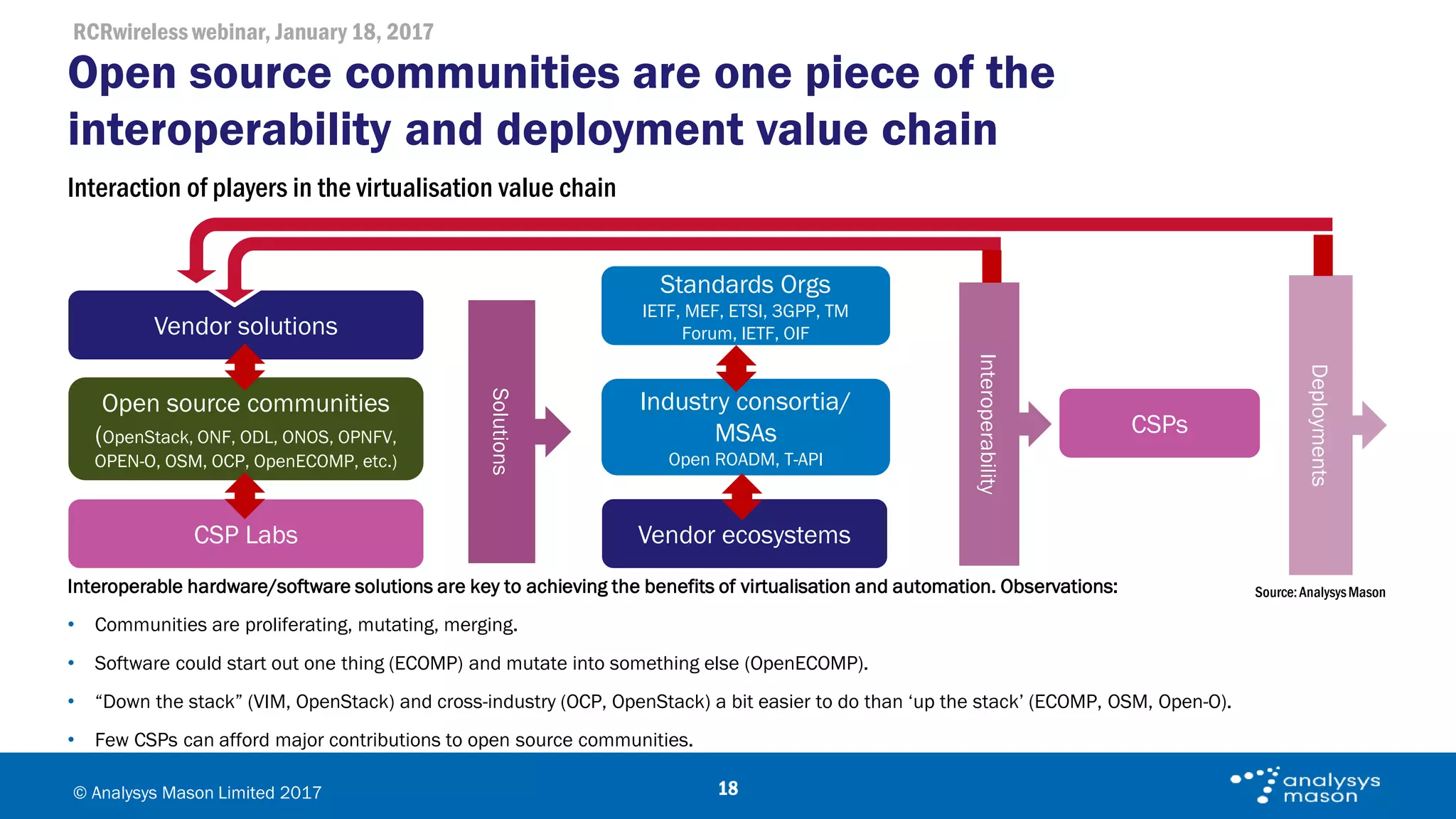
Interaction of players in the virtualisation value chain
Interoperable hardware/software solutions are key to achieving the benefits of virtualisation and automation. Observations:
• Communities are proliferating, mutating, merging.
• Software could start out one thing (ECOMP) and mutate into something else (OpenECOMP).
• “Down the stack” (VIM, OpenStack) and cross-industry (OCP, OpenStack) a bit easier to do than ‘up the stack’ (ECOMP, OSM, Open-O).
• Few CSPs can afford major contributions to open source communities.
Open source communities are one piece of the
interoperability and deployment value chain
Standards Orgs
IETF, MEF, ETSI, 3GPP, TM
Forum, IETF, OIF
Open source communities
(OpenStack, ONF, ODL, ONOS, OPNFV,
OPEN-O, OSM, OCP, OpenECOMP, etc.)
Vendor solutions
Vendor ecosystems
CSPs
Industry consortia/
MSAs
Open ROADM, T-API
Deployments
Interoperability
Solutions
CSP Labs
Source:AnalysysMason
RCRwireless webinar, January 18, 2017
© Analysys Mason Limited 2017
Return code
Vendor
solutions
19
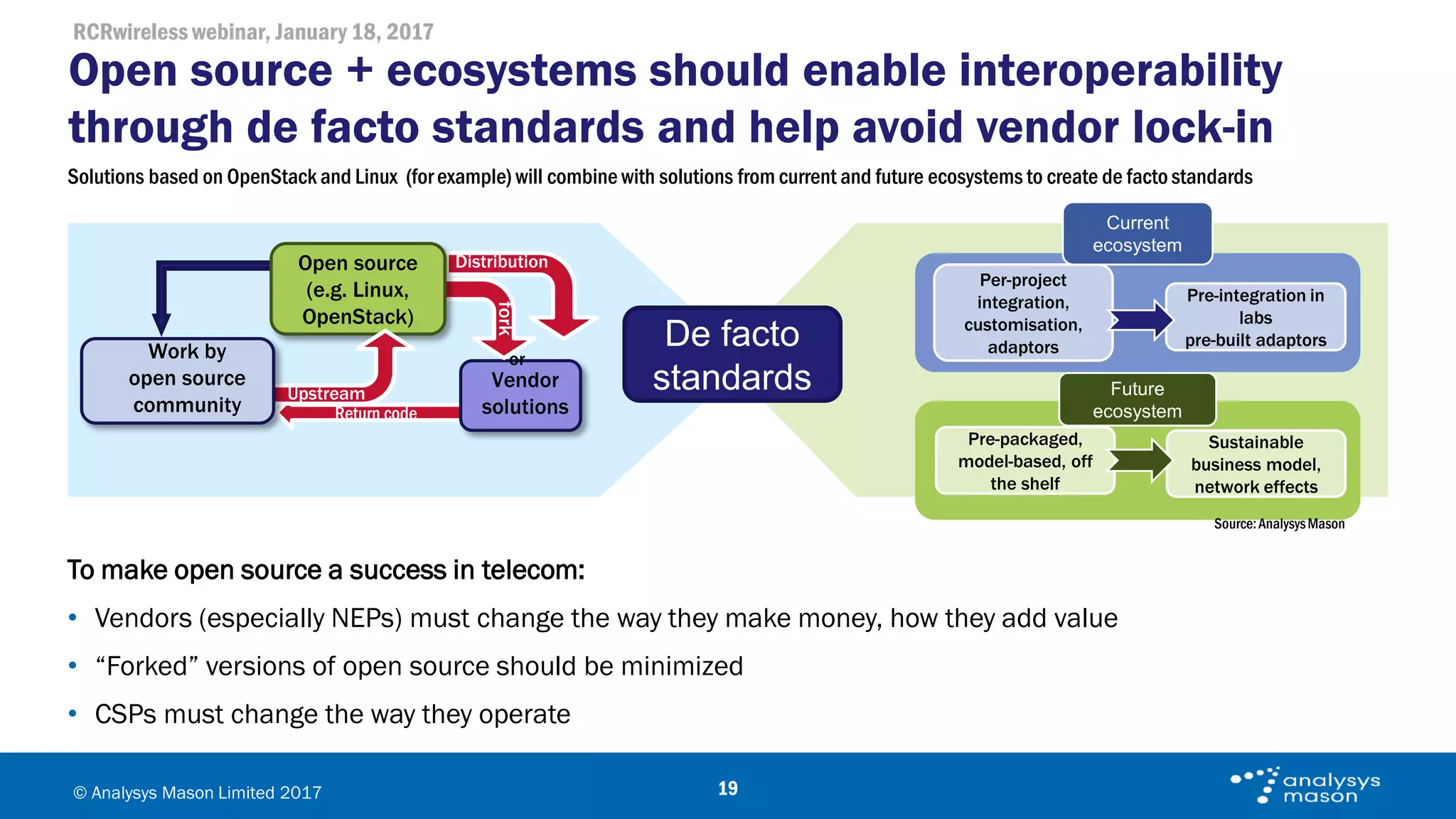
Solutions based on OpenStack and Linux (for example) will combine with solutions from current and future ecosystems to create de factostandards
To make open source a success in telecom:
• Vendors (especially NEPs) must change the way they make money, how they add value
• “Forked” versions of open source should be minimized
• CSPs must change the way they operate
Open source + ecosystems should enable interoperability
through de facto standards and help avoid vendor lock-in
Sustainable
business model,
network effects
Pre-packaged,
model-based, off
the shelf
Future
ecosystem
Pre-integration in
labs
pre-built adaptors
Per-project
integration,
customisation,
adaptors
Current
ecosystem
Source:AnalysysMason
De facto
standards
Open source
(e.g. Linux,
OpenStack)
Work by
open source
community
Upstream
Distribution
or
fork
RCRwireless webinar, January 18, 2017
© Analysys Mason Limited 2017
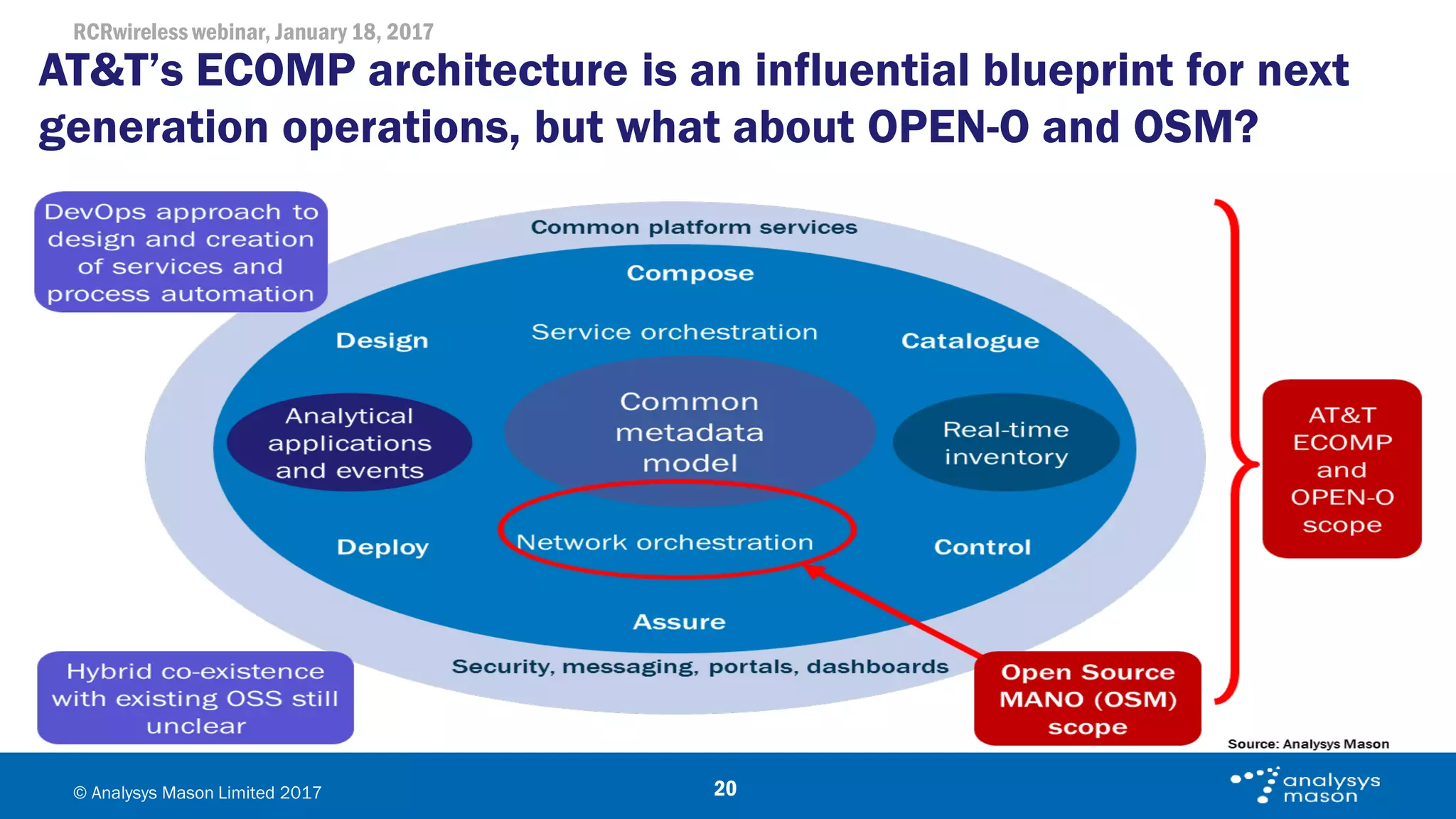
AT&T’s ECOMP architecture is an influential blueprint for next
generation operations, but what about OPEN-O and OSM?
20
RCRwireless webinar, January 18, 2017
© Analysys Mason Limited 2017
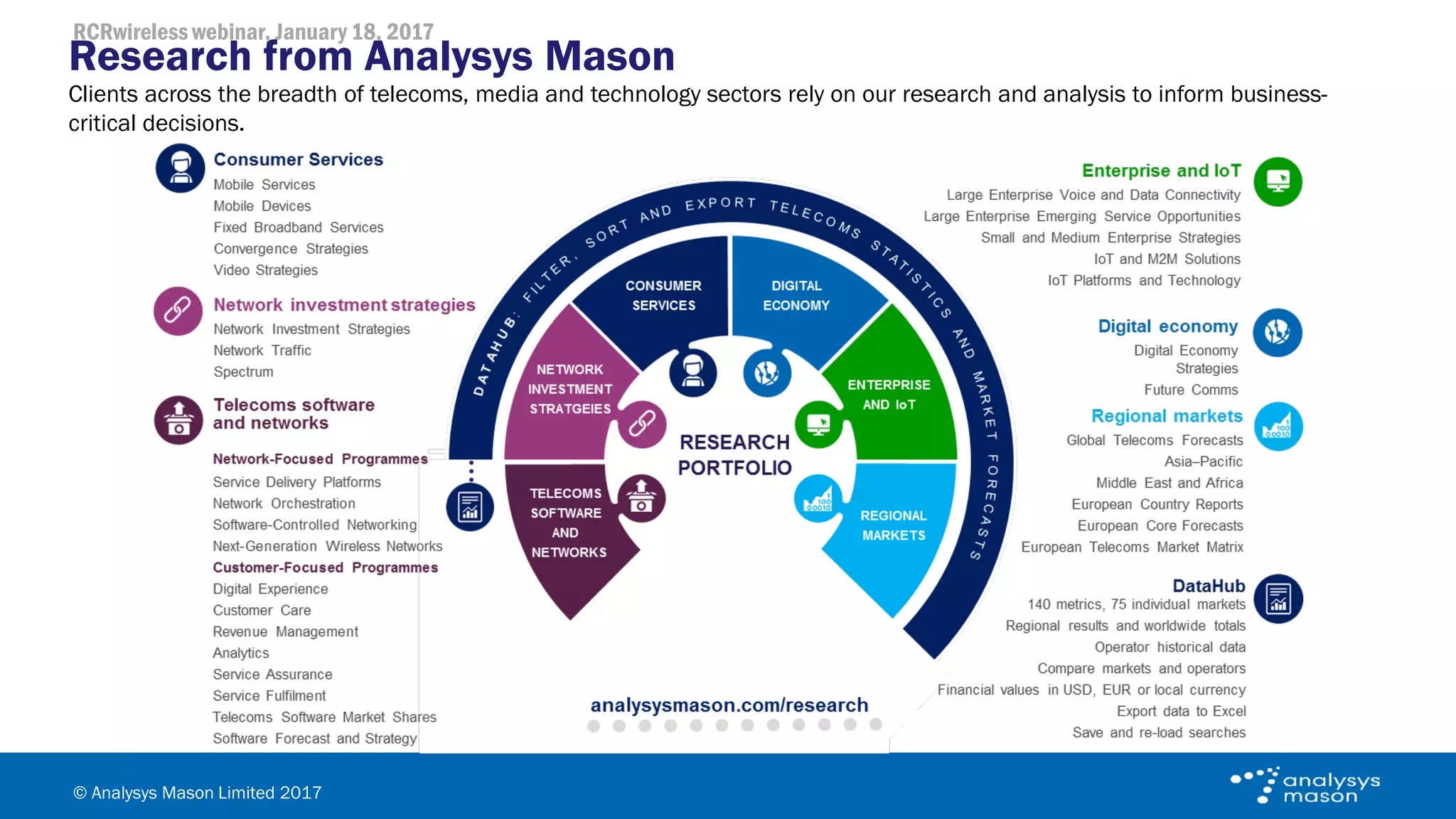
Research from Analysys Mason
Clients across the breadth of telecoms, media and technology sectors rely on our research and analysis to inform business-
critical decisions.
RCRwireless webinar, January 18, 2017
© Analysys Mason Limited 2017
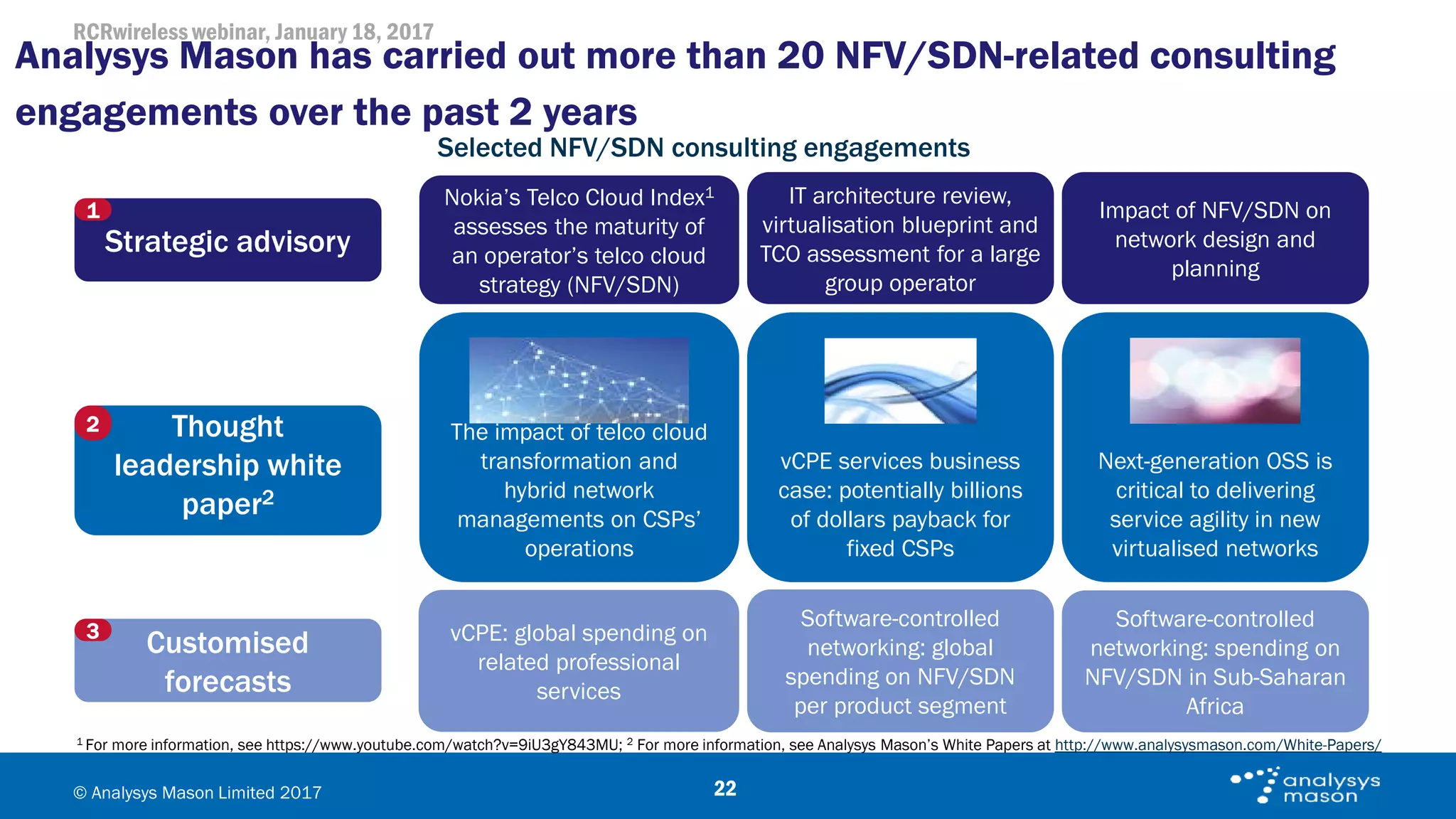
Analysys Mason has carried out more than 20 NFV/SDN-related consulting
engagements over the past 2 years
22
1 For more information, see https://www.youtube.com/watch?v=9iU3gY843MU; 2 For more information, see Analysys Mason’s White Papers at http://www.analysysmason.com/White-Papers/
Selected NFV/SDN consulting engagements
Nokia’s Telco Cloud Index1
assesses the maturity of
an operator’s telco cloud
strategy (NFV/SDN)
vCPE: global spending on
related professional
services
IT architecture review,
virtualisation blueprint and
TCO assessment for a large
group operator
Impact of NFV/SDN on
network design and
planning
Strategic advisory
1
Thought
leadership white
paper2
2
vCPE services business
case: potentially billions
of dollars payback for
fixed CSPs
The impact of telco cloud
transformation and
hybrid network
managements on CSPs’
operations
Next-generation OSS is
critical to delivering
service agility in new
virtualised networks
Customised
forecasts
3
Software-controlled
networking: spending on
NFV/SDN in Sub-Saharan
Africa
Software-controlled
networking: global
spending on NFV/SDN
per product segment
RCRwireless webinar, January 18, 2017
© Analysys Mason Limited 2017
Contact details
23
Cambridge
Tel: +44 (0)1223 460600
cambridge@analysysmason.com
Milan
Tel: +39 02 76 31 88 34
milan@analysysmason.com
Dubai
Tel: +971 (0)4 446 7473
dubai@analysysmason.com
New Delhi
Tel: +91 124 4501860
newdelhi@analysysmason.com
Dublin
Tel: +353 (0)1 602 4755
dublin@analysysmason.com
Paris
Tel: +33 (0)1 72 71 96 96
paris@analysysmason.com
London
Tel: +44 (0)20 7395 9000
london@analysysmason.com
Singapore
Tel: +65 6493 6038
singapore@analysysmason.com
Madrid
Tel: +34 91 399 5016
madrid@analysysmason.com
Manchester
Tel: +44 (0)161 877 7808
manchester@analysysmason.com
@AnalysysMason linkedin.com/company/analysys-mason youtube.com/AnalysysMason analysysmason.com/RSS
Dana Cooperson
Research Director
Dana.Cooperson@analysysmason.com
Dana Cooperson
DanaCooperson
Boston
Tel: +1 202 331 3080
boston@analysysmason.com
Hong Kong
Tel: +852 3669 7090
hongkong@analysysmason.com
24
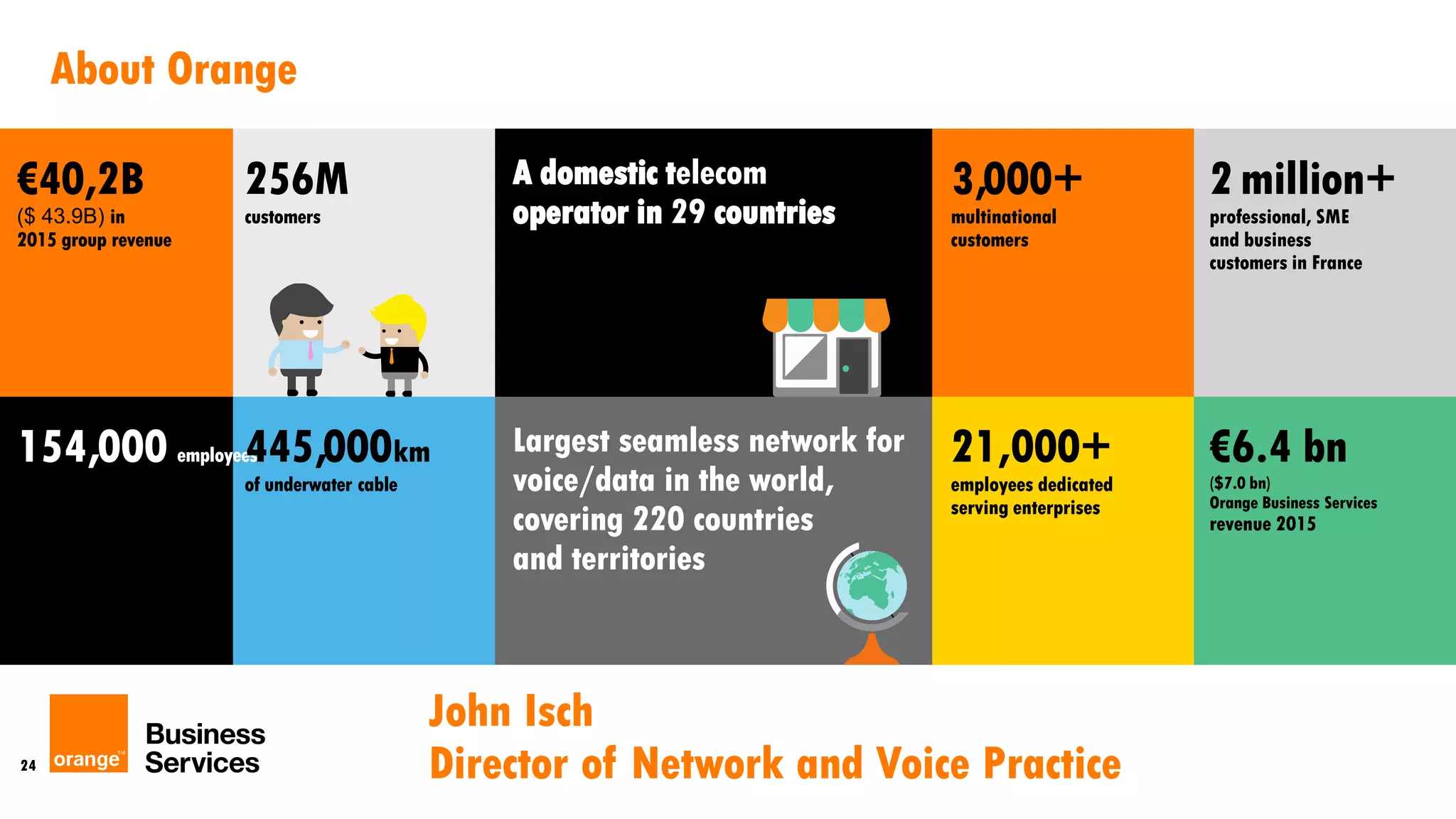
About Orange
€40,2B
($ 43.9B) in
2015 group revenue
256M
customers
154,000 employees445,000km
of underwater cable
3,000+
multinational
customers
21,000+
employees dedicated
serving enterprises
€6.4 bn
($7.0 bn)
Orange Business Services
revenue 2015
2million+
professional, SME
and business
customers in France
A domestic telecom
operator in 29 countries
Largest seamless network for
voice/data in the world,
covering 220 countries
and territories
John Isch
Director of Network and Voice Practice
25
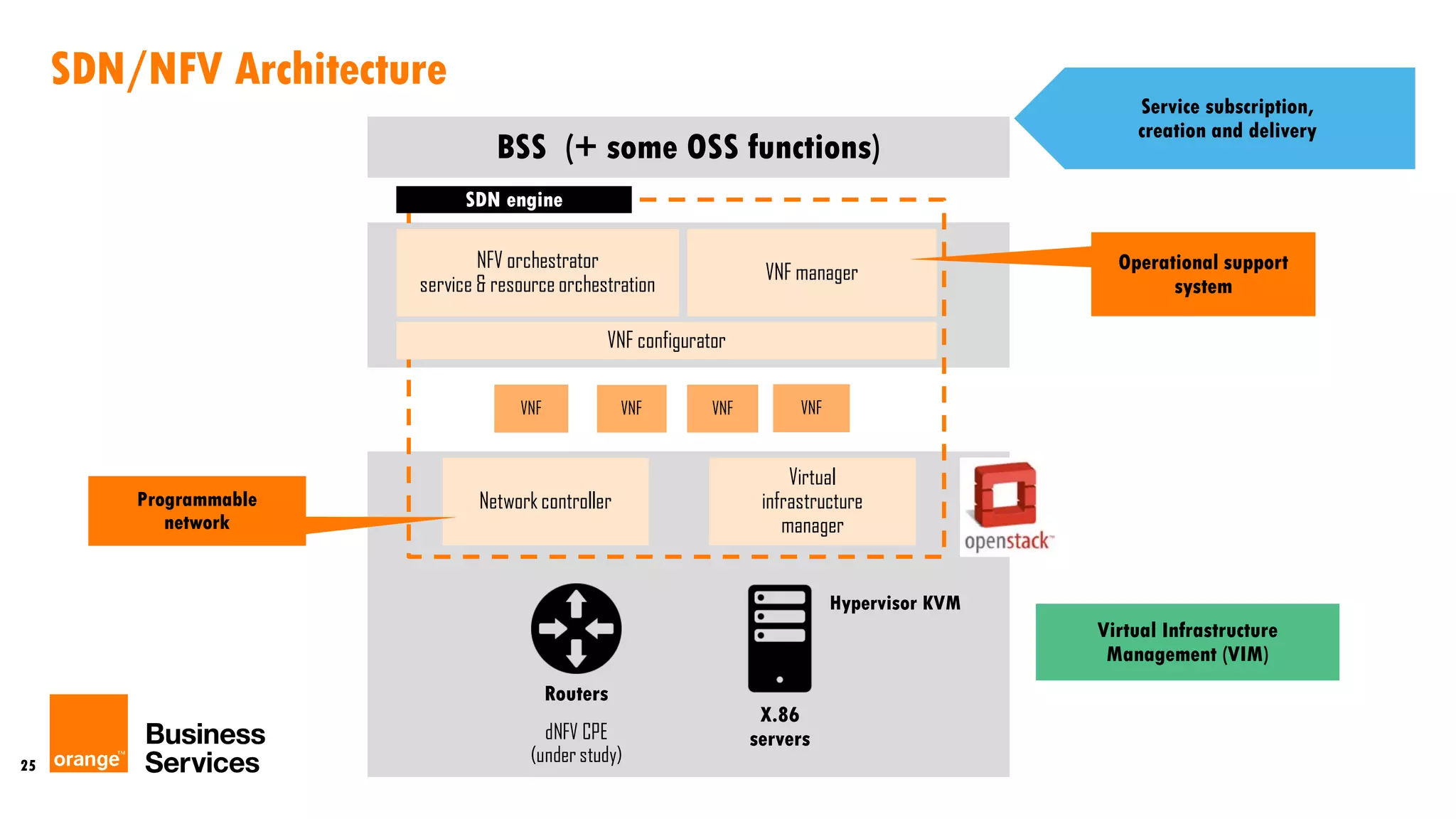
SDN/NFV Architecture
Network controller
Virtual
infrastructure
manager
VNF VNF VNF VNF
BSS (+ some OSS functions)
NFV orchestrator
service & resource orchestration
VNF manager
dNFV CPE
(under study)
Service subscription,
creation and delivery
VNF configurator
Hypervisor KVM
Routers
X.86
servers
Virtual Infrastructure
Management (VIM)
SDN engine
Programmable
network
Operational support
system
26
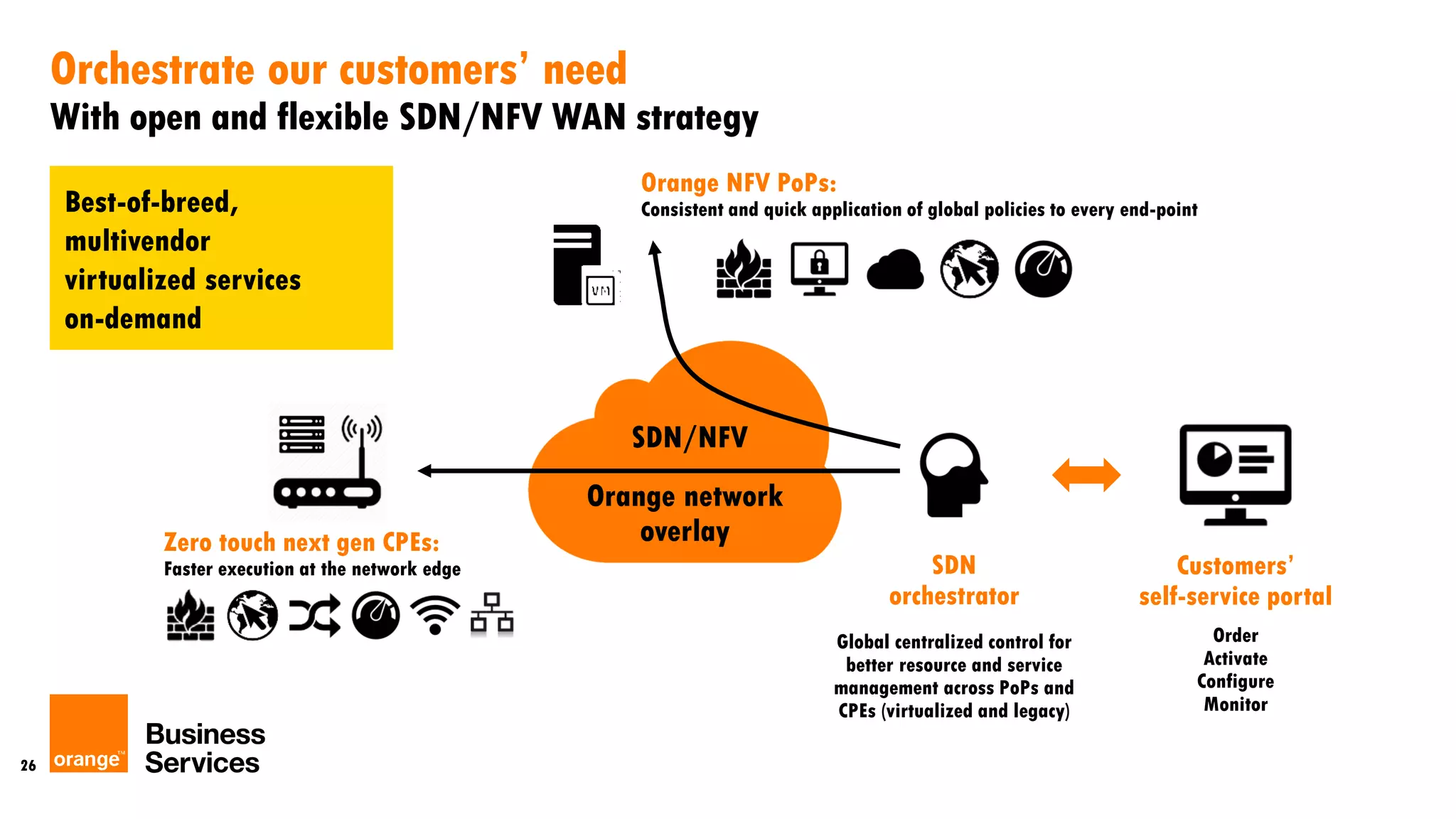
Orchestrate our customers’ need
With open and flexible SDN/NFV WAN strategy
Best-of-breed,
multivendor
virtualized services
on-demand
SDN
orchestrator
Orange network
overlay
Orange NFV PoPs:
Consistent and quick application of global policies to every end-point
Zero touch next gen CPEs:
Faster execution at the network edge
Order
Activate
Configure
Monitor
Global centralized control for
better resource and service
management across PoPs and
CPEs (virtualized and legacy)
Customers’
self-service portal
SDN/NFV
27
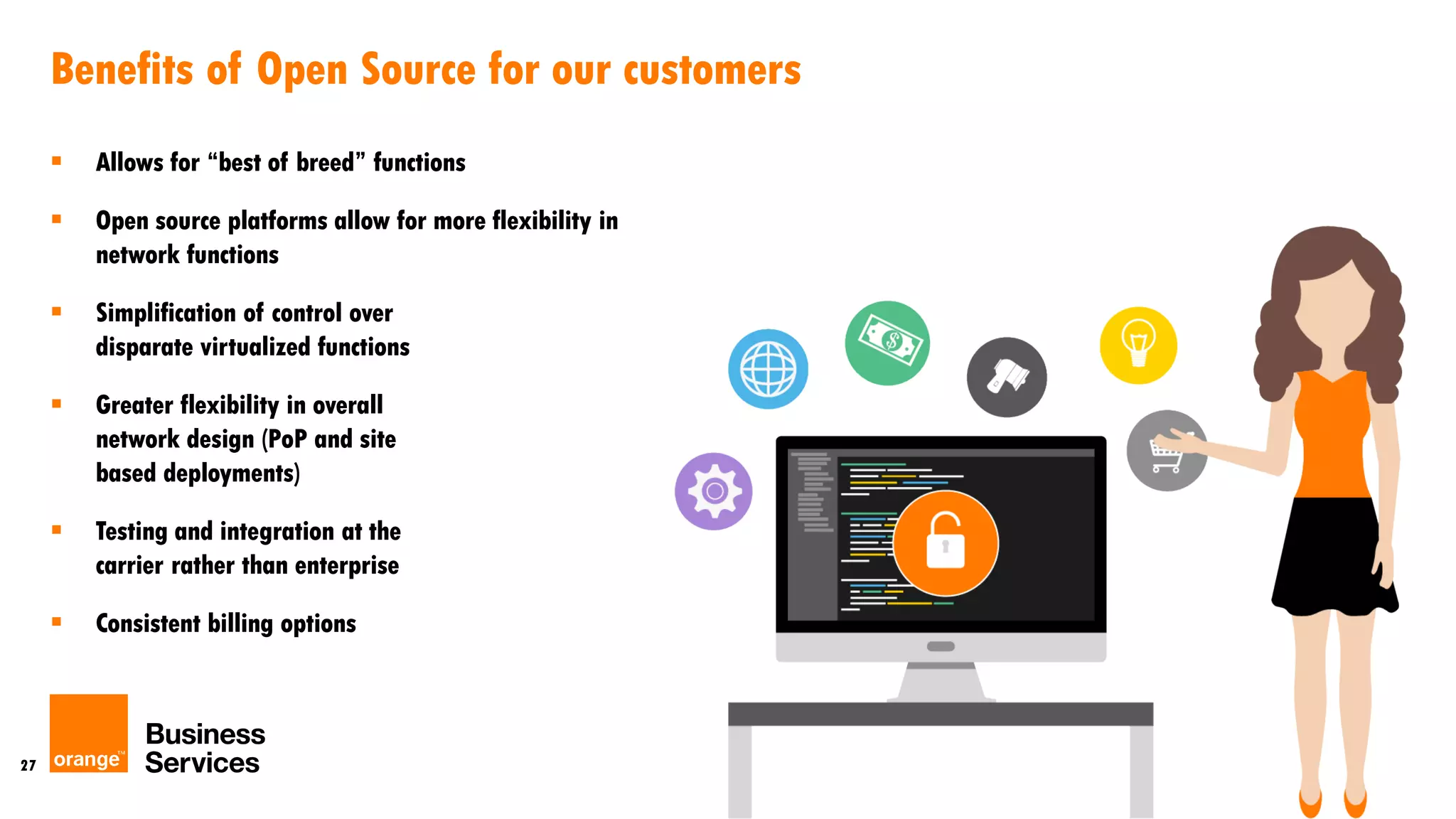
Benefits of Open Source for our customers
 Allows for “best of breed” functions
 Open source platforms allow for more flexibility in
network functions
 Simplification of control over
disparate virtualized functions
 Greater flexibility in overall
network design (PoP and site
based deployments)
 Testing and integration at the
carrier rather than enterprise
 Consistent billing options
RCR Wireless Radisys Introduction Suzanne Kelliher
DCEngine Product Line Manager
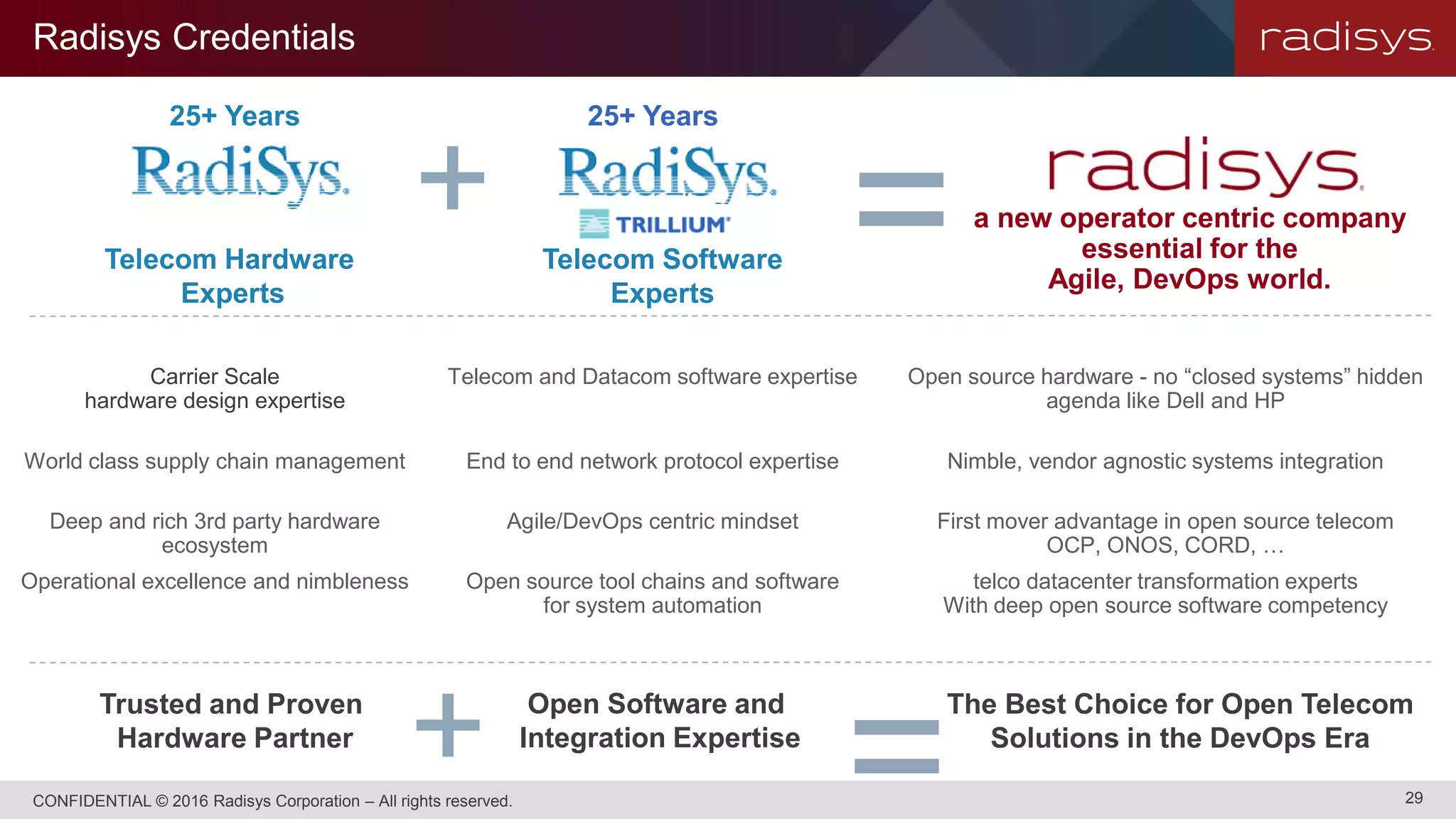
Radisys Credentials
CONFIDENTIAL © 2016 Radisys Corporation – All rights reserved. 29
25+ Years
Telecom Software
Experts
a new operator centric company
essential for the
Agile, DevOps world.
+ =Telecom Hardware
Experts
25+ Years
Carrier Scale
hardware design expertise
Telecom and Datacom software expertise Open source hardware - no “closed systems” hidden
agenda like Dell and HP
World class supply chain management End to end network protocol expertise Nimble, vendor agnostic systems integration
Deep and rich 3rd party hardware
ecosystem
Agile/DevOps centric mindset First mover advantage in open source telecom
OCP, ONOS, CORD, …
Operational excellence and nimbleness Open source tool chains and software
for system automation
telco datacenter transformation experts
With deep open source software competency
Trusted and Proven
Hardware Partner
Open Software and
Integration Expertise
The Best Choice for Open Telecom
Solutions in the DevOps Era
+ =
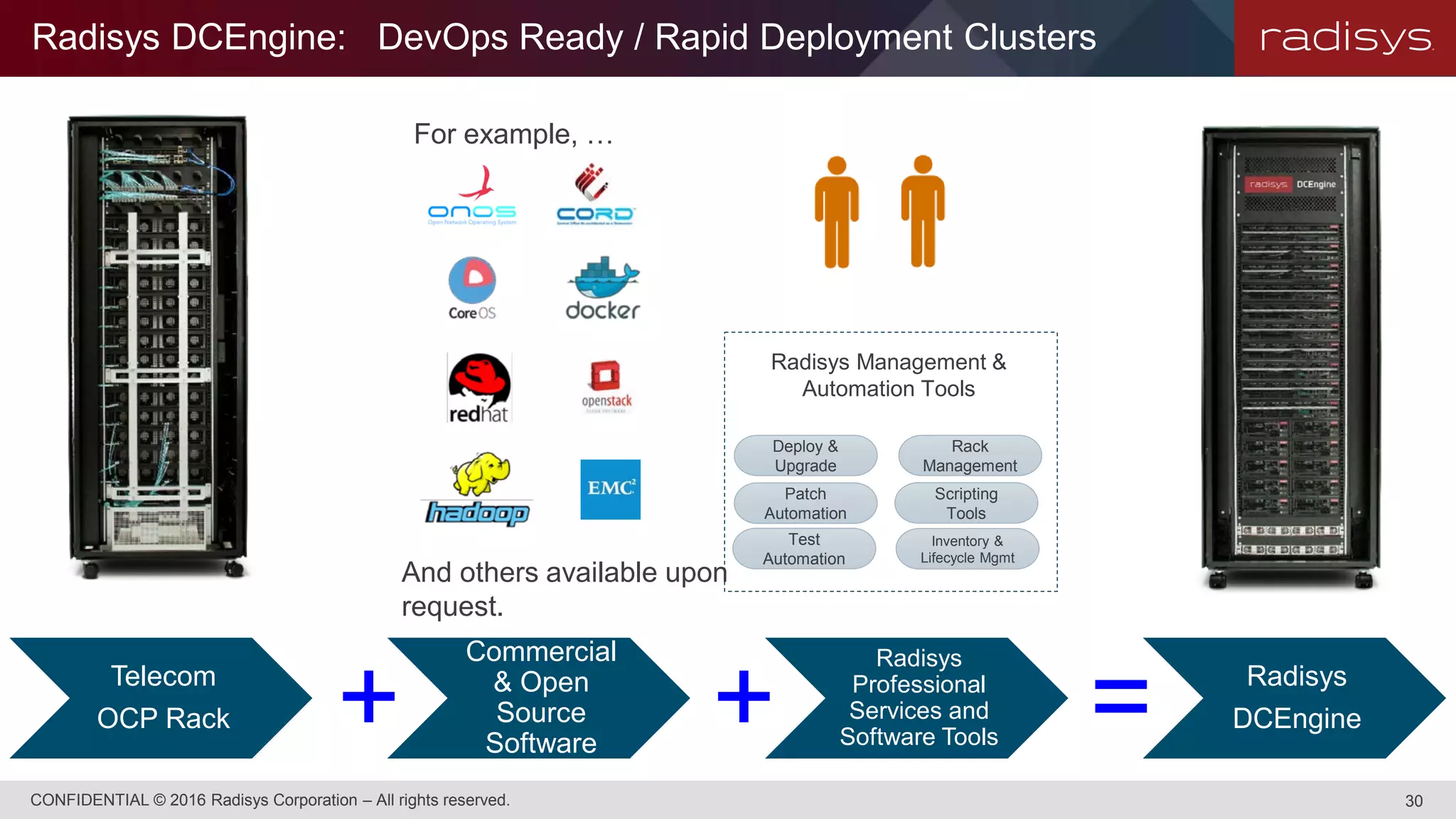
Radisys DCEngine: DevOps Ready / Rapid Deployment Clusters
CONFIDENTIAL © 2016 Radisys Corporation – All rights reserved. 30
+ =Telecom
OCP Rack
Radisys
Professional
Services and
Software Tools
Commercial
& Open
Source
Software
Radisys
DCEngine+
Test
Automation
Deploy &
Upgrade
Rack
Management
Scripting
Tools
Inventory &
Lifecycle Mgmt
Radisys Management &
Automation Tools
Patch
Automation
For example, …
And others available upon
request.
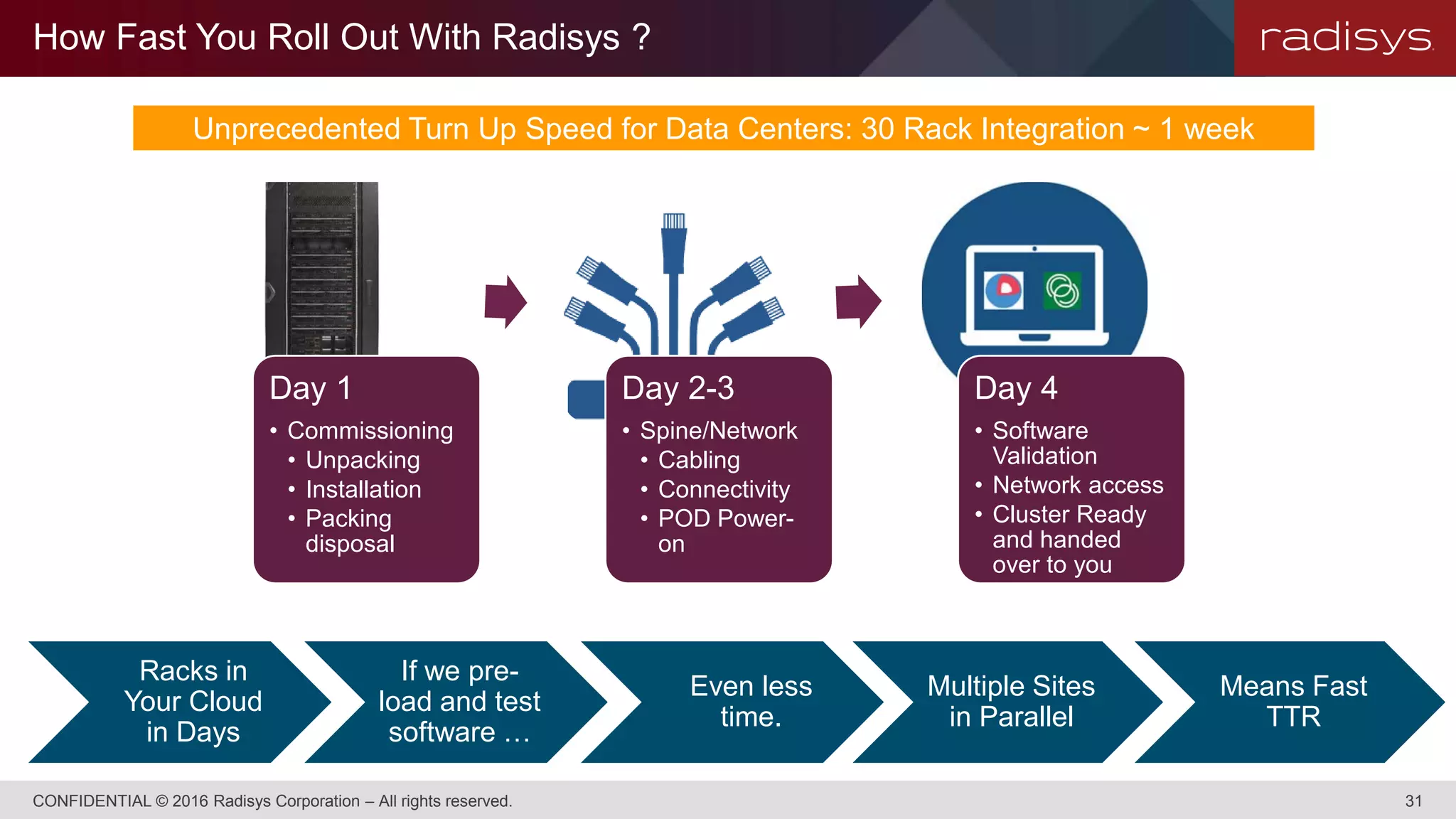
How Fast You Roll Out With Radisys ?
CONFIDENTIAL © 2016 Radisys Corporation – All rights reserved. 31
Racks in
Your Cloud
in Days
If we pre-
load and test
software …
Even less
time.
Multiple Sites
in Parallel
Means Fast
TTR
Unprecedented Turn Up Speed for Data Centers: 30 Rack Integration ~ 1 week
Day 1
• Commissioning
• Unpacking
• Installation
• Packing
disposal
Day 2-3
• Spine/Network
• Cabling
• Connectivity
• POD Power-
on
Day 4
• Software
Validation
• Network access
• Cluster Ready
and handed
over to you
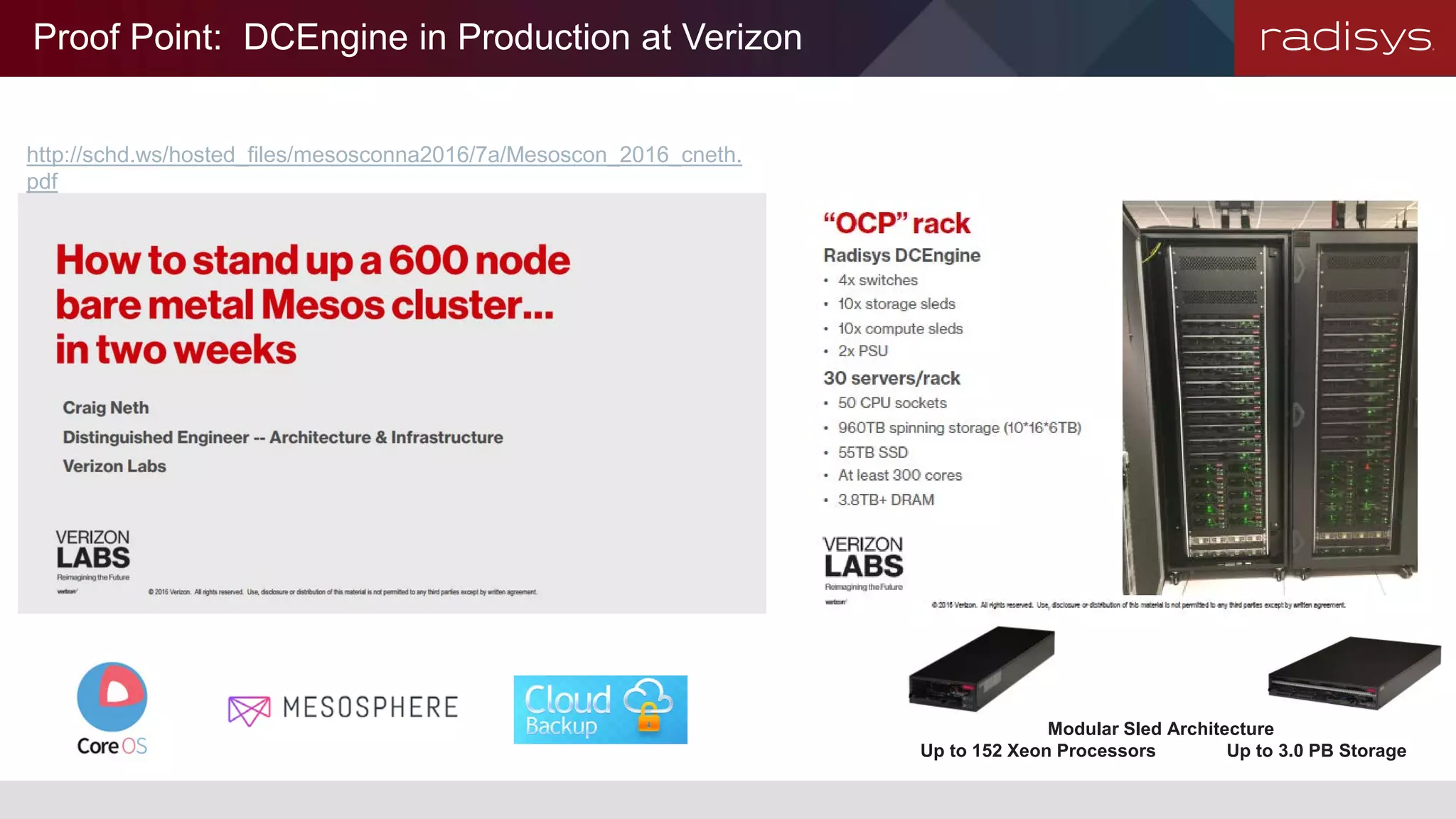
Proof Point: DCEngine in Production at Verizon
http://schd.ws/hosted_files/mesosconna2016/7a/Mesoscon_2016_cneth.
pdf
Modular Sled Architecture
Up to 152 Xeon Processors Up to 3.0 PB Storage
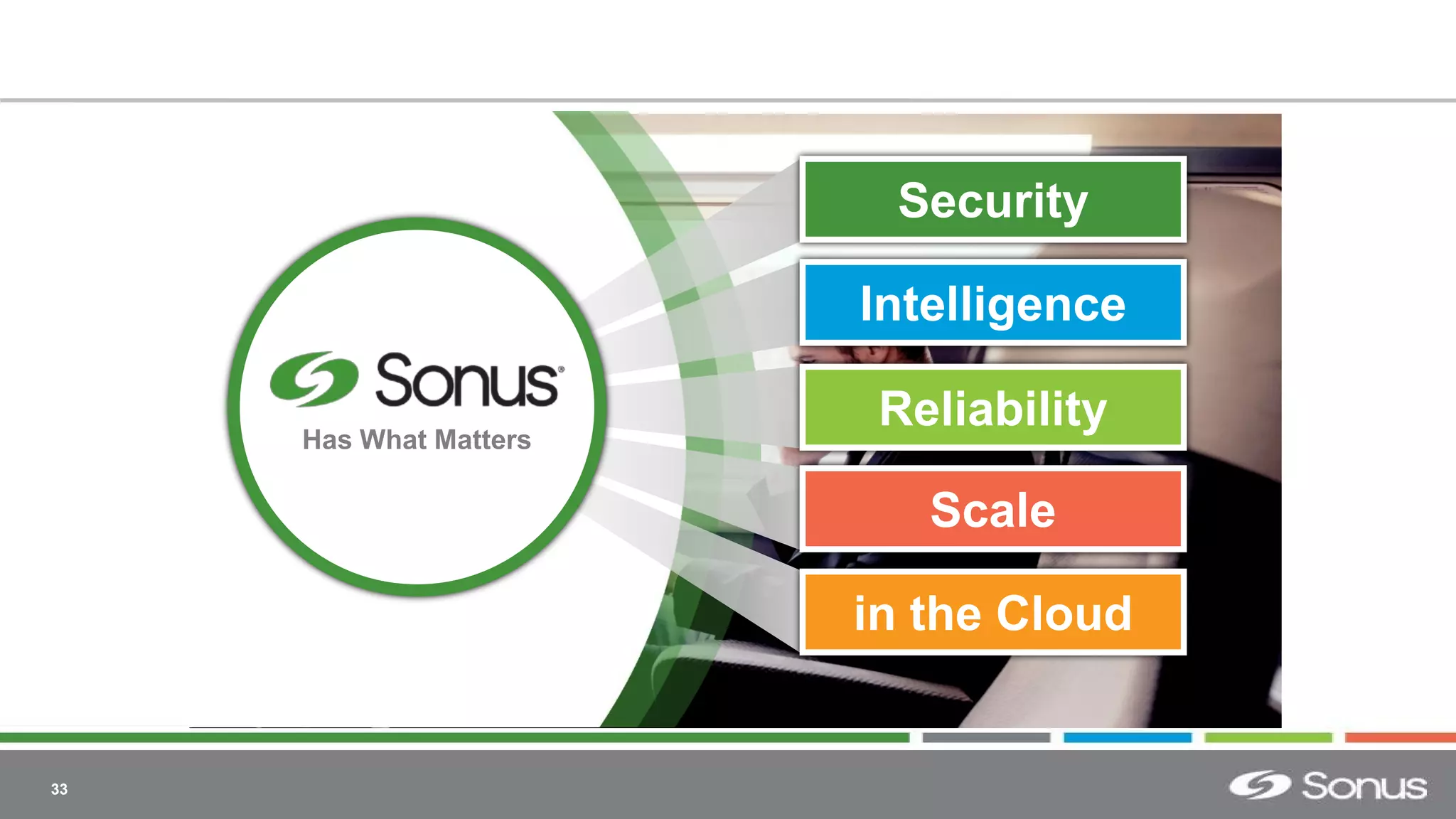
33
Has What Matters
Security
Intelligence
Scale
in the Cloud
Reliability
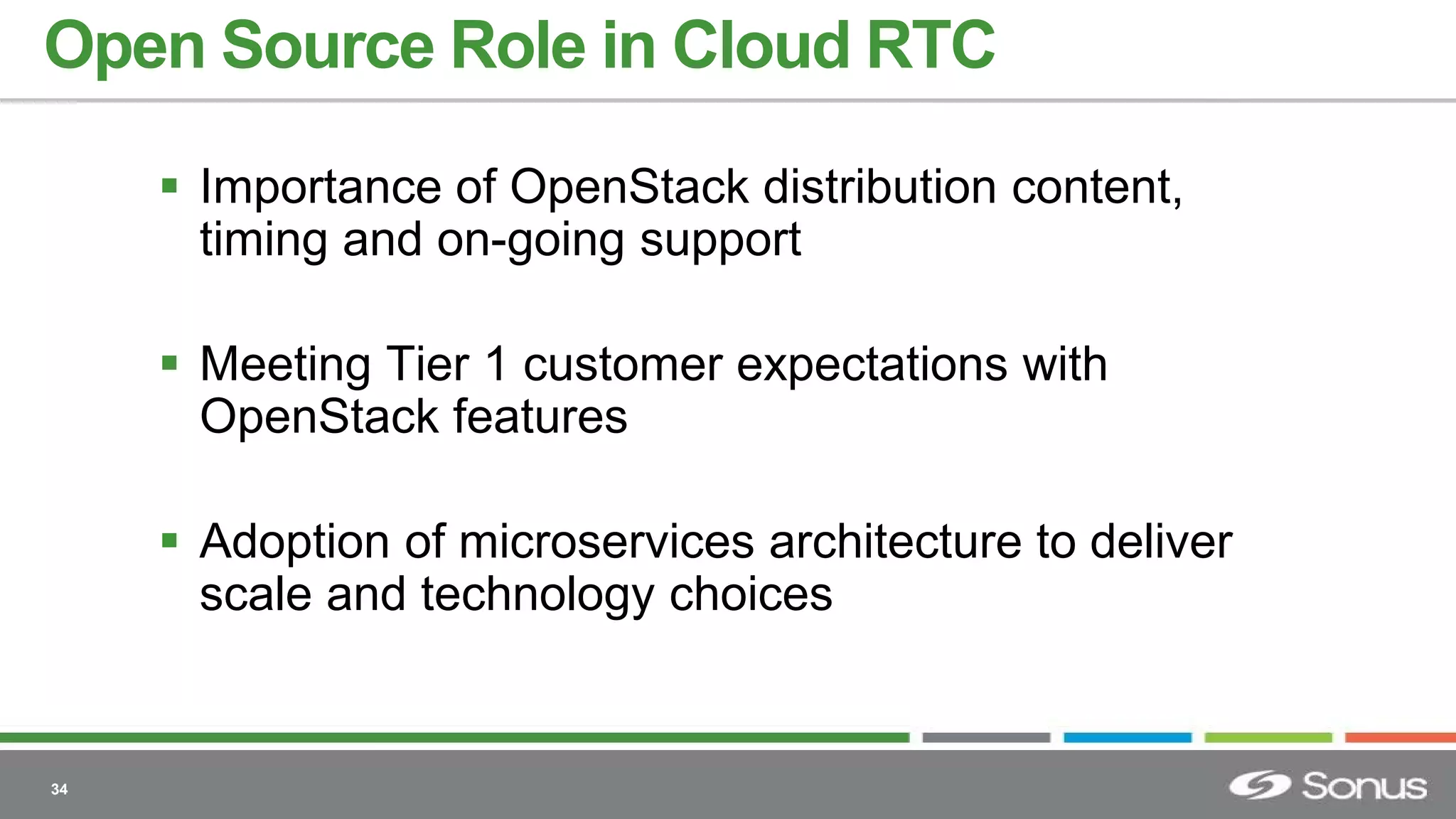
34
 Importance of OpenStack distribution content,
timing and on-going support
 Meeting Tier 1 customer expectations with
OpenStack features
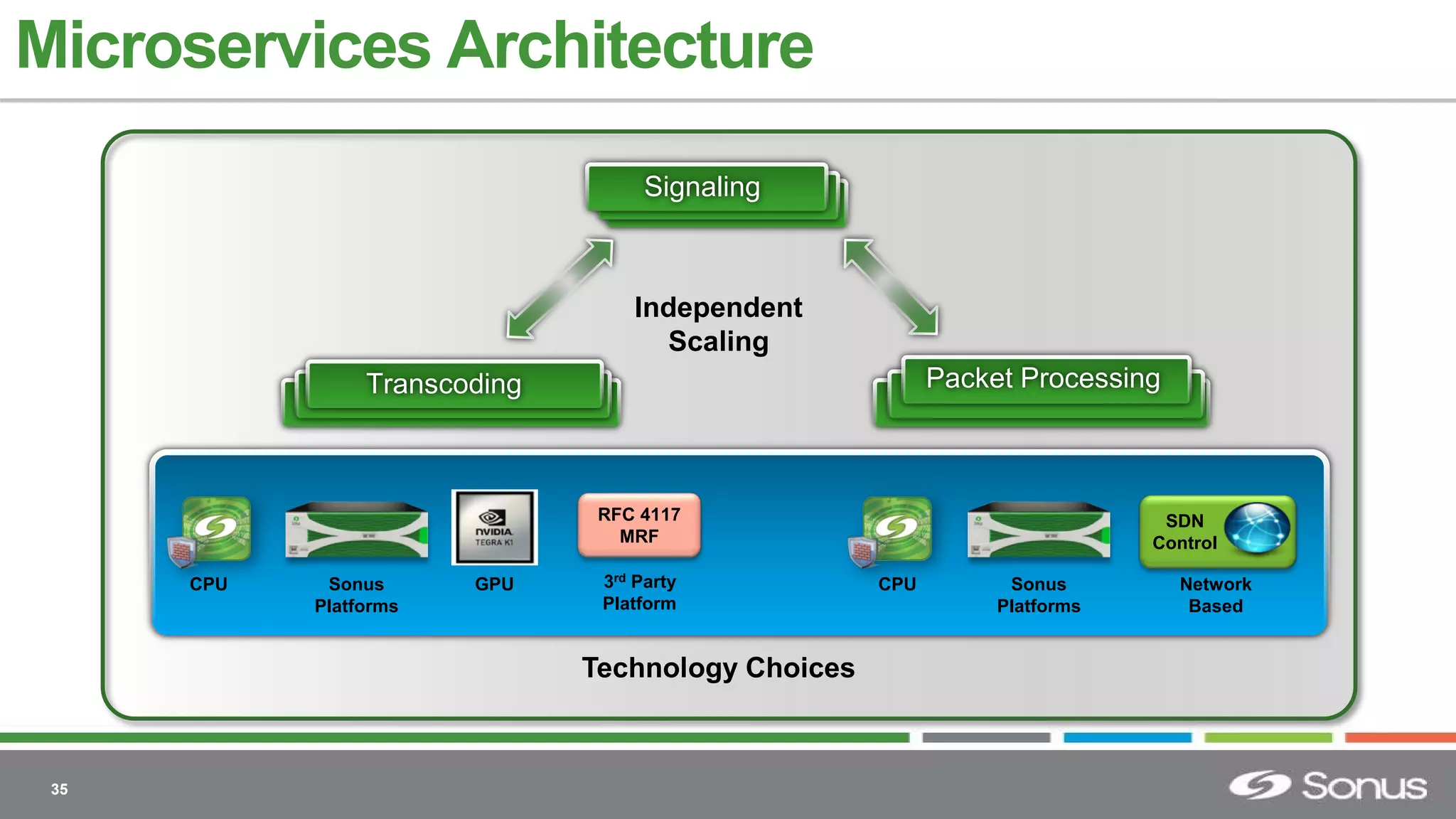
 Adoption of microservices architecture to deliver
scale and technology choices
Open Source Role in Cloud RTC
35
Packet Processing
Signaling
Transcoding
CPU CPU Sonus
Platforms
Sonus
Platforms
RFC 4117
MRF
3rd Party
Platform
Network
Based
SDN
Control
Independent
Scaling
GPU
Microservices Architecture
Technology Choices
Panel discussion
Questions?
• Dan Meyer, Editor-in-Chief, RCR Wireless
News
• Dana Cooperson, Research Director, Analysys
Mason
• John Isch, Network and Voice Center of
Excellence, Orange Business Services
• Suzanne Kelliher, Product Line Manager,
Radisys
• Bryan Hill, VP of Engineering, Sonus
RCR Wireless News Feature Report
Open Source:
Opening up the
telecom world to new
opportunities and
challenges
Available via RCRWireless.com

Open Source: Opening up the telecom world for new opportunities and challenges

  • 2.
    Your panelists fortoday’s webinar: • Dan Meyer, Editor-in-Chief, RCR Wireless News • Dana Cooperson, Research Director, Analysys Mason • John Isch, Network and Voice Center of Excellence, Orange Business Services • Suzanne Kelliher, Product Line Manager, Radisys • Bryan Hill, VP of Engineering, Sonus
  • 3.
    About RCR WirelessNews: • RCR Wireless News is the premier news source for the wireless communications industry and is first with carrier, distributor, network, handset and mobile content news. • Published since 1981, RCR Wireless News keeps our subscribers engaged and informed with breaking stories, enlightened features and invaluable industry insight. • RCR Wireless News target audience is executive-level employees at leading wireless companies, and volume buyers at enterprise-class organizations. • RCRWireless.com
  • 4.
    RCR Wireless NewsFeature Report Open Source: Opening up the telecom world to new opportunities and challenges Available via RCRWireless.com
  • 5.
  • 6.
    What is opensource? • Most often linked to a model in which source code for an application or architecture is available to others to alter or help in developing. • Term coined in the late 1990s, with the Open Source Initiative noting the label was created at a “strategy session” surrounding the Netscape web browser held on Feb. 3, 1998, in Palo Alto, California.
  • 7.
    What is opensource? • By early 2000, open source received a boost from the formation of the Open Source Development Labs, which focused on the deployment of the Linux platform for enterprise computing. • The OSDL merged with the Free Standards Group in 2007 to form the Linux Foundation.
  • 8.
    Open source intelecom • The traditional telecommunications space has a history of using hardware and software systems that are proprietary to a specific vendor, though are in some cases geared towards using similar technology standards – such as GSM, TDMA and CDMA – making sure telecom operators can deploy solutions from different vendors and have them work across their network. • This approach to using multiple vendors allowed telecom operators to an extent to open source some of their network operations, though not to the degree typically connected with open source software.
  • 9.
    Open source intelecom • The telecom space has more recently begun to take a more computing view of the open source space, highlighted by growing operator and vendors moves towards deployment plans using cloud, NFV and SDN technologies. • This is being helped by a rapidly maturing ecosystem surrounding telecom-focused open source platforms.
  • 10.
    Open source intelecom • Operators are also on board with the new wave of vendors the open source world is bringing to the market. ▫ AT&T Domain 2.0 • This ability to reach outside the traditional vendor model was echoed by a number of operators, who cited a chance to bring new players and better platforms into their operations.
  • 11.
    Growing support foropen source • One key challenge for growing the support of open source into the telecommunications space is through various organizations that are looking to either bolster the use of open source or build platforms based on open source specifications. • These efforts are seen as beneficial to operators and vendors looking to take advantage of open source platforms.
  • 12.
    Growing support foropen source • ETSI’s recent Open Source MANO initiative launched its OSM Release One stack. • Work has also flourished under The Linux Foundation umbrella with highly touted work through OPNFV and OpenDaylight. • In general, telecom operators seem to welcome the help from open source organizations, noting their ability to provide a level of stability assurance for platforms.
  • 13.
    Open source challenges •Operators have for years denounced the dreaded vendor lock scenario that has shackled them to a dwindling equipment vendor community. • But, those vendors are exceedingly familiar with the needs of telecommunication operators and have built a level of trust with the network operations folks in terms of comfort with equipment deployments.
  • 14.
    Open source challenges •The new world of open source and software is bringing with it the web-based mindset of “fast fail,” which is similar to the application model where software can just be updated after it’s released. • That might be a good model for “Angry Birds,” but is a different story for operators dealing with specific and expensive service level agreements.
  • 15.
    Vendor challenges • Themove towards open source has had a somewhat divisive impact on the vendor community, with established telecom suppliers now having to share the attention – and budgets – of operators with new entrants. • One of the most cited challenges for established vendors is the obliteration of past business models that has come with the move towards open source platforms.
  • 16.
    Vendor challenges • Establishedvendors are taking on the challenge, with all of the big names having joined various open source industry groups and implemented open source platforms to some extent into their operations. • Established vendors can also take some solace in the history they have with telecommunication operators.
  • 17.
    RCRwireless webinar, January18, 2017 © Analysys Mason Limited 2017 RCR Wireless Webinar #AMTMT Open source: virtualization platforms, standards, deployments DANA COOPERSON January 18, 2017
  • 18.
    RCRwireless webinar, January18, 2017 © Analysys Mason Limited 2017 18 Interaction of players in the virtualisation value chain Interoperable hardware/software solutions are key to achieving the benefits of virtualisation and automation. Observations: • Communities are proliferating, mutating, merging. • Software could start out one thing (ECOMP) and mutate into something else (OpenECOMP). • “Down the stack” (VIM, OpenStack) and cross-industry (OCP, OpenStack) a bit easier to do than ‘up the stack’ (ECOMP, OSM, Open-O). • Few CSPs can afford major contributions to open source communities. Open source communities are one piece of the interoperability and deployment value chain Standards Orgs IETF, MEF, ETSI, 3GPP, TM Forum, IETF, OIF Open source communities (OpenStack, ONF, ODL, ONOS, OPNFV, OPEN-O, OSM, OCP, OpenECOMP, etc.) Vendor solutions Vendor ecosystems CSPs Industry consortia/ MSAs Open ROADM, T-API Deployments Interoperability Solutions CSP Labs Source:AnalysysMason
  • 19.
    RCRwireless webinar, January18, 2017 © Analysys Mason Limited 2017 Return code Vendor solutions 19 Solutions based on OpenStack and Linux (for example) will combine with solutions from current and future ecosystems to create de factostandards To make open source a success in telecom: • Vendors (especially NEPs) must change the way they make money, how they add value • “Forked” versions of open source should be minimized • CSPs must change the way they operate Open source + ecosystems should enable interoperability through de facto standards and help avoid vendor lock-in Sustainable business model, network effects Pre-packaged, model-based, off the shelf Future ecosystem Pre-integration in labs pre-built adaptors Per-project integration, customisation, adaptors Current ecosystem Source:AnalysysMason De facto standards Open source (e.g. Linux, OpenStack) Work by open source community Upstream Distribution or fork
  • 20.
    RCRwireless webinar, January18, 2017 © Analysys Mason Limited 2017 AT&T’s ECOMP architecture is an influential blueprint for next generation operations, but what about OPEN-O and OSM? 20
  • 21.
    RCRwireless webinar, January18, 2017 © Analysys Mason Limited 2017 Research from Analysys Mason Clients across the breadth of telecoms, media and technology sectors rely on our research and analysis to inform business- critical decisions.
  • 22.
    RCRwireless webinar, January18, 2017 © Analysys Mason Limited 2017 Analysys Mason has carried out more than 20 NFV/SDN-related consulting engagements over the past 2 years 22 1 For more information, see https://www.youtube.com/watch?v=9iU3gY843MU; 2 For more information, see Analysys Mason’s White Papers at http://www.analysysmason.com/White-Papers/ Selected NFV/SDN consulting engagements Nokia’s Telco Cloud Index1 assesses the maturity of an operator’s telco cloud strategy (NFV/SDN) vCPE: global spending on related professional services IT architecture review, virtualisation blueprint and TCO assessment for a large group operator Impact of NFV/SDN on network design and planning Strategic advisory 1 Thought leadership white paper2 2 vCPE services business case: potentially billions of dollars payback for fixed CSPs The impact of telco cloud transformation and hybrid network managements on CSPs’ operations Next-generation OSS is critical to delivering service agility in new virtualised networks Customised forecasts 3 Software-controlled networking: spending on NFV/SDN in Sub-Saharan Africa Software-controlled networking: global spending on NFV/SDN per product segment
  • 23.
    RCRwireless webinar, January18, 2017 © Analysys Mason Limited 2017 Contact details 23 Cambridge Tel: +44 (0)1223 460600 cambridge@analysysmason.com Milan Tel: +39 02 76 31 88 34 milan@analysysmason.com Dubai Tel: +971 (0)4 446 7473 dubai@analysysmason.com New Delhi Tel: +91 124 4501860 newdelhi@analysysmason.com Dublin Tel: +353 (0)1 602 4755 dublin@analysysmason.com Paris Tel: +33 (0)1 72 71 96 96 paris@analysysmason.com London Tel: +44 (0)20 7395 9000 london@analysysmason.com Singapore Tel: +65 6493 6038 singapore@analysysmason.com Madrid Tel: +34 91 399 5016 madrid@analysysmason.com Manchester Tel: +44 (0)161 877 7808 manchester@analysysmason.com @AnalysysMason linkedin.com/company/analysys-mason youtube.com/AnalysysMason analysysmason.com/RSS Dana Cooperson Research Director Dana.Cooperson@analysysmason.com Dana Cooperson DanaCooperson Boston Tel: +1 202 331 3080 boston@analysysmason.com Hong Kong Tel: +852 3669 7090 hongkong@analysysmason.com
  • 24.
    24 About Orange €40,2B ($ 43.9B)in 2015 group revenue 256M customers 154,000 employees445,000km of underwater cable 3,000+ multinational customers 21,000+ employees dedicated serving enterprises €6.4 bn ($7.0 bn) Orange Business Services revenue 2015 2million+ professional, SME and business customers in France A domestic telecom operator in 29 countries Largest seamless network for voice/data in the world, covering 220 countries and territories John Isch Director of Network and Voice Practice
  • 25.
    25 SDN/NFV Architecture Network controller Virtual infrastructure manager VNFVNF VNF VNF BSS (+ some OSS functions) NFV orchestrator service & resource orchestration VNF manager dNFV CPE (under study) Service subscription, creation and delivery VNF configurator Hypervisor KVM Routers X.86 servers Virtual Infrastructure Management (VIM) SDN engine Programmable network Operational support system
  • 26.
    26 Orchestrate our customers’need With open and flexible SDN/NFV WAN strategy Best-of-breed, multivendor virtualized services on-demand SDN orchestrator Orange network overlay Orange NFV PoPs: Consistent and quick application of global policies to every end-point Zero touch next gen CPEs: Faster execution at the network edge Order Activate Configure Monitor Global centralized control for better resource and service management across PoPs and CPEs (virtualized and legacy) Customers’ self-service portal SDN/NFV
  • 27.
    27 Benefits of OpenSource for our customers  Allows for “best of breed” functions  Open source platforms allow for more flexibility in network functions  Simplification of control over disparate virtualized functions  Greater flexibility in overall network design (PoP and site based deployments)  Testing and integration at the carrier rather than enterprise  Consistent billing options
  • 28.
    RCR Wireless RadisysIntroduction Suzanne Kelliher DCEngine Product Line Manager
  • 29.
    Radisys Credentials CONFIDENTIAL ©2016 Radisys Corporation – All rights reserved. 29 25+ Years Telecom Software Experts a new operator centric company essential for the Agile, DevOps world. + =Telecom Hardware Experts 25+ Years Carrier Scale hardware design expertise Telecom and Datacom software expertise Open source hardware - no “closed systems” hidden agenda like Dell and HP World class supply chain management End to end network protocol expertise Nimble, vendor agnostic systems integration Deep and rich 3rd party hardware ecosystem Agile/DevOps centric mindset First mover advantage in open source telecom OCP, ONOS, CORD, … Operational excellence and nimbleness Open source tool chains and software for system automation telco datacenter transformation experts With deep open source software competency Trusted and Proven Hardware Partner Open Software and Integration Expertise The Best Choice for Open Telecom Solutions in the DevOps Era + =
  • 30.
    Radisys DCEngine: DevOpsReady / Rapid Deployment Clusters CONFIDENTIAL © 2016 Radisys Corporation – All rights reserved. 30 + =Telecom OCP Rack Radisys Professional Services and Software Tools Commercial & Open Source Software Radisys DCEngine+ Test Automation Deploy & Upgrade Rack Management Scripting Tools Inventory & Lifecycle Mgmt Radisys Management & Automation Tools Patch Automation For example, … And others available upon request.
  • 31.
    How Fast YouRoll Out With Radisys ? CONFIDENTIAL © 2016 Radisys Corporation – All rights reserved. 31 Racks in Your Cloud in Days If we pre- load and test software … Even less time. Multiple Sites in Parallel Means Fast TTR Unprecedented Turn Up Speed for Data Centers: 30 Rack Integration ~ 1 week Day 1 • Commissioning • Unpacking • Installation • Packing disposal Day 2-3 • Spine/Network • Cabling • Connectivity • POD Power- on Day 4 • Software Validation • Network access • Cluster Ready and handed over to you
  • 32.
    Proof Point: DCEnginein Production at Verizon http://schd.ws/hosted_files/mesosconna2016/7a/Mesoscon_2016_cneth. pdf Modular Sled Architecture Up to 152 Xeon Processors Up to 3.0 PB Storage
  • 33.
  • 34.
    34  Importance ofOpenStack distribution content, timing and on-going support  Meeting Tier 1 customer expectations with OpenStack features  Adoption of microservices architecture to deliver scale and technology choices Open Source Role in Cloud RTC
  • 35.
    35 Packet Processing Signaling Transcoding CPU CPUSonus Platforms Sonus Platforms RFC 4117 MRF 3rd Party Platform Network Based SDN Control Independent Scaling GPU Microservices Architecture Technology Choices
  • 36.
  • 37.
    Questions? • Dan Meyer,Editor-in-Chief, RCR Wireless News • Dana Cooperson, Research Director, Analysys Mason • John Isch, Network and Voice Center of Excellence, Orange Business Services • Suzanne Kelliher, Product Line Manager, Radisys • Bryan Hill, VP of Engineering, Sonus
  • 38.
    RCR Wireless NewsFeature Report Open Source: Opening up the telecom world to new opportunities and challenges Available via RCRWireless.com