Sponsored by:
Sponsored by:
May 25 2017
High-Performance Media Processing
in an NFV World
Sponsored by:
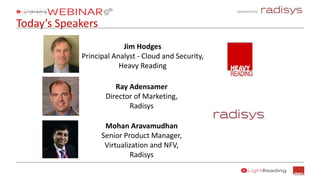
Today’s Speakers
Ray Adensamer
Director of Marketing,
Radisys
Mohan Aravamudhan
Senior Product Manager,
Virtualization and NFV,
Radisys
Jim Hodges
Principal Analyst - Cloud and Security,
Heavy Reading
Sponsored by:
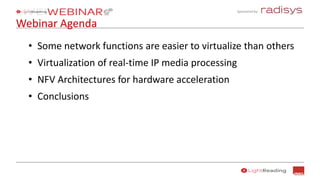
Webinar Agenda
• Some network functions are easier to virtualize than others
• Virtualization of real-time IP media processing
• NFV Architectures for hardware acceleration
• Conclusions
Sponsored by:
NFV Market Sizing
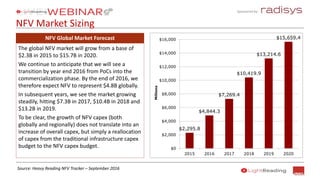
NFV Global Market Forecast
The global NFV market will grow from a base of
$2.3B in 2015 to $15.7B in 2020.
We continue to anticipate that we will see a
transition by year end 2016 from PoCs into the
commercialization phase. By the end of 2016, we
therefore expect NFV to represent $4.8B globally.
In subsequent years, we see the market growing
steadily, hitting $7.3B in 2017, $10.4B in 2018 and
$13.2B in 2019.
To be clear, the growth of NFV capex (both
globally and regionally) does not translate into an
increase of overall capex, but simply a reallocation
of capex from the traditional infrastructure capex
budget to the NFV capex budget.
$2,295.8
$4,844.3
$7,269.4
$10,419.9
$13,214.6
$15,659.4
$0
$2,000
$4,000
$6,000
$8,000
$10,000
$12,000
$14,000
$16,000
2015 2016 2017 2018 2019 2020
Millions
Source: Heavy Reading NFV Tracker – September 2016
Sponsored by:
Virtualization Priorities
46%
39%
39%
36%
17%
44%
48%
46%
46%
42%
10%
13%
15%
18%
41%
0% 10% 20% 30% 40% 50% 60% 70% 80% 90% 100%
Edge gateways & firewalls
(includes NATs & SBCs)
Applications & services (includes
IMS, TAS & control plane)
OSS/BSS
EPC (evolved packet core)
RAN (radio access network)
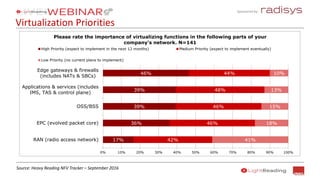
Please rate the importance of virtualizing functions in the following parts of your
company's network. N=141
High Priority (expect to implement in the next 12 months) Medium Priority (expect to implement eventually)
Low Priority (no current plans to implement)
Source: Heavy Reading NFV Tracker – September 2016
Sponsored by:
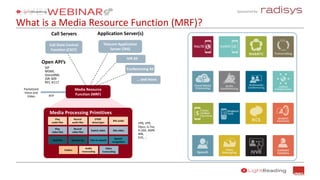
What is a Media Resource Function (MRF)?
Call Servers
Play
audio files
Record
audio files
DTMF
detect/gen
Mix audio
Switch video Mix video
Send fax Text-to-speech
Speech
recognition
Play
video files
Record
video files
Receive fax
Video
transcoding
Audio
transcoding
Media Processing Primitives
Codecs
Open API’s
Application Server(s)
Packetized
Voice and
Video
VP8, VP9,
Opus, G.7xx,
H.26X, AMR-
WB,
EVS, …
Telecom
Telecom Application
Server (TAS)
Conferencing AS
IVR AS
Call State Control
Function (CSCF)
Media Resource
Function (MRF)
SIP
MSML
VoiceXML
JSR-309
RFC 4117
… and more.
RTP
Sponsored by:
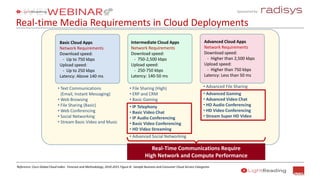
Real-time Media Requirements in Cloud Deployments
Reference: Cisco Global Cloud Index: Forecast and Methodology, 2010-2015 Figure 8: Sample Business and Consumer Cloud Service Categories
Real-Time Communications Require
High Network and Compute Performance
• Text Communications
(Email, Instant Messaging)
• Web Browsing
• File Sharing (Basic)
• Web Conferencing
• Social Networking
• Stream Basic Video and Music
• File Sharing (High)
• ERP and CRM
• Basic Gaming
• IP Telephony
• Basic Video Chat
• IP Audio Conferencing
• Basic Video Conferencing
• HD Video Streaming
• Advanced Social Networking
• Advanced File Sharing
• Advanced Gaming
• Advanced Video Chat
• HD Audio Conferencing
• HD Video Conferencing
• Stream Super HD Video
Basic Cloud Apps
Network Requirements
Download speed:
- Up to 750 kbps
Upload speed:
- Up to 250 kbps
Latency: Above 140 ms
Intermediate Cloud Apps
Network Requirements
Download speed:
- 750-2,500 kbps
Upload speed:
- 250-750 kbps
Latency: 140-50 ms
Advanced Cloud Apps
Network Requirements
Download speed:
- Higher than 2,500 kbps
Upload speed:
- Higher than 750 kbps
Latency: Less than 50 ms
Sponsored by:
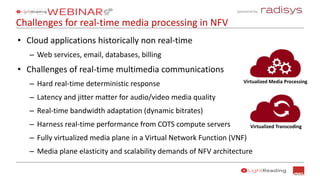
Challenges for real-time media processing in NFV
• Cloud applications historically non real-time
– Web services, email, databases, billing
• Challenges of real-time multimedia communications
– Hard real-time deterministic response
– Latency and jitter matter for audio/video media quality
– Real-time bandwidth adaptation (dynamic bitrates)
– Harness real-time performance from COTS compute servers
– Fully virtualized media plane in a Virtual Network Function (VNF)
– Media plane elasticity and scalability demands of NFV architecture
Virtualized Media Processing
Virtualized Transcoding
Sponsored by:
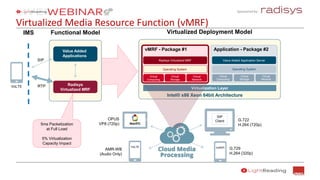
Virtualized Media Resource Function (vMRF)
Virtualization Layer
Intel® x86 Xeon 64bit Architecture
Virtualized Deployment Model
Application - Package #2
3rd Party WebRTC Application Server
Operating System
Value Added Application Server
Virtual
Computing
Virtual
Storage
Virtual
Network
vMRF - Package #1
3rd Party WebRTC Application Server
Operating System
Radisys Virtualized MRF
Virtual
Computing
Virtual
Storage
Virtual
Network
OPUS
VP8 (720p)
AMR-WB
(Audio Only)
SIP
Client
VoWiFiVoLTE
G.722
H.264 (720p)
G.729
H.264 (320p)
Functional Model
Radisys
Virtualized MRF
Value Added
Applications
VoLTE
IMS
5ms Packetization
at Full Load
5% Virtualization
Capacity Impact
SIP
RTP
Sponsored by:
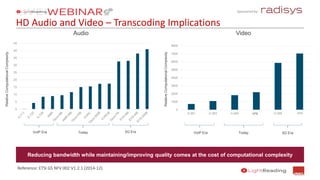
HD Audio and Video – Transcoding Implications
Reference: ETSI GS NFV 002 V1.2.1 (2014-12)
0
5
10
15
20
25
30
35
40
45
Audio
0
1000
2000
3000
4000
5000
6000
7000
8000
H.261 H.263 H.264 VP8 H.265 VP9
Video
RelativeComputationalComplexity
VP8
VoIP Era Today 5G Era VoIP Era Today 5G Era
Reducing bandwidth while maintaining/improving quality comes at the cost of computational complexity
Sponsored by:
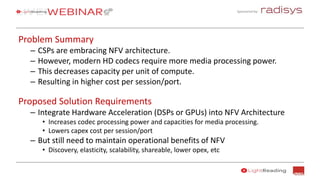
Problem Summary
– CSPs are embracing NFV architecture.
– However, modern HD codecs require more media processing power.
– This decreases capacity per unit of compute.
– Resulting in higher cost per session/port.
Proposed Solution Requirements
– Integrate Hardware Acceleration (DSPs or GPUs) into NFV Architecture
• Increases codec processing power and capacities for media processing.
• Lowers capex cost per session/port
– But still need to maintain operational benefits of NFV
• Discovery, elasticity, scalability, shareable, lower opex, etc
Sponsored by:
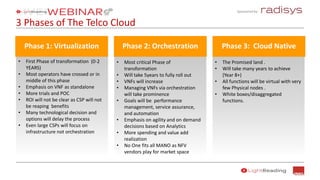
3 Phases of The Telco Cloud
Phase 1: Virtualization Phase 2: Orchestration Phase 3: Cloud Native
• First Phase of transformation (0-2
YEARS)
• Most operators have crossed or in
middle of this phase
• Emphasis on VNF as standalone
• More trials and POC
• ROI will not be clear as CSP will not
be reaping benefits
• Many technological decision and
options will delay the process
• Even large CSPs will focus on
infrastructure not orchestration
• Most critical Phase of
transformation
• Will take 5years to fully roll out
• VNFs will increase
• Managing VNFs via orchestration
will take prominence
• Goals will be performance
management, service assurance,
and automation
• Emphasis on agility and on demand
decisions based on Analytics
• More spending and value add
realization
• No One fits all MANO as NFV
vendors play for market space
• The Promised land .
• Will take many years to achieve
(Year 8+)
• All functions will be virtual with very
few Physical nodes .
• White boxes/disaggregated
functions.
Sponsored by:
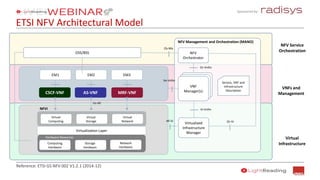
ETSI NFV Architectural Model
Reference: ETSI GS NFV 002 V1.2.1 (2014-12)
VNFs and
Management
NFV
Orchestrator
Virtualized
Infrastructure
Manager
VNF
Manager(s)
Virtualization Layer
Virtual
Computing
Virtual
Storage
Virtual
Network
NFVI
EM1 EM2 EM3
MRF-VNFCSCF-VNF AS-VNF
NFV Management and Orchestration (MANO)
Os-Ma
Ve-Vnfm
Nf-Vi
Or-Vnfm
Vi-Vnfm
Or-Vi
Service, VNF and
Infrastructure
Description
OSS/BSS
NFV Service
Orchestration
Virtual
Infrastructure
Vn-Nf
OSS/BSS
Computing
Hardware
Storage
Hardware
Network
Hardware
Hardware Resources
Sponsored by:
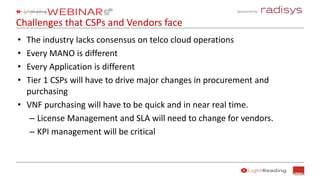
Challenges that CSPs and Vendors face
• The industry lacks consensus on telco cloud operations
• Every MANO is different
• Every Application is different
• Tier 1 CSPs will have to drive major changes in procurement and
purchasing
• VNF purchasing will have to be quick and in near real time.
– License Management and SLA will need to change for vendors.
– KPI management will be critical
Sponsored by:
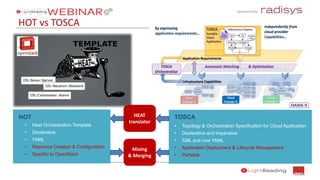
HOT vs TOSCA
• Heat Orchestration Template
• Declarative
• YAML
• Resource Creation & Configuration
• Specific to OpenStack
HOT
• Topology & Orchestration Specification for Cloud Application
• Declarative and Imperative
• XML and now YAML
• Application Deployment & Lifecycle Management
• Portable
TOSCA
Mixing
& Merging
HEAT
translator
Sponsored by:
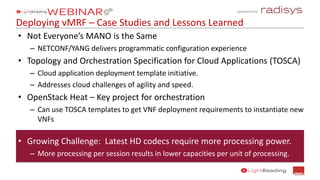
Deploying vMRF – Case Studies and Lessons Learned
• Not Everyone’s MANO is the Same
– NETCONF/YANG delivers programmatic configuration experience
• Topology and Orchestration Specification for Cloud Applications (TOSCA)
– Cloud application deployment template initiative.
– Addresses cloud challenges of agility and speed.
• OpenStack Heat – Key project for orchestration
– Can use TOSCA templates to get VNF deployment requirements to instantiate new
VNFs
• Growing Challenge: Latest HD codecs require more processing power.
– More processing per session results in lower capacities per unit of processing.
Sponsored by:
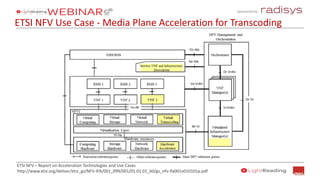
ETSI NFV Use Case - Media Plane Acceleration for Transcoding
ETSI NFV – Report on Acceleration Technologies and Use Cases
http://www.etsi.org/deliver/etsi_gs/NFV-IFA/001_099/001/01.01.01_60/gs_nfv-ifa001v010101p.pdf
Sponsored by:
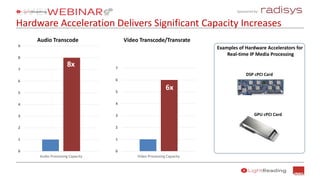
GPU cPCI Card
DSP cPCI Card
Examples of Hardware Accelerators for
Real-time IP Media Processing
Hardware Acceleration Delivers Significant Capacity Increases
0
1
2
3
4
5
6
7
8
9
Audio Processing Capacity
0
1
2
3
4
5
6
7
Video Processing Capacity
Audio Transcode Video Transcode/Transrate
8x
6x
Sponsored by:
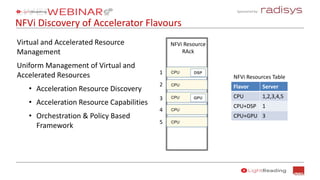
NFVi Discovery of Accelerator Flavours
CPU DSP
Flavor Server
CPU 1,2,3,4,5
CPU+DSP 1
CPU+GPU 3
1
2
NFVi Resources Table
CPU
CPU GPU
CPU
CPU
3
4
5
NFVi Resource
RAck
Virtual and Accelerated Resource
Management
Uniform Management of Virtual and
Accelerated Resources
• Acceleration Resource Discovery
• Acceleration Resource Capabilities
• Orchestration & Policy Based
Framework
Sponsored by:
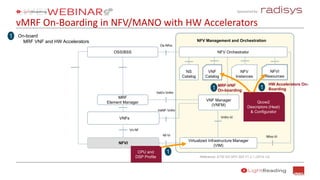
Os-Nfvo
Vn-Nf
NFV Management and Orchestration
Qcow2
Descriptors (Heat)
& Configurator
OSS/BSS
NS
Catalog
VNF
Catalog
NFV
Instances
NFVI
Resources
NFV Orchestrator
Virtualized Infrastructure Manager
(VIM)
VNF Manager
(VNFM)
NFVI
MRF
Element Manager
1 On-board
MRF VNF and HW Accelerators
VNFs
VeEn-Vnfm
VeNF-Vnfm
Os-Nfvo
Vnfm-Vi
Nfvo-ViNf-Vi
MRF-VNF
On-boarding1
Reference: ETSI GS NFV 002 V1.2.1 (2014-12)
CPU and
DSP Profile
1
HW Accelerators On-
Boarding1
vMRF On-Boarding in NFV/MANO with HW Accelerators
Sponsored by:
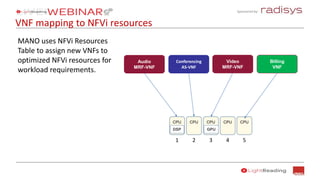
VNF mapping to NFVi resources
1
CPU
DSP
2
CPU
3
CPU
GPU
4
CPU
5
CPU
Audio
MRF-VNF
Video
MRF-VNF
Billing
VNF
MANO uses NFVi Resources
Table to assign new VNFs to
optimized NFVi resources for
workload requirements.
Conferencing
AS-VNF
Sponsored by:
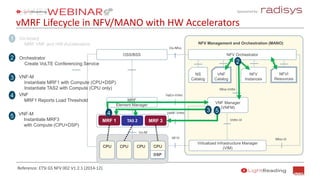
vMRF Lifecycle in NFV/MANO with HW Accelerators
Reference: ETSI GS NFV 002 V1.2.1 (2014-12)
Os-Nfvo
Vn-Nf
NFV Management and Orchestration (MANO)
OSS/BSS
NS
Catalog
VNF
Catalog
NFV
Instances
NFVI
Resources
NFV Orchestrator
Virtualized Infrastructure Manager
(VIM)
VNF Manager
(VNFM)
MRF
Element Manager
1 On-board
MRF VNF and HW Accelerators
2 Orchestrator
Create VoLTE Conferencing Service
3 VNF-M
Instantiate MRF1 with Compute (CPU+DSP)
Instantiate TAS2 with Compute (CPU only)
4
5
VNF
MRF1 Reports Load Threshold
VNF-M
Instantiate MRF3
with Compute (CPU+DSP)
VNFsMRF 1 TAS 2 MRF 3
VeEn-Vnfm
VeNF-Vnfm
Os-Nfvo
Nfvo-Vnfm
Vnfm-Vi
Nfvo-ViNf-Vi
5
2
3
4
CPU CPU CPU CPU
DSP
Sponsored by:
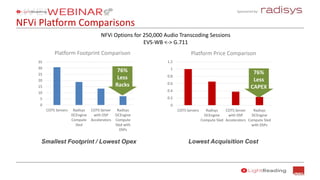
NFVi Platform Comparisons
Smallest Footprint / Lowest Opex
0
5
10
15
20
25
30
35
COTS Servers Radisys
DCEngine
Compute
Sled
COTS Server
with DSP
Accelerators
Radisys
DCEngine
Compute
Sled with
DSPs
0
0.2
0.4
0.6
0.8
1
1.2
COTS Servers Radisys
DCEngine
Compute Sled
COTS Server
with DSP
Accelerators
Radisys
DCEngine
Compute Sled
with DSPs
Lowest Acquisition Cost
Platform Footprint Comparison Platform Price Comparison
76%
Less
CAPEX
76%
Less
Racks
NFVi Options for 250,000 Audio Transcoding Sessions
EVS-WB <-> G.711
Sponsored by:
What is your view on adding HW Accelerating Resources into
your NFVi?
a) Required.
b) Maybe for Future Applications.
c) Not Required.
Poll Question #2
Sponsored by:
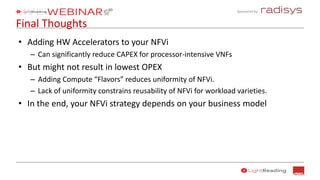
Final Thoughts
• Adding HW Accelerators to your NFVi
– Can significantly reduce CAPEX for processor-intensive VNFs
• But might not result in lowest OPEX
– Adding Compute “Flavors” reduces uniformity of NFVi.
– Lack of uniformity constrains reusability of NFVi for workload varieties.
• In the end, your NFVi strategy depends on your business model
Sponsored by:
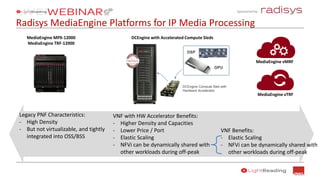
Radisys MediaEngine Platforms for IP Media Processing
VNF with HW Accelerator Benefits:
- Higher Density and Capacities
- Lower Price / Port
- Elastic Scaling
- NFVi can be dynamically shared with
other workloads during off-peak
MediaEngine vMRF
MediaEngine vTRF
Legacy PNF Characteristics:
- High Density
- But not virtualizable, and tightly
integrated into OSS/BSS
VNF Benefits:
- Elastic Scaling
- NFVi can be dynamically shared with
other workloads during off-peak
DCEngine with Accelerated Compute SledsMediaEngine MPX-12000
MediaEngine TRF-12000
DCEngine Compute Sled with
Hardware Accelerator
GPU
DSP
Sponsored by:
Summary
• Real-time Media Processing is a tough networking application
– Many challenges to virtualize.
– And when you do, still not the best economics (today) for large deployments.
• ETSI NFV working groups recognize some use cases need hardware
acceleration
– Hence the need for HW acceleration technologies, that interwork within NFV
• Radisys are leaders in high performance virtualized media processing
– MediaEngine Solutions deployed today for Virtualized MRF and Transcoding
Requirements
– Product programs underway to add HW Acceleration
Sponsored by:
About Radisys
• Radisys (NASDAQ: RSYS) Helps Service Providers Deploy Agile Service
Delivery Networks for Accelerating Communication Service Revenues.
• Our combination of telecom hardware expertise, with telecom and
open source software experience, makes Radisys uniquely qualified to
help our service provider customers transform their infrastructure to
open solutions for SDN, NFV, and 5G.
Sponsored by:
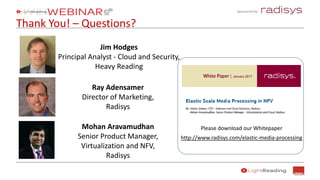
Thank You! – Questions?
Please download our Whitepaper
http://www.radisys.com/elastic-media-processing
Ray Adensamer
Director of Marketing,
Radisys
Mohan Aravamudhan
Senior Product Manager,
Virtualization and NFV,
Radisys
Jim Hodges
Principal Analyst - Cloud and Security,
Heavy Reading

High-Performance Media Processing in an NFV World

  • 1.
    Sponsored by: Sponsored by: May25 2017 High-Performance Media Processing in an NFV World
  • 2.
    Sponsored by: Today’s Speakers RayAdensamer Director of Marketing, Radisys Mohan Aravamudhan Senior Product Manager, Virtualization and NFV, Radisys Jim Hodges Principal Analyst - Cloud and Security, Heavy Reading
  • 3.
    Sponsored by: Webinar Agenda •Some network functions are easier to virtualize than others • Virtualization of real-time IP media processing • NFV Architectures for hardware acceleration • Conclusions
  • 4.
    Sponsored by: NFV MarketSizing NFV Global Market Forecast The global NFV market will grow from a base of $2.3B in 2015 to $15.7B in 2020. We continue to anticipate that we will see a transition by year end 2016 from PoCs into the commercialization phase. By the end of 2016, we therefore expect NFV to represent $4.8B globally. In subsequent years, we see the market growing steadily, hitting $7.3B in 2017, $10.4B in 2018 and $13.2B in 2019. To be clear, the growth of NFV capex (both globally and regionally) does not translate into an increase of overall capex, but simply a reallocation of capex from the traditional infrastructure capex budget to the NFV capex budget. $2,295.8 $4,844.3 $7,269.4 $10,419.9 $13,214.6 $15,659.4 $0 $2,000 $4,000 $6,000 $8,000 $10,000 $12,000 $14,000 $16,000 2015 2016 2017 2018 2019 2020 Millions Source: Heavy Reading NFV Tracker – September 2016
  • 5.
    Sponsored by: Virtualization Priorities 46% 39% 39% 36% 17% 44% 48% 46% 46% 42% 10% 13% 15% 18% 41% 0%10% 20% 30% 40% 50% 60% 70% 80% 90% 100% Edge gateways & firewalls (includes NATs & SBCs) Applications & services (includes IMS, TAS & control plane) OSS/BSS EPC (evolved packet core) RAN (radio access network) Please rate the importance of virtualizing functions in the following parts of your company's network. N=141 High Priority (expect to implement in the next 12 months) Medium Priority (expect to implement eventually) Low Priority (no current plans to implement) Source: Heavy Reading NFV Tracker – September 2016
  • 6.
    Sponsored by: What isa Media Resource Function (MRF)? Call Servers Play audio files Record audio files DTMF detect/gen Mix audio Switch video Mix video Send fax Text-to-speech Speech recognition Play video files Record video files Receive fax Video transcoding Audio transcoding Media Processing Primitives Codecs Open API’s Application Server(s) Packetized Voice and Video VP8, VP9, Opus, G.7xx, H.26X, AMR- WB, EVS, … Telecom Telecom Application Server (TAS) Conferencing AS IVR AS Call State Control Function (CSCF) Media Resource Function (MRF) SIP MSML VoiceXML JSR-309 RFC 4117 … and more. RTP
  • 7.
    Sponsored by: Real-time MediaRequirements in Cloud Deployments Reference: Cisco Global Cloud Index: Forecast and Methodology, 2010-2015 Figure 8: Sample Business and Consumer Cloud Service Categories Real-Time Communications Require High Network and Compute Performance • Text Communications (Email, Instant Messaging) • Web Browsing • File Sharing (Basic) • Web Conferencing • Social Networking • Stream Basic Video and Music • File Sharing (High) • ERP and CRM • Basic Gaming • IP Telephony • Basic Video Chat • IP Audio Conferencing • Basic Video Conferencing • HD Video Streaming • Advanced Social Networking • Advanced File Sharing • Advanced Gaming • Advanced Video Chat • HD Audio Conferencing • HD Video Conferencing • Stream Super HD Video Basic Cloud Apps Network Requirements Download speed: - Up to 750 kbps Upload speed: - Up to 250 kbps Latency: Above 140 ms Intermediate Cloud Apps Network Requirements Download speed: - 750-2,500 kbps Upload speed: - 250-750 kbps Latency: 140-50 ms Advanced Cloud Apps Network Requirements Download speed: - Higher than 2,500 kbps Upload speed: - Higher than 750 kbps Latency: Less than 50 ms
  • 8.
    Sponsored by: Challenges forreal-time media processing in NFV • Cloud applications historically non real-time – Web services, email, databases, billing • Challenges of real-time multimedia communications – Hard real-time deterministic response – Latency and jitter matter for audio/video media quality – Real-time bandwidth adaptation (dynamic bitrates) – Harness real-time performance from COTS compute servers – Fully virtualized media plane in a Virtual Network Function (VNF) – Media plane elasticity and scalability demands of NFV architecture Virtualized Media Processing Virtualized Transcoding
  • 9.
    Sponsored by: Virtualized MediaResource Function (vMRF) Virtualization Layer Intel® x86 Xeon 64bit Architecture Virtualized Deployment Model Application - Package #2 3rd Party WebRTC Application Server Operating System Value Added Application Server Virtual Computing Virtual Storage Virtual Network vMRF - Package #1 3rd Party WebRTC Application Server Operating System Radisys Virtualized MRF Virtual Computing Virtual Storage Virtual Network OPUS VP8 (720p) AMR-WB (Audio Only) SIP Client VoWiFiVoLTE G.722 H.264 (720p) G.729 H.264 (320p) Functional Model Radisys Virtualized MRF Value Added Applications VoLTE IMS 5ms Packetization at Full Load 5% Virtualization Capacity Impact SIP RTP
  • 10.
    Sponsored by: HD Audioand Video – Transcoding Implications Reference: ETSI GS NFV 002 V1.2.1 (2014-12) 0 5 10 15 20 25 30 35 40 45 Audio 0 1000 2000 3000 4000 5000 6000 7000 8000 H.261 H.263 H.264 VP8 H.265 VP9 Video RelativeComputationalComplexity RelativeComputationalComplexity VP8 VoIP Era Today 5G Era VoIP Era Today 5G Era Reducing bandwidth while maintaining/improving quality comes at the cost of computational complexity
  • 11.
    Sponsored by: Problem Summary –CSPs are embracing NFV architecture. – However, modern HD codecs require more media processing power. – This decreases capacity per unit of compute. – Resulting in higher cost per session/port. Proposed Solution Requirements – Integrate Hardware Acceleration (DSPs or GPUs) into NFV Architecture • Increases codec processing power and capacities for media processing. • Lowers capex cost per session/port – But still need to maintain operational benefits of NFV • Discovery, elasticity, scalability, shareable, lower opex, etc
  • 12.
    Sponsored by: 3 Phasesof The Telco Cloud Phase 1: Virtualization Phase 2: Orchestration Phase 3: Cloud Native • First Phase of transformation (0-2 YEARS) • Most operators have crossed or in middle of this phase • Emphasis on VNF as standalone • More trials and POC • ROI will not be clear as CSP will not be reaping benefits • Many technological decision and options will delay the process • Even large CSPs will focus on infrastructure not orchestration • Most critical Phase of transformation • Will take 5years to fully roll out • VNFs will increase • Managing VNFs via orchestration will take prominence • Goals will be performance management, service assurance, and automation • Emphasis on agility and on demand decisions based on Analytics • More spending and value add realization • No One fits all MANO as NFV vendors play for market space • The Promised land . • Will take many years to achieve (Year 8+) • All functions will be virtual with very few Physical nodes . • White boxes/disaggregated functions.
  • 13.
    Sponsored by: ETSI NFVArchitectural Model Reference: ETSI GS NFV 002 V1.2.1 (2014-12) VNFs and Management NFV Orchestrator Virtualized Infrastructure Manager VNF Manager(s) Virtualization Layer Virtual Computing Virtual Storage Virtual Network NFVI EM1 EM2 EM3 MRF-VNFCSCF-VNF AS-VNF NFV Management and Orchestration (MANO) Os-Ma Ve-Vnfm Nf-Vi Or-Vnfm Vi-Vnfm Or-Vi Service, VNF and Infrastructure Description OSS/BSS NFV Service Orchestration Virtual Infrastructure Vn-Nf OSS/BSS Computing Hardware Storage Hardware Network Hardware Hardware Resources
  • 14.
    Sponsored by: Challenges thatCSPs and Vendors face • The industry lacks consensus on telco cloud operations • Every MANO is different • Every Application is different • Tier 1 CSPs will have to drive major changes in procurement and purchasing • VNF purchasing will have to be quick and in near real time. – License Management and SLA will need to change for vendors. – KPI management will be critical
  • 15.
    Sponsored by: HOT vsTOSCA • Heat Orchestration Template • Declarative • YAML • Resource Creation & Configuration • Specific to OpenStack HOT • Topology & Orchestration Specification for Cloud Application • Declarative and Imperative • XML and now YAML • Application Deployment & Lifecycle Management • Portable TOSCA Mixing & Merging HEAT translator
  • 16.
    Sponsored by: Deploying vMRF– Case Studies and Lessons Learned • Not Everyone’s MANO is the Same – NETCONF/YANG delivers programmatic configuration experience • Topology and Orchestration Specification for Cloud Applications (TOSCA) – Cloud application deployment template initiative. – Addresses cloud challenges of agility and speed. • OpenStack Heat – Key project for orchestration – Can use TOSCA templates to get VNF deployment requirements to instantiate new VNFs • Growing Challenge: Latest HD codecs require more processing power. – More processing per session results in lower capacities per unit of processing.
  • 17.
    Sponsored by: ETSI NFVUse Case - Media Plane Acceleration for Transcoding ETSI NFV – Report on Acceleration Technologies and Use Cases http://www.etsi.org/deliver/etsi_gs/NFV-IFA/001_099/001/01.01.01_60/gs_nfv-ifa001v010101p.pdf
  • 18.
    Sponsored by: GPU cPCICard DSP cPCI Card Examples of Hardware Accelerators for Real-time IP Media Processing Hardware Acceleration Delivers Significant Capacity Increases 0 1 2 3 4 5 6 7 8 9 Audio Processing Capacity 0 1 2 3 4 5 6 7 Video Processing Capacity Audio Transcode Video Transcode/Transrate 8x 6x
  • 19.
    Sponsored by: NFVi Discoveryof Accelerator Flavours CPU DSP Flavor Server CPU 1,2,3,4,5 CPU+DSP 1 CPU+GPU 3 1 2 NFVi Resources Table CPU CPU GPU CPU CPU 3 4 5 NFVi Resource RAck Virtual and Accelerated Resource Management Uniform Management of Virtual and Accelerated Resources • Acceleration Resource Discovery • Acceleration Resource Capabilities • Orchestration & Policy Based Framework
  • 20.
    Sponsored by: Os-Nfvo Vn-Nf NFV Managementand Orchestration Qcow2 Descriptors (Heat) & Configurator OSS/BSS NS Catalog VNF Catalog NFV Instances NFVI Resources NFV Orchestrator Virtualized Infrastructure Manager (VIM) VNF Manager (VNFM) NFVI MRF Element Manager 1 On-board MRF VNF and HW Accelerators VNFs VeEn-Vnfm VeNF-Vnfm Os-Nfvo Vnfm-Vi Nfvo-ViNf-Vi MRF-VNF On-boarding1 Reference: ETSI GS NFV 002 V1.2.1 (2014-12) CPU and DSP Profile 1 HW Accelerators On- Boarding1 vMRF On-Boarding in NFV/MANO with HW Accelerators
  • 21.
    Sponsored by: VNF mappingto NFVi resources 1 CPU DSP 2 CPU 3 CPU GPU 4 CPU 5 CPU Audio MRF-VNF Video MRF-VNF Billing VNF MANO uses NFVi Resources Table to assign new VNFs to optimized NFVi resources for workload requirements. Conferencing AS-VNF
  • 22.
    Sponsored by: vMRF Lifecyclein NFV/MANO with HW Accelerators Reference: ETSI GS NFV 002 V1.2.1 (2014-12) Os-Nfvo Vn-Nf NFV Management and Orchestration (MANO) OSS/BSS NS Catalog VNF Catalog NFV Instances NFVI Resources NFV Orchestrator Virtualized Infrastructure Manager (VIM) VNF Manager (VNFM) MRF Element Manager 1 On-board MRF VNF and HW Accelerators 2 Orchestrator Create VoLTE Conferencing Service 3 VNF-M Instantiate MRF1 with Compute (CPU+DSP) Instantiate TAS2 with Compute (CPU only) 4 5 VNF MRF1 Reports Load Threshold VNF-M Instantiate MRF3 with Compute (CPU+DSP) VNFsMRF 1 TAS 2 MRF 3 VeEn-Vnfm VeNF-Vnfm Os-Nfvo Nfvo-Vnfm Vnfm-Vi Nfvo-ViNf-Vi 5 2 3 4 CPU CPU CPU CPU DSP
  • 23.
    Sponsored by: NFVi PlatformComparisons Smallest Footprint / Lowest Opex 0 5 10 15 20 25 30 35 COTS Servers Radisys DCEngine Compute Sled COTS Server with DSP Accelerators Radisys DCEngine Compute Sled with DSPs 0 0.2 0.4 0.6 0.8 1 1.2 COTS Servers Radisys DCEngine Compute Sled COTS Server with DSP Accelerators Radisys DCEngine Compute Sled with DSPs Lowest Acquisition Cost Platform Footprint Comparison Platform Price Comparison 76% Less CAPEX 76% Less Racks NFVi Options for 250,000 Audio Transcoding Sessions EVS-WB <-> G.711
  • 24.
    Sponsored by: What isyour view on adding HW Accelerating Resources into your NFVi? a) Required. b) Maybe for Future Applications. c) Not Required. Poll Question #2
  • 25.
    Sponsored by: Final Thoughts •Adding HW Accelerators to your NFVi – Can significantly reduce CAPEX for processor-intensive VNFs • But might not result in lowest OPEX – Adding Compute “Flavors” reduces uniformity of NFVi. – Lack of uniformity constrains reusability of NFVi for workload varieties. • In the end, your NFVi strategy depends on your business model
  • 26.
    Sponsored by: Radisys MediaEnginePlatforms for IP Media Processing VNF with HW Accelerator Benefits: - Higher Density and Capacities - Lower Price / Port - Elastic Scaling - NFVi can be dynamically shared with other workloads during off-peak MediaEngine vMRF MediaEngine vTRF Legacy PNF Characteristics: - High Density - But not virtualizable, and tightly integrated into OSS/BSS VNF Benefits: - Elastic Scaling - NFVi can be dynamically shared with other workloads during off-peak DCEngine with Accelerated Compute SledsMediaEngine MPX-12000 MediaEngine TRF-12000 DCEngine Compute Sled with Hardware Accelerator GPU DSP
  • 27.
    Sponsored by: Summary • Real-timeMedia Processing is a tough networking application – Many challenges to virtualize. – And when you do, still not the best economics (today) for large deployments. • ETSI NFV working groups recognize some use cases need hardware acceleration – Hence the need for HW acceleration technologies, that interwork within NFV • Radisys are leaders in high performance virtualized media processing – MediaEngine Solutions deployed today for Virtualized MRF and Transcoding Requirements – Product programs underway to add HW Acceleration
  • 28.
    Sponsored by: About Radisys •Radisys (NASDAQ: RSYS) Helps Service Providers Deploy Agile Service Delivery Networks for Accelerating Communication Service Revenues. • Our combination of telecom hardware expertise, with telecom and open source software experience, makes Radisys uniquely qualified to help our service provider customers transform their infrastructure to open solutions for SDN, NFV, and 5G.
  • 29.
    Sponsored by: Thank You!– Questions? Please download our Whitepaper http://www.radisys.com/elastic-media-processing Ray Adensamer Director of Marketing, Radisys Mohan Aravamudhan Senior Product Manager, Virtualization and NFV, Radisys Jim Hodges Principal Analyst - Cloud and Security, Heavy Reading