Open Source and its role in a new IT Ecosystem Heise Congress „Open Source meets Business“ Bob Gett Nürnberg, January 27, 2007
Abstract – not to be presented Open Source and it’s role in a new IT ecosystem Open Source has gone a long way and is one of the most influential trends in modern information technology. It’s one of the fastest growing segments and the adoption rate in large and small enterprises is breath taking. Open Source is everywhere be it in commercial products, appliances, software-as-a-service offerings or web 2.0 solutions. This presentation will illustrate the developing open source eco systems and position the wide range of players contributing, profiting and influencing the further development. Using open source adoption and an overall maturity assessment it will be explained why and how open source is used, what can be expected from it over the next years and what role  IT services play in this scenario.
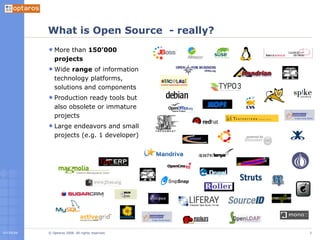
What is Open Source  - really? More than  150’000 projects Wide  range  of information technology platforms, solutions and components Production ready tools but also obsolete or immature projects Large endeavors and small projects (e.g. 1 developer)
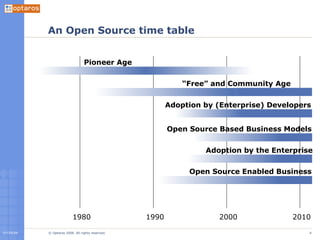
An Open Source time table 1980 1990 2000 2010 Pioneer Age “ Free” and Community Age Adoption by (Enterprise) Developers Open Source Based Business Models Adoption by the Enterprise Open Source Enabled Business
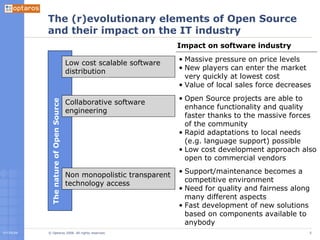
The (r)evolutionary elements of Open Source  and their impact on the IT industry The nature of Open Source Low cost scalable software distribution Collaborative software engineering Non monopolistic transparent technology access Impact on software industry Massive pressure on price levels New pla yers can enter the market very quickly at lowest cost Value of local sales force decreases Open Source projects are able to enhance functionality and quality faster thanks to the massive forces of the community  Rapid adaptations to local needs (e.g. language support) possible Low cost development approach also open to commercial vendors Support/maintenance becomes a competitive environment Need for quality and fairness along many different aspects Fast development of new solutions based on components available to anybody
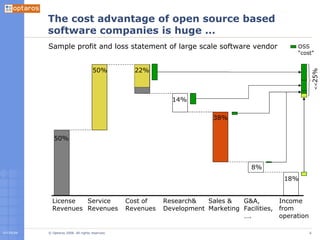
The cost advantage of open source based software companies is huge … License Revenues Service Revenues Cost of  Revenues Income from operation Research& Development Sales & Marketing G&A,  Facilities, …. 50% 50% 22% 14% 38% 8% 18% Sample profit and loss statement of large scale software vendor << 25% OSS “cost”
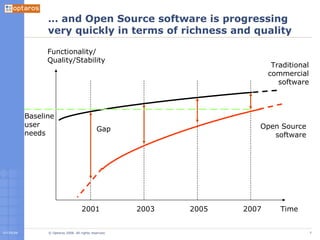
…  and Open Source software is progressing very quickly in terms of richness and quality Functionality/ Quality/Stability Time 2001 2003 2005 2007 Traditional commercial software Open Source software Gap Baseline user needs
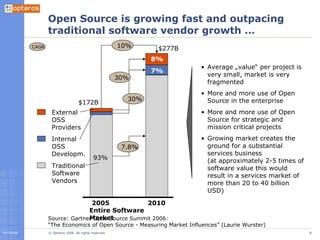
Open Source is growing fast and outpacing traditional software vendor growth … Source: Gartner Open Source Summit 2006:  “The Economics of Open Source - Measuring Market Influences” (Laurie Wurster) 8% 7% 93% 2005 2010 10% CAGR  30% 30% 7.8% $172B $277B Traditional Software Vendors Internal OSS Developm. External OSS Providers Entire Software Market Average „value“ per project is very small, market is very fragmented More and more use of Open Source in the enterprise More and more use of Open Source for strategic and mission critical projects Growing market creates the ground for a substantial services business  (at approximately 2-5 times of software value this would result in a services market of more than 20 to 40 billion USD)
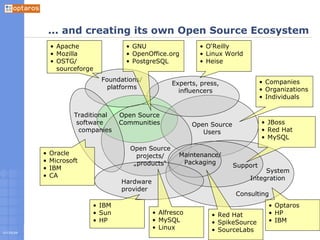
... and creating its own Open Source Ecosystem Open Source Users Support Maintenance/ Packaging Consulting System    Integration  Experts, press, influencers Foundations/ platforms Traditional  software   companies Open Source projects/ „products“ Hardware provider O‘Reilly Linux World Heise Apache Mozilla OSTG/ sourceforge Oracle Microsoft IBM CA IBM Sun HP Companies Organizations Individuals GNU OpenOffice.org PostgreSQL Alfresco MySQL Linux Red Hat SpikeSource SourceLabs JBoss Red Hat MySQL Optaros HP IBM Open Source Communities
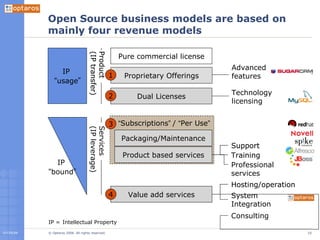
Open Source business models are based on mainly four revenue models System  Integration Pure commercial license Dual Licenses Packaging/Maintenance Product based services Value add services Product (IP transfer) Services (IP leverage) Support Training Hosting/operation „ Subscriptions“/“Per Use“ Proprietary Offerings Pure commercial license Packaging/Maintenance Product based services Value add services IP   “ bound ” IP    “ usage ”  Product (IP transfer) Support Training Professional  services Hosting/operation Consulting 1 2 3 “ Subscriptions ”  /  “ Per Use ”   IP =  Intellectual Property Advanced  features 4 Technology licensing
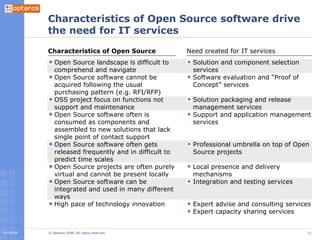
Characteristics of Open Source software drive the need for IT services Characteristics of Open Source Open Source landscape is difficult to comprehend and navigate Open Source software cannot be acquired following the usual purchasing pattern (e.g. RFI/RFP) OSS project focus on functions not support and maintenance Open Source software often is consumed as components and assembled to new solutions that lack single point of contact support Open Source software often gets released frequently and in difficult to predict time scales Open Source projects are often purely virtual and cannot be present locally Open Source software can be integrated and used in many different ways High pace of technology innovation Need created for IT services Solution and component selection services Software evaluation and “Proof of Concept” services Solution packaging and release management services Support and application management services Professional umbrella on top of Open Source projects Local presence and delivery mechanisms Integration and testing services Expert advise and consulting services Expert capacity sharing services
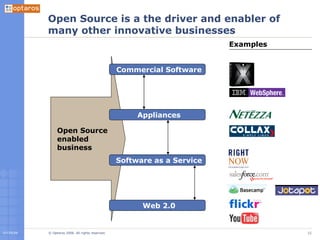
Open Source is a the driver and enabler of many other innovative businesses Open Source enabled business Commercial Software Appliances Software as a Service Web 2.0 Examples
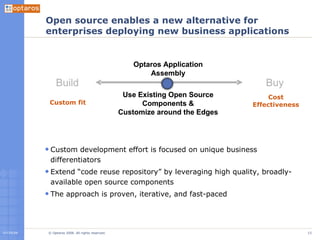
Open source enables a new alternative for enterprises deploying new business applications Custom fit Cost   Effectiveness Custom development effort is focused on unique business differentiators  Extend “code reuse repository” by leveraging high quality, broadly-available open source components The approach is proven, iterative, and fast-paced
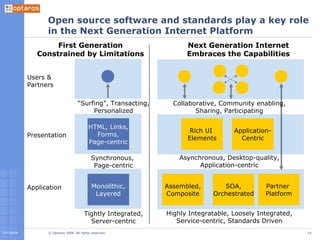
Open source software and standards play a key role in the Next Generation Internet Platform Users & Partners Presentation Application Monolithic, Layered HTML, Links, Forms, Page-centric Assembled, Composite Rich UI  Elements Application- Centric SOA, Orchestrated Partner  Platform Tightly Integrated, Server-centric Highly Integratable, Loosely Integrated, Service-centric, Standards Driven First Generation Constrained by Limitations Next Generation Internet Embraces the Capabilities Synchronous,  Page-centric Asynchronous, Desktop-quality, Application-centric “ Surfing”, Transacting, Personalized Collaborative, Community enabling, Sharing, Participating
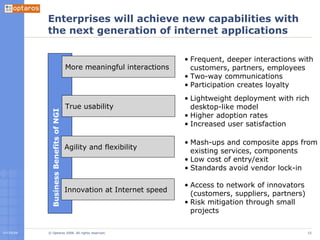
Enterprises will achieve new capabilities with the next generation of internet applications Business Benefits of NGI More meaningful interactions True usability Agility and flexibility Frequent, deeper interactions with customers, partners, employees Two-way communications Participation creates loyalty Lightweight deployment with rich desktop-like model Higher adoption rates Increased user satisfaction Mash-ups and composite apps from existing services, components Low cost of entry/exit Standards avoid vendor lock-in Innovation at Internet speed Access to network of innovators (customers, suppliers, partners) Risk mitigation through small projects
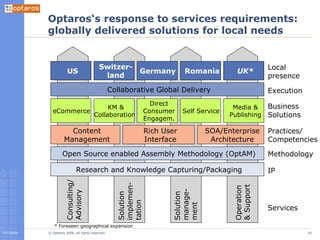
Optaros‘s response to services requirements: globally delivered solutions for local needs Collaborative Global Delivery Content Management Rich User Interface SOA/Enterprise Architecture Consulting/ Advisory Solution implemen- tation Solution manage- ment Operation & Support Practices/ Competencies Local presence Execution Services * Foreseen geographical expansion eCommerce  KM & Collaboration  Direct Consumer Engagem. Self Service  Media & Publishing Business Solutions US Switzer- land Germany  Romania UK* Open Source enabled Assembly Methodology (OptAM) Research and Knowledge Capturing/Packaging Methodology IP
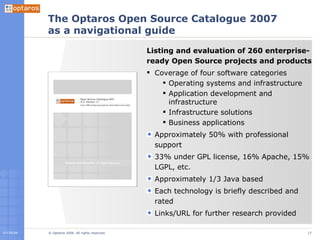
The Optaros Open Source Catalogue 2007 as a navigational guide Listing and evaluation of 260 enterprise- ready Open Source projects and products Coverage of four software categories Operating systems and infrastructure Application development and infrastructure Infrastructure solutions Business applications Approximately 50% with professional support 33% under GPL license, 16% Apache, 15% LGPL, etc. Approximately 1/3 Java based Each technology is briefly described and rated Links/URL for further research provided
Thank you for your attention Optaros USA Boston New York San Francisco Chicago  Austin Optaros Europe Geneva Zurich Munich Bucharest  www.optaros.com
Your Optaros Contacts in Europe München: Zürich: Genf: Theresienstrasse 6-8 D-80333 München P: +49 (0) 89 288 90 379 F: +49 (0) 89 288 90 45 Weinbergstrasse 147 CH-8006 Zürich P: +41 (0) 44 362 11 11 F: +41 (0) 44 362 11 17 Geneva Business Center GBC-1 12, Avenue the Morgines CH-1213 Genève/Petit-Lancy P: +41 (0) 22 731 84 20 F: +41 (0) 22 731 85 64 www.optaros.com/de   www.optaros-update.blogspot.com   Lutz Seeger Sebastian Wohlrapp Jürg Heim Bruno von Rotz Kay Flieger Frédéric Weill

Open Source and its role in a new IT ecosystem

  • 1.
    Open Source andits role in a new IT Ecosystem Heise Congress „Open Source meets Business“ Bob Gett Nürnberg, January 27, 2007
  • 2.
    Abstract – notto be presented Open Source and it’s role in a new IT ecosystem Open Source has gone a long way and is one of the most influential trends in modern information technology. It’s one of the fastest growing segments and the adoption rate in large and small enterprises is breath taking. Open Source is everywhere be it in commercial products, appliances, software-as-a-service offerings or web 2.0 solutions. This presentation will illustrate the developing open source eco systems and position the wide range of players contributing, profiting and influencing the further development. Using open source adoption and an overall maturity assessment it will be explained why and how open source is used, what can be expected from it over the next years and what role IT services play in this scenario.
  • 3.
    What is OpenSource - really? More than 150’000 projects Wide range of information technology platforms, solutions and components Production ready tools but also obsolete or immature projects Large endeavors and small projects (e.g. 1 developer)
  • 4.
    An Open Sourcetime table 1980 1990 2000 2010 Pioneer Age “ Free” and Community Age Adoption by (Enterprise) Developers Open Source Based Business Models Adoption by the Enterprise Open Source Enabled Business
  • 5.
    The (r)evolutionary elementsof Open Source and their impact on the IT industry The nature of Open Source Low cost scalable software distribution Collaborative software engineering Non monopolistic transparent technology access Impact on software industry Massive pressure on price levels New pla yers can enter the market very quickly at lowest cost Value of local sales force decreases Open Source projects are able to enhance functionality and quality faster thanks to the massive forces of the community Rapid adaptations to local needs (e.g. language support) possible Low cost development approach also open to commercial vendors Support/maintenance becomes a competitive environment Need for quality and fairness along many different aspects Fast development of new solutions based on components available to anybody
  • 6.
    The cost advantageof open source based software companies is huge … License Revenues Service Revenues Cost of Revenues Income from operation Research& Development Sales & Marketing G&A, Facilities, …. 50% 50% 22% 14% 38% 8% 18% Sample profit and loss statement of large scale software vendor << 25% OSS “cost”
  • 7.
    … andOpen Source software is progressing very quickly in terms of richness and quality Functionality/ Quality/Stability Time 2001 2003 2005 2007 Traditional commercial software Open Source software Gap Baseline user needs
  • 8.
    Open Source isgrowing fast and outpacing traditional software vendor growth … Source: Gartner Open Source Summit 2006: “The Economics of Open Source - Measuring Market Influences” (Laurie Wurster) 8% 7% 93% 2005 2010 10% CAGR 30% 30% 7.8% $172B $277B Traditional Software Vendors Internal OSS Developm. External OSS Providers Entire Software Market Average „value“ per project is very small, market is very fragmented More and more use of Open Source in the enterprise More and more use of Open Source for strategic and mission critical projects Growing market creates the ground for a substantial services business (at approximately 2-5 times of software value this would result in a services market of more than 20 to 40 billion USD)
  • 9.
    ... and creatingits own Open Source Ecosystem Open Source Users Support Maintenance/ Packaging Consulting System Integration Experts, press, influencers Foundations/ platforms Traditional software companies Open Source projects/ „products“ Hardware provider O‘Reilly Linux World Heise Apache Mozilla OSTG/ sourceforge Oracle Microsoft IBM CA IBM Sun HP Companies Organizations Individuals GNU OpenOffice.org PostgreSQL Alfresco MySQL Linux Red Hat SpikeSource SourceLabs JBoss Red Hat MySQL Optaros HP IBM Open Source Communities
  • 10.
    Open Source businessmodels are based on mainly four revenue models System Integration Pure commercial license Dual Licenses Packaging/Maintenance Product based services Value add services Product (IP transfer) Services (IP leverage) Support Training Hosting/operation „ Subscriptions“/“Per Use“ Proprietary Offerings Pure commercial license Packaging/Maintenance Product based services Value add services IP “ bound ” IP “ usage ” Product (IP transfer) Support Training Professional services Hosting/operation Consulting 1 2 3 “ Subscriptions ” / “ Per Use ” IP = Intellectual Property Advanced features 4 Technology licensing
  • 11.
    Characteristics of OpenSource software drive the need for IT services Characteristics of Open Source Open Source landscape is difficult to comprehend and navigate Open Source software cannot be acquired following the usual purchasing pattern (e.g. RFI/RFP) OSS project focus on functions not support and maintenance Open Source software often is consumed as components and assembled to new solutions that lack single point of contact support Open Source software often gets released frequently and in difficult to predict time scales Open Source projects are often purely virtual and cannot be present locally Open Source software can be integrated and used in many different ways High pace of technology innovation Need created for IT services Solution and component selection services Software evaluation and “Proof of Concept” services Solution packaging and release management services Support and application management services Professional umbrella on top of Open Source projects Local presence and delivery mechanisms Integration and testing services Expert advise and consulting services Expert capacity sharing services
  • 12.
    Open Source isa the driver and enabler of many other innovative businesses Open Source enabled business Commercial Software Appliances Software as a Service Web 2.0 Examples
  • 13.
    Open source enablesa new alternative for enterprises deploying new business applications Custom fit Cost Effectiveness Custom development effort is focused on unique business differentiators Extend “code reuse repository” by leveraging high quality, broadly-available open source components The approach is proven, iterative, and fast-paced
  • 14.
    Open source softwareand standards play a key role in the Next Generation Internet Platform Users & Partners Presentation Application Monolithic, Layered HTML, Links, Forms, Page-centric Assembled, Composite Rich UI Elements Application- Centric SOA, Orchestrated Partner Platform Tightly Integrated, Server-centric Highly Integratable, Loosely Integrated, Service-centric, Standards Driven First Generation Constrained by Limitations Next Generation Internet Embraces the Capabilities Synchronous, Page-centric Asynchronous, Desktop-quality, Application-centric “ Surfing”, Transacting, Personalized Collaborative, Community enabling, Sharing, Participating
  • 15.
    Enterprises will achievenew capabilities with the next generation of internet applications Business Benefits of NGI More meaningful interactions True usability Agility and flexibility Frequent, deeper interactions with customers, partners, employees Two-way communications Participation creates loyalty Lightweight deployment with rich desktop-like model Higher adoption rates Increased user satisfaction Mash-ups and composite apps from existing services, components Low cost of entry/exit Standards avoid vendor lock-in Innovation at Internet speed Access to network of innovators (customers, suppliers, partners) Risk mitigation through small projects
  • 16.
    Optaros‘s response toservices requirements: globally delivered solutions for local needs Collaborative Global Delivery Content Management Rich User Interface SOA/Enterprise Architecture Consulting/ Advisory Solution implemen- tation Solution manage- ment Operation & Support Practices/ Competencies Local presence Execution Services * Foreseen geographical expansion eCommerce KM & Collaboration Direct Consumer Engagem. Self Service Media & Publishing Business Solutions US Switzer- land Germany Romania UK* Open Source enabled Assembly Methodology (OptAM) Research and Knowledge Capturing/Packaging Methodology IP
  • 17.
    The Optaros OpenSource Catalogue 2007 as a navigational guide Listing and evaluation of 260 enterprise- ready Open Source projects and products Coverage of four software categories Operating systems and infrastructure Application development and infrastructure Infrastructure solutions Business applications Approximately 50% with professional support 33% under GPL license, 16% Apache, 15% LGPL, etc. Approximately 1/3 Java based Each technology is briefly described and rated Links/URL for further research provided
  • 18.
    Thank you foryour attention Optaros USA Boston New York San Francisco Chicago Austin Optaros Europe Geneva Zurich Munich Bucharest www.optaros.com
  • 19.
    Your Optaros Contactsin Europe München: Zürich: Genf: Theresienstrasse 6-8 D-80333 München P: +49 (0) 89 288 90 379 F: +49 (0) 89 288 90 45 Weinbergstrasse 147 CH-8006 Zürich P: +41 (0) 44 362 11 11 F: +41 (0) 44 362 11 17 Geneva Business Center GBC-1 12, Avenue the Morgines CH-1213 Genève/Petit-Lancy P: +41 (0) 22 731 84 20 F: +41 (0) 22 731 85 64 www.optaros.com/de www.optaros-update.blogspot.com Lutz Seeger Sebastian Wohlrapp Jürg Heim Bruno von Rotz Kay Flieger Frédéric Weill

Editor's Notes

  • #2 Open Source and it’s role in a new IT ecosystem Open Source has gone a long way and is one of the most influential trends in modern information technology. It’s one of the fastest growing segments and the adoption rate in large and small enterprises is breath taking. Open Source is everywhere be it in commercial products, appliances, software-as-a-service offerings or web 2.0 solutions. This presentation will illustrate the developing open source eco systems and position the wide range of players contributing, profiting and influencing the further development. Using open source adoption and an overall maturity assessment it will be explained why and how open source is used, what can be expected from it over the next years and what role IT services play in this scenario.