Week 6: Open data


Technology	
  in	
  the	
  Public	
  Sector	
  

Northwestern	
  University	
  MPPA	
  490	
  

Summer	
  2012	
  -­‐	
  Greg	
  Wass	


                                                  1
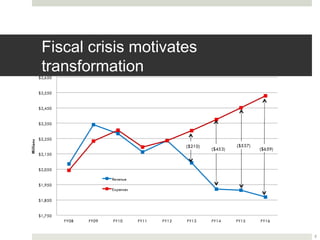
Fiscal crisis motivates transformation
           $2,650


           $2,550


           $2,450


           $2,350


           $2,250
Millions


                                                           ($210)            ($537)
                                                                    ($453)            ($659)
           $2,150


           $2,050

                                  Revenue
           $1,950
                                  Expenses

           $1,850


           $1,750
                    FY08   FY09   FY10       FY11   FY12   FY13     FY14     FY15     FY16


                                                                                               2
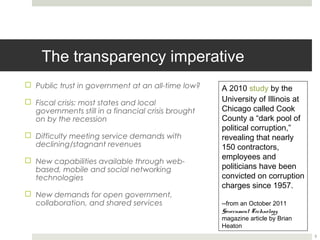
The transparency imperative
¨  Public trust in government at an all-time low?    A 2010 study by the
                                                      University of Illinois at
¨  Fiscal crisis: most states and local
    governments still in a financial crisis brought   Chicago called Cook
    on by the recession                               County a “dark pool of
                                                      political corruption,”
¨  Difficulty meeting service demands with           revealing that nearly 150
    declining/stagnant revenues                       contractors, employees
                                                      and politicians have been
¨  New capabilities available through web-           convicted on corruption
    based, mobile and social networking
    technologies                                      charges since 1957.

¨  New demands for open government,                  --from an October 2011
                                                      Government Technology
    collaboration, and shared services
                                                      magazine article by Brian
                                                      Heaton


                                                                                  3
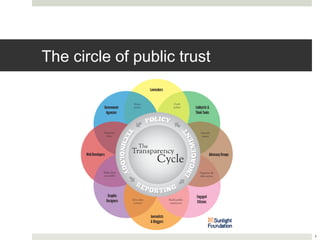
The circle of public trust


                             4
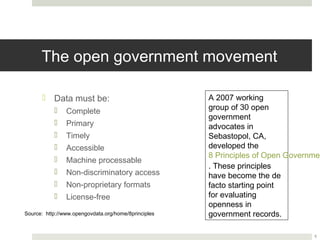
The open government movement

       ¤  Data must be:                              A 2007 working group
                                                      of 30 open government
            ¤  Complete
                                                      advocates in
            ¤  Primary                               Sebastopol, CA,
            ¤  Timely                                developed the
            ¤  Accessible                            8 Principles of Open
                                                      Government Data.
            ¤  Machine processable
                                                      These principles have
            ¤  Non-discriminatory access             become the de facto
            ¤  Non-proprietary formats               starting point for
            ¤  License-free                          evaluating openness in
                                                      government records.
Source: http://www.opengovdata.org/home/8principles


                                                                               5
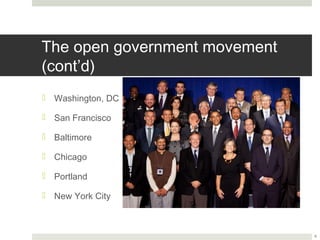
The open government movement (cont’d)

¤  Washington, DC

¤  San Francisco

¤  Baltimore

¤  Chicago

¤  Portland

¤  New York City


                                        6
Governments globally are using the power of the Internet and Web, including
                social media, to transform governance, empower citizens and rebuild the social
                contract between political leaders and citizens. Although the emphasis and details
                differ from country to country, many central governments are making more
                information public and easily available on the Web in formats that citizens can
                access, reuse, mash up, remix, visualize, map and share.


                Tracking and mapping tools and systems allow citizens to examine government
                activities and expenditures. Citizen engagement platforms and tools allow
                governments to reach out and incorporate the perspectives and ideas of citizens
                in decision-making and policy-making. Still others are building networked
                relationships between the public and private sectors to solve challenging problems
                that cannot be addressed by either sector working alone.
Excerpt from
The Future of   An increasing number of countries are building transparency and accountability
Government:     and driving public and private innovation through the use of information and
Lessons         communication technologies, including social media.
Learned from
Around the      Right to Information. Several countries – including Indonesia, Mexico, Turkey and
World, 2011     India – have recently passed legislation guaranteeing the right of citizens to public
                information and requiring ministries to make information accessible to the public.
                The Obama Administration has inked an open government partnership with India
                to exchange best practices and share data.


                Transparency and Accountability. Tracking systems used in countries such as India,
                Kenya and Brazil allow and engage citizens in the monitoring and exposure of
Open            inefficiencies and corruption.
Government
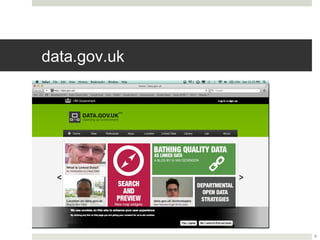
and Open        Open Data. Today, 10 countries or more have open data portals. Significant
Data, Part 1    Data.gov initiatives are now established in Australia, Canada, Estonia, Norway, the
                United Kingdom, the United States and New Zealand. These efforts are designed to
                make government data accessible in a form that may be used by citizens.
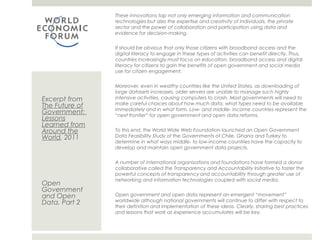
These innovations tap not only emerging information and communication
                technologies but also the expertise and creativity of individuals, the private sector
                and the power of collaboration and participation using data and evidence for
                decision-making.

                It should be obvious that only those citizens with broadband access and the
                digital literacy to engage in these types of activities can benefit directly. Thus,
                countries increasingly must focus on education, broadband access and digital
                literacy for citizens to gain the benefits of open government and social media use
                for citizen engagement.


                Moreover, even in wealthy countries like the United States, as downloading of
                large datasets increases, older servers are unable to manage such highly
Excerpt from    intensive activities, causing computers to crash. Most governments will need to
                make careful choices about how much data, what types need to be available
The Future of   immediately and in what form. Low- and middle- income countries represent the
Government:     “next frontier” for open government and open data reforms.
Lessons
Learned from
Around the      To this end, the World Wide Web Foundation launched an Open Government
World, 2011     Data Feasibility Study of the Governments of Chile, Ghana and Turkey to
                determine in what ways middle- to low-income countries have the capacity to
                develop and maintain open government data projects.


                A number of international organizations and foundations have formed a donor
                collaborative called the Transparency and Accountability Initiative to foster the
                powerful concepts of transparency and accountability through greater use of
                networking and information technologies coupled with social media.
Open
Government
and Open        Open government and open data represent an emergent “movement”
                worldwide although national governments will continue to differ with respect to
Data, Part 2
                their definition and implementation of these ideas. Clearly, sharing best practices
                and lessons that work as experience accumulates will be key.
data.gov.uk


              9
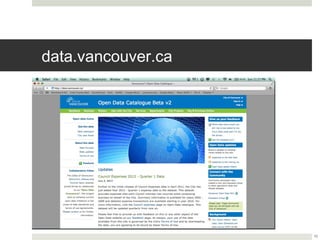
data.vancouver.ca


                    10
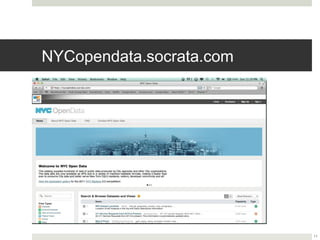
NYCopendata.socrata.com


                          11
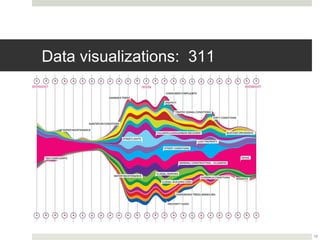
Data visualizations: 311


                           12
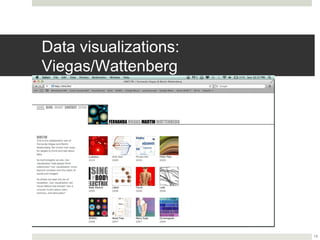
Data visualizations: Viegas/Wattenberg


                                         13
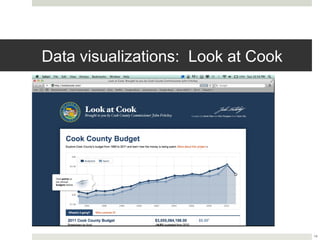
Data visualizations: Look at Cook


                                    14
Open government in Cook County

¨ Many residents don’t know what County
   government is or what it does
¨ Many residents don’t know how their tax dollars
   are collected or spent
¨ Historical lack of transparency means many
   local citizen activists are disengaged and
   cynical
¨ Lack of transparency breeds doubt, skepticism,
   inefficiency and corruption

                                                     15
Open government in Cook County
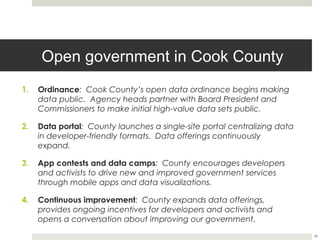
1.    Ordinance: Cook County’s open data ordinance begins making
      data public. Agency heads partner with Board President and
      Commissioners to make initial high-value data sets public.

2.    Data portal: County launches a single-site portal centralizing data
      in developer-friendly formats. Data offerings continuously expand.

3.    App contests and data camps: County encourages developers
      and activists to drive new and improved government services
      through mobile apps and data visualizations.

4.    Continuous improvement: County expands data offerings,
      provides ongoing incentives for developers and activists and
      opens a conversation about improving our government.


                                                                            16
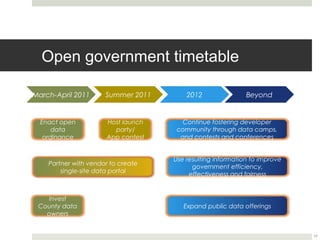
Open government timetable
  March-April
                       Summer 2011          2012               Beyond
    2011


Enact open             Host launch         Continue fostering developer
    data                 party/         community through data camps, and
 ordinance             App contest          contests and conferences


                                         Use resulting information to improve
Partner with vendor to create single-   government efficiency, effectiveness
           site data portal
                                                      and fairness


Invest County
                                            Expand public data offerings
 data owners


                                                                                17
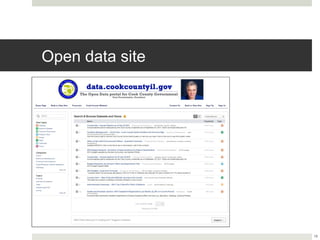
Open data site


                 18
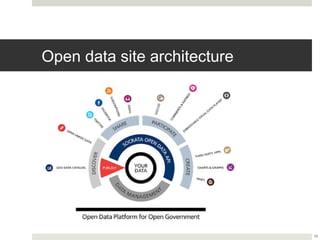
Open data site architecture


                              19
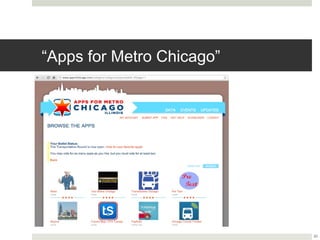
“Apps for Metro Chicago”


                           20
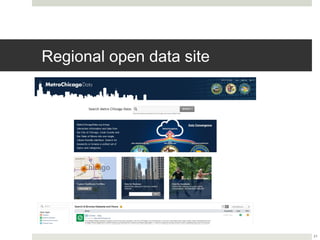
Regional open data site


                          21
Results and reactions
¤  “The Cook County open data website        ¤  “(Metrochicagodata.org) appears to
    was launched on-time and it has               deliver what public-sector technologists
    been a reliable platform for the              long have said could be possible—a truly
    County to deliver information to              regional clearinghouse where all public
    citizens and for potential use by             data is available for free in one
    entrepreneurs developing                      place.”—Government Technology, May
    applications. The shared platform             2012
    with the State of Illinois and the City
    of Chicago keeps costs down and           ¤  “Yesterday, Cook County released an
    promotes consistent approaches for            unprecedented amount of data on their
    data sharing.”—TechAmerica, The               website. It’s exciting to see both the City
    Cloud Imperative: Better                      of Chicago and Cook County creating
    Collaboration, Better Service, Better         new, innovative ways to inform and
    Cost, Feb 2012                                engage with citizens about important local
                                                  issues including public safety, economic
                                                  development and especially government
                                                  spending.”—Illinois PIRG, Sep 2011


                                                                                                22
Next steps

¤ Big Data


¤ More use of open data for research and
  analysis


¤ Expanding data.gov
                                            23

Week 6: Open data

  • 1.
    Week 6: Opendata   Technology  in  the  Public  Sector   Northwestern  University  MPPA  490   Summer  2012  -­‐  Greg  Wass   1
  • 2.
    Fiscal crisis motivatestransformation $2,650 $2,550 $2,450 $2,350 $2,250 Millions ($210) ($537) ($453) ($659) $2,150 $2,050 Revenue $1,950 Expenses $1,850 $1,750 FY08 FY09 FY10 FY11 FY12 FY13 FY14 FY15 FY16 2
  • 3.
    The transparency imperative ¨ Public trust in government at an all-time low? A 2010 study by the University of Illinois at ¨  Fiscal crisis: most states and local governments still in a financial crisis brought Chicago called Cook on by the recession County a “dark pool of political corruption,” ¨  Difficulty meeting service demands with revealing that nearly 150 declining/stagnant revenues contractors, employees and politicians have been ¨  New capabilities available through web- convicted on corruption based, mobile and social networking technologies charges since 1957. ¨  New demands for open government, --from an October 2011 Government Technology collaboration, and shared services magazine article by Brian Heaton 3
  • 4.
    The circle ofpublic trust 4
  • 5.
    The open governmentmovement ¤  Data must be: A 2007 working group of 30 open government ¤  Complete advocates in ¤  Primary Sebastopol, CA, ¤  Timely developed the ¤  Accessible 8 Principles of Open Government Data. ¤  Machine processable These principles have ¤  Non-discriminatory access become the de facto ¤  Non-proprietary formats starting point for ¤  License-free evaluating openness in government records. Source: http://www.opengovdata.org/home/8principles 5
  • 6.
    The open governmentmovement (cont’d) ¤  Washington, DC ¤  San Francisco ¤  Baltimore ¤  Chicago ¤  Portland ¤  New York City 6
  • 7.
    Governments globally areusing the power of the Internet and Web, including social media, to transform governance, empower citizens and rebuild the social contract between political leaders and citizens. Although the emphasis and details differ from country to country, many central governments are making more information public and easily available on the Web in formats that citizens can access, reuse, mash up, remix, visualize, map and share. Tracking and mapping tools and systems allow citizens to examine government activities and expenditures. Citizen engagement platforms and tools allow governments to reach out and incorporate the perspectives and ideas of citizens in decision-making and policy-making. Still others are building networked relationships between the public and private sectors to solve challenging problems that cannot be addressed by either sector working alone. Excerpt from The Future of An increasing number of countries are building transparency and accountability Government: and driving public and private innovation through the use of information and Lessons communication technologies, including social media. Learned from Around the Right to Information. Several countries – including Indonesia, Mexico, Turkey and World, 2011 India – have recently passed legislation guaranteeing the right of citizens to public information and requiring ministries to make information accessible to the public. The Obama Administration has inked an open government partnership with India to exchange best practices and share data. Transparency and Accountability. Tracking systems used in countries such as India, Kenya and Brazil allow and engage citizens in the monitoring and exposure of Open inefficiencies and corruption. Government and Open Open Data. Today, 10 countries or more have open data portals. Significant Data, Part 1 Data.gov initiatives are now established in Australia, Canada, Estonia, Norway, the United Kingdom, the United States and New Zealand. These efforts are designed to make government data accessible in a form that may be used by citizens.
  • 8.
    These innovations tapnot only emerging information and communication technologies but also the expertise and creativity of individuals, the private sector and the power of collaboration and participation using data and evidence for decision-making. It should be obvious that only those citizens with broadband access and the digital literacy to engage in these types of activities can benefit directly. Thus, countries increasingly must focus on education, broadband access and digital literacy for citizens to gain the benefits of open government and social media use for citizen engagement. Moreover, even in wealthy countries like the United States, as downloading of large datasets increases, older servers are unable to manage such highly Excerpt from intensive activities, causing computers to crash. Most governments will need to make careful choices about how much data, what types need to be available The Future of immediately and in what form. Low- and middle- income countries represent the Government: “next frontier” for open government and open data reforms. Lessons Learned from Around the To this end, the World Wide Web Foundation launched an Open Government World, 2011 Data Feasibility Study of the Governments of Chile, Ghana and Turkey to determine in what ways middle- to low-income countries have the capacity to develop and maintain open government data projects. A number of international organizations and foundations have formed a donor collaborative called the Transparency and Accountability Initiative to foster the powerful concepts of transparency and accountability through greater use of networking and information technologies coupled with social media. Open Government and Open Open government and open data represent an emergent “movement” worldwide although national governments will continue to differ with respect to Data, Part 2 their definition and implementation of these ideas. Clearly, sharing best practices and lessons that work as experience accumulates will be key.
  • 9.
  • 10.
  • 11.
  • 12.
  • 13.
  • 14.
  • 15.
    Open government inCook County ¨ Many residents don’t know what County government is or what it does ¨ Many residents don’t know how their tax dollars are collected or spent ¨ Historical lack of transparency means many local citizen activists are disengaged and cynical ¨ Lack of transparency breeds doubt, skepticism, inefficiency and corruption 15
  • 16.
    Open government inCook County 1.  Ordinance: Cook County’s open data ordinance begins making data public. Agency heads partner with Board President and Commissioners to make initial high-value data sets public. 2.  Data portal: County launches a single-site portal centralizing data in developer-friendly formats. Data offerings continuously expand. 3.  App contests and data camps: County encourages developers and activists to drive new and improved government services through mobile apps and data visualizations. 4.  Continuous improvement: County expands data offerings, provides ongoing incentives for developers and activists and opens a conversation about improving our government. 16
  • 17.
    Open government timetable March-April Summer 2011 2012 Beyond 2011 Enact open Host launch Continue fostering developer data party/ community through data camps, and ordinance App contest contests and conferences Use resulting information to improve Partner with vendor to create single- government efficiency, effectiveness site data portal and fairness Invest County Expand public data offerings data owners 17
  • 18.
  • 19.
    Open data sitearchitecture 19
  • 20.
    “Apps for MetroChicago” 20
  • 21.
  • 22.
    Results and reactions ¤ “The Cook County open data website ¤  “(Metrochicagodata.org) appears to was launched on-time and it has deliver what public-sector technologists been a reliable platform for the long have said could be possible—a truly County to deliver information to regional clearinghouse where all public citizens and for potential use by data is available for free in one entrepreneurs developing place.”—Government Technology, May applications. The shared platform 2012 with the State of Illinois and the City of Chicago keeps costs down and ¤  “Yesterday, Cook County released an promotes consistent approaches for unprecedented amount of data on their data sharing.”—TechAmerica, The website. It’s exciting to see both the City Cloud Imperative: Better of Chicago and Cook County creating Collaboration, Better Service, Better new, innovative ways to inform and Cost, Feb 2012 engage with citizens about important local issues including public safety, economic development and especially government spending.”—Illinois PIRG, Sep 2011 22
  • 23.
    Next steps ¤ Big Data ¤ Moreuse of open data for research and analysis ¤ Expanding data.gov 23