


Dynamics/London MPPA-DL 452 Session 2
Course Themes Dynamics:  Globalization, Urbanization Circuits:  Transnationals, Diasporas Centers:  Agglomeration, Sprawl Margins:  New Inequalities Ecologies:  Sustainability Architectures:  A Sense of Place Crises:  Globalization in Reverse Frontiers:  Looking Ahead
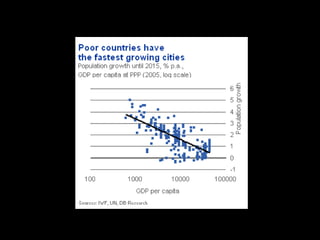
Why do some cities grow faster than others?
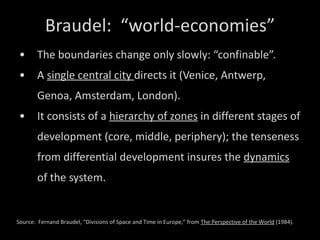
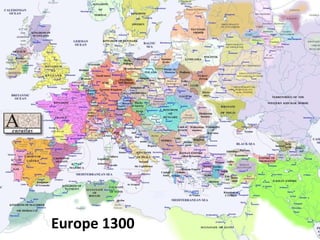
Braudel:  “world-economies” The boundaries change only slowly: “confinable”. A  single central city  directs it (Venice, Antwerp, Genoa, Amsterdam, London). It consists of a  hierarchy of zones  in different stages of development (core, middle, periphery); the tenseness from differential development insures the  dynamics  of the system. Source:  Fernand Braudel, “Divisions of Space and Time in Europe,” from  The Perspective of the World  (1984).
 
Europe 1300
Impermanence of global hegemony Venice (14 th  century) Antwerp (15 th  century) Genoa (16 th  century) Amsterdam (17 th  century) London (“long 19 th  century”) New York (“short 20 th  century”)
Impermanence of global hegemony:  will London/NYC retain their status as strategic centers for global finance?
Historical theories of economic growth
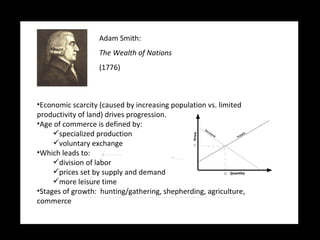
Adam Smith:   The Wealth of Nations   (1776) Economic scarcity (caused by increasing population vs. limited productivity of land) drives progression. Age of commerce is defined by: specialized production voluntary exchange Which leads to: division of labor prices set by supply and demand more leisure time Stages of growth:  hunting/gathering, shepherding, agriculture, commerce
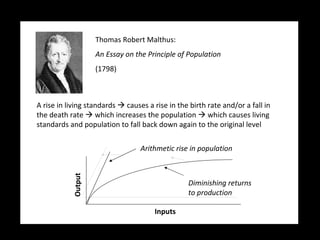
Thomas Robert Malthus:   An Essay on the Principle of Population   (1798) A rise in living standards    causes a rise in the birth rate and/or a fall in the death rate    which increases the population    which causes living standards and population to fall back down again to the original level Inputs Output Arithmetic rise in population Diminishing returns to production
David Ricardo:   On the Principles of Political Economy and Taxation (1817) As the economy grows, profits are squeezed out by rents and wages.  In the limit, a "stationary state" is reached where capitalists are making near-zero profits and no further accumulation occurs. =Law of diminishing returns Two exceptions: Technical progress:  requires the introduction of labor-saving machinery (cost will reduce $ available for wages) Foreign trade:  each nation specializes in the production of the good in which it has a "comparative" cost advantage, then trades with other nations for other goods (theory of comparative advantage) Source:  cepa.newschool.edu
John Maynard Keynes:   The General Theory of Employment, Interest and Money (1936) Permanently changed the way the world looked at the economy and the role of government in society:  macroeconomic theory Income-expenditure  multiplier Aggregate demand determines aggregate output - and as a consequence, employment (demand-determined equilibrium) Ineffectiveness of price flexibility to cure unemployment Marginal efficiency of investment schedule breaking Say's Law Theory of money based on “liquidity preference” Introduction of radical uncertainty and expectations Possibility of using government fiscal and monetary policy to help eliminate recessions and control economic booms
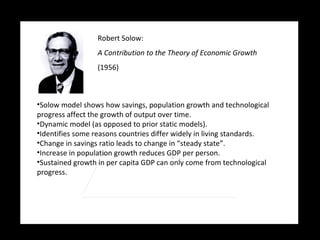
Robert Solow:   A Contribution to the Theory of Economic Growth (1956) Solow model shows how savings, population growth and technological progress affect the growth of output over time. Dynamic model (as opposed to prior static models). Identifies some reasons countries differ widely in living standards. Change in savings ratio leads to change in “steady state”. Increase in population growth reduces GDP per person. Sustained growth in per capita GDP can only come from technological progress.
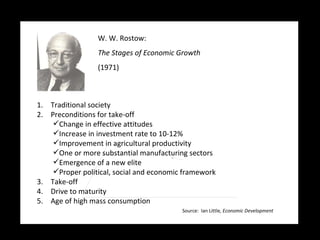
W. W. Rostow:   The Stages of Economic Growth (1971) Traditional society Preconditions for take-off  Change in effective attitudes Increase in investment rate to 10-12% Improvement in agricultural productivity One or more substantial manufacturing sectors Emergence of a new elite Proper political, social and economic framework Take-off  Drive to maturity  Age of high mass consumption  Source:  Ian Little , Economic Development
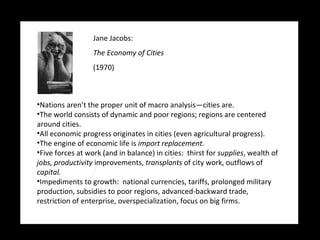
Jane Jacobs:   The Economy of Cities (1970) Nations aren’t the proper unit of macro analysis—cities are. The world consists of dynamic and poor regions; regions are centered around cities. All economic progress originates in cities (even agricultural progress). The engine of economic life is  import replacement. Five forces at work (and in balance) in cities:  thirst for  supplies , wealth of  jobs,   productivity  improvements,  transplants  of city work, outflows of  capital. Impediments to growth:  national currencies, tariffs, prolonged military production, subsidies to poor regions, advanced-backward trade, restriction of enterprise, overspecialization, focus on big firms.
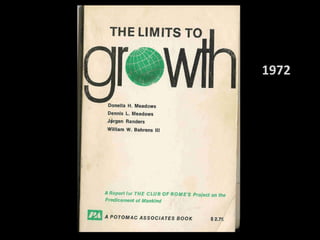
1972
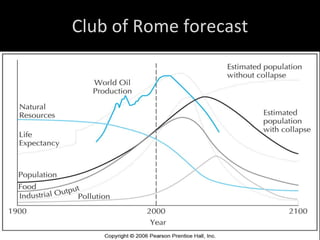
Club of Rome forecast
“ Since the 1980s, major transformations in the composition of the world economy, including the sharp growth of specialized services for firms and finance, have renewed the importance of major cities as sites for producing strategic global inputs.” Saskia Sassen,  Cities in a World Economy , p.7
“ Global cities are strategic sites for the management of the global economy and the production of the most advanced services and financial operations that have become key inputs for the work of managing global economic operations.” Saskia Sassen,  Cities in a World Economy , p.32
Headquarters of transnational corporations Export processing zones Offshore banking centers Business services production sites “ Recognized global spaces” Source:  Saskia Sassen,  Cities in a World Economy
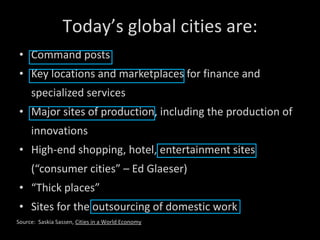
Command posts Key locations and marketplaces for finance and specialized services Major sites of production, including the production of innovations High-end shopping, hotel, entertainment sites (“consumer cities” – Ed Glaeser) “ Thick places” Sites for the outsourcing of domestic work Today’s global cities are: Source:  Saskia Sassen,  Cities in a World Economy
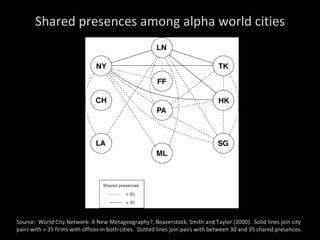
Shared presences among alpha world cities Source:  World City Network: A New Metageography?, Beaverstock, Smith and Taylor (2000).  Solid lines join city pairs with > 35 firms with offices in both cities.  Dotted lines join pairs with between 30 and 35 shared presences.
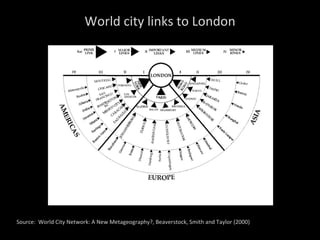
World city links to London Source:  World City Network: A New Metageography?, Beaverstock, Smith and Taylor (2000)
 
 
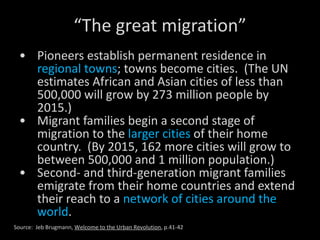
“ The great migration” Pioneers establish permanent residence in  regional towns ; towns become cities.  (The UN estimates African and Asian cities of less than 500,000 will grow by 273 million people by 2015.) Migrant families begin a second stage of migration to the  larger cities  of their home country.  (By 2015, 162 more cities will grow to between 500,000 and 1 million population.) Second- and third-generation migrant families emigrate from their home countries and extend their reach to a  network of cities around the world . Source:  Jeb Brugmann,  Welcome to the Urban Revolution , p.41-42
“… wherever talent goes” “ The global talent pool and the high-end, high margin creative industries that used to be the sole province of the U.S., and a critical source of its prosperity, have begun to disperse around the globe.  “ A host of countries—Ireland, Finland, Canada, Australia, New Zealand, among them—are investing in higher education, cultivating creative people, and churning out stellar products… “ To stay innovative, America must continue to attract the world’s sharpest minds. And to do that, it needs to invest in the further development of its creative sector. Because wherever creativity goes—and, by extension, wherever talent goes—innovation and economic growth are sure to follow.”  Source:  Richard Florida, “America’s Looming Creativity Crisis”, Harvard Business Review, October 2004
 
 
“ The rise of cities on the scale seen in the contemporary world is a phenomenon directly linked to the  exploitation of fossil fuels and the emergence of high-energy-use societies  with complex commercial and financial linkages. “ Not only are they responsible for most of the energy consumption within society, they are also a focus for a range of environmental problems. “ In addition to crowded and often poor living conditions they are characterized by  high levels of air pollution and noise, long commuting distances, either on overcrowded public transport systems or by car on congested roads, and a multitude of social problems .” Clive Ponting, A New Green History of the World, p.313

2 dynamics-london

  • 1.
  • 2.
    Course Themes Dynamics: Globalization, Urbanization Circuits: Transnationals, Diasporas Centers: Agglomeration, Sprawl Margins: New Inequalities Ecologies: Sustainability Architectures: A Sense of Place Crises: Globalization in Reverse Frontiers: Looking Ahead
  • 3.
    Why do somecities grow faster than others?
  • 4.
    Braudel: “world-economies”The boundaries change only slowly: “confinable”. A single central city directs it (Venice, Antwerp, Genoa, Amsterdam, London). It consists of a hierarchy of zones in different stages of development (core, middle, periphery); the tenseness from differential development insures the dynamics of the system. Source: Fernand Braudel, “Divisions of Space and Time in Europe,” from The Perspective of the World (1984).
  • 5.
  • 6.
  • 7.
    Impermanence of globalhegemony Venice (14 th century) Antwerp (15 th century) Genoa (16 th century) Amsterdam (17 th century) London (“long 19 th century”) New York (“short 20 th century”)
  • 8.
    Impermanence of globalhegemony: will London/NYC retain their status as strategic centers for global finance?
  • 9.
    Historical theories ofeconomic growth
  • 10.
    Adam Smith: The Wealth of Nations (1776) Economic scarcity (caused by increasing population vs. limited productivity of land) drives progression. Age of commerce is defined by: specialized production voluntary exchange Which leads to: division of labor prices set by supply and demand more leisure time Stages of growth: hunting/gathering, shepherding, agriculture, commerce
  • 11.
    Thomas Robert Malthus: An Essay on the Principle of Population (1798) A rise in living standards  causes a rise in the birth rate and/or a fall in the death rate  which increases the population  which causes living standards and population to fall back down again to the original level Inputs Output Arithmetic rise in population Diminishing returns to production
  • 12.
    David Ricardo: On the Principles of Political Economy and Taxation (1817) As the economy grows, profits are squeezed out by rents and wages. In the limit, a "stationary state" is reached where capitalists are making near-zero profits and no further accumulation occurs. =Law of diminishing returns Two exceptions: Technical progress: requires the introduction of labor-saving machinery (cost will reduce $ available for wages) Foreign trade: each nation specializes in the production of the good in which it has a "comparative" cost advantage, then trades with other nations for other goods (theory of comparative advantage) Source: cepa.newschool.edu
  • 13.
    John Maynard Keynes: The General Theory of Employment, Interest and Money (1936) Permanently changed the way the world looked at the economy and the role of government in society: macroeconomic theory Income-expenditure multiplier Aggregate demand determines aggregate output - and as a consequence, employment (demand-determined equilibrium) Ineffectiveness of price flexibility to cure unemployment Marginal efficiency of investment schedule breaking Say's Law Theory of money based on “liquidity preference” Introduction of radical uncertainty and expectations Possibility of using government fiscal and monetary policy to help eliminate recessions and control economic booms
  • 14.
    Robert Solow: A Contribution to the Theory of Economic Growth (1956) Solow model shows how savings, population growth and technological progress affect the growth of output over time. Dynamic model (as opposed to prior static models). Identifies some reasons countries differ widely in living standards. Change in savings ratio leads to change in “steady state”. Increase in population growth reduces GDP per person. Sustained growth in per capita GDP can only come from technological progress.
  • 15.
    W. W. Rostow: The Stages of Economic Growth (1971) Traditional society Preconditions for take-off Change in effective attitudes Increase in investment rate to 10-12% Improvement in agricultural productivity One or more substantial manufacturing sectors Emergence of a new elite Proper political, social and economic framework Take-off Drive to maturity Age of high mass consumption Source: Ian Little , Economic Development
  • 16.
    Jane Jacobs: The Economy of Cities (1970) Nations aren’t the proper unit of macro analysis—cities are. The world consists of dynamic and poor regions; regions are centered around cities. All economic progress originates in cities (even agricultural progress). The engine of economic life is import replacement. Five forces at work (and in balance) in cities: thirst for supplies , wealth of jobs, productivity improvements, transplants of city work, outflows of capital. Impediments to growth: national currencies, tariffs, prolonged military production, subsidies to poor regions, advanced-backward trade, restriction of enterprise, overspecialization, focus on big firms.
  • 17.
  • 18.
    Club of Romeforecast
  • 19.
    “ Since the1980s, major transformations in the composition of the world economy, including the sharp growth of specialized services for firms and finance, have renewed the importance of major cities as sites for producing strategic global inputs.” Saskia Sassen, Cities in a World Economy , p.7
  • 20.
    “ Global citiesare strategic sites for the management of the global economy and the production of the most advanced services and financial operations that have become key inputs for the work of managing global economic operations.” Saskia Sassen, Cities in a World Economy , p.32
  • 21.
    Headquarters of transnationalcorporations Export processing zones Offshore banking centers Business services production sites “ Recognized global spaces” Source: Saskia Sassen, Cities in a World Economy
  • 22.
    Command posts Keylocations and marketplaces for finance and specialized services Major sites of production, including the production of innovations High-end shopping, hotel, entertainment sites (“consumer cities” – Ed Glaeser) “ Thick places” Sites for the outsourcing of domestic work Today’s global cities are: Source: Saskia Sassen, Cities in a World Economy
  • 23.
    Shared presences amongalpha world cities Source: World City Network: A New Metageography?, Beaverstock, Smith and Taylor (2000). Solid lines join city pairs with > 35 firms with offices in both cities. Dotted lines join pairs with between 30 and 35 shared presences.
  • 24.
    World city linksto London Source: World City Network: A New Metageography?, Beaverstock, Smith and Taylor (2000)
  • 25.
  • 26.
  • 27.
    “ The greatmigration” Pioneers establish permanent residence in regional towns ; towns become cities. (The UN estimates African and Asian cities of less than 500,000 will grow by 273 million people by 2015.) Migrant families begin a second stage of migration to the larger cities of their home country. (By 2015, 162 more cities will grow to between 500,000 and 1 million population.) Second- and third-generation migrant families emigrate from their home countries and extend their reach to a network of cities around the world . Source: Jeb Brugmann, Welcome to the Urban Revolution , p.41-42
  • 28.
    “… wherever talentgoes” “ The global talent pool and the high-end, high margin creative industries that used to be the sole province of the U.S., and a critical source of its prosperity, have begun to disperse around the globe. “ A host of countries—Ireland, Finland, Canada, Australia, New Zealand, among them—are investing in higher education, cultivating creative people, and churning out stellar products… “ To stay innovative, America must continue to attract the world’s sharpest minds. And to do that, it needs to invest in the further development of its creative sector. Because wherever creativity goes—and, by extension, wherever talent goes—innovation and economic growth are sure to follow.” Source: Richard Florida, “America’s Looming Creativity Crisis”, Harvard Business Review, October 2004
  • 29.
  • 30.
  • 31.
    “ The riseof cities on the scale seen in the contemporary world is a phenomenon directly linked to the exploitation of fossil fuels and the emergence of high-energy-use societies with complex commercial and financial linkages. “ Not only are they responsible for most of the energy consumption within society, they are also a focus for a range of environmental problems. “ In addition to crowded and often poor living conditions they are characterized by high levels of air pollution and noise, long commuting distances, either on overcrowded public transport systems or by car on congested roads, and a multitude of social problems .” Clive Ponting, A New Green History of the World, p.313