Open Credentials for
Open Education
Moving the Needle Forward
Ildiko Mazar
Knowledge Innovation Centre
Open EducationWeek – 8 March 2019
Education is a Public Good
This means
 Open Access to Educational Opportunities
 Use of Open Educational Resources
 Empowerement of Students through Open Educational Practices
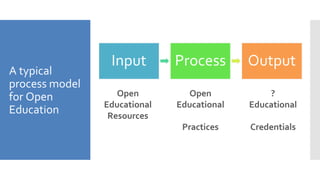
A typical
process model
for Open
Education
Open
Educational
Resources
Open
Educational
Practices
?
Educational
Credentials
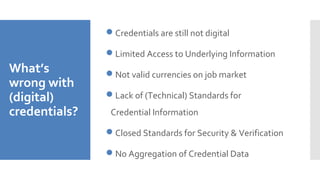
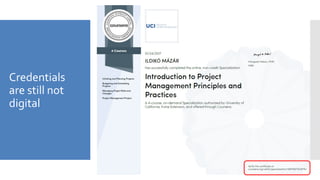
Credentials are still not digital
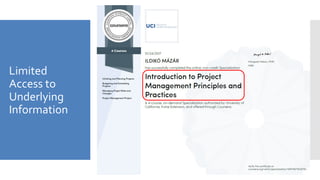
Limited Access to Underlying Information
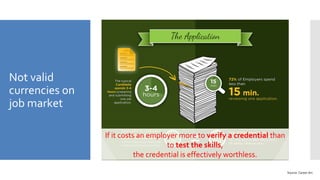
Not valid currencies on job market
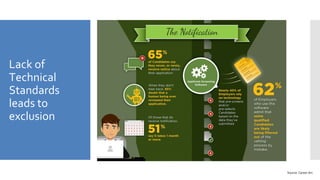
Lack of (Technical) Standards for
Credential Information
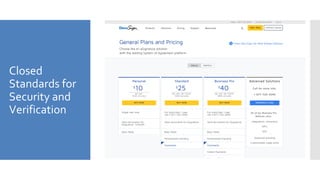
Closed Standards for Security & Verification
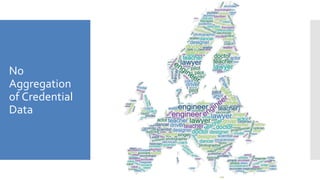
No Aggregation of Credential Data
What’s
wrong with
(digital)
credentials?
Credentials
are still not
digital
Limited
Access to
Underlying
Information
Not valid
currencies on
job market
Source: Career Arc
If it costs an employer more to verify a credential than
to test the skills,
the credential is effectively worthless.
Lack of
Technical
Standards
leads to
exclusion
Source: Career Arc
Closed
Standards for
Security and
Verification
No
Aggregation
of Credential
Data
Closed
Credentials
expensive and time consuming to
acquire
hard to use and share
hinder Open Education by failing to
evidence flexible learning pathways
in a transparent manner
exclude the people who need them
most
can be abused by networks of
intermediaries
do not inform policy
We have all the pieces for an
Open Credential System
EU Standards
for
Qualifications
EU standards for qualifications
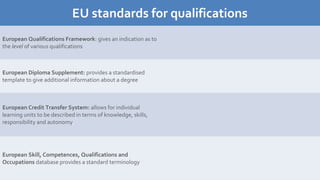
European Qualifications Framework: gives an indication as to
the level of various qualifications
European Diploma Supplement: provides a standardised
template to give additional information about a degree
European Credit Transfer System: allows for individual
learning units to be described in terms of knowledge, skills,
responsibility and autonomy
European Skill, Competences, Qualifications and
Occupations database provides a standard terminology
EU Standards
for
Qualifications
EU standards for qualifications
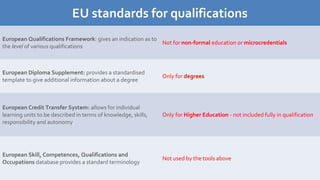
European Qualifications Framework: gives an indication as to
the level of various qualifications
Not for non-formal education or microcredentials
European Diploma Supplement: provides a standardised
template to give additional information about a degree
Only for degrees
European Credit Transfer System: allows for individual
learning units to be described in terms of knowledge, skills,
responsibility and autonomy
Only for Higher Education - not included fully in qualification
European Skill, Competences, Qualifications and
Occupations database provides a standard terminology
Not used by the tools above
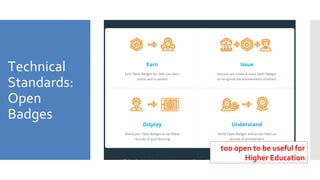
Technical
Standards:
Open
Badges
too open to be useful for
Higher Education
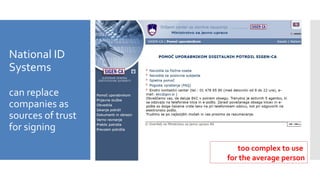
National ID
Systems
can replace
companies as
sources of trust
for signing
too complex to use
for the average person
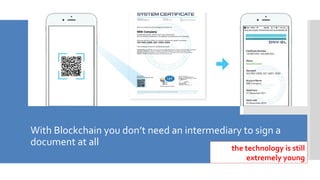
With Blockchain you don’t need an intermediary to sign a
document at all
the technology is still
extremely young
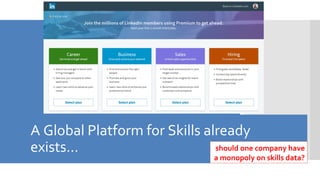
A Global Platform for Skills already
exists… should one company have
a monopoly on skills data?
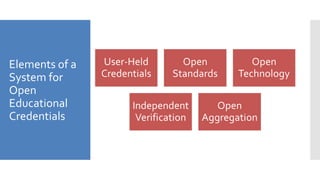
Elements of a
System for
Open
Educational
Credentials
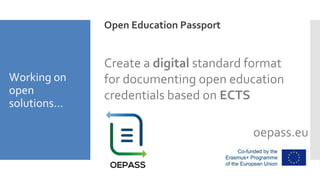
Working on
open
solutions...
Create a digital standard format
for documenting open education
credentials based on ECTS
oepass.eu
Open Education Passport
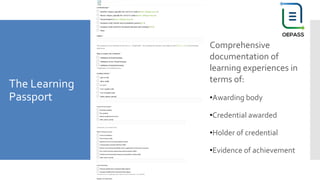
The Learning
Passport
Comprehensive
documentation of
learning experiences in
terms of:
•Awarding body
•Credential awarded
•Holder of credential
•Evidence of achievement
Working on
open
solutions...
Support Future Learning Excellence through
Micro-Credentialling in Higher Education
Create a model blockchain
infrastructure for storing and
automatically verifying credentials
microcredentials.eu
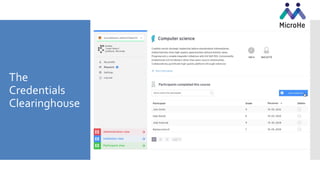
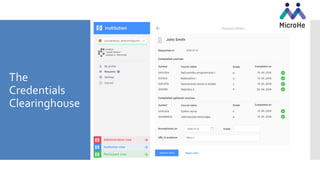
The
Credentials
Clearinghouse
The
Credentials
Clearinghouse
www.microcredentials.eu
Imagine a Future
where recognition is
universal
automatic
seamless
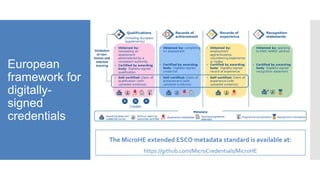
European
framework for
digitally-
signed
credentials
The MicroHE extended ESCO metadata standard is available at:
https://github.com/MicroCredentials/MicroHE
THANK YOU FOR
YOUR ATTENTION
You can download this presentation at:
Ildiko Mazar
ildiko@knowledgeinnovation.eu
https://www.slideshare.net/ildikomazar
The European Commission support for the production of this publication does not constitute an endorsement of the contents which
reflects the views only of the authors, and the Commission cannot be held responsible for any use which may be made of the
information contained therein.
This work is licensed under a Creative Commons Attribution ShareAlike 4.0 International License.
You are free to:
Share — copy and redistribute the material in any medium or format
Adapt — remix, transform, and build upon the material
for any purpose, even commercially.
The licensor cannot revoke these freedoms as long as you follow the license terms.
Under the following conditions:
Attribution — You must give appropriate credit, provide a link to the license, and indicate if changes were made. You may do so in any
reasonable manner, but not in any way that suggests the licensor endorses you or your use.
ShareAlike — If you remix, transform, or build upon the material, you must distribute your contributions under the same license as the
original.
No additional restrictions — You may not apply legal terms or technological

OEWeek 2019 - Open Credentials for Open Education

  • 1.
    Open Credentials for OpenEducation Moving the Needle Forward Ildiko Mazar Knowledge Innovation Centre Open EducationWeek – 8 March 2019
  • 2.
    Education is aPublic Good This means  Open Access to Educational Opportunities  Use of Open Educational Resources  Empowerement of Students through Open Educational Practices
  • 3.
    A typical process model forOpen Education Open Educational Resources Open Educational Practices ? Educational Credentials
  • 4.
    Credentials are stillnot digital Limited Access to Underlying Information Not valid currencies on job market Lack of (Technical) Standards for Credential Information Closed Standards for Security & Verification No Aggregation of Credential Data What’s wrong with (digital) credentials?
  • 5.
  • 6.
  • 7.
    Not valid currencies on jobmarket Source: Career Arc If it costs an employer more to verify a credential than to test the skills, the credential is effectively worthless.
  • 8.
  • 9.
  • 10.
  • 11.
    Closed Credentials expensive and timeconsuming to acquire hard to use and share hinder Open Education by failing to evidence flexible learning pathways in a transparent manner exclude the people who need them most can be abused by networks of intermediaries do not inform policy
  • 12.
    We have allthe pieces for an Open Credential System
  • 13.
    EU Standards for Qualifications EU standardsfor qualifications European Qualifications Framework: gives an indication as to the level of various qualifications European Diploma Supplement: provides a standardised template to give additional information about a degree European Credit Transfer System: allows for individual learning units to be described in terms of knowledge, skills, responsibility and autonomy European Skill, Competences, Qualifications and Occupations database provides a standard terminology
  • 14.
    EU Standards for Qualifications EU standardsfor qualifications European Qualifications Framework: gives an indication as to the level of various qualifications Not for non-formal education or microcredentials European Diploma Supplement: provides a standardised template to give additional information about a degree Only for degrees European Credit Transfer System: allows for individual learning units to be described in terms of knowledge, skills, responsibility and autonomy Only for Higher Education - not included fully in qualification European Skill, Competences, Qualifications and Occupations database provides a standard terminology Not used by the tools above
  • 15.
    Technical Standards: Open Badges too open tobe useful for Higher Education
  • 16.
    National ID Systems can replace companiesas sources of trust for signing too complex to use for the average person
  • 17.
    With Blockchain youdon’t need an intermediary to sign a document at all the technology is still extremely young
  • 18.
    A Global Platformfor Skills already exists… should one company have a monopoly on skills data?
  • 19.
    Elements of a Systemfor Open Educational Credentials
  • 20.
    Working on open solutions... Create adigital standard format for documenting open education credentials based on ECTS oepass.eu Open Education Passport
  • 21.
    The Learning Passport Comprehensive documentation of learningexperiences in terms of: •Awarding body •Credential awarded •Holder of credential •Evidence of achievement
  • 22.
    Working on open solutions... Support FutureLearning Excellence through Micro-Credentialling in Higher Education Create a model blockchain infrastructure for storing and automatically verifying credentials microcredentials.eu
  • 23.
  • 24.
  • 25.
    www.microcredentials.eu Imagine a Future whererecognition is universal automatic seamless
  • 26.
    European framework for digitally- signed credentials The MicroHEextended ESCO metadata standard is available at: https://github.com/MicroCredentials/MicroHE
  • 27.
    THANK YOU FOR YOURATTENTION You can download this presentation at: Ildiko Mazar ildiko@knowledgeinnovation.eu https://www.slideshare.net/ildikomazar
  • 28.
    The European Commissionsupport for the production of this publication does not constitute an endorsement of the contents which reflects the views only of the authors, and the Commission cannot be held responsible for any use which may be made of the information contained therein. This work is licensed under a Creative Commons Attribution ShareAlike 4.0 International License. You are free to: Share — copy and redistribute the material in any medium or format Adapt — remix, transform, and build upon the material for any purpose, even commercially. The licensor cannot revoke these freedoms as long as you follow the license terms. Under the following conditions: Attribution — You must give appropriate credit, provide a link to the license, and indicate if changes were made. You may do so in any reasonable manner, but not in any way that suggests the licensor endorses you or your use. ShareAlike — If you remix, transform, or build upon the material, you must distribute your contributions under the same license as the original. No additional restrictions — You may not apply legal terms or technological

Editor's Notes

  • #5 There are no technical standards – employers do simple keyword search No Aggregation of Credential Data: no data available on what skills are driving the job market in Europe
  • #6 Even official transcripts (supporting ’digital’ credentials) are paper based and closed. Cost a lot of time and money to prove credentials (to employers).
  • #7 What does UCI mean by Project Management Principles and Practices?
  • #10 Paper certificates – many believe – are harder to forge if they are printed on special paper/plastic with a watermark, stamp etc. Digital equivalent (e.g. digital signatures, stamp) requires proprietary standards and vendors that is expensive.
  • #11 It is possible to check the average hotel rating in any European country, but not the job market’s demand for skills and qualifications (or supply of skills and qualifications by education providers).
  • #16 No indication of level, learning outcomes, etc. Universities need the details and standards.
  • #19 Should one company have global monopoly on skills data?
  • #20 Until a comprehensive solution emerges: Use learning outcomes in certificates Use secure certificates Stay away from proprietary certificate software
  • #21 A harmonised European approach to recognizing and transferring open education credentials will enable virtual student mobility, empowering students to adapt their learning portfolio to changing labour market demands and new technological trends. In order to make an informed and consistent decision on recognizing open learning as ECTS credits towards a degree programme, Higher Education Institutions (HEIs) need sufficient information about a credential. Online education providers on portals such as iversity, edX, Coursera, FUN, etc. already provide in-demand skills to the labour market, but to contribute their offerings in the higher education sector as equals to accredited coursed/modules, they need to know which information they should provide and which formal requirements exist regarding workload, learning outcomes, assessment, ID verification, EQF level, quality of learning etc. to make their credentials recognizable.
  • #24 https://xd.adobe.com/view/ac1bf980-7b32-41ec-5a02-41b271dfc91e-da2a/?fullscreen