QUALITY ASSURANCE OF E-LEARNING
METHODOLOGIES & ISSUES TO CONSIDER
ANTHONY F. CAMILLERI – KNOWLEDGE INNOVATION CENTRE
ELIXIR WORKSHOP, LJUBLJANA 15/09/2015
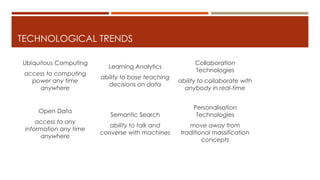
TECHNOLOGICAL TRENDS
Ubiquitous Computing
access to computing
power any time
anywhere
Open Data
access to any
information any time
anywhere
Learning Analytics
ability to base teaching
decisions on data
Semantic Search
ability to talk and
converse with machines
Collaboration
Technologies
ability to collaborate with
anybody in real-time
Personalisation
Technologies
move away from
traditional massification
concepts
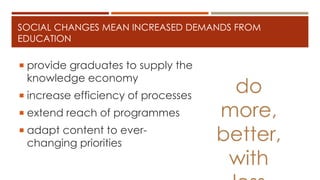
SOCIAL CHANGES MEAN INCREASED DEMANDS FROM
EDUCATION
 provide graduates to supply the
knowledge economy
 increase efficiency of processes
 extend reach of programmes
 adapt content to ever-
changing priorities
do
more,
better,
with
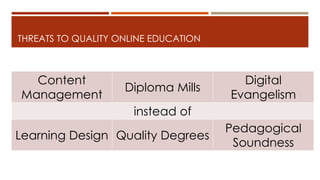
THREATS TO QUALITY ONLINE EDUCATION
Content
Management
Diploma Mills
Digital
Evangelism
instead of
Learning Design Quality Degrees
Pedagogical
Soundness
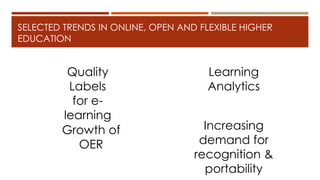
SELECTED TRENDS IN ONLINE, OPEN AND FLEXIBLE HIGHER
EDUCATION
Quality
Labels
for e-
learning
Learning
Analytics
Increasing
demand for
recognition &
portability
Growth of
OER
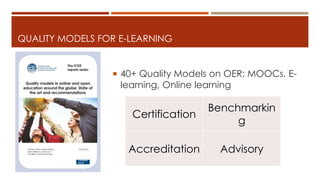
QUALITY MODELS FOR E-LEARNING
 40+ Quality Models on OER; MOOCs, E-
learning, Online learning
Certification
Benchmarkin
g
Accreditation Advisory
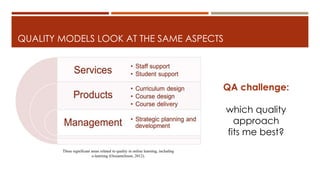
QUALITY MODELS LOOK AT THE SAME ASPECTS
Three significant areas related to quality in online learning, including
e-learning (Ossiannilsson, 2012).
QA challenge:
which quality
approach
fits me best?
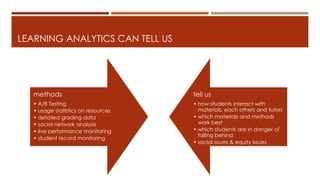
LEARNING ANALYTICS CAN TELL US
methods
• A/B Testing
• usage statistics on resources
• detailed grading data
• social network analysis
• live performance monitoring
• student record monitoring
tell us
• how students interact with
materials, each others and tutors
• which materials and methods
work best
• which students are in danger of
falling behind
• social issues & equity issues
QA-RELATED ISSUES TO CONSIDER
Can we claim a course
to be quality without
data?
How do we define an
expert in the future?
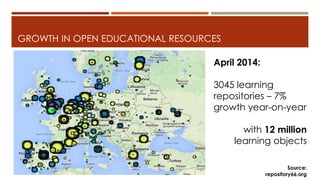
GROWTH IN OPEN EDUCATIONAL RESOURCES
April 2014:
3045 learning
repositories – 7%
growth year-on-year
with 12 million
learning objects
Source:
repository66.org
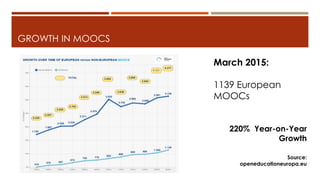
GROWTH IN MOOCS
March 2015:
1139 European
MOOCs
220% Year-on-Year
Growth
Source:
openeducationeuropa.eu
QA-RELATED ISSUES TO CONSIDER
How to adapt teacher
performance metrics to
consider use/re-use of
their resources?
How does open
resources affect
concepts of efficiency?
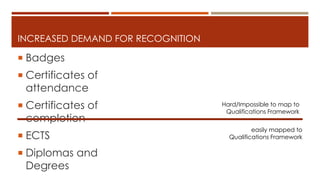
INCREASED DEMAND FOR RECOGNITION
 Badges
 Certificates of
attendance
 Certificates of
completion
 ECTS
 Diplomas and
Degrees
easily mapped to
Qualifications Framework
Hard/Impossible to map to
Qualifications Framework
CHALLENGES FOR QA
Equivalent Quality
across all qualification
types
Quality of the
Qualification itself
(recognition & portability as elements
of quality)
THANK YOU FOR
YOUR ATTENTION
ANTHONY F. CAMILLERI
ANTHONY@KNOWLEDGEINNOVATIONEU
Download this presentation at:
www.slideshare.net/anthonyca
milleri

Quality Assurance of e-Learning: Methodologies and Issues to Consider

  • 1.
    QUALITY ASSURANCE OFE-LEARNING METHODOLOGIES & ISSUES TO CONSIDER ANTHONY F. CAMILLERI – KNOWLEDGE INNOVATION CENTRE ELIXIR WORKSHOP, LJUBLJANA 15/09/2015
  • 2.
    TECHNOLOGICAL TRENDS Ubiquitous Computing accessto computing power any time anywhere Open Data access to any information any time anywhere Learning Analytics ability to base teaching decisions on data Semantic Search ability to talk and converse with machines Collaboration Technologies ability to collaborate with anybody in real-time Personalisation Technologies move away from traditional massification concepts
  • 3.
    SOCIAL CHANGES MEANINCREASED DEMANDS FROM EDUCATION  provide graduates to supply the knowledge economy  increase efficiency of processes  extend reach of programmes  adapt content to ever- changing priorities do more, better, with
  • 4.
    THREATS TO QUALITYONLINE EDUCATION Content Management Diploma Mills Digital Evangelism instead of Learning Design Quality Degrees Pedagogical Soundness
  • 5.
    SELECTED TRENDS INONLINE, OPEN AND FLEXIBLE HIGHER EDUCATION Quality Labels for e- learning Learning Analytics Increasing demand for recognition & portability Growth of OER
  • 6.
    QUALITY MODELS FORE-LEARNING  40+ Quality Models on OER; MOOCs, E- learning, Online learning Certification Benchmarkin g Accreditation Advisory
  • 7.
    QUALITY MODELS LOOKAT THE SAME ASPECTS Three significant areas related to quality in online learning, including e-learning (Ossiannilsson, 2012). QA challenge: which quality approach fits me best?
  • 8.
    LEARNING ANALYTICS CANTELL US methods • A/B Testing • usage statistics on resources • detailed grading data • social network analysis • live performance monitoring • student record monitoring tell us • how students interact with materials, each others and tutors • which materials and methods work best • which students are in danger of falling behind • social issues & equity issues
  • 9.
    QA-RELATED ISSUES TOCONSIDER Can we claim a course to be quality without data? How do we define an expert in the future?
  • 10.
    GROWTH IN OPENEDUCATIONAL RESOURCES April 2014: 3045 learning repositories – 7% growth year-on-year with 12 million learning objects Source: repository66.org
  • 11.
    GROWTH IN MOOCS March2015: 1139 European MOOCs 220% Year-on-Year Growth Source: openeducationeuropa.eu
  • 12.
    QA-RELATED ISSUES TOCONSIDER How to adapt teacher performance metrics to consider use/re-use of their resources? How does open resources affect concepts of efficiency?
  • 13.
    INCREASED DEMAND FORRECOGNITION  Badges  Certificates of attendance  Certificates of completion  ECTS  Diplomas and Degrees easily mapped to Qualifications Framework Hard/Impossible to map to Qualifications Framework
  • 14.
    CHALLENGES FOR QA EquivalentQuality across all qualification types Quality of the Qualification itself (recognition & portability as elements of quality)
  • 15.
    THANK YOU FOR YOURATTENTION ANTHONY F. CAMILLERI ANTHONY@KNOWLEDGEINNOVATIONEU Download this presentation at: www.slideshare.net/anthonyca milleri