Department ofDepartment
                                                 Veterans Affairs   of Veterans Affairs


Best Practices for Team-Based
Assistive Technology
Design Courses
Mary Goldberg, MEd
Education & Outreach Coordinator

Jon Pearlman, PhD
Assistant Professor, RST, SHRS


Department of Rehabilitation Science and Technology
School of Health and Rehabilitation Sciences
Human Engineering Research Laboratories
Department of Veterans Affairs


Outline

• Background & Introduction
• Literature review
• Methods
• Results
• Best Practice Recommendations
Department of Veterans Affairs


Background: Departmental Structure

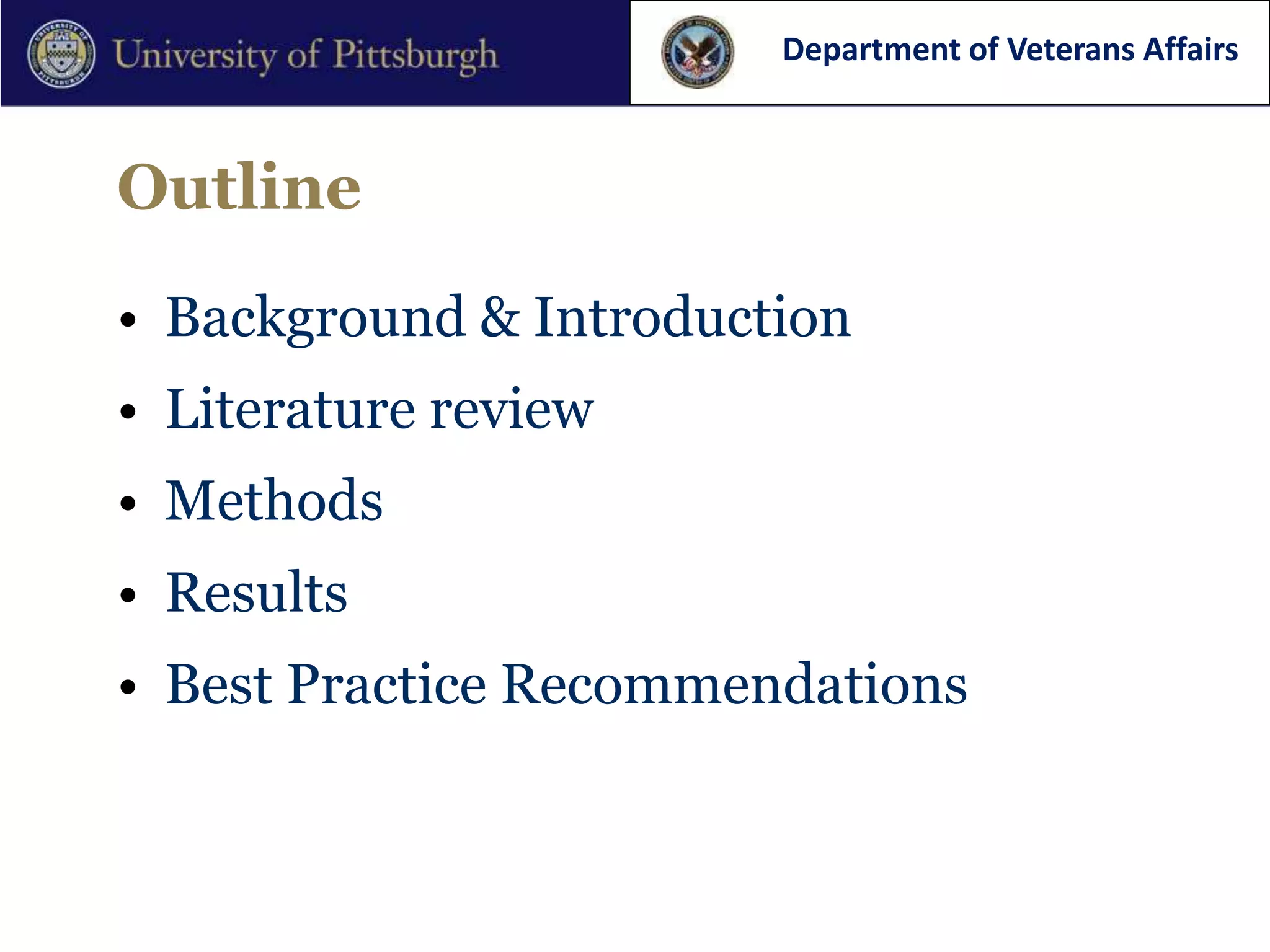
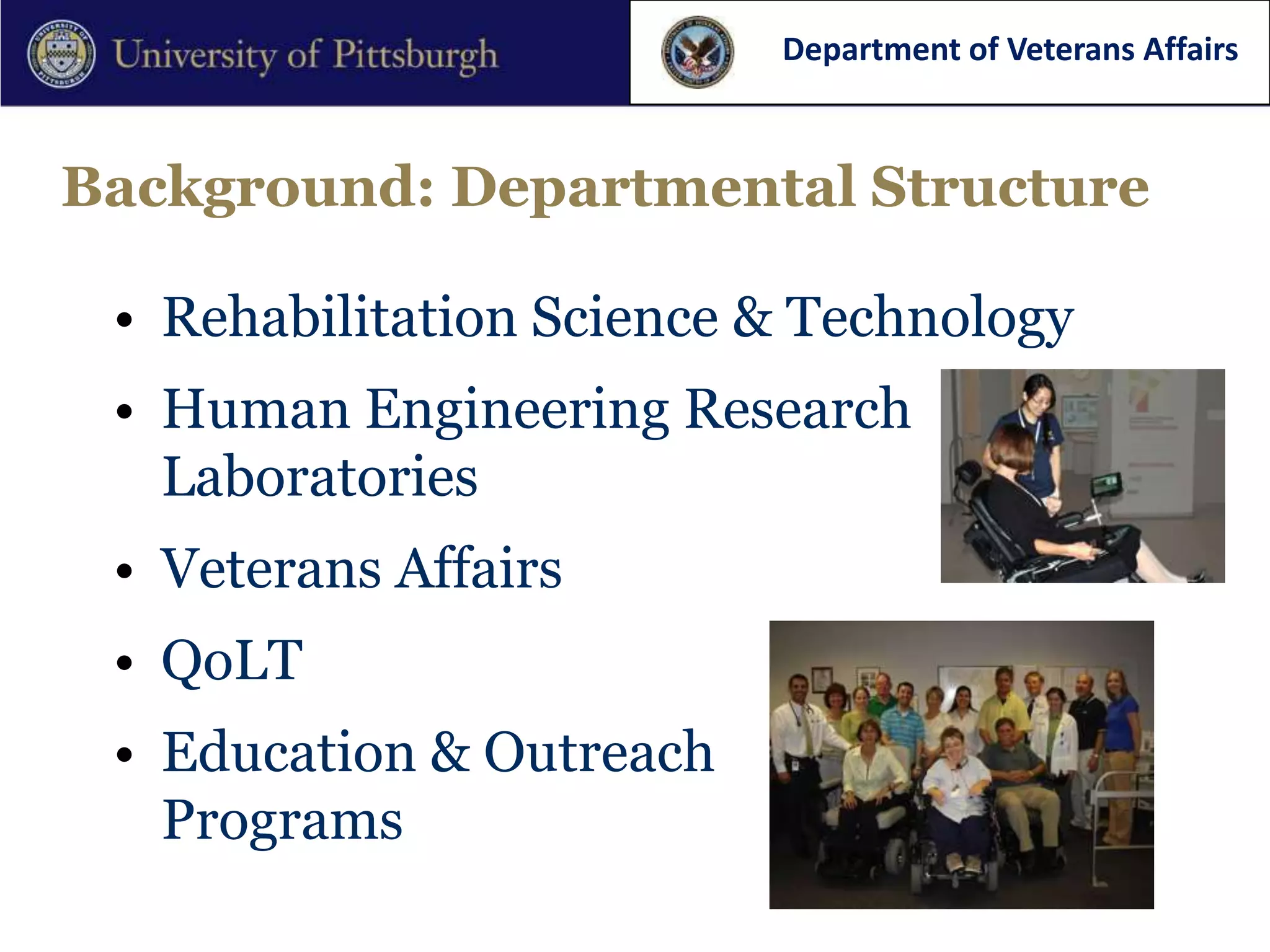
 • Rehabilitation Science & Technology
 • Human Engineering Research
   Laboratories
 • Veterans Affairs
 • QoLT
 • Education & Outreach
   Programs
Department of Veterans Affairs


Background: Product Development Training

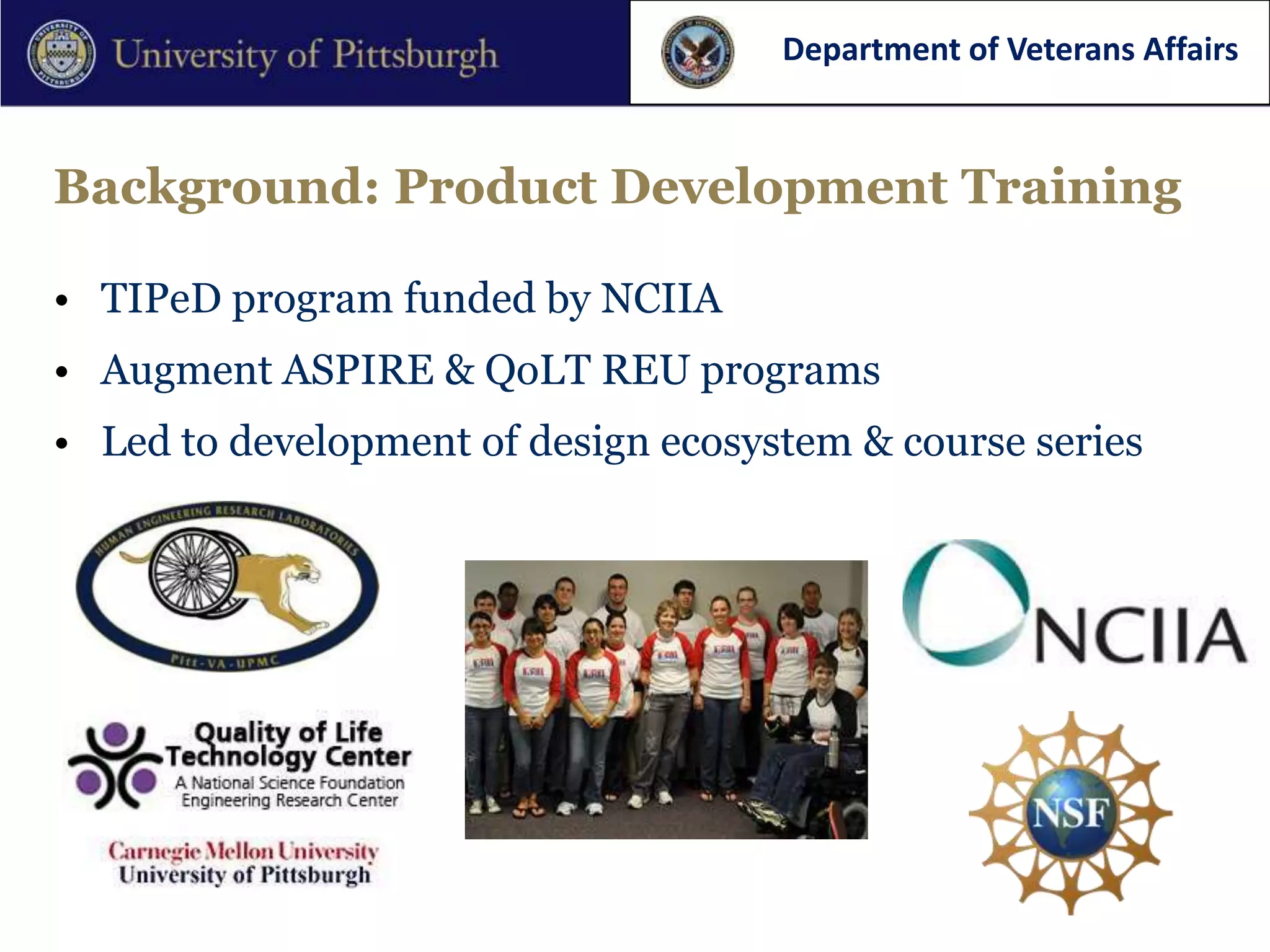
• TIPeD program funded by NCIIA
• Augment ASPIRE & QoLT REU programs
• Led to development of design ecosystem & course series
Department of Veterans Affairs


Background: Design Curricula

          Fall             Spring               Summer


                                           TIPeD-P: [facilitated
                                           in collaboration with
                        TIPeD-C: Rehab         the NSF REU
        TIPeD-C:        Design Project      program] and with
     Fundamentals of                         business and law
     Rehab Design and                             students
       Fabrication


                           FabLab                  RET


         FabLab
                             RET                ELeVATE
Department of Veterans Affairs


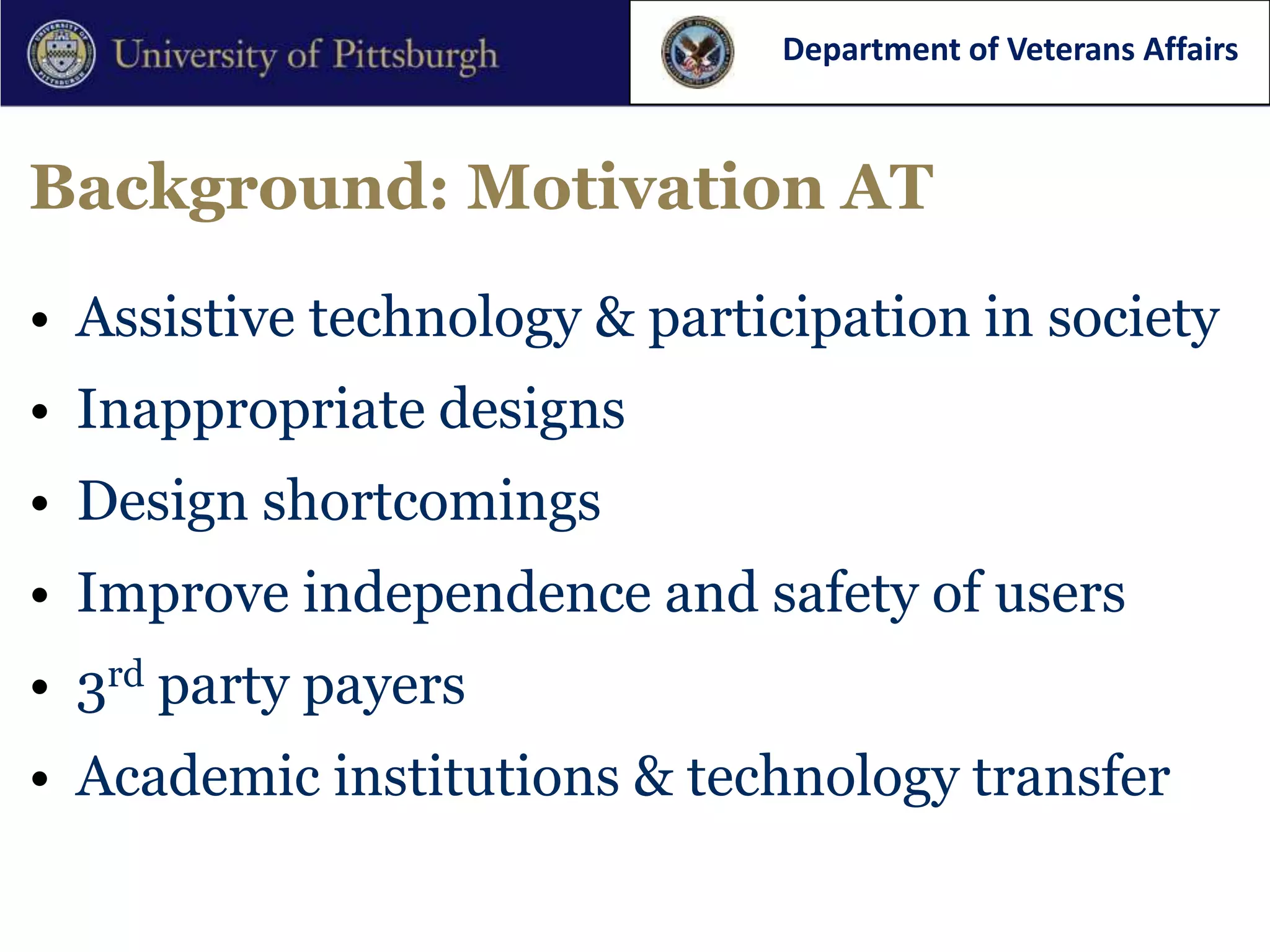
Background: Motivation AT

• Assistive technology & participation in society
• Inappropriate designs
• Design shortcomings
• Improve independence and safety of users
• 3rd party payers
• Academic institutions & technology transfer
Department of Veterans Affairs


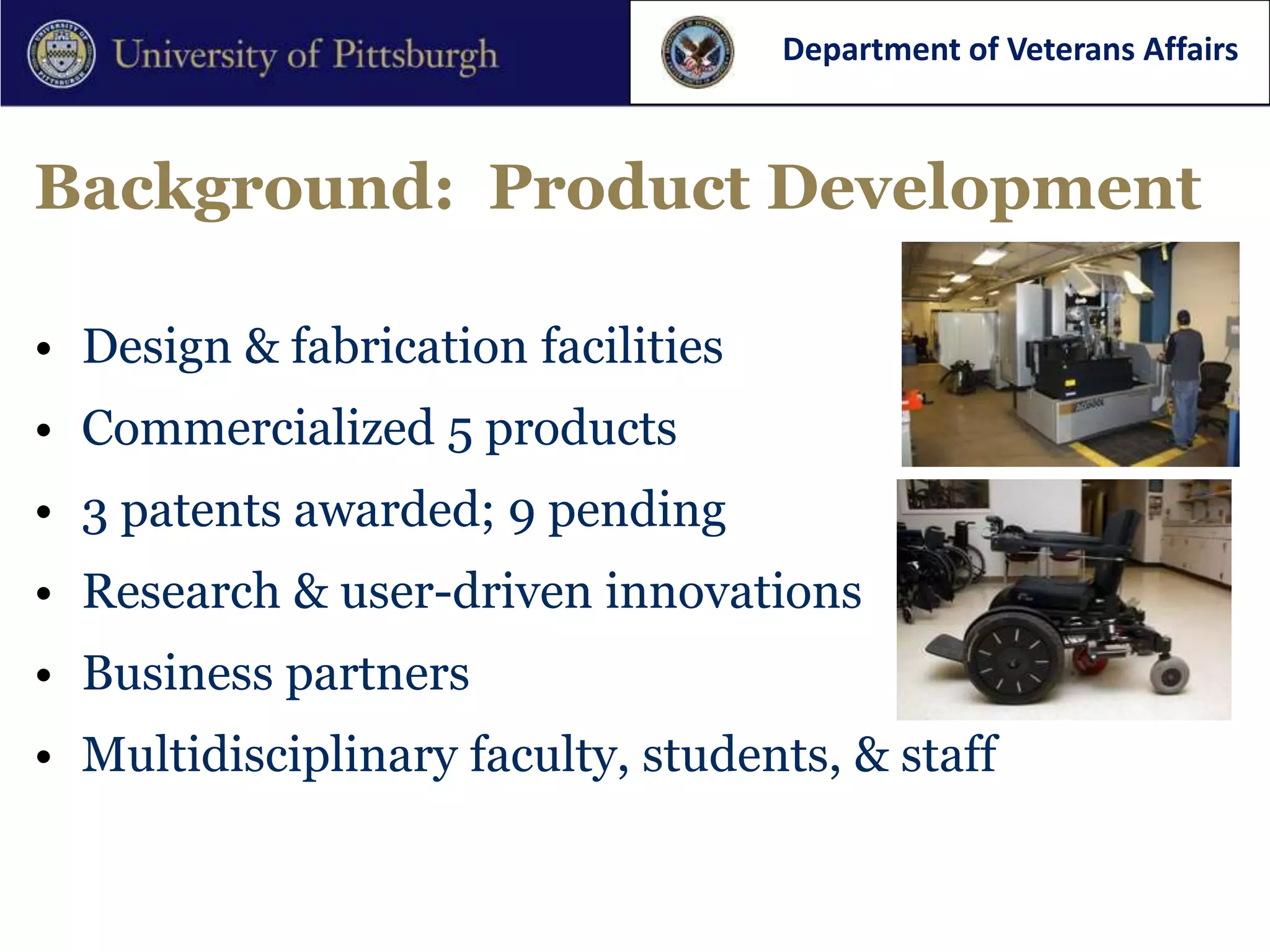
Background: Product Development

• Design & fabrication facilities
• Commercialized 5 products
• 3 patents awarded; 9 pending
• Research & user-driven innovations
• Business partners
• Multidisciplinary faculty, students, & staff
Department of Veterans Affairs


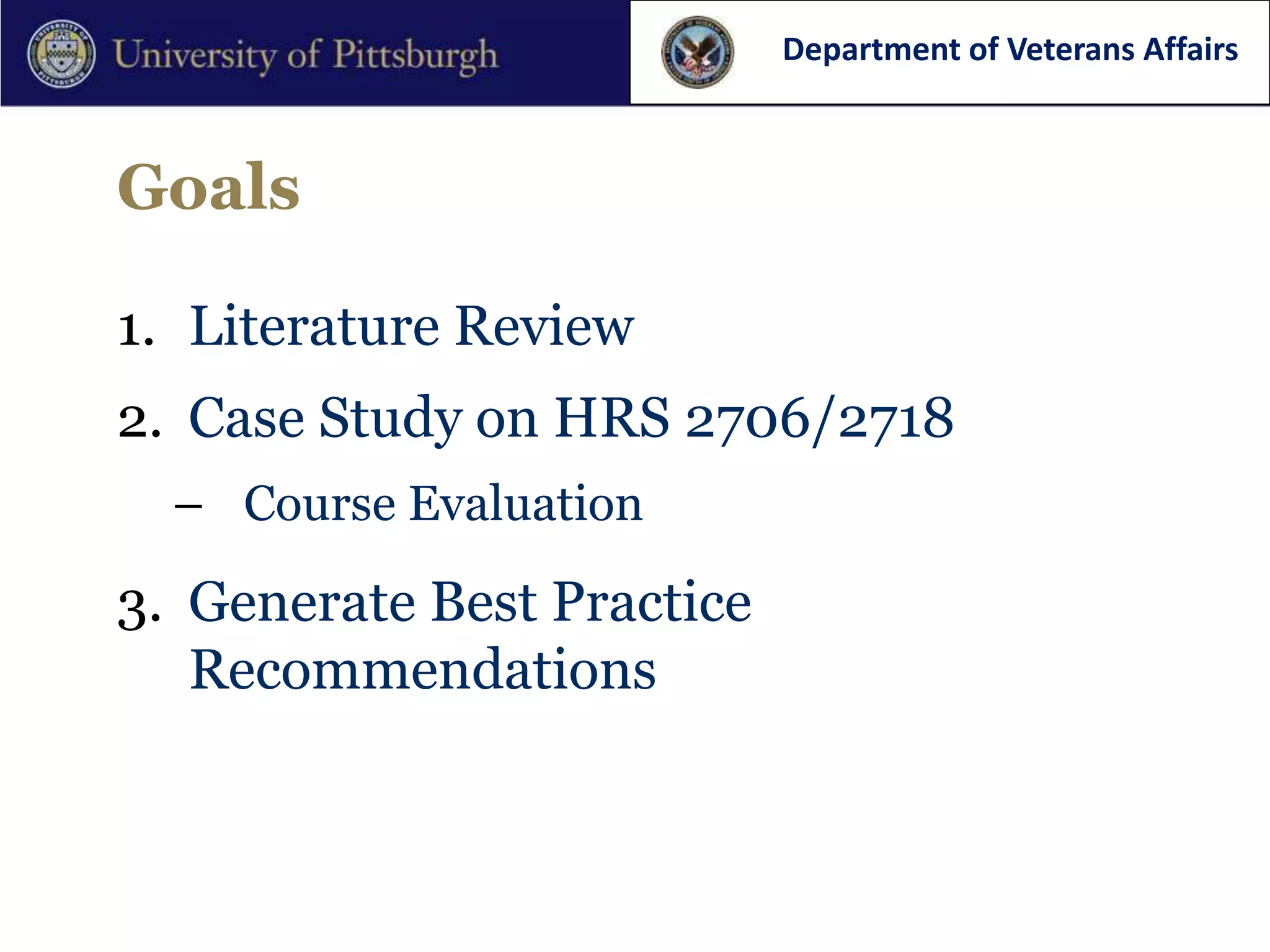
Goals

1. Literature Review
2. Case Study on HRS 2706/2718
  – Course Evaluation

3. Generate Best Practice
   Recommendations
Department of Veterans Affairs


Literature Review: Themes

• Projects
• Process
• Recommendations for Improving the Process
Department of Veterans Affairs


Literature Review: Projects
• Range from low-tech to high-tech24, 26, 21
• Low-tech often focus on international or low-cost products to
  broaden access
• Primary (ADL) to secondary (IADL) to “for fun” (recreational)
  products1, 26
• Client-based (individual & group)
• Promote collaborations while benefitting local use3
• Persons with disabilities as clients
    – Demonstrate inequities & lack of resources4

    – Consider additional needs & universal design18
Department of Veterans Affairs


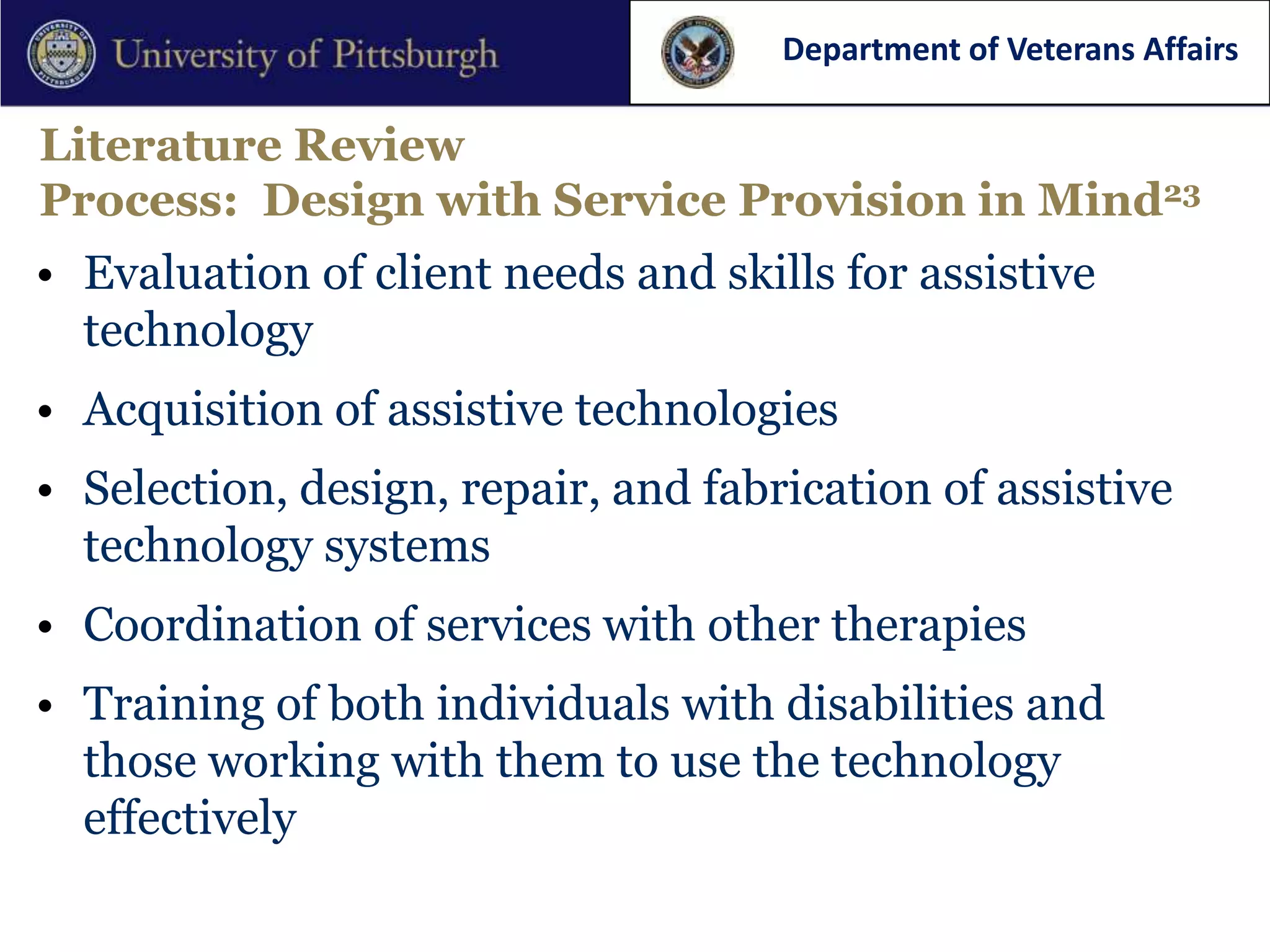
Literature Review: Process
• Students uncomfortable with lack of instruction4
• Products meeting users’ needs as correct solution
• Profession-specific language1
  – Process-oriented vs. solution-oriented
  – Engagement in process vs. didactic learning


                                     Ulrich & Eppinger, 2011
Department of Veterans Affairs

Literature Review
Process: Design with Service Provision in Mind23
• Evaluation of client needs and skills for assistive
  technology
• Acquisition of assistive technologies
• Selection, design, repair, and fabrication of assistive
  technology systems
• Coordination of services with other therapies
• Training of both individuals with disabilities and
  those working with them to use the technology
  effectively
Department of Veterans Affairs


Case Study of HRS 2706/2718
• Pre/post survey
  – Mixed methods including 7 short answer & 2 Likert
    series related to design, rehabilitation, and career
    perceptions & skills

• MBTI
  – Used to identify team roles

• Mid-Point interviews with all students
• Ethnographic observations by co-instructor in-
  person and online
Department of Veterans Affairs

Course Overview: Learning Objectives
• Be able to
   – Execute needs assessment for a client;

   – Develop product concepts;

   – Convert product concepts and specifications into a prototype;

   – Perform concept refinement & selection to system & detail design
     (emphasizing participatory action design through all phases);

   – Develop a prototyping and testing plan;

   – Fabricate and test the prototype;

   – Interact with a client in a professional capacity as rehabilitation engineer

   – Investigate IP considerations and methods of technology transfer.
Department of Veterans Affairs


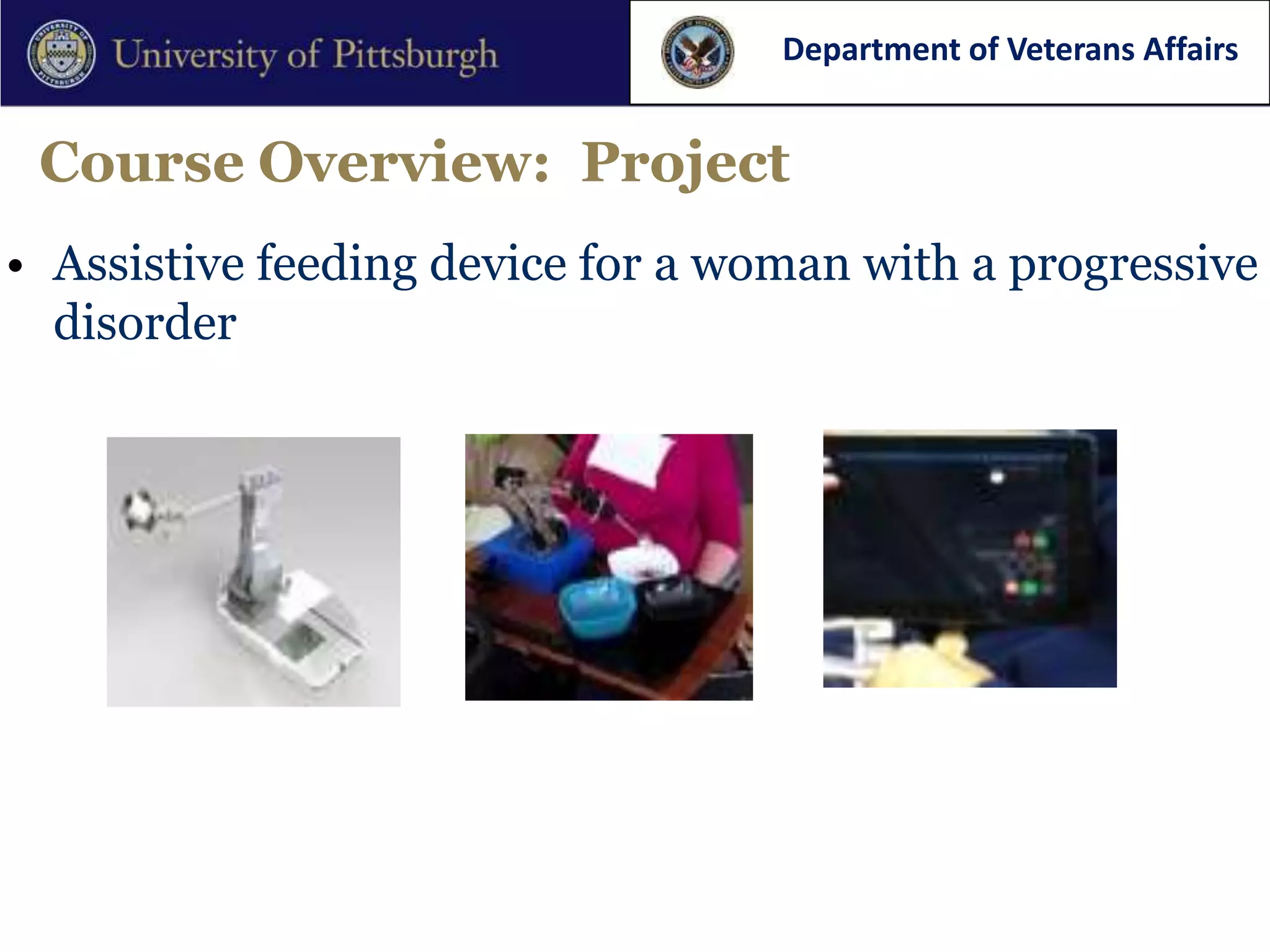
 Course Overview: Project
• Assistive feeding device for a woman with a progressive
  disorder
Department of Veterans Affairs


Quantitative Results (n=7)
• Significant increase (p=0.03, M=.571, SD=.535) in students’
  identification and comfort with his/her individual team role
• Nearly significant increase pre/post class
   – In self-assessment on confidence in various skills (p=0.07, M=.258 , SD=.31)

   – In knowledge of commercially available assistive technology (p=0.07, M=.429,
     SD=.787)

   – In confidence in design skills (p=0.07, M=.429 , SD=.535)

• Nearly significant Relationship between gender and scores (p=.07,
  M=.144, SD=.929)
Department of Veterans Affairs


Example Qualitative Results
• Before: “I think I am learning a lot of things, that will allow me to
  succeed in the field. Perhaps I will need to have more real world
  experience with clients, and also learn more technical things,
  (Electronics, Programing, design software) to feel more confident in
  applying technology to rehabilitation.”


• After: “I feel I am part of the community. It gives me satisfaction that my
  designs could someday help a lot of individuals in ways that a consumer
  device rarely does. I am committed to the field and would like to see it
  grow further and increase the involvement of end users in the design
  process.”
Department of Veterans Affairs


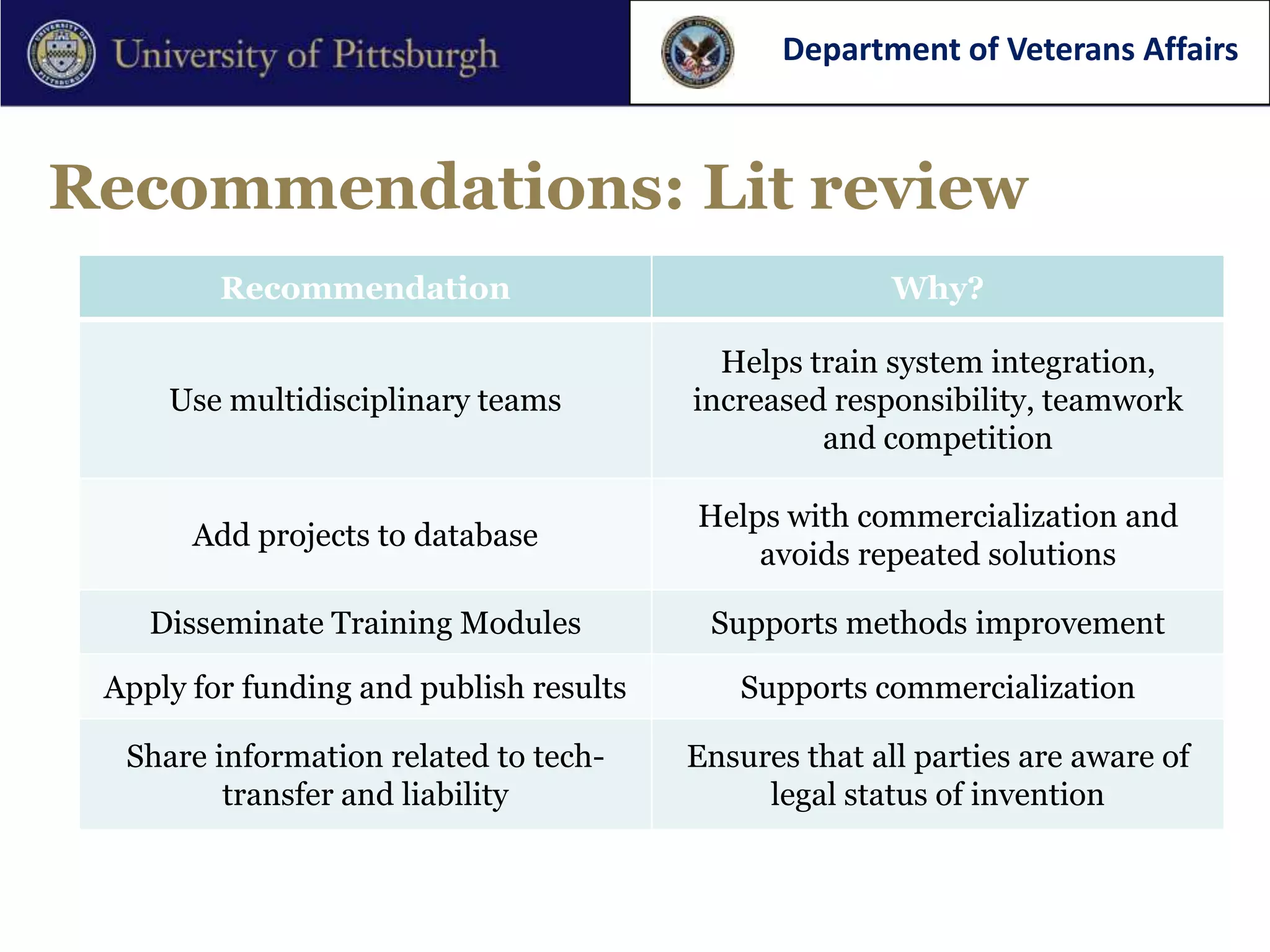
Recommendations: Lit review
         Recommendation                                 Why?

                                           Helps train system integration,
     Use multidisciplinary teams         increased responsibility, teamwork
                                                  and competition

                                         Helps with commercialization and
       Add projects to database
                                             avoids repeated solutions

    Disseminate Training Modules          Supports methods improvement

 Apply for funding and publish results      Supports commercialization

  Share information related to tech-     Ensures that all parties are aware of
         transfer and liability               legal status of invention
Department of Veterans Affairs


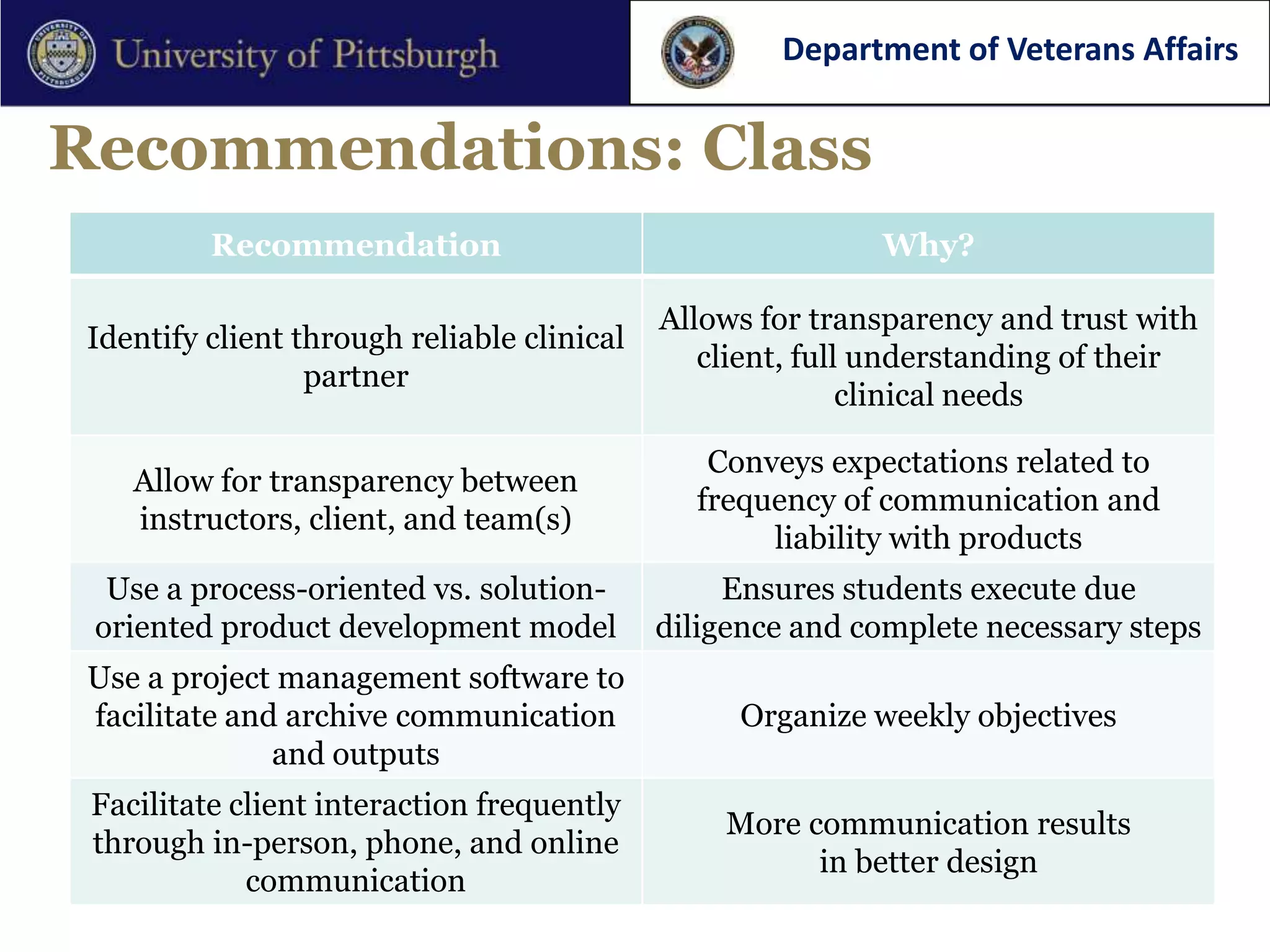
Recommendations: Class
          Recommendation                                    Why?

                                             Allows for transparency and trust with
 Identify client through reliable clinical
                                                client, full understanding of their
                  partner
                                                            clinical needs

                                                Conveys expectations related to
    Allow for transparency between
                                               frequency of communication and
    instructors, client, and team(s)
                                                    liability with products
  Use a process-oriented vs. solution-            Ensures students execute due
 oriented product development model          diligence and complete necessary steps
 Use a project management software to
 facilitate and archive communication             Organize weekly objectives
               and outputs
 Facilitate client interaction frequently
                                                 More communication results
 through in-person, phone, and online
                                                       in better design
             communication
Department of Veterans Affairs


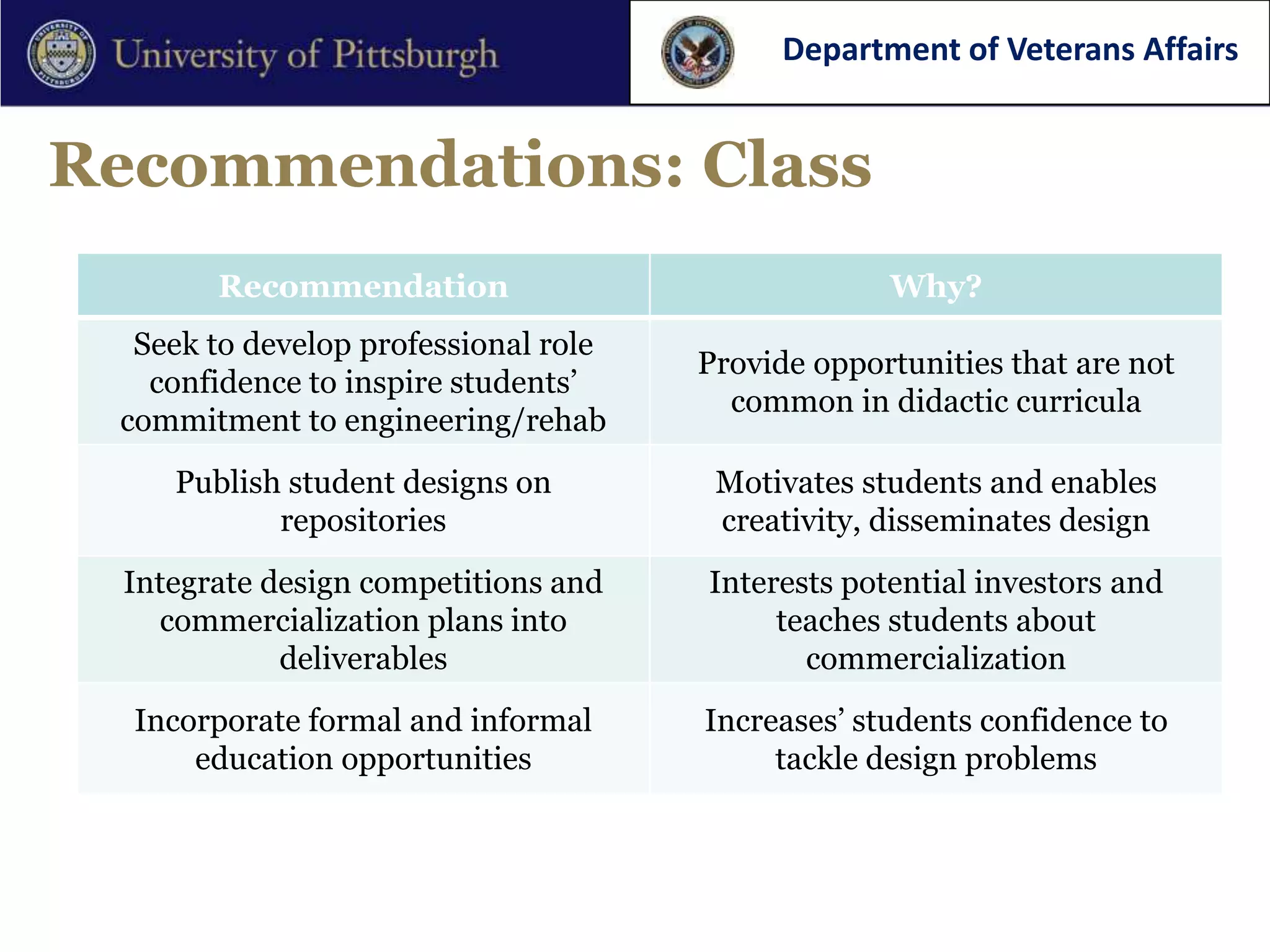
Recommendations: Class
        Recommendation                             Why?
  Seek to develop professional role
                                      Provide opportunities that are not
   confidence to inspire students’
                                        common in didactic curricula
 commitment to engineering/rehab
     Publish student designs on        Motivates students and enables
            repositories               creativity, disseminates design
  Integrate design competitions and   Interests potential investors and
    commercialization plans into           teaches students about
             deliverables                    commercialization
  Incorporate formal and informal     Increases’ students confidence to
      education opportunities              tackle design problems
Department of Veterans Affairs


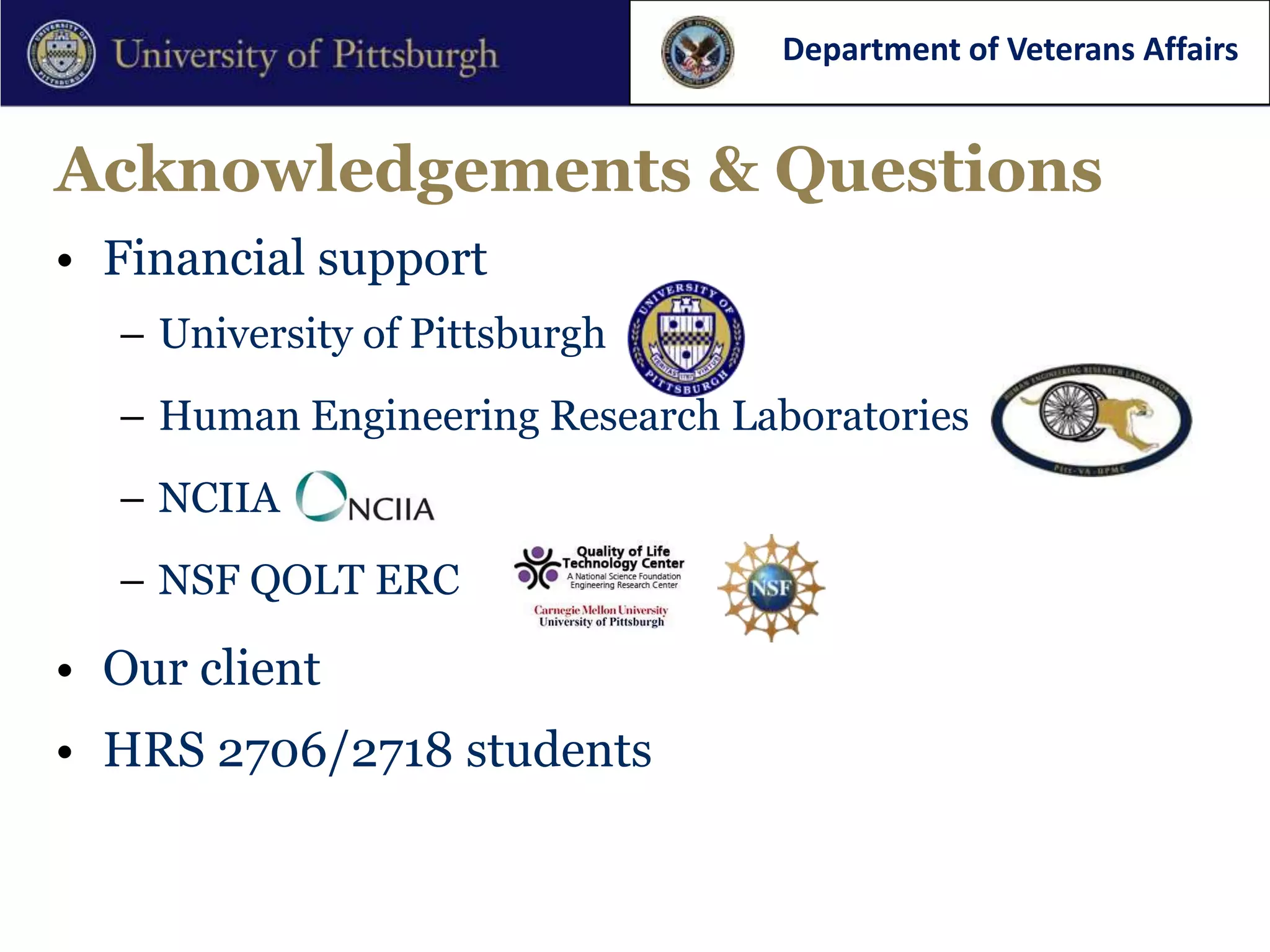
Acknowledgements & Questions
• Financial support
  – University of Pittsburgh
  – Human Engineering Research Laboratories
  – NCIIA
  – NSF QOLT ERC

• Our client
• HRS 2706/2718 students

Open 2013: Best Practices for Assistive Technology Design Classes and Their Products

  • 1.
    Department ofDepartment Veterans Affairs of Veterans Affairs Best Practices for Team-Based Assistive Technology Design Courses Mary Goldberg, MEd Education & Outreach Coordinator Jon Pearlman, PhD Assistant Professor, RST, SHRS Department of Rehabilitation Science and Technology School of Health and Rehabilitation Sciences Human Engineering Research Laboratories
  • 2.
    Department of VeteransAffairs Outline • Background & Introduction • Literature review • Methods • Results • Best Practice Recommendations
  • 3.
    Department of VeteransAffairs Background: Departmental Structure • Rehabilitation Science & Technology • Human Engineering Research Laboratories • Veterans Affairs • QoLT • Education & Outreach Programs
  • 4.
    Department of VeteransAffairs Background: Product Development Training • TIPeD program funded by NCIIA • Augment ASPIRE & QoLT REU programs • Led to development of design ecosystem & course series
  • 5.
    Department of VeteransAffairs Background: Design Curricula Fall Spring Summer TIPeD-P: [facilitated in collaboration with TIPeD-C: Rehab the NSF REU TIPeD-C: Design Project program] and with Fundamentals of business and law Rehab Design and students Fabrication FabLab RET FabLab RET ELeVATE
  • 6.
    Department of VeteransAffairs Background: Motivation AT • Assistive technology & participation in society • Inappropriate designs • Design shortcomings • Improve independence and safety of users • 3rd party payers • Academic institutions & technology transfer
  • 7.
    Department of VeteransAffairs Background: Product Development • Design & fabrication facilities • Commercialized 5 products • 3 patents awarded; 9 pending • Research & user-driven innovations • Business partners • Multidisciplinary faculty, students, & staff
  • 8.
    Department of VeteransAffairs Goals 1. Literature Review 2. Case Study on HRS 2706/2718 – Course Evaluation 3. Generate Best Practice Recommendations
  • 9.
    Department of VeteransAffairs Literature Review: Themes • Projects • Process • Recommendations for Improving the Process
  • 10.
    Department of VeteransAffairs Literature Review: Projects • Range from low-tech to high-tech24, 26, 21 • Low-tech often focus on international or low-cost products to broaden access • Primary (ADL) to secondary (IADL) to “for fun” (recreational) products1, 26 • Client-based (individual & group) • Promote collaborations while benefitting local use3 • Persons with disabilities as clients – Demonstrate inequities & lack of resources4 – Consider additional needs & universal design18
  • 11.
    Department of VeteransAffairs Literature Review: Process • Students uncomfortable with lack of instruction4 • Products meeting users’ needs as correct solution • Profession-specific language1 – Process-oriented vs. solution-oriented – Engagement in process vs. didactic learning Ulrich & Eppinger, 2011
  • 12.
    Department of VeteransAffairs Literature Review Process: Design with Service Provision in Mind23 • Evaluation of client needs and skills for assistive technology • Acquisition of assistive technologies • Selection, design, repair, and fabrication of assistive technology systems • Coordination of services with other therapies • Training of both individuals with disabilities and those working with them to use the technology effectively
  • 13.
    Department of VeteransAffairs Case Study of HRS 2706/2718 • Pre/post survey – Mixed methods including 7 short answer & 2 Likert series related to design, rehabilitation, and career perceptions & skills • MBTI – Used to identify team roles • Mid-Point interviews with all students • Ethnographic observations by co-instructor in- person and online
  • 14.
    Department of VeteransAffairs Course Overview: Learning Objectives • Be able to – Execute needs assessment for a client; – Develop product concepts; – Convert product concepts and specifications into a prototype; – Perform concept refinement & selection to system & detail design (emphasizing participatory action design through all phases); – Develop a prototyping and testing plan; – Fabricate and test the prototype; – Interact with a client in a professional capacity as rehabilitation engineer – Investigate IP considerations and methods of technology transfer.
  • 15.
    Department of VeteransAffairs Course Overview: Project • Assistive feeding device for a woman with a progressive disorder
  • 16.
    Department of VeteransAffairs Quantitative Results (n=7) • Significant increase (p=0.03, M=.571, SD=.535) in students’ identification and comfort with his/her individual team role • Nearly significant increase pre/post class – In self-assessment on confidence in various skills (p=0.07, M=.258 , SD=.31) – In knowledge of commercially available assistive technology (p=0.07, M=.429, SD=.787) – In confidence in design skills (p=0.07, M=.429 , SD=.535) • Nearly significant Relationship between gender and scores (p=.07, M=.144, SD=.929)
  • 17.
    Department of VeteransAffairs Example Qualitative Results • Before: “I think I am learning a lot of things, that will allow me to succeed in the field. Perhaps I will need to have more real world experience with clients, and also learn more technical things, (Electronics, Programing, design software) to feel more confident in applying technology to rehabilitation.” • After: “I feel I am part of the community. It gives me satisfaction that my designs could someday help a lot of individuals in ways that a consumer device rarely does. I am committed to the field and would like to see it grow further and increase the involvement of end users in the design process.”
  • 18.
    Department of VeteransAffairs Recommendations: Lit review Recommendation Why? Helps train system integration, Use multidisciplinary teams increased responsibility, teamwork and competition Helps with commercialization and Add projects to database avoids repeated solutions Disseminate Training Modules Supports methods improvement Apply for funding and publish results Supports commercialization Share information related to tech- Ensures that all parties are aware of transfer and liability legal status of invention
  • 19.
    Department of VeteransAffairs Recommendations: Class Recommendation Why? Allows for transparency and trust with Identify client through reliable clinical client, full understanding of their partner clinical needs Conveys expectations related to Allow for transparency between frequency of communication and instructors, client, and team(s) liability with products Use a process-oriented vs. solution- Ensures students execute due oriented product development model diligence and complete necessary steps Use a project management software to facilitate and archive communication Organize weekly objectives and outputs Facilitate client interaction frequently More communication results through in-person, phone, and online in better design communication
  • 20.
    Department of VeteransAffairs Recommendations: Class Recommendation Why? Seek to develop professional role Provide opportunities that are not confidence to inspire students’ common in didactic curricula commitment to engineering/rehab Publish student designs on Motivates students and enables repositories creativity, disseminates design Integrate design competitions and Interests potential investors and commercialization plans into teaches students about deliverables commercialization Incorporate formal and informal Increases’ students confidence to education opportunities tackle design problems
  • 21.
    Department of VeteransAffairs Acknowledgements & Questions • Financial support – University of Pittsburgh – Human Engineering Research Laboratories – NCIIA – NSF QOLT ERC • Our client • HRS 2706/2718 students

Editor's Notes

  • #4 40k sqft lab space with 15k machining & fabrication facilities VA CoENSF ERCE&O mission
  • #5 Purpose of creating impactful technologies for PWDs & spinning them out to market via SBIR programs and resultant companiesASPIRE & QoLT REU programs support ~25 students/summer
  • #6 Expansion plans1. Expansion of curriculum, 2.funding to support development of materials, 3. visits to int’l partnrs
  • #7 PWDs unemployment rate higher than able-bodied individualsDisabled veterans from the current conflict higher unemployment rate as wellAT can be the gateway to a person’s involvement in society Tech that does make it to the market is often inappropriate for certain conditoins (scooters)..a need for reimbursable, low-cost but effective technologies
  • #8 All major (reputable)AT manufacturersHinted at throughout-this idea of multidisciplinary team
  • #9 2-3 rehabilitation engineering and assistive technology design courses annually for nearly 20 years, accumulating approximately 60 teams and projects and 300 students.
  • #17 Repeated measures t-tests