



Teaching Innovation Using
Multidisciplinary Collaboration


                     Darrell Kleinke, PhD, PE - Engineering
              Molly McClelland, R.N., M.S.N, PhD – Nursing
Mission, Design & Overview

INTRODUCTION
UDM Mission
The University of Detroit Mercy, a Catholic
university in the Jesuit and Mercy
traditions, exists to provide excellent
student-centered undergraduate and
graduate education in an urban context. A
UDM education seeks to integrate the
intellectual, spiritual, ethical and social
development of our students.
Interdisciplinary Collaboration
• Interdisciplinary collaboration in higher
  education has the potential to create fertile
  grounds for learning beyond that of a single
  discipline approach.

• Current literature suggests collaboration across
  disciplines stimulates reflection, leads to
  increased awareness of one’s own
  perspective, facilitates dialogue, and creates a
  common ground for both the students and
  faculty
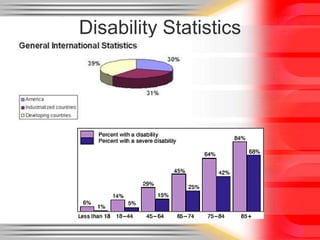
Disability Statistics
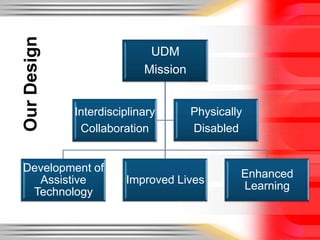
Our Design
                            UDM
                           Mission


             Interdisciplinary       Physically
              Collaboration          Disabled


Development of
                                              Enhanced
  Assistive            Improved Lives
                                              Learning
 Technology
ME 493 & NUR 498

THE PROCESS
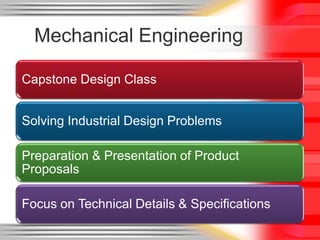
Mechanical Engineering

Capstone Design Class


Solving Industrial Design Problems

Preparation & Presentation of Product
Proposals

Focus on Technical Details & Specifications
Engineering Course Objectives
Recognize societal or business needs and properly formulate the
corresponding problem.

Conduct literature, patent and standards search to establish the state of the
art of a design problem.

Carry out and apply the design process beginning from a recognized need
and ending in a final and complete design.

Separate complex systems into major components and then apply the design
process and mathematical modeling on each subsystem.

Use state of the art computer software to conduct virtual prototyping.


Work in diverse teams consisting of students, faculty and industry sponsors.


Professionally communicate and present ideas, concepts and design details.
Nursing Course Objectives
Partake in the process of product development as a health consultant.

Educate team members on the health related effects of client’s
physical disabilities.

Examine the product at all stages for safety and health promotion.

Collaborate with interdisciplinary students and faculty throughout the
design process.

Facilitate interaction between the client and other team members
especially pertaining to health related issues.

Provide health related expertise throughout all steps of product design
and implementation.
Improving right-sided hemiparesis

EXAMPLE OF PROCESS
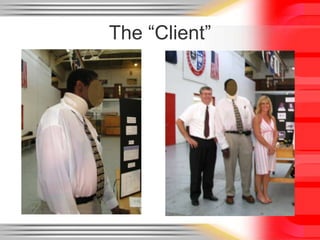
The “Client”
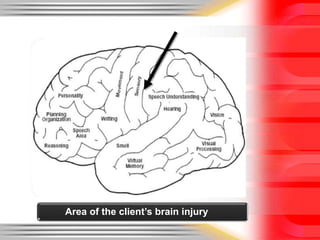
Area of the client’s brain injury
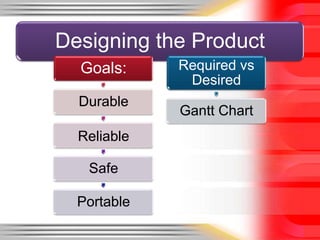
Designing the Product
  Goals:     Required vs
              Desired
  Durable
             Gantt Chart
  Reliable

   Safe

  Portable
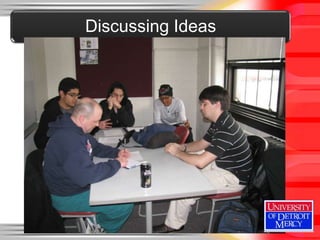
Discussing Ideas
Problem Statement

• Client ------ from Michigan Rehabilitation
  Services is experiencing difficulties in
  obtaining employment due to reduced
  functionality of his right arm.
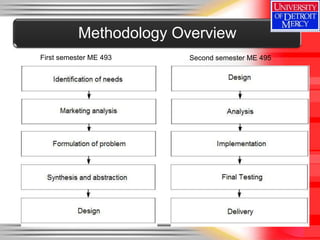
Methodology Overview
First semester ME 493    Second semester ME 495
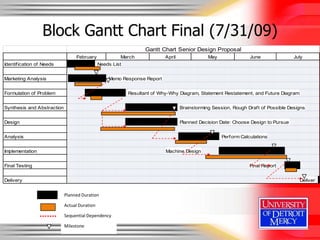
Block Gantt Chart Final (7/31/09)
                                                                  Gantt Chart Senior Design Proposal
                                 February              March              April               May               June               July
Identification of Needs                       Needs List


Marketing Analysis                                Memo Response Report


Formulation of Problem                                     Resultant of Why-Why Diagram, Statement Restatement, and Future Diagram


Synthesis and Abstraction                                                         Brainstorming Session, Rough Draft of Possible Designs


Design                                                                            Planned Decision Date: Choose Design to Pursue


Analysis                                                                                            Perform Calculations


Implementation                                                            Machine Design


Final Testing                                                                                                   Final Report


Delivery                                                                                                                             Deliver


                            Planned Duration

                            Actual Duration

                            Sequential Dependency

                            Milestone
Discussing Ideas with Client
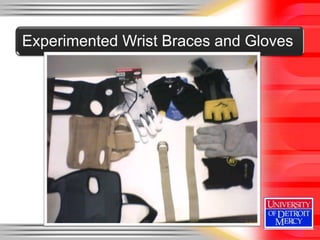
Experimented Wrist Braces and Gloves
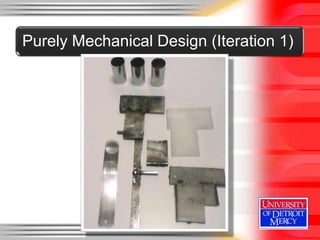
Purely Mechanical Design (Iteration 1)
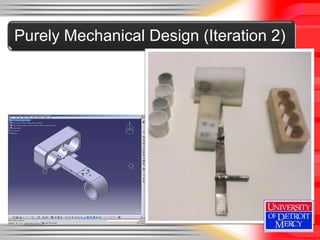
Purely Mechanical Design (Iteration 2)
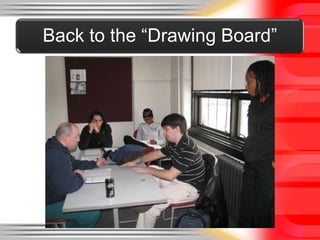
Back to the “Drawing Board”
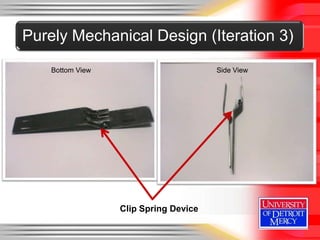
Purely Mechanical Design (Iteration 3)
    Bottom View                        Side View


                  Clip Spring Device
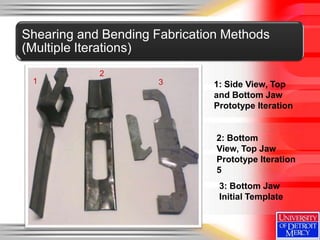
Shearing and Bending Fabrication Methods
(Multiple Iterations)
            2
 1                    3       1: Side View, Top
                              and Bottom Jaw
                              Prototype Iteration


                               2: Bottom
                               View, Top Jaw
                               Prototype Iteration
                               5
                               3: Bottom Jaw
                               Initial Template
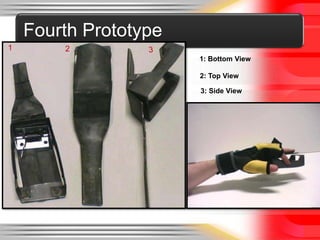
Fourth Prototype
1       2         3
                       1: Bottom View

                       2: Top View

                       3: Side View
OTHER PROJECTS
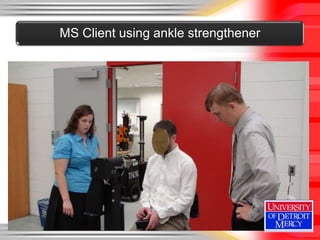
MS Client using ankle strengthener
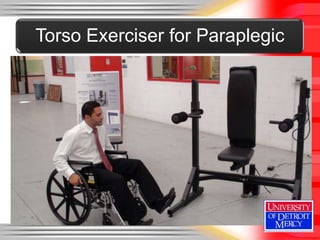
Torso Exerciser for Paraplegic
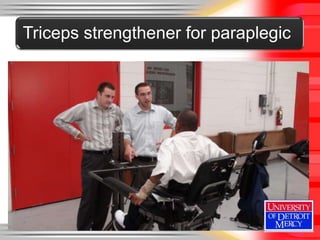
Triceps strengthener for paraplegic
Additional Projects for the Disabled

Cribs for wheelchair bound mothers

Baby carriers for Mom’s in wheelchairs

Walkers with built in lifts to assist with falls

Motorized attachments for wheelchairs
LIMITATIONS & LESSONS
Limitations
• Ambiguous student expectations between
  disciplines.

• Scheduling student meetings between
  disciplines.

• Different student outcomes/objectives
  between disciplines.
Benefits
• Learning collaboration skills across
  disciplines
• Working in teams to assist physically
  disabled people.
• Client & Student satisfaction.
• Physically disabled people gaining helpful
  assistive devices to improve their lives.
Feel free to contact us with additional questions
regarding Multidisciplinary Education.

Darrell Kleinke - kleinked@udmercy.edu
Molly McClelland - mcclelml@udmercy.edu


QUESTIONS?
References
Census Bureau, U.S., Michigan. Census 2000 Summary File 3. . 2000.
http://factfinder.census.gov/servlet/QTTable?_bm=y&-geo_id=04000US26&-
qr_name=DEC_2000_SF3_U_DP2&-ds_name=DEC_2000_SF3_U&redoLog=false


Holley, Karri. 2009. The challenge of an interdisciplinary curriculum: a cultural
analysis of a doctoral-degree program in neuroscience. Higher
Education, 58(2):241-255.

Kijima, Kyoichi Jim. 2008. Guest editorial. Systems Research and Behavioral
Science, 25(5): 583-586.

Öberg, Gunilla. 2009. Facilitating interdisciplinary work: using quality assessment
to create common ground." Higher Education, 57(4):405-415.

Wright, Geoffrey, Skaggs, Paul, Fry, Richard and Phelps, Richard. 2009.
Increasing the Innovation Ability and Aptitude of Technology and Engineering
Students Through Focused Collaborative, Cross-disciplinary Design Thinking
Boot Camps. Proceedings of the ASEE Annual, Austin, TX.
The End


          University of Detroit Mercy

Open2012 teaching-innovation-multidisciplinary-collaboration

  • 1.
    Teaching Innovation Using MultidisciplinaryCollaboration Darrell Kleinke, PhD, PE - Engineering Molly McClelland, R.N., M.S.N, PhD – Nursing
  • 2.
    Mission, Design &Overview INTRODUCTION
  • 4.
    UDM Mission The Universityof Detroit Mercy, a Catholic university in the Jesuit and Mercy traditions, exists to provide excellent student-centered undergraduate and graduate education in an urban context. A UDM education seeks to integrate the intellectual, spiritual, ethical and social development of our students.
  • 5.
    Interdisciplinary Collaboration • Interdisciplinarycollaboration in higher education has the potential to create fertile grounds for learning beyond that of a single discipline approach. • Current literature suggests collaboration across disciplines stimulates reflection, leads to increased awareness of one’s own perspective, facilitates dialogue, and creates a common ground for both the students and faculty
  • 6.
  • 7.
    Our Design UDM Mission Interdisciplinary Physically Collaboration Disabled Development of Enhanced Assistive Improved Lives Learning Technology
  • 8.
    ME 493 &NUR 498 THE PROCESS
  • 9.
    Mechanical Engineering Capstone DesignClass Solving Industrial Design Problems Preparation & Presentation of Product Proposals Focus on Technical Details & Specifications
  • 10.
    Engineering Course Objectives Recognizesocietal or business needs and properly formulate the corresponding problem. Conduct literature, patent and standards search to establish the state of the art of a design problem. Carry out and apply the design process beginning from a recognized need and ending in a final and complete design. Separate complex systems into major components and then apply the design process and mathematical modeling on each subsystem. Use state of the art computer software to conduct virtual prototyping. Work in diverse teams consisting of students, faculty and industry sponsors. Professionally communicate and present ideas, concepts and design details.
  • 11.
    Nursing Course Objectives Partakein the process of product development as a health consultant. Educate team members on the health related effects of client’s physical disabilities. Examine the product at all stages for safety and health promotion. Collaborate with interdisciplinary students and faculty throughout the design process. Facilitate interaction between the client and other team members especially pertaining to health related issues. Provide health related expertise throughout all steps of product design and implementation.
  • 12.
  • 13.
  • 14.
    Area of theclient’s brain injury
  • 15.
    Designing the Product Goals: Required vs Desired Durable Gantt Chart Reliable Safe Portable
  • 16.
  • 17.
    Problem Statement • Client------ from Michigan Rehabilitation Services is experiencing difficulties in obtaining employment due to reduced functionality of his right arm.
  • 18.
    Methodology Overview First semesterME 493 Second semester ME 495
  • 19.
    Block Gantt ChartFinal (7/31/09) Gantt Chart Senior Design Proposal February March April May June July Identification of Needs Needs List Marketing Analysis Memo Response Report Formulation of Problem Resultant of Why-Why Diagram, Statement Restatement, and Future Diagram Synthesis and Abstraction Brainstorming Session, Rough Draft of Possible Designs Design Planned Decision Date: Choose Design to Pursue Analysis Perform Calculations Implementation Machine Design Final Testing Final Report Delivery Deliver Planned Duration Actual Duration Sequential Dependency Milestone
  • 20.
  • 21.
  • 22.
  • 23.
  • 24.
    Back to the“Drawing Board”
  • 25.
    Purely Mechanical Design(Iteration 3) Bottom View Side View Clip Spring Device
  • 26.
    Shearing and BendingFabrication Methods (Multiple Iterations) 2 1 3 1: Side View, Top and Bottom Jaw Prototype Iteration 2: Bottom View, Top Jaw Prototype Iteration 5 3: Bottom Jaw Initial Template
  • 27.
    Fourth Prototype 1 2 3 1: Bottom View 2: Top View 3: Side View
  • 28.
  • 29.
    MS Client usingankle strengthener
  • 30.
  • 31.
  • 32.
    Additional Projects forthe Disabled Cribs for wheelchair bound mothers Baby carriers for Mom’s in wheelchairs Walkers with built in lifts to assist with falls Motorized attachments for wheelchairs
  • 33.
  • 34.
    Limitations • Ambiguous studentexpectations between disciplines. • Scheduling student meetings between disciplines. • Different student outcomes/objectives between disciplines.
  • 35.
    Benefits • Learning collaborationskills across disciplines • Working in teams to assist physically disabled people. • Client & Student satisfaction. • Physically disabled people gaining helpful assistive devices to improve their lives.
  • 36.
    Feel free tocontact us with additional questions regarding Multidisciplinary Education. Darrell Kleinke - kleinked@udmercy.edu Molly McClelland - mcclelml@udmercy.edu QUESTIONS?
  • 37.
    References Census Bureau, U.S.,Michigan. Census 2000 Summary File 3. . 2000. http://factfinder.census.gov/servlet/QTTable?_bm=y&-geo_id=04000US26&- qr_name=DEC_2000_SF3_U_DP2&-ds_name=DEC_2000_SF3_U&redoLog=false Holley, Karri. 2009. The challenge of an interdisciplinary curriculum: a cultural analysis of a doctoral-degree program in neuroscience. Higher Education, 58(2):241-255. Kijima, Kyoichi Jim. 2008. Guest editorial. Systems Research and Behavioral Science, 25(5): 583-586. Öberg, Gunilla. 2009. Facilitating interdisciplinary work: using quality assessment to create common ground." Higher Education, 57(4):405-415. Wright, Geoffrey, Skaggs, Paul, Fry, Richard and Phelps, Richard. 2009. Increasing the Innovation Ability and Aptitude of Technology and Engineering Students Through Focused Collaborative, Cross-disciplinary Design Thinking Boot Camps. Proceedings of the ASEE Annual, Austin, TX.
  • 38.
    The End University of Detroit Mercy

Editor's Notes

  • #2 13 Minutes to goThis paper describes the interdisciplinary collaborative effort between two university departments to ameliorate challenges faced by physically challenged individuals in our community.
  • #3 . Improving the lives of individuals with physical disabilities in communities is an admirable goal of any interdisciplinary scientific team. Educating and training students to collaborate to do the same is the goal of interdisciplinary faculty working towards this end.
  • #5 The president of the International Society for the Systems Sciences recently proposed goals for systems sciences (Kijima 2007). He stated that in addition to interdisciplinary collaboration and synthesis of systems sciences, the production of a shared map of differentiated and fragmented scientific knowledge from human, social and natural/ engineering sciences in such a way that it can provide a transparent perspective of them should be one aim of systems sciences. Another goal of systems sciences should relate a variety of scientific knowledge that have different construction and acquisition principles such as reduction, induction and abduction while stressing an objective, subjective and inter-subjective view of the human being. Kijima (2007) suggested the advancement of interdisciplinary collaboration in the systems sciences could effectively be called “a 'new-generation liberal arts', where we broadly understand liberal arts as studies of general knowledge and general intellectual skills rather than as those of more specialized occupational or artistic skills. Systems sciences, then, turns out to be something like an intelligent common knowledge for future generations” (Kijima 2007, p.583).
  • #6 collaboration requires an active and deliberate process from faculty who traditionally have been highly invested in their individual discipline or department (Holley 2009). Examples of interdisciplinary collaboration within similar fields are prevalent in the literature. For example, nursing commonly collaborates with other health care disciplines such as medicine, social work, physical, respiratory, occupational and nutritional therapies (Nelson, King, & Brodine 2008; Syrett & Taylor 2003). Engineering often collaborates within the technical communities related to mechanical, electrical, civil and computer specialties (Harvey & Koubek 1998; Wright et al 2009). There is some evidence of collaboration across disciplines although less common. For example, computer engineers have collaborated with nurses to develop technology used in advancing electronics to improve health care (O’Neill, Dluhy, Fortier, Michel 2004; Rantz 2005). This partnership continues to grow with the advancement of electronic medical technology. No literature was identified indicating faculty and student collaboration between mechanical engineering and nursing with the joint purpose of improving the lives of persons with physical disabilities.
  • #7 In a report issued in the December 2008 Current Population Reports the U.S. Census Bureau reported that of the 291.1 million people in the 2005 population of the United States, 54.4 million, or 18.7 percent, reported some level of disability, and 35 million (12.0 percent of all people) reported a severe disability.Physical disabilities affect 1.7 million people living in Michigan. According to the 2000 Michigan census, 8.3 percent of Michigan’s working age adults between the ages of 21 and 64 are physically disabled (“Census Bureau” 2000).
  • #8 The US Federal Government passed the Technology-Related Assistance for Individuals with Disabilities Act in 1988 (“Tech Act” 2000). Increasing the availability of assistive technology as well as the capacity to provide technology-related assistive devices were two objectives of the federal act. Accordingly, the departments of Mechanical Engineering and Nursing at the University of Detroit Mercy have collaborated to provide unique assistive devices to physically challenged individuals living in the Detroit Metro Area. A team of engineering and nursing students are paired with a physically challenged individual. The individuals requiring assistance are identified through a variety of avenues such as Michigan Rehabilitation Services, personal contacts and previous experience with the University. The engineers design and build an assistive device identified by the client as being useful to improving the quality of their life. The nursing students evaluate the device and the client for any potential health related issues. The multidisciplinary student team works together to provide a safe, useful and health conscious device with the goal of improving quality of life.
  • #9 10 minutes to go
  • #10 The Capstone Design class (ME 493) is a two-term sequence course dealing with the solution of an industrial design problem. Mechanical engineering students work together in teams to engineers. The use of engineering design discipline is practiced by all ME students while business development is practiced by engineering students interested in entrepreneurship.. The preparation and presentation of product proposals are central to the course. ME students focus on technical details and specifications, and some students develop business plans and assess marketability of the product(s).
  • #11 The course objectives are to develop the ability to carry out the design process starting with a recognized need, through problem definition and specification and culminating with a complete design package including assembly drawings and part prints. The professor (Dr. Kleinke) for the course determined to educate the engineering students to design products useful to specific individuals with physical disabilities. With that purpose in mind, the department of nursing was consulted.
  • #12 The goal of this interdisciplinary educational effort is to teach collaboration and team work between disciplines. The collaboration between mechanical engineering and nursing in this manner lends support to Kijima’s (2007) encouragement to advance interdisciplinary work in the systems sciences where one system is mechanical and the other human. This combined course could effectively be called a “new-generation liberal arts” class (Kijima 2007, p. 583).
  • #13 8 minute to go Our clients are identified through a variety of means. The aim of the interdisciplinary project is to meet the needs of specific clients with unique needs rather than the mass production of a newly designed product marketable for the majority.
  • #14 One such client was a former Detroit police officer referred to as “G.S”. G.S. is a 6 foot 6 inch man in previously excellent physical condition. However, in 1989, G.S. was shot in the head and he sustained injuries to the left temporal area of his brain.G.S. had been employed in a mail room but his inability to hold objects in his right hand became problematic. G.S. was working with the Michigan Rehabilitation Services in an attempt to find work when he was referred to the University of Detroit Mercy for further assistance to help meet his physical challenges. The mechanical engineering and nursing design team met G.S. and began to conceptualize a device to improve G.S.’s physical disability. The idea was to create a device that would allow G.S. to hold objects in his right hand in order to increase his marketability and functionality in the workplace.
  • #15 the area of G.S’s brain that was damaged by the bullet. The resulting deficits left G.S. with hemiparesis (significant weakness and impaired movement) on the right side of his body. In addition, Wernicke’s area, the part of the brain responsible for expressive communication, was damaged but Broca’s area (the portion of the brain responsible for understanding language) was not. Meaning, G.S. has the ability to understand language but his responses are delayed and slow, a condition known as expressive aphasia. G.S. is able to walk albeit slowly but he drags his right leg and has almost no function in his right arm and hand. All of G.S.’s symptoms are consistent with a left sided traumatic brain injury.
  • #16 The primary design goals of the device were that it would be durable, reliable, safe and portable. G.S. and the design team identified options for the new device. The design elements were placed into “required” and “desired” categories. The required elements took precedence over the desired elements in the construction of the device
  • #29 5 minutes to go
  • #33 3 minutes to go
  • #36 The lessons learned from this interdisciplinary collaborative educational approach to helping people with physical disabilities went well beyond that of a traditional classroom. Students have voiced great satisfaction in using their expertise to help those in need and enjoyed the collaborative experience. Students become personally vested in the projects.The collaborative projects help students understand how working together is valuable because clients are counting on them for results. The increasing number of nursing students requesting to work on this collaborative effort has also surprised the faculty. Although the nursing portion is an optional elective and in its infancy, several nursing students have signed up to take the course even without needing the extra course credits. This suggests students’ desire for interdisciplinary learning experiences. The faculty from both departments worked well together in educating the students and learned a lot in the process as well. It is our goal to continue to educate students using more interdisciplinary collaboration and more importantly to use those collaborative efforts to improve the lives of people in need, especially in Michigan.