 Class.
Objects.
Abstraction.
Encapsulation.
Inheritance.
Data Hiding.
Polymorphism.
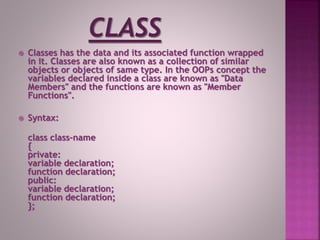
 Classes has the data and its associated function wrapped
in it. Classes are also known as a collection of similar
objects or objects of same type. In the OOPs concept the
variables declared inside a class are known as "Data
Members" and the functions are known as "Member
Functions".
 Syntax:
class class-name
{
private:
variable declaration;
function declaration;
public:
variable declaration;
function declaration;
};
 MEMBER DATA : Member data is the
attribute of class.It may private , public or
protected.We can use these access
specifier.
 MEMBER FUNCTION : Member function is
the operation performed by the class on
the member data.Member function can be
protected by using three keywords private
, public or protected.
 Object is a real world entity.
 Objects sometimes correspond to things found in
the real world. For example, a graphics program
may have objects such as "circle," "square," "menu."
An online shopping system will have objects such as
"shopping cart," "customer," and "product." The
shopping system will support behaviors such as
"place order," "make payment," and "offer
discount.“
 Syntax :
void main()
{
class_name obj_name;
}
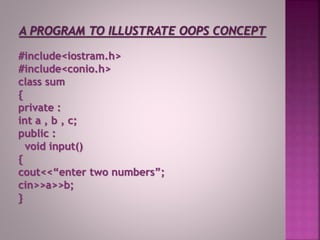
#include<iostram.h>
#include<conio.h>
class sum
{
private :
int a , b , c;
public :
void input()
{
cout<<“enter two numbers”;
cin>>a>>b;
}
void display()
{
c = a + b;
cout<<“sum of two numbers is : ”<<c;
}
};
void main()
{
sum s;
s.input();
s.display();
getch();
}
 Data abstraction refers to, providing only
essential information to the outside world
and hiding their background details, i.e., to
represent the needed information in
program without presenting the details.
 Data abstraction is a programming (and
design) technique that relies on the
separation of interface and
implementation.
 C++ classes provides great level of data
abstraction. They provide sufficient public
methods to the outside world to play with the
functionality of the object and to manipulate
object data, i.e., state without actually
knowing how class has been implemented
internally.
 For example, your program can make a call to
the sort() function without knowing what
algorithm the function actually uses to sort the
given values. In fact, the underlying
implementation of the sorting functionality
could change between releases of the library,
and as long as the interface stays the same,
your function call will still work.
Encapsulation is the packing of data
and functions into a single
component. The features of
encapsulation are supported using
classes in most object-oriented
programming languages, although
other alternatives also exist. It allows
selective hiding of properties and
methods in an object by building an
impenetrable wall to protect the
code from accidental corruption.
 In programming languages, encapsulation is
used to refer to one of two related but distinct
notions, and sometimes to the
combination thereof:
* A language mechanism for restricting access to
some of the object's components.]
* A language construct that facilitates the
bundling of data with the methods (or other
functions) operating on that data.
 Some programming language researchers and
academics use the first meaning alone or in
combination with the second as a
distinguishing feature of object-oriented
programming, while other programming
languages which provide lexical closures view
encapsulation as a feature of the
language orthogonal to object orientation.
 One of the most important concepts in object-
oriented programming is that of inheritance.
Inheritance allows us to define a class in terms
of another class, which makes it easier to
create and maintain an application. This also
provides an opportunity to reuse the code
functionality and fast implementation time.
 When creating a class, instead of writing
completely new data members and member
functions, the programmer can designate that
the new class should inherit the members of
an existing class. This existing class is called
the base class, and the new class is referred to
as the derived class.
Base & Derived Classes:
 A class can be derived from more than one
classes, which means it can inherit data
and functions from multiple base classes.
To define a derived class, we use a class
derivation list to specify the base class(es).
A class derivation list names one or more
base classes and has the form:
 class derived-class: access-specifier base
class.
 Where access-specifier is one of public,
protected, or private, and base-class is the
name of a previously defined class. If the
access-specifier is not used, then it is
private by default.
 Consider a base class Shape and its derived
class Rectangle as follows:
include <iostream>
using namespace std;
// Base class
class Shape
{
public:
void setWidth(int w)
{
width = w;
}
void setHeight(int h)
{
height = h;
}
protected:
int width;
int height;
};
// Derived class
class Rectangle: public Shape
{
public:
int getArea()
{
return (width * height);
}
};
int main(void)
{
Rectangle Rect;
Rect.setWidth(5);
Rect.setHeight(7);
// Print the area of the object.
cout << "Total area: " << Rect.getArea() << endl;
return 0;
}
 Data hiding is a software development
technique specifically used in object-oriented
programming (OOP) to hide internal object
details (data members). Data hiding ensures
exclusive data access to class members and
protects object integrity by preventing
unintended or intended changes.
 Data hiding also reduces system complexity for
increased robustness by limiting
interdependencies between software
components.
Data hiding is also known as data encapsulation
or information hiding.
 Polymorphism is a greek word in which
‘poly’ means ‘many’ and ‘morph’ means
‘forms’.
 In object-oriented programming,
polymorphism (from the Greek meaning
"having multiple forms") is the
characteristic of being able to assign a
different meaning or usage to something in
different contexts - specifically, to allow an
entity such as a variable, afunction, or
an object to have more than one form.
There are several different kinds of
polymorphism.
a) Run time polymorphism : The
appropriate member function could be
selected while the programming is
running. This is known as run-time
polymorphism. The run-
time polymorphism is implemented with
inheritance and virtual functions.
 Virtual function : A function qualified by
the virtual keyword. When a virtual function
is called via a pointer, the class of the object
pointed to determines which function
definition will be used. Virtual functions
implement polymorphism, whereby objects
belonging to different classes can respond to
the same message in different ways.
b) Compile time polymorphism : The
compiler is able to select the appropriate
function for a particular call at compile-time
itself. This is known as compile-time
polymorphism. The compile-
time polymorphism is implemented with
templates.
 Function name overloading : Using a
single function name to perform different
types of tasks is known as function
overloading.
Using the concept of function overloading,
design a family of functions with one function
name but with different argument lists. The
function would perform different operations
depending on the argument list in the function
call. The correct function to be invoked is
determined by checking the number and type
of the arguments but not on the function type.
 Operator overloading : The process of
making an operator to exhibit different
behaviors in different instances is known as
operator overloading.
The general form of an operator function is:
return type classname: : operator(op-arglist)
{
Functionbody;
}

concept of oops

  • 2.
  • 3.
     Classes hasthe data and its associated function wrapped in it. Classes are also known as a collection of similar objects or objects of same type. In the OOPs concept the variables declared inside a class are known as "Data Members" and the functions are known as "Member Functions".  Syntax: class class-name { private: variable declaration; function declaration; public: variable declaration; function declaration; };
  • 4.
     MEMBER DATA: Member data is the attribute of class.It may private , public or protected.We can use these access specifier.  MEMBER FUNCTION : Member function is the operation performed by the class on the member data.Member function can be protected by using three keywords private , public or protected.
  • 5.
     Object isa real world entity.  Objects sometimes correspond to things found in the real world. For example, a graphics program may have objects such as "circle," "square," "menu." An online shopping system will have objects such as "shopping cart," "customer," and "product." The shopping system will support behaviors such as "place order," "make payment," and "offer discount.“  Syntax : void main() { class_name obj_name; }
  • 6.
    #include<iostram.h> #include<conio.h> class sum { private : inta , b , c; public : void input() { cout<<“enter two numbers”; cin>>a>>b; }
  • 7.
    void display() { c =a + b; cout<<“sum of two numbers is : ”<<c; } }; void main() { sum s; s.input(); s.display(); getch(); }
  • 8.
     Data abstractionrefers to, providing only essential information to the outside world and hiding their background details, i.e., to represent the needed information in program without presenting the details.  Data abstraction is a programming (and design) technique that relies on the separation of interface and implementation.
  • 9.
     C++ classesprovides great level of data abstraction. They provide sufficient public methods to the outside world to play with the functionality of the object and to manipulate object data, i.e., state without actually knowing how class has been implemented internally.  For example, your program can make a call to the sort() function without knowing what algorithm the function actually uses to sort the given values. In fact, the underlying implementation of the sorting functionality could change between releases of the library, and as long as the interface stays the same, your function call will still work.
  • 10.
    Encapsulation is thepacking of data and functions into a single component. The features of encapsulation are supported using classes in most object-oriented programming languages, although other alternatives also exist. It allows selective hiding of properties and methods in an object by building an impenetrable wall to protect the code from accidental corruption.
  • 11.
     In programminglanguages, encapsulation is used to refer to one of two related but distinct notions, and sometimes to the combination thereof: * A language mechanism for restricting access to some of the object's components.] * A language construct that facilitates the bundling of data with the methods (or other functions) operating on that data.  Some programming language researchers and academics use the first meaning alone or in combination with the second as a distinguishing feature of object-oriented programming, while other programming languages which provide lexical closures view encapsulation as a feature of the language orthogonal to object orientation.
  • 12.
     One ofthe most important concepts in object- oriented programming is that of inheritance. Inheritance allows us to define a class in terms of another class, which makes it easier to create and maintain an application. This also provides an opportunity to reuse the code functionality and fast implementation time.  When creating a class, instead of writing completely new data members and member functions, the programmer can designate that the new class should inherit the members of an existing class. This existing class is called the base class, and the new class is referred to as the derived class.
  • 13.
    Base & DerivedClasses:  A class can be derived from more than one classes, which means it can inherit data and functions from multiple base classes. To define a derived class, we use a class derivation list to specify the base class(es). A class derivation list names one or more base classes and has the form:  class derived-class: access-specifier base class.  Where access-specifier is one of public, protected, or private, and base-class is the name of a previously defined class. If the access-specifier is not used, then it is private by default.
  • 14.
     Consider abase class Shape and its derived class Rectangle as follows: include <iostream> using namespace std; // Base class class Shape { public: void setWidth(int w) { width = w; } void setHeight(int h) { height = h; }
  • 15.
    protected: int width; int height; }; //Derived class class Rectangle: public Shape { public: int getArea() { return (width * height); } };
  • 16.
    int main(void) { Rectangle Rect; Rect.setWidth(5); Rect.setHeight(7); //Print the area of the object. cout << "Total area: " << Rect.getArea() << endl; return 0; }
  • 17.
     Data hidingis a software development technique specifically used in object-oriented programming (OOP) to hide internal object details (data members). Data hiding ensures exclusive data access to class members and protects object integrity by preventing unintended or intended changes.  Data hiding also reduces system complexity for increased robustness by limiting interdependencies between software components. Data hiding is also known as data encapsulation or information hiding.
  • 18.
     Polymorphism isa greek word in which ‘poly’ means ‘many’ and ‘morph’ means ‘forms’.  In object-oriented programming, polymorphism (from the Greek meaning "having multiple forms") is the characteristic of being able to assign a different meaning or usage to something in different contexts - specifically, to allow an entity such as a variable, afunction, or an object to have more than one form. There are several different kinds of polymorphism.
  • 19.
    a) Run timepolymorphism : The appropriate member function could be selected while the programming is running. This is known as run-time polymorphism. The run- time polymorphism is implemented with inheritance and virtual functions.  Virtual function : A function qualified by the virtual keyword. When a virtual function is called via a pointer, the class of the object pointed to determines which function definition will be used. Virtual functions implement polymorphism, whereby objects belonging to different classes can respond to the same message in different ways.
  • 20.
    b) Compile timepolymorphism : The compiler is able to select the appropriate function for a particular call at compile-time itself. This is known as compile-time polymorphism. The compile- time polymorphism is implemented with templates.  Function name overloading : Using a single function name to perform different types of tasks is known as function overloading. Using the concept of function overloading, design a family of functions with one function name but with different argument lists. The function would perform different operations depending on the argument list in the function call. The correct function to be invoked is determined by checking the number and type of the arguments but not on the function type.
  • 21.
     Operator overloading: The process of making an operator to exhibit different behaviors in different instances is known as operator overloading. The general form of an operator function is: return type classname: : operator(op-arglist) { Functionbody; }