1
Operator overloading
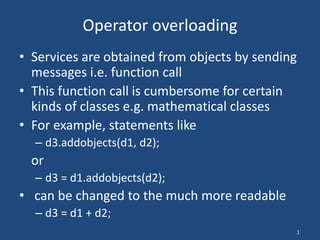
• Services are obtained from objects by sending
messages i.e. function call
• This function call is cumbersome for certain
kinds of classes e.g. mathematical classes
• For example, statements like
– d3.addobjects(d1, d2);
or
– d3 = d1.addobjects(d2);
• can be changed to the much more readable
– d3 = d1 + d2;
2
Cont.
• Operator overloading refers to giving the
normal C++ operators, such as +, *, <=, and
etc., additional meanings when they are
applied to user-defined data types
• Operator overloading gives you the
opportunity to redefine the C++ language
– By using classes to create new kinds of variables,
– operator overloading to create new definitions for
operators
3
Examples of c++ overloaded operator
• Addition + and subtraction – operator
 +, – operators perform differently, depending on their
context in integer arithmetic, floating-point arithmetic
and pointer arithmetic.
• Stream insertion (<<) and extractor (>>) operator
(cout<< and cin>>)
 << is used both as the stream insertion operator and
as the bitwise left-shift operator
 >> is used both as the stream extraction operator and
as the bitwise right-shift operator
 <<, >> are overloaded in the C++ Standard Library std
4
Fundamentals of Operator Overloading
• Jobs performed by overloaded operators can also
be performed by explicit function calls
• Programmers can use operators with user-
defined types
• C++ does not allow new operators to be created
• It does allow most existing operators to be
overloaded so that, when these operators are
used with objects
• This is a powerful capability
5
Cont.
• An operator is overloaded by writing a non-static
member function definition
• Function name becomes the keyword operator
followed by the symbol for the operator being
overloaded
– E.g. operator + () { …. }
• Function name operator+ would be used to
overload the addition operator (+)
• Assignment operator (=) may be used with every
class to perform member wise assignment of the
data members
– d1 = d2;
6
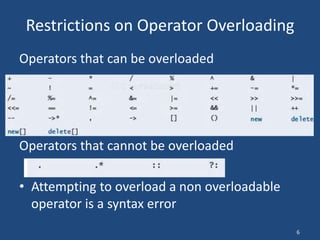
Restrictions on Operator Overloading
Operators that can be overloaded
Operators that cannot be overloaded
• Attempting to overload a non overloadable
operator is a syntax error
7
Precedence, Associativity and No. of
Operands
• Precedence means which operator to solve
first (+, -, *, /, = )
• The precedence of an operator cannot be
changed by overloading
• The associativity of an operator cannot be
changed by overloading
• Overloaded unary operators (++, --) remain
unary operators
• overloaded binary operators remain binary
operators
8
Creating New Operators
• It is not possible to create new operators
• only existing operators can be overloaded
– E.g. ** can be used for exponential in some
programming languages
– ** is not in the list od existing operator so it
cannot be overloaded
• Attempting to create new operators via
operator overloading is a syntax error
9
Operators for Fundamental Types
• The meaning of how an operator works on
fundamental types cannot be changed by
operator overloading
• For example, programmer cannot change the
meaning of how + adds two integers
• Operator overloading works only with
– objects of user-defined types or
– a mixture of an object of a user-defined type and
an object of a fundamental type
10
Examples
• c1++; or c1--;
– Overloading ++ and -- unary operator
• dist3 = dist1 + dist2;
– Overloading assignment and addition binary
operator
– It does not mean that += is also overloaded for
Distance objects
• dist1+= dist2; or dist1-=dist2
11
Overloading Unary Operators
• Examples of unary operators are the increment and
decrement operators ++ and --, and the unary minus,
as in -33
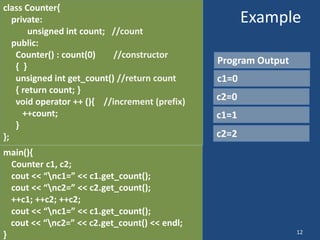
• Counter class example
– To keep track of a count.
– Objects of that class were increment the count
value by calling a member function:
c1.inc_count();
• But it would be more readable if we could have used
the increment operator ++
++c1;
12
Example
class Counter{
private:
unsigned int count; //count
public:
Counter() : count(0) //constructor
{ }
unsigned int get_count() //return count
{ return count; }
void operator ++ (){ //increment (prefix)
++count;
}
};
Program Output
main(){
Counter c1, c2;
cout << “nc1=” << c1.get_count();
cout << “nc2=” << c2.get_count();
++c1; ++c2; ++c2;
cout << “nc1=” << c1.get_count();
cout << “nc2=” << c2.get_count() << endl;
}
c1=0
c2=0
c2=2
c1=1
13
The operator Keyword
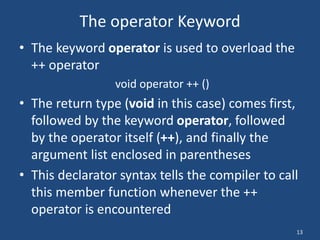
• The keyword operator is used to overload the
++ operator
void operator ++ ()
• The return type (void in this case) comes first,
followed by the keyword operator, followed
by the operator itself (++), and finally the
argument list enclosed in parentheses
• This declarator syntax tells the compiler to call
this member function whenever the ++
operator is encountered
14
Cont.
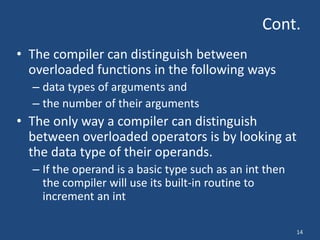
• The compiler can distinguish between
overloaded functions in the following ways
– data types of arguments and
– the number of their arguments
• The only way a compiler can distinguish
between overloaded operators is by looking at
the data type of their operands.
– If the operand is a basic type such as an int then
the compiler will use its built-in routine to
increment an int
15
Operator Arguments
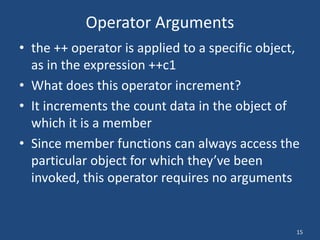
• the ++ operator is applied to a specific object,
as in the expression ++c1
• What does this operator increment?
• It increments the count data in the object of
which it is a member
• Since member functions can always access the
particular object for which they’ve been
invoked, this operator requires no arguments
16
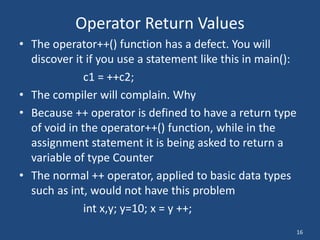
Operator Return Values
• The operator++() function has a defect. You will
discover it if you use a statement like this in main():
c1 = ++c2;
• The compiler will complain. Why
• Because ++ operator is defined to have a return type
of void in the operator++() function, while in the
assignment statement it is being asked to return a
variable of type Counter
• The normal ++ operator, applied to basic data types
such as int, would not have this problem
int x,y; y=10; x = y ++;
17
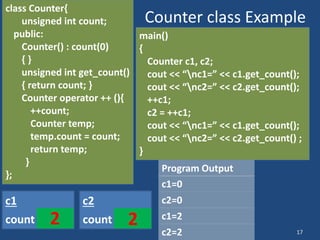
class Counter{
unsigned int count;
public:
Counter() : count(0)
{ }
unsigned int get_count()
{ return count; }
Counter operator ++ (){
++count;
Counter temp;
temp.count = count;
return temp;
}
};
Counter class Example
main()
{
Counter c1, c2;
cout << “nc1=” << c1.get_count();
cout << “nc2=” << c2.get_count();
++c1;
c2 = ++c1;
cout << “nc1=” << c1.get_count();
cout << “nc2=” << c2.get_count() ;
}
0
count
c1
0
count
c2
1 2
2
Program Output
c1=0
c2=0
c2=2
c1=2
18
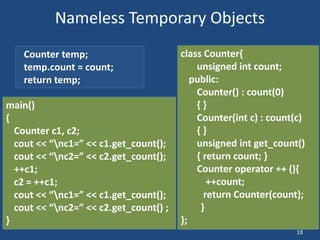
Nameless Temporary Objects
main()
{
Counter c1, c2;
cout << “nc1=” << c1.get_count();
cout << “nc2=” << c2.get_count();
++c1;
c2 = ++c1;
cout << “nc1=” << c1.get_count();
cout << “nc2=” << c2.get_count() ;
}
class Counter{
unsigned int count;
public:
Counter() : count(0)
{ }
Counter(int c) : count(c)
{ }
unsigned int get_count()
{ return count; }
Counter operator ++ (){
++count;
return Counter(count);
}
};
Counter temp;
temp.count = count;
return temp;
19
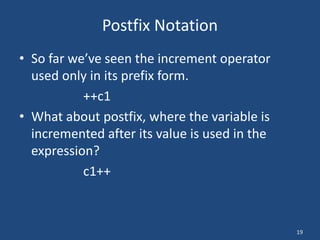
Postfix Notation
• So far we’ve seen the increment operator
used only in its prefix form.
++c1
• What about postfix, where the variable is
incremented after its value is used in the
expression?
c1++
20
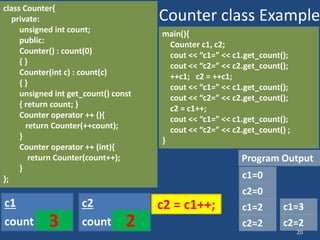
Counter class Example
class Counter{
private:
unsigned int count;
public:
Counter() : count(0)
{ }
Counter(int c) : count(c)
{ }
unsigned int get_count() const
{ return count; }
Counter operator ++ (){
return Counter(++count);
}
Counter operator ++ (int){
return Counter(count++);
}
};
main(){
Counter c1, c2;
cout << “c1=” << c1.get_count();
cout << “c2=” << c2.get_count();
++c1; c2 = ++c1;
cout << “c1=” << c1.get_count();
cout << “c2=” << c2.get_count();
c2 = c1++;
cout << “c1=” << c1.get_count();
cout << “c2=” << c2.get_count() ;
}
0
count
c1
0
count
c2
1
2 2
Program Output
c1=0
c2=0
c2=2
c1=2
++c1;
c2 = ++c1;
c2 = c1++;
2
3 c2=2
c1=3

Week7a.pptx

  • 1.
    1 Operator overloading • Servicesare obtained from objects by sending messages i.e. function call • This function call is cumbersome for certain kinds of classes e.g. mathematical classes • For example, statements like – d3.addobjects(d1, d2); or – d3 = d1.addobjects(d2); • can be changed to the much more readable – d3 = d1 + d2;
  • 2.
    2 Cont. • Operator overloadingrefers to giving the normal C++ operators, such as +, *, <=, and etc., additional meanings when they are applied to user-defined data types • Operator overloading gives you the opportunity to redefine the C++ language – By using classes to create new kinds of variables, – operator overloading to create new definitions for operators
  • 3.
    3 Examples of c++overloaded operator • Addition + and subtraction – operator  +, – operators perform differently, depending on their context in integer arithmetic, floating-point arithmetic and pointer arithmetic. • Stream insertion (<<) and extractor (>>) operator (cout<< and cin>>)  << is used both as the stream insertion operator and as the bitwise left-shift operator  >> is used both as the stream extraction operator and as the bitwise right-shift operator  <<, >> are overloaded in the C++ Standard Library std
  • 4.
    4 Fundamentals of OperatorOverloading • Jobs performed by overloaded operators can also be performed by explicit function calls • Programmers can use operators with user- defined types • C++ does not allow new operators to be created • It does allow most existing operators to be overloaded so that, when these operators are used with objects • This is a powerful capability
  • 5.
    5 Cont. • An operatoris overloaded by writing a non-static member function definition • Function name becomes the keyword operator followed by the symbol for the operator being overloaded – E.g. operator + () { …. } • Function name operator+ would be used to overload the addition operator (+) • Assignment operator (=) may be used with every class to perform member wise assignment of the data members – d1 = d2;
  • 6.
    6 Restrictions on OperatorOverloading Operators that can be overloaded Operators that cannot be overloaded • Attempting to overload a non overloadable operator is a syntax error
  • 7.
    7 Precedence, Associativity andNo. of Operands • Precedence means which operator to solve first (+, -, *, /, = ) • The precedence of an operator cannot be changed by overloading • The associativity of an operator cannot be changed by overloading • Overloaded unary operators (++, --) remain unary operators • overloaded binary operators remain binary operators
  • 8.
    8 Creating New Operators •It is not possible to create new operators • only existing operators can be overloaded – E.g. ** can be used for exponential in some programming languages – ** is not in the list od existing operator so it cannot be overloaded • Attempting to create new operators via operator overloading is a syntax error
  • 9.
    9 Operators for FundamentalTypes • The meaning of how an operator works on fundamental types cannot be changed by operator overloading • For example, programmer cannot change the meaning of how + adds two integers • Operator overloading works only with – objects of user-defined types or – a mixture of an object of a user-defined type and an object of a fundamental type
  • 10.
    10 Examples • c1++; orc1--; – Overloading ++ and -- unary operator • dist3 = dist1 + dist2; – Overloading assignment and addition binary operator – It does not mean that += is also overloaded for Distance objects • dist1+= dist2; or dist1-=dist2
  • 11.
    11 Overloading Unary Operators •Examples of unary operators are the increment and decrement operators ++ and --, and the unary minus, as in -33 • Counter class example – To keep track of a count. – Objects of that class were increment the count value by calling a member function: c1.inc_count(); • But it would be more readable if we could have used the increment operator ++ ++c1;
  • 12.
    12 Example class Counter{ private: unsigned intcount; //count public: Counter() : count(0) //constructor { } unsigned int get_count() //return count { return count; } void operator ++ (){ //increment (prefix) ++count; } }; Program Output main(){ Counter c1, c2; cout << “nc1=” << c1.get_count(); cout << “nc2=” << c2.get_count(); ++c1; ++c2; ++c2; cout << “nc1=” << c1.get_count(); cout << “nc2=” << c2.get_count() << endl; } c1=0 c2=0 c2=2 c1=1
  • 13.
    13 The operator Keyword •The keyword operator is used to overload the ++ operator void operator ++ () • The return type (void in this case) comes first, followed by the keyword operator, followed by the operator itself (++), and finally the argument list enclosed in parentheses • This declarator syntax tells the compiler to call this member function whenever the ++ operator is encountered
  • 14.
    14 Cont. • The compilercan distinguish between overloaded functions in the following ways – data types of arguments and – the number of their arguments • The only way a compiler can distinguish between overloaded operators is by looking at the data type of their operands. – If the operand is a basic type such as an int then the compiler will use its built-in routine to increment an int
  • 15.
    15 Operator Arguments • the++ operator is applied to a specific object, as in the expression ++c1 • What does this operator increment? • It increments the count data in the object of which it is a member • Since member functions can always access the particular object for which they’ve been invoked, this operator requires no arguments
  • 16.
    16 Operator Return Values •The operator++() function has a defect. You will discover it if you use a statement like this in main(): c1 = ++c2; • The compiler will complain. Why • Because ++ operator is defined to have a return type of void in the operator++() function, while in the assignment statement it is being asked to return a variable of type Counter • The normal ++ operator, applied to basic data types such as int, would not have this problem int x,y; y=10; x = y ++;
  • 17.
    17 class Counter{ unsigned intcount; public: Counter() : count(0) { } unsigned int get_count() { return count; } Counter operator ++ (){ ++count; Counter temp; temp.count = count; return temp; } }; Counter class Example main() { Counter c1, c2; cout << “nc1=” << c1.get_count(); cout << “nc2=” << c2.get_count(); ++c1; c2 = ++c1; cout << “nc1=” << c1.get_count(); cout << “nc2=” << c2.get_count() ; } 0 count c1 0 count c2 1 2 2 Program Output c1=0 c2=0 c2=2 c1=2
  • 18.
    18 Nameless Temporary Objects main() { Counterc1, c2; cout << “nc1=” << c1.get_count(); cout << “nc2=” << c2.get_count(); ++c1; c2 = ++c1; cout << “nc1=” << c1.get_count(); cout << “nc2=” << c2.get_count() ; } class Counter{ unsigned int count; public: Counter() : count(0) { } Counter(int c) : count(c) { } unsigned int get_count() { return count; } Counter operator ++ (){ ++count; return Counter(count); } }; Counter temp; temp.count = count; return temp;
  • 19.
    19 Postfix Notation • Sofar we’ve seen the increment operator used only in its prefix form. ++c1 • What about postfix, where the variable is incremented after its value is used in the expression? c1++
  • 20.
    20 Counter class Example classCounter{ private: unsigned int count; public: Counter() : count(0) { } Counter(int c) : count(c) { } unsigned int get_count() const { return count; } Counter operator ++ (){ return Counter(++count); } Counter operator ++ (int){ return Counter(count++); } }; main(){ Counter c1, c2; cout << “c1=” << c1.get_count(); cout << “c2=” << c2.get_count(); ++c1; c2 = ++c1; cout << “c1=” << c1.get_count(); cout << “c2=” << c2.get_count(); c2 = c1++; cout << “c1=” << c1.get_count(); cout << “c2=” << c2.get_count() ; } 0 count c1 0 count c2 1 2 2 Program Output c1=0 c2=0 c2=2 c1=2 ++c1; c2 = ++c1; c2 = c1++; 2 3 c2=2 c1=3