Introduction to Inheritance
Object Oriented Programming Copyright © 2012 IM
Group. All rights
reserved
Inheritance
• Inheritance refers to derived classes
▫ Derived classes are obtained from another class
by adding features
▫ The class of input-file streams is derived from the
class of all input streams by adding member
functions such as open and close
▫ cin belongs to the class of all input streams, but not
the class of input-file streams
Copyright © 2012 IM
Group. All rights
reserved
Inheritance and Streams
• cin and an input-file stream are input streams
▫ Input-file streams are members of the class
ifstream
 Can be connected to a file
▫ cin is a member of the class istream (no 'f ')
 Cannot be connected to a file
▫ The ifstream class is a derived class of the
istream class
Copyright © 2012 IM
Group. All rights
reserved
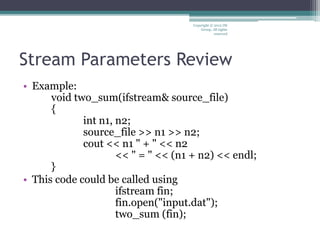
Stream Parameters Review
• Example:
void two_sum(ifstream& source_file)
{
int n1, n2;
source_file >> n1 >> n2;
cout << n1 " + " << n2
<< " = " << (n1 + n2) << endl;
}
• This code could be called using
ifstream fin;
fin.open("input.dat");
two_sum (fin);
Copyright © 2012 IM
Group. All rights
reserved
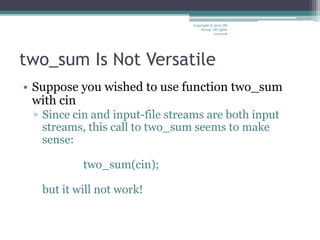
two_sum Is Not Versatile
• Suppose you wished to use function two_sum
with cin
▫ Since cin and input-file streams are both input
streams, this call to two_sum seems to make
sense:
two_sum(cin);
but it will not work!
Copyright © 2012 IM
Group. All rights
reserved
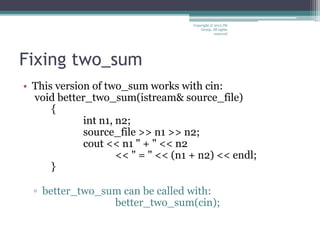
Fixing two_sum
• This version of two_sum works with cin:
void better_two_sum(istream& source_file)
{
int n1, n2;
source_file >> n1 >> n2;
cout << n1 " + " << n2
<< " = " << (n1 + n2) << endl;
}
▫ better_two_sum can be called with:
better_two_sum(cin);
Copyright © 2012 IM
Group. All rights
reserved
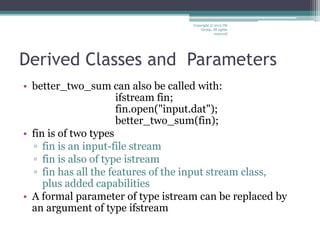
Derived Classes and Parameters
• better_two_sum can also be called with:
ifstream fin;
fin.open("input.dat");
better_two_sum(fin);
• fin is of two types
▫ fin is an input-file stream
▫ fin is also of type istream
▫ fin has all the features of the input stream class,
plus added capabilities
• A formal parameter of type istream can be replaced by
an argument of type ifstream
Copyright © 2012 IM
Group. All rights
reserved
Inheritance Relationships
• If class B is derived from class A
▫ Class B is a derived class of class A
▫ Class B is a child of class A
▫ Class A is the parent of class B
▫ Class B inherits the member functions of class A
Copyright © 2012 IM
Group. All rights
reserved
Inheritance and Output
• ostream is the class of all output streams
▫ cout is of type ostream
• ofstream is the class of output-file streams
▫ The ofstream class is a child class of ostream
▫ This function can be called with ostream or
ofstream arguments
void say_hello(ostream& any_out_stream)
{
any_out_stream << "Hello";
}
Copyright © 2012 IM
Group. All rights
reserved
Default Arguments
• It is not necessary to have two versions of
the new_line function
▫ A default value can be specified in the parameter
list
▫ The default value is selected if no argument is
available for the parameter
• The new_line header can be written as
new_line (istream & in_stream = cin)
▫ If new_line is called without an argument, cin is
used
Copyright © 2012 IM
Group. All rights
reserved
Multiple Default Arguments
• When some formal parameters have default
values and others do not
▫ All formal parameters with default values must be
at the end of the parameter list
▫ Arguments are applied to the all formal parameters
in order just as we have seen before
▫ The function call must provide at least as many
arguments as there are parameters without default
values
Copyright © 2012 IM
Group. All rights
reserved
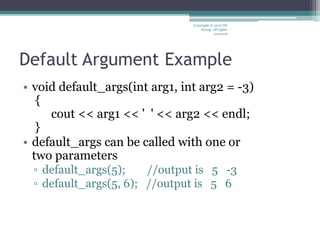
Default Argument Example
• void default_args(int arg1, int arg2 = -3)
{
cout << arg1 << ' ' << arg2 << endl;
}
• default_args can be called with one or
two parameters
▫ default_args(5); //output is 5 -3
▫ default_args(5, 6); //output is 5 6
Copyright © 2012 IM
Group. All rights
reserved
Copyright ©
2012 IM
Group. All
rights reserved
Inheritance
Object Oriented Programming
Inheritance Basics
• Inheritance is the process by which a new class,
called a derived class, is created from another
class, called the base class
▫ A derived class automatically has all the member
variables and functions of the base class
▫ A derived class can have additional member
variables and/or member functions
▫ The derived class is a child of the base or parent
class
Copyright © 2012 IM
Group. All rights
reserved
Employee Classes
• To design a record-keeping program with
records for salaried and hourly employees…
▫ Salaried and hourly employees belong to a class of
people who share the property "employee"
▫ A subset of employees are those with a fixed wage
▫ Another subset of employees earn hourly wages
• All employees have a name and SSN
▫ Functions to manipulate name and SSN are the same
for hourly and salaried employees
Copyright © 2012 IM
Group. All rights
reserved
• We will define a class called Employee for all
employees
• The Employee class will be used to define
classes for hourly and salaried employees.
A Base Class
Copyright © 2012 IM
Group. All rights
reserved
Training
• Let’s create the Employee class.
Copyright © 2012 IM
Group. All rights
reserved
Function print_check
• Function print_check will have different
definitions to print different checks for each type
of employee
▫ An Employee object lacks sufficient information to
print a check
▫ Each derived class will have sufficient information
to print a check
Copyright © 2012 IM
Group. All rights
reserved
Training
• Let’s create print_check function for class
Employee.
Copyright © 2012 IM
Group. All rights
reserved
• HourlyEmployee is derived from Class Employee
▫ HourlyEmployee inherits all member functions and
member variables of Employee
▫ The class definition begins
class HourlyEmployee : public Employee
 :public Employee shows that HourlyEmployee is
derived from class Employee
▫ HourlyEmployee declares additional member
variables wage_rate and hours
Class HourlyEmployee
Copyright © 2012 IM
Group. All rights
reserved
Inherited Members
• A derived class inherits all the members of the
parent class
▫ The derived class does not re-declare or re-define
members inherited from the parent, except…
▫ The derived class re-declares and re-defines
member functions of the parent class that will
have a different definition in the derived class
▫ The derived class can add member variables and
functions
Copyright © 2012 IM
Group. All rights
reserved
• Any member functions added in the derived
class are defined in the implementation file for
the derived class
▫ Definitions are not given for inherited functions
that are not to be changed
Implementing a Derived Class
Copyright © 2012 IM
Group. All rights
reserved
Training
• Let’s create the HourlyEmployee class.
Copyright © 2012 IM
Group. All rights
reserved
• The class SalariedEmployee is also derived from
Employee
▫ Function print_check is redefined to have a
meaning specific to salaried employees
▫ SalariedEmployee adds a member variable salary
Class SalariedEmployee
Copyright © 2012 IM
Group. All rights
reserved
Parent and Child Classes
• Recall that a child class automatically has all the
members of the parent class
• The parent class is an ancestor of the child class
• The child class is a descendent of the parent
class
• The parent class (Employee) contains all the
code common to the child classes
▫ You do not have to re-write the code for each child
Copyright © 2012 IM
Group. All rights
reserved
Derived Class Types
• An hourly employee is an employee
▫ In C++, an object of type HourlyEmployee can be
used where an object of type Employee can be
used
▫ An object of a class type can be used wherever any
of its ancestors can be used
▫ An ancestor cannot be used wherever one of its
descendents can be used
Copyright © 2012 IM
Group. All rights
reserved
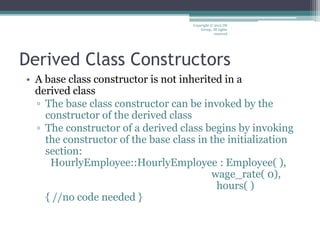
• A base class constructor is not inherited in a
derived class
▫ The base class constructor can be invoked by the
constructor of the derived class
▫ The constructor of a derived class begins by invoking
the constructor of the base class in the initialization
section:
HourlyEmployee::HourlyEmployee : Employee( ),
wage_rate( 0),
hours( )
{ //no code needed }
Derived Class Constructors
Copyright © 2012 IM
Group. All rights
reserved
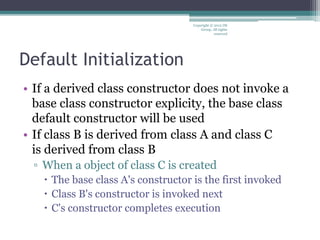
Default Initialization
• If a derived class constructor does not invoke a
base class constructor explicity, the base class
default constructor will be used
• If class B is derived from class A and class C
is derived from class B
▫ When a object of class C is created
 The base class A's constructor is the first invoked
 Class B's constructor is invoked next
 C's constructor completes execution
Copyright © 2012 IM
Group. All rights
reserved
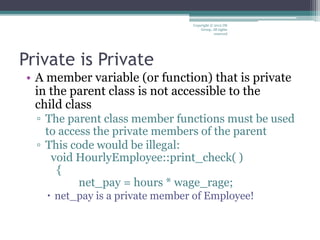
Private is Private
• A member variable (or function) that is private
in the parent class is not accessible to the
child class
▫ The parent class member functions must be used
to access the private members of the parent
▫ This code would be illegal:
void HourlyEmployee::print_check( )
{
net_pay = hours * wage_rage;
 net_pay is a private member of Employee!
Copyright © 2012 IM
Group. All rights
reserved
The protected Qualifier
• protected members of a class appear to be
private outside the class, but are accessible by
derived classes
▫ If member variables name, net_pay, and ssn are
listed as protected (not private) in the Employee
class, this code, illegal on the previous slide,
becomes legal:
HourlyEmployee::print_check( )
{
net_pay = hours * wage_rage;
Copyright © 2012 IM
Group. All rights
reserved
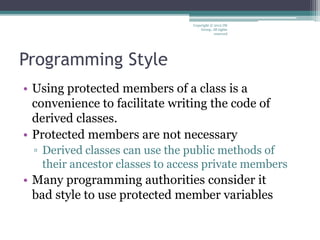
Programming Style
• Using protected members of a class is a
convenience to facilitate writing the code of
derived classes.
• Protected members are not necessary
▫ Derived classes can use the public methods of
their ancestor classes to access private members
• Many programming authorities consider it
bad style to use protected member variables
Copyright © 2012 IM
Group. All rights
reserved
• When defining a derived class, only list the
inherited functions that you wish to change
for the derived class
▫ The function is declared in the class definition
▫ HourlyEmployee and SalariedEmployee each have
their own definitions of print_check
Redefinition of Member Functions
Copyright © 2012 IM
Group. All rights
reserved
Redefining or Overloading
• A function redefined in a derived class has the
same number and type of parameters
▫ The derived class has only one function with the
same name as the base class
• An overloaded function has a different number
and/or type of parameters than the base class
▫ The derived class has two functions with the same
name as the base class
 One is defined in the base class, one in the derived
class
Copyright © 2012 IM
Group. All rights
reserved
Access to a Redefined Base Function
• When a base class function is redefined in a
derived class, the base class function can still
be used
▫ To specify that you want to use the base class
version of the redefined function:
HourlyEmployee sally_h;
sally_h.Employee::print_check( );
Copyright © 2012 IM
Group. All rights
reserved
Inheritance Details
• Some special functions are, for all practical
purposes, not inherited by a derived class
▫ Some of the special functions that are not
effectively inherited by a derived class include
 Destructors
 Copy constructors
 The assignment operator
Copyright © 2012 IM
Group. All rights
reserved
Copyright ©
2012 IM
Group. All
rights reserved
Polymorphism
Object Oriented Programming
Polymorphism
• Polymorphism refers to the ability to associate
multiple meanings with one function name
using a mechanism called late binding
• Polymorphism is a key component of the
philosophy of object oriented programming
Copyright © 2012 IM
Group. All rights
reserved
A Late Binding Example
• Imagine a graphics program with several types
of figures
▫ Each figure may be an object of a different class,
such as a circle, oval, rectangle, etc.
▫ Each is a descendant of a class Figure
▫ Each has a function draw( ) implemented with
code specific to each shape
▫ Class Figure has functions common to all figures
Copyright © 2012 IM
Group. All rights
reserved
A Problem
• Suppose that class Figure has a function center
▫ Function center moves a figure to the center of the
screen by erasing the figure and redrawing it in
the center of the screen
▫ Function center is inherited by each of the derived
classes
 Function center uses each derived object's draw
function to draw the figure
 The Figure class does not know about its derived
classes, so it cannot know how to draw each figure
Copyright © 2012 IM
Group. All rights
reserved
Virtual Functions
• Because the Figure class includes a method to
draw figures, but the Figure class cannot know
how to draw the figures, virtual functions are
used
• Making a function virtual tells the compiler that
you don't know how the function is implemented
and to wait until the function is used in a
program, then get the implementation from the
object.
▫ This is called late binding
Copyright © 2012 IM
Group. All rights
reserved
Virtual Details
• To define a function differently in a derived class
and to make it virtual
▫ Add keyword virtual to the function declaration in
the base class
▫ virtual is not needed for the function declaration in
the derived class, but is often included
▫ virtual is not added to the function definition
Copyright © 2012 IM
Group. All rights
reserved
Overriding
• Virtual functions whose definitions are changed
in a derived class are said to be overridden
• Non-virtual functions whose definitions are
changed in a derived class are redefined
Copyright © 2012 IM
Group. All rights
reserved
Any Questions
Session 5 Copyright © 2012 IM
Group. All rights
reserved

OOP - Introduction to Inheritance

  • 1.
    Introduction to Inheritance ObjectOriented Programming Copyright © 2012 IM Group. All rights reserved
  • 2.
    Inheritance • Inheritance refersto derived classes ▫ Derived classes are obtained from another class by adding features ▫ The class of input-file streams is derived from the class of all input streams by adding member functions such as open and close ▫ cin belongs to the class of all input streams, but not the class of input-file streams Copyright © 2012 IM Group. All rights reserved
  • 3.
    Inheritance and Streams •cin and an input-file stream are input streams ▫ Input-file streams are members of the class ifstream  Can be connected to a file ▫ cin is a member of the class istream (no 'f ')  Cannot be connected to a file ▫ The ifstream class is a derived class of the istream class Copyright © 2012 IM Group. All rights reserved
  • 4.
    Stream Parameters Review •Example: void two_sum(ifstream& source_file) { int n1, n2; source_file >> n1 >> n2; cout << n1 " + " << n2 << " = " << (n1 + n2) << endl; } • This code could be called using ifstream fin; fin.open("input.dat"); two_sum (fin); Copyright © 2012 IM Group. All rights reserved
  • 5.
    two_sum Is NotVersatile • Suppose you wished to use function two_sum with cin ▫ Since cin and input-file streams are both input streams, this call to two_sum seems to make sense: two_sum(cin); but it will not work! Copyright © 2012 IM Group. All rights reserved
  • 6.
    Fixing two_sum • Thisversion of two_sum works with cin: void better_two_sum(istream& source_file) { int n1, n2; source_file >> n1 >> n2; cout << n1 " + " << n2 << " = " << (n1 + n2) << endl; } ▫ better_two_sum can be called with: better_two_sum(cin); Copyright © 2012 IM Group. All rights reserved
  • 7.
    Derived Classes andParameters • better_two_sum can also be called with: ifstream fin; fin.open("input.dat"); better_two_sum(fin); • fin is of two types ▫ fin is an input-file stream ▫ fin is also of type istream ▫ fin has all the features of the input stream class, plus added capabilities • A formal parameter of type istream can be replaced by an argument of type ifstream Copyright © 2012 IM Group. All rights reserved
  • 8.
    Inheritance Relationships • Ifclass B is derived from class A ▫ Class B is a derived class of class A ▫ Class B is a child of class A ▫ Class A is the parent of class B ▫ Class B inherits the member functions of class A Copyright © 2012 IM Group. All rights reserved
  • 9.
    Inheritance and Output •ostream is the class of all output streams ▫ cout is of type ostream • ofstream is the class of output-file streams ▫ The ofstream class is a child class of ostream ▫ This function can be called with ostream or ofstream arguments void say_hello(ostream& any_out_stream) { any_out_stream << "Hello"; } Copyright © 2012 IM Group. All rights reserved
  • 10.
    Default Arguments • Itis not necessary to have two versions of the new_line function ▫ A default value can be specified in the parameter list ▫ The default value is selected if no argument is available for the parameter • The new_line header can be written as new_line (istream & in_stream = cin) ▫ If new_line is called without an argument, cin is used Copyright © 2012 IM Group. All rights reserved
  • 11.
    Multiple Default Arguments •When some formal parameters have default values and others do not ▫ All formal parameters with default values must be at the end of the parameter list ▫ Arguments are applied to the all formal parameters in order just as we have seen before ▫ The function call must provide at least as many arguments as there are parameters without default values Copyright © 2012 IM Group. All rights reserved
  • 12.
    Default Argument Example •void default_args(int arg1, int arg2 = -3) { cout << arg1 << ' ' << arg2 << endl; } • default_args can be called with one or two parameters ▫ default_args(5); //output is 5 -3 ▫ default_args(5, 6); //output is 5 6 Copyright © 2012 IM Group. All rights reserved
  • 13.
    Copyright © 2012 IM Group.All rights reserved Inheritance Object Oriented Programming
  • 14.
    Inheritance Basics • Inheritanceis the process by which a new class, called a derived class, is created from another class, called the base class ▫ A derived class automatically has all the member variables and functions of the base class ▫ A derived class can have additional member variables and/or member functions ▫ The derived class is a child of the base or parent class Copyright © 2012 IM Group. All rights reserved
  • 15.
    Employee Classes • Todesign a record-keeping program with records for salaried and hourly employees… ▫ Salaried and hourly employees belong to a class of people who share the property "employee" ▫ A subset of employees are those with a fixed wage ▫ Another subset of employees earn hourly wages • All employees have a name and SSN ▫ Functions to manipulate name and SSN are the same for hourly and salaried employees Copyright © 2012 IM Group. All rights reserved
  • 16.
    • We willdefine a class called Employee for all employees • The Employee class will be used to define classes for hourly and salaried employees. A Base Class Copyright © 2012 IM Group. All rights reserved
  • 17.
    Training • Let’s createthe Employee class. Copyright © 2012 IM Group. All rights reserved
  • 18.
    Function print_check • Functionprint_check will have different definitions to print different checks for each type of employee ▫ An Employee object lacks sufficient information to print a check ▫ Each derived class will have sufficient information to print a check Copyright © 2012 IM Group. All rights reserved
  • 19.
    Training • Let’s createprint_check function for class Employee. Copyright © 2012 IM Group. All rights reserved
  • 20.
    • HourlyEmployee isderived from Class Employee ▫ HourlyEmployee inherits all member functions and member variables of Employee ▫ The class definition begins class HourlyEmployee : public Employee  :public Employee shows that HourlyEmployee is derived from class Employee ▫ HourlyEmployee declares additional member variables wage_rate and hours Class HourlyEmployee Copyright © 2012 IM Group. All rights reserved
  • 21.
    Inherited Members • Aderived class inherits all the members of the parent class ▫ The derived class does not re-declare or re-define members inherited from the parent, except… ▫ The derived class re-declares and re-defines member functions of the parent class that will have a different definition in the derived class ▫ The derived class can add member variables and functions Copyright © 2012 IM Group. All rights reserved
  • 22.
    • Any memberfunctions added in the derived class are defined in the implementation file for the derived class ▫ Definitions are not given for inherited functions that are not to be changed Implementing a Derived Class Copyright © 2012 IM Group. All rights reserved
  • 23.
    Training • Let’s createthe HourlyEmployee class. Copyright © 2012 IM Group. All rights reserved
  • 24.
    • The classSalariedEmployee is also derived from Employee ▫ Function print_check is redefined to have a meaning specific to salaried employees ▫ SalariedEmployee adds a member variable salary Class SalariedEmployee Copyright © 2012 IM Group. All rights reserved
  • 25.
    Parent and ChildClasses • Recall that a child class automatically has all the members of the parent class • The parent class is an ancestor of the child class • The child class is a descendent of the parent class • The parent class (Employee) contains all the code common to the child classes ▫ You do not have to re-write the code for each child Copyright © 2012 IM Group. All rights reserved
  • 26.
    Derived Class Types •An hourly employee is an employee ▫ In C++, an object of type HourlyEmployee can be used where an object of type Employee can be used ▫ An object of a class type can be used wherever any of its ancestors can be used ▫ An ancestor cannot be used wherever one of its descendents can be used Copyright © 2012 IM Group. All rights reserved
  • 27.
    • A baseclass constructor is not inherited in a derived class ▫ The base class constructor can be invoked by the constructor of the derived class ▫ The constructor of a derived class begins by invoking the constructor of the base class in the initialization section: HourlyEmployee::HourlyEmployee : Employee( ), wage_rate( 0), hours( ) { //no code needed } Derived Class Constructors Copyright © 2012 IM Group. All rights reserved
  • 28.
    Default Initialization • Ifa derived class constructor does not invoke a base class constructor explicity, the base class default constructor will be used • If class B is derived from class A and class C is derived from class B ▫ When a object of class C is created  The base class A's constructor is the first invoked  Class B's constructor is invoked next  C's constructor completes execution Copyright © 2012 IM Group. All rights reserved
  • 29.
    Private is Private •A member variable (or function) that is private in the parent class is not accessible to the child class ▫ The parent class member functions must be used to access the private members of the parent ▫ This code would be illegal: void HourlyEmployee::print_check( ) { net_pay = hours * wage_rage;  net_pay is a private member of Employee! Copyright © 2012 IM Group. All rights reserved
  • 30.
    The protected Qualifier •protected members of a class appear to be private outside the class, but are accessible by derived classes ▫ If member variables name, net_pay, and ssn are listed as protected (not private) in the Employee class, this code, illegal on the previous slide, becomes legal: HourlyEmployee::print_check( ) { net_pay = hours * wage_rage; Copyright © 2012 IM Group. All rights reserved
  • 31.
    Programming Style • Usingprotected members of a class is a convenience to facilitate writing the code of derived classes. • Protected members are not necessary ▫ Derived classes can use the public methods of their ancestor classes to access private members • Many programming authorities consider it bad style to use protected member variables Copyright © 2012 IM Group. All rights reserved
  • 32.
    • When defininga derived class, only list the inherited functions that you wish to change for the derived class ▫ The function is declared in the class definition ▫ HourlyEmployee and SalariedEmployee each have their own definitions of print_check Redefinition of Member Functions Copyright © 2012 IM Group. All rights reserved
  • 33.
    Redefining or Overloading •A function redefined in a derived class has the same number and type of parameters ▫ The derived class has only one function with the same name as the base class • An overloaded function has a different number and/or type of parameters than the base class ▫ The derived class has two functions with the same name as the base class  One is defined in the base class, one in the derived class Copyright © 2012 IM Group. All rights reserved
  • 34.
    Access to aRedefined Base Function • When a base class function is redefined in a derived class, the base class function can still be used ▫ To specify that you want to use the base class version of the redefined function: HourlyEmployee sally_h; sally_h.Employee::print_check( ); Copyright © 2012 IM Group. All rights reserved
  • 35.
    Inheritance Details • Somespecial functions are, for all practical purposes, not inherited by a derived class ▫ Some of the special functions that are not effectively inherited by a derived class include  Destructors  Copy constructors  The assignment operator Copyright © 2012 IM Group. All rights reserved
  • 36.
    Copyright © 2012 IM Group.All rights reserved Polymorphism Object Oriented Programming
  • 37.
    Polymorphism • Polymorphism refersto the ability to associate multiple meanings with one function name using a mechanism called late binding • Polymorphism is a key component of the philosophy of object oriented programming Copyright © 2012 IM Group. All rights reserved
  • 38.
    A Late BindingExample • Imagine a graphics program with several types of figures ▫ Each figure may be an object of a different class, such as a circle, oval, rectangle, etc. ▫ Each is a descendant of a class Figure ▫ Each has a function draw( ) implemented with code specific to each shape ▫ Class Figure has functions common to all figures Copyright © 2012 IM Group. All rights reserved
  • 39.
    A Problem • Supposethat class Figure has a function center ▫ Function center moves a figure to the center of the screen by erasing the figure and redrawing it in the center of the screen ▫ Function center is inherited by each of the derived classes  Function center uses each derived object's draw function to draw the figure  The Figure class does not know about its derived classes, so it cannot know how to draw each figure Copyright © 2012 IM Group. All rights reserved
  • 40.
    Virtual Functions • Becausethe Figure class includes a method to draw figures, but the Figure class cannot know how to draw the figures, virtual functions are used • Making a function virtual tells the compiler that you don't know how the function is implemented and to wait until the function is used in a program, then get the implementation from the object. ▫ This is called late binding Copyright © 2012 IM Group. All rights reserved
  • 41.
    Virtual Details • Todefine a function differently in a derived class and to make it virtual ▫ Add keyword virtual to the function declaration in the base class ▫ virtual is not needed for the function declaration in the derived class, but is often included ▫ virtual is not added to the function definition Copyright © 2012 IM Group. All rights reserved
  • 42.
    Overriding • Virtual functionswhose definitions are changed in a derived class are said to be overridden • Non-virtual functions whose definitions are changed in a derived class are redefined Copyright © 2012 IM Group. All rights reserved
  • 43.
    Any Questions Session 5Copyright © 2012 IM Group. All rights reserved