Friend Functions
Object Oriented Programming Copyright © 2012 IM
Group. All rights
reserved
Trainig
• Make class called DayOfYear has variables:
▫ Month
▫ Day
• And functions:
▫ Default Constructor
▫ Parameterized Constructor
▫ inputDate
Copyright © 2012 IM
Group. All rights
reserved
Friend Function
• Class operations are typically implemented
as member functions
• Some operations are better implemented as
ordinary (nonmember) functions
Copyright © 2012 IM
Group. All rights
reserved
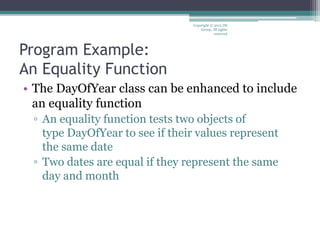
Program Example:
An Equality Function
• The DayOfYear class can be enhanced to include
an equality function
▫ An equality function tests two objects of
type DayOfYear to see if their values represent
the same date
▫ Two dates are equal if they represent the same
day and month
Copyright © 2012 IM
Group. All rights
reserved
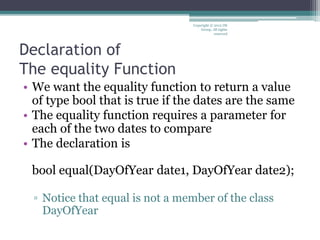
Declaration of
The equality Function
• We want the equality function to return a value
of type bool that is true if the dates are the same
• The equality function requires a parameter for
each of the two dates to compare
• The declaration is
bool equal(DayOfYear date1, DayOfYear date2);
▫ Notice that equal is not a member of the class
DayOfYear
Copyright © 2012 IM
Group. All rights
reserved
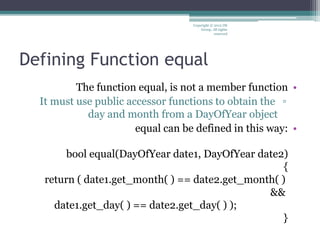
Defining Function equal
•The function equal, is not a member function
▫It must use public accessor functions to obtain the
day and month from a DayOfYear object
•equal can be defined in this way:
bool equal(DayOfYear date1, DayOfYear date2)
{
return ( date1.get_month( ) == date2.get_month( )
&&
date1.get_day( ) == date2.get_day( ) );
}
Copyright © 2012 IM
Group. All rights
reserved
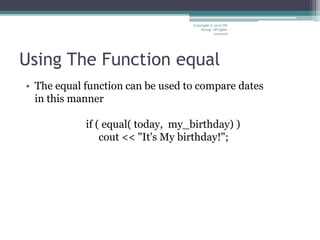
• The equal function can be used to compare dates
in this manner
if ( equal( today, my_birthday) )
cout << "It's My birthday!";
Using The Function equal
Copyright © 2012 IM
Group. All rights
reserved
Is equal Efficient?
• Function equal could be made more efficient
▫ Equal uses member function calls to obtain the
private data values
▫ Direct access of the member variables would be
more efficient (faster)
Copyright © 2012 IM
Group. All rights
reserved
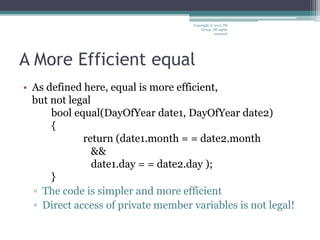
A More Efficient equal
• As defined here, equal is more efficient,
but not legal
bool equal(DayOfYear date1, DayOfYear date2)
{
return (date1.month = = date2.month
&&
date1.day = = date2.day );
}
▫ The code is simpler and more efficient
▫ Direct access of private member variables is not legal!
Copyright © 2012 IM
Group. All rights
reserved
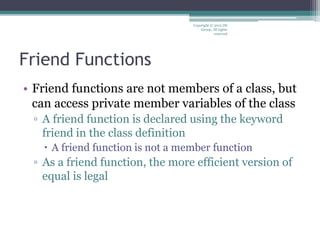
Friend Functions
• Friend functions are not members of a class, but
can access private member variables of the class
▫ A friend function is declared using the keyword
friend in the class definition
 A friend function is not a member function
▫ As a friend function, the more efficient version of
equal is legal
Copyright © 2012 IM
Group. All rights
reserved
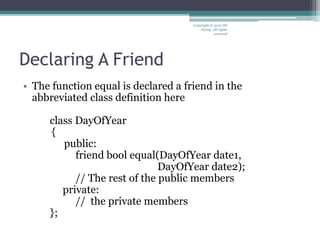
Declaring A Friend
• The function equal is declared a friend in the
abbreviated class definition here
class DayOfYear
{
public:
friend bool equal(DayOfYear date1,
DayOfYear date2);
// The rest of the public members
private:
// the private members
};
Copyright © 2012 IM
Group. All rights
reserved
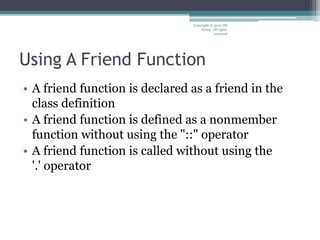
• A friend function is declared as a friend in the
class definition
• A friend function is defined as a nonmember
function without using the "::" operator
• A friend function is called without using the
'.' operator
Using A Friend Function
Copyright © 2012 IM
Group. All rights
reserved
Are Friends Needed?
• Friend functions can be written as non-friend
functions using the normal accessor and mutator
functions that should be part of the class
• The code of a friend function is simpler and it is
more efficient
Copyright © 2012 IM
Group. All rights
reserved
Choosing Friends
• How do you know when a function should be
a friend or a member function?
▫ In general, use a member function if the task
performed by the function involves only one object
▫ In general, use a nonmember function if the task
performed by the function involves more than
one object
 Choosing to make the nonmember function a friend is
a decision of efficiency and personal taste
Copyright © 2012 IM
Group. All rights
reserved
Parameter Passing Efficiency
• A call-by-value parameter less efficient than a
call-by-reference parameter
▫ The parameter is a local variable initialized to the
value of the argument
 This results in two copies of the argument
• A call-by-reference parameter is more efficient
▫ The parameter is a placeholder replaced by the
argument
 There is only one copy of the argument
Copyright © 2012 IM
Group. All rights
reserved
Class Parameters
• It can be much more efficient to use
call-by-reference parameters when the
parameter is of a class type
• When using a call-by-reference parameter
▫ If the function does not change the value of the
parameter, mark the parameter so the compiler
knows it should not be changed
Copyright © 2012 IM
Group. All rights
reserved
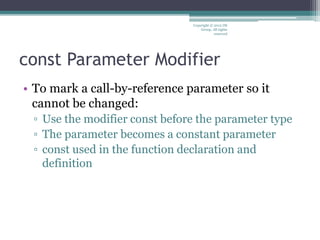
const Parameter Modifier
• To mark a call-by-reference parameter so it
cannot be changed:
▫ Use the modifier const before the parameter type
▫ The parameter becomes a constant parameter
▫ const used in the function declaration and
definition
Copyright © 2012 IM
Group. All rights
reserved
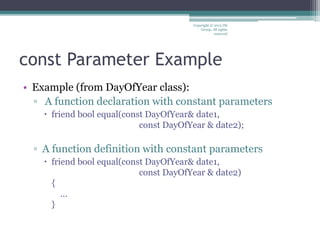
const Parameter Example
• Example (from DayOfYear class):
▫ A function declaration with constant parameters
 friend bool equal(const DayOfYear& date1,
const DayOfYear & date2);
▫ A function definition with constant parameters
 friend bool equal(const DayOfYear& date1,
const DayOfYear & date2)
{
…
}
Copyright © 2012 IM
Group. All rights
reserved
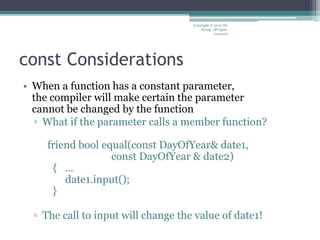
const Considerations
• When a function has a constant parameter,
the compiler will make certain the parameter
cannot be changed by the function
▫ What if the parameter calls a member function?
friend bool equal(const DayOfYear& date1,
const DayOfYear & date2)
{ …
date1.input();
}
▫ The call to input will change the value of date1!
Copyright © 2012 IM
Group. All rights
reserved
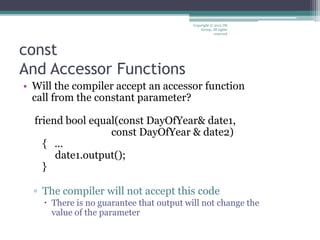
const
And Accessor Functions
• Will the compiler accept an accessor function
call from the constant parameter?
friend bool equal(const DayOfYear& date1,
const DayOfYear & date2)
{ …
date1.output();
}
▫ The compiler will not accept this code
 There is no guarantee that output will not change the
value of the parameter
Copyright © 2012 IM
Group. All rights
reserved
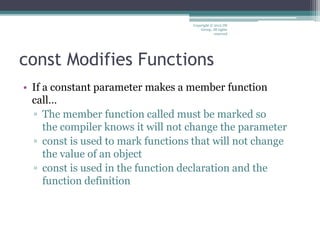
const Modifies Functions
• If a constant parameter makes a member function
call…
▫ The member function called must be marked so
the compiler knows it will not change the parameter
▫ const is used to mark functions that will not change
the value of an object
▫ const is used in the function declaration and the
function definition
Copyright © 2012 IM
Group. All rights
reserved
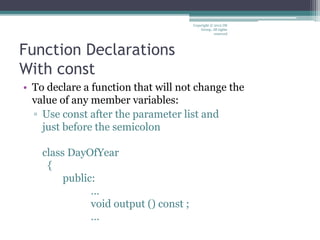
Function Declarations
With const
• To declare a function that will not change the
value of any member variables:
▫ Use const after the parameter list and
just before the semicolon
class DayOfYear
{
public:
…
void output () const ;
…
Copyright © 2012 IM
Group. All rights
reserved
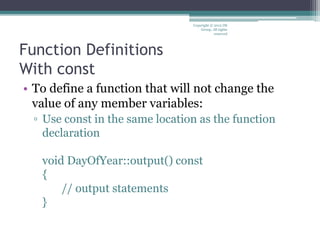
Function Definitions
With const
• To define a function that will not change the
value of any member variables:
▫ Use const in the same location as the function
declaration
void DayOfYear::output() const
{
// output statements
}
Copyright © 2012 IM
Group. All rights
reserved
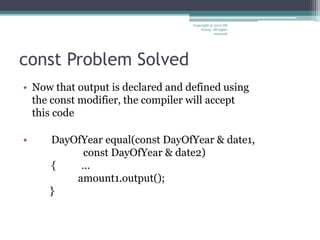
const Problem Solved
• Now that output is declared and defined using
the const modifier, the compiler will accept
this code
• DayOfYear equal(const DayOfYear & date1,
const DayOfYear & date2)
{ …
amount1.output();
}
Copyright © 2012 IM
Group. All rights
reserved
• Using const to modify parameters of class types
improves program efficiency
• Member functions called by constant parameters
must also use const to let the compiler know
they do not change the value of the parameter
const Wrapup
Copyright © 2012 IM
Group. All rights
reserved
Use const Consistently
• Once a parameter is modified by using const to
make it a constant parameter
▫ Any member functions that are called by the
parameter must also be modified using const to
tell the compiler they will not change the parameter
▫ It is a good idea to modify, with const, every
member function that does not change a member
variable
Copyright © 2012 IM
Group. All rights
reserved
Any Questions
Session 2 Copyright © 2012 IM
Group. All rights
reserved

OOP - Friend Functions

  • 1.
    Friend Functions Object OrientedProgramming Copyright © 2012 IM Group. All rights reserved
  • 2.
    Trainig • Make classcalled DayOfYear has variables: ▫ Month ▫ Day • And functions: ▫ Default Constructor ▫ Parameterized Constructor ▫ inputDate Copyright © 2012 IM Group. All rights reserved
  • 3.
    Friend Function • Classoperations are typically implemented as member functions • Some operations are better implemented as ordinary (nonmember) functions Copyright © 2012 IM Group. All rights reserved
  • 4.
    Program Example: An EqualityFunction • The DayOfYear class can be enhanced to include an equality function ▫ An equality function tests two objects of type DayOfYear to see if their values represent the same date ▫ Two dates are equal if they represent the same day and month Copyright © 2012 IM Group. All rights reserved
  • 5.
    Declaration of The equalityFunction • We want the equality function to return a value of type bool that is true if the dates are the same • The equality function requires a parameter for each of the two dates to compare • The declaration is bool equal(DayOfYear date1, DayOfYear date2); ▫ Notice that equal is not a member of the class DayOfYear Copyright © 2012 IM Group. All rights reserved
  • 6.
    Defining Function equal •Thefunction equal, is not a member function ▫It must use public accessor functions to obtain the day and month from a DayOfYear object •equal can be defined in this way: bool equal(DayOfYear date1, DayOfYear date2) { return ( date1.get_month( ) == date2.get_month( ) && date1.get_day( ) == date2.get_day( ) ); } Copyright © 2012 IM Group. All rights reserved
  • 7.
    • The equalfunction can be used to compare dates in this manner if ( equal( today, my_birthday) ) cout << "It's My birthday!"; Using The Function equal Copyright © 2012 IM Group. All rights reserved
  • 8.
    Is equal Efficient? •Function equal could be made more efficient ▫ Equal uses member function calls to obtain the private data values ▫ Direct access of the member variables would be more efficient (faster) Copyright © 2012 IM Group. All rights reserved
  • 9.
    A More Efficientequal • As defined here, equal is more efficient, but not legal bool equal(DayOfYear date1, DayOfYear date2) { return (date1.month = = date2.month && date1.day = = date2.day ); } ▫ The code is simpler and more efficient ▫ Direct access of private member variables is not legal! Copyright © 2012 IM Group. All rights reserved
  • 10.
    Friend Functions • Friendfunctions are not members of a class, but can access private member variables of the class ▫ A friend function is declared using the keyword friend in the class definition  A friend function is not a member function ▫ As a friend function, the more efficient version of equal is legal Copyright © 2012 IM Group. All rights reserved
  • 11.
    Declaring A Friend •The function equal is declared a friend in the abbreviated class definition here class DayOfYear { public: friend bool equal(DayOfYear date1, DayOfYear date2); // The rest of the public members private: // the private members }; Copyright © 2012 IM Group. All rights reserved
  • 12.
    • A friendfunction is declared as a friend in the class definition • A friend function is defined as a nonmember function without using the "::" operator • A friend function is called without using the '.' operator Using A Friend Function Copyright © 2012 IM Group. All rights reserved
  • 13.
    Are Friends Needed? •Friend functions can be written as non-friend functions using the normal accessor and mutator functions that should be part of the class • The code of a friend function is simpler and it is more efficient Copyright © 2012 IM Group. All rights reserved
  • 14.
    Choosing Friends • Howdo you know when a function should be a friend or a member function? ▫ In general, use a member function if the task performed by the function involves only one object ▫ In general, use a nonmember function if the task performed by the function involves more than one object  Choosing to make the nonmember function a friend is a decision of efficiency and personal taste Copyright © 2012 IM Group. All rights reserved
  • 15.
    Parameter Passing Efficiency •A call-by-value parameter less efficient than a call-by-reference parameter ▫ The parameter is a local variable initialized to the value of the argument  This results in two copies of the argument • A call-by-reference parameter is more efficient ▫ The parameter is a placeholder replaced by the argument  There is only one copy of the argument Copyright © 2012 IM Group. All rights reserved
  • 16.
    Class Parameters • Itcan be much more efficient to use call-by-reference parameters when the parameter is of a class type • When using a call-by-reference parameter ▫ If the function does not change the value of the parameter, mark the parameter so the compiler knows it should not be changed Copyright © 2012 IM Group. All rights reserved
  • 17.
    const Parameter Modifier •To mark a call-by-reference parameter so it cannot be changed: ▫ Use the modifier const before the parameter type ▫ The parameter becomes a constant parameter ▫ const used in the function declaration and definition Copyright © 2012 IM Group. All rights reserved
  • 18.
    const Parameter Example •Example (from DayOfYear class): ▫ A function declaration with constant parameters  friend bool equal(const DayOfYear& date1, const DayOfYear & date2); ▫ A function definition with constant parameters  friend bool equal(const DayOfYear& date1, const DayOfYear & date2) { … } Copyright © 2012 IM Group. All rights reserved
  • 19.
    const Considerations • Whena function has a constant parameter, the compiler will make certain the parameter cannot be changed by the function ▫ What if the parameter calls a member function? friend bool equal(const DayOfYear& date1, const DayOfYear & date2) { … date1.input(); } ▫ The call to input will change the value of date1! Copyright © 2012 IM Group. All rights reserved
  • 20.
    const And Accessor Functions •Will the compiler accept an accessor function call from the constant parameter? friend bool equal(const DayOfYear& date1, const DayOfYear & date2) { … date1.output(); } ▫ The compiler will not accept this code  There is no guarantee that output will not change the value of the parameter Copyright © 2012 IM Group. All rights reserved
  • 21.
    const Modifies Functions •If a constant parameter makes a member function call… ▫ The member function called must be marked so the compiler knows it will not change the parameter ▫ const is used to mark functions that will not change the value of an object ▫ const is used in the function declaration and the function definition Copyright © 2012 IM Group. All rights reserved
  • 22.
    Function Declarations With const •To declare a function that will not change the value of any member variables: ▫ Use const after the parameter list and just before the semicolon class DayOfYear { public: … void output () const ; … Copyright © 2012 IM Group. All rights reserved
  • 23.
    Function Definitions With const •To define a function that will not change the value of any member variables: ▫ Use const in the same location as the function declaration void DayOfYear::output() const { // output statements } Copyright © 2012 IM Group. All rights reserved
  • 24.
    const Problem Solved •Now that output is declared and defined using the const modifier, the compiler will accept this code • DayOfYear equal(const DayOfYear & date1, const DayOfYear & date2) { … amount1.output(); } Copyright © 2012 IM Group. All rights reserved
  • 25.
    • Using constto modify parameters of class types improves program efficiency • Member functions called by constant parameters must also use const to let the compiler know they do not change the value of the parameter const Wrapup Copyright © 2012 IM Group. All rights reserved
  • 26.
    Use const Consistently •Once a parameter is modified by using const to make it a constant parameter ▫ Any member functions that are called by the parameter must also be modified using const to tell the compiler they will not change the parameter ▫ It is a good idea to modify, with const, every member function that does not change a member variable Copyright © 2012 IM Group. All rights reserved
  • 27.
    Any Questions Session 2Copyright © 2012 IM Group. All rights reserved