

Ontology mapping
         needs
context & approximation

        Frank van Harmelen
   Vrije Universiteit Amsterdam
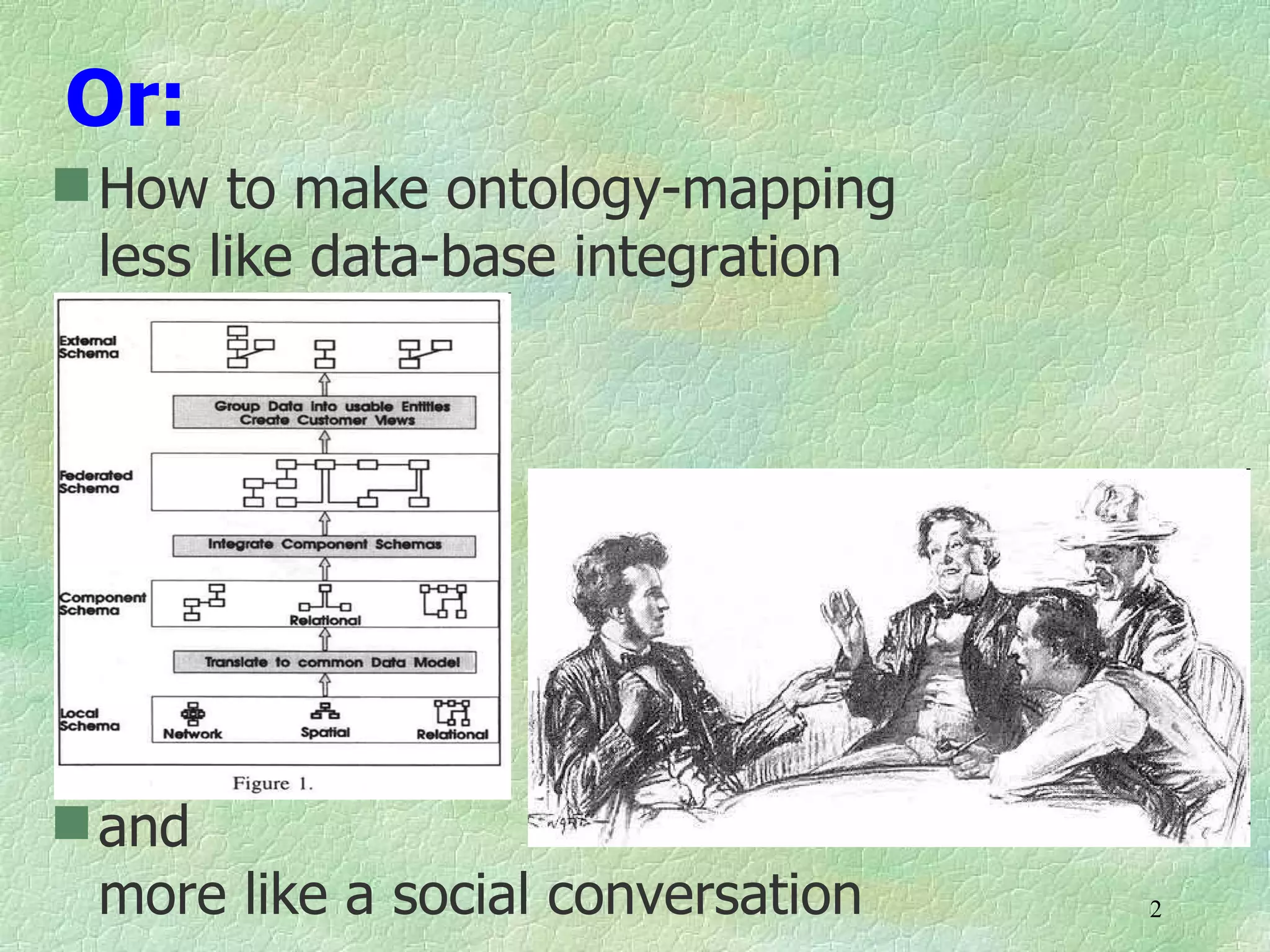
Or:
 How to make ontology-mapping
  less like data-base integration


 and
  more like a social conversation   2
Three
Two obvious intuitions
 The Semantic Web needs
  ontology mapping
 Ontology mapping needs
  background knowledge


 Ontology mapping needs approximation

                                         3
Which Semantic Web?
 Version 1:
  "Semantic Web as Web of Data" (TBL)


 recipe:
  expose databases on the web,
  use RDF, integrate
 meta-data from:
  q   expressing DB schema semantics
      in machine interpretable ways
 enable integration and unexpected re-use
                                        4
Which Semantic Web?
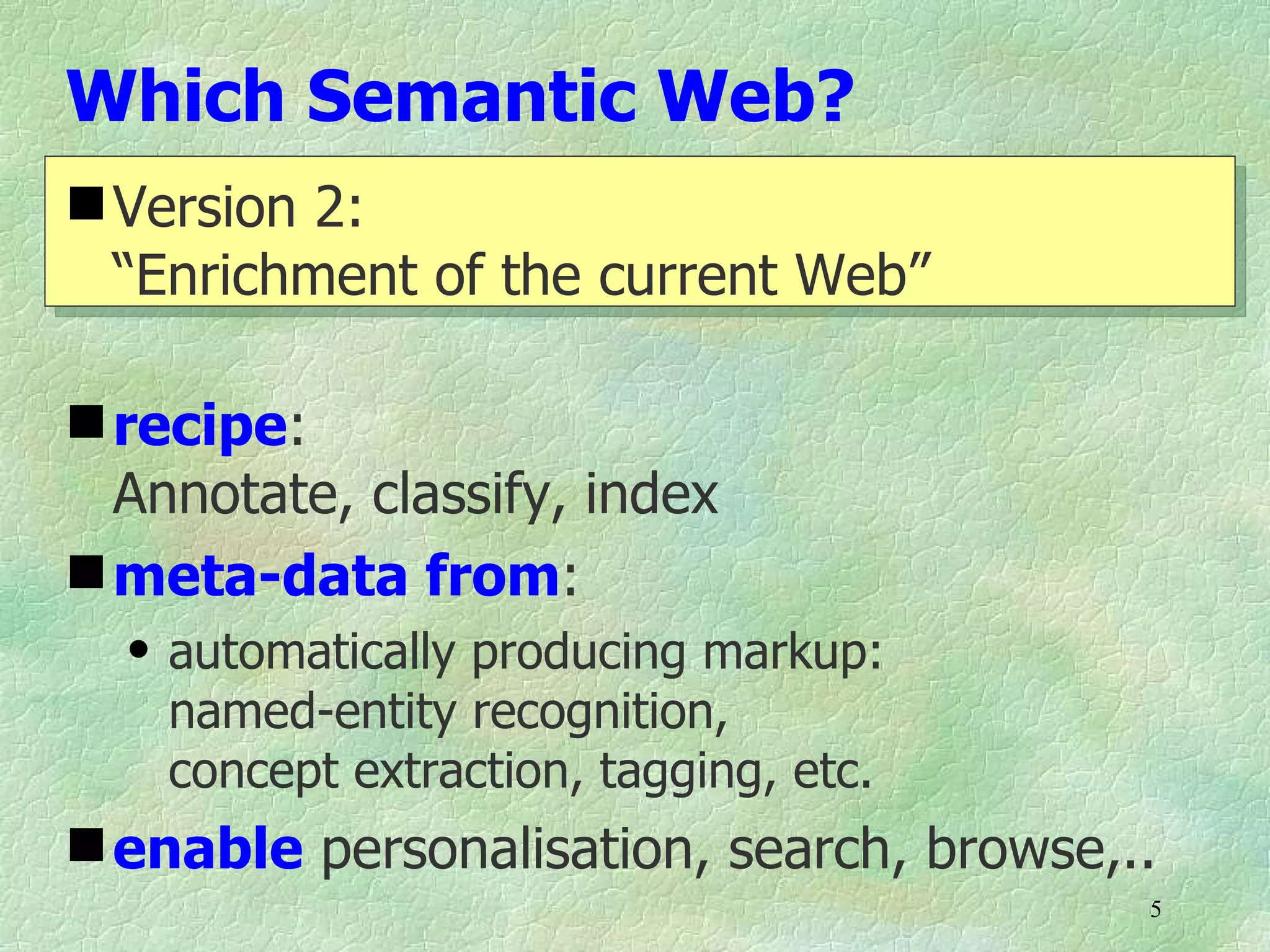
 Version 2:
  “Enrichment of the current Web”

 recipe:
  Annotate, classify, index
 meta-data from:
  q   automatically producing markup:
      named-entity recognition,
      concept extraction, tagging, etc.
 enable personalisation, search, browse,..
                                          5
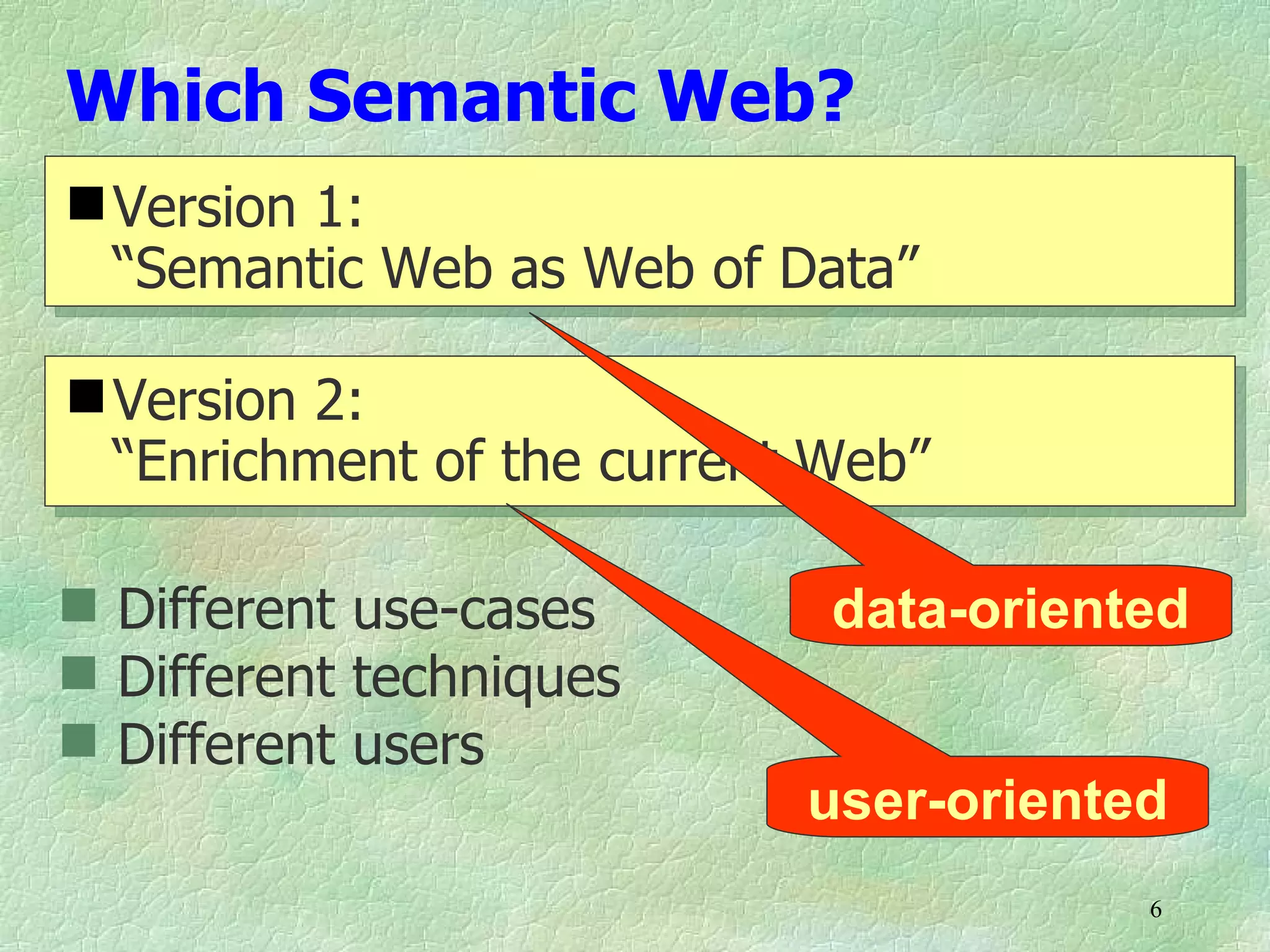
Which Semantic Web?
 Version 1:
  “Semantic Web as Web of Data”

 Version 2:
  “Enrichment of the current Web”

 Different use-cases        data-oriented
 Different techniques
 Different users
                            user-oriented
                                        6
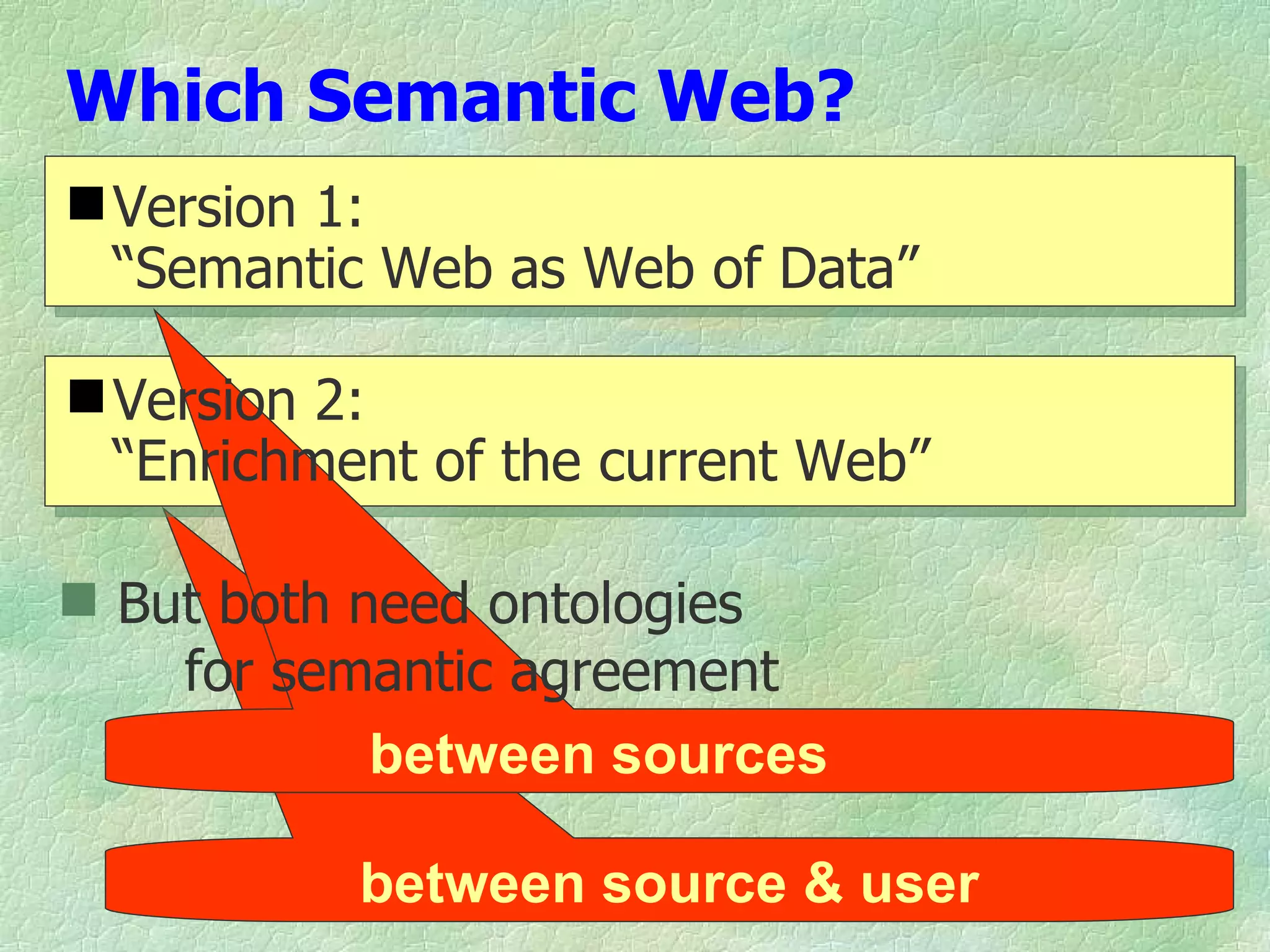
Which Semantic Web?
 Version 1:
  “Semantic Web as Web of Data”

 Version 2:
  “Enrichment of the current Web”

 But both need ontologies
    for semantic agreement
            between sources

           between source & user    7

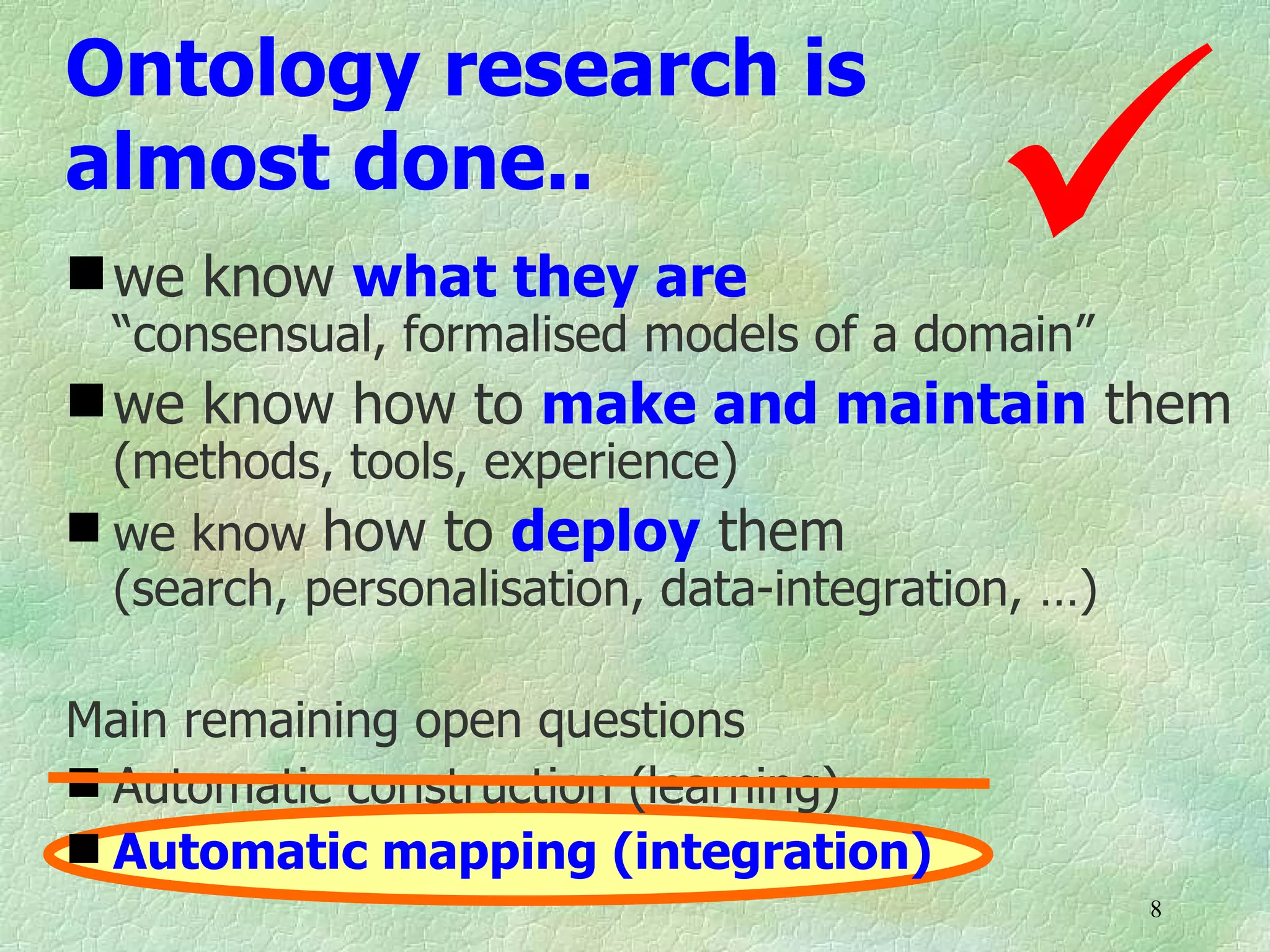
Ontology research is
almost done..
 we know what they are
  “consensual, formalised models of a domain”
 we know how to make and maintain them
  (methods, tools, experience)
 we know how to deploy them
  (search, personalisation, data-integration, …)

Main remaining open questions
 Automatic construction (learning)
 Automatic mapping (integration)
                                                   8
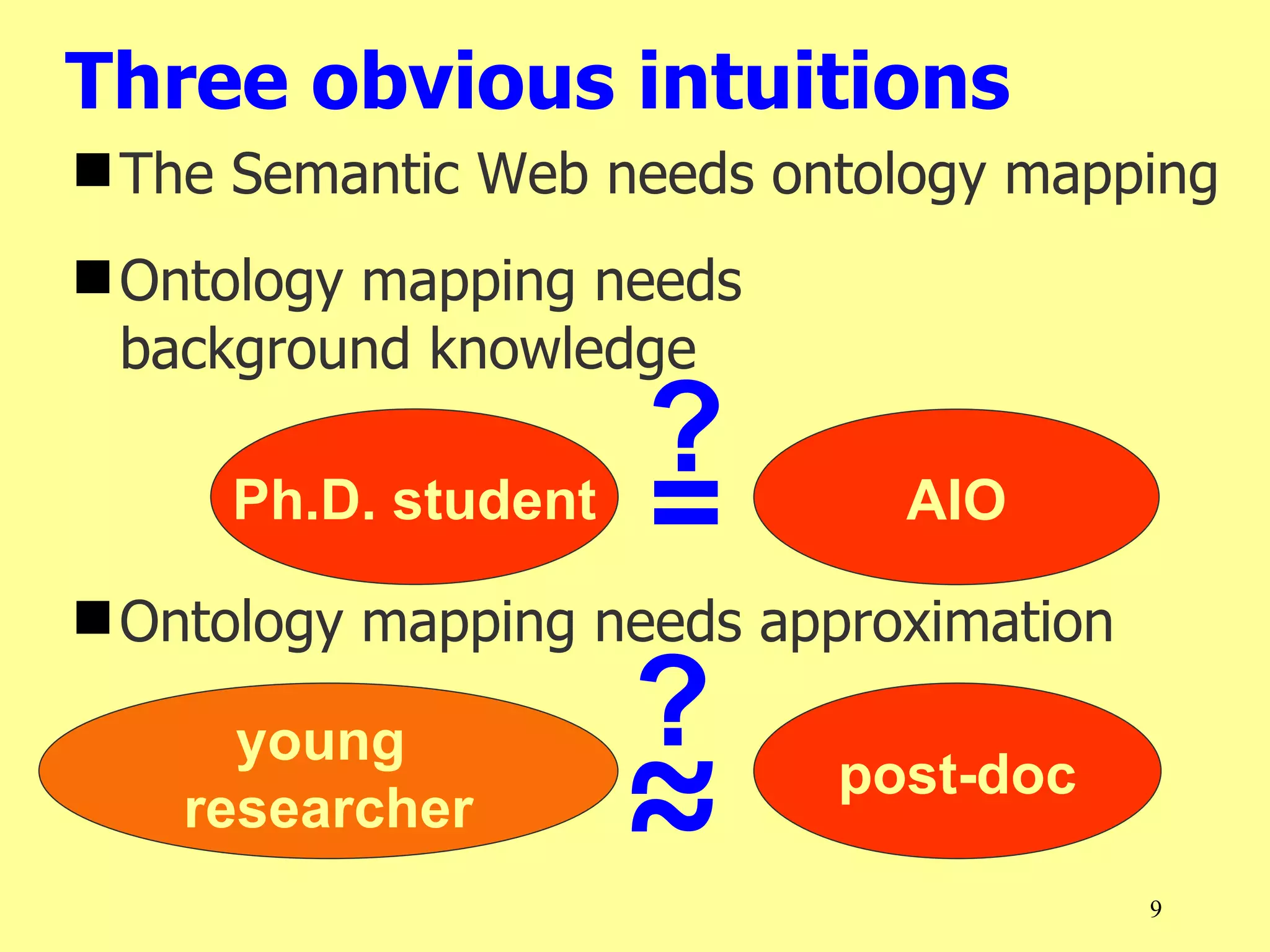
Three obvious intuitions
 The Semantic Web needs ontology mapping
 Ontology mapping needs
  background knowledge
                     ?
     Ph.D. student   =        AIO

 Ontology mapping needs approximation

      young          ?
    researcher       ≈     post-doc

                                         9
This work with
Zharko Aleksovski &
   Michel Klein
Does context knowledge help
mapping?
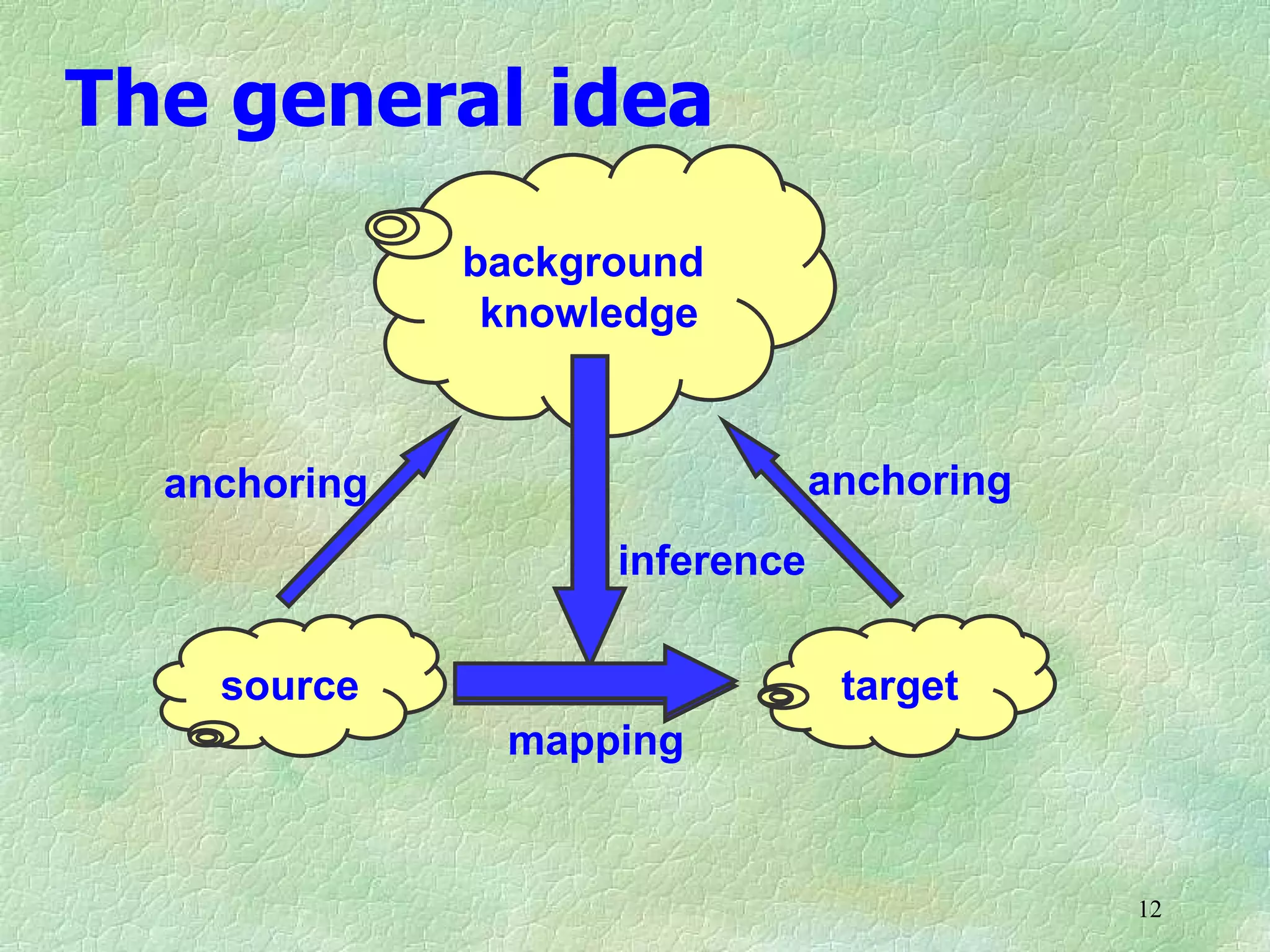
The general idea
              background
               knowledge


  anchoring                     anchoring
                    inference

    source                       target
               mapping


                                            12
a realistic example
 Two Amsterdam hospitals (OLVG, AMC)
 Two Intensive Care Units, different vocab’s
 Want to compare quality of care
 OLVG-1400:
   q   1400 terms in a flat list
   q   used in the first 24 hour of stay
   q   some implicit hierarchy e.g.6 types of Diabetes
       Mellitus)
   q   some reduncy (spelling mistakes)
 AMC: similar list, but from different hospital

                                                         13
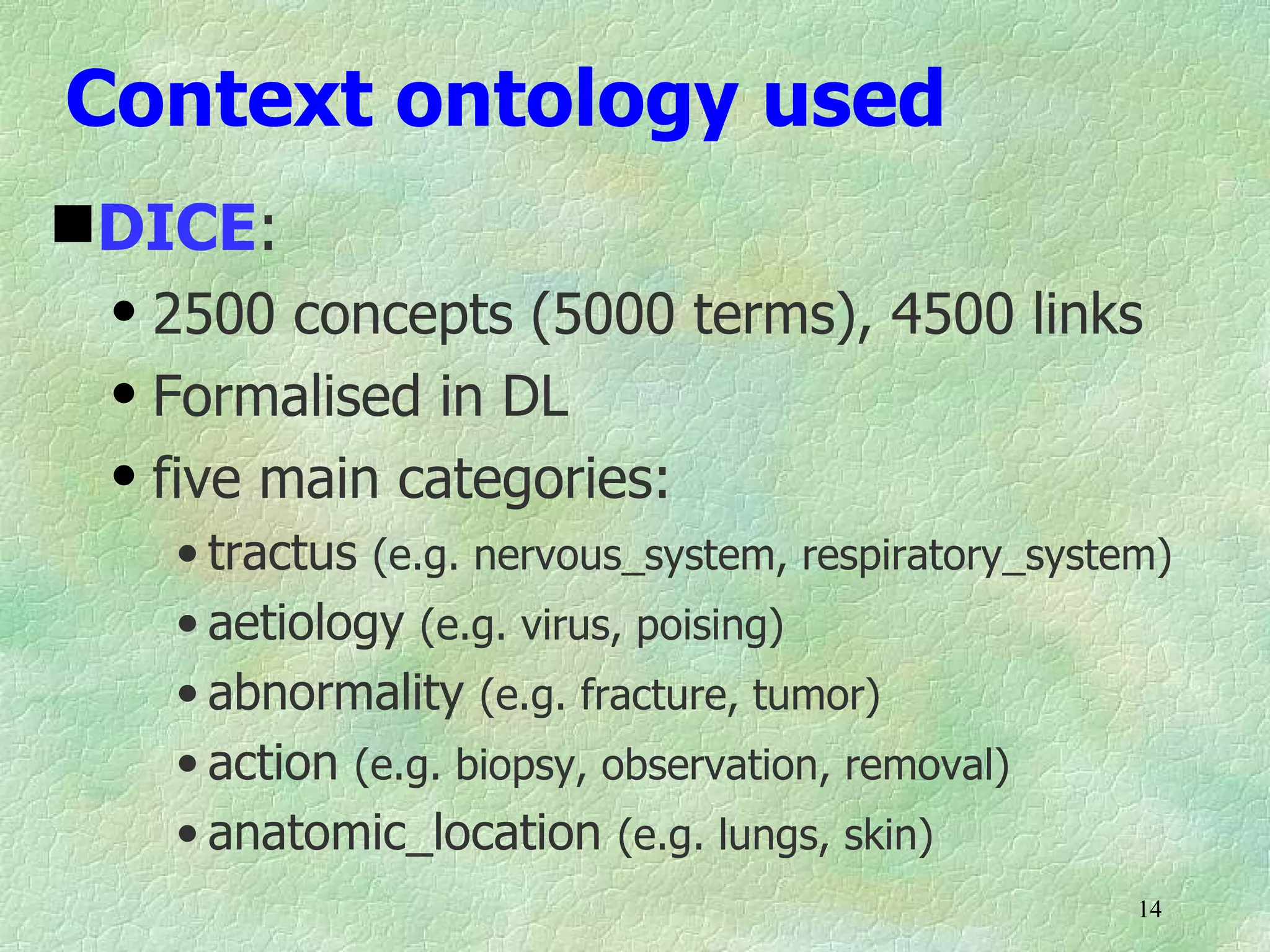
Context ontology used
DICE:
 q   2500 concepts (5000 terms), 4500 links
 q   Formalised in DL
 q   five main categories:
     • tractus (e.g. nervous_system, respiratory_system)
     • aetiology (e.g. virus, poising)
     • abnormality (e.g. fracture, tumor)
     • action (e.g. biopsy, observation, removal)
     • anatomic_location (e.g. lungs, skin)
                                                      14
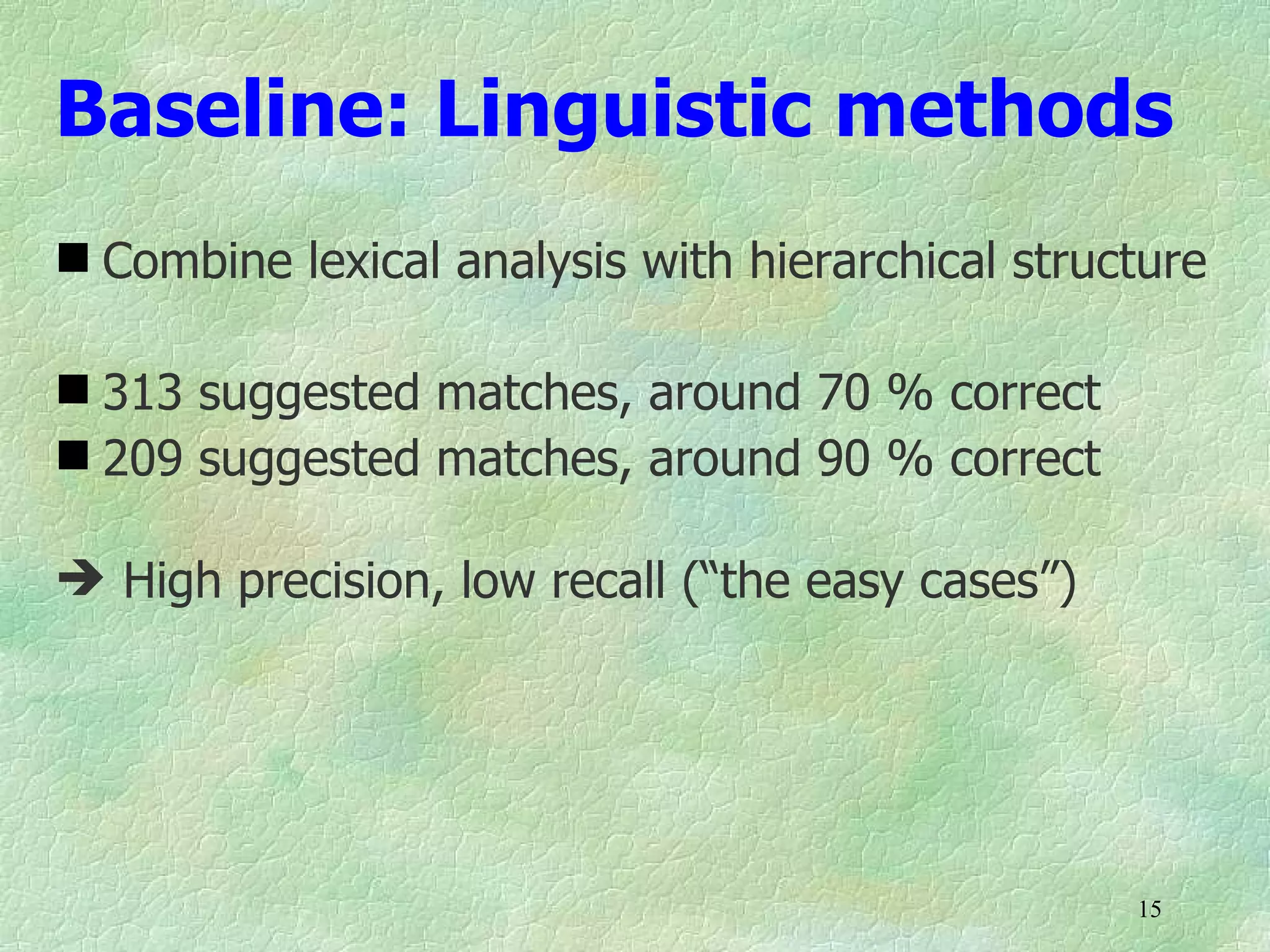
Baseline: Linguistic methods
 Combine lexical analysis with hierarchical structure

 313 suggested matches, around 70 % correct
 209 suggested matches, around 90 % correct

 High precision, low recall (“the easy cases”)


                                                  15
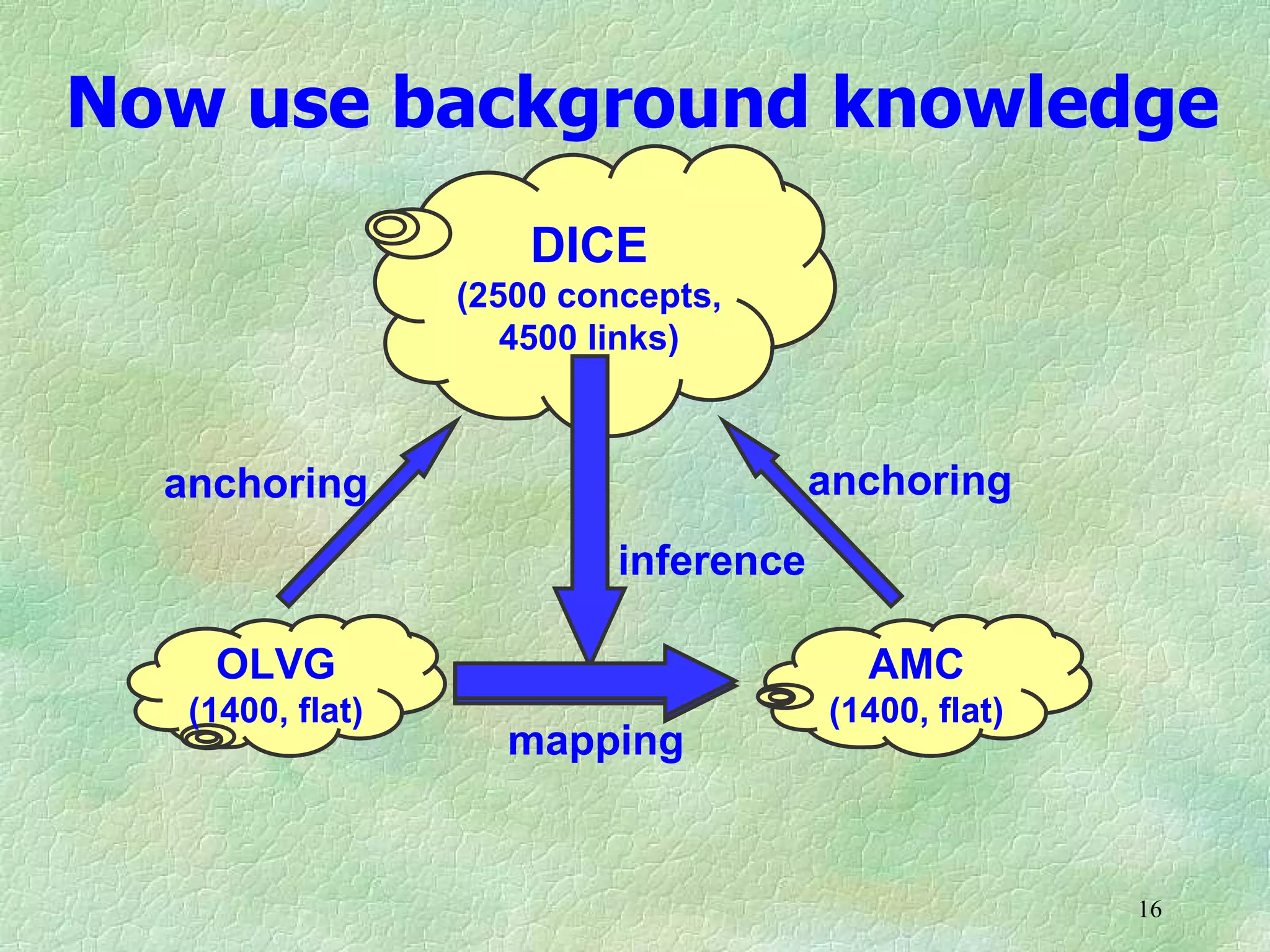
Now use background knowledge
                      DICE
                  (2500 concepts,
                     4500 links)


  anchoring                            anchoring
                           inference

    OLVG                                 AMC
   (1400, flat)                        (1400, flat)
                    mapping


                                                      16
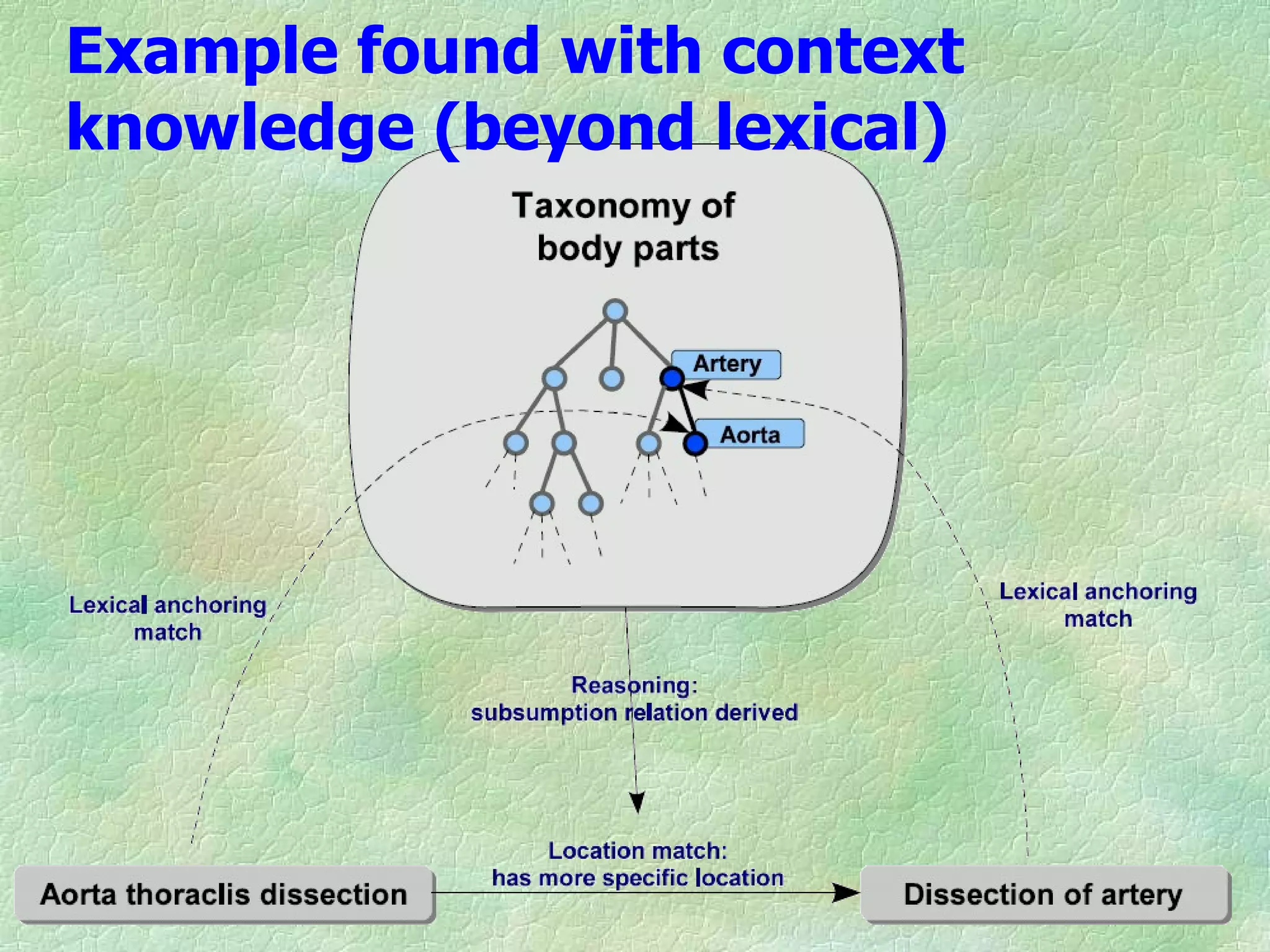
Example found with context
knowledge (beyond lexical)


                             17
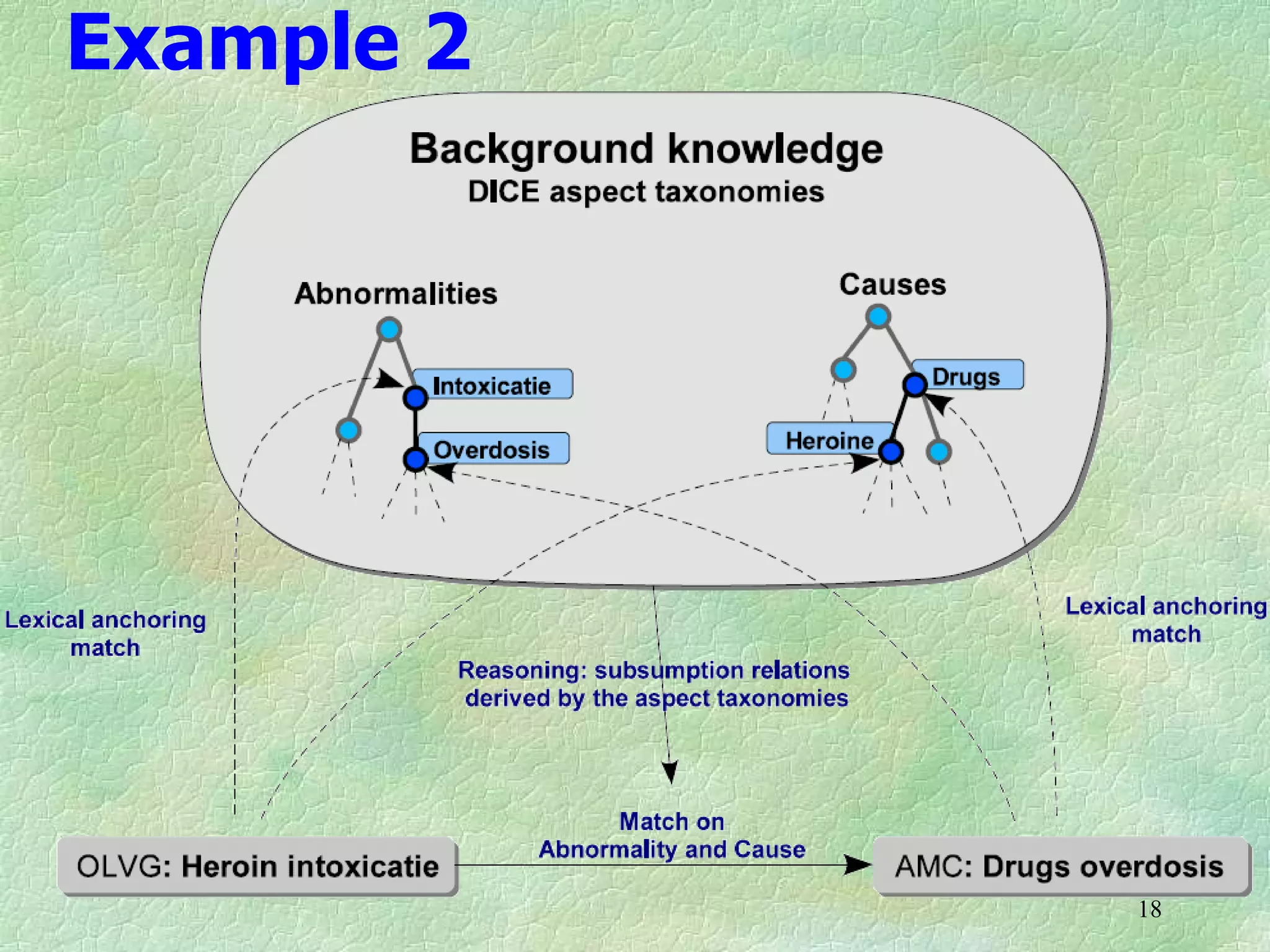
Example 2


            18
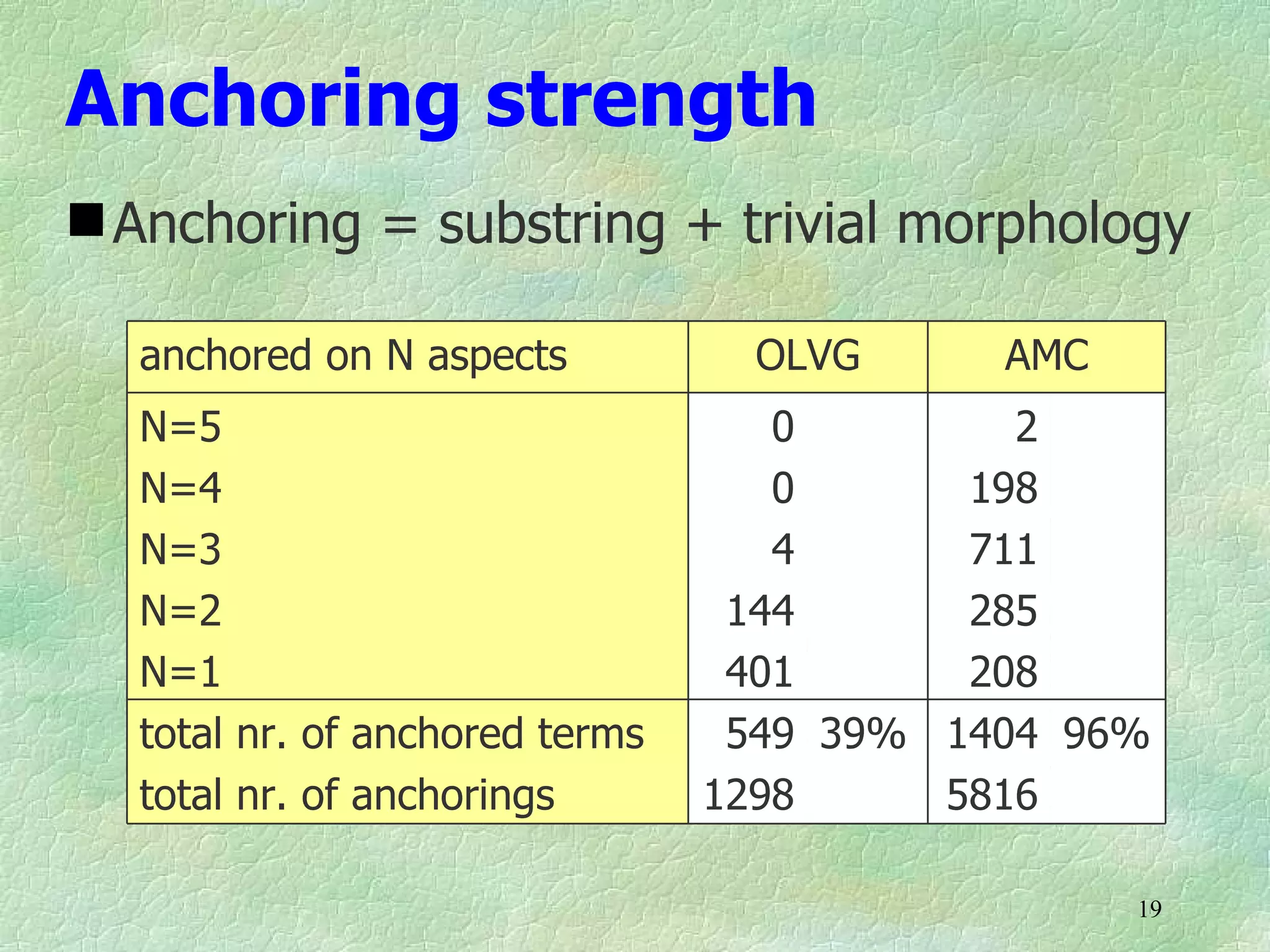
Anchoring strength
 Anchoring = substring + trivial morphology

  anchored on N aspects           OLVG     AMC
  N=5                              0        2
  N=4                              0      198
  N=3                              4      711
  N=2                            144      285
  N=1                            401      208
  total nr. of anchored terms    549 39% 1404 96%
  total nr. of anchorings       1298     5816

                                                 19
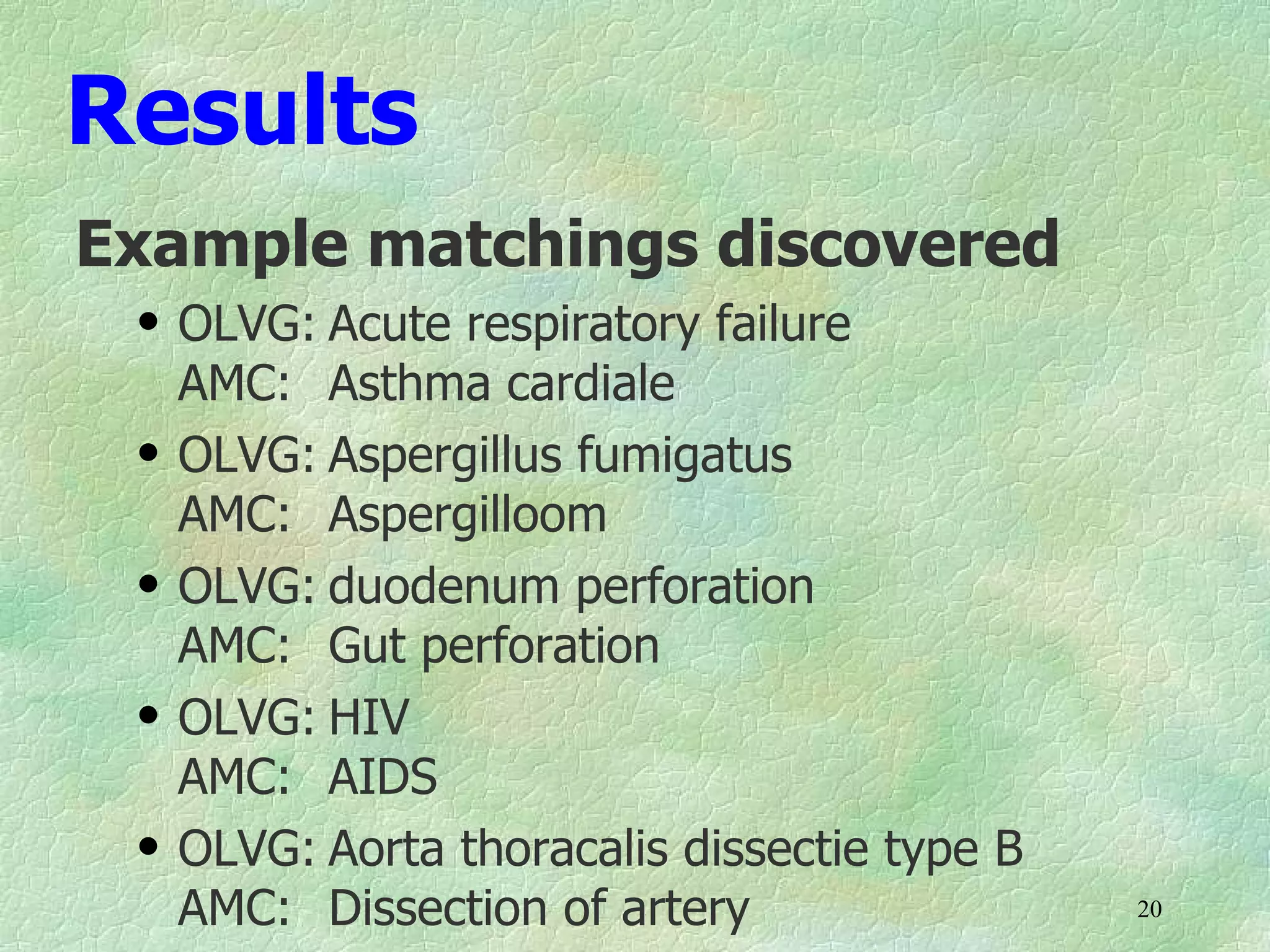
Results
Example matchings discovered
 q   OLVG: Acute respiratory failure
     AMC: Asthma cardiale
 q   OLVG: Aspergillus fumigatus
     AMC: Aspergilloom
 q   OLVG: duodenum perforation
     AMC: Gut perforation
 q   OLVG: HIV
     AMC: AIDS
 q   OLVG: Aorta thoracalis dissectie type B
     AMC: Dissection of artery                 20
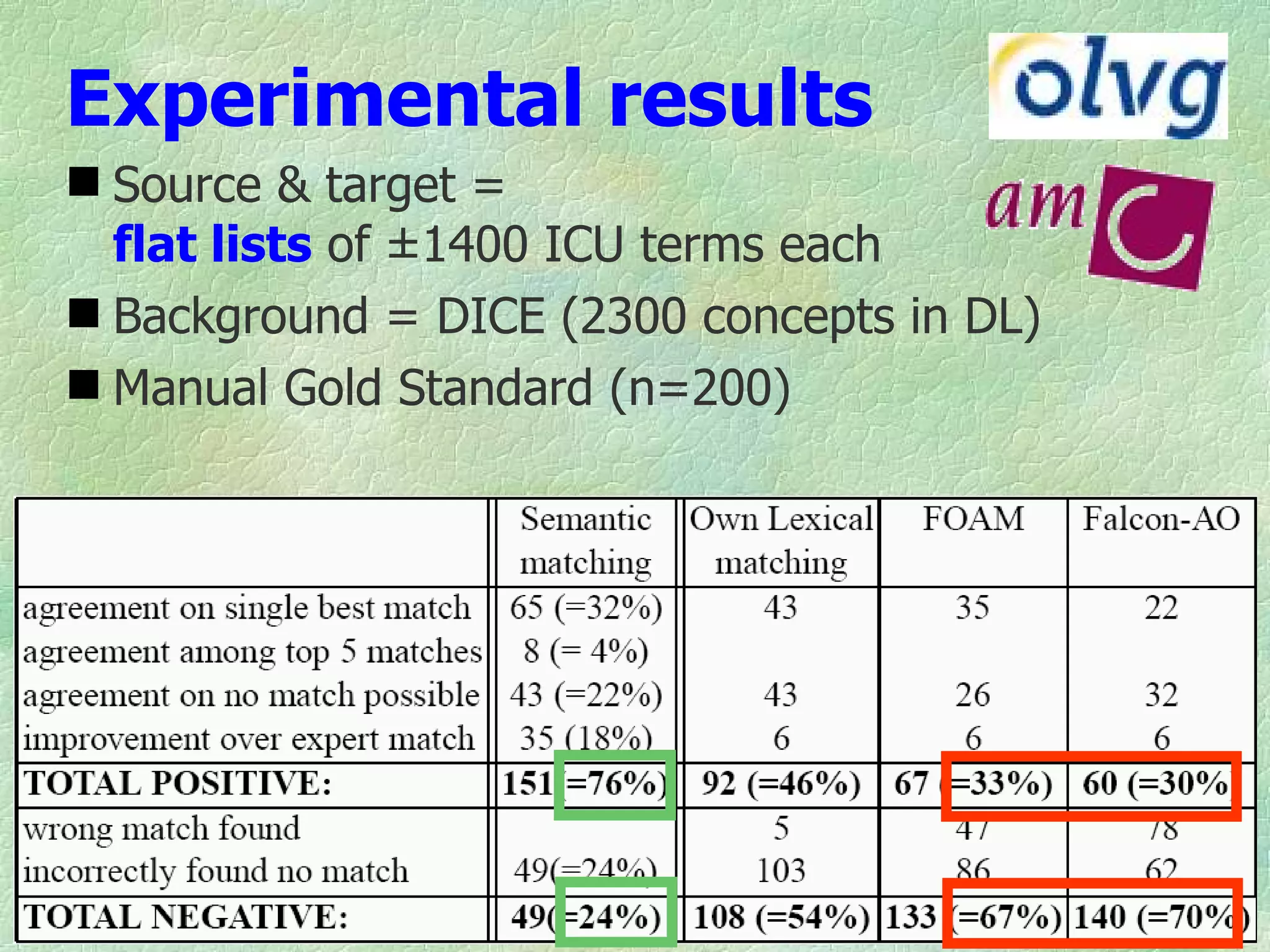
Experimental results
 Source & target =
  flat lists of ±1400 ICU terms each
 Background = DICE (2300 concepts in DL)
 Manual Gold Standard (n=200)


                                            21
Does more context
knowledge help?
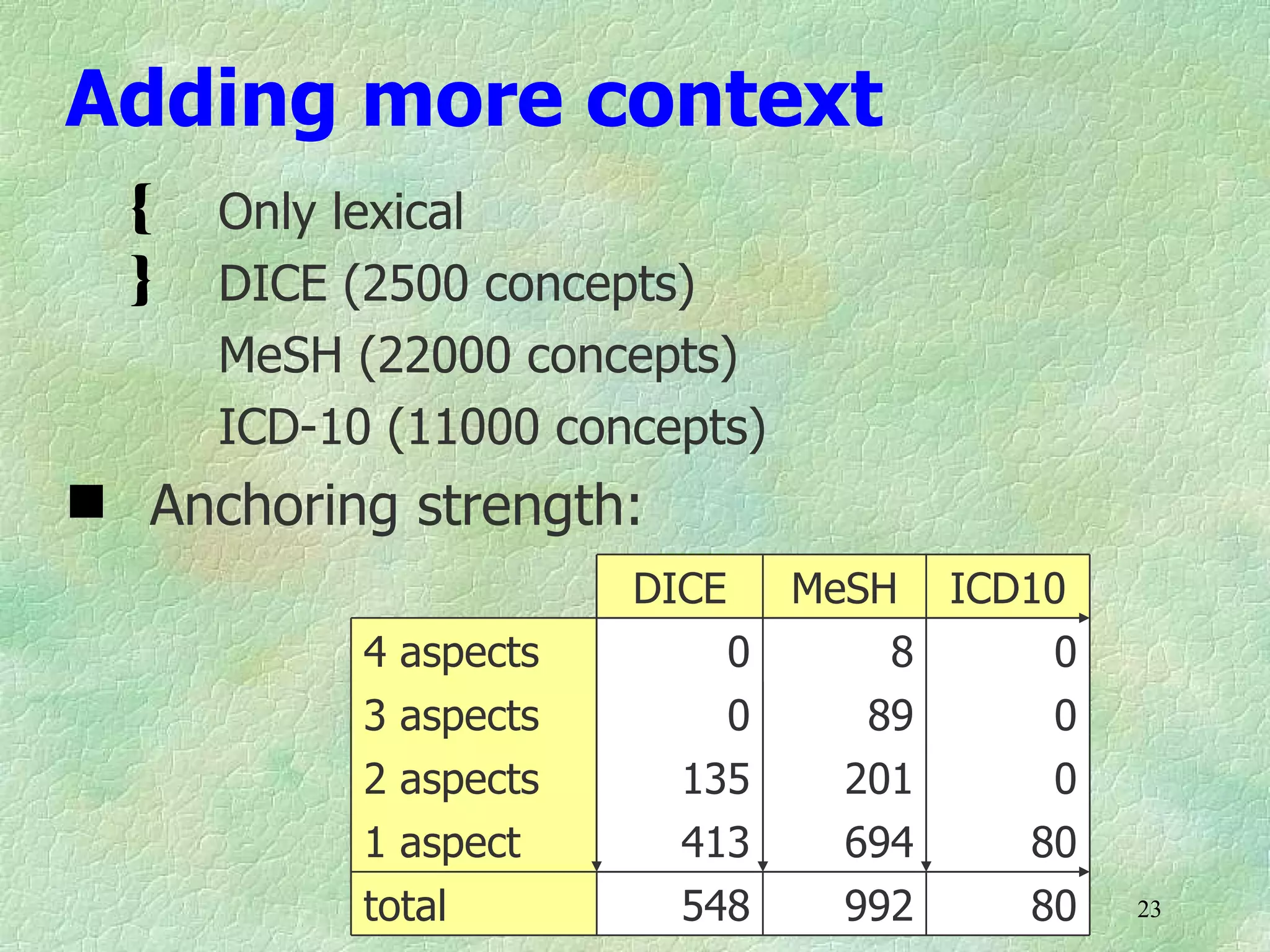
Adding more context
     Only lexical
     DICE (2500 concepts)
     MeSH (22000 concepts)
     ICD-10 (11000 concepts)
 Anchoring strength:
                       DICE    MeSH ICD10
           4 aspects       0       8    0
           3 aspects       0      89    0
           2 aspects     135     201    0
           1 aspect      413     694   80
           total         548     992   80   23
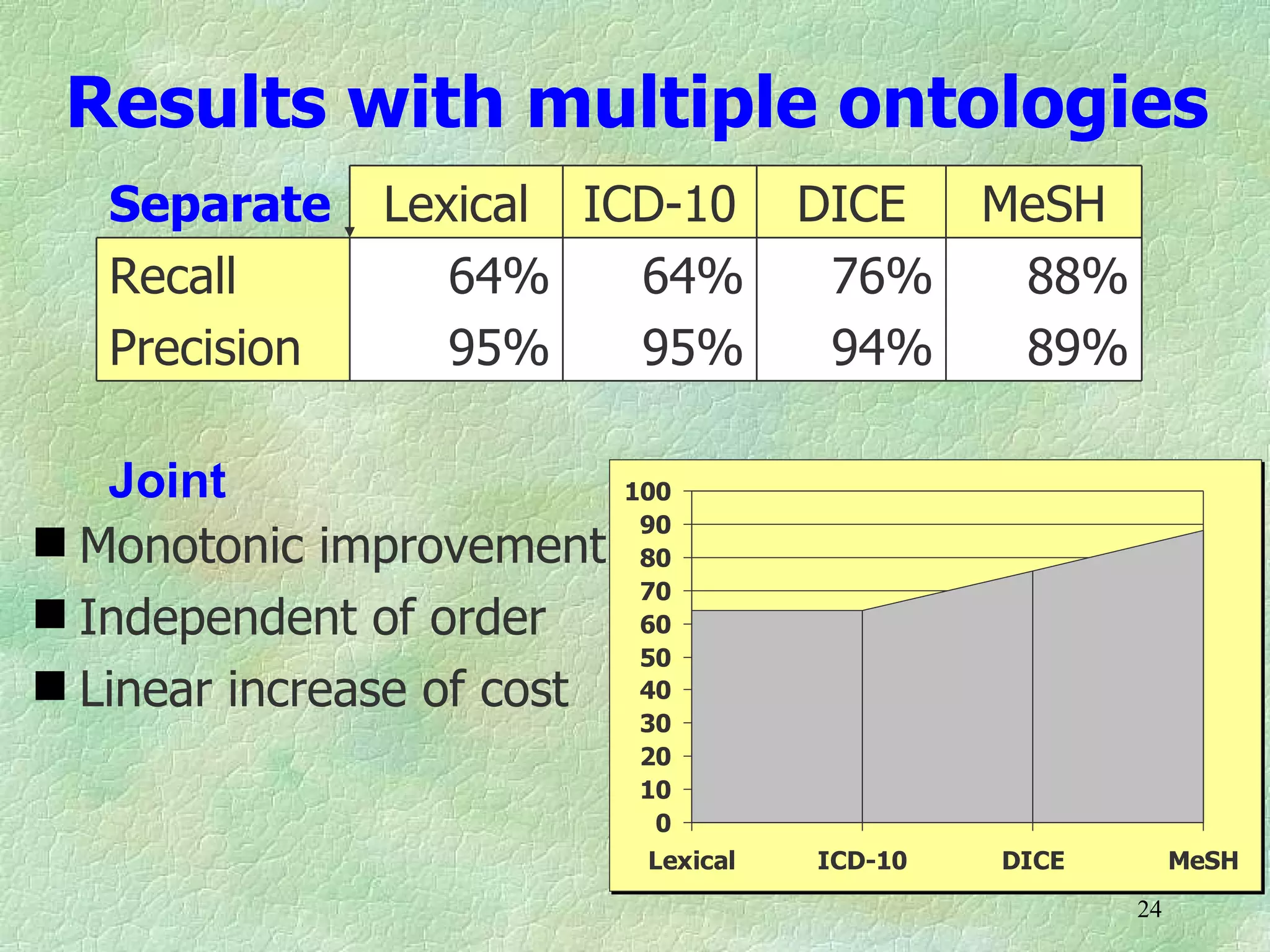
Results with multiple ontologies
   Separate    Lexical ICD-10          DICE MeSH
   Recall         64%    64%            76%  88%
   Precision      95%    95%            94%  89%

   Joint                    100
                             90
 Monotonic improvement      80
                             70
 Independent of order       60
                             50
 Linear increase of cost    40
                             30
                             20
                             10
                              0
                             Lexical   ICD-10   DICE        MeSH
                                                       24
does structured context
knowledge help?
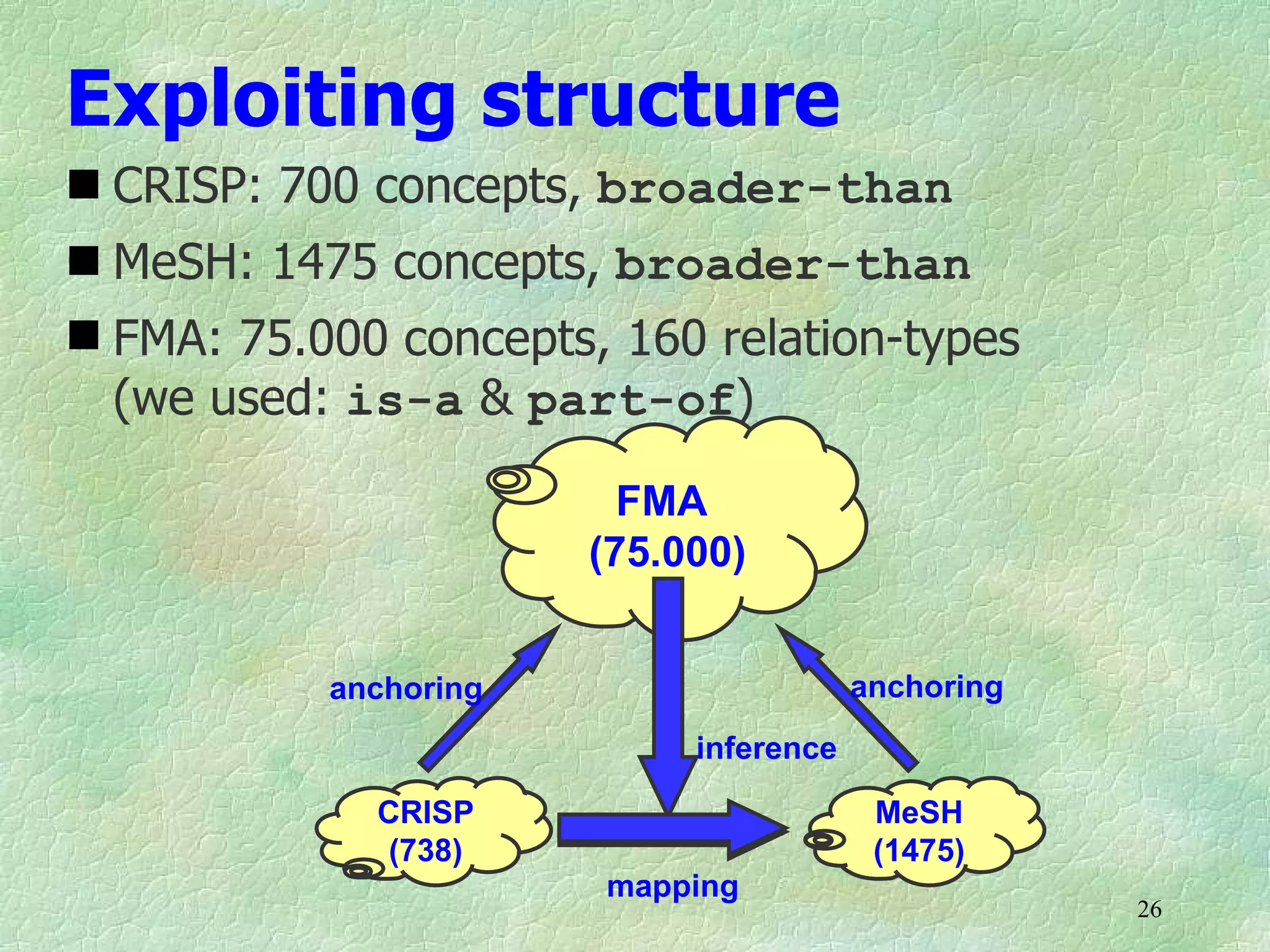
Exploiting structure
 CRISP: 700 concepts, broader-than
 MeSH: 1475 concepts, broader-than
 FMA: 75.000 concepts, 160 relation-types
  (we used: is-a & part-of)

                         FMA
                       (75.000)


           anchoring                    anchoring
                            inference

             CRISP                       MeSH
              (738)                      (1475)
                       mapping
                                                    26
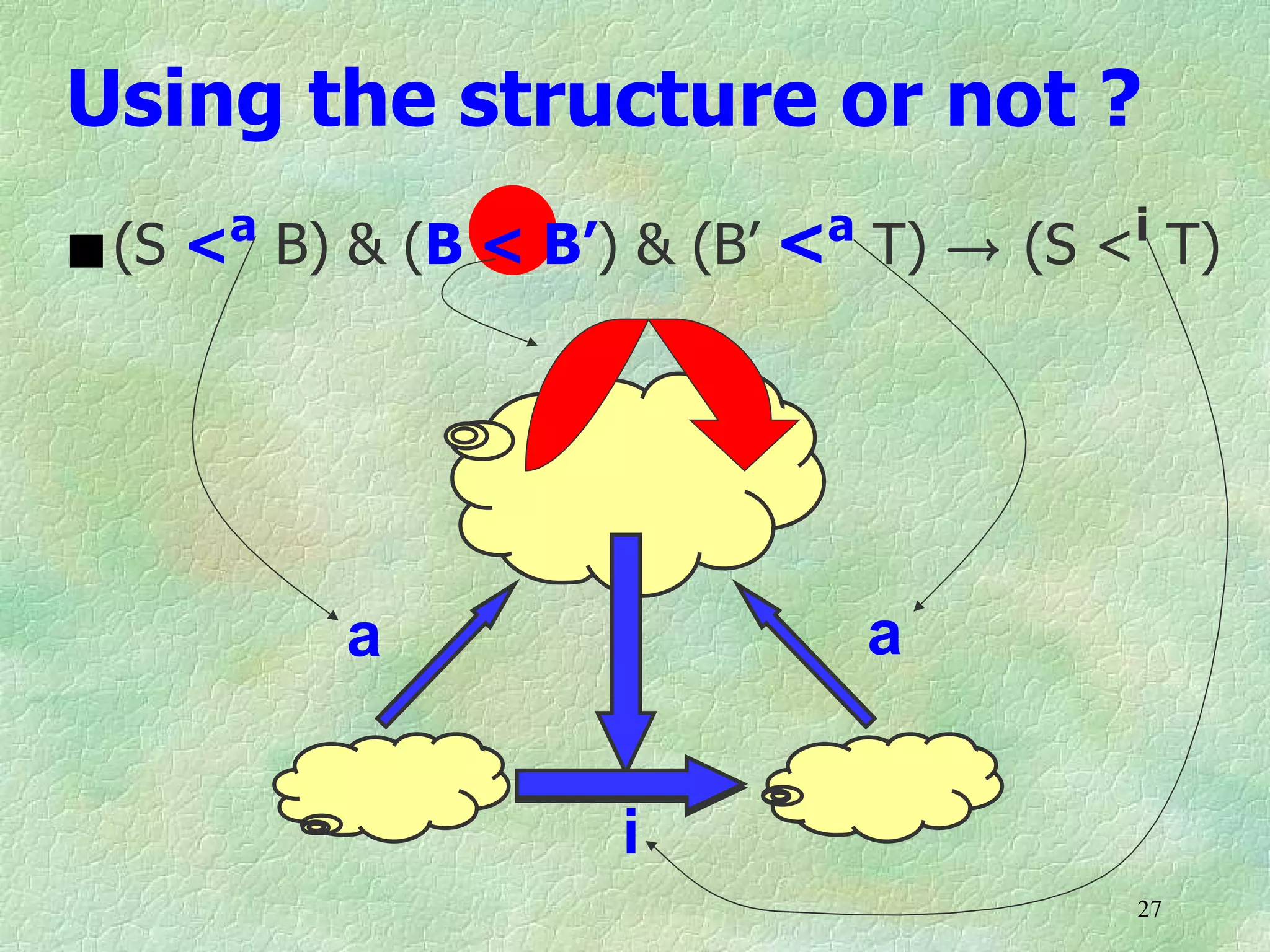
Using the structure or not ?
 (S <a B) & (B < B’) & (B’ <a T) ! (S <i T)


          a                   a


                     i
                                        27
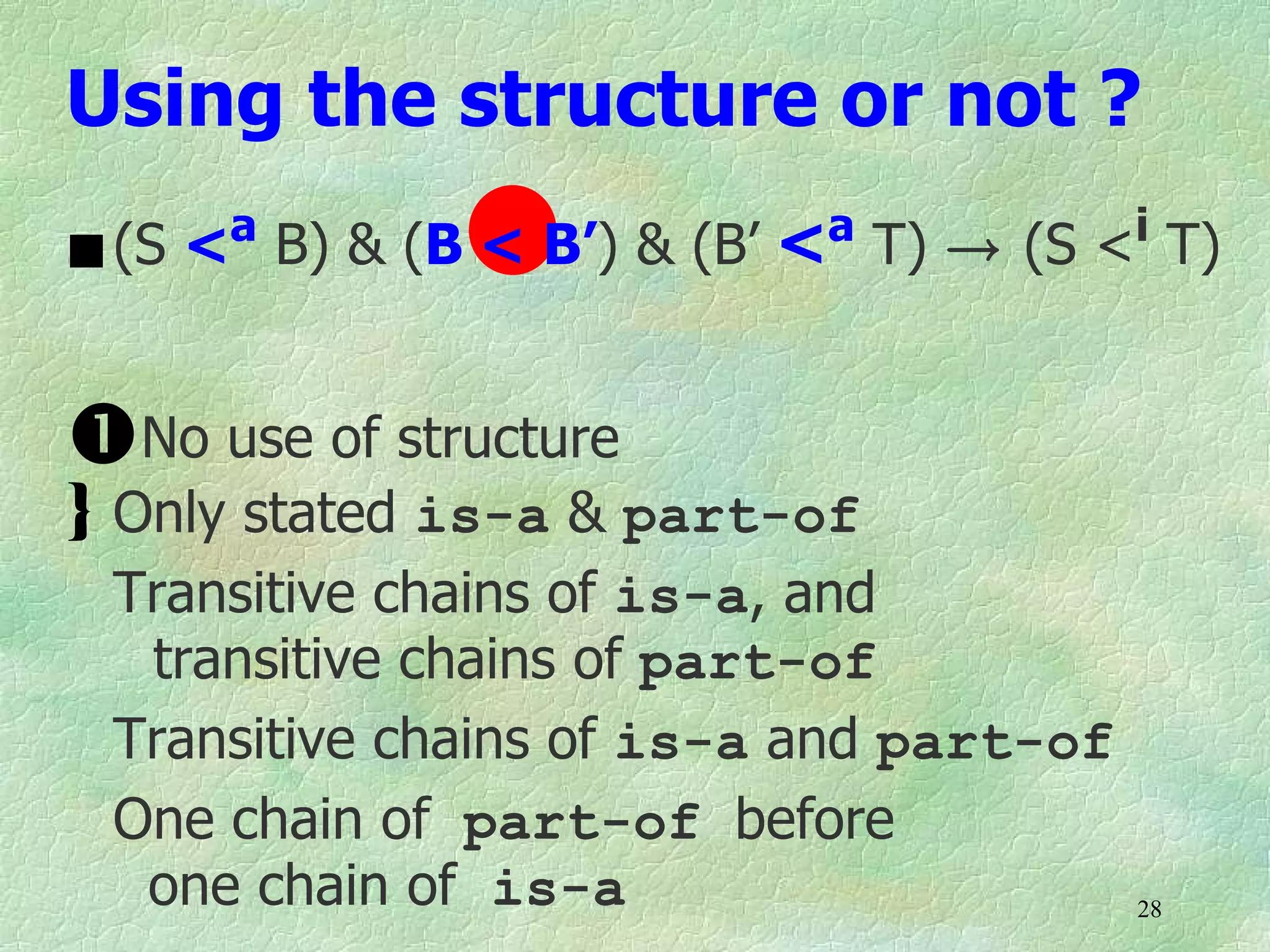
Using the structure or not ?
 (S <a B) & (B < B’) & (B’ <a T) ! (S <i T)


No use of structure
 Only stated is-a & part-of
 Transitive chains of is-a, and
  transitive chains of part-of
 Transitive chains of is-a and part-of
 One chain of part-of before
  one chain of is-a                      28
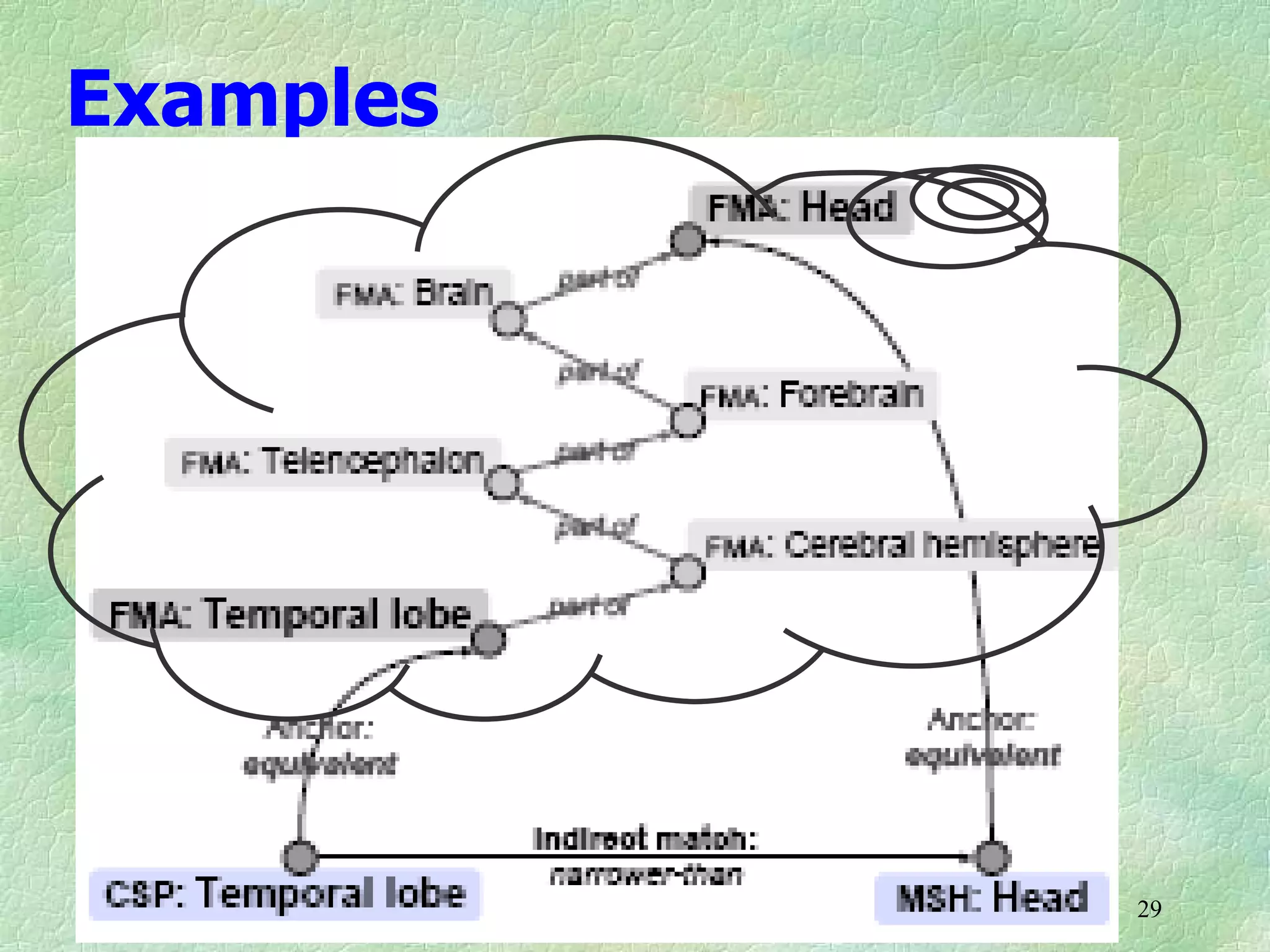
Examples


           29
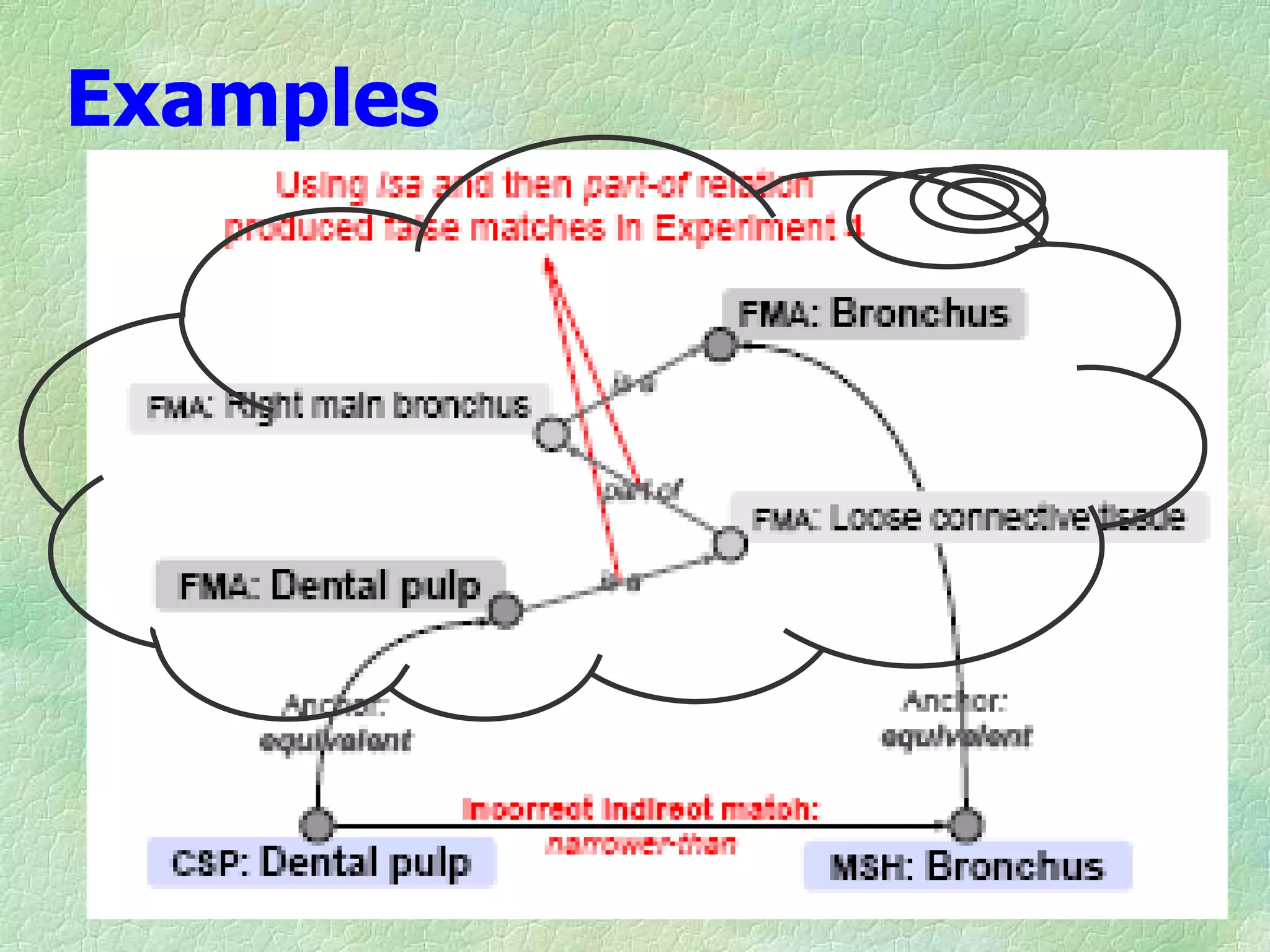
Examples


           30
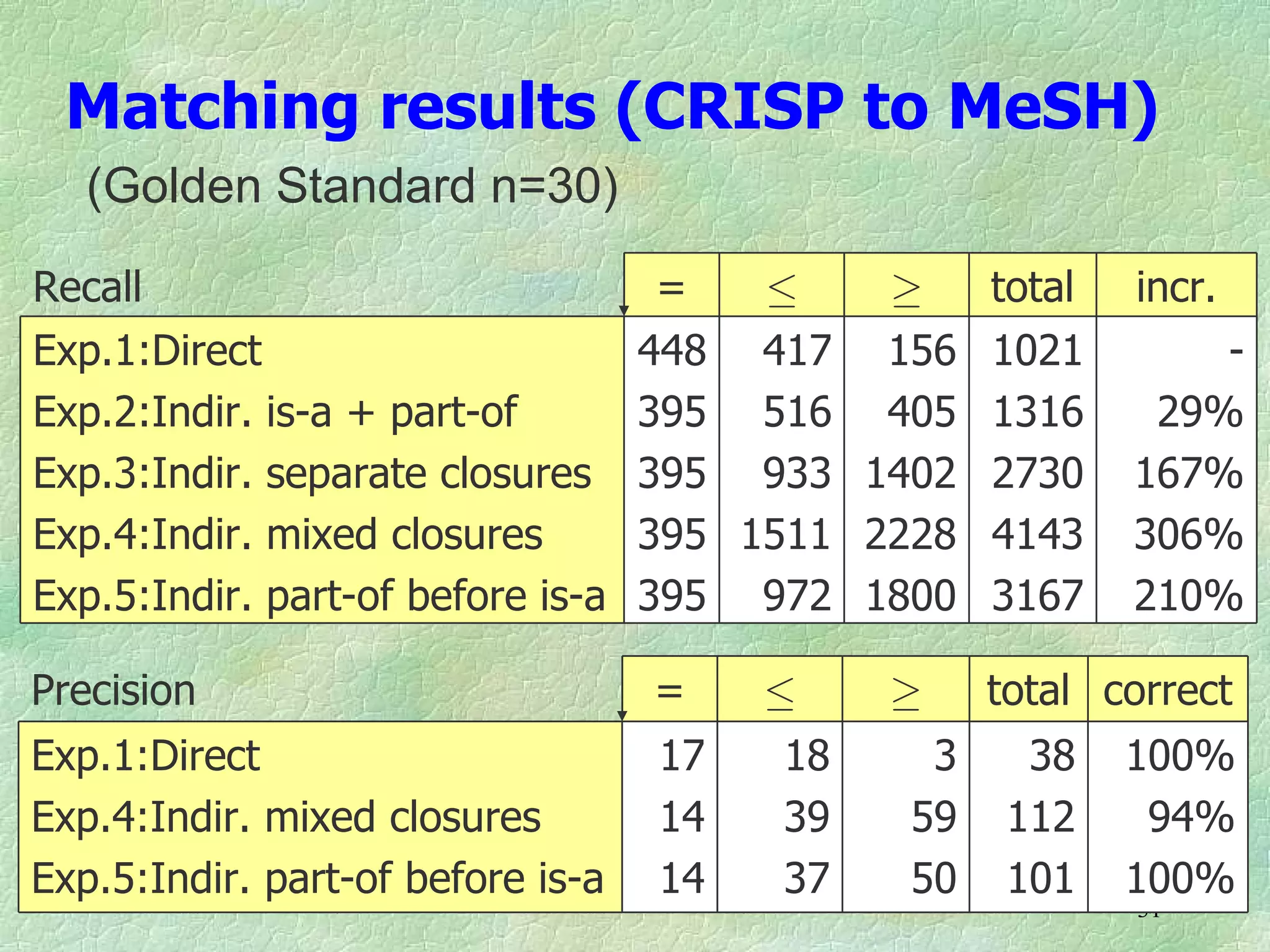
Matching results (CRISP to MeSH)
   (Golden Standard n=30)

Recall                              =   ·    ¸     total   incr.
Exp.1:Direct                       448 417 156     1021        -
Exp.2:Indir. is-a + part-of        395 516 405     1316     29%
Exp.3:Indir. separate closures     395 933 1402    2730    167%
Exp.4:Indir. mixed closures        395 1511 2228   4143    306%
Exp.5:Indir. part-of before is-a   395 972 1800    3167    210%

Precision                          =    ·    ¸     total correct
Exp.1:Direct                       17   18     3     38    100%
Exp.4:Indir. mixed closures        14   39    59    112     94%
Exp.5:Indir. part-of before is-a   14   37    50    101    100%
                                                           31
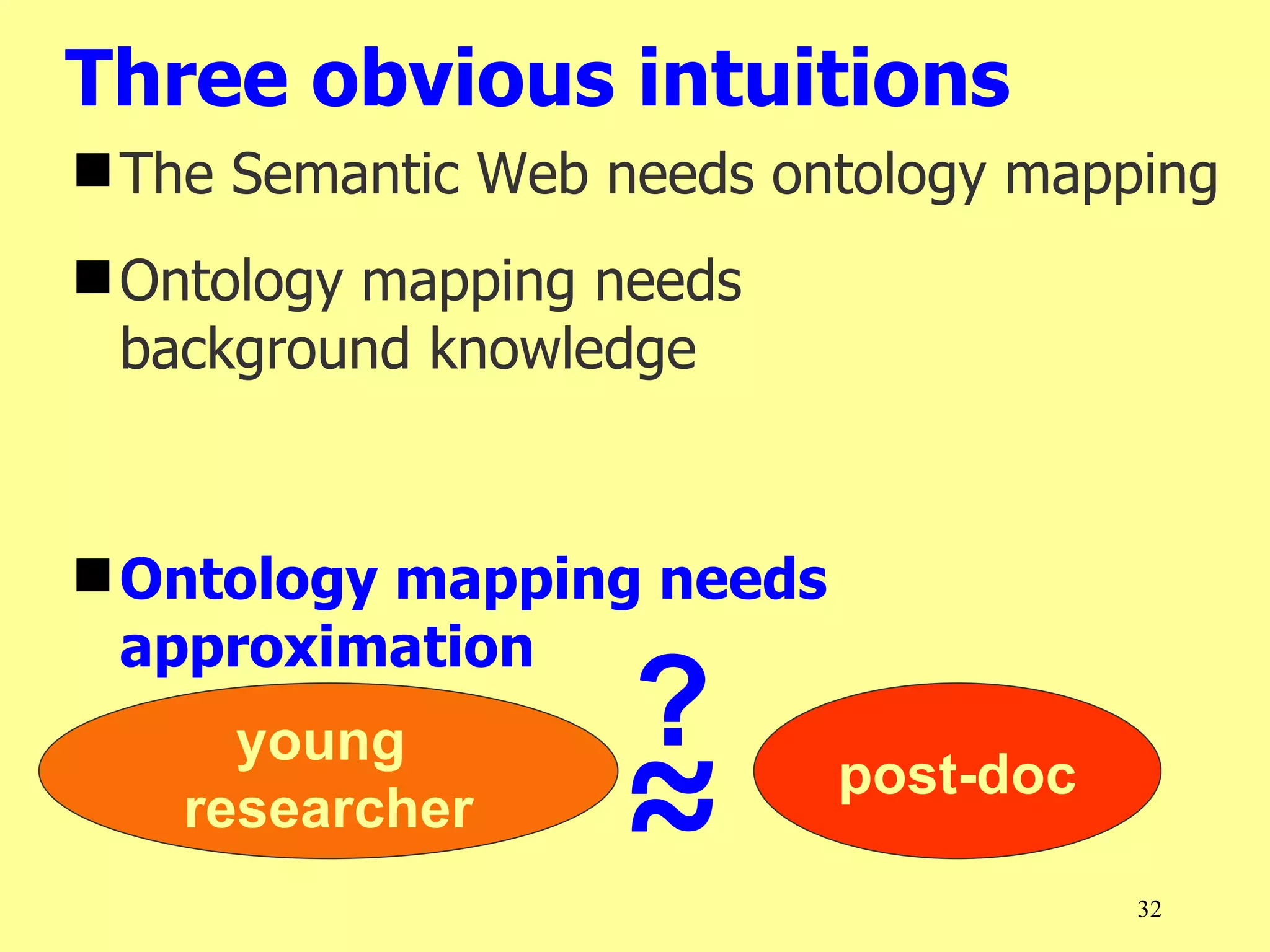
Three obvious intuitions
 The Semantic Web needs ontology mapping
 Ontology mapping needs
  background knowledge


 Ontology mapping needs
  approximation
      young        ?
    researcher     ≈       post-doc

                                      32
This work with
Zharko Aleksovski
  Risto Gligorov
 Warner ten Kate
Approximating subsumptions
  (and hence mappings)
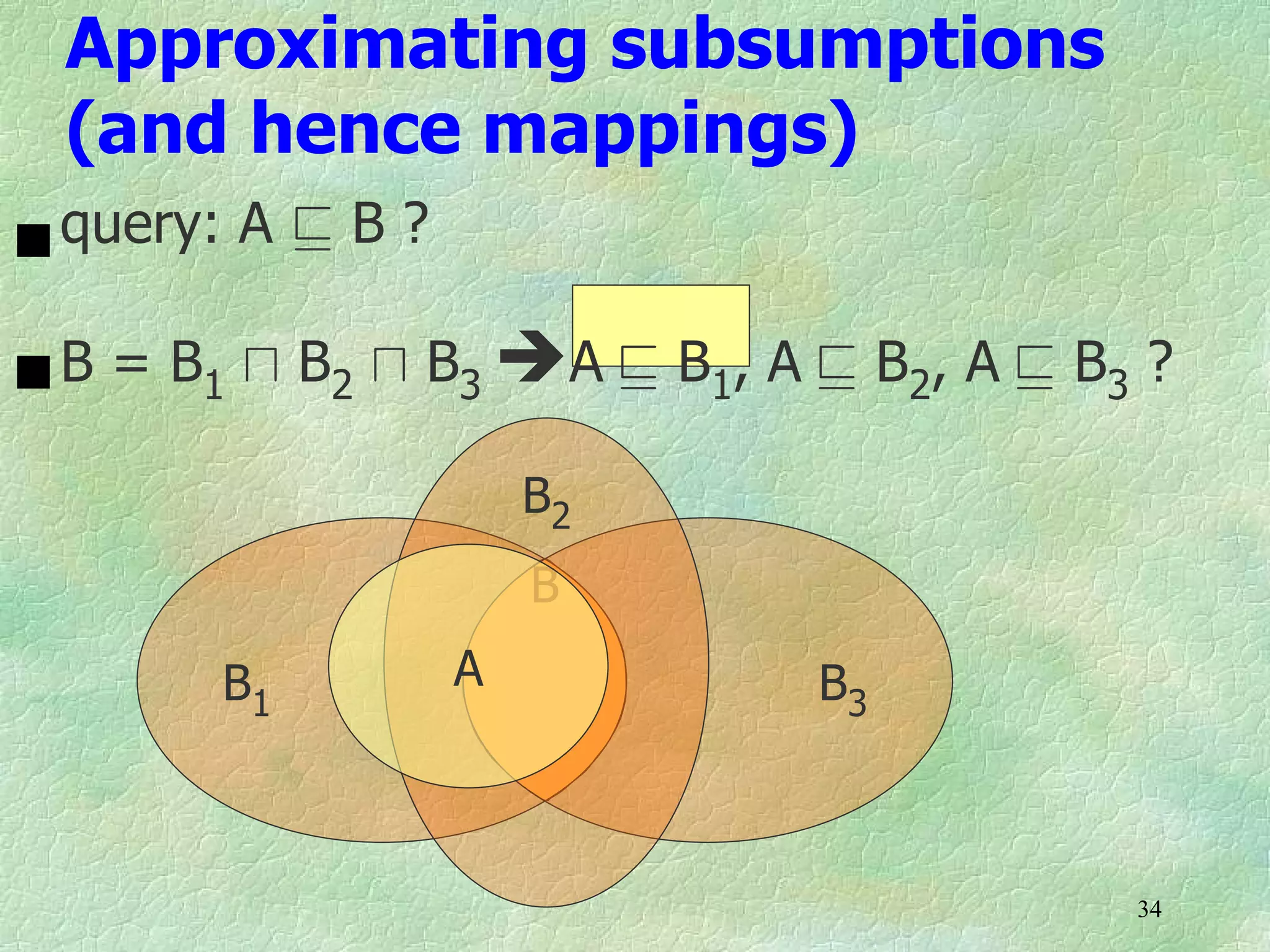
 query: A v B ?

 B = B1 u B2 u B3 A v B1, A v B2, A v B3 ?

                       B2
                       B
        B1         A          B3


                                          34
Approximating subsumptions
                                        bi lity
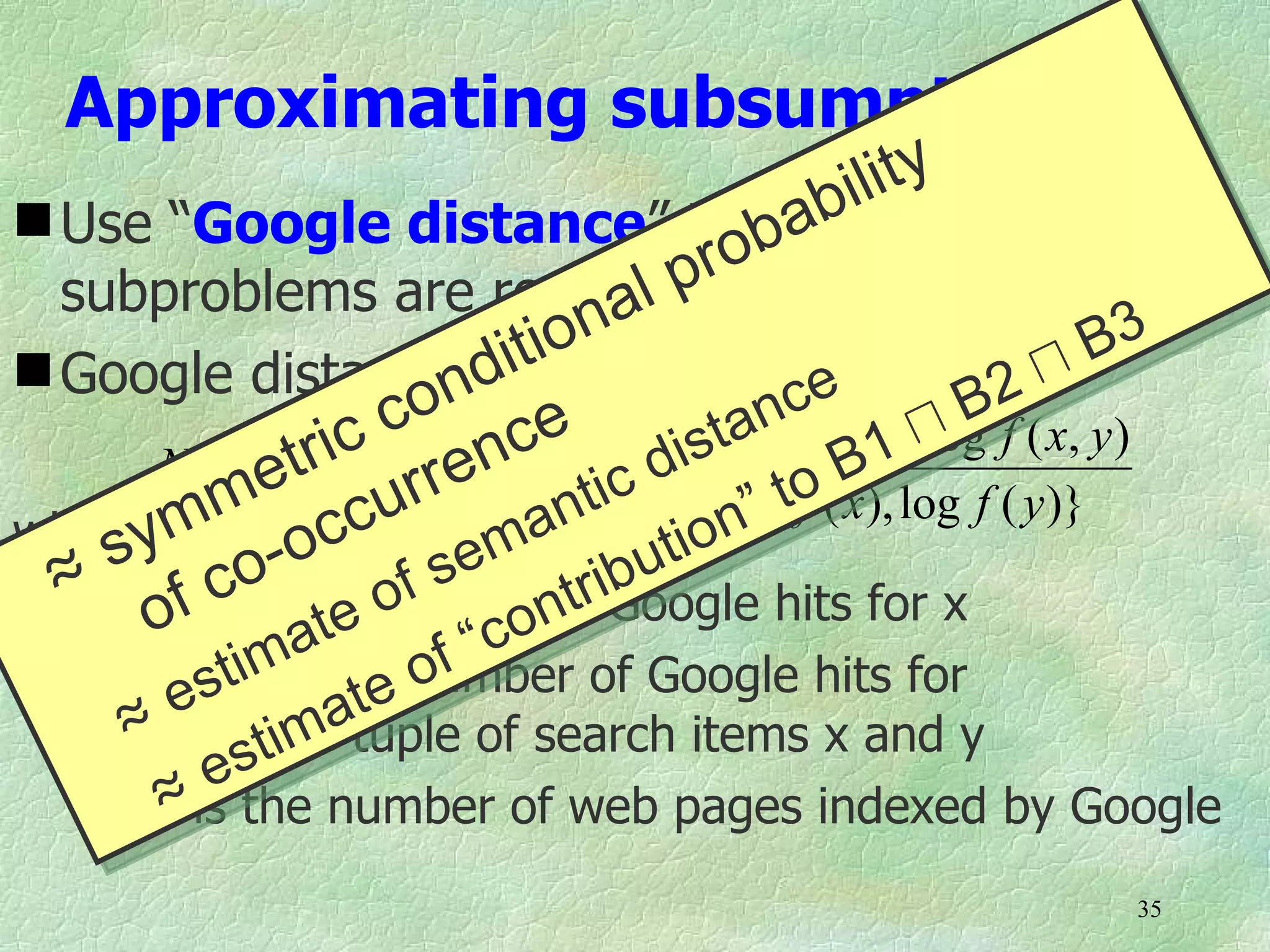
 Use “Google distance” to decide whichba
  subproblems are reasonable    al pro to focus on
 Google distancendit
                            ion                           B3
                                         e         2u
                     co ce f ( x),stanfc y )} −u B f ( x, y )
       NGD( xt,  ryc = max{log c di log o B1 log
                  i ) en                (

wherey
          me ccurr log anti min{logt f ( x), log f ( y )}
        m o                 M−       n”
    s       o -          em ibutio
 ≈ f(x)cis the number ntr Google hits for x
                      fs
       of       at e o “co of
           ti is te of
      f(x,y)m the number of Google hits for
        es
    ≈         theatuple of search items x and y
            stim
       ≈  e
      M is the number of web pages indexed by Google
                                                        35
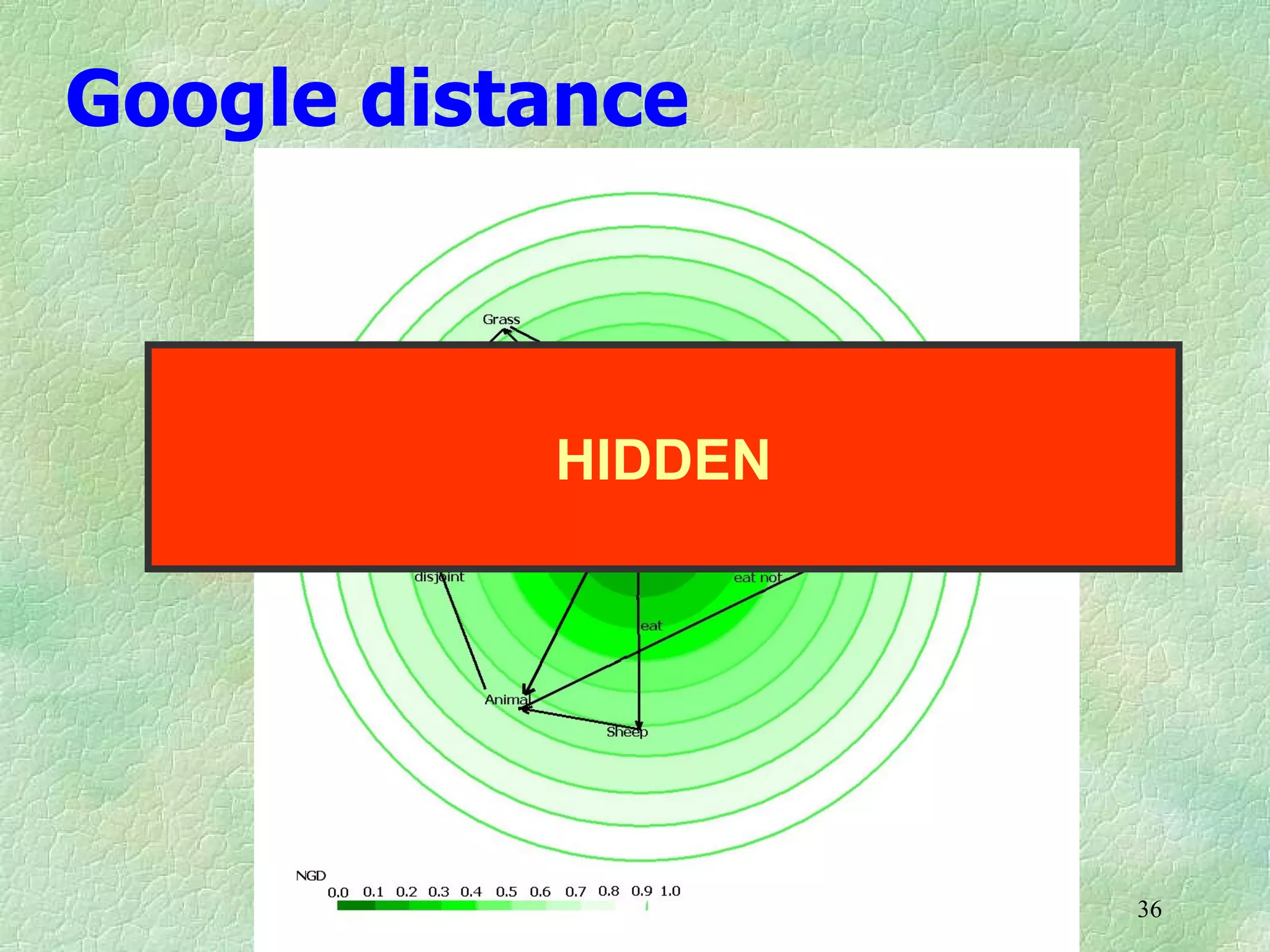
Google distance


           HIDDEN


                    36
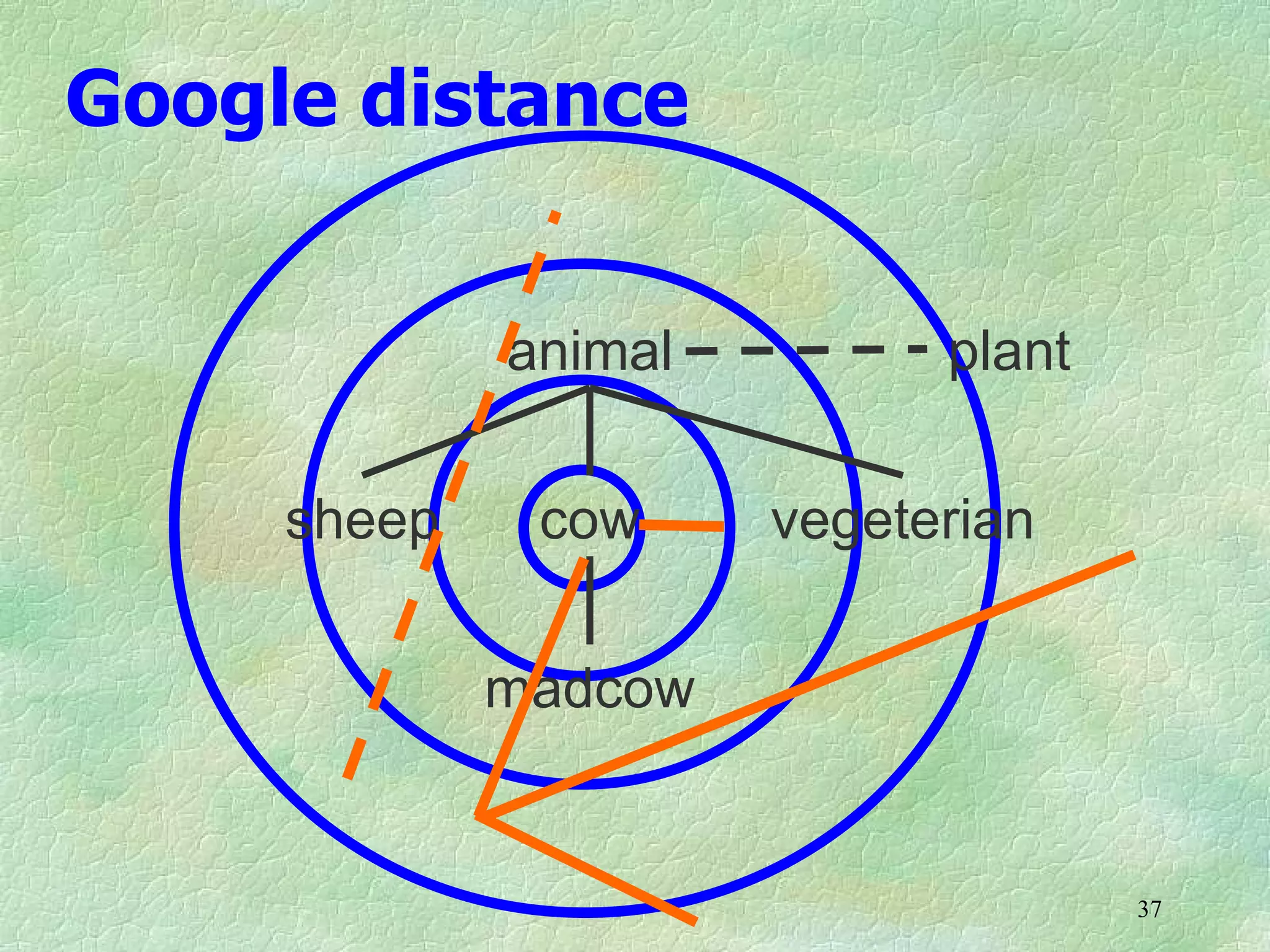
Google distance


             animal         plant

     sheep    cow     vegeterian

             madcow


                                    37
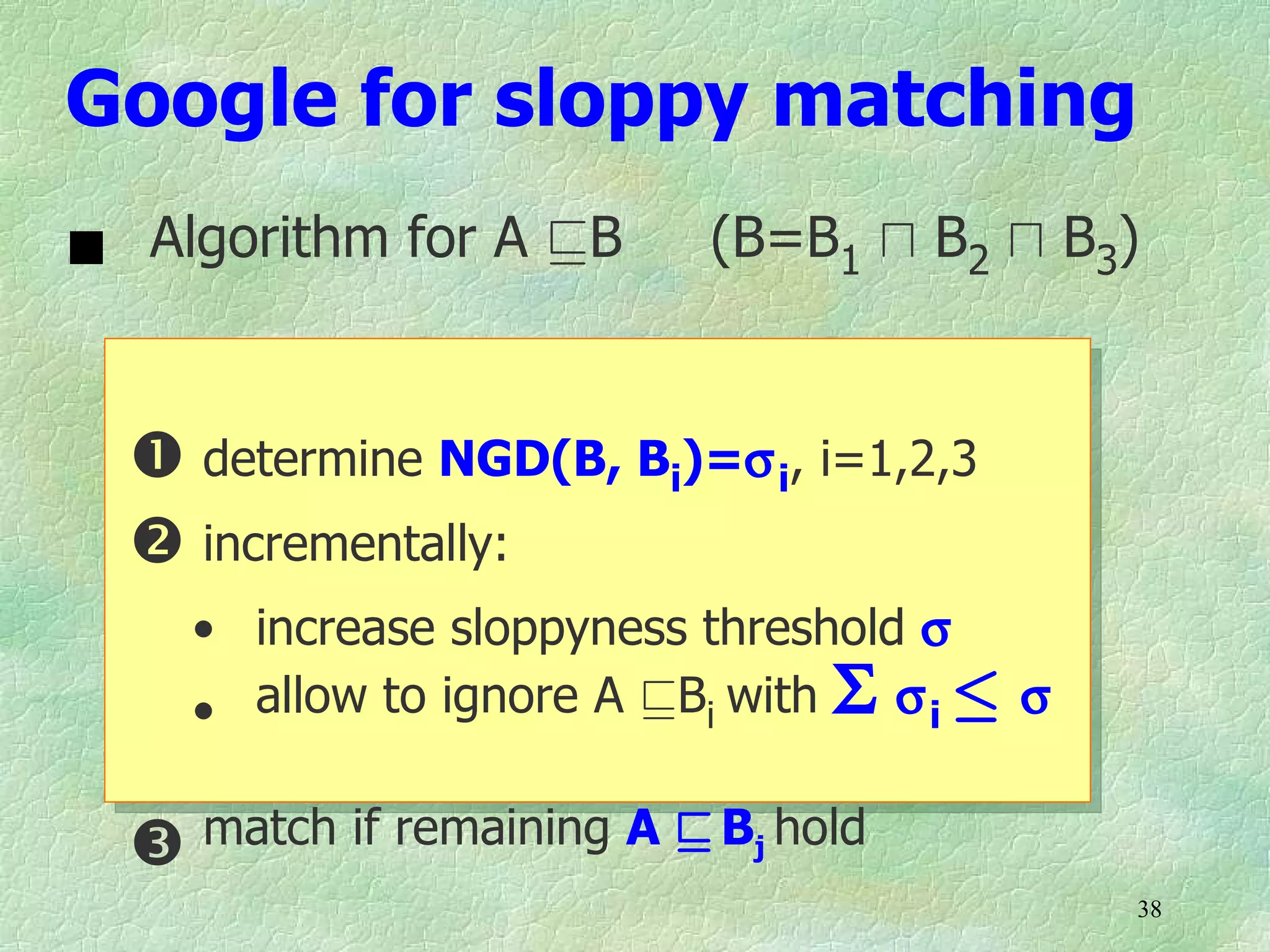
Google for sloppy matching
 Algorithm for A vB       (B=B1 u B2 u B3)


   determine NGD(B, Bi)=σ i, i=1,2,3
   incrementally:
    • increase sloppyness threshold σ
    • allow to ignore A vBi with Σ σ i · σ

   match if remaining A v Bj hold
                                             38
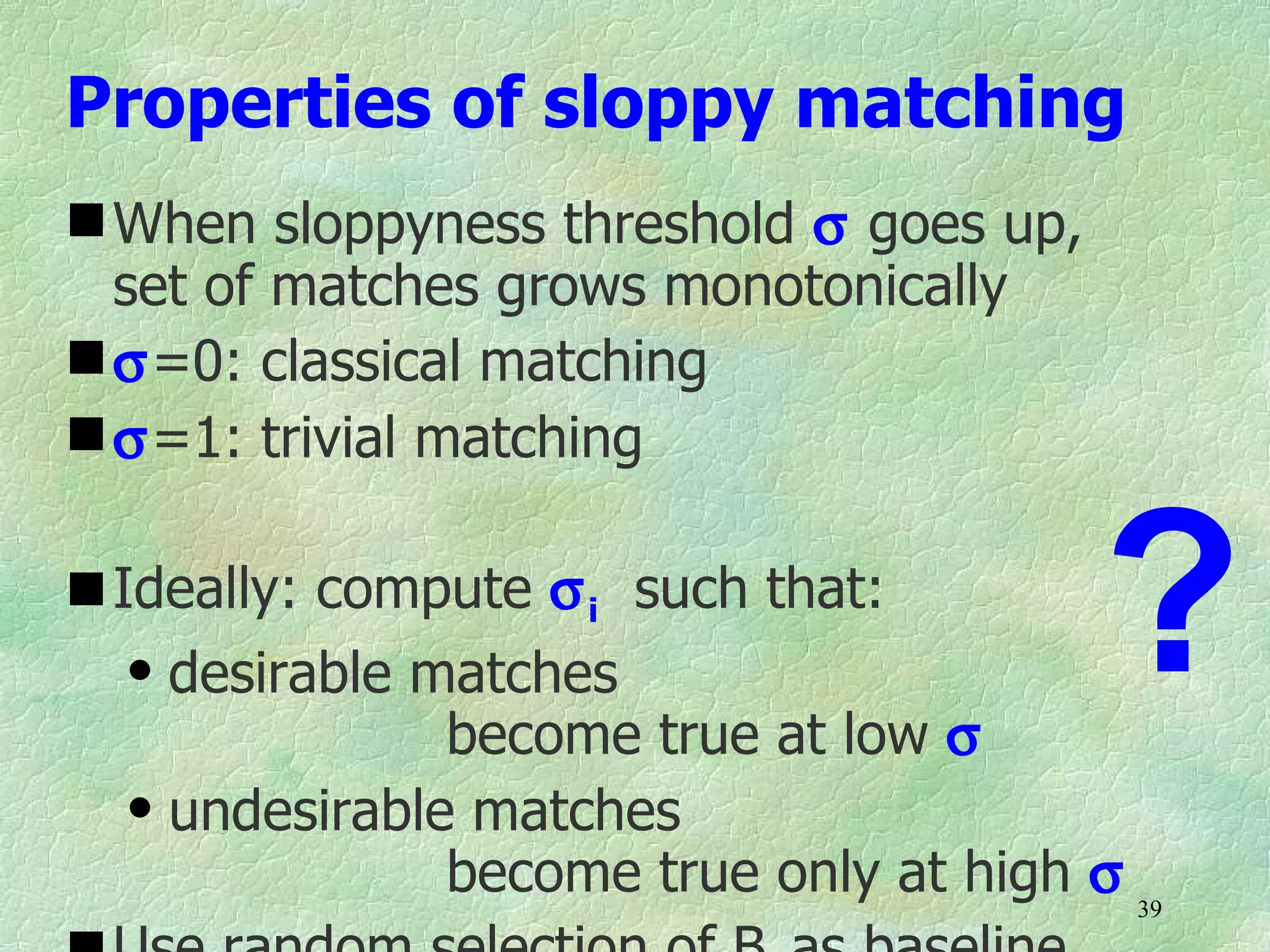
Properties of sloppy matching
 When sloppyness threshold σ goes up,
  set of matches grows monotonically
 σ=0: classical matching
 σ=1: trivial matching

 Ideally: compute σ i such that:
   q desirable matches

                become true at low σ
                                          ?
   q undesirable matches

                become true only at high σ 39
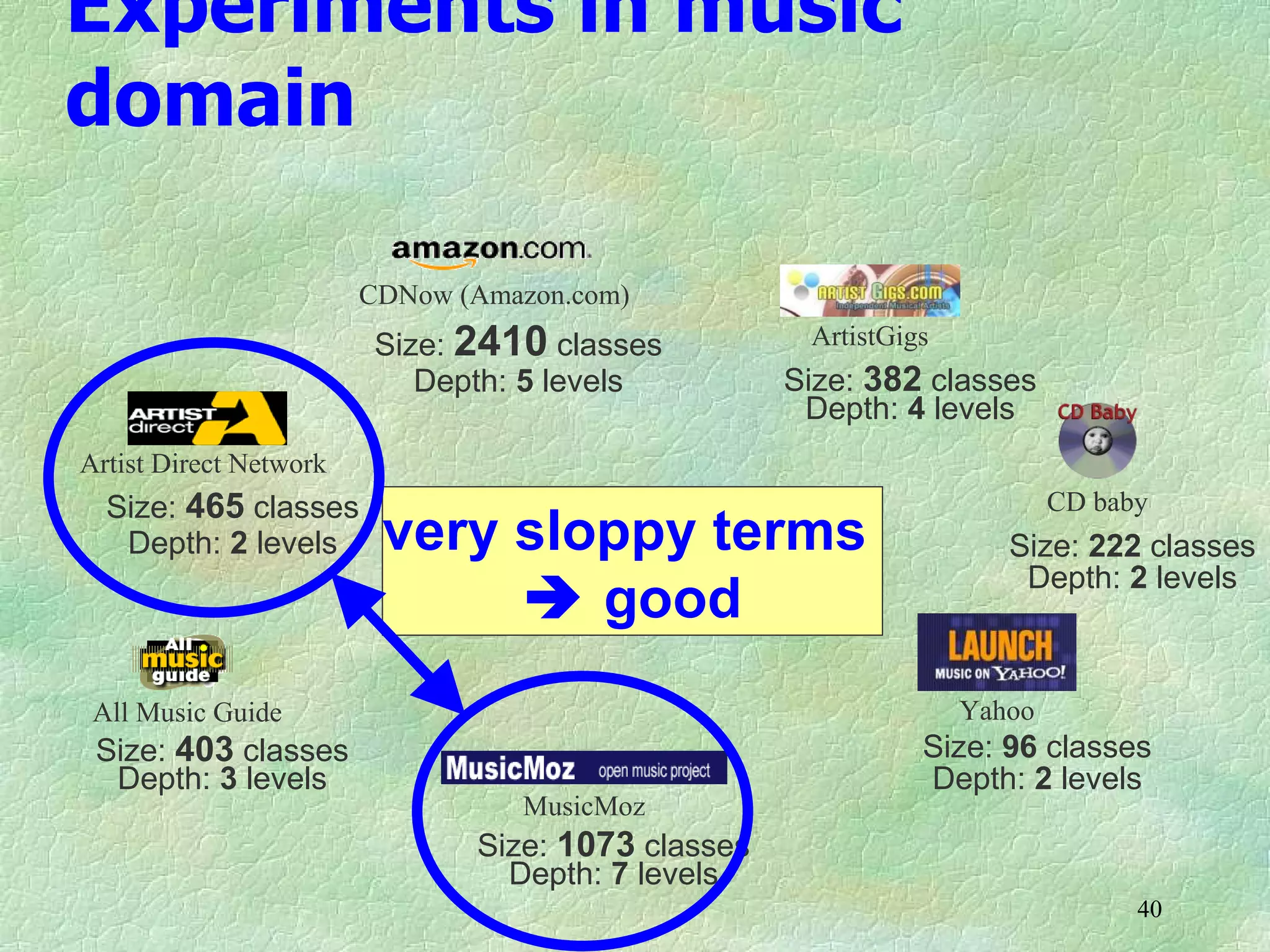
Experiments in music
domain

                        CDNow (Amazon.com)
                         Size: 2410 classes          ArtistGigs
                            Depth: 5 levels         Size: 382 classes
                                                     Depth: 4 levels
Artist Direct Network
  Size: 465 classes                                                       CD baby
   Depth: 2 levels       very sloppy terms                           Size: 222 classes
                                                                      Depth: 2 levels
                               good
 All Music Guide                                                  Yahoo
 Size: 403 classes                                            Size: 96 classes
  Depth: 3 levels                                             Depth: 2 levels
                                  MusicMoz
                               Size: 1073 classes
                                 Depth: 7 levels
                                                                                40
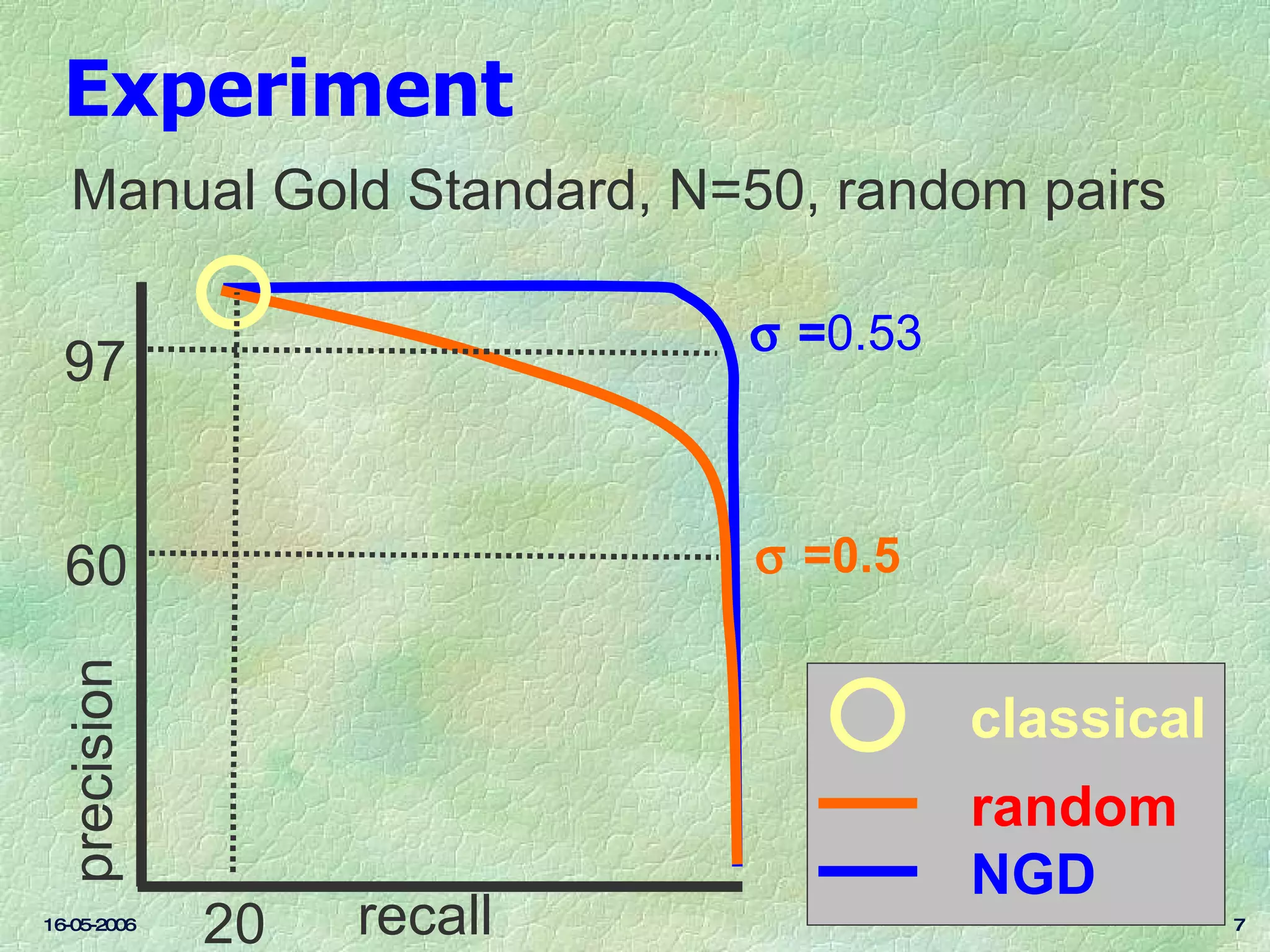
Experiment
  Manual Gold Standard, N=50, random pairs

                           σ =0.53
  97


  60                       σ =0.5
 precision


                                     classical
                                     random
                                     NGD
16-05-2006
             20   recall                         7
wrapping up
Three obvious intuitions
 The Semantic Web needs
  ontology mapping

 Ontology mapping needs
  background knowledge

 Ontology mapping needs approximation


                                         43
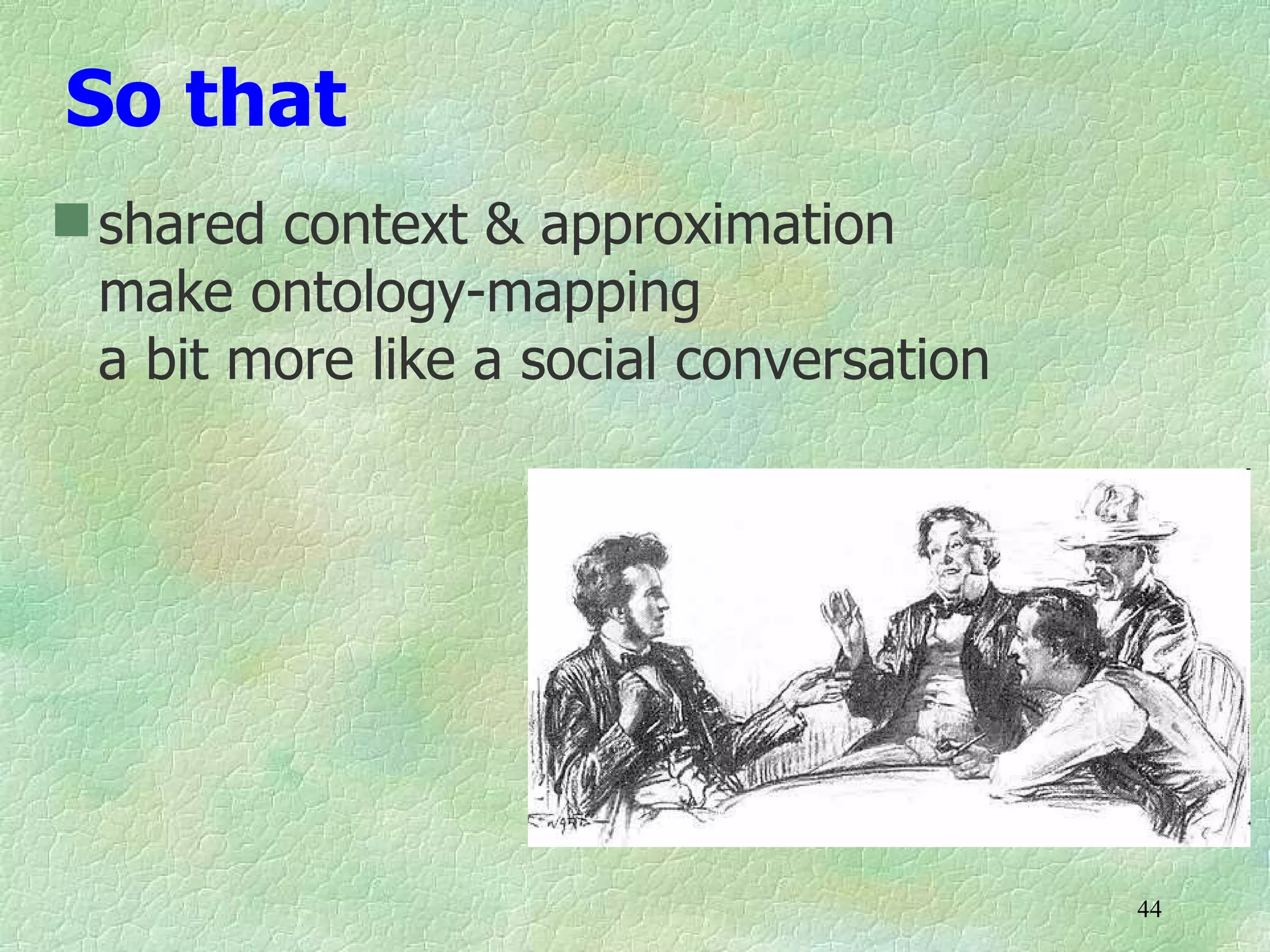
So that
 shared context & approximation
  make ontology-mapping
  a bit more like a social conversation


                                          44
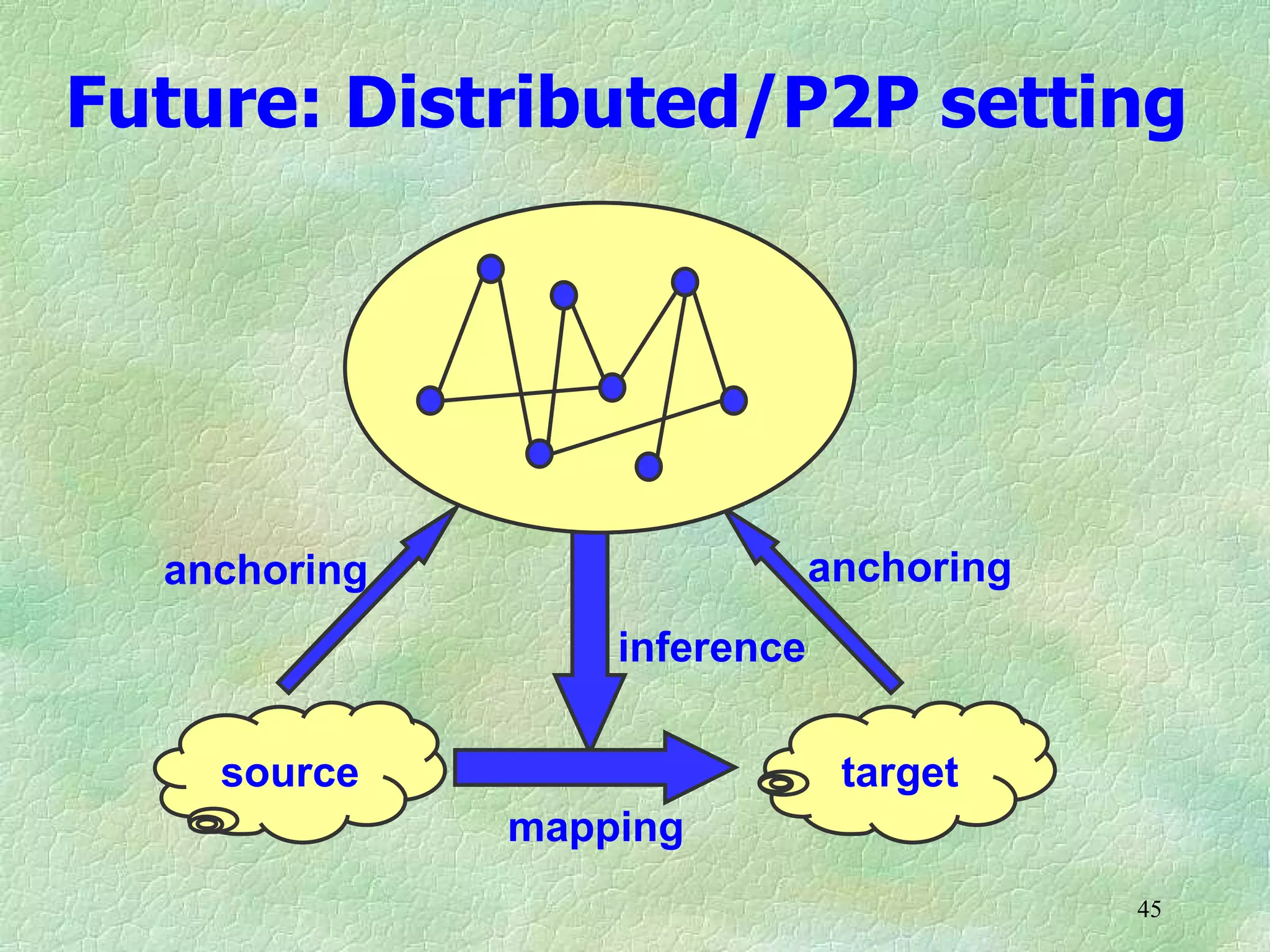
Future: Distributed/P2P setting


              background
               knowledge


  anchoring                     anchoring
                    inference

    source                       target
               mapping
                                            45
Vragen & discussie

 Frank.van.Harmelen@cs.vu.nl
 http://www.cs.vu.nl/~frankh


                               46

Ontology mapping needs context & approximation

  • 1.
    Ontology mapping needs context & approximation Frank van Harmelen Vrije Universiteit Amsterdam
  • 2.
    Or:  How tomake ontology-mapping less like data-base integration  and more like a social conversation 2
  • 3.
    Three Two obvious intuitions The Semantic Web needs ontology mapping  Ontology mapping needs background knowledge  Ontology mapping needs approximation 3
  • 4.
    Which Semantic Web? Version 1: "Semantic Web as Web of Data" (TBL)  recipe: expose databases on the web, use RDF, integrate  meta-data from: q expressing DB schema semantics in machine interpretable ways  enable integration and unexpected re-use 4
  • 5.
    Which Semantic Web? Version 2: “Enrichment of the current Web”  recipe: Annotate, classify, index  meta-data from: q automatically producing markup: named-entity recognition, concept extraction, tagging, etc.  enable personalisation, search, browse,.. 5
  • 6.
    Which Semantic Web? Version 1: “Semantic Web as Web of Data”  Version 2: “Enrichment of the current Web”  Different use-cases data-oriented  Different techniques  Different users user-oriented 6
  • 7.
    Which Semantic Web? Version 1: “Semantic Web as Web of Data”  Version 2: “Enrichment of the current Web”  But both need ontologies for semantic agreement between sources between source & user 7
  • 8.
     Ontology research is almostdone..  we know what they are “consensual, formalised models of a domain”  we know how to make and maintain them (methods, tools, experience)  we know how to deploy them (search, personalisation, data-integration, …) Main remaining open questions  Automatic construction (learning)  Automatic mapping (integration) 8
  • 9.
    Three obvious intuitions The Semantic Web needs ontology mapping  Ontology mapping needs background knowledge ? Ph.D. student = AIO  Ontology mapping needs approximation young ? researcher ≈ post-doc 9
  • 10.
    This work with ZharkoAleksovski & Michel Klein
  • 11.
  • 12.
    The general idea background knowledge anchoring anchoring inference source target mapping 12
  • 13.
    a realistic example Two Amsterdam hospitals (OLVG, AMC)  Two Intensive Care Units, different vocab’s  Want to compare quality of care  OLVG-1400: q 1400 terms in a flat list q used in the first 24 hour of stay q some implicit hierarchy e.g.6 types of Diabetes Mellitus) q some reduncy (spelling mistakes)  AMC: similar list, but from different hospital 13
  • 14.
    Context ontology used DICE: q 2500 concepts (5000 terms), 4500 links q Formalised in DL q five main categories: • tractus (e.g. nervous_system, respiratory_system) • aetiology (e.g. virus, poising) • abnormality (e.g. fracture, tumor) • action (e.g. biopsy, observation, removal) • anatomic_location (e.g. lungs, skin) 14
  • 15.
    Baseline: Linguistic methods Combine lexical analysis with hierarchical structure  313 suggested matches, around 70 % correct  209 suggested matches, around 90 % correct  High precision, low recall (“the easy cases”) 15
  • 16.
    Now use backgroundknowledge DICE (2500 concepts, 4500 links) anchoring anchoring inference OLVG AMC (1400, flat) (1400, flat) mapping 16
  • 17.
    Example found withcontext knowledge (beyond lexical) 17
  • 18.
  • 19.
    Anchoring strength  Anchoring= substring + trivial morphology anchored on N aspects OLVG AMC N=5 0 2 N=4 0 198 N=3 4 711 N=2 144 285 N=1 401 208 total nr. of anchored terms 549 39% 1404 96% total nr. of anchorings 1298 5816 19
  • 20.
    Results Example matchings discovered q OLVG: Acute respiratory failure AMC: Asthma cardiale q OLVG: Aspergillus fumigatus AMC: Aspergilloom q OLVG: duodenum perforation AMC: Gut perforation q OLVG: HIV AMC: AIDS q OLVG: Aorta thoracalis dissectie type B AMC: Dissection of artery 20
  • 21.
    Experimental results  Source& target = flat lists of ±1400 ICU terms each  Background = DICE (2300 concepts in DL)  Manual Gold Standard (n=200) 21
  • 22.
  • 23.
    Adding more context Only lexical DICE (2500 concepts) MeSH (22000 concepts) ICD-10 (11000 concepts)  Anchoring strength: DICE MeSH ICD10 4 aspects 0 8 0 3 aspects 0 89 0 2 aspects 135 201 0 1 aspect 413 694 80 total 548 992 80 23
  • 24.
    Results with multipleontologies Separate Lexical ICD-10 DICE MeSH Recall 64% 64% 76% 88% Precision 95% 95% 94% 89% Joint 100 90  Monotonic improvement 80 70  Independent of order 60 50  Linear increase of cost 40 30 20 10 0 Lexical ICD-10 DICE MeSH 24
  • 25.
  • 26.
    Exploiting structure  CRISP:700 concepts, broader-than  MeSH: 1475 concepts, broader-than  FMA: 75.000 concepts, 160 relation-types (we used: is-a & part-of) FMA (75.000) anchoring anchoring inference CRISP MeSH (738) (1475) mapping 26
  • 27.
    Using the structureor not ?  (S <a B) & (B < B’) & (B’ <a T) ! (S <i T) a a i 27
  • 28.
    Using the structureor not ?  (S <a B) & (B < B’) & (B’ <a T) ! (S <i T) No use of structure Only stated is-a & part-of Transitive chains of is-a, and transitive chains of part-of Transitive chains of is-a and part-of One chain of part-of before one chain of is-a 28
  • 29.
  • 30.
  • 31.
    Matching results (CRISPto MeSH) (Golden Standard n=30) Recall = · ¸ total incr. Exp.1:Direct 448 417 156 1021 - Exp.2:Indir. is-a + part-of 395 516 405 1316 29% Exp.3:Indir. separate closures 395 933 1402 2730 167% Exp.4:Indir. mixed closures 395 1511 2228 4143 306% Exp.5:Indir. part-of before is-a 395 972 1800 3167 210% Precision = · ¸ total correct Exp.1:Direct 17 18 3 38 100% Exp.4:Indir. mixed closures 14 39 59 112 94% Exp.5:Indir. part-of before is-a 14 37 50 101 100% 31
  • 32.
    Three obvious intuitions The Semantic Web needs ontology mapping  Ontology mapping needs background knowledge  Ontology mapping needs approximation young ? researcher ≈ post-doc 32
  • 33.
    This work with ZharkoAleksovski Risto Gligorov Warner ten Kate
  • 34.
    Approximating subsumptions (and hence mappings)  query: A v B ?  B = B1 u B2 u B3 A v B1, A v B2, A v B3 ? B2 B B1 A B3 34
  • 35.
    Approximating subsumptions bi lity  Use “Google distance” to decide whichba subproblems are reasonable al pro to focus on  Google distancendit ion B3 e 2u co ce f ( x),stanfc y )} −u B f ( x, y ) NGD( xt, ryc = max{log c di log o B1 log i ) en ( wherey me ccurr log anti min{logt f ( x), log f ( y )} m o M− n” s o - em ibutio ≈ f(x)cis the number ntr Google hits for x fs of at e o “co of ti is te of f(x,y)m the number of Google hits for es ≈ theatuple of search items x and y stim ≈ e M is the number of web pages indexed by Google 35
  • 36.
  • 37.
    Google distance animal plant sheep cow vegeterian madcow 37
  • 38.
    Google for sloppymatching  Algorithm for A vB (B=B1 u B2 u B3)  determine NGD(B, Bi)=σ i, i=1,2,3  incrementally: • increase sloppyness threshold σ • allow to ignore A vBi with Σ σ i · σ  match if remaining A v Bj hold 38
  • 39.
    Properties of sloppymatching  When sloppyness threshold σ goes up, set of matches grows monotonically  σ=0: classical matching  σ=1: trivial matching  Ideally: compute σ i such that: q desirable matches become true at low σ ? q undesirable matches become true only at high σ 39
  • 40.
    Experiments in music domain CDNow (Amazon.com) Size: 2410 classes ArtistGigs Depth: 5 levels Size: 382 classes Depth: 4 levels Artist Direct Network Size: 465 classes CD baby Depth: 2 levels very sloppy terms Size: 222 classes Depth: 2 levels  good All Music Guide Yahoo Size: 403 classes Size: 96 classes Depth: 3 levels Depth: 2 levels MusicMoz Size: 1073 classes Depth: 7 levels 40
  • 41.
    Experiment ManualGold Standard, N=50, random pairs σ =0.53 97 60 σ =0.5 precision classical random NGD 16-05-2006 20 recall 7
  • 42.
  • 43.
    Three obvious intuitions The Semantic Web needs ontology mapping  Ontology mapping needs background knowledge  Ontology mapping needs approximation 43
  • 44.
    So that  sharedcontext & approximation make ontology-mapping a bit more like a social conversation 44
  • 45.
    Future: Distributed/P2P setting background knowledge anchoring anchoring inference source target mapping 45
  • 46.
    Vragen & discussie Frank.van.Harmelen@cs.vu.nl http://www.cs.vu.nl/~frankh 46