Towards a Reliable SDN Firewall
Hongxin Hu
Delaware State University
Gail-Joon Ahn, Wonkyu Han and Ziming Zhao
Arizona State University
2
SDN Security Apps
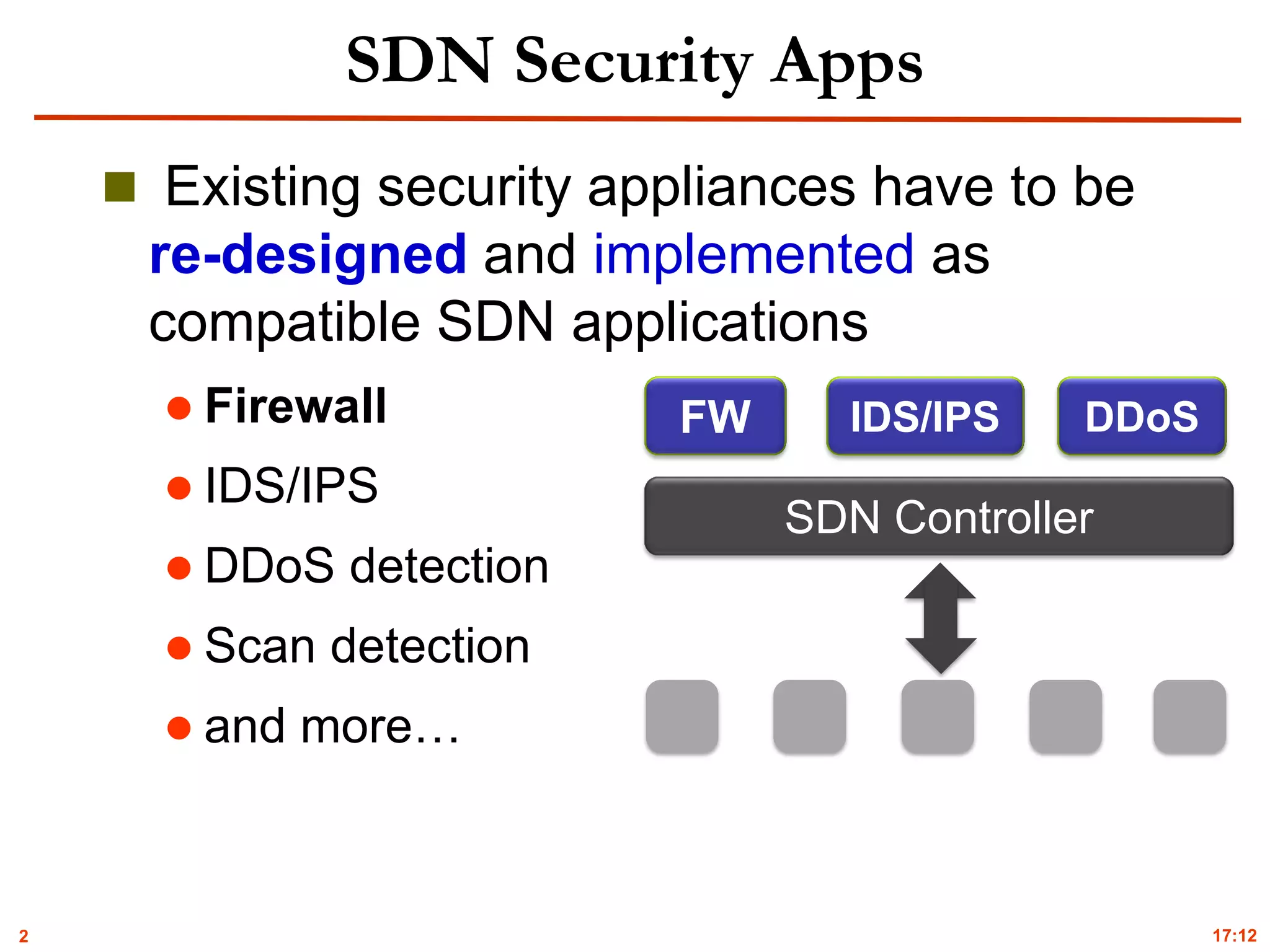
 Existing security appliances have to be
re-designed and implemented as
compatible SDN applications
 Firewall
 IDS/IPS
 DDoS detection
 Scan detection
 and more…
17:12
SDN Controller
FW IDS/IPS DDoS
3
Challenges in Building SDN Firewalls
 Examining Dynamic Network Policy Updates
 A traditional firewall is only a packet filter
 An SDN firewall is both
A Packet Filter (flow packet violation)
– The first packet of each flow goes through the controller and is filtered
by the firewall
– The subsequent packets of the flow directly match the flow policy
A Policy Checker (flow policy violation)
– Existing flow policies may violate the firewall policy
 Flow policy update
 Firewall policy update
 Flow policies can be proactively installed in the switches
17:12
4
Challenges in Building SDN Firewalls (cont’d)
 Checking Indirect Security Violations
 Firewalls can be bypassed
Dynamic packet modification
– OpenFlow allows an action, Set-Field, which can
rewrite the values of respective header fields in
flow packets
 E.g. a load balancer may need to dynamically change
flow paths
Rule dependency
– Flow and firewall rules may overlap each other
17:12
5
Challenges in Building SDN Firewalls (cont’d)
 Architecture Option
 Centralized SDN firewall
Firewall policy is centrally defined and enforced at the
controller
Limitation: cannot deal with partial policy violations
 Distributed SDN firewall
Firewall policy is defined centrally, but propagated and
enforced at each individual flow entry (ingress switch)
Limitation: needs a complicated revocation and
repropagation mechanism to handle dynamic policy
updates
17:12
6
State Of The Art
 SDN Firewall App
 Built-in firewall application in Floodlight
 Limited to check flow packet violations and unable to examine flow
policy violations
 Policy Conflict Detection and Resolution
 VeriFlow [Khurshid’13] and NetPlumber [Kazemian’13]
 Lack of automatic, effective and real-time violation resolution
 Pyretic [Monsanto’13]
 Cannot discover and resolve indirect security violations
 FortNOX [Porras’12]
 Only conducts pairwise conflict analysis without considering rule
dependencies in flow tables and firewall policies
17:13
7
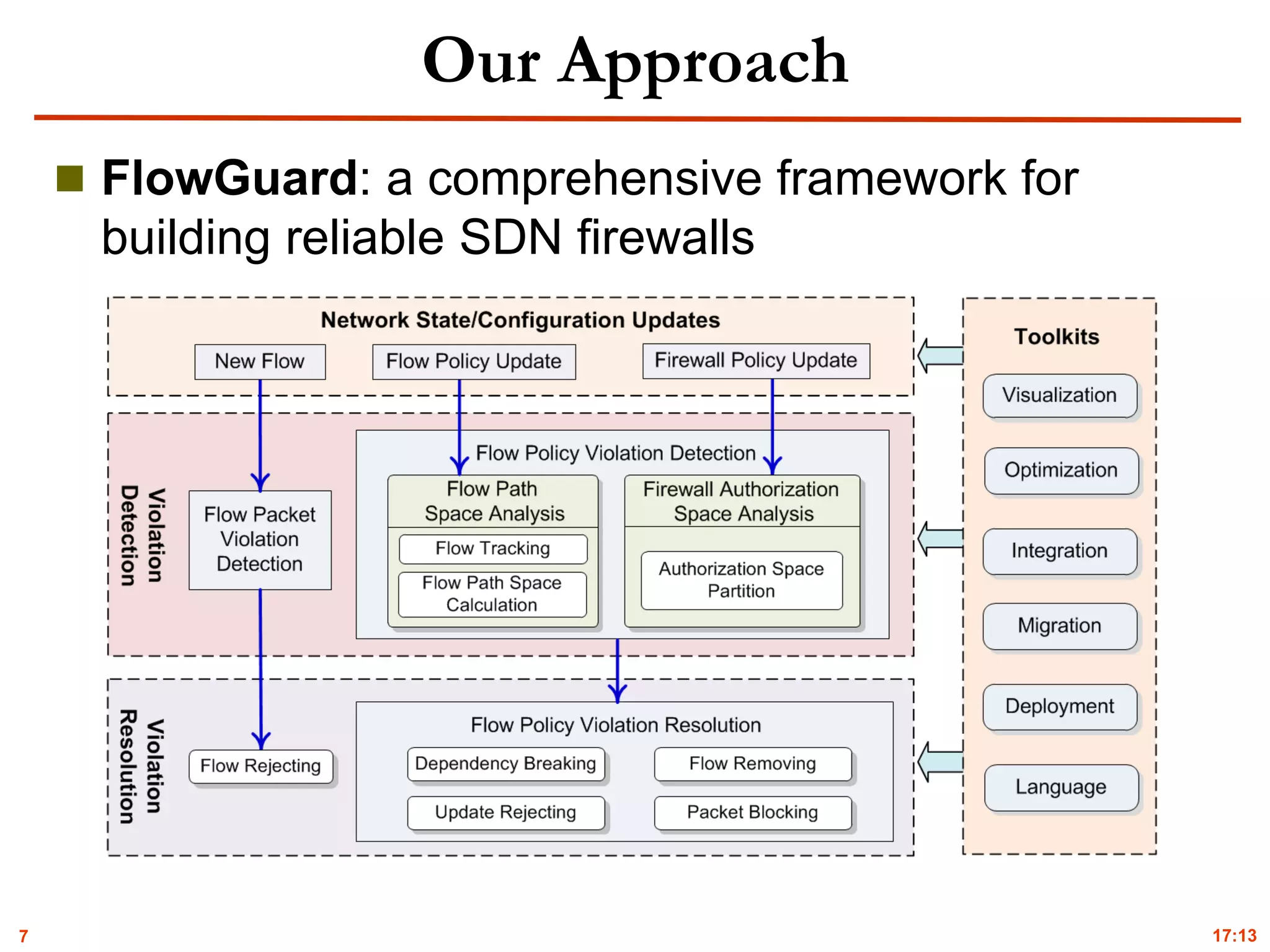
Our Approach
 FlowGuard: a comprehensive framework for
building reliable SDN firewalls
17:13
8
Violation Detection
 Flow Path Space Analysis
 Flow tracking (NetPlumber [Kazemian’13])
Dynamic packet modification
Rule dependency
 Flow path space calculation
 Incoming space
 Outgoing space
 Tracked space
17:13
9
Violation Detection (cont’d)
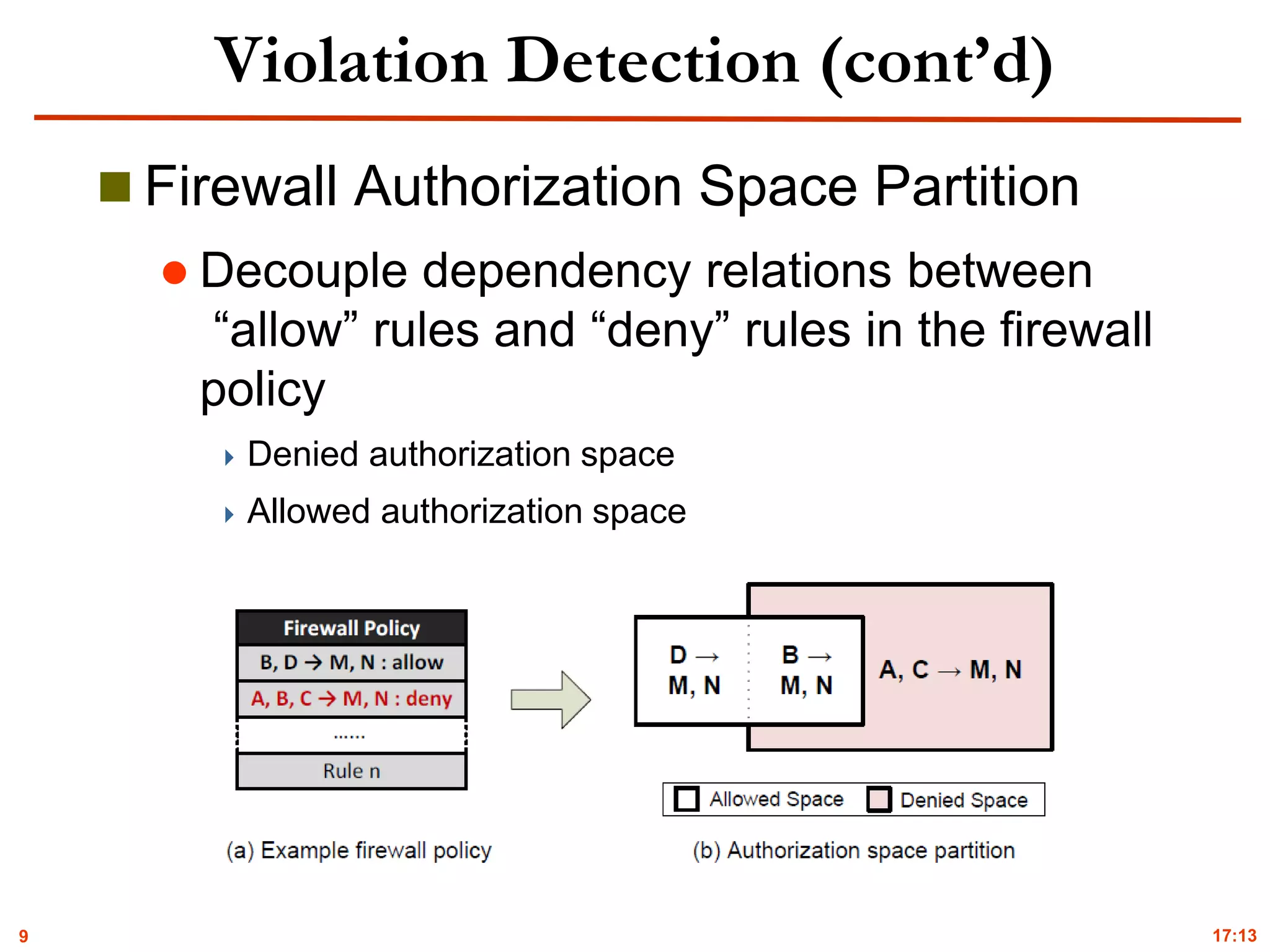
 Firewall Authorization Space Partition
 Decouple dependency relations between
“allow” rules and “deny” rules in the firewall
policy
 Denied authorization space
 Allowed authorization space
17:13
10
Violation Detection (cont’d)
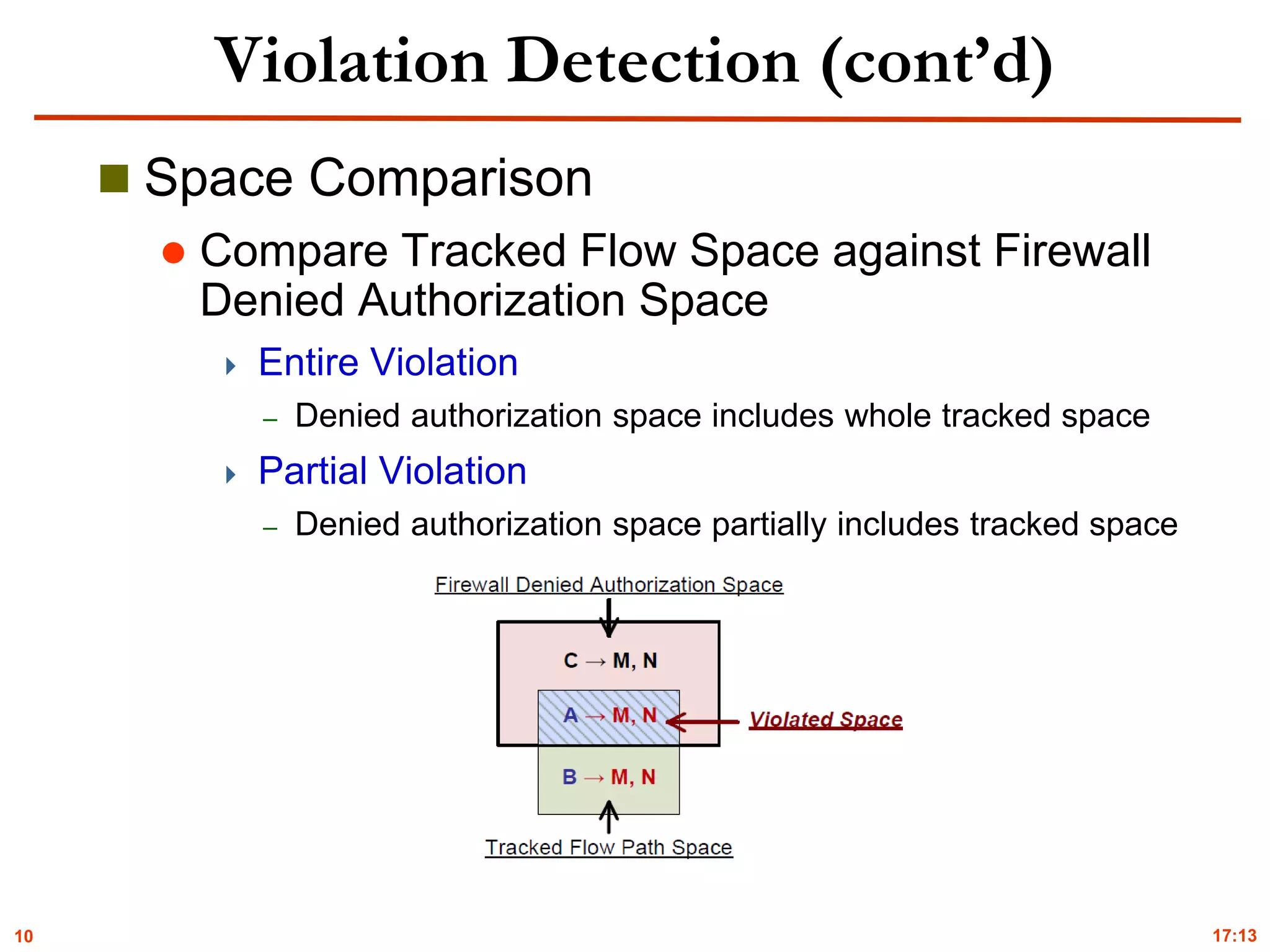
 Space Comparison
 Compare Tracked Flow Space against Firewall
Denied Authorization Space
 Entire Violation
– Denied authorization space includes whole tracked space
 Partial Violation
– Denied authorization space partially includes tracked space
17:13
11
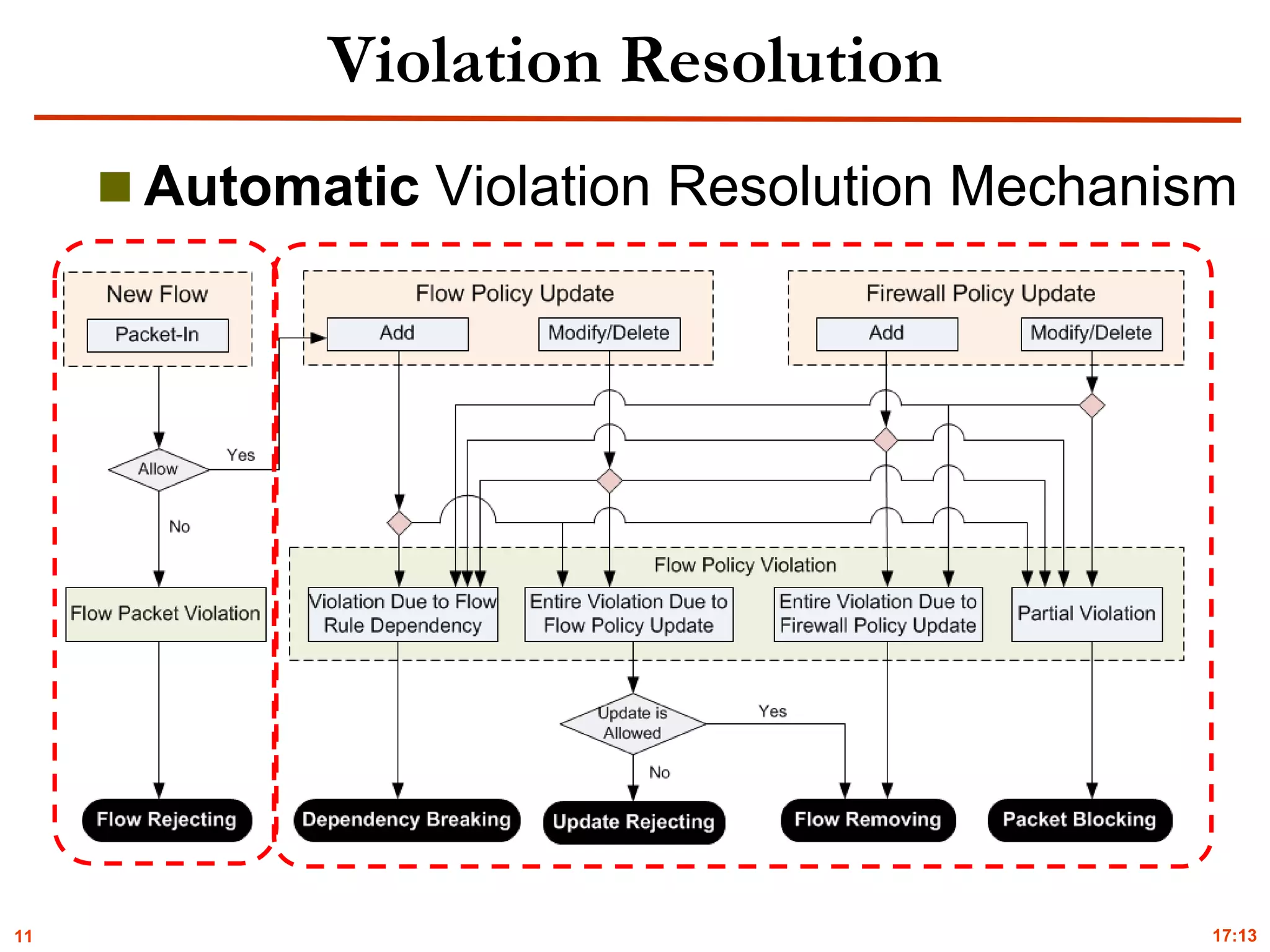
Violation Resolution
 Automatic Violation Resolution Mechanism
17:13
12
Implementation & Evaluation
 Prototype of FlowGuard
 Floodlight V 0.90
 Evolution Environment
 Real-world network topology
 Stanford backbone network [kazemian’13]
 Mininet 2.0
 Violation Detection and Resolution
Table 1: Detection and resolution elapsed time (ms) for different resolution strategies
17:13
13
Evaluation (cont’d)
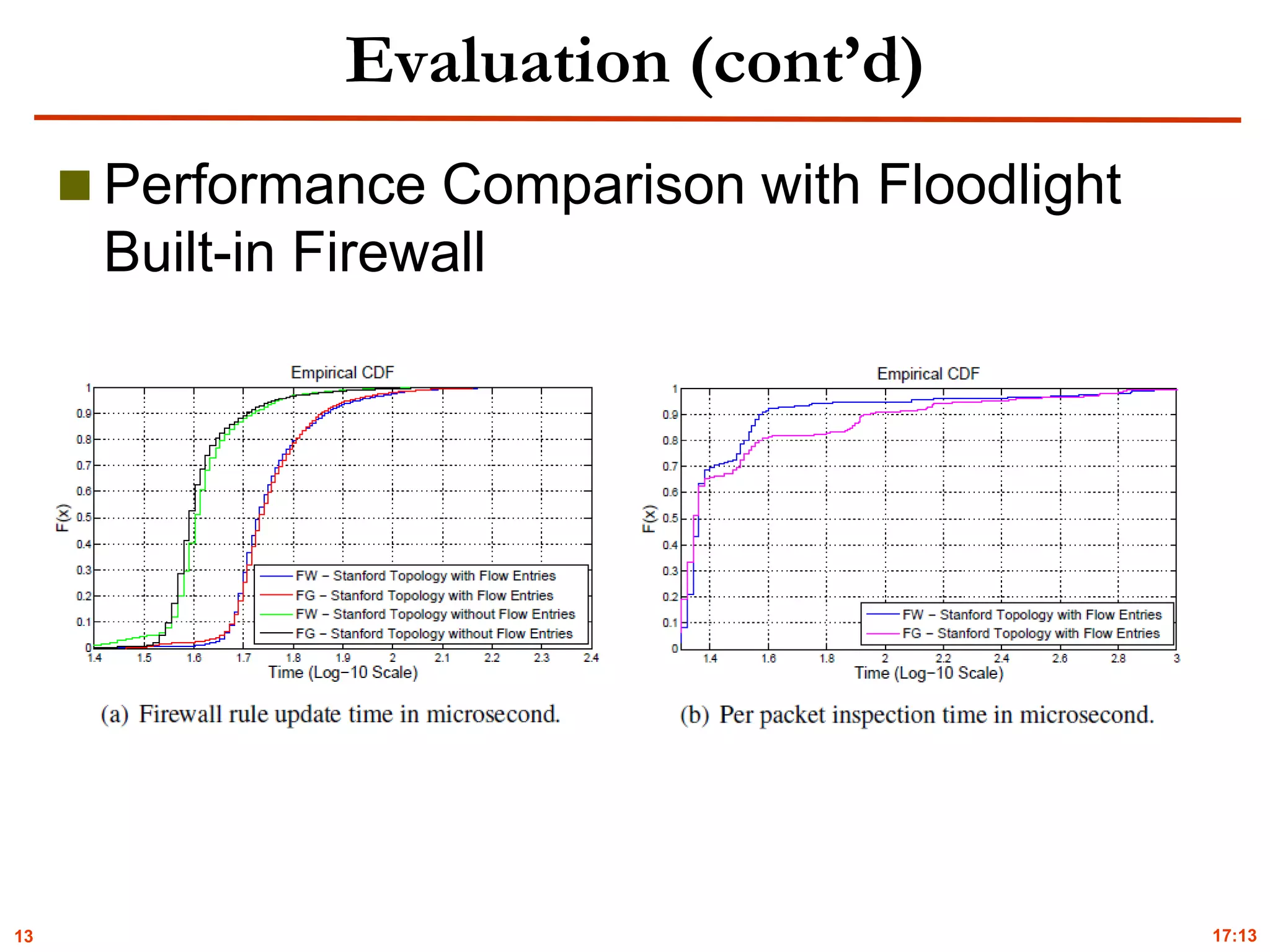
 Performance Comparison with Floodlight
Built-in Firewall
17:13
14
On-going Work
 Investigate a more sophisticated flow
tracking mechanism
 Implement stateful SDN firewalls
 Design a high-level policy language for SDN
firewalls
 Develop various toolkits for visualization,
optimization, migration, and integration of
SDN firewalls
17:13
15
Q & A
hhu@desu.edu
http://www.cis.desu.edu/~hhu/
17:13
16
Challenges in Building SDN Firewalls (cont’d)
 Stateful Monitoring
 Only inspects the first packet of each flow
Limited access to packet-level information in the
controller [Sajad13]
Forwarding plane is almost stateless [Hao13]
17:13

SFA: Stateful Forwarding Abstraction in SDN Data Plane

  • 3.
    Towards a ReliableSDN Firewall Hongxin Hu Delaware State University Gail-Joon Ahn, Wonkyu Han and Ziming Zhao Arizona State University
  • 4.
    2 SDN Security Apps Existing security appliances have to be re-designed and implemented as compatible SDN applications  Firewall  IDS/IPS  DDoS detection  Scan detection  and more… 17:12 SDN Controller FW IDS/IPS DDoS
  • 5.
    3 Challenges in BuildingSDN Firewalls  Examining Dynamic Network Policy Updates  A traditional firewall is only a packet filter  An SDN firewall is both A Packet Filter (flow packet violation) – The first packet of each flow goes through the controller and is filtered by the firewall – The subsequent packets of the flow directly match the flow policy A Policy Checker (flow policy violation) – Existing flow policies may violate the firewall policy  Flow policy update  Firewall policy update  Flow policies can be proactively installed in the switches 17:12
  • 6.
    4 Challenges in BuildingSDN Firewalls (cont’d)  Checking Indirect Security Violations  Firewalls can be bypassed Dynamic packet modification – OpenFlow allows an action, Set-Field, which can rewrite the values of respective header fields in flow packets  E.g. a load balancer may need to dynamically change flow paths Rule dependency – Flow and firewall rules may overlap each other 17:12
  • 7.
    5 Challenges in BuildingSDN Firewalls (cont’d)  Architecture Option  Centralized SDN firewall Firewall policy is centrally defined and enforced at the controller Limitation: cannot deal with partial policy violations  Distributed SDN firewall Firewall policy is defined centrally, but propagated and enforced at each individual flow entry (ingress switch) Limitation: needs a complicated revocation and repropagation mechanism to handle dynamic policy updates 17:12
  • 8.
    6 State Of TheArt  SDN Firewall App  Built-in firewall application in Floodlight  Limited to check flow packet violations and unable to examine flow policy violations  Policy Conflict Detection and Resolution  VeriFlow [Khurshid’13] and NetPlumber [Kazemian’13]  Lack of automatic, effective and real-time violation resolution  Pyretic [Monsanto’13]  Cannot discover and resolve indirect security violations  FortNOX [Porras’12]  Only conducts pairwise conflict analysis without considering rule dependencies in flow tables and firewall policies 17:13
  • 9.
    7 Our Approach  FlowGuard:a comprehensive framework for building reliable SDN firewalls 17:13
  • 10.
    8 Violation Detection  FlowPath Space Analysis  Flow tracking (NetPlumber [Kazemian’13]) Dynamic packet modification Rule dependency  Flow path space calculation  Incoming space  Outgoing space  Tracked space 17:13
  • 11.
    9 Violation Detection (cont’d) Firewall Authorization Space Partition  Decouple dependency relations between “allow” rules and “deny” rules in the firewall policy  Denied authorization space  Allowed authorization space 17:13
  • 12.
    10 Violation Detection (cont’d) Space Comparison  Compare Tracked Flow Space against Firewall Denied Authorization Space  Entire Violation – Denied authorization space includes whole tracked space  Partial Violation – Denied authorization space partially includes tracked space 17:13
  • 13.
    11 Violation Resolution  AutomaticViolation Resolution Mechanism 17:13
  • 14.
    12 Implementation & Evaluation Prototype of FlowGuard  Floodlight V 0.90  Evolution Environment  Real-world network topology  Stanford backbone network [kazemian’13]  Mininet 2.0  Violation Detection and Resolution Table 1: Detection and resolution elapsed time (ms) for different resolution strategies 17:13
  • 15.
    13 Evaluation (cont’d)  PerformanceComparison with Floodlight Built-in Firewall 17:13
  • 16.
    14 On-going Work  Investigatea more sophisticated flow tracking mechanism  Implement stateful SDN firewalls  Design a high-level policy language for SDN firewalls  Develop various toolkits for visualization, optimization, migration, and integration of SDN firewalls 17:13
  • 17.
  • 18.
    16 Challenges in BuildingSDN Firewalls (cont’d)  Stateful Monitoring  Only inspects the first packet of each flow Limited access to packet-level information in the controller [Sajad13] Forwarding plane is almost stateless [Hao13] 17:13