Proof-based Verification of
Software Defined Networks
Chen Chen, Limin Jia, Wenchao Zhou and Boon Thau Loo
University of Pennsylvania, Carnegie Mellon University, Georgetown University
1
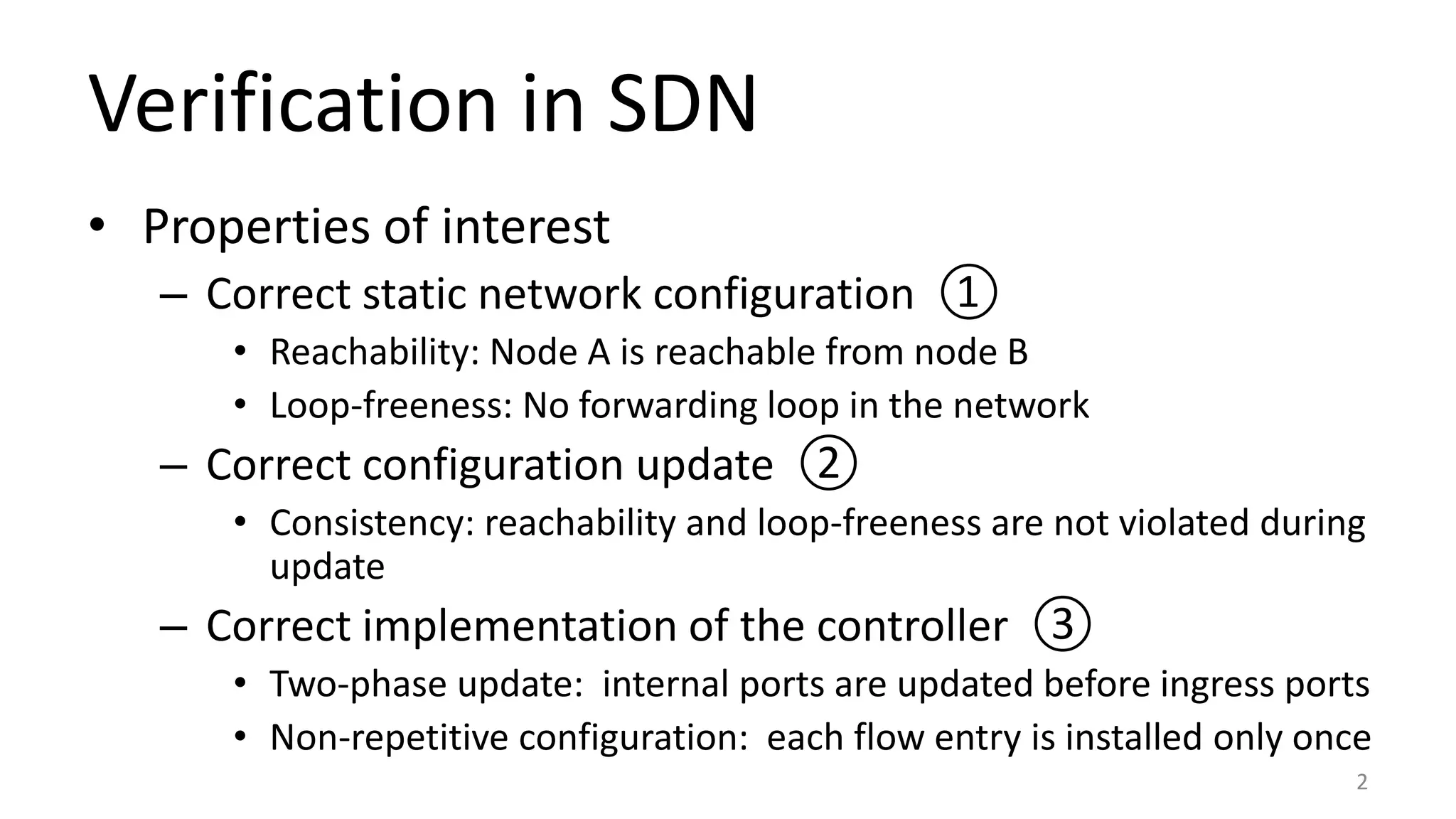
Verification in SDN
• Properties of interest
– Correct static network configuration ①
• Reachability: Node A is reachable from node B
• Loop-freeness: No forwarding loop in the network
– Correct configuration update ②
• Consistency: reachability and loop-freeness are not violated during
update
– Correct implementation of the controller ③
• Two-phase update: internal ports are updated before ingress ports
• Non-repetitive configuration: each flow entry is installed only once
2
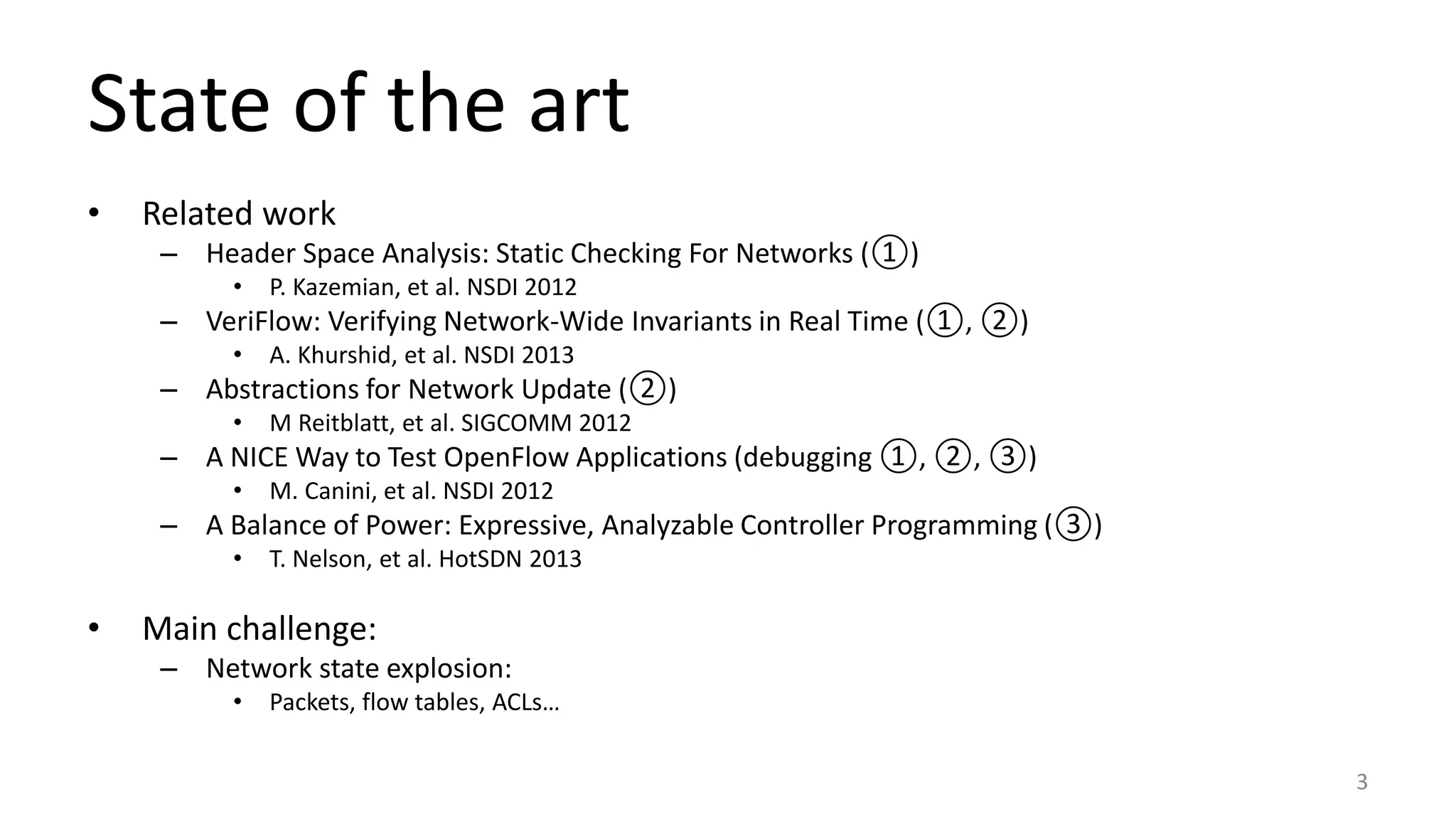
• Related work
– Header Space Analysis: Static Checking For Networks (①)
• P. Kazemian, et al. NSDI 2012
– VeriFlow: Verifying Network-Wide Invariants in Real Time (①, ②)
• A. Khurshid, et al. NSDI 2013
– Abstractions for Network Update (②)
• M Reitblatt, et al. SIGCOMM 2012
– A NICE Way to Test OpenFlow Applications (debugging ①, ②, ③)
• M. Canini, et al. NSDI 2012
– A Balance of Power: Expressive, Analyzable Controller Programming (③)
• T. Nelson, et al. HotSDN 2013
• Main challenge:
– Network state explosion:
• Packets, flow tables, ACLs…
3
State of the art
Our work
• Observation:
– Not all properties are topology-dependent
• We propose:
– Proof-based verification of controller programs
• Use a declarative language to encode the controller program
and switch functionality
• A sound proof system for the language to prove topology-
independent properties
• Compilation to low-level imperative languages
4
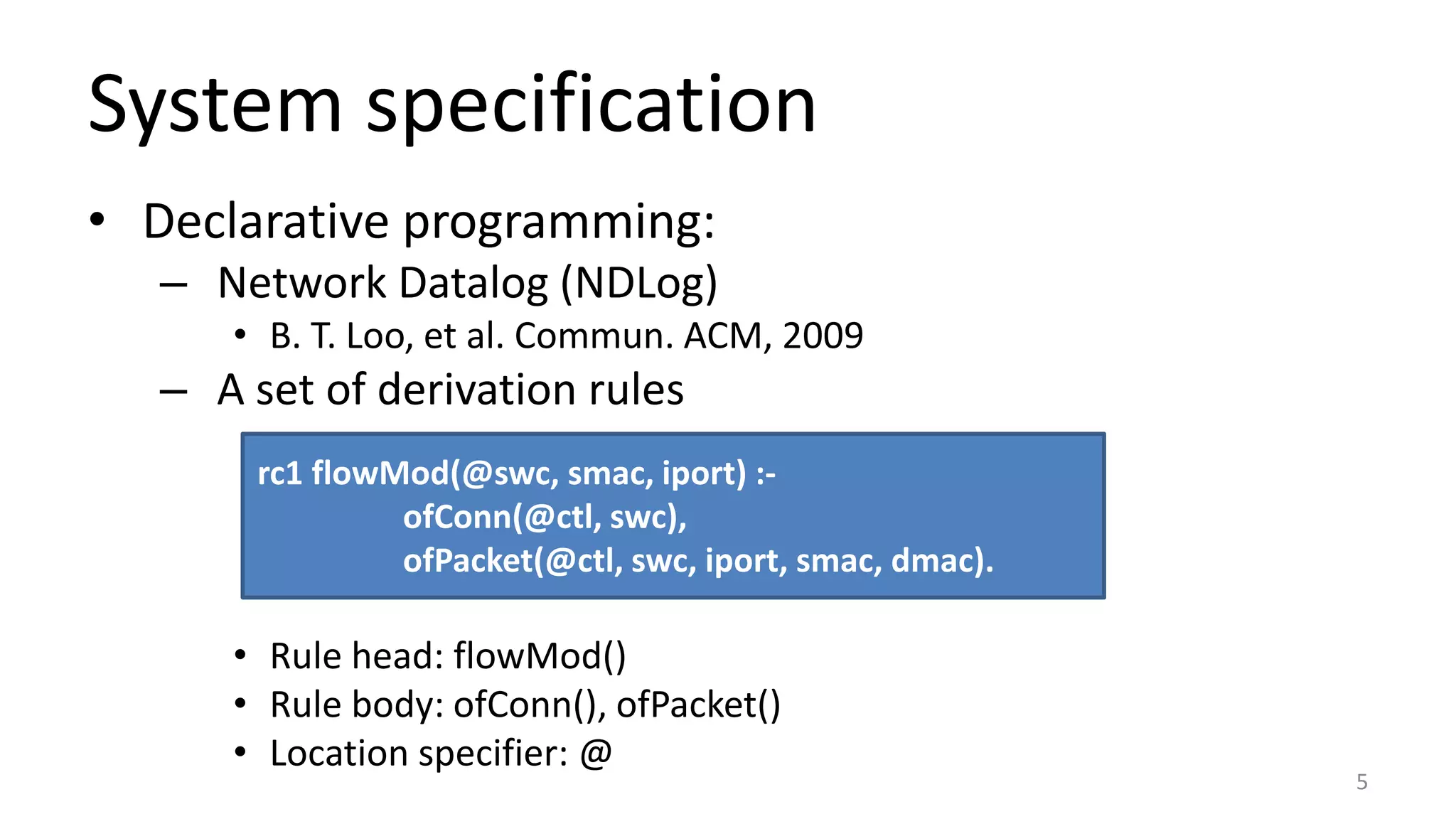
System specification
• Declarative programming:
– Network Datalog (NDLog)
• B. T. Loo, et al. Commun. ACM, 2009
– A set of derivation rules
• Rule head: flowMod()
• Rule body: ofConn(), ofPacket()
• Location specifier: @
rc1 flowMod(@swc, smac, iport) :-
ofConn(@ctl, swc),
ofPacket(@ctl, swc, iport, smac, dmac).
5
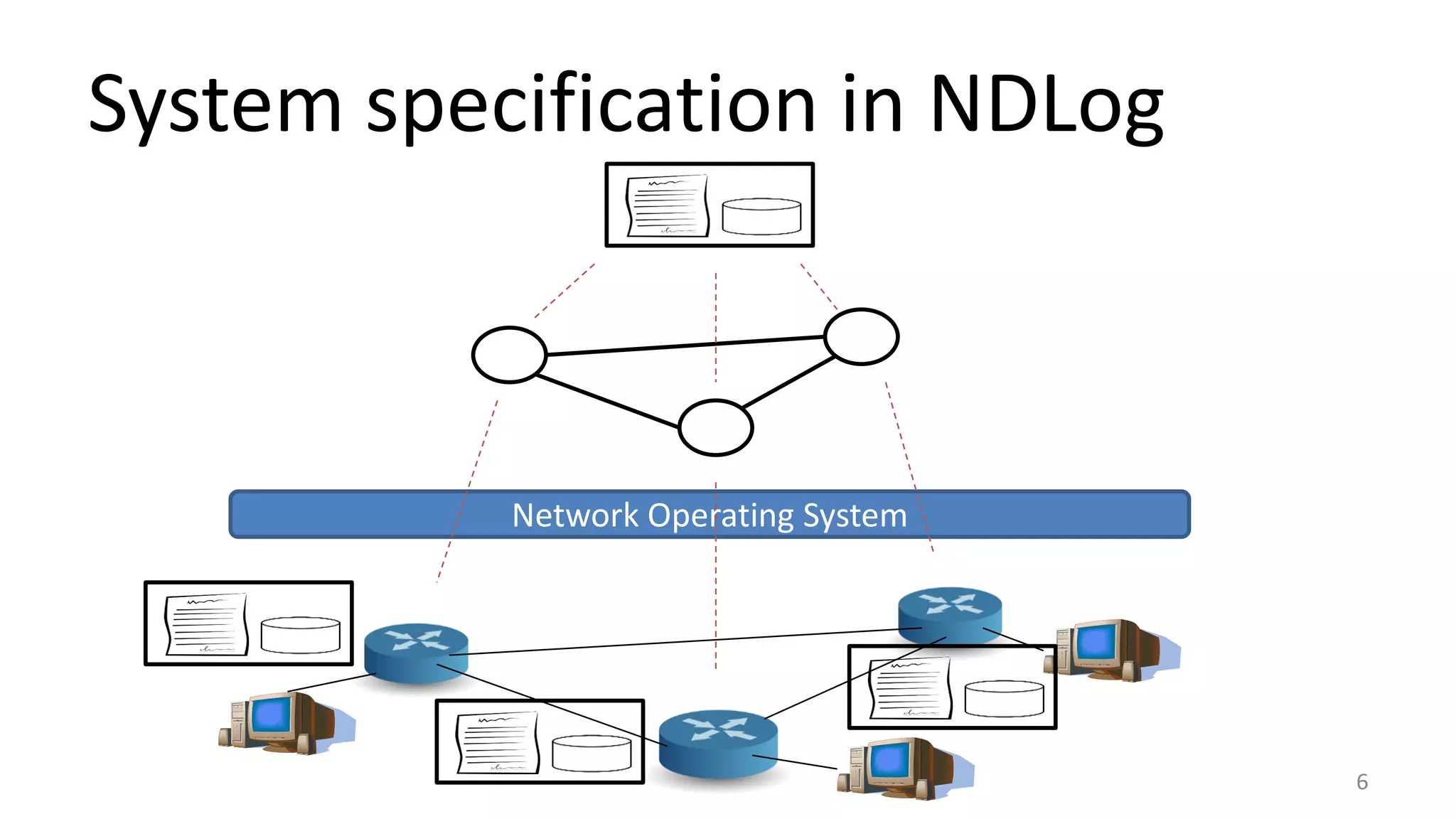
System specification in NDLog
6
Network Operating System
Verify topology-independent properties
7
• Program logic:
– Prove invariant properties of NDLog programs
– Sound w.r.t. NDLog operational semantics
• Example:
– Ethernet MAC learning
– Property: flow installation follows table miss
• Whenever a forwarding entry with destination “m” is installed on a
switch s, there must have been a forwarding table miss at s before,
triggered by a packet whose src address is “m”
Flow installation follows table miss
• Property specification:
– First-order logic
– flowEntry(swc, m, t) => ∃t’, flowMiss(swc, m, t’) & t’ < t
• Proof:
– Switch invariant:
• flowEntry(swc, m, t) => ∃t1, flowMod(swc, ctl, m, t1) & t1 < t
– Controller invariant:
• flowMod(swc, ctl, m, t) => ∃t2, ofPacket(ctl, swc, m, t2) & t2 < t
– Switch invariant:
• ofPacket(ctl, swc, m, t) => ∃t3, flowMiss(swc, m, t3) & t3 < t
8
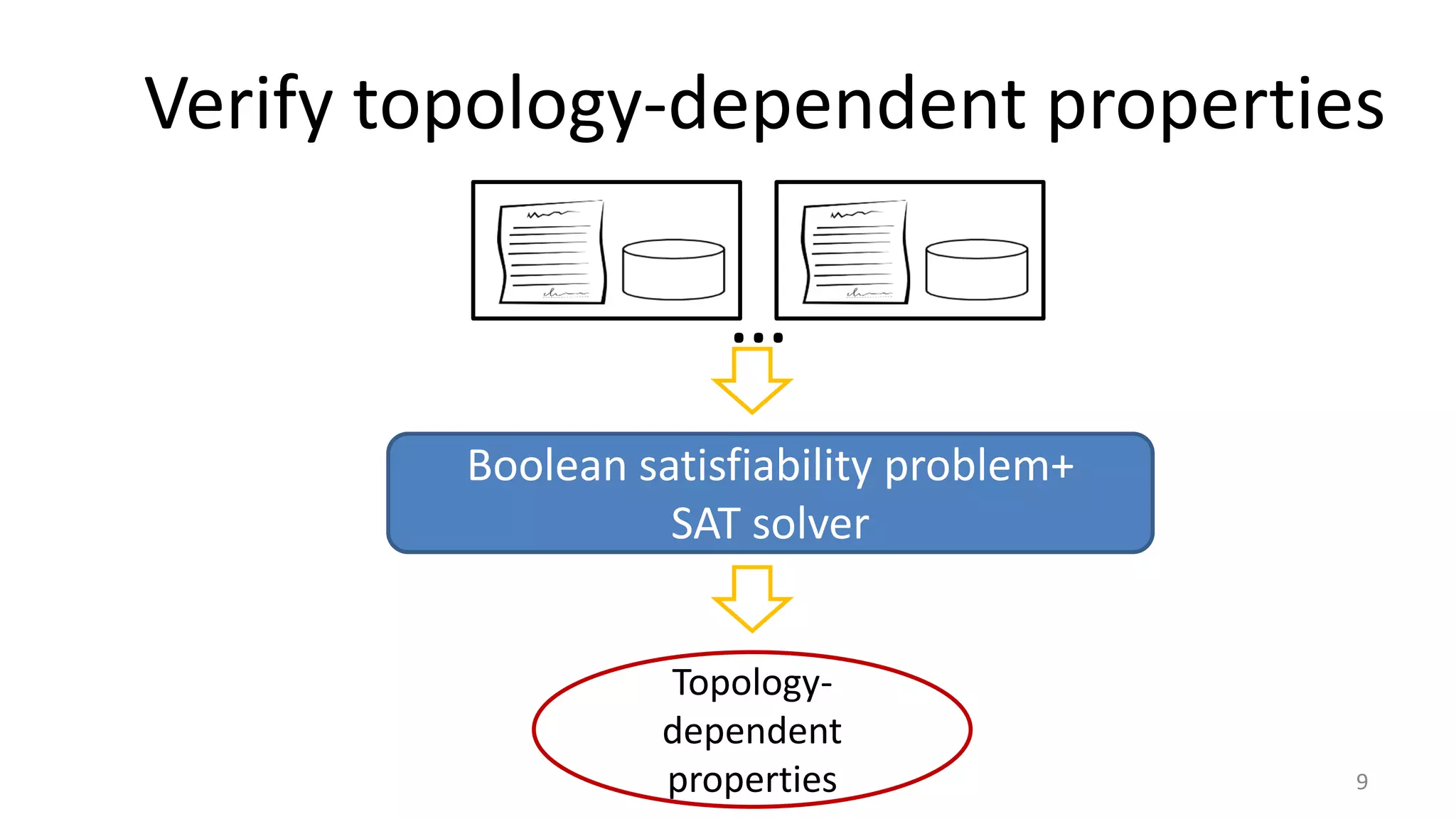
Verify topology-dependent properties
9
Topology-
dependent
properties
…
Boolean satisfiability problem+
SAT solver
Current status & Open issue
• Implementation choices:
– Compile NDLog programs into low-level execution code
– Invoke Openflow APIs directly from NDLog programs
• More properties:
– Security properties on WAN
• Proof automation:
– Automatic invariant specification
– Automatic proof process
10
Thank you & Questions?
11
Properties category
• Topology-dependent properties
– Reachability
– No black holes in the network
– Correct ordering of rule issuing to a number of switches
– VLAN isolation
• Topology-independent properties
– First packet of each flow is never dropped
– Correct ordering of rule issuing to a single switch
– Packets are either forwarded or processed by controller
– The controller eventually processes all OpenFlow messages
– Loop-freeness with BGP
12

Proof-based Verification of Software Defined Networks

  • 3.
    Proof-based Verification of SoftwareDefined Networks Chen Chen, Limin Jia, Wenchao Zhou and Boon Thau Loo University of Pennsylvania, Carnegie Mellon University, Georgetown University 1
  • 4.
    Verification in SDN •Properties of interest – Correct static network configuration ① • Reachability: Node A is reachable from node B • Loop-freeness: No forwarding loop in the network – Correct configuration update ② • Consistency: reachability and loop-freeness are not violated during update – Correct implementation of the controller ③ • Two-phase update: internal ports are updated before ingress ports • Non-repetitive configuration: each flow entry is installed only once 2
  • 5.
    • Related work –Header Space Analysis: Static Checking For Networks (①) • P. Kazemian, et al. NSDI 2012 – VeriFlow: Verifying Network-Wide Invariants in Real Time (①, ②) • A. Khurshid, et al. NSDI 2013 – Abstractions for Network Update (②) • M Reitblatt, et al. SIGCOMM 2012 – A NICE Way to Test OpenFlow Applications (debugging ①, ②, ③) • M. Canini, et al. NSDI 2012 – A Balance of Power: Expressive, Analyzable Controller Programming (③) • T. Nelson, et al. HotSDN 2013 • Main challenge: – Network state explosion: • Packets, flow tables, ACLs… 3 State of the art
  • 6.
    Our work • Observation: –Not all properties are topology-dependent • We propose: – Proof-based verification of controller programs • Use a declarative language to encode the controller program and switch functionality • A sound proof system for the language to prove topology- independent properties • Compilation to low-level imperative languages 4
  • 7.
    System specification • Declarativeprogramming: – Network Datalog (NDLog) • B. T. Loo, et al. Commun. ACM, 2009 – A set of derivation rules • Rule head: flowMod() • Rule body: ofConn(), ofPacket() • Location specifier: @ rc1 flowMod(@swc, smac, iport) :- ofConn(@ctl, swc), ofPacket(@ctl, swc, iport, smac, dmac). 5
  • 8.
    System specification inNDLog 6 Network Operating System
  • 9.
    Verify topology-independent properties 7 •Program logic: – Prove invariant properties of NDLog programs – Sound w.r.t. NDLog operational semantics • Example: – Ethernet MAC learning – Property: flow installation follows table miss • Whenever a forwarding entry with destination “m” is installed on a switch s, there must have been a forwarding table miss at s before, triggered by a packet whose src address is “m”
  • 10.
    Flow installation followstable miss • Property specification: – First-order logic – flowEntry(swc, m, t) => ∃t’, flowMiss(swc, m, t’) & t’ < t • Proof: – Switch invariant: • flowEntry(swc, m, t) => ∃t1, flowMod(swc, ctl, m, t1) & t1 < t – Controller invariant: • flowMod(swc, ctl, m, t) => ∃t2, ofPacket(ctl, swc, m, t2) & t2 < t – Switch invariant: • ofPacket(ctl, swc, m, t) => ∃t3, flowMiss(swc, m, t3) & t3 < t 8
  • 11.
  • 12.
    Current status &Open issue • Implementation choices: – Compile NDLog programs into low-level execution code – Invoke Openflow APIs directly from NDLog programs • More properties: – Security properties on WAN • Proof automation: – Automatic invariant specification – Automatic proof process 10
  • 13.
    Thank you &Questions? 11
  • 14.
    Properties category • Topology-dependentproperties – Reachability – No black holes in the network – Correct ordering of rule issuing to a number of switches – VLAN isolation • Topology-independent properties – First packet of each flow is never dropped – Correct ordering of rule issuing to a single switch – Packets are either forwarded or processed by controller – The controller eventually processes all OpenFlow messages – Loop-freeness with BGP 12