COPYRIGHT © 2018 NETSCOUT SYSTEMS, INC. | PUBLIC 1
COPYRIGHT © 2018 NETSCOUT SYSTEMS, INC. | PUBLIC 2
BGP FlowSpec in 2019: operational
experience and future developments
a.k.a. “yet another FlowSpec talk”
Alessandro Bulletti
Kirill Kasavchenko
COPYRIGHT © 2018 NETSCOUT SYSTEMS, INC. | PUBLIC 3
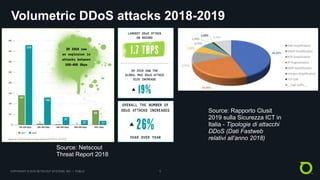
Volumetric DDoS attacks 2018-2019
Source: Netscout
Threat Report 2018
Source: Rapporto Clusit
2019 sulla Sicurezza ICT in
Italia - Tipologie di attacchi
DDoS (Dati Fastweb
relativi all’anno 2018)
COPYRIGHT © 2018 NETSCOUT SYSTEMS, INC. | PUBLIC 4
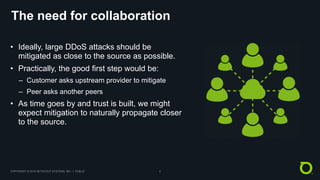
The need for collaboration
• Ideally, large DDoS attacks should be
mitigated as close to the source as possible.
• Practically, the good first step would be:
– Customer asks upstream provider to mitigate
– Peer asks another peers
• As time goes by and trust is built, we might
expect mitigation to naturally propagate closer
to the source.
COPYRIGHT © 2018 NETSCOUT SYSTEMS, INC. | PUBLIC 5
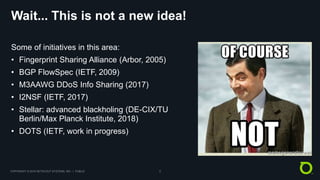
Wait... This is not a new idea!
Some of initiatives in this area:
• Fingerprint Sharing Alliance (Arbor, 2005)
• BGP FlowSpec (IETF, 2009)
• M3AAWG DDoS Info Sharing (2017)
• I2NSF (IETF, 2017)
• Stellar: advanced blackholing (DE-CIX/TU
Berlin/Max Planck Institute, 2018)
• DOTS (IETF, work in progress)
COPYRIGHT © 2018 NETSCOUT SYSTEMS, INC. | PUBLIC 6
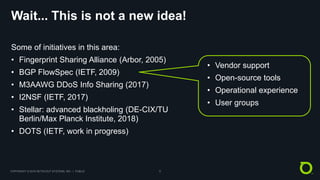
Wait... This is not a new idea!
Some of initiatives in this area:
• Fingerprint Sharing Alliance (Arbor, 2005)
• BGP FlowSpec (IETF, 2009)
• M3AAWG DDoS Info Sharing (2017)
• I2NSF (IETF, 2017)
• Stellar: advanced blackholing (DE-CIX/TU
Berlin/Max Planck Institute, 2018)
• DOTS (IETF, work in progress)
• Vendor support
• Open-source tools
• Operational experience
• User groups
COPYRIGHT © 2018 NETSCOUT SYSTEMS, INC. | PUBLIC 7
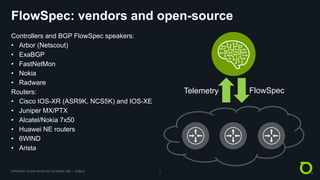
FlowSpec: vendors and open-source
Controllers and BGP FlowSpec speakers:
• Arbor (Netscout)
• ExaBGP
• FastNetMon
• Nokia
• Radware
Routers:
• Cisco IOS-XR (ASR9K, NCS5K) and IOS-XE
• Juniper MX/PTX
• Alcatel/Nokia 7x50
• Huawei NE routers
• 6WIND
• Arista
Telemetry FlowSpec
COPYRIGHT © 2018 NETSCOUT SYSTEMS, INC. | PUBLIC 8
FlowSpec: operational experience & user groups
Deployments (based on public information):
• Cloudflare, Level3, Rostelecom, Orange Poland
DDoS Peering initiative:
• AT&T, Century Link, Charter
• See slides at NANOG 71 and 75 (links in the end of this presentation)
FlowSpec multi vendor tests by T-Mobile Austria and NextLayer :
• Cisco, Juniper, Huawei, Nokia
• Focus on Inter-AS applicability and operational needs
COPYRIGHT © 2018 NETSCOUT SYSTEMS, INC. | PUBLIC 9
What works well
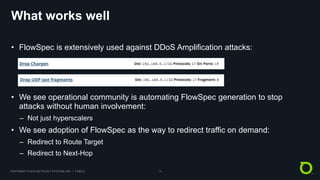
• FlowSpec is extensively used against DDoS Amplification attacks:
• We see operational community is automating FlowSpec generation to stop
attacks without human involvement:
– Not just hyperscalers
• We see adoption of FlowSpec as the way to redirect traffic on demand:
– Redirect to Route Target
– Redirect to Next-Hop
COPYRIGHT © 2018 NETSCOUT SYSTEMS, INC. | PUBLIC 10
What could be improved
• Scale on router side:
– Number of concurrently supported FlowSpec rules
– Speed of FlowSpec rules import and processing
• Various „safety nets“:
– Prevent too many FlowSpec rules from impacting router forwarding performance
– Lack of granularity in import policies:
• It is impossible to allow/reject FlowSpec rules based on action
• Therefore, possible for customer to change DSCP of their traffic to „network-critical“
• These are implementation-specific improvements. They do not require industry
consensus in a form of IETF document or BCP.
COPYRIGHT © 2018 NETSCOUT SYSTEMS, INC. | PUBLIC 11
What is impossible to do with FlowSpec today
• Match traffic based on random L3-L4 field or based on payload
– Example: IP TTL, TCP Window Size
• Report traffic statistics across administrative boundaries
– ISP1 sends a FlowSpec rule to ISP2
– How ISP1 gets visibility into dropped traffic to estimate the efficacy of FlowSpec?
• There is a lack of common approach to these problems.
– We need standards (think RFC documents) or some well-defined Best Current Practices
COPYRIGHT © 2018 NETSCOUT SYSTEMS, INC. | PUBLIC 12
Flexible Payload Matching: problem statement
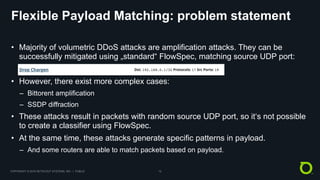
• Majority of volumetric DDoS attacks are amplification attacks. They can be
successfully mitigated using „standard“ FlowSpec, matching source UDP port:
• However, there exist more complex cases:
– Bittorent amplification
– SSDP diffraction
• These attacks result in packets with random source UDP port, so it‘s not possible
to create a classifier using FlowSpec.
• At the same time, these attacks generate specific patterns in payload.
– And some routers are able to match packets based on payload.
COPYRIGHT © 2018 NETSCOUT SYSTEMS, INC. | PUBLIC 13
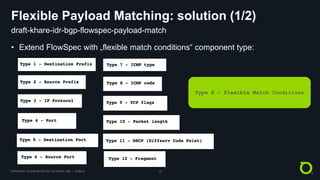
Flexible Payload Matching: solution (1/2)
• Extend FlowSpec with „flexible match conditions“ component type:
draft-khare-idr-bgp-flowspec-payload-match
Type X – Flexible Match Conditions
COPYRIGHT © 2018 NETSCOUT SYSTEMS, INC. | PUBLIC 14
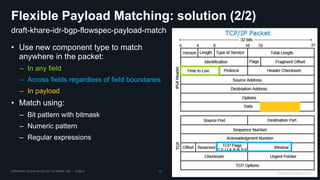
Flexible Payload Matching: solution (2/2)
• Use new component type to match
anywhere in the packet:
– In any field
– Across fields regardless of field boundaries
– In payload
• Match using:
– Bit pattern with bitmask
– Numeric pattern
– Regular expressions
draft-khare-idr-bgp-flowspec-payload-match
COPYRIGHT © 2018 NETSCOUT SYSTEMS, INC. | PUBLIC 15
FlowSpec and Reporting: problem statement
• How do you know if FlowSpec rule is effective?
• No standardized way to report traffic that matches FlowSpec policy:
– SNMP counters
– XML/Netconf
– draft-wu-idr-flowspec-yang-cfg-02
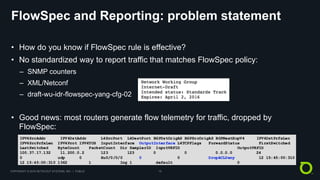
• Good news: most routers generate flow telemetry for traffic, dropped by
FlowSpec:
COPYRIGHT © 2018 NETSCOUT SYSTEMS, INC. | PUBLIC 16
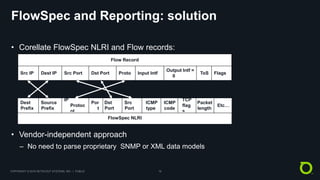
FlowSpec and Reporting: solution
• Corellate FlowSpec NLRI and Flow records:
• Vendor-independent approach
– No need to parse proprietary SNMP or XML data models
FlagsToS
Output Intf =
0
Input IntfProtoDst PortSrc PortDest IPSrc IP
Flow Record
Packet
length
TCP
flag
s
ICMP
type
Dst
Port
Por
t
IP
Protoc
ol
Source
Prefix
Dest
Prefix
FlowSpec NLRI
Src
Port
ICMP
code
Etc…
COPYRIGHT © 2018 NETSCOUT SYSTEMS, INC. | PUBLIC 17
FlowSpec and Reporting: Inter-AS?
• Reporting based on Netflow and FlowSpec correlation won‘t work between ASNs
– No way for ISP1 to receive flow telemetry from ISP2
• Other approaches (SNMP, Netconf, streaming telemetry) won‘t work either
• We would need something totally new:
– Most likely some mediation tool that makes sure only relevant information is reported
between ASNs
– Or some concept of „administrative domains“ in flow / SNMP / streaming telemetry
• Whatever the solution would be, having visibility into FlowSpec rules propagated
between ASNs is going to be an essential factor for adoption
COPYRIGHT © 2018 NETSCOUT SYSTEMS, INC. | PUBLIC 18
FlowSpec evolution: RFC5575bis
• Defines all traffic action extended communities as transitive extended
communities. RFC5575 defined the traffic- rate action to be non-transitive and did
not define the transitivity of the other action communities at all.
• Introduces a new traffic filtering action traffic-rate-packets:
– Instead of ”rate-limit to 100 bps” you can now “rate-limit to 100 pps”
• Introduces rules how updates of Flow Specifications shall be handled in case
they contain interfering actions
• A full list of changes can be found in the references section of this slide deck
Major changes
COPYRIGHT © 2018 NETSCOUT SYSTEMS, INC. | PUBLIC 19
Other interesting FlowSpec developments
• FlowSpec interface set (draft-ietf-idr-flowspec-interfaceset)
– Use BGP communities to signal to which interfaces (interface-set) should a FlowSpec
action be applied
– Supported in Cisco IOS-XE
COPYRIGHT © 2018 NETSCOUT SYSTEMS, INC. | PUBLIC 20
Summary
• FlowSpec is a mature DDoS mitigation technology
• No, it‘s not perfect and alone is not enough to stop all types of DDoS attacks
– it is not applicable against TCP SYN floods and application layer DDoS
– but it mitigates the most impacting DDoS types in ISP networks – amplification attacks
• Check with $your_router_vendor what the platform limits are:
– Scale
– Policies
• Don‘t be afraid to automate FlowSpec. If you don‘t know how – talk to us.
• Work with IETF and vendors to get new FlowSpec ideas implemented
A.k.a Last Slide
COPYRIGHT © 2018 NETSCOUT SYSTEMS, INC. | PUBLIC 21
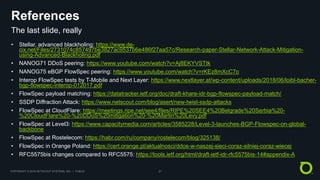
References
• Stellar, advanced blackholing: https://www.de-
cix.net/Files/2731074c857497be3827ac9537b6e486f27aa57c/Research-paper-Stellar-Network-Attack-Mitigation-
using-Advanced-Blackholing.pdf
• NANOG71 DDoS peering: https://www.youtube.com/watch?v=Aj8EKYVSTtk
• NANOG75 eBGP FlowSpec peering: https://www.youtube.com/watch?v=rKEz8mXcC7o
• Interop FlowSpec tests by T-Mobile and Next Layer: https://www.nextlayer.at/wp-content/uploads/2018/06/loibl-bacher-
bgp-flowspec-interop-012017.pdf
• FlowSpec payload matching: https://datatracker.ietf.org/doc/draft-khare-idr-bgp-flowspec-payload-match/
• SSDP Diffraction Attack: https://www.netscout.com/blog/asert/new-twist-ssdp-attacks
• FlowSpec at CloudFlare: https://meetings.ripe.net/see4/files/RIPE%20SEE4%20Belgrade%20Serbia%20-
%20CloudFlare%20-%20DDoS%20mitigation%20-%20Martin%20Levy.pdf
• FlowSpec at Level3: https://www.capacitymedia.com/articles/3585228/Level-3-launches-BGP-Flowspec-on-global-
backbone
• FlowSpec at Rostelecom: https://habr.com/ru/company/rostelecom/blog/325138/
• FlowSpec in Orange Poland: https://cert.orange.pl/aktualnosci/ddos-w-naszej-sieci-coraz-silniej-coraz-wiecej
• RFC5575bis changes compared to RFC5575: https://tools.ietf.org/html/draft-ietf-idr-rfc5575bis-14#appendix-A
The last slide, really
COPYRIGHT © 2018 NETSCOUT SYSTEMS, INC. | PUBLIC 22
Thank You.
www.netscout.com
alessandro.bulletti@netscout.com
kirill.kasavchenko@netscout.com

BGP FlowSpec experience and future developments

  • 1.
    COPYRIGHT © 2018NETSCOUT SYSTEMS, INC. | PUBLIC 1
  • 2.
    COPYRIGHT © 2018NETSCOUT SYSTEMS, INC. | PUBLIC 2 BGP FlowSpec in 2019: operational experience and future developments a.k.a. “yet another FlowSpec talk” Alessandro Bulletti Kirill Kasavchenko
  • 3.
    COPYRIGHT © 2018NETSCOUT SYSTEMS, INC. | PUBLIC 3 Volumetric DDoS attacks 2018-2019 Source: Netscout Threat Report 2018 Source: Rapporto Clusit 2019 sulla Sicurezza ICT in Italia - Tipologie di attacchi DDoS (Dati Fastweb relativi all’anno 2018)
  • 4.
    COPYRIGHT © 2018NETSCOUT SYSTEMS, INC. | PUBLIC 4 The need for collaboration • Ideally, large DDoS attacks should be mitigated as close to the source as possible. • Practically, the good first step would be: – Customer asks upstream provider to mitigate – Peer asks another peers • As time goes by and trust is built, we might expect mitigation to naturally propagate closer to the source.
  • 5.
    COPYRIGHT © 2018NETSCOUT SYSTEMS, INC. | PUBLIC 5 Wait... This is not a new idea! Some of initiatives in this area: • Fingerprint Sharing Alliance (Arbor, 2005) • BGP FlowSpec (IETF, 2009) • M3AAWG DDoS Info Sharing (2017) • I2NSF (IETF, 2017) • Stellar: advanced blackholing (DE-CIX/TU Berlin/Max Planck Institute, 2018) • DOTS (IETF, work in progress)
  • 6.
    COPYRIGHT © 2018NETSCOUT SYSTEMS, INC. | PUBLIC 6 Wait... This is not a new idea! Some of initiatives in this area: • Fingerprint Sharing Alliance (Arbor, 2005) • BGP FlowSpec (IETF, 2009) • M3AAWG DDoS Info Sharing (2017) • I2NSF (IETF, 2017) • Stellar: advanced blackholing (DE-CIX/TU Berlin/Max Planck Institute, 2018) • DOTS (IETF, work in progress) • Vendor support • Open-source tools • Operational experience • User groups
  • 7.
    COPYRIGHT © 2018NETSCOUT SYSTEMS, INC. | PUBLIC 7 FlowSpec: vendors and open-source Controllers and BGP FlowSpec speakers: • Arbor (Netscout) • ExaBGP • FastNetMon • Nokia • Radware Routers: • Cisco IOS-XR (ASR9K, NCS5K) and IOS-XE • Juniper MX/PTX • Alcatel/Nokia 7x50 • Huawei NE routers • 6WIND • Arista Telemetry FlowSpec
  • 8.
    COPYRIGHT © 2018NETSCOUT SYSTEMS, INC. | PUBLIC 8 FlowSpec: operational experience & user groups Deployments (based on public information): • Cloudflare, Level3, Rostelecom, Orange Poland DDoS Peering initiative: • AT&T, Century Link, Charter • See slides at NANOG 71 and 75 (links in the end of this presentation) FlowSpec multi vendor tests by T-Mobile Austria and NextLayer : • Cisco, Juniper, Huawei, Nokia • Focus on Inter-AS applicability and operational needs
  • 9.
    COPYRIGHT © 2018NETSCOUT SYSTEMS, INC. | PUBLIC 9 What works well • FlowSpec is extensively used against DDoS Amplification attacks: • We see operational community is automating FlowSpec generation to stop attacks without human involvement: – Not just hyperscalers • We see adoption of FlowSpec as the way to redirect traffic on demand: – Redirect to Route Target – Redirect to Next-Hop
  • 10.
    COPYRIGHT © 2018NETSCOUT SYSTEMS, INC. | PUBLIC 10 What could be improved • Scale on router side: – Number of concurrently supported FlowSpec rules – Speed of FlowSpec rules import and processing • Various „safety nets“: – Prevent too many FlowSpec rules from impacting router forwarding performance – Lack of granularity in import policies: • It is impossible to allow/reject FlowSpec rules based on action • Therefore, possible for customer to change DSCP of their traffic to „network-critical“ • These are implementation-specific improvements. They do not require industry consensus in a form of IETF document or BCP.
  • 11.
    COPYRIGHT © 2018NETSCOUT SYSTEMS, INC. | PUBLIC 11 What is impossible to do with FlowSpec today • Match traffic based on random L3-L4 field or based on payload – Example: IP TTL, TCP Window Size • Report traffic statistics across administrative boundaries – ISP1 sends a FlowSpec rule to ISP2 – How ISP1 gets visibility into dropped traffic to estimate the efficacy of FlowSpec? • There is a lack of common approach to these problems. – We need standards (think RFC documents) or some well-defined Best Current Practices
  • 12.
    COPYRIGHT © 2018NETSCOUT SYSTEMS, INC. | PUBLIC 12 Flexible Payload Matching: problem statement • Majority of volumetric DDoS attacks are amplification attacks. They can be successfully mitigated using „standard“ FlowSpec, matching source UDP port: • However, there exist more complex cases: – Bittorent amplification – SSDP diffraction • These attacks result in packets with random source UDP port, so it‘s not possible to create a classifier using FlowSpec. • At the same time, these attacks generate specific patterns in payload. – And some routers are able to match packets based on payload.
  • 13.
    COPYRIGHT © 2018NETSCOUT SYSTEMS, INC. | PUBLIC 13 Flexible Payload Matching: solution (1/2) • Extend FlowSpec with „flexible match conditions“ component type: draft-khare-idr-bgp-flowspec-payload-match Type X – Flexible Match Conditions
  • 14.
    COPYRIGHT © 2018NETSCOUT SYSTEMS, INC. | PUBLIC 14 Flexible Payload Matching: solution (2/2) • Use new component type to match anywhere in the packet: – In any field – Across fields regardless of field boundaries – In payload • Match using: – Bit pattern with bitmask – Numeric pattern – Regular expressions draft-khare-idr-bgp-flowspec-payload-match
  • 15.
    COPYRIGHT © 2018NETSCOUT SYSTEMS, INC. | PUBLIC 15 FlowSpec and Reporting: problem statement • How do you know if FlowSpec rule is effective? • No standardized way to report traffic that matches FlowSpec policy: – SNMP counters – XML/Netconf – draft-wu-idr-flowspec-yang-cfg-02 • Good news: most routers generate flow telemetry for traffic, dropped by FlowSpec:
  • 16.
    COPYRIGHT © 2018NETSCOUT SYSTEMS, INC. | PUBLIC 16 FlowSpec and Reporting: solution • Corellate FlowSpec NLRI and Flow records: • Vendor-independent approach – No need to parse proprietary SNMP or XML data models FlagsToS Output Intf = 0 Input IntfProtoDst PortSrc PortDest IPSrc IP Flow Record Packet length TCP flag s ICMP type Dst Port Por t IP Protoc ol Source Prefix Dest Prefix FlowSpec NLRI Src Port ICMP code Etc…
  • 17.
    COPYRIGHT © 2018NETSCOUT SYSTEMS, INC. | PUBLIC 17 FlowSpec and Reporting: Inter-AS? • Reporting based on Netflow and FlowSpec correlation won‘t work between ASNs – No way for ISP1 to receive flow telemetry from ISP2 • Other approaches (SNMP, Netconf, streaming telemetry) won‘t work either • We would need something totally new: – Most likely some mediation tool that makes sure only relevant information is reported between ASNs – Or some concept of „administrative domains“ in flow / SNMP / streaming telemetry • Whatever the solution would be, having visibility into FlowSpec rules propagated between ASNs is going to be an essential factor for adoption
  • 18.
    COPYRIGHT © 2018NETSCOUT SYSTEMS, INC. | PUBLIC 18 FlowSpec evolution: RFC5575bis • Defines all traffic action extended communities as transitive extended communities. RFC5575 defined the traffic- rate action to be non-transitive and did not define the transitivity of the other action communities at all. • Introduces a new traffic filtering action traffic-rate-packets: – Instead of ”rate-limit to 100 bps” you can now “rate-limit to 100 pps” • Introduces rules how updates of Flow Specifications shall be handled in case they contain interfering actions • A full list of changes can be found in the references section of this slide deck Major changes
  • 19.
    COPYRIGHT © 2018NETSCOUT SYSTEMS, INC. | PUBLIC 19 Other interesting FlowSpec developments • FlowSpec interface set (draft-ietf-idr-flowspec-interfaceset) – Use BGP communities to signal to which interfaces (interface-set) should a FlowSpec action be applied – Supported in Cisco IOS-XE
  • 20.
    COPYRIGHT © 2018NETSCOUT SYSTEMS, INC. | PUBLIC 20 Summary • FlowSpec is a mature DDoS mitigation technology • No, it‘s not perfect and alone is not enough to stop all types of DDoS attacks – it is not applicable against TCP SYN floods and application layer DDoS – but it mitigates the most impacting DDoS types in ISP networks – amplification attacks • Check with $your_router_vendor what the platform limits are: – Scale – Policies • Don‘t be afraid to automate FlowSpec. If you don‘t know how – talk to us. • Work with IETF and vendors to get new FlowSpec ideas implemented A.k.a Last Slide
  • 21.
    COPYRIGHT © 2018NETSCOUT SYSTEMS, INC. | PUBLIC 21 References • Stellar, advanced blackholing: https://www.de- cix.net/Files/2731074c857497be3827ac9537b6e486f27aa57c/Research-paper-Stellar-Network-Attack-Mitigation- using-Advanced-Blackholing.pdf • NANOG71 DDoS peering: https://www.youtube.com/watch?v=Aj8EKYVSTtk • NANOG75 eBGP FlowSpec peering: https://www.youtube.com/watch?v=rKEz8mXcC7o • Interop FlowSpec tests by T-Mobile and Next Layer: https://www.nextlayer.at/wp-content/uploads/2018/06/loibl-bacher- bgp-flowspec-interop-012017.pdf • FlowSpec payload matching: https://datatracker.ietf.org/doc/draft-khare-idr-bgp-flowspec-payload-match/ • SSDP Diffraction Attack: https://www.netscout.com/blog/asert/new-twist-ssdp-attacks • FlowSpec at CloudFlare: https://meetings.ripe.net/see4/files/RIPE%20SEE4%20Belgrade%20Serbia%20- %20CloudFlare%20-%20DDoS%20mitigation%20-%20Martin%20Levy.pdf • FlowSpec at Level3: https://www.capacitymedia.com/articles/3585228/Level-3-launches-BGP-Flowspec-on-global- backbone • FlowSpec at Rostelecom: https://habr.com/ru/company/rostelecom/blog/325138/ • FlowSpec in Orange Poland: https://cert.orange.pl/aktualnosci/ddos-w-naszej-sieci-coraz-silniej-coraz-wiecej • RFC5575bis changes compared to RFC5575: https://tools.ietf.org/html/draft-ietf-idr-rfc5575bis-14#appendix-A The last slide, really
  • 22.
    COPYRIGHT © 2018NETSCOUT SYSTEMS, INC. | PUBLIC 22 Thank You. www.netscout.com alessandro.bulletti@netscout.com kirill.kasavchenko@netscout.com