







Sales and Site Optimisation Keith Feighery: Digital Strategist
Design, Info Architecture & Calls to Action Case Studies
Design with Clear Intent
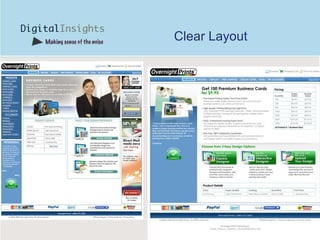
Clear Layout
Obvious Benefits
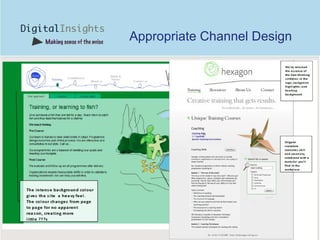
Appropriate Channel Design
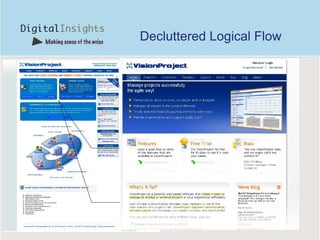
Decluttered Logical Flow
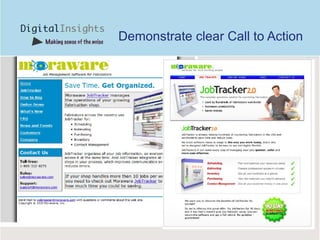
Demonstrate clear Call to Action
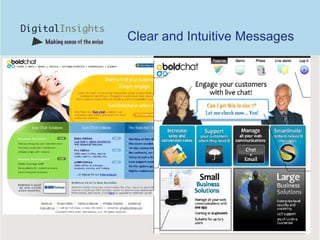
Clear and Intuitive Messages
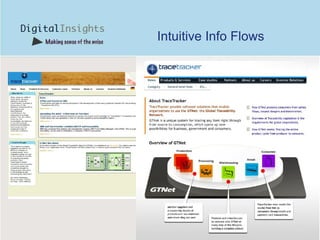
Intuitive Info Flows
eCommerce Case Study
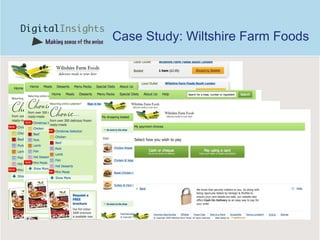
Case Study: Wiltshire Farm Foods
Key Take-Aways Remove Clutter – focus on key goals all the time  Remove any obstacles Provide lots of visual feedback  Users know that actions have been successful Adhere to affordance rules – make them obvious Big Buttons, Clear Large Links Anticipate and Answer questions upfront  Embed as part of user experience Knit USPs in copy and images of site Emphasise all your differentiators
Website Optimisation Dynamically Testi key elements of site Test Copy, Calls to Action, Images, Placement The $300,000,000 Button Both Split (A/B) and Multi-Variate Test Google Website Optimiser or Proprietary tools Define and set up conversion points Need to track and measure user actions Clear calls to action significantly augment optimisation goals Don’t force user to think – TELL THEM WHAT TO DO
Test Process Never stop testing and tracking user actions on website A/B Split Testing Define specific site goals (sale, sign-up etc..) Test two specific pages (typically high volume landing pages) Commercial tools (Vertster) or Google Optimiser  Monitor which test is performing better Use Variable rate or throttle testing to vary the percentage of traffic that gets routed to the various pages Multi-Variate testing Enables variable testing of elements within single pages D ifferent copy text, form layouts and even landing page images and background colours  together Track combinations that achieve predetermined goals
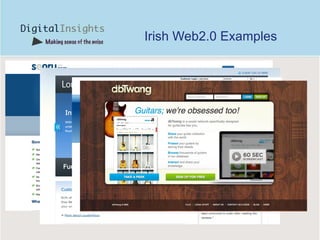
Irish Web 2.0 Examples
Irish Web2.0 Examples
Look at Irish Enterprise Examples
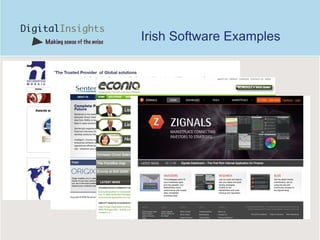
Irish Software Examples
International Web2.0 Examples
International Examples Web 2.0
Sales Funnel Specifics
Managing the Sales Funnel Methods of acquisition PPC Ads, SEO, Video, Email, LeagGen, Affiliate Marketing, Offer based, etc. Once there – what’s important? Prove you can Add Value Qualify Leads with intent  You want users who are amenable to your message – Its ok for users to self-select opt out Monetise towards latter end of the Funnel After user sees value and expresses intent Push low-cost options in the middle of funnel High cost ones at the end of your funnel
Customer Lifecycle Understand the customer lifecycle  The various stages of a customer over a timer period Create indicators to track their intent As they begin to move lag – make sure you target them Identify high repeat behaviour  Identify a common characteristic – and track this  e.g. have visited more than 3 time and purchase Track rising and falling repeat rates Have early warning systems in place Track repeat rate by media source  Search Engine, PPC, Banner Ad etc..
Customer Lifetime Value Segment customers into acquisition channels Identify the potential lifetime value per channel Identify length of customer lifecycle per channel Low cost channels could have shortest lifecycle Compare the relative potential value Consider: length of lifecycle, potential revenue per Customer  A llocate money towards higher potential value customers  By corollary - away from lower potential value customers
Understanding “Recency” Tracking Recency  Time since a customer last engaged in a behaviour Recency is  # 1  most powerful predictor of future behavior  C an predict likelihood of purchases, visits, game plays, or “ other  action-oriented” behavio u r T he more Recent a customer is,  the higher their potential value  is Segment Repeat segment into past and present (30 days) Apply a recency filter for real-time view L onger a customer has stopped engaging the less likely they are to repeat Take adjustive measures to increase in quality recency repeat customers
Dave McClure’s  AARRR for Start Ups
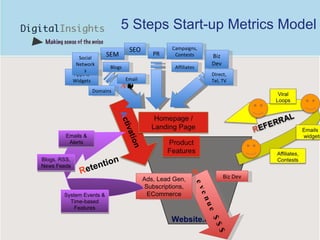
Start-Up Metrics A cquisition:   users come to site from various  channels A ctivation :   users enjoy 1 st  visit: " happy ” experience R etention:   users  come back , visit site multiple times R eferral:   users like product enough to  refer others R evenue:   users conduct some  monetization  behavior
Start-up Marketing Plan Marketing Plan = Target Customer Acquisition Channels 3 Important Factors = Volume (#), Cost ($), Conversion (%) Measure conversion to target customer actions Test audience segments, campaign themes, Call-To-Action (CTAs)  [Gradually] Match Channel Costs =>  Revenue Potential  Increase Vol. & Conversion, Decrease Cost, Optimize for Revenue Potential Avg Txn Value (ATV), Ann Rev Per User (ARPU), Cust Lifetime Value (CLV) Design channels that (eventually) cost <20-50% of target ATV, ARPU, CLV Consider Costs, Scarce Resource Tradeoffs Actual $ expenses Marketing time & resources Product/Engineering time & resources Cashflow timing of expense vs. revenue, profit
5 Steps Start-up Metrics Model Website.com R evenue $$$ Biz Dev Ads, Lead Gen, Subscriptions, ECommerce A CQUISITION SEO SEM Apps & Widgets Affiliates Email PR Biz Dev Campaigns, Contests Direct, Tel, TV Social Networks Blogs Domains R etention Emails & Alerts System Events & Time-based Features Blogs, RSS, News Feeds
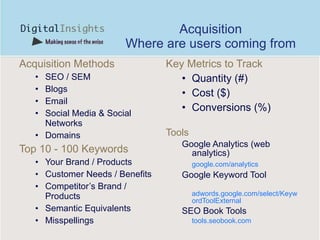
Acquisition Where are users coming from Acquisition Methods SEO / SEM Blogs Email Social Media & Social Networks Domains Top 10 - 100 Keywords Your Brand / Products Customer Needs / Benefits Competitor’s Brand / Products Semantic Equivalents Misspellings Key Metrics to Track Quantity (#) Cost ($) Conversions (%) Tools Google Analytics (web analytics) google.com/analytics Google Keyword Tool adwords.google.com/select/KeywordToolExternal SEO Book Tools tools.seobook.com
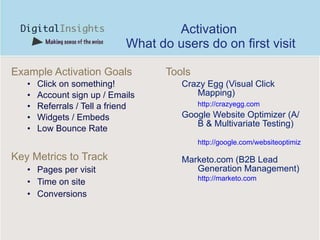
Activation  What do users do on first visit Example Activation Goals Click on something! Account sign up / Emails Referrals / Tell a friend Widgets / Embeds Low Bounce Rate Key Metrics to Track Pages per visit Time on site Conversions Tools Crazy Egg (Visual Click Mapping) http://crazyegg.com   Google Website Optimizer (A/B & Multivariate Testing) http://google.com/websiteoptimizer   Marketo.com (B2B Lead Generation Management) http://marketo.com
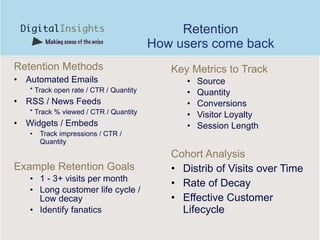
Retention How users come back Retention Methods Automated Emails * Track open rate / CTR / Quantity RSS / News Feeds * Track % viewed / CTR / Quantity Widgets / Embeds Track impressions / CTR / Quantity Example Retention Goals 1 - 3+ visits per month Long customer life cycle / Low decay Identify fanatics Key Metrics to Track Source Quantity Conversions Visitor Loyalty Session Length Cohort Analysis Distrib of Visits over Time Rate of Decay Effective Customer Lifecycle
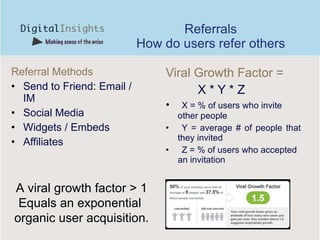
Referrals How do users refer others Referral Methods Send to Friend: Email / IM Social Media Widgets / Embeds Affiliates Viral Growth Factor =  X * Y * Z X = % of users who invite other people Y = average # of people that they invited Z = % of users who accepted an invitation A viral growth factor > 1 Equals an exponential  organic user acquisition.
Revenue How do you make money Revenue Tips Start Free => 2% “ Freemium ” Subscription / Recurring transactions Qualify your customers -> Lead generation (arbitrage) Sell something! (physical or virtual) Don’t Rely on AdSense (only) Resources & Tools Revenue Metrics (Andrew Chen) http://tinyurl.com/47r63a How to Create a Profitable “Freemium” Startup (Andrew Chen) http://tinyurl.com/8z9ygk   2008 Affiliate Marketing Review (Scott Jangro) http://tinyurl.com/86wak4
Appendix
Case Studies for Optimised Sites Dave McClure’s Presentation www.slideshare.net/dmc500hats/startup-metrics-for-pirates-startonomics-hawaii-nov-2009?src=embed Andrew Chen’s Blog www.andrewchenblog.com Website Optimisation Sites http://www.marketingexperiments.com/blog/ http://www.iamalandingpagedesigner.com/my-blog/ http://www.widerfunnel.com/

Onlne Sales And Optimisationv1.1

  • 1.
    Sales and SiteOptimisation Keith Feighery: Digital Strategist
  • 2.
    Design, Info Architecture& Calls to Action Case Studies
  • 3.
  • 4.
  • 5.
  • 6.
  • 7.
  • 8.
  • 9.
  • 10.
  • 11.
  • 12.
  • 13.
    Key Take-Aways RemoveClutter – focus on key goals all the time Remove any obstacles Provide lots of visual feedback Users know that actions have been successful Adhere to affordance rules – make them obvious Big Buttons, Clear Large Links Anticipate and Answer questions upfront Embed as part of user experience Knit USPs in copy and images of site Emphasise all your differentiators
  • 14.
    Website Optimisation DynamicallyTesti key elements of site Test Copy, Calls to Action, Images, Placement The $300,000,000 Button Both Split (A/B) and Multi-Variate Test Google Website Optimiser or Proprietary tools Define and set up conversion points Need to track and measure user actions Clear calls to action significantly augment optimisation goals Don’t force user to think – TELL THEM WHAT TO DO
  • 15.
    Test Process Neverstop testing and tracking user actions on website A/B Split Testing Define specific site goals (sale, sign-up etc..) Test two specific pages (typically high volume landing pages) Commercial tools (Vertster) or Google Optimiser Monitor which test is performing better Use Variable rate or throttle testing to vary the percentage of traffic that gets routed to the various pages Multi-Variate testing Enables variable testing of elements within single pages D ifferent copy text, form layouts and even landing page images and background colours together Track combinations that achieve predetermined goals
  • 16.
    Irish Web 2.0Examples
  • 17.
  • 18.
    Look at IrishEnterprise Examples
  • 19.
  • 20.
  • 21.
  • 22.
  • 23.
    Managing the SalesFunnel Methods of acquisition PPC Ads, SEO, Video, Email, LeagGen, Affiliate Marketing, Offer based, etc. Once there – what’s important? Prove you can Add Value Qualify Leads with intent You want users who are amenable to your message – Its ok for users to self-select opt out Monetise towards latter end of the Funnel After user sees value and expresses intent Push low-cost options in the middle of funnel High cost ones at the end of your funnel
  • 24.
    Customer Lifecycle Understandthe customer lifecycle The various stages of a customer over a timer period Create indicators to track their intent As they begin to move lag – make sure you target them Identify high repeat behaviour Identify a common characteristic – and track this e.g. have visited more than 3 time and purchase Track rising and falling repeat rates Have early warning systems in place Track repeat rate by media source Search Engine, PPC, Banner Ad etc..
  • 25.
    Customer Lifetime ValueSegment customers into acquisition channels Identify the potential lifetime value per channel Identify length of customer lifecycle per channel Low cost channels could have shortest lifecycle Compare the relative potential value Consider: length of lifecycle, potential revenue per Customer A llocate money towards higher potential value customers By corollary - away from lower potential value customers
  • 26.
    Understanding “Recency” TrackingRecency Time since a customer last engaged in a behaviour Recency is # 1 most powerful predictor of future behavior  C an predict likelihood of purchases, visits, game plays, or “ other action-oriented” behavio u r T he more Recent a customer is, the higher their potential value is Segment Repeat segment into past and present (30 days) Apply a recency filter for real-time view L onger a customer has stopped engaging the less likely they are to repeat Take adjustive measures to increase in quality recency repeat customers
  • 27.
    Dave McClure’s AARRR for Start Ups
  • 28.
    Start-Up Metrics Acquisition: users come to site from various channels A ctivation : users enjoy 1 st visit: &quot; happy ” experience R etention: users come back , visit site multiple times R eferral: users like product enough to refer others R evenue: users conduct some monetization behavior
  • 29.
    Start-up Marketing PlanMarketing Plan = Target Customer Acquisition Channels 3 Important Factors = Volume (#), Cost ($), Conversion (%) Measure conversion to target customer actions Test audience segments, campaign themes, Call-To-Action (CTAs) [Gradually] Match Channel Costs => Revenue Potential Increase Vol. & Conversion, Decrease Cost, Optimize for Revenue Potential Avg Txn Value (ATV), Ann Rev Per User (ARPU), Cust Lifetime Value (CLV) Design channels that (eventually) cost <20-50% of target ATV, ARPU, CLV Consider Costs, Scarce Resource Tradeoffs Actual $ expenses Marketing time & resources Product/Engineering time & resources Cashflow timing of expense vs. revenue, profit
  • 30.
    5 Steps Start-upMetrics Model Website.com R evenue $$$ Biz Dev Ads, Lead Gen, Subscriptions, ECommerce A CQUISITION SEO SEM Apps & Widgets Affiliates Email PR Biz Dev Campaigns, Contests Direct, Tel, TV Social Networks Blogs Domains R etention Emails & Alerts System Events & Time-based Features Blogs, RSS, News Feeds
  • 31.
    Acquisition Where areusers coming from Acquisition Methods SEO / SEM Blogs Email Social Media & Social Networks Domains Top 10 - 100 Keywords Your Brand / Products Customer Needs / Benefits Competitor’s Brand / Products Semantic Equivalents Misspellings Key Metrics to Track Quantity (#) Cost ($) Conversions (%) Tools Google Analytics (web analytics) google.com/analytics Google Keyword Tool adwords.google.com/select/KeywordToolExternal SEO Book Tools tools.seobook.com
  • 32.
    Activation Whatdo users do on first visit Example Activation Goals Click on something! Account sign up / Emails Referrals / Tell a friend Widgets / Embeds Low Bounce Rate Key Metrics to Track Pages per visit Time on site Conversions Tools Crazy Egg (Visual Click Mapping) http://crazyegg.com Google Website Optimizer (A/B & Multivariate Testing) http://google.com/websiteoptimizer Marketo.com (B2B Lead Generation Management) http://marketo.com
  • 33.
    Retention How userscome back Retention Methods Automated Emails * Track open rate / CTR / Quantity RSS / News Feeds * Track % viewed / CTR / Quantity Widgets / Embeds Track impressions / CTR / Quantity Example Retention Goals 1 - 3+ visits per month Long customer life cycle / Low decay Identify fanatics Key Metrics to Track Source Quantity Conversions Visitor Loyalty Session Length Cohort Analysis Distrib of Visits over Time Rate of Decay Effective Customer Lifecycle
  • 34.
    Referrals How dousers refer others Referral Methods Send to Friend: Email / IM Social Media Widgets / Embeds Affiliates Viral Growth Factor = X * Y * Z X = % of users who invite other people Y = average # of people that they invited Z = % of users who accepted an invitation A viral growth factor > 1 Equals an exponential organic user acquisition.
  • 35.
    Revenue How doyou make money Revenue Tips Start Free => 2% “ Freemium ” Subscription / Recurring transactions Qualify your customers -> Lead generation (arbitrage) Sell something! (physical or virtual) Don’t Rely on AdSense (only) Resources & Tools Revenue Metrics (Andrew Chen) http://tinyurl.com/47r63a How to Create a Profitable “Freemium” Startup (Andrew Chen) http://tinyurl.com/8z9ygk 2008 Affiliate Marketing Review (Scott Jangro) http://tinyurl.com/86wak4
  • 36.
  • 37.
    Case Studies forOptimised Sites Dave McClure’s Presentation www.slideshare.net/dmc500hats/startup-metrics-for-pirates-startonomics-hawaii-nov-2009?src=embed Andrew Chen’s Blog www.andrewchenblog.com Website Optimisation Sites http://www.marketingexperiments.com/blog/ http://www.iamalandingpagedesigner.com/my-blog/ http://www.widerfunnel.com/