



Week 2 – Digital Strategy and Planning Keith Feighery
Overview Components of Digital Marketing Strategy Create a rich Digital Marketing Ecosystem Developing a Digital Strategy SOSTAC RACE Case Studies Measuring Digital Marketing Programmes Questions and Answers
Core Components of Digital Strategy Have clear and defined business objectives for your Digital Programmes Increase Sales, Lead Gen, Build Awareness, Increase Customer Retention, Reduce Cost of Acquisition etc… Know exactly who your audience is – and where they reside digitally Behaviours, demographics, socialgraphics, vocabulary, media preferences, channel preferences  Chose Channels and develop a content strategy that adds value for your customers Develop, Execute, Iterate & Measure performance
Key Online Marketing Tactics Content & Inbound Marketing  Website, blog, social platforms, partnership sites etc… Social Media Marketing Twitter, LinkinedIn, Facebook, YouTube, Blogs, Podcasts Search Engine Marketing PPC, Display and Affiliates Search Engine Optimisation (SEO) Structured & Planned Content, Optimismed Vocabulary, Links  Email Marketing Email Service Providers, Acquisition and Retention, Lead Nurturing Mobile Marketing Location Based, Text, Advertising, Coupons, Offline-Activation Measurement and Analytics Clear Objectives and Benchmarks

Digital Marketing Strategy Frameworks
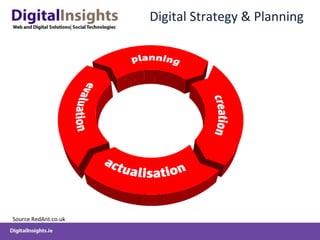
Digital Strategy & Planning Source RedAnt.co.uk
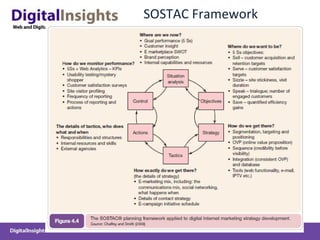
SOSTAC Framework
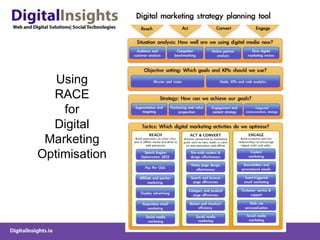
Using RACE for Digital Marketing Optimisation
Planning Phase
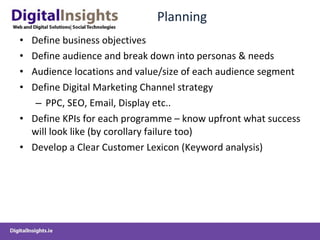
Planning Define business objectives Define audience and break down into personas & needs Audience locations and value/size of each audience segment Define Digital Marketing Channel strategy PPC, SEO, Email, Display etc.. Define KPIs for each programme – know upfront what success will look like (by corollary failure too) Develop a Clear Customer Lexicon (Keyword analysis)
Setting Clear Business Objectives
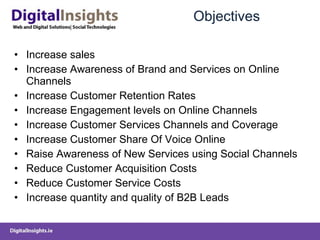
Objectives Increase sales Increase Awareness of Brand and Services on Online Channels Increase Customer Retention Rates Increase Engagement levels on Online Channels Increase Customer Services Channels and Coverage Increase Customer Share Of Voice Online Raise Awareness of New Services using Social Channels Reduce Customer Acquisition Costs Reduce Customer Service Costs Increase quantity and quality of B2B Leads
Goals Increase Average order size Reduce cart abandonment rates Increase number of marketing qualified leads Increase % of leads to closed business Increase # of branded traffic to site Increase length of time on site areas Increase # of email subscriptions Increase # of social media likes, comments and shares
Typical Trackable KPIs Rate & Value of Conversions Average order size (ecommerce apps) Customer Lifetime Value Average Revenue Per User Abandonment rates Cost per Lead & Cost Per Sale Core Bounce rates Frequency and Return rates
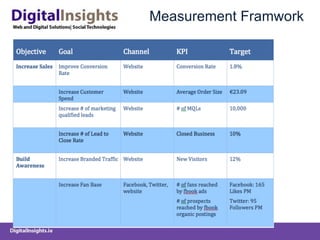
Measurement Framwork
Strategy
Strategy – How realise objectives Define Your Personas Needs, behaviours, demographics etc. Define Persona Locations Map Personas to Channels Map Channels to Goals Define Value Propositions per Channel
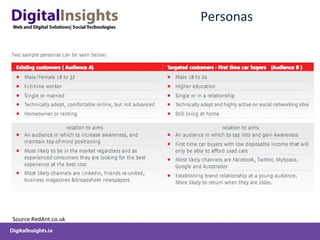
Personas Source RedAnt.co.uk
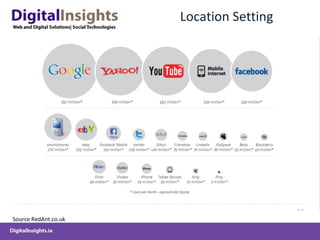
Location Setting Source RedAnt.co.uk
Research & Planning Tools
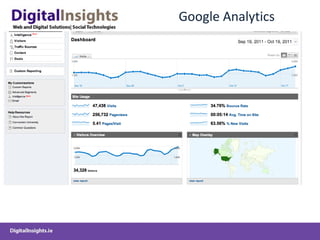
Google Analytics
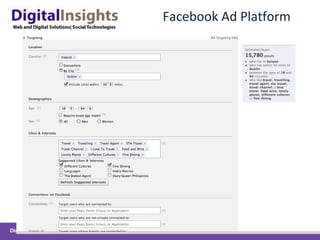
Facebook Ad Platform
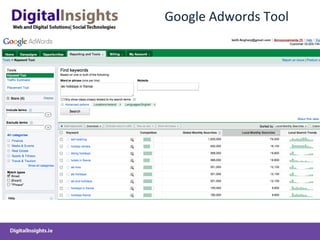
Google Adwords Tool
Research Channels
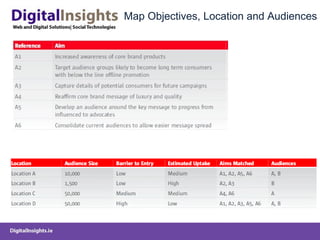
Map Objectives, Location and Audiences
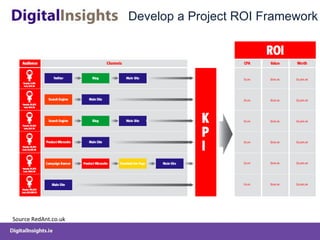
Develop a Project ROI Framework Source RedAnt.co.uk
PPC Channel ROI Work Through
Work-Through Spend €30,000 on PPC Channel 1 Million Impressions  30000 Clicks (3% CTR) 3% Conversion Rate (900) CPA = 30000/900 ->  €33.33  (Cost to Acquire One New Customer) Average Order Size €100  50% Profit Earned = €50.00 Profit Per Average Customer = (€50.00 – €33.33) = € 16.67 Total Amount ordered – 900 x 100 = €90,000 Generated 50% Profit Margin =  €45,000 (900 x 50) Total ROI  - €15,000 (16.67 x 900) or (€45,000 – €30,000 [cost of marketing and advertising]) Extrapolate Customer Lifetime Value
B2B Lead Management Work Through
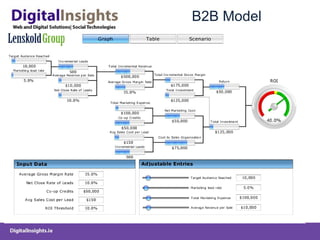
B2B Model
Creation & Actualisation Phase
Creation Once strategy, audience, locations are known Start conceiving, designing and creating tactical solutions Identify themes, channels, tone, aims for each tactical channel and initiative PPC, Social Platforms, SEO, Display, Affiliate, Email, Lead Gen etc… Create Digital Presence on Key Platforms Website, Social Channels, Ad Platforms, Email etc.. Initiate a content marketing production programme Create Content Editorial Calendars Map buyer informational needs along the buyer journey
Actualisation Real-time implementation of each channel, campaign and platform Engaging and interacting with your audiences Reacting to issues and tweaking campaigns as they proceed live Constantly compare performance with projected KPIs created during the previous phases Create a cross functional communications feedback loop to resolve all issues  and update status Capture all lessons learnt in a repository in order to feedback into an improvement process
Tactics & Actions
Social Media Programmes
Challenge is to build engaging digital and social strategies aligned with clear business objectives for each channel
Be Social – Interact with People & Solicit Feedback and Responses
Be Entertaining, Informative or Offer Something of VALUE to Followers
Elements of a social media campaign Essentials of a successful campaign Know your target audience Plan goals and aims of campaign and channel Think about the tone, voice and personality to adopt Choose your platforms carefully Think about the type of content to use on each platform Take risks – not everything will work Connect to other channels
Social Media Case Studies
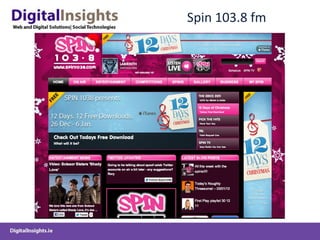
Spin 103.8 fm
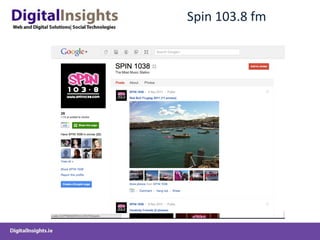
Spin 103.8 fm
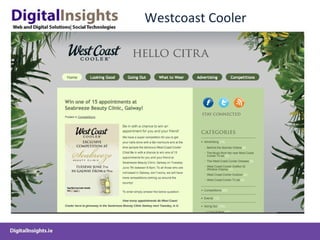
Westcoast Cooler
Westcoast Cooler
Branded Facebook Page
Adding/Tagging Images
Barrys Tea
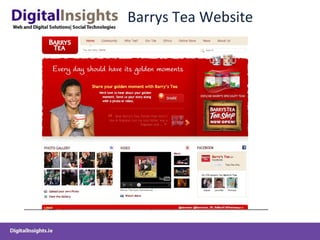
Barrys Tea Website
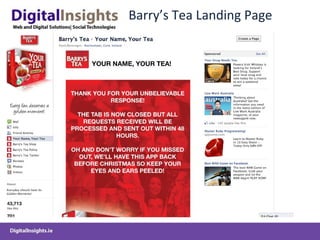
Barry ’s Tea Landing Page
Make UpandBeauty.ie
MakeupAndBeauty.ie
MakeUp&Beauty.ie
Brand Leverage
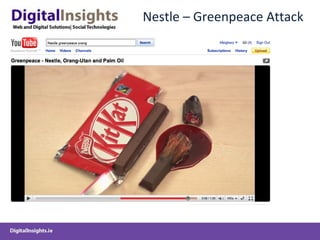
Big Brands Need to be Plan for Crisis on Social Media
Nestle – Greenpeace Attack
Moves Mainstream RealTime
Badly Managed Facebook
Pay Per Click Advertising
PPC & Display
Search: Health Insurance Quote
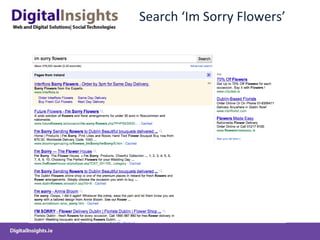
Search  ‘Im Sorry Flowers’
Google Display Network
Google Display Ads
Google Display Ads
Direct Networks
YouTube Masthead
Independent
Search Engine Optimisation
SEO Case Example
Search:  Flowers  for newborn baby
Newborn Flowers
Top Ranking Factors
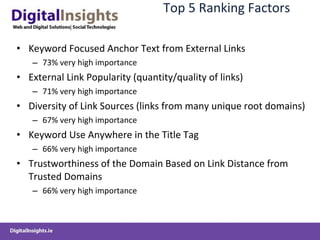
Top 5 Ranking Factors Keyword Focused Anchor Text from External Links   73% very high importance External Link Popularity (quantity/quality of links)   71% very high importance Diversity of Link Sources (links from many unique root domains)   67% very high importance Keyword Use Anywhere in the Title Tag   66% very high importance Trustworthiness of the Domain Based on Link Distance from Trusted Domains 66% very high importance
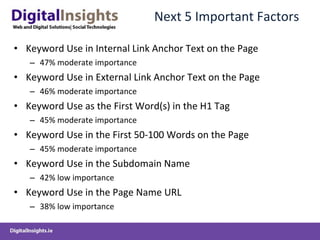
Next 5 Important Factors Keyword Use in Internal Link Anchor Text on the Page 47% moderate importance  Keyword Use in External Link Anchor Text on the Page 46% moderate importance  Keyword Use as the First Word(s) in the H1 Tag 45% moderate importance Keyword Use in the First 50-100 Words on the Page 45% moderate importance Keyword Use in the Subdomain Name 42% low importance Keyword Use in the Page Name URL 38% low importance
Local Search
Places Page
Email Marketing
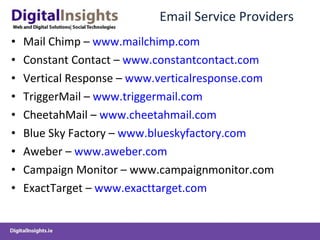
Email Service Providers Mail Chimp –  www.mailchimp.com Constant Contact –  www.constantcontact.com Vertical Response –  www.verticalresponse.com TriggerMail –  www.triggermail.com CheetahMail –  www.cheetahmail.com Blue Sky Factory –  www.blueskyfactory.com Aweber –  www.aweber.com Campaign Monitor – www.campaignmonitor.com ExactTarget –  www.exacttarget.com
Email Applications
Case Studies
CityDeal.ie
 
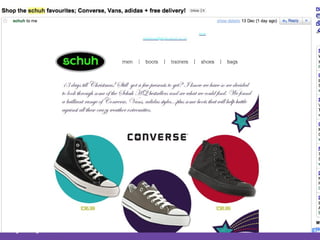
Schuh
 
Evaluation Phase
KPIs & Goals set in the Creation Phases should be assessed according to actuals
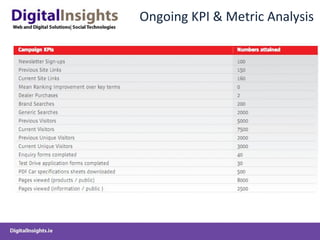
Ongoing KPI & Metric Analysis
Metrics Traffic Related Statistics # Page Views, Visits, Unique Visitors Channel Statistics  Decomposition of Organic, Paid, Email, Direct etc.. Social Stats # of Twitter, FB, Blog, LinkedIn followers/comments # of 3 rd  Party Links  Partners, Referrals, Promotions, Affiliates  # of Newsletter signups # of Site Specific Downloads  Webinar Views, Articles, Whitepapers, podcasts
Evaluation Feedback loop Implement a continuous learning and improvement framework All findings and experiences should feed into subsequent phases, campaigns  and initiatives Refine reporting process  Improve ROI metrics in their broadest sense Educate management through correlation of digital and business goals Iterate constantly
Questions & Answers
Contact Details www.linkedin.com/in/keithfeighery www.twitter.com/kfeighery www.faceboook.com/keith.feighery [email_address] 086 6070274
Thank You

DBS-Week2-DigitalStrategySession

  • 1.
    Week 2 –Digital Strategy and Planning Keith Feighery
  • 2.
    Overview Components ofDigital Marketing Strategy Create a rich Digital Marketing Ecosystem Developing a Digital Strategy SOSTAC RACE Case Studies Measuring Digital Marketing Programmes Questions and Answers
  • 3.
    Core Components ofDigital Strategy Have clear and defined business objectives for your Digital Programmes Increase Sales, Lead Gen, Build Awareness, Increase Customer Retention, Reduce Cost of Acquisition etc… Know exactly who your audience is – and where they reside digitally Behaviours, demographics, socialgraphics, vocabulary, media preferences, channel preferences Chose Channels and develop a content strategy that adds value for your customers Develop, Execute, Iterate & Measure performance
  • 4.
    Key Online MarketingTactics Content & Inbound Marketing Website, blog, social platforms, partnership sites etc… Social Media Marketing Twitter, LinkinedIn, Facebook, YouTube, Blogs, Podcasts Search Engine Marketing PPC, Display and Affiliates Search Engine Optimisation (SEO) Structured & Planned Content, Optimismed Vocabulary, Links Email Marketing Email Service Providers, Acquisition and Retention, Lead Nurturing Mobile Marketing Location Based, Text, Advertising, Coupons, Offline-Activation Measurement and Analytics Clear Objectives and Benchmarks
  • 5.
  • 6.
    Digital Strategy &Planning Source RedAnt.co.uk
  • 7.
  • 8.
    Using RACE forDigital Marketing Optimisation
  • 9.
  • 10.
    Planning Define businessobjectives Define audience and break down into personas & needs Audience locations and value/size of each audience segment Define Digital Marketing Channel strategy PPC, SEO, Email, Display etc.. Define KPIs for each programme – know upfront what success will look like (by corollary failure too) Develop a Clear Customer Lexicon (Keyword analysis)
  • 11.
  • 12.
    Objectives Increase salesIncrease Awareness of Brand and Services on Online Channels Increase Customer Retention Rates Increase Engagement levels on Online Channels Increase Customer Services Channels and Coverage Increase Customer Share Of Voice Online Raise Awareness of New Services using Social Channels Reduce Customer Acquisition Costs Reduce Customer Service Costs Increase quantity and quality of B2B Leads
  • 13.
    Goals Increase Averageorder size Reduce cart abandonment rates Increase number of marketing qualified leads Increase % of leads to closed business Increase # of branded traffic to site Increase length of time on site areas Increase # of email subscriptions Increase # of social media likes, comments and shares
  • 14.
    Typical Trackable KPIsRate & Value of Conversions Average order size (ecommerce apps) Customer Lifetime Value Average Revenue Per User Abandonment rates Cost per Lead & Cost Per Sale Core Bounce rates Frequency and Return rates
  • 15.
  • 16.
  • 17.
    Strategy – Howrealise objectives Define Your Personas Needs, behaviours, demographics etc. Define Persona Locations Map Personas to Channels Map Channels to Goals Define Value Propositions per Channel
  • 18.
  • 19.
  • 20.
  • 21.
  • 22.
  • 23.
  • 24.
  • 25.
  • 26.
    Develop a ProjectROI Framework Source RedAnt.co.uk
  • 27.
    PPC Channel ROIWork Through
  • 28.
    Work-Through Spend €30,000on PPC Channel 1 Million Impressions 30000 Clicks (3% CTR) 3% Conversion Rate (900) CPA = 30000/900 -> €33.33 (Cost to Acquire One New Customer) Average Order Size €100 50% Profit Earned = €50.00 Profit Per Average Customer = (€50.00 – €33.33) = € 16.67 Total Amount ordered – 900 x 100 = €90,000 Generated 50% Profit Margin = €45,000 (900 x 50) Total ROI - €15,000 (16.67 x 900) or (€45,000 – €30,000 [cost of marketing and advertising]) Extrapolate Customer Lifetime Value
  • 29.
    B2B Lead ManagementWork Through
  • 30.
  • 31.
  • 32.
    Creation Once strategy,audience, locations are known Start conceiving, designing and creating tactical solutions Identify themes, channels, tone, aims for each tactical channel and initiative PPC, Social Platforms, SEO, Display, Affiliate, Email, Lead Gen etc… Create Digital Presence on Key Platforms Website, Social Channels, Ad Platforms, Email etc.. Initiate a content marketing production programme Create Content Editorial Calendars Map buyer informational needs along the buyer journey
  • 33.
    Actualisation Real-time implementationof each channel, campaign and platform Engaging and interacting with your audiences Reacting to issues and tweaking campaigns as they proceed live Constantly compare performance with projected KPIs created during the previous phases Create a cross functional communications feedback loop to resolve all issues and update status Capture all lessons learnt in a repository in order to feedback into an improvement process
  • 34.
  • 35.
  • 36.
    Challenge is tobuild engaging digital and social strategies aligned with clear business objectives for each channel
  • 37.
    Be Social –Interact with People & Solicit Feedback and Responses
  • 38.
    Be Entertaining, Informativeor Offer Something of VALUE to Followers
  • 39.
    Elements of asocial media campaign Essentials of a successful campaign Know your target audience Plan goals and aims of campaign and channel Think about the tone, voice and personality to adopt Choose your platforms carefully Think about the type of content to use on each platform Take risks – not everything will work Connect to other channels
  • 40.
  • 41.
  • 42.
  • 43.
  • 44.
  • 45.
  • 46.
  • 47.
  • 48.
  • 49.
    Barry ’s TeaLanding Page
  • 50.
  • 51.
  • 52.
  • 53.
  • 54.
    Big Brands Needto be Plan for Crisis on Social Media
  • 55.
  • 56.
  • 57.
  • 58.
    Pay Per ClickAdvertising
  • 59.
  • 60.
  • 61.
    Search ‘ImSorry Flowers’
  • 62.
  • 63.
  • 64.
  • 65.
  • 66.
  • 67.
  • 68.
  • 69.
  • 70.
    Search: Flowers for newborn baby
  • 71.
  • 72.
  • 73.
    Top 5 RankingFactors Keyword Focused Anchor Text from External Links 73% very high importance External Link Popularity (quantity/quality of links) 71% very high importance Diversity of Link Sources (links from many unique root domains) 67% very high importance Keyword Use Anywhere in the Title Tag 66% very high importance Trustworthiness of the Domain Based on Link Distance from Trusted Domains 66% very high importance
  • 74.
    Next 5 ImportantFactors Keyword Use in Internal Link Anchor Text on the Page 47% moderate importance Keyword Use in External Link Anchor Text on the Page 46% moderate importance Keyword Use as the First Word(s) in the H1 Tag 45% moderate importance Keyword Use in the First 50-100 Words on the Page 45% moderate importance Keyword Use in the Subdomain Name 42% low importance Keyword Use in the Page Name URL 38% low importance
  • 75.
  • 76.
  • 77.
  • 78.
    Email Service ProvidersMail Chimp – www.mailchimp.com Constant Contact – www.constantcontact.com Vertical Response – www.verticalresponse.com TriggerMail – www.triggermail.com CheetahMail – www.cheetahmail.com Blue Sky Factory – www.blueskyfactory.com Aweber – www.aweber.com Campaign Monitor – www.campaignmonitor.com ExactTarget – www.exacttarget.com
  • 79.
  • 80.
  • 81.
  • 82.
  • 83.
  • 84.
  • 85.
  • 86.
    KPIs & Goalsset in the Creation Phases should be assessed according to actuals
  • 87.
    Ongoing KPI &Metric Analysis
  • 88.
    Metrics Traffic RelatedStatistics # Page Views, Visits, Unique Visitors Channel Statistics Decomposition of Organic, Paid, Email, Direct etc.. Social Stats # of Twitter, FB, Blog, LinkedIn followers/comments # of 3 rd Party Links Partners, Referrals, Promotions, Affiliates # of Newsletter signups # of Site Specific Downloads Webinar Views, Articles, Whitepapers, podcasts
  • 89.
    Evaluation Feedback loopImplement a continuous learning and improvement framework All findings and experiences should feed into subsequent phases, campaigns and initiatives Refine reporting process Improve ROI metrics in their broadest sense Educate management through correlation of digital and business goals Iterate constantly
  • 90.
  • 91.
    Contact Details www.linkedin.com/in/keithfeigherywww.twitter.com/kfeighery www.faceboook.com/keith.feighery [email_address] 086 6070274
  • 92.