University of North Texas Department of Journalism Oct. 2, 2008 Interactivity, Blogs, Sources
What We’ll Do Today Your Blogs – Campaign Websites Interactivity In-Class Writing  Political Coverage ‘08/NTNewsNet  HOMEWORK: - Do a complete analysis of PegasusNews.com. What works? What doesn’t? How would you improve it? 300 – 400 Words. Be prepared to ask questions to Mike Orren who will be speaking to our class next class.
Developing Sources Lifeblood of your career as a reporter Get over your shyness, it’s time to open up Learn to talk to everybody – yes, strangers! Everybody is a potential source when you’re covering a breaking news story Start with newspaper clippings Pick up the phone or hit the streets
Importance of Interaction & Involvement Two key factors Shift in flow of mass communications from one-way to multi-directional flow. Impacting how news is defined, the way it’s presented and how journalists do their jobs What people learn from the news User-controlled, user-driven content enhance learning Readers making mental connections to stories “ Participating” in the news
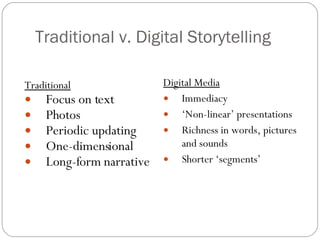
Traditional v. Digital Storytelling Traditional Focus on text Photos Periodic updating One-dimensional Long-form narrative Digital Media Immediacy ‘ Non-linear’ presentations Richness in words, pictures and sounds Shorter ‘segments’
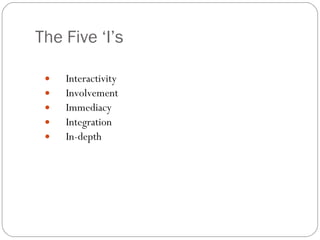
The Five ‘I’s Interactivity Involvement Immediacy Integration  In-depth
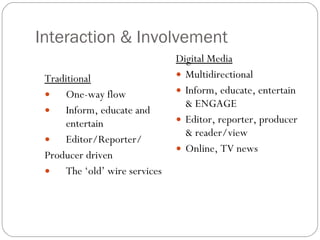
Interaction & Involvement Traditional One-way flow Inform, educate and entertain Editor/Reporter/ Producer driven The ‘old’ wire services Digital Media Multidirectional Inform, educate, entertain & ENGAGE Editor, reporter, producer & reader/view Online, TV news
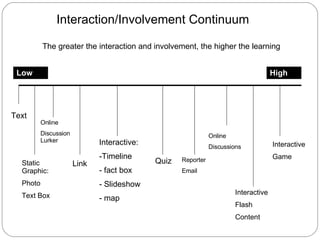
Text Static Graphic: Photo Text Box Online  Discussion Lurker Link Interactive: Timeline fact box Slideshow map Quiz Interactive  Game Interactive Flash  Content Online Discussions Reporter Email Interaction/Involvement Continuum Low High The greater the interaction and involvement, the higher the learning
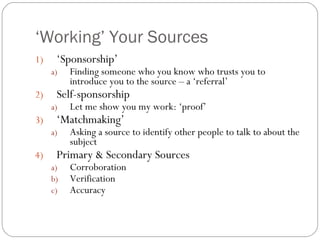
‘ Working’ Your Sources ‘ Sponsorship’ Finding someone who you know who trusts you to introduce you to the source – a ‘referral’ Self-sponsorship Let me show you my work: ‘proof’ ‘ Matchmaking’ Asking a source to identify other people to talk to about the subject Primary & Secondary Sources Corroboration Verification Accuracy
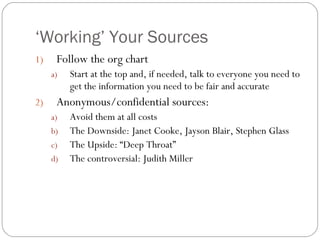
‘ Working’ Your Sources Follow the org chart Start at the top and, if needed, talk to everyone you need to get the information you need to be fair and accurate Anonymous/confidential sources: Avoid them at all costs The Downside: Janet Cooke, Jayson Blair, Stephen Glass The Upside: “Deep Throat” The controversial: Judith Miller
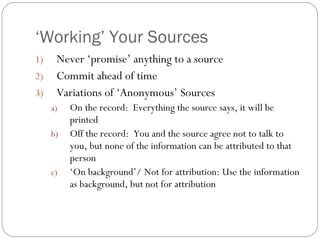
‘ Working’ Your Sources Never ‘promise’ anything to a source Commit ahead of time Variations of ‘Anonymous’ Sources On the record:  Everything the source says, it will be printed Off the record:  You and the source agree not to talk to you, but none of the information can be attributed to that person ‘ On background’/ Not for attribution: Use the information as background, but not for attribution
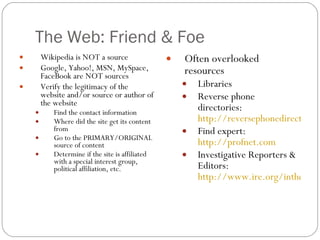
The Web: Friend & Foe Wikipedia is NOT a source Google, Yahoo!, MSN, MySpace, FaceBook are NOT sources Verify the legitimacy of the website and/or source or author of the website Find the contact information  Where did the site get its content from Go to the PRIMARY/ORIGINAL source of content Determine if the site is affiliated with a special interest group, political affiliation, etc. Often overlooked resources Libraries Reverse phone directories:  http://reversephonedirectory.com Find expert:  http://profnet.com Investigative Reporters & Editors:  http://www.ire.org/inthenews_archive/
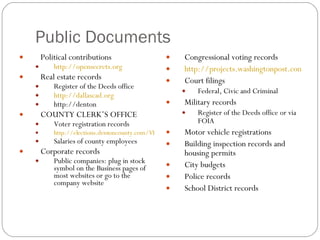
Public Documents Political contributions http://opensecrets.org Real estate records Register of the Deeds office http://dallascad.org http://denton COUNTY CLERK’S OFFICE Voter registration records http://elections.dentoncounty.com/VRsearch/down.asp Salaries of county employees Corporate records Public companies: plug in stock symbol on the Business pages of most websites or go to the company website Congressional voting records http://projects.washingtonpost.com/congress/members/h001016/ Court filings Federal, Civic and Criminal Military records Register of the Deeds office or via FOIA Motor vehicle registrations Building inspection records and housing permits City budgets Police records School District records
The Freedom of Information Act Established by Congress in 1966 Make public records available Request is made to get access to these records:  Weeks, months, years *  From When Words Collide: A journalist’s Guide to Grammar and Style & EB White’s ‘Elements of Style

Online Journalism Oct 2 Blogs Interactivy Sources

  • 1.
    University of NorthTexas Department of Journalism Oct. 2, 2008 Interactivity, Blogs, Sources
  • 2.
    What We’ll DoToday Your Blogs – Campaign Websites Interactivity In-Class Writing Political Coverage ‘08/NTNewsNet HOMEWORK: - Do a complete analysis of PegasusNews.com. What works? What doesn’t? How would you improve it? 300 – 400 Words. Be prepared to ask questions to Mike Orren who will be speaking to our class next class.
  • 3.
    Developing Sources Lifebloodof your career as a reporter Get over your shyness, it’s time to open up Learn to talk to everybody – yes, strangers! Everybody is a potential source when you’re covering a breaking news story Start with newspaper clippings Pick up the phone or hit the streets
  • 4.
    Importance of Interaction& Involvement Two key factors Shift in flow of mass communications from one-way to multi-directional flow. Impacting how news is defined, the way it’s presented and how journalists do their jobs What people learn from the news User-controlled, user-driven content enhance learning Readers making mental connections to stories “ Participating” in the news
  • 5.
    Traditional v. DigitalStorytelling Traditional Focus on text Photos Periodic updating One-dimensional Long-form narrative Digital Media Immediacy ‘ Non-linear’ presentations Richness in words, pictures and sounds Shorter ‘segments’
  • 6.
    The Five ‘I’sInteractivity Involvement Immediacy Integration In-depth
  • 7.
    Interaction & InvolvementTraditional One-way flow Inform, educate and entertain Editor/Reporter/ Producer driven The ‘old’ wire services Digital Media Multidirectional Inform, educate, entertain & ENGAGE Editor, reporter, producer & reader/view Online, TV news
  • 8.
    Text Static Graphic:Photo Text Box Online Discussion Lurker Link Interactive: Timeline fact box Slideshow map Quiz Interactive Game Interactive Flash Content Online Discussions Reporter Email Interaction/Involvement Continuum Low High The greater the interaction and involvement, the higher the learning
  • 9.
    ‘ Working’ YourSources ‘ Sponsorship’ Finding someone who you know who trusts you to introduce you to the source – a ‘referral’ Self-sponsorship Let me show you my work: ‘proof’ ‘ Matchmaking’ Asking a source to identify other people to talk to about the subject Primary & Secondary Sources Corroboration Verification Accuracy
  • 10.
    ‘ Working’ YourSources Follow the org chart Start at the top and, if needed, talk to everyone you need to get the information you need to be fair and accurate Anonymous/confidential sources: Avoid them at all costs The Downside: Janet Cooke, Jayson Blair, Stephen Glass The Upside: “Deep Throat” The controversial: Judith Miller
  • 11.
    ‘ Working’ YourSources Never ‘promise’ anything to a source Commit ahead of time Variations of ‘Anonymous’ Sources On the record: Everything the source says, it will be printed Off the record: You and the source agree not to talk to you, but none of the information can be attributed to that person ‘ On background’/ Not for attribution: Use the information as background, but not for attribution
  • 12.
    The Web: Friend& Foe Wikipedia is NOT a source Google, Yahoo!, MSN, MySpace, FaceBook are NOT sources Verify the legitimacy of the website and/or source or author of the website Find the contact information Where did the site get its content from Go to the PRIMARY/ORIGINAL source of content Determine if the site is affiliated with a special interest group, political affiliation, etc. Often overlooked resources Libraries Reverse phone directories: http://reversephonedirectory.com Find expert: http://profnet.com Investigative Reporters & Editors: http://www.ire.org/inthenews_archive/
  • 13.
    Public Documents Politicalcontributions http://opensecrets.org Real estate records Register of the Deeds office http://dallascad.org http://denton COUNTY CLERK’S OFFICE Voter registration records http://elections.dentoncounty.com/VRsearch/down.asp Salaries of county employees Corporate records Public companies: plug in stock symbol on the Business pages of most websites or go to the company website Congressional voting records http://projects.washingtonpost.com/congress/members/h001016/ Court filings Federal, Civic and Criminal Military records Register of the Deeds office or via FOIA Motor vehicle registrations Building inspection records and housing permits City budgets Police records School District records
  • 14.
    The Freedom ofInformation Act Established by Congress in 1966 Make public records available Request is made to get access to these records: Weeks, months, years * From When Words Collide: A journalist’s Guide to Grammar and Style & EB White’s ‘Elements of Style