The Information Cycle…how today’s events are tomorrow’s information.Bichel, Rebecca, Debora Cheney, Sylvia M. DeSantis, and Jiyeon Ryu. “The Information Lifecycle.” Pennsylvania State University. PowerPoint. 2004. 9 August 2010. <http://www.libraries.psu.edu/instruction/infocycle/infocycle.html>.
The Information Cycle The Information Cycle is a visual model of how information is developed and distributed.
 Can be applied to an event, era, social movement, discovery…
 Will go over how the documentation of events is distributed & how researchers can find this documentationHurricane KatrinaAugust 29-September 1, 2005A Story Unfolds…Using Hurricane Katrina as a example…We can track the development of information through the sources…from television reports & newspapers to scholarly journals & books simply by focusing on a specific event.
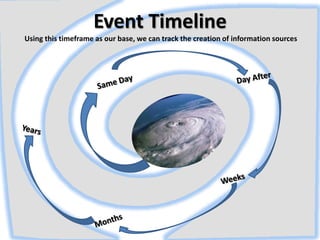
Event Timeline  Using this timeframe as our base, we can track the creation of information sourcesDay AfterSame DayYearsWeeksMonths
Information Timeline Tracking timeline through information outputTV, RadioNewspapersFacebook, blogs…Books…Documentaries…Popular MagazinesScholarly JournalsTrade Magazines
Blogs, Facebook…Personal website: http://wilddogdigital.comTimeframe: Immediate
 Images from Facebook, personal website
 Access through Google, etc.TV & RadioTimeframe: As early as the SAME DAY
 Images taken from television (including news programs), radio
 Access through Google, television, radio (NOTE: took above TV screenshots from Vanderbilt Archive)"The only [Katrina victims] we're seeing on television are the scumbags." –"The Glenn Beck Program," Sept. 9, 2005
NewspapersStarting day after event
 Components to look for: Authors (staff writers, syndicated columnists), images, text, etc.
 Access: print copies of newspapers, Google (to an extent), databases like Lexis Nexis (with time delay)Popular MagazinesTime: week/weeks
 Noteworthy: Authors, images, text, subjects covered, etc. Access to information: **Research Database (like Academic Search Complete & Proquest Research Library)**Google (ONLY to an extent)

The Information Cycle...

  • 1.
    The Information Cycle…howtoday’s events are tomorrow’s information.Bichel, Rebecca, Debora Cheney, Sylvia M. DeSantis, and Jiyeon Ryu. “The Information Lifecycle.” Pennsylvania State University. PowerPoint. 2004. 9 August 2010. <http://www.libraries.psu.edu/instruction/infocycle/infocycle.html>.
  • 2.
    The Information CycleThe Information Cycle is a visual model of how information is developed and distributed.
  • 3.
    Can beapplied to an event, era, social movement, discovery…
  • 4.
    Will goover how the documentation of events is distributed & how researchers can find this documentationHurricane KatrinaAugust 29-September 1, 2005A Story Unfolds…Using Hurricane Katrina as a example…We can track the development of information through the sources…from television reports & newspapers to scholarly journals & books simply by focusing on a specific event.
  • 5.
    Event Timeline Using this timeframe as our base, we can track the creation of information sourcesDay AfterSame DayYearsWeeksMonths
  • 6.
    Information Timeline Trackingtimeline through information outputTV, RadioNewspapersFacebook, blogs…Books…Documentaries…Popular MagazinesScholarly JournalsTrade Magazines
  • 7.
    Blogs, Facebook…Personal website:http://wilddogdigital.comTimeframe: Immediate
  • 8.
    Images fromFacebook, personal website
  • 9.
    Access throughGoogle, etc.TV & RadioTimeframe: As early as the SAME DAY
  • 10.
    Images takenfrom television (including news programs), radio
  • 11.
    Access throughGoogle, television, radio (NOTE: took above TV screenshots from Vanderbilt Archive)"The only [Katrina victims] we're seeing on television are the scumbags." –"The Glenn Beck Program," Sept. 9, 2005
  • 12.
  • 13.
    Components tolook for: Authors (staff writers, syndicated columnists), images, text, etc.
  • 14.
    Access: printcopies of newspapers, Google (to an extent), databases like Lexis Nexis (with time delay)Popular MagazinesTime: week/weeks
  • 15.
    Noteworthy: Authors,images, text, subjects covered, etc. Access to information: **Research Database (like Academic Search Complete & Proquest Research Library)**Google (ONLY to an extent)

Editor's Notes

  • #2  The Information Cycle is a visual model of how information is developed and distributed. Can be applied to an event, era, social movement, discovery… Will go over how the documentation of events is distributed &amp; how researchers can find this documentation
  • #3  The Information Cycle is a visual model of how information is developed and distributed. Can be applied to an event, era, social movement, discovery… Will go over how the documentation of events is distributed &amp; how researchers can find this documentation
  • #4  Using Hurricane Katrina as a example… We can track the development of information through the sources…from television reports &amp; newspapers to scholarly journals &amp; books simply by focusing on a specific event.
  • #5  Using this timeframe as our base, we can track the creation of information sources
  • #6 Tracking timeline through information output Information SourcesTV, Radio, Internet=Same Day Newspapers=Day After Magazines=Weeks Scholarly Journals=Months Books=Years
  • #7  Timeframe: Immediate Images from Facebook, personal website Access through Google, etc.
  • #8 Timeframe: As early as the SAME DAY Images taken from television (including news programs), radio Access through Google, television, radio (NOTE: took above TV screenshots from Vanderbilt Archive)
  • #9 Starting day after event Components to look for: Authors (staff writers, syndicated columnists), images, text, etc. Access: print copies of newspapers, Google (to an extent), databases like Lexis Nexis (with time delay)Open up discussion
  • #10  Noteworthy:Authors, images, text, subjects covered, etc.___________________________________ Time frame: week/weeks Access to information: Research Databases (Can mention popular examples you use), Google (to an extent)
  • #11 Time frame: 6 months+ Noteworthy: Subjects covered, text, images, ads, etc.Access to information: Research Databases (examples), limited access through Google Note: Differences between Professional &amp; Popular/ScholarlyENR: Engineering News Record as example________________________________________
  • #12 Time frame: 6 months+ Note: Author info, abstract, original research, images, references, etc. Access to information: Research Databases (interdisciplinary &amp; subject specific)
  • #13 Noteworthy: Publication timeframe Topics, content, etc. Parts of the book: Table of Contents, Index, etc.______________ Time frame: 2+ years Access to information: Library Catalog
  • #14 NOTED ABOVE:Keep this timeline in mind when you… Look for background information on class readings (ex: Rosa Parks &amp; the Bus Boycotts) Research your chosen paper topic for this class Write research papers for other classes Analyze the “information overload” for current events (ex: Oil Spill off the Gulf Coast)
  • #15 CYCLE OF INFORMATION: Putting It All Together From the occurrence of an event, era, social movement, discovery. To the documentation of the event, era, etc. To how the evidence is disseminated. And how researchers (and term paper writers) can find this documentation.Go to library homepageShow links for catalog for finding books, etcShow links to research databaseHighlight Ask-a-Librarian (IM, desk, phone, InfoGuides, etc.)
  • #16 SHOWING LIVE WEBPAGE: Highlight links for Catalog, Research Databases, InfoGuides, IM, Liaison Librarians, Hours/locations, Reserves, WRLC…