


Role of blogs University of North Texas Department of Journalism Online Journalism 3340 Sept. 15, 2009
Today’s class Tool of the day Blogging Post Due Thursday
What is a blog?  A Blog (a contraction of the term "Web log") is a Web site, usually maintained by an individual with regular entries of commentary, descriptions of events, or other material such as graphics or video. Entries are commonly displayed in reverse-chronological order. Source: http://technorati.com/blogging/state-of-the-blogosphere/
What is a blog? Cont. The Blogosphere is the collective community of all blogs.  Since all blogs are on the Internet by definition, they may be seen as interconnected and socially networked. Discussions "in the Blogosphere" have been used by the media as a gauge of public opinion on various issues. Source: http://technorati.com/blogging/state-of-the-blogosphere/
Blogs defined… Blurring lines between what is a blog and what is a mainstream media site become less clear.  Larger blogs are taking on more characteristics of mainstream sites and mainstream sites are incorporating styles and formats from the Blogosphere.  In fact, 95% of the top 100 US newspapers have reporter blogs (see The Bivings Group).  Source: http://technorati.com/blogging/state-of-the-blogosphere/
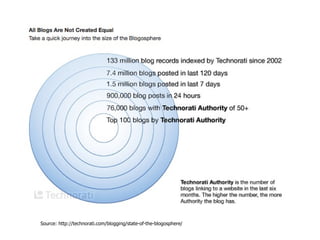
Source: http://technorati.com/blogging/state-of-the-blogosphere/
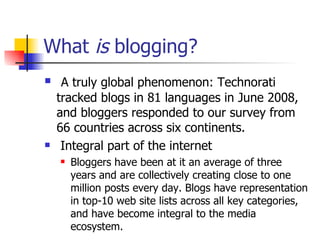
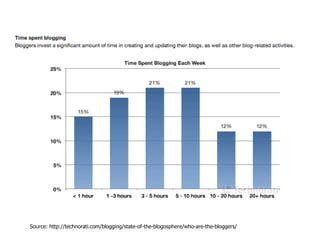
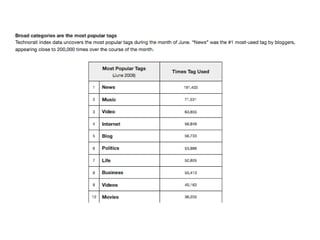
What  is  blogging?  A truly global phenomenon: Technorati tracked blogs in 81 languages in June 2008, and bloggers responded to our survey from 66 countries across six continents. Integral part of the internet Bloggers have been at it an average of three years and are collectively creating close to one million posts every day. Blogs have representation in top-10 web site lists across all key categories, and have become integral to the media ecosystem.
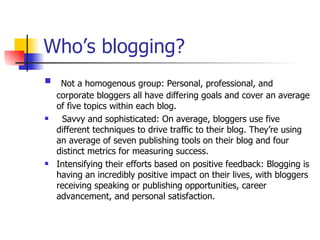
Who’s blogging?  Not a homogenous group: Personal, professional, and corporate bloggers all have differing goals and cover an average of five topics within each blog. Savvy and sophisticated: On average, bloggers use five different techniques to drive traffic to their blog. They’re using an average of seven publishing tools on their blog and four distinct metrics for measuring success. Intensifying their efforts based on positive feedback: Blogging is having an incredibly positive impact on their lives, with bloggers receiving speaking or publishing opportunities, career advancement, and personal satisfaction.
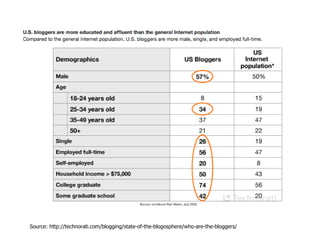
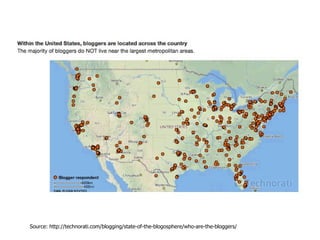
Source: http://technorati.com/blogging/state-of-the-blogosphere/who-are-the-bloggers/
 
Future of blogs “ The future of blogs will have arrived when you check your favorite blog for sports news in the morning, instead of your local paper.” Richard MacManus, Founder / Editor, ReadWriteWeb,  www.readwriteweb.com
Journalists & Blogs ‘ I was surprised at just how much these journalists felt their work had been changed by the simple act of blogging.’ Paul Bradshaw, When Journalists Blog: How It Changes What They Do, Nieman Reports, Winter 2008  ( http://www.nieman.harvard.edu/reportsitem.aspx?id=100696 )
How blogging makes a difference “ Cutting out the middleman” No guessing on who the readers are: They’re reading the reporters’ blogs Sources are going directly to reporters Diminished role of public relations professionals Blogs generating story leads Creating a greater variety of sources  Fueling debate on hot stories Readers as integral parts of the story development
How blogging makes a difference Blogs generating story leads Creating a greater variety of sources  Fueling debate on hot stories Readers as integral parts of the story development “ Putting a call out” for information Reporting a “two-way, on-going” process Collaboration/crowdsourcing Ability to gather more information than you need
“ On hot-button stories where our readers are asking a lot of questions, we post updates every time we make a phone call. For example, [a company] declared bankruptcy and the new owner wouldn’t take the previous owner’s gift cards.  “ Our readers were peeved and hounding us to do something. The corporate folks weren’t saying anything so we didn’t have any new information to report. Because we didn’t have any new info, we didn’t write anything in the paper.  “ But on our blog, we would post updates at least daily to tell people when we left a message and if we had heard back yet. We eventually scored an interview with the new CEO and posted it in its entirety on our site.  “ Another reporter saw it and called us. We swapped info. Our readers also post links to other stories on the topic from other news orgs.” (Respondent 63, US, newspapers)
How blogging makes a difference cont.  More stories, quicker “ Speed, depth, informality” (Matheson, 2004)  Ability to post shorter stories as the story is evolving – why wait for a “deadline”? Aggressive coverage of a story while integrating relevant links: “ Covering what you do best and linking to the rest,” Jeff Jarvis, BuzzMachine.com Stories have more legs, more voices Stories as conversations
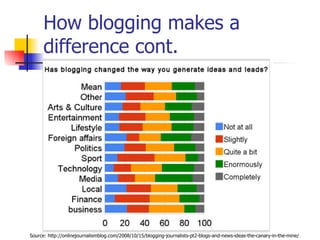
How blogging makes a difference cont.  Source: http://onlinejournalismblog.com/2008/10/15/blogging-journalists-pt2-blogs-and-news-ideas-the-canary-in-the-mine/
How blogging makes a difference cont.  Stories just don’t die No limitations due to space, deadlines No constraints on distribution “ Everybody is a paperboy/girl.” (Bradshaw, 2008) No more “file and forget” Once published, there are comments Follow up, new leads, new information Add, correct information Source: http://onlinejournalismblog.com/2008/10/15/blogging-journalists-pt2-blogs-and-news-ideas-the-canary-in-the-mine/
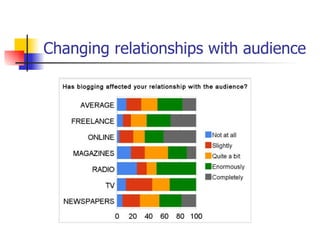
Changing relationships with audience
What’s this mean? Audience becomes more familiar with reporter Journalists feel: More accountable More exposed More obliged to interact, respond, talk to audience: No more hiding for fear of being called out
Overall impact blogs & journalism Hugely positive  Increased SEO: Search engine optimization Increased site traffic Greater interaction with audience
Key Terms Permalink A direct link to your post Trackback/Pingback Allows bloggers to follow you Attracts spam Vlog: video blog
Making blogs work Link, summarize, analyze Get to the point Be sharp, precise, poignant Write strong, catchy headlines Avoid cutesy Preview, tweak, hook Speak with authority & personality
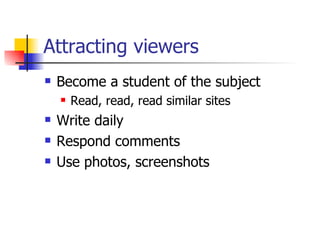
Attracting viewers Become a student of the subject Read, read, read similar sites Write daily Respond comments Use photos, screenshots
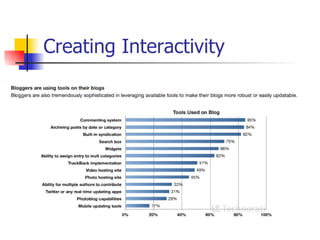
Creating Interactivity
Attracting visitors
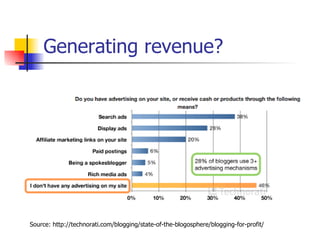
Generating revenue? Source: http://technorati.com/blogging/state-of-the-blogosphere/blogging-for-profit/
How much revenue? Ad Costs? Source: http://technorati.com/blogging/state-of-the-blogosphere/blogging-for-profit/
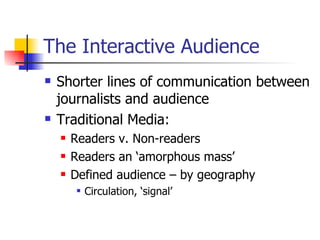
The Interactive Audience Shorter lines of communication between journalists and audience Traditional Media: Readers v. Non-readers Readers an ‘amorphous mass’ Defined audience – by geography Circulation, ‘signal’
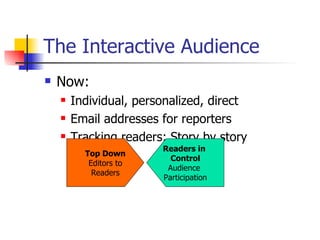
The Interactive Audience Now: Individual, personalized, direct Email addresses for reporters Tracking readers: Story by story Top Down Editors to Readers Readers in  Control Audience  Participation
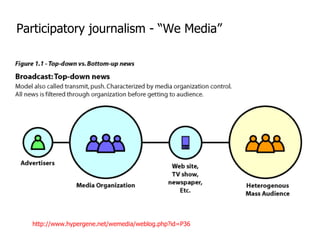
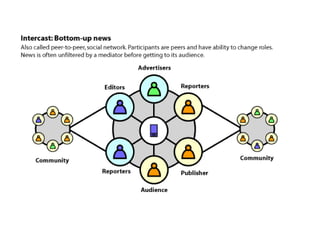
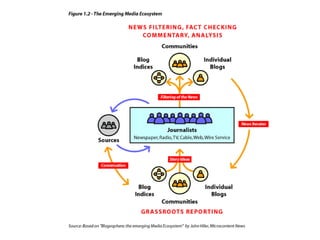
Participatory journalism - “We Media” http://www.hypergene.net/wemedia/weblog.php?id=P36


15 S E P T 09 3340 Blogs& Journalism

  • 1.
    Role of blogsUniversity of North Texas Department of Journalism Online Journalism 3340 Sept. 15, 2009
  • 2.
    Today’s class Toolof the day Blogging Post Due Thursday
  • 3.
    What is ablog? A Blog (a contraction of the term "Web log") is a Web site, usually maintained by an individual with regular entries of commentary, descriptions of events, or other material such as graphics or video. Entries are commonly displayed in reverse-chronological order. Source: http://technorati.com/blogging/state-of-the-blogosphere/
  • 4.
    What is ablog? Cont. The Blogosphere is the collective community of all blogs. Since all blogs are on the Internet by definition, they may be seen as interconnected and socially networked. Discussions "in the Blogosphere" have been used by the media as a gauge of public opinion on various issues. Source: http://technorati.com/blogging/state-of-the-blogosphere/
  • 5.
    Blogs defined… Blurringlines between what is a blog and what is a mainstream media site become less clear. Larger blogs are taking on more characteristics of mainstream sites and mainstream sites are incorporating styles and formats from the Blogosphere. In fact, 95% of the top 100 US newspapers have reporter blogs (see The Bivings Group). Source: http://technorati.com/blogging/state-of-the-blogosphere/
  • 6.
  • 7.
    What is blogging? A truly global phenomenon: Technorati tracked blogs in 81 languages in June 2008, and bloggers responded to our survey from 66 countries across six continents. Integral part of the internet Bloggers have been at it an average of three years and are collectively creating close to one million posts every day. Blogs have representation in top-10 web site lists across all key categories, and have become integral to the media ecosystem.
  • 8.
    Who’s blogging? Not a homogenous group: Personal, professional, and corporate bloggers all have differing goals and cover an average of five topics within each blog. Savvy and sophisticated: On average, bloggers use five different techniques to drive traffic to their blog. They’re using an average of seven publishing tools on their blog and four distinct metrics for measuring success. Intensifying their efforts based on positive feedback: Blogging is having an incredibly positive impact on their lives, with bloggers receiving speaking or publishing opportunities, career advancement, and personal satisfaction.
  • 9.
  • 10.
  • 11.
  • 12.
  • 13.
    Future of blogs“ The future of blogs will have arrived when you check your favorite blog for sports news in the morning, instead of your local paper.” Richard MacManus, Founder / Editor, ReadWriteWeb, www.readwriteweb.com
  • 14.
    Journalists & Blogs‘ I was surprised at just how much these journalists felt their work had been changed by the simple act of blogging.’ Paul Bradshaw, When Journalists Blog: How It Changes What They Do, Nieman Reports, Winter 2008 ( http://www.nieman.harvard.edu/reportsitem.aspx?id=100696 )
  • 15.
    How blogging makesa difference “ Cutting out the middleman” No guessing on who the readers are: They’re reading the reporters’ blogs Sources are going directly to reporters Diminished role of public relations professionals Blogs generating story leads Creating a greater variety of sources Fueling debate on hot stories Readers as integral parts of the story development
  • 16.
    How blogging makesa difference Blogs generating story leads Creating a greater variety of sources Fueling debate on hot stories Readers as integral parts of the story development “ Putting a call out” for information Reporting a “two-way, on-going” process Collaboration/crowdsourcing Ability to gather more information than you need
  • 17.
    “ On hot-buttonstories where our readers are asking a lot of questions, we post updates every time we make a phone call. For example, [a company] declared bankruptcy and the new owner wouldn’t take the previous owner’s gift cards. “ Our readers were peeved and hounding us to do something. The corporate folks weren’t saying anything so we didn’t have any new information to report. Because we didn’t have any new info, we didn’t write anything in the paper. “ But on our blog, we would post updates at least daily to tell people when we left a message and if we had heard back yet. We eventually scored an interview with the new CEO and posted it in its entirety on our site. “ Another reporter saw it and called us. We swapped info. Our readers also post links to other stories on the topic from other news orgs.” (Respondent 63, US, newspapers)
  • 18.
    How blogging makesa difference cont. More stories, quicker “ Speed, depth, informality” (Matheson, 2004) Ability to post shorter stories as the story is evolving – why wait for a “deadline”? Aggressive coverage of a story while integrating relevant links: “ Covering what you do best and linking to the rest,” Jeff Jarvis, BuzzMachine.com Stories have more legs, more voices Stories as conversations
  • 19.
    How blogging makesa difference cont. Source: http://onlinejournalismblog.com/2008/10/15/blogging-journalists-pt2-blogs-and-news-ideas-the-canary-in-the-mine/
  • 20.
    How blogging makesa difference cont. Stories just don’t die No limitations due to space, deadlines No constraints on distribution “ Everybody is a paperboy/girl.” (Bradshaw, 2008) No more “file and forget” Once published, there are comments Follow up, new leads, new information Add, correct information Source: http://onlinejournalismblog.com/2008/10/15/blogging-journalists-pt2-blogs-and-news-ideas-the-canary-in-the-mine/
  • 21.
  • 22.
    What’s this mean?Audience becomes more familiar with reporter Journalists feel: More accountable More exposed More obliged to interact, respond, talk to audience: No more hiding for fear of being called out
  • 23.
    Overall impact blogs& journalism Hugely positive Increased SEO: Search engine optimization Increased site traffic Greater interaction with audience
  • 24.
    Key Terms PermalinkA direct link to your post Trackback/Pingback Allows bloggers to follow you Attracts spam Vlog: video blog
  • 25.
    Making blogs workLink, summarize, analyze Get to the point Be sharp, precise, poignant Write strong, catchy headlines Avoid cutesy Preview, tweak, hook Speak with authority & personality
  • 26.
    Attracting viewers Becomea student of the subject Read, read, read similar sites Write daily Respond comments Use photos, screenshots
  • 27.
  • 28.
  • 29.
    Generating revenue? Source:http://technorati.com/blogging/state-of-the-blogosphere/blogging-for-profit/
  • 30.
    Generating revenue? Source:http://technorati.com/blogging/state-of-the-blogosphere/blogging-for-profit/
  • 31.
    How much revenue?Ad Costs? Source: http://technorati.com/blogging/state-of-the-blogosphere/blogging-for-profit/
  • 32.
    The Interactive AudienceShorter lines of communication between journalists and audience Traditional Media: Readers v. Non-readers Readers an ‘amorphous mass’ Defined audience – by geography Circulation, ‘signal’
  • 33.
    The Interactive AudienceNow: Individual, personalized, direct Email addresses for reporters Tracking readers: Story by story Top Down Editors to Readers Readers in Control Audience Participation
  • 34.
    Participatory journalism -“We Media” http://www.hypergene.net/wemedia/weblog.php?id=P36
  • 35.
  • 36.