ONLINE COLLABORATION ~  STRENGTHS, WEAKNESSES, OPPORTUNITIES, THREATS Anne Welsh XX Elisad Meeting ~ Torino ~ 2008
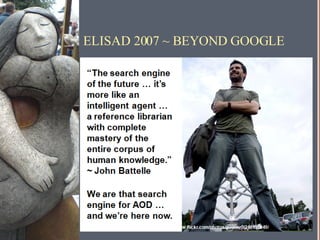
ELISAD 2007 ~ BEYOND GOOGLE
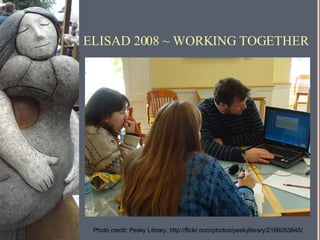
ELISAD 2008 ~ WORKING TOGETHER Photo credit: Pesky Library, http://flickr.com/photos/peskylibrary/2166053845/
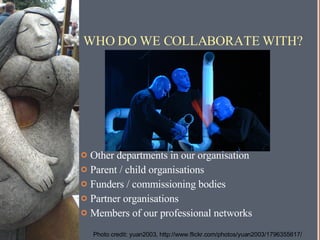
WHO DO WE COLLABORATE WITH? Other departments in our organisation Parent / child organisations Funders / commissioning bodies Partner organisations Members of our professional networks Photo credit: yuan2003, http://www.flickr.com/photos/yuan2003/1796355617/
... AND INCREASINGLY ... “ The new Web challenges the assumption  that information must move from  credentialed producers to passive consumers ... The democratization of the media publishing tools ... is rapidly transforming our notions of how expertise, relevance, and professionalism develop in the media Don Tapscott and Anthony D. Williams.  Wikinomics: how mass collaboration changes everything. Rev. & updated ed. Atlantic, 2008. p. 146.
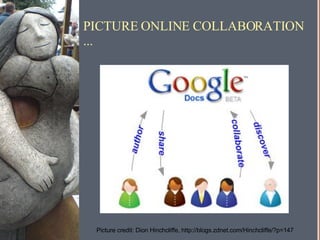
PICTURE ONLINE COLLABORATION ... Picture credit: Dion Hinchcliffe, http://blogs.zdnet.com/Hinchcliffe/?p=147
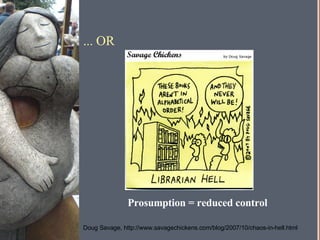
... OR Prosumption = reduced control Doug Savage, http://www.savagechickens.com/blog/2007/10/chaos-in-hell.html
ONLINE COLLABORATION TOOLS Email (including lists and groups) Chat / Instant Messenger e.g. http://www.ceruleanstudios.com/  VOIP (Voice Over Internet Protocol e.g. http://www.skype.com Co-authoring / co-editing documents e.g. http://www.google.com/google-d-s/tour1.html Wikis Blogs & “microblogs” Social networks
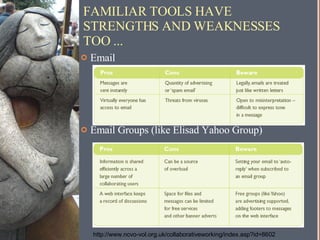
FAMILIAR TOOLS HAVE STRENGTHS AND WEAKNESSES TOO ... Email Email Groups (like Elisad Yahoo Group) http://www.ncvo-vol.org.uk/collaborativeworking/index.asp?id=8602
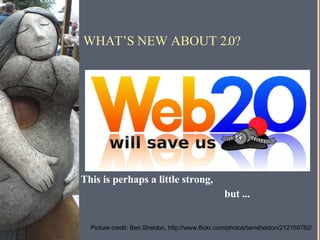
WHAT’S NEW ABOUT 2.0? This is perhaps a little strong, but ... Picture credit: Ben Sheldon, http://www.flickr.com/photos/bensheldon/212159782/
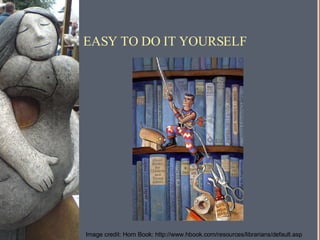
EASY TO DO IT YOURSELF Image credit: Horn Book: http://www.hbook.com/resources/librarians/default.asp
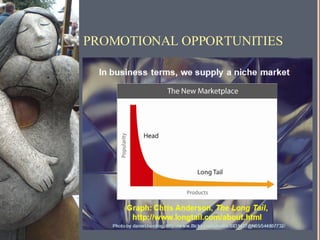
PROMOTIONAL OPPORTUNITIES
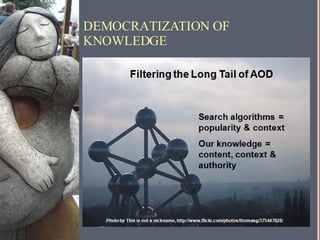
DEMOCRATIZATION OF KNOWLEDGE
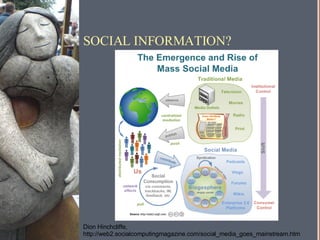
SOCIAL INFORMATION? Dion Hinchcliffe, http://web2.socialcomputingmagazine.com/social_media_goes_mainstream.htm
OPPORTUNITIES FROM COLLABORATING VS. RISKS OF NOT COLLABORATING A V[oluntary] C[ommunity] O[rganisation] becomes more innovative through the involvement of its network of users, volunteers and other supporters, and attracts increased funding Vs. A VCO’s staff and volunteers are frustrated by not being able to work in a collaborative way and leave the organisation ~ ICT Foresight.  How online communities can make the net work for the VCS http://www.ncvo-vol.org.uk/uploadedFiles/NCVO/Publications/Publications_Catalogue/Sector_Research/ICT%20Foresight%20-%20social%20networks.pdf
OPPORTUNITIES FROM COLLABORATING  “ Visitors may feel more inclined to trust an organisation that they see is itself part of a network and is pulling in (aggregating) information from other useful and interesting sources. Likewise, individuals will want to link from their online spaces to the organisations that they support and will want to pull content from the websites they are interested in, into their own sites.  ~ ICT Foresight.  How online communities can make the net work for the VCS http://www.ncvo-vol.org.uk/uploadedFiles/NCVO/Publications/Publications_Catalogue/Sector_Research/ICT%20Foresight%20-%20social%20networks.pdf
RISKS OF NOT COLLABORATING “ However, organisations that don’t integrate social elements into their websites may risk not being found online by interested people, or turning off those who find that they can’t engage with an organisation in the way they increasingly come to expect. ~ ICT Foresight.  How online communities can make the net work for the VCS http://www.ncvo-vol.org.uk/uploadedFiles/NCVO/Publications/Publications_Catalogue/Sector_Research/ICT%20Foresight%20-%20social%20networks.pdf
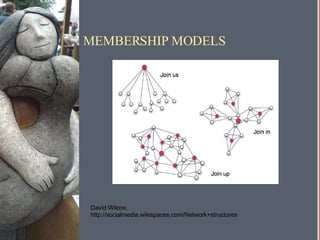
MEMBERSHIP MODELS David Wilcox,  http://socialmedia.wikispaces.com/Network+structures
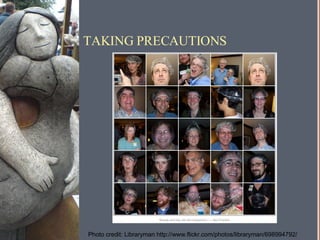
TAKING PRECAUTIONS Photo credit: Libraryman http://www.flickr.com/photos/libraryman/698994792/
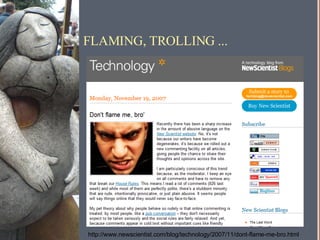
FLAMING, TROLLING ... http://www.newscientist.com/blog/technology/2007/11/dont-flame-me-bro.html
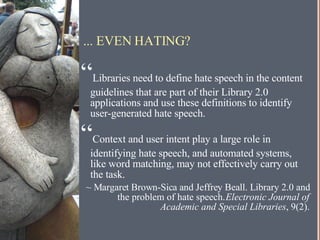
... EVEN HATING? “ Libraries need to define hate speech in the content guidelines that are part of their Library 2.0 applications and use these definitions to identify user-generated hate speech. “ Context and user intent play a large role in identifying hate speech, and automated systems, like word matching, may not effectively carry out the task. ~ Margaret Brown-Sica and Jeffrey Beall. Library 2.0 and the problem of hate speech.  Electronic Journal of Academic and Special Libraries , 9(2).
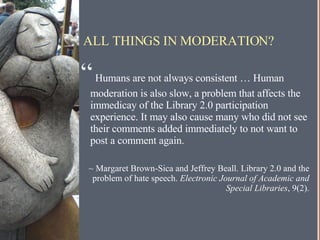
ALL THINGS IN MODERATION? “   Humans are not always consistent … Human moderation is also slow, a problem that affects the immedicay of the Library 2.0 participation experience. It may also cause many who did not see their comments added immediately to not want to post a comment again. ~ Margaret Brown-Sica and Jeffrey Beall. Library 2.0 and the problem of hate speech.  Electronic Journal of Academic and Special Libraries , 9(2).
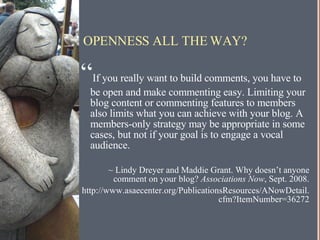
OPENNESS ALL THE WAY? “ If you really want to build comments, you have to be open and make commenting easy. Limiting your blog content or commenting features to members also limits what you can achieve with your blog. A members-only strategy may be appropriate in some cases, but not if your goal is to engage a vocal audience. ~ Lindy Dreyer and Maddie Grant. Why doesn’t anyone comment on your blog?  Associations Now , Sept. 2008. http://www.asaecenter.org/PublicationsResources/ANowDetail.cfm?ItemNumber=36272
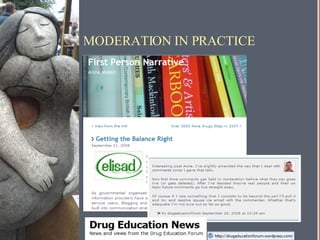
MODERATION IN PRACTICE
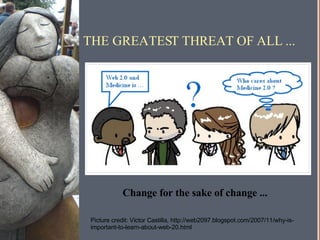
THE GREATEST THREAT OF ALL ... Picture credit: Victor Castilla, http://web2097.blogspot.com/2007/11/why-is-important-to-learn-about-web-20.html Change for the sake of change ...
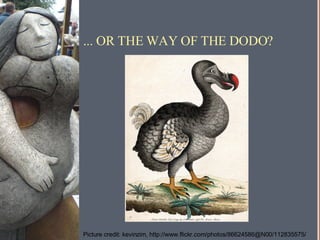
... OR THE WAY OF THE DODO? Picture credit: kevinzim, http://www.flickr.com/photos/86624586@N00/112835575/
[email_address] ONLINE COLLABORATION ~  STRENGTHS, WEAKNESSES, OPPORTUNITIES, THREATS

Online Collaboration

  • 1.
    ONLINE COLLABORATION ~ STRENGTHS, WEAKNESSES, OPPORTUNITIES, THREATS Anne Welsh XX Elisad Meeting ~ Torino ~ 2008
  • 2.
    ELISAD 2007 ~BEYOND GOOGLE
  • 3.
    ELISAD 2008 ~WORKING TOGETHER Photo credit: Pesky Library, http://flickr.com/photos/peskylibrary/2166053845/
  • 4.
    WHO DO WECOLLABORATE WITH? Other departments in our organisation Parent / child organisations Funders / commissioning bodies Partner organisations Members of our professional networks Photo credit: yuan2003, http://www.flickr.com/photos/yuan2003/1796355617/
  • 5.
    ... AND INCREASINGLY... “ The new Web challenges the assumption that information must move from credentialed producers to passive consumers ... The democratization of the media publishing tools ... is rapidly transforming our notions of how expertise, relevance, and professionalism develop in the media Don Tapscott and Anthony D. Williams. Wikinomics: how mass collaboration changes everything. Rev. & updated ed. Atlantic, 2008. p. 146.
  • 6.
    PICTURE ONLINE COLLABORATION... Picture credit: Dion Hinchcliffe, http://blogs.zdnet.com/Hinchcliffe/?p=147
  • 7.
    ... OR Prosumption= reduced control Doug Savage, http://www.savagechickens.com/blog/2007/10/chaos-in-hell.html
  • 8.
    ONLINE COLLABORATION TOOLSEmail (including lists and groups) Chat / Instant Messenger e.g. http://www.ceruleanstudios.com/ VOIP (Voice Over Internet Protocol e.g. http://www.skype.com Co-authoring / co-editing documents e.g. http://www.google.com/google-d-s/tour1.html Wikis Blogs & “microblogs” Social networks
  • 9.
    FAMILIAR TOOLS HAVESTRENGTHS AND WEAKNESSES TOO ... Email Email Groups (like Elisad Yahoo Group) http://www.ncvo-vol.org.uk/collaborativeworking/index.asp?id=8602
  • 10.
    WHAT’S NEW ABOUT2.0? This is perhaps a little strong, but ... Picture credit: Ben Sheldon, http://www.flickr.com/photos/bensheldon/212159782/
  • 11.
    EASY TO DOIT YOURSELF Image credit: Horn Book: http://www.hbook.com/resources/librarians/default.asp
  • 12.
  • 13.
  • 14.
    SOCIAL INFORMATION? DionHinchcliffe, http://web2.socialcomputingmagazine.com/social_media_goes_mainstream.htm
  • 15.
    OPPORTUNITIES FROM COLLABORATINGVS. RISKS OF NOT COLLABORATING A V[oluntary] C[ommunity] O[rganisation] becomes more innovative through the involvement of its network of users, volunteers and other supporters, and attracts increased funding Vs. A VCO’s staff and volunteers are frustrated by not being able to work in a collaborative way and leave the organisation ~ ICT Foresight. How online communities can make the net work for the VCS http://www.ncvo-vol.org.uk/uploadedFiles/NCVO/Publications/Publications_Catalogue/Sector_Research/ICT%20Foresight%20-%20social%20networks.pdf
  • 16.
    OPPORTUNITIES FROM COLLABORATING “ Visitors may feel more inclined to trust an organisation that they see is itself part of a network and is pulling in (aggregating) information from other useful and interesting sources. Likewise, individuals will want to link from their online spaces to the organisations that they support and will want to pull content from the websites they are interested in, into their own sites. ~ ICT Foresight. How online communities can make the net work for the VCS http://www.ncvo-vol.org.uk/uploadedFiles/NCVO/Publications/Publications_Catalogue/Sector_Research/ICT%20Foresight%20-%20social%20networks.pdf
  • 17.
    RISKS OF NOTCOLLABORATING “ However, organisations that don’t integrate social elements into their websites may risk not being found online by interested people, or turning off those who find that they can’t engage with an organisation in the way they increasingly come to expect. ~ ICT Foresight. How online communities can make the net work for the VCS http://www.ncvo-vol.org.uk/uploadedFiles/NCVO/Publications/Publications_Catalogue/Sector_Research/ICT%20Foresight%20-%20social%20networks.pdf
  • 18.
    MEMBERSHIP MODELS DavidWilcox, http://socialmedia.wikispaces.com/Network+structures
  • 19.
    TAKING PRECAUTIONS Photocredit: Libraryman http://www.flickr.com/photos/libraryman/698994792/
  • 20.
    FLAMING, TROLLING ...http://www.newscientist.com/blog/technology/2007/11/dont-flame-me-bro.html
  • 21.
    ... EVEN HATING?“ Libraries need to define hate speech in the content guidelines that are part of their Library 2.0 applications and use these definitions to identify user-generated hate speech. “ Context and user intent play a large role in identifying hate speech, and automated systems, like word matching, may not effectively carry out the task. ~ Margaret Brown-Sica and Jeffrey Beall. Library 2.0 and the problem of hate speech. Electronic Journal of Academic and Special Libraries , 9(2).
  • 22.
    ALL THINGS INMODERATION? “ Humans are not always consistent … Human moderation is also slow, a problem that affects the immedicay of the Library 2.0 participation experience. It may also cause many who did not see their comments added immediately to not want to post a comment again. ~ Margaret Brown-Sica and Jeffrey Beall. Library 2.0 and the problem of hate speech. Electronic Journal of Academic and Special Libraries , 9(2).
  • 23.
    OPENNESS ALL THEWAY? “ If you really want to build comments, you have to be open and make commenting easy. Limiting your blog content or commenting features to members also limits what you can achieve with your blog. A members-only strategy may be appropriate in some cases, but not if your goal is to engage a vocal audience. ~ Lindy Dreyer and Maddie Grant. Why doesn’t anyone comment on your blog? Associations Now , Sept. 2008. http://www.asaecenter.org/PublicationsResources/ANowDetail.cfm?ItemNumber=36272
  • 24.
  • 25.
    THE GREATEST THREATOF ALL ... Picture credit: Victor Castilla, http://web2097.blogspot.com/2007/11/why-is-important-to-learn-about-web-20.html Change for the sake of change ...
  • 26.
    ... OR THEWAY OF THE DODO? Picture credit: kevinzim, http://www.flickr.com/photos/86624586@N00/112835575/
  • 27.
    [email_address] ONLINE COLLABORATION~ STRENGTHS, WEAKNESSES, OPPORTUNITIES, THREATS