WELCOME TO THE PRESENTATION ON
“ONE WAY SLAB DESIGN”
MD. ASIF RAHMAN
10.01.03.108
DEPT. OF CE
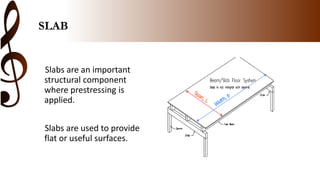
SLAB
Slabs are an important
structural component
where prestressing is
applied.
Slabs are used to provide
flat or useful surfaces.
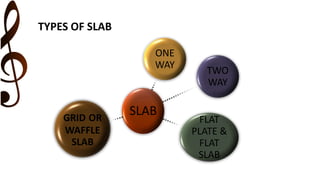
SLAB
ONE
WAY
TWO
WAY
FLAT
PLATE &
FLAT
SLAB
GRID OR
WAFFLE
SLAB
TYPES OF SLAB
ONE WAY SLAB
One-way slabs are those slabs with an aspect ratio in plan of
2:1 or greater, in which bending is primarily about the long
axis.
So, the slab is one way where L/B ≥ 2.
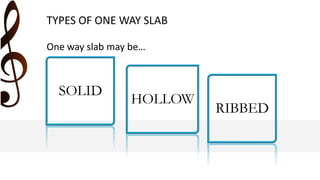
SOLID
HOLLOW
RIBBED
TYPES OF ONE WAY SLAB
One way slab may be…
APPLICATION OF L/B RATIO
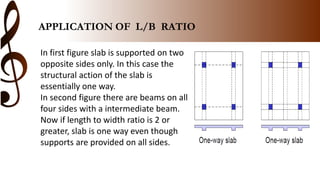
In first figure slab is supported on two
opposite sides only. In this case the
structural action of the slab is
essentially one way.
In second figure there are beams on all
four sides with a intermediate beam.
Now if length to width ratio is 2 or
greater, slab is one way even though
supports are provided on all sides.
LOADING OF ONE WAY SLAB
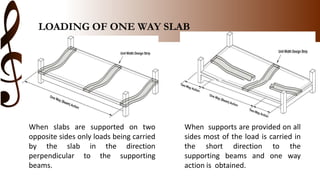
When slabs are supported on two
opposite sides only loads being carried
by the slab in the direction
perpendicular to the supporting
beams.
When supports are provided on all
sides most of the load is carried in
the short direction to the
supporting beams and one way
action is obtained.
DESIGN & ANALYSIS
For analysis there is a term as….
“ONE WAY SLAB IS A SET OF A RECTANGULAR
BEAMS SIDE BY SIDE”
But How ???
Lets find it…..
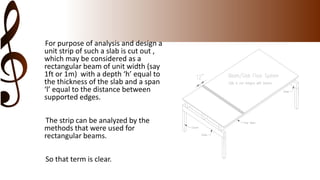
For purpose of analysis and design a
unit strip of such a slab is cut out ,
which may be considered as a
rectangular beam of unit width (say
1ft or 1m) with a depth ‘h’ equal to
the thickness of the slab and a span
‘l’ equal to the distance between
supported edges.
The strip can be analyzed by the
methods that were used for
rectangular beams.
So that term is clear.
ACI CODE SPECIFICATIONS
For design purposes there are some ACI code specifications.
Such as…..
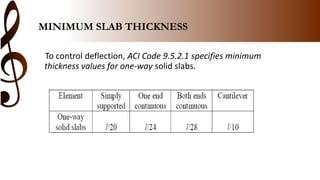
MINIMUM SLAB THICKNESS
To control deflection, ACI Code 9.5.2.1 specifies minimum
thickness values for one-way solid slabs.
MINIMUM CONCRETE COVER
According to ACI Code 7.7.1, the following minimum concrete cover is to be provided:
a. Concrete not exposed to weather or in contact with ground:
• Larger than Ø 36 mm bar ---------------------------------------------4 cm
• Ø 36 mm and smaller bars -------------------------------------------2 cm
b. Concrete exposed to weather or in contact with ground:
• Ø 19 mm and larger bars----------------------------------------------5 cm
Ø 16 mm and smaller bars --------------------------------------------4 cm
c. Concrete cast against and permanently exposed to earth -----------7.5 cm
SPAN
According to ACI code 8.7.1
If the slab rests freely on its
supports the span length
may be taken equal to the
clear span plus the depth
of the slab but need not
exceed the distance
between centers of
supports .
BAR SPACING
The lateral spacing of the flexural
bars should not exceed 3 times
the thickness h or 18 inch
according to ACI code 7.6.5
The lateral spacing of
temperature and shrinkage
reinforcement should not be
placed farther apart than 5 times
the slab thickness or 18 inch
according to ACI code 7.12.2
MAXIMAM REINFORCEMENT RATIO
REINFORCEMENT RATIO : Reinforcement ratio is the ratio of
reinforcement area to gross concrete area based on total
depth of slab.
One-way solid slabs are designed as rectangular sections
subjected to shear and moment. Thus, the maximum
reinforcement ratio corresponds to a net tensile stain in the
reinforcement, €t of 0.004
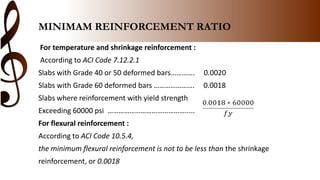
MINIMAM REINFORCEMENT RATIO
For temperature and shrinkage reinforcement :
According to ACI Code 7.12.2.1
Slabs with Grade 40 or 50 deformed bars…………. 0.0020
Slabs with Grade 60 deformed bars …………………. 0.0018
Slabs where reinforcement with yield strength
Exceeding 60000 psi …………………………………….....
For flexural reinforcement :
According to ACI Code 10.5.4,
the minimum flexural reinforcement is not to be less than the shrinkage
reinforcement, or 0.0018
EXAMPLE PROBLEM
A reinforced concrete slab is built integrally with its supports
and consists of equal span of 15 ft. The service live load is 100
psf and 4000 psi concrete is specified for use with steel with a
yield stress equal to 60000 psi. Design the slab following the
provisions of the ACI code.
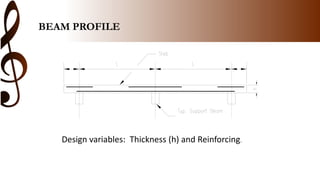
BEAM PROFILE
Design variables: Thickness (h) and Reinforcing.
THICKNESS ESTIMATION
For being both ends continuous minimum slab thickness =
L/28=(15*120)/28=6.43 in.
Let a trial thickness of 6.50 in.
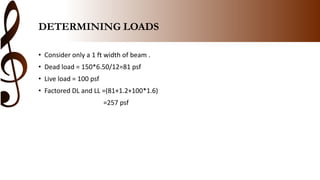
DETERMINING LOADS
• Consider only a 1 ft width of beam .
• Dead load = 150*6.50/12=81 psf
• Live load = 100 psf
• Factored DL and LL =(81+1.2+100*1.6)
=257 psf
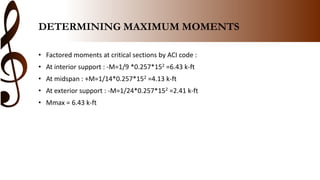
DETERMINING MAXIMUM MOMENTS
• Factored moments at critical sections by ACI code :
• At interior support : -M=1/9 *0.257*152 =6.43 k-ft
• At midspan : +M=1/14*0.257*152 =4.13 k-ft
• At exterior support : -M=1/24*0.257*152 =2.41 k-ft
• Mmax = 6.43 k-ft
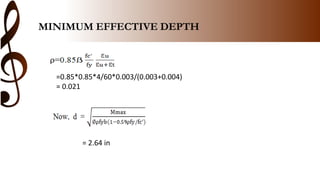
MINIMUM EFFECTIVE DEPTH
=0.85*0.85*4/60*0.003/(0.003+0.004)
= 0.021
= 2.64 in
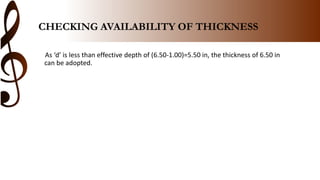
CHECKING AVAILABILITY OF THICKNESS
As ‘d’ is less than effective depth of (6.50-1.00)=5.50 in, the thickness of 6.50 in
can be adopted.
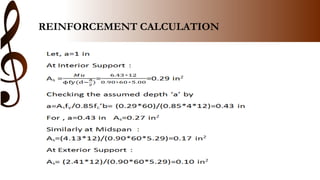
REINFORCEMENT CALCULATION
MINIMUM REINFORCEMENT
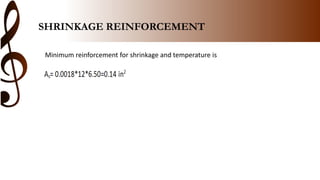
SHRINKAGE REINFORCEMENT
Minimum reinforcement for shrinkage and temperature is
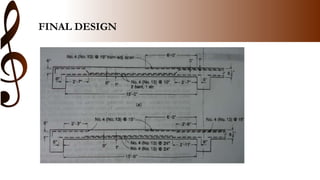
FINAL DESIGN
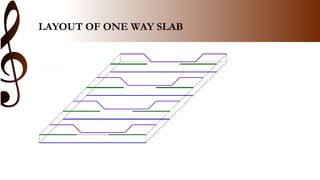
LAYOUT OF ONE WAY SLAB
Provides useful flat surface
One way slab may be used when there is
architectural limitations
It is the simplest form of slab design
Main reinforcement placing is one way, so there
is a little congestion than two way slab
APPLICATION OF ONE WAY SLAB
THANKS FOR LISTENING
COMPASSIONATELY

One-Way Slab Design

  • 1.
    WELCOME TO THEPRESENTATION ON “ONE WAY SLAB DESIGN” MD. ASIF RAHMAN 10.01.03.108 DEPT. OF CE
  • 2.
    SLAB Slabs are animportant structural component where prestressing is applied. Slabs are used to provide flat or useful surfaces.
  • 3.
  • 4.
    ONE WAY SLAB One-wayslabs are those slabs with an aspect ratio in plan of 2:1 or greater, in which bending is primarily about the long axis. So, the slab is one way where L/B ≥ 2.
  • 5.
    SOLID HOLLOW RIBBED TYPES OF ONEWAY SLAB One way slab may be…
  • 6.
    APPLICATION OF L/BRATIO In first figure slab is supported on two opposite sides only. In this case the structural action of the slab is essentially one way. In second figure there are beams on all four sides with a intermediate beam. Now if length to width ratio is 2 or greater, slab is one way even though supports are provided on all sides.
  • 7.
    LOADING OF ONEWAY SLAB When slabs are supported on two opposite sides only loads being carried by the slab in the direction perpendicular to the supporting beams. When supports are provided on all sides most of the load is carried in the short direction to the supporting beams and one way action is obtained.
  • 8.
    DESIGN & ANALYSIS Foranalysis there is a term as…. “ONE WAY SLAB IS A SET OF A RECTANGULAR BEAMS SIDE BY SIDE” But How ??? Lets find it…..
  • 9.
    For purpose ofanalysis and design a unit strip of such a slab is cut out , which may be considered as a rectangular beam of unit width (say 1ft or 1m) with a depth ‘h’ equal to the thickness of the slab and a span ‘l’ equal to the distance between supported edges. The strip can be analyzed by the methods that were used for rectangular beams. So that term is clear.
  • 10.
    ACI CODE SPECIFICATIONS Fordesign purposes there are some ACI code specifications. Such as…..
  • 11.
    MINIMUM SLAB THICKNESS Tocontrol deflection, ACI Code 9.5.2.1 specifies minimum thickness values for one-way solid slabs.
  • 12.
    MINIMUM CONCRETE COVER Accordingto ACI Code 7.7.1, the following minimum concrete cover is to be provided: a. Concrete not exposed to weather or in contact with ground: • Larger than Ø 36 mm bar ---------------------------------------------4 cm • Ø 36 mm and smaller bars -------------------------------------------2 cm b. Concrete exposed to weather or in contact with ground: • Ø 19 mm and larger bars----------------------------------------------5 cm Ø 16 mm and smaller bars --------------------------------------------4 cm c. Concrete cast against and permanently exposed to earth -----------7.5 cm
  • 13.
    SPAN According to ACIcode 8.7.1 If the slab rests freely on its supports the span length may be taken equal to the clear span plus the depth of the slab but need not exceed the distance between centers of supports . BAR SPACING The lateral spacing of the flexural bars should not exceed 3 times the thickness h or 18 inch according to ACI code 7.6.5 The lateral spacing of temperature and shrinkage reinforcement should not be placed farther apart than 5 times the slab thickness or 18 inch according to ACI code 7.12.2
  • 14.
    MAXIMAM REINFORCEMENT RATIO REINFORCEMENTRATIO : Reinforcement ratio is the ratio of reinforcement area to gross concrete area based on total depth of slab. One-way solid slabs are designed as rectangular sections subjected to shear and moment. Thus, the maximum reinforcement ratio corresponds to a net tensile stain in the reinforcement, €t of 0.004
  • 15.
    MINIMAM REINFORCEMENT RATIO Fortemperature and shrinkage reinforcement : According to ACI Code 7.12.2.1 Slabs with Grade 40 or 50 deformed bars…………. 0.0020 Slabs with Grade 60 deformed bars …………………. 0.0018 Slabs where reinforcement with yield strength Exceeding 60000 psi ……………………………………..... For flexural reinforcement : According to ACI Code 10.5.4, the minimum flexural reinforcement is not to be less than the shrinkage reinforcement, or 0.0018
  • 16.
    EXAMPLE PROBLEM A reinforcedconcrete slab is built integrally with its supports and consists of equal span of 15 ft. The service live load is 100 psf and 4000 psi concrete is specified for use with steel with a yield stress equal to 60000 psi. Design the slab following the provisions of the ACI code.
  • 17.
    BEAM PROFILE Design variables:Thickness (h) and Reinforcing.
  • 18.
    THICKNESS ESTIMATION For beingboth ends continuous minimum slab thickness = L/28=(15*120)/28=6.43 in. Let a trial thickness of 6.50 in.
  • 19.
    DETERMINING LOADS • Consideronly a 1 ft width of beam . • Dead load = 150*6.50/12=81 psf • Live load = 100 psf • Factored DL and LL =(81+1.2+100*1.6) =257 psf
  • 20.
    DETERMINING MAXIMUM MOMENTS •Factored moments at critical sections by ACI code : • At interior support : -M=1/9 *0.257*152 =6.43 k-ft • At midspan : +M=1/14*0.257*152 =4.13 k-ft • At exterior support : -M=1/24*0.257*152 =2.41 k-ft • Mmax = 6.43 k-ft
  • 21.
  • 22.
    CHECKING AVAILABILITY OFTHICKNESS As ‘d’ is less than effective depth of (6.50-1.00)=5.50 in, the thickness of 6.50 in can be adopted.
  • 23.
  • 24.
  • 25.
    SHRINKAGE REINFORCEMENT Minimum reinforcementfor shrinkage and temperature is
  • 26.
  • 27.
    LAYOUT OF ONEWAY SLAB
  • 28.
    Provides useful flatsurface One way slab may be used when there is architectural limitations It is the simplest form of slab design Main reinforcement placing is one way, so there is a little congestion than two way slab APPLICATION OF ONE WAY SLAB
  • 29.