Pa#ern	
  Recogni-on	
  	
  
and	
  Applica-ons	
  Lab	


University	
  
of	
  Cagliari,	
  Italy	


Department	
  of	
  
Electrical	
  and	
  Electronic	
  
Engineering	
  
1.5-class MCSs for Secure Learning against
Evasion Attacks at Test Time
Ba#sta	
  Biggio1,	
  Igino	
  Corona1,	
  Zhi-­‐min	
  He2,	
  Patrick	
  P.K.	
  Chan2,	
  
Giorgio	
  Giacinto1,	
  Daniel	
  Yeung2,	
  Fabio	
  Roli1	


(1)	
  Dept.	
  Of	
  Electrical	
  and	
  Electronic	
  Engineering,	
  University	
  of	
  Cagliari,	
  Italy	
  
(2)	
  School	
  of	
  Computer	
  Science	
  and	
  Eng.,	
  South	
  China	
  University	
  of	
  Technology,	
  China	


Guenzburg,	
  Germany,	
  Jun	
  29	
  -­‐	
  Jul	
  1,	
  2015	
  MCS	
  2015	
  
 
http://pralab.diee.unica.it
Machine Learning in Adversarial Settings
•  Pattern recognition in security applications
–  spam filtering, malware detection, biometrics
•  Attackers manipulate data to evade detection at test time
2	
  
legitimate
malicious
x1	
  
x2	
   f(x)
…cheap…
…che4p…
a(x)
 
http://pralab.diee.unica.it
a(x)
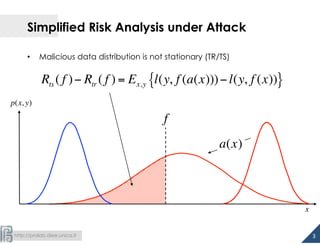
Simplified Risk Analysis under Attack
•  Malicious data distribution is not stationary (TR/TS)
3	
  
f
Rts ( f )− Rtr ( f ) = Ex,y l(y, f (a(x)))−l(y, f (x)){ }
x
p(x, y)
 
http://pralab.diee.unica.it
a(x)
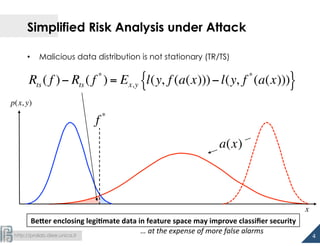
Simplified Risk Analysis under Attack
•  Malicious data distribution is not stationary (TR/TS)
4	
  
Rts ( f )− Rts ( f *
) = Ex,y l(y, f (a(x)))−l(y, f *
(a(x))){ }
x
p(x, y)
f *
Be+er	
  enclosing	
  legi4mate	
  data	
  in	
  feature	
  space	
  may	
  improve	
  classifier	
  security	
  
…	
  at	
  the	
  expense	
  of	
  more	
  false	
  alarms	
  
 
http://pralab.diee.unica.it
1.5-class Classification
The Rationale Behind
5	
  
2−class classification
−5 0 5
−5
0
5
1−class classification (legitimate)
−5 0 5
−5
0
5
•  2-­‐class	
  classifica-on	
  is	
  usually	
  more	
  accurate	
  in	
  the	
  absence	
  of	
  a#ack	
  
•  …	
  but	
  poten-ally	
  more	
  vulnerable	
  under	
  a#ack	
  (not	
  enclosing	
  legi-mate	
  data)	
  
1.5C classification (MCS)
−5 0 5
−5
0
5
1.5-­‐class	
  classifica4on	
  aims	
  at	
  retaining	
  high	
  accuracy	
  and	
  security	
  under	
  a+ack	


http://pralab.diee.unica.it
Secure 1.5-class Classification with MCSs
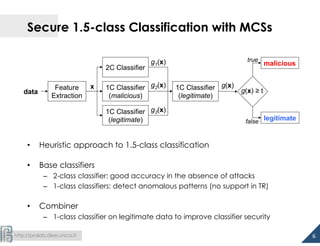
•  Heuristic approach to 1.5-class classification
•  Base classifiers
–  2-class classifier: good accuracy in the absence of attacks
–  1-class classifiers: detect anomalous patterns (no support in TR)
•  Combiner
–  1-class classifier on legitimate data to improve classifier security
6	
  
data
1C Classifier
(malicious)
Feature
Extraction
malicious
1C Classifier
(legitimate)
2C Classifier
1C Classifier
(legitimate)
legitimate
x
g1(x)
g2(x)
g3(x)
g(x) ≥ t
g(x)
true
false
 
http://pralab.diee.unica.it
Classifier Security against Evasion Attacks
7	
  
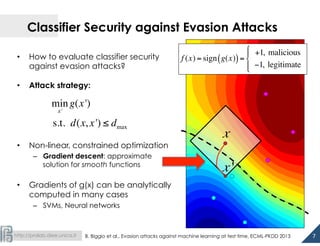
•  How to evaluate classifier security
against evasion attacks?
•  Attack strategy:
•  Non-linear, constrained optimization
–  Gradient descent: approximate
solution for smooth functions
•  Gradients of g(x) can be analytically
computed in many cases
–  SVMs, Neural networks
−2−1.5−1−0.500.51
x
f (x) = sign g(x)( )=
+1, malicious
−1, legitimate
"
#
$
%$
min
x'
g(x')
s.t. d(x, x') ≤ dmax
x '
B. Biggio et al., Evasion attacks against machine learning at test time, ECML-PKDD 2013
 
http://pralab.diee.unica.it
Computing Descent Directions
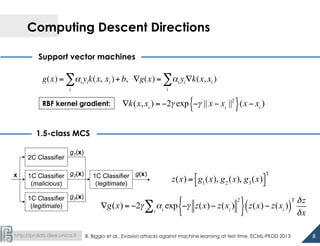
Support vector machines
1.5-class MCS
g(x) = αi yik(x,
i
∑ xi )+ b, ∇g(x) = αi yi∇k(x, xi )
i
∑
RBF kernel gradient: ∇k(x,xi
) = −2γ exp −γ || x − xi
||2
{ }(x − xi
)
8	
  
1C Classifier
(malicious)
e
on
malicious
1C Classifier
(legitimate)
2C Classifier
1C Classifier
(legitimate)
legitimate
x
g1(x)
g2(x)
g3(x)
g(x) ≥ t
g(x)
true
false
z(x) = g1
(x), g2
(x), g3
(x)!
"
#
$
T
∇g(x) = −2γ αi
exp −γ z(x)− z(xi
)
2
{ }i
∑ z(x)− z(xi
)( )
Τ δz
δx
B. Biggio et al., Evasion attacks against machine learning at test time, ECML-PKDD 2013
 
http://pralab.diee.unica.it
Bounding the Adversary’s Knowledge
Limited-knowledge attacks
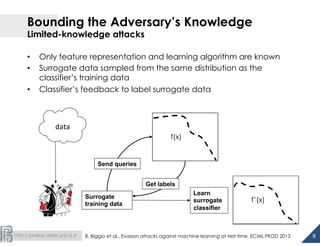
•  Only feature representation and learning algorithm are known
•  Surrogate data sampled from the same distribution as the
classifier’s training data
•  Classifier’s feedback to label surrogate data
PD(X,Y)data	
  
Surrogate
training data
f(x)
Send queries
Get labels
Learn
surrogate
classifier
f’(x)
9	
  B. Biggio et al., Evasion attacks against machine learning at test time, ECML-PKDD 2013
 
http://pralab.diee.unica.it
Experimental Analysis
•  Two case studies: spam and PDF malware detection
–  Perfect-knowledge (PK) and limited-knowledge (LK) attacks
•  Spam data (TREC ’07)
–  25,220 ham and 50,199 spam emails
•  we used the first 5,000 emails in chronological order
–  2-class linear SVM, 1-class RBF SVMs
•  PDF data
–  2,000 samples collected from the web and public malware
databases (e.g., Contagio)
–  2-class RBF SVM, 1-class RBF SVMs
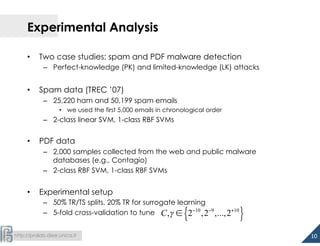
•  Experimental setup
–  50% TR/TS splits, 20% TR for surrogate learning
–  5-fold cross-validation to tune
10	
  
C,γ ∈ 2−10
,2−9
,...,2+10
{ }
 
http://pralab.diee.unica.it
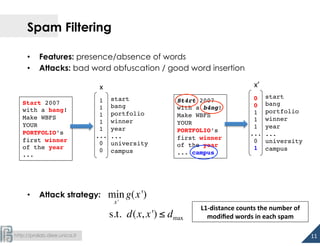
Spam Filtering
•  Features: presence/absence of words
•  Attacks: bad word obfuscation / good word insertion
•  Attack strategy:
11	
  
Start 2007
with a bang!

Make WBFS
YOUR
PORTFOLIO’s

first winner
of the year

...
start
bang

portfolio

winner
year

...

university

campus
1

1
1
1
1
...
0
0
x	
   x’	
  
St4rt 2007
with a b4ng!

Make WBFS
YOUR
PORTFOLIO’s

first winner
of the year

... campus
start
bang

portfolio

winner
year

...

university

campus
0

0
1
1
1
...
0
1
min
x'
g(x')
s.t. d(x, x') ≤ dmax
L1-­‐distance	
  counts	
  the	
  number	
  of	
  
modified	
  words	
  in	
  each	
  spam	
  
 
http://pralab.diee.unica.it
Experiments on PDF Malware Detection
•  PDF: hierarchy of interconnected objects (keyword/value pairs)
•  Attack strategy
–  adding up to dmax objects to the PDF
–  removing objects may
compromise the PDF file
(and embedded malware code)!
/Type 	
   	
  2	
  
/Page 	
   	
  1	
  
/Encoding 	
  1	
  
…	
  
13	
  0	
  obj	
  
<<	
  /Kids	
  [	
  1	
  0	
  R	
  11	
  0	
  R	
  ]	
  
/Type	
  /Page	
  
...	
  >>	
  end	
  obj	
  
17	
  0	
  obj	
  
<<	
  /Type	
  /Encoding	
  
/Differences	
  [	
  0	
  /C0032	
  ]	
  >>	
  
endobj	


Features:	
  keyword	
  count	
  
min
x'
g(x')
s.t. d(x, x') ≤ dmax
x ≤ x'
12	
  
 
http://pralab.diee.unica.it
Experimental Results
13	
  
0 5 10 15 20 25 30
0
0.2
0.4
0.6
0.8
1
maximum number of modified words
AUC
1%
(PK)
2C SVM
1C SVM (L)
1C SVM (M)
1.5C MCS
0 5 10 15 20 25 30
0
0.2
0.4
0.6
0.8
1
maximum number of modified words
AUC
1%
(LK)
2C SVM
1C SVM (L)
1C SVM (M)
1.5C MCS
Spam	
  filtering	
  
0 5 10 15 20 25 30
0
0.2
0.4
0.6
0.8
1
maximum number of added keywords
AUC
1%
(PK)
2C SVM
1C SVM (L)
1C SVM (M)
1.5C MCS
0 5 10 15 20 25 30
0
0.2
0.4
0.6
0.8
1
maximum number of added keywords
AUC
1%
(LK)
2C SVM
1C SVM (L)
1C SVM (M)
1.5C MCS
PDF	
  Malware	
  Detec-on	
  
 
http://pralab.diee.unica.it
Conclusions and Future Work
•  1.5-class MCSs
–  to improve classifier security under attack (enclosing legitimate data)
–  to retain good accuracy in the absence of attack
•  General approach
–  Suitable for any learning/classification algorithm (in principle)
–  No specific assumption on adversarial data manipulation
•  Future work
–  Formal characterization of trade-off between security and accuracy
–  Robustness to poisoning attacks (training data contamination)
14	
  
 
http://pralab.diee.unica.it
?	
  Any questions
Thanks	
  for	
  your	
  a#en-on!	
  
15	
  

Battista Biggio @ MCS 2015, June 29 - July 1, Guenzburg, Germany: "1.5-class MCSs for Secure Learning against Evasion Attacks at Test Time"

  • 1.
    Pa#ern  Recogni-on     and  Applica-ons  Lab                                     University   of  Cagliari,  Italy     Department  of   Electrical  and  Electronic   Engineering   1.5-class MCSs for Secure Learning against Evasion Attacks at Test Time Ba#sta  Biggio1,  Igino  Corona1,  Zhi-­‐min  He2,  Patrick  P.K.  Chan2,   Giorgio  Giacinto1,  Daniel  Yeung2,  Fabio  Roli1     (1)  Dept.  Of  Electrical  and  Electronic  Engineering,  University  of  Cagliari,  Italy   (2)  School  of  Computer  Science  and  Eng.,  South  China  University  of  Technology,  China       Guenzburg,  Germany,  Jun  29  -­‐  Jul  1,  2015  MCS  2015  
  • 2.
      http://pralab.diee.unica.it Machine Learning inAdversarial Settings •  Pattern recognition in security applications –  spam filtering, malware detection, biometrics •  Attackers manipulate data to evade detection at test time 2   legitimate malicious x1   x2   f(x) …cheap… …che4p… a(x)
  • 3.
      http://pralab.diee.unica.it a(x) Simplified Risk Analysisunder Attack •  Malicious data distribution is not stationary (TR/TS) 3   f Rts ( f )− Rtr ( f ) = Ex,y l(y, f (a(x)))−l(y, f (x)){ } x p(x, y)
  • 4.
      http://pralab.diee.unica.it a(x) Simplified Risk Analysisunder Attack •  Malicious data distribution is not stationary (TR/TS) 4   Rts ( f )− Rts ( f * ) = Ex,y l(y, f (a(x)))−l(y, f * (a(x))){ } x p(x, y) f * Be+er  enclosing  legi4mate  data  in  feature  space  may  improve  classifier  security   …  at  the  expense  of  more  false  alarms  
  • 5.
      http://pralab.diee.unica.it 1.5-class Classification The RationaleBehind 5   2−class classification −5 0 5 −5 0 5 1−class classification (legitimate) −5 0 5 −5 0 5 •  2-­‐class  classifica-on  is  usually  more  accurate  in  the  absence  of  a#ack   •  …  but  poten-ally  more  vulnerable  under  a#ack  (not  enclosing  legi-mate  data)   1.5C classification (MCS) −5 0 5 −5 0 5 1.5-­‐class  classifica4on  aims  at  retaining  high  accuracy  and  security  under  a+ack    
  • 6.
      http://pralab.diee.unica.it Secure 1.5-class Classificationwith MCSs •  Heuristic approach to 1.5-class classification •  Base classifiers –  2-class classifier: good accuracy in the absence of attacks –  1-class classifiers: detect anomalous patterns (no support in TR) •  Combiner –  1-class classifier on legitimate data to improve classifier security 6   data 1C Classifier (malicious) Feature Extraction malicious 1C Classifier (legitimate) 2C Classifier 1C Classifier (legitimate) legitimate x g1(x) g2(x) g3(x) g(x) ≥ t g(x) true false
  • 7.
      http://pralab.diee.unica.it Classifier Security againstEvasion Attacks 7   •  How to evaluate classifier security against evasion attacks? •  Attack strategy: •  Non-linear, constrained optimization –  Gradient descent: approximate solution for smooth functions •  Gradients of g(x) can be analytically computed in many cases –  SVMs, Neural networks −2−1.5−1−0.500.51 x f (x) = sign g(x)( )= +1, malicious −1, legitimate " # $ %$ min x' g(x') s.t. d(x, x') ≤ dmax x ' B. Biggio et al., Evasion attacks against machine learning at test time, ECML-PKDD 2013
  • 8.
      http://pralab.diee.unica.it Computing Descent Directions Supportvector machines 1.5-class MCS g(x) = αi yik(x, i ∑ xi )+ b, ∇g(x) = αi yi∇k(x, xi ) i ∑ RBF kernel gradient: ∇k(x,xi ) = −2γ exp −γ || x − xi ||2 { }(x − xi ) 8   1C Classifier (malicious) e on malicious 1C Classifier (legitimate) 2C Classifier 1C Classifier (legitimate) legitimate x g1(x) g2(x) g3(x) g(x) ≥ t g(x) true false z(x) = g1 (x), g2 (x), g3 (x)! " # $ T ∇g(x) = −2γ αi exp −γ z(x)− z(xi ) 2 { }i ∑ z(x)− z(xi )( ) Τ δz δx B. Biggio et al., Evasion attacks against machine learning at test time, ECML-PKDD 2013
  • 9.
      http://pralab.diee.unica.it Bounding the Adversary’sKnowledge Limited-knowledge attacks •  Only feature representation and learning algorithm are known •  Surrogate data sampled from the same distribution as the classifier’s training data •  Classifier’s feedback to label surrogate data PD(X,Y)data   Surrogate training data f(x) Send queries Get labels Learn surrogate classifier f’(x) 9  B. Biggio et al., Evasion attacks against machine learning at test time, ECML-PKDD 2013
  • 10.
      http://pralab.diee.unica.it Experimental Analysis •  Twocase studies: spam and PDF malware detection –  Perfect-knowledge (PK) and limited-knowledge (LK) attacks •  Spam data (TREC ’07) –  25,220 ham and 50,199 spam emails •  we used the first 5,000 emails in chronological order –  2-class linear SVM, 1-class RBF SVMs •  PDF data –  2,000 samples collected from the web and public malware databases (e.g., Contagio) –  2-class RBF SVM, 1-class RBF SVMs •  Experimental setup –  50% TR/TS splits, 20% TR for surrogate learning –  5-fold cross-validation to tune 10   C,γ ∈ 2−10 ,2−9 ,...,2+10 { }
  • 11.
      http://pralab.diee.unica.it Spam Filtering •  Features:presence/absence of words •  Attacks: bad word obfuscation / good word insertion •  Attack strategy: 11   Start 2007 with a bang!
 Make WBFS YOUR PORTFOLIO’s
 first winner of the year
 ... start bang
 portfolio
 winner year
 ...
 university
 campus 1
 1 1 1 1 ... 0 0 x   x’   St4rt 2007 with a b4ng!
 Make WBFS YOUR PORTFOLIO’s
 first winner of the year
 ... campus start bang
 portfolio
 winner year
 ...
 university
 campus 0
 0 1 1 1 ... 0 1 min x' g(x') s.t. d(x, x') ≤ dmax L1-­‐distance  counts  the  number  of   modified  words  in  each  spam  
  • 12.
      http://pralab.diee.unica.it Experiments on PDFMalware Detection •  PDF: hierarchy of interconnected objects (keyword/value pairs) •  Attack strategy –  adding up to dmax objects to the PDF –  removing objects may compromise the PDF file (and embedded malware code)! /Type    2   /Page    1   /Encoding  1   …   13  0  obj   <<  /Kids  [  1  0  R  11  0  R  ]   /Type  /Page   ...  >>  end  obj   17  0  obj   <<  /Type  /Encoding   /Differences  [  0  /C0032  ]  >>   endobj     Features:  keyword  count   min x' g(x') s.t. d(x, x') ≤ dmax x ≤ x' 12  
  • 13.
      http://pralab.diee.unica.it Experimental Results 13   05 10 15 20 25 30 0 0.2 0.4 0.6 0.8 1 maximum number of modified words AUC 1% (PK) 2C SVM 1C SVM (L) 1C SVM (M) 1.5C MCS 0 5 10 15 20 25 30 0 0.2 0.4 0.6 0.8 1 maximum number of modified words AUC 1% (LK) 2C SVM 1C SVM (L) 1C SVM (M) 1.5C MCS Spam  filtering   0 5 10 15 20 25 30 0 0.2 0.4 0.6 0.8 1 maximum number of added keywords AUC 1% (PK) 2C SVM 1C SVM (L) 1C SVM (M) 1.5C MCS 0 5 10 15 20 25 30 0 0.2 0.4 0.6 0.8 1 maximum number of added keywords AUC 1% (LK) 2C SVM 1C SVM (L) 1C SVM (M) 1.5C MCS PDF  Malware  Detec-on  
  • 14.
      http://pralab.diee.unica.it Conclusions and FutureWork •  1.5-class MCSs –  to improve classifier security under attack (enclosing legitimate data) –  to retain good accuracy in the absence of attack •  General approach –  Suitable for any learning/classification algorithm (in principle) –  No specific assumption on adversarial data manipulation •  Future work –  Formal characterization of trade-off between security and accuracy –  Robustness to poisoning attacks (training data contamination) 14  
  • 15.