Download as PDF, PPTX


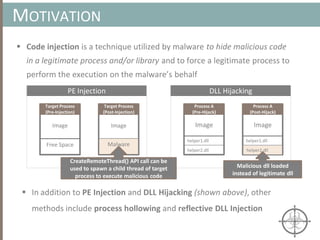
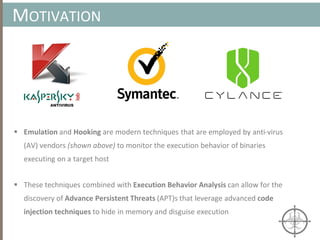
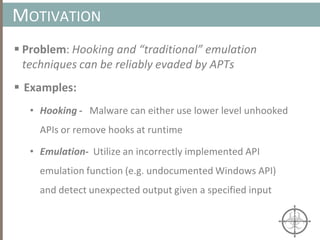
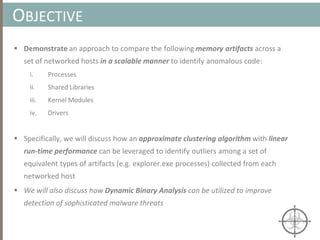
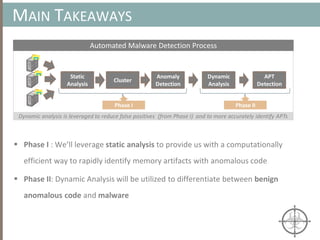
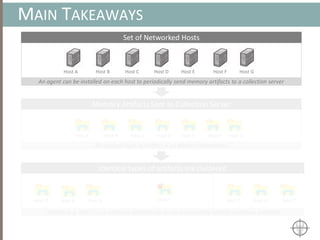
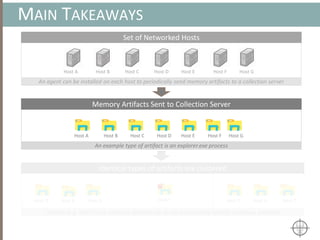
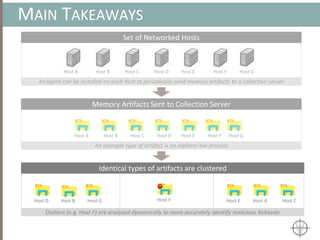
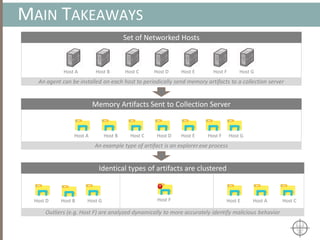
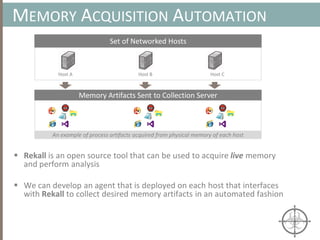
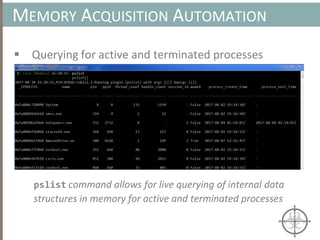
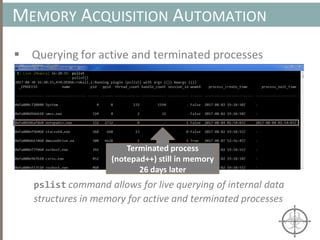
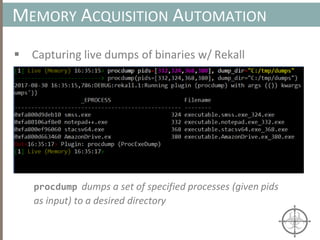
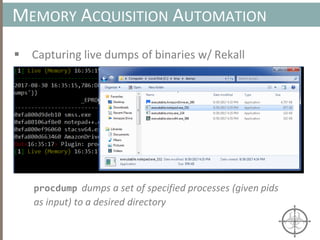
![CLUSTERING ARTIFACTS AT SCALE
Clustering Algorithms
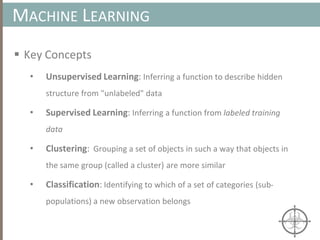
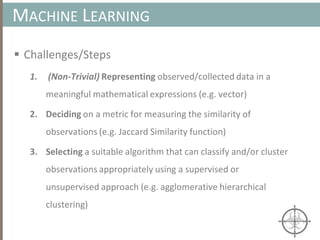
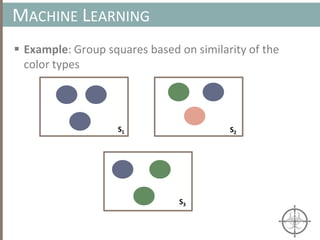
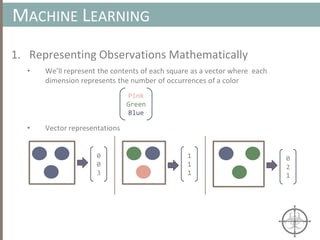
• We’ll utilize an agglomerative hierarchical clustering algorithm
because we don’t have to specify the exact number of clusters, k, a
priori (vs. k-means, where k must be specified)
• Computational complexity for a non-approximated implementation
of the algorithm is , which is not a desirable property for
achieving scalability
• Instead, we’ll use an approximate implementation (presented in [1]),
which has a linear worse-case complexity of
• Note: k is constant and k << n](https://image.slidesharecdn.com/automatedinmemorymalwarerootkitdetectionviabinaryanalysisandmachinelearningsmarttalkaspresented-171115190902/85/Automated-In-memory-Malware-Rootkit-Detection-via-Binary-Analysis-and-Machine-Learning-39-320.jpg)
![ Approximate Clustering Algorithm [1] Sketch
CLUSTERING ARTIFACTS AT SCALE
Set of memory artifacts
Step 1: Prototype Extraction [O(k·n) ]
Step 2: Clustering w/ Prototype [O(k2 log (k) + n) ]
Host A Host B Host C Host D Host E Host F Host G
Host D
Host B
Host F
Host G
Host B Host FHost A
Host A
Host CHost E
Prototypes are a small (k << n), yet representative subset of artifacts](https://image.slidesharecdn.com/automatedinmemorymalwarerootkitdetectionviabinaryanalysisandmachinelearningsmarttalkaspresented-171115190902/85/Automated-In-memory-Malware-Rootkit-Detection-via-Binary-Analysis-and-Machine-Learning-40-320.jpg)
![AUTOMATING CALL TRACE GENERATION
main()
push ebp
mov rbp, rsp
call foo()
t0 = GET:I64(bp)
t3 = GET:I64(rsp)
t2 = Sub64(t3, 0x008)
PUT(rsp) = t2
Stle(t1) = t0
t3 = GET:I64(rsp)
PUT(bp) = t3
call libfuncfoo()
Disassembler vex ir
main() [vex ir]
emulation
t0 = GET:I64(bp)
t3 = GET:I64(rsp)
t2 = Sub64(t3, 0x008)
PUT(rsp) = t2
Stle(t1) = t0
t3 = GET:I64(rsp)
PUT(bp) = t3
call libfuncfoo()
vex ir
call libfuncfoo()
Instruction
pointer](https://image.slidesharecdn.com/automatedinmemorymalwarerootkitdetectionviabinaryanalysisandmachinelearningsmarttalkaspresented-171115190902/85/Automated-In-memory-Malware-Rootkit-Detection-via-Binary-Analysis-and-Machine-Learning-50-320.jpg)
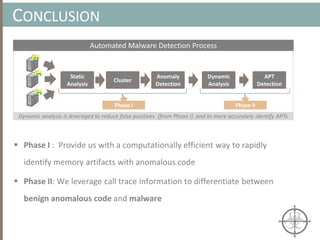
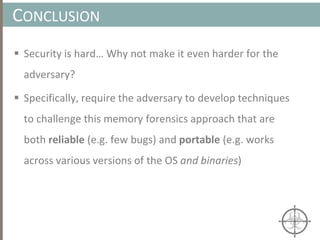
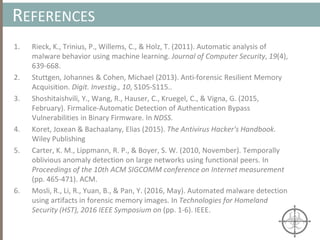
![BINARY ANALYSIS
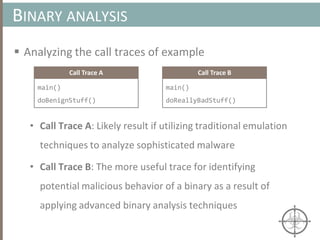
Motivational example for Symbolic Execution
int main(void) {
char buf[32];
char *data = read_string();
unsigned int magic = read_number();
// difficult check for fuzzing
if (magic == 0x31337987) {
// Bad stuff
doBadStuff();
}
else if(magic < 100 && magic % 15 == 2 && magic % 11 == 6) {
// Only solution is 17;
doReallyBadStuff();
}
else{
doBenignStuff();
}](https://image.slidesharecdn.com/automatedinmemorymalwarerootkitdetectionviabinaryanalysisandmachinelearningsmarttalkaspresented-171115190902/85/Automated-In-memory-Malware-Rootkit-Detection-via-Binary-Analysis-and-Machine-Learning-79-320.jpg)
![BINARY ANALYSIS
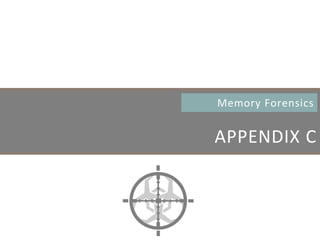
Motivational example for Symbolic Execution
int main(void) {
char buf[32];
char *data = read_string();
unsigned int magic = read_number();
// difficult check for fuzzing
if (magic == 0x31337987) {
// Bad stuff
doBadStuff();
}
else if(magic < 100 && magic % 15 == 2 && magic % 11 == 6) {
// Only solution is 17;
doReallyBadStuff();
}
else{
doBenignStuff();
}
Symbolic execution allows us
to figure out the conditions
(i.e. magic=0x31337987) to
exercise this code path
A more sophisticated code path that
can be reached via symbolic execution](https://image.slidesharecdn.com/automatedinmemorymalwarerootkitdetectionviabinaryanalysisandmachinelearningsmarttalkaspresented-171115190902/85/Automated-In-memory-Malware-Rootkit-Detection-via-Binary-Analysis-and-Machine-Learning-80-320.jpg)
![HOOKING
Monitoring Behavior w/ Hooks
• Detouring a number of common APIs (e.g. CreateFile) to
ensure monitoring code is executed before actual code
• Depending on a set of rules ( typically dynamic), the monitor
code blocks, allows, or reports execution of API
CreateFileA (Original)
mov edi, edi
push ebp
mov ebp, esp
CreateFileA (Hooked)
jmp MonitorCode
push ebp
mov ebp, esp
Monitor Code
inc dword ptr [edx+8]
.......
jmp CreateFileA + 5
jmp MonitorCode
Modified
Instruction](https://image.slidesharecdn.com/automatedinmemorymalwarerootkitdetectionviabinaryanalysisandmachinelearningsmarttalkaspresented-171115190902/85/Automated-In-memory-Malware-Rootkit-Detection-via-Binary-Analysis-and-Machine-Learning-111-320.jpg)

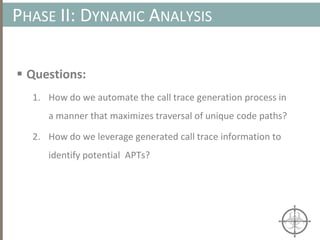
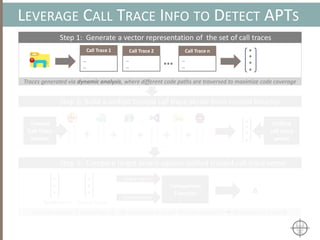
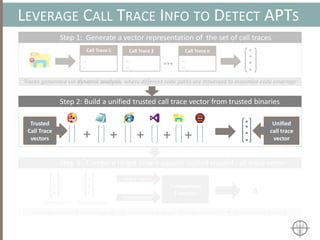
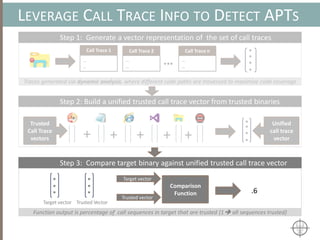
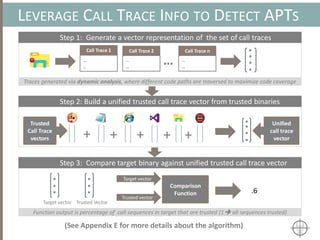
The document presents a method for detecting malware and rootkits using in-memory analysis and machine learning techniques. It outlines a two-phase approach where phase I employs static analysis for anomaly detection in memory artifacts, while phase II utilizes dynamic analysis to accurately classify benign versus malicious code. The objective is to automate the detection process efficiently and effectively, leveraging clustering algorithms and call trace analysis to identify advanced persistent threats in a scalable manner.


![20260201 [FOSDEM] gomodjail - library sandboxing for Go modules.pdf](https://cdn.slidesharecdn.com/ss_thumbnails/20260201fosdemgomodjail-librarysandboxingforgomodules-260201225659-76609ec4-thumbnail.jpg?width=640&height=640&fit=bounds)
