Causative Adversarial Learning
Huang Xiao, am 24.06.2015
xiaohu(at)in.tum.de
Talk presented on Deep Learning in Action
@Munich
Motivation
Deep networks can be easily fooled … [1]
Evolution Algor.
generated images
99.99%
confidence
“It turns out some DNNs only
focus on discriminative
features in images.”
[1] Nguyen A, Yosinski J, Clune J. Deep Neural Networks are Easily Fooled: High Confidence Predictions for Unrecognizable Images. In Computer Vision and
Pattern Recognition (CVPR '15), IEEE, 2015.
Motivation
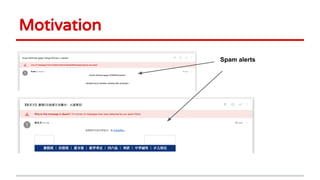
Spam alerts
Google brain, 16000 CPUs
Learning is expensive!
Motivation
Adversarial Learning
Reverse engineering of machine learning. It
aims to design robust and secure learning
algorithms.
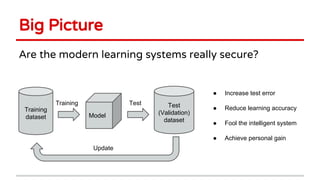
Big Picture
Are the modern learning systems really secure?
Training
dataset Model
Test
(Validation)
dataset
Training Test
Update
● Increase test error
● Reduce learning accuracy
● Fool the intelligent system
● Achieve personal gain
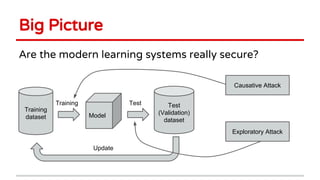
Big Picture
Are the modern learning systems really secure?
Training
dataset Model
Test
(Validation)
dataset
Training Test
Update
Causative Attack
Exploratory Attack
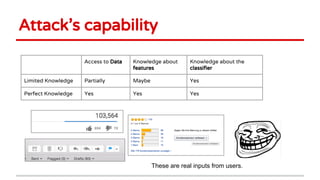
Attack’s capability
Access to Data Knowledge about
features
Knowledge about the
classifier
Limited Knowledge Partially Maybe Yes
Perfect Knowledge Yes Yes Yes
These are real inputs from users.
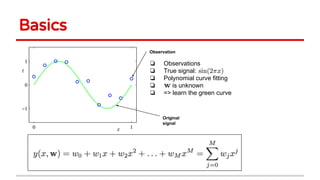
Basics
❏ Observations
❏ True signal:
❏ Polynomial curve fitting
❏ is unknown
❏ => learn the green curve
Observation
Original
signal
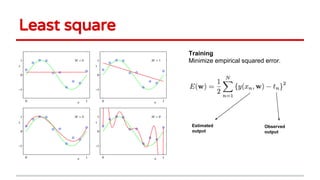
Least square
Training
Minimize empirical squared error.
Estimated
output
Observed
output
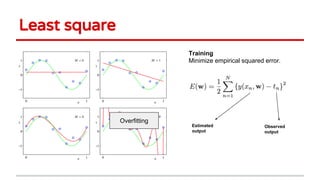
Least square
Training
Minimize empirical squared error.
Overfitting
Estimated
output
Observed
output
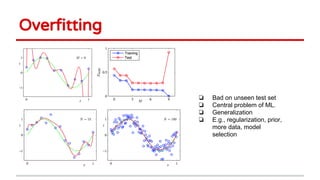
Overfitting
❏ Bad on unseen test set
❏ Central problem of ML.
❏ Generalization
❏ E.g., regularization, prior,
more data, model
selection
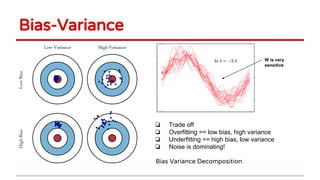
Bias-Variance
❏ Trade off
❏ Overfitting == low bias, high variance
❏ Underfitting == high bias, low variance
❏ Noise is dominating!
W is very
sensitive
Bias Variance Decomposition
Objective
Increase bias or variance?
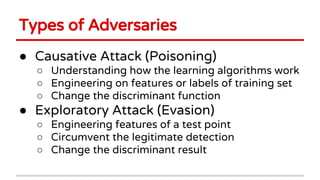
Types of Adversaries
● Causative Attack (Poisoning)
○ Understanding how the learning algorithms work
○ Engineering on features or labels of training set
○ Change the discriminant function
● Exploratory Attack (Evasion)
○ Engineering features of a test point
○ Circumvent the legitimate detection
○ Change the discriminant result
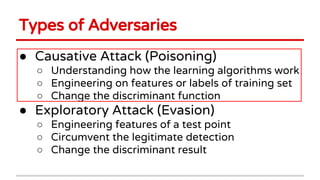
Types of Adversaries
● Causative Attack (Poisoning)
○ Understanding how the learning algorithms work
○ Engineering on features or labels of training set
○ Change the discriminant function
● Exploratory Attack (Evasion)
○ Engineering features of a test point
○ Circumvent the legitimate detection
○ Change the discriminant result
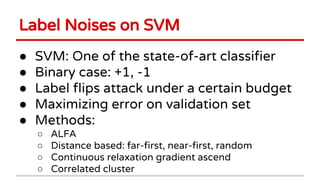
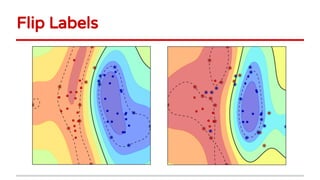
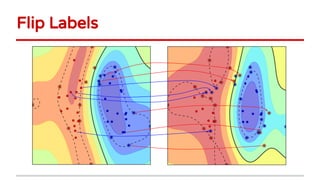
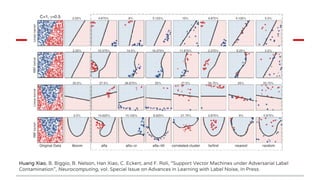
Label Noises on SVM
● SVM: One of the state-of-art classifier
● Binary case: +1, -1
● Label flips attack under a certain budget
● Maximizing error on validation set
● Methods:
○ ALFA
○ Distance based: far-first, near-first, random
○ Continuous relaxation gradient ascend
○ Correlated cluster
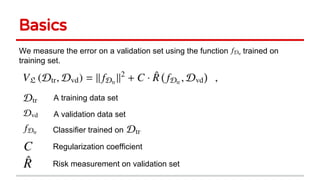
Basics
We measure the error on a validation set using the function trained on
training set.
A training data set
A validation data set
Classifier trained on
Regularization coefficient
Risk measurement on validation set
Flip Labels
Flip Labels
Huang Xiao, B. Biggio, B. Nelson, Han Xiao, C. Eckert, and F. Roli, “Support Vector Machines under Adversarial Label
Contamination”, Neurocomputing, vol. Special Issue on Advances in Learning with Label Noise, In Press.
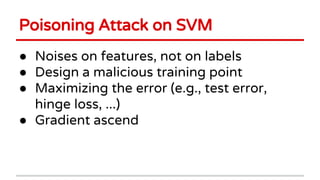
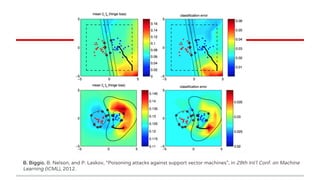
Poisoning Attack on SVM
● Noises on features, not on labels
● Design a malicious training point
● Maximizing the error (e.g., test error,
hinge loss, ...)
● Gradient ascend
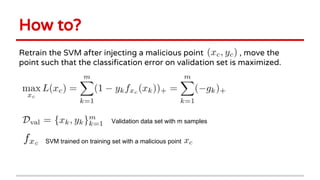
How to?
Retrain the SVM after injecting a malicious point ,, , move the
point such that the classification error on validation set is maximized.
Validation data set with m samples
SVM trained on training set with a malicious point
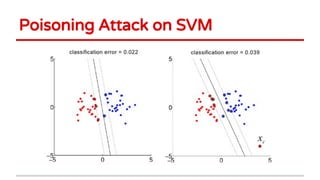
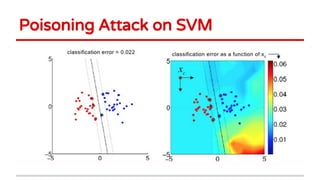
Poisoning Attack on SVM
B. Biggio, B. Nelson, and P. Laskov, “Poisoning attacks against support vector machines”, in 29th Int'l Conf. on Machine
Learning (ICML), 2012.
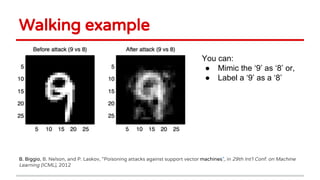
Walking example
B. Biggio, B. Nelson, and P. Laskov, “Poisoning attacks against support vector machines”, in 29th Int'l Conf. on Machine
Learning (ICML), 2012
You can:
● Mimic the ‘9’ as ‘8’ or,
● Label a ‘9’ as a ‘8’
Poisoning Lasso
● Lasso: feature selection, more generally,
L1 regularization
● Feature selection is often the first step
for many learning system
● Other targets: Rigid regression, elastic
network
● Gradient based method
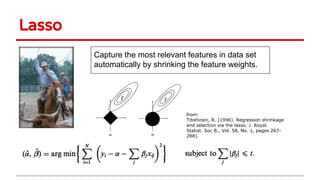
Lasso
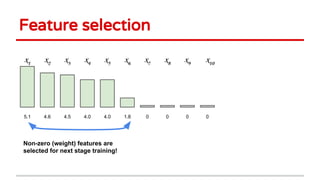
Capture the most relevant features in data set
automatically by shrinking the feature weights.
from:
Tibshirani, R. (1996). Regression shrinkage
and selection via the lasso. J. Royal.
Statist. Soc B., Vol. 58, No. 1, pages 267-
288).
Feature selection
x1
x2
x3
x4
x5
x6
x7
x8
x9
x10
5.1 4.6 4.5 4.0 4.0 1.8 0 0 0 0
Non-zero (weight) features are
selected for next stage training!
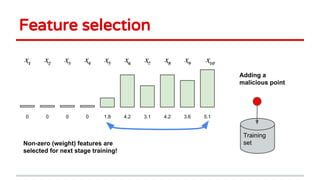
Feature selection
x1
x2
x3
x4
x5
x6
x7
x8
x9
x10
5.13.64.23.14.21.80000
Non-zero (weight) features are
selected for next stage training!
Adding a
malicious point
Training
set
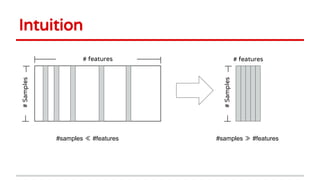
Intuition
# features
#Samples
# features
#Samples
#samples ≪ #features #samples ≫ #features
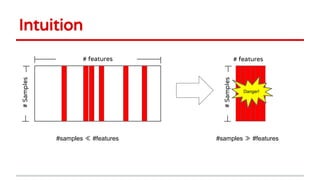
Intuition
# features
#Samples
# features
#Samples
#samples ≪ #features #samples ≫ #features
Danger!
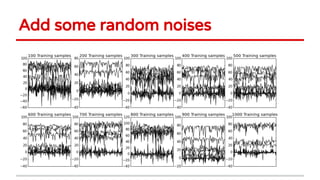
Add some random noises
Research goals
● Investigating robustness of feature
selection algorithms
● Design a multiple point attack method
● Warning: feature selection might not be
reliable
● A gradient based poisoning framework
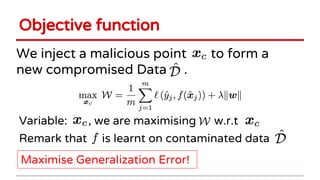
Objective function
We inject a malicious point to form a
new compromised Data .
Variable: , we are maximising w.r.t
Remark that is learnt on contaminated data .
Maximise Generalization Error!
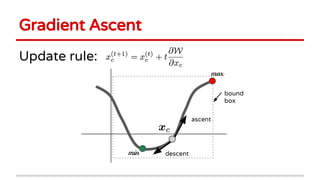
Gradient Ascent
Update rule:
descent
ascent
min
max
bound
box
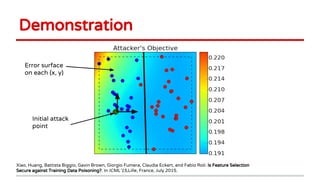
Demonstration
Error surface
Initial attack
point
on each (x, y)
Xiao, Huang, Battista Biggio, Gavin Brown, Giorgio Fumera, Claudia Eckert, and Fabio Roli. Is Feature Selection
Secure against Training Data Poisoning?. In ICML'15,Lille, France, July 2015.
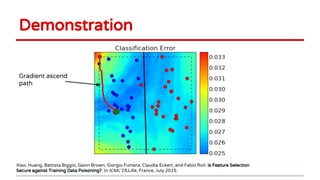
Demonstration
Gradient ascend
path
Xiao, Huang, Battista Biggio, Gavin Brown, Giorgio Fumera, Claudia Eckert, and Fabio Roli. Is Feature Selection
Secure against Training Data Poisoning?. In ICML'15,Lille, France, July 2015.
Wrap up
● Don’t expect your algorithms too fancy
● Don’t expect adversaries too silly
● Setup objective and do the worst-case
study
● Machine learning needs to be more
robust
● There’s no innocent data
Thank you, question?

Causative Adversarial Learning

  • 1.
    Causative Adversarial Learning HuangXiao, am 24.06.2015 xiaohu(at)in.tum.de Talk presented on Deep Learning in Action @Munich
  • 2.
    Motivation Deep networks canbe easily fooled … [1] Evolution Algor. generated images 99.99% confidence “It turns out some DNNs only focus on discriminative features in images.” [1] Nguyen A, Yosinski J, Clune J. Deep Neural Networks are Easily Fooled: High Confidence Predictions for Unrecognizable Images. In Computer Vision and Pattern Recognition (CVPR '15), IEEE, 2015.
  • 3.
  • 4.
    Google brain, 16000CPUs Learning is expensive! Motivation
  • 5.
    Adversarial Learning Reverse engineeringof machine learning. It aims to design robust and secure learning algorithms.
  • 6.
    Big Picture Are themodern learning systems really secure? Training dataset Model Test (Validation) dataset Training Test Update ● Increase test error ● Reduce learning accuracy ● Fool the intelligent system ● Achieve personal gain
  • 7.
    Big Picture Are themodern learning systems really secure? Training dataset Model Test (Validation) dataset Training Test Update Causative Attack Exploratory Attack
  • 8.
    Attack’s capability Access toData Knowledge about features Knowledge about the classifier Limited Knowledge Partially Maybe Yes Perfect Knowledge Yes Yes Yes These are real inputs from users.
  • 9.
    Basics ❏ Observations ❏ Truesignal: ❏ Polynomial curve fitting ❏ is unknown ❏ => learn the green curve Observation Original signal
  • 10.
    Least square Training Minimize empiricalsquared error. Estimated output Observed output
  • 11.
    Least square Training Minimize empiricalsquared error. Overfitting Estimated output Observed output
  • 12.
    Overfitting ❏ Bad onunseen test set ❏ Central problem of ML. ❏ Generalization ❏ E.g., regularization, prior, more data, model selection
  • 13.
    Bias-Variance ❏ Trade off ❏Overfitting == low bias, high variance ❏ Underfitting == high bias, low variance ❏ Noise is dominating! W is very sensitive Bias Variance Decomposition
  • 14.
  • 15.
    Types of Adversaries ●Causative Attack (Poisoning) ○ Understanding how the learning algorithms work ○ Engineering on features or labels of training set ○ Change the discriminant function ● Exploratory Attack (Evasion) ○ Engineering features of a test point ○ Circumvent the legitimate detection ○ Change the discriminant result
  • 16.
    Types of Adversaries ●Causative Attack (Poisoning) ○ Understanding how the learning algorithms work ○ Engineering on features or labels of training set ○ Change the discriminant function ● Exploratory Attack (Evasion) ○ Engineering features of a test point ○ Circumvent the legitimate detection ○ Change the discriminant result
  • 17.
    Label Noises onSVM ● SVM: One of the state-of-art classifier ● Binary case: +1, -1 ● Label flips attack under a certain budget ● Maximizing error on validation set ● Methods: ○ ALFA ○ Distance based: far-first, near-first, random ○ Continuous relaxation gradient ascend ○ Correlated cluster
  • 18.
    Basics We measure theerror on a validation set using the function trained on training set. A training data set A validation data set Classifier trained on Regularization coefficient Risk measurement on validation set
  • 19.
  • 20.
  • 21.
    Huang Xiao, B.Biggio, B. Nelson, Han Xiao, C. Eckert, and F. Roli, “Support Vector Machines under Adversarial Label Contamination”, Neurocomputing, vol. Special Issue on Advances in Learning with Label Noise, In Press.
  • 22.
    Poisoning Attack onSVM ● Noises on features, not on labels ● Design a malicious training point ● Maximizing the error (e.g., test error, hinge loss, ...) ● Gradient ascend
  • 23.
    How to? Retrain theSVM after injecting a malicious point ,, , move the point such that the classification error on validation set is maximized. Validation data set with m samples SVM trained on training set with a malicious point
  • 24.
  • 25.
  • 26.
    B. Biggio, B.Nelson, and P. Laskov, “Poisoning attacks against support vector machines”, in 29th Int'l Conf. on Machine Learning (ICML), 2012.
  • 27.
    Walking example B. Biggio,B. Nelson, and P. Laskov, “Poisoning attacks against support vector machines”, in 29th Int'l Conf. on Machine Learning (ICML), 2012 You can: ● Mimic the ‘9’ as ‘8’ or, ● Label a ‘9’ as a ‘8’
  • 28.
    Poisoning Lasso ● Lasso:feature selection, more generally, L1 regularization ● Feature selection is often the first step for many learning system ● Other targets: Rigid regression, elastic network ● Gradient based method
  • 29.
    Lasso Capture the mostrelevant features in data set automatically by shrinking the feature weights. from: Tibshirani, R. (1996). Regression shrinkage and selection via the lasso. J. Royal. Statist. Soc B., Vol. 58, No. 1, pages 267- 288).
  • 30.
    Feature selection x1 x2 x3 x4 x5 x6 x7 x8 x9 x10 5.1 4.64.5 4.0 4.0 1.8 0 0 0 0 Non-zero (weight) features are selected for next stage training!
  • 31.
    Feature selection x1 x2 x3 x4 x5 x6 x7 x8 x9 x10 5.13.64.23.14.21.80000 Non-zero (weight)features are selected for next stage training! Adding a malicious point Training set
  • 32.
  • 33.
    Intuition # features #Samples # features #Samples #samples≪ #features #samples ≫ #features Danger!
  • 34.
  • 35.
    Research goals ● Investigatingrobustness of feature selection algorithms ● Design a multiple point attack method ● Warning: feature selection might not be reliable ● A gradient based poisoning framework
  • 36.
    Objective function We injecta malicious point to form a new compromised Data . Variable: , we are maximising w.r.t Remark that is learnt on contaminated data . Maximise Generalization Error!
  • 37.
  • 38.
    Demonstration Error surface Initial attack point oneach (x, y) Xiao, Huang, Battista Biggio, Gavin Brown, Giorgio Fumera, Claudia Eckert, and Fabio Roli. Is Feature Selection Secure against Training Data Poisoning?. In ICML'15,Lille, France, July 2015.
  • 39.
    Demonstration Gradient ascend path Xiao, Huang,Battista Biggio, Gavin Brown, Giorgio Fumera, Claudia Eckert, and Fabio Roli. Is Feature Selection Secure against Training Data Poisoning?. In ICML'15,Lille, France, July 2015.
  • 40.
    Wrap up ● Don’texpect your algorithms too fancy ● Don’t expect adversaries too silly ● Setup objective and do the worst-case study ● Machine learning needs to be more robust ● There’s no innocent data
  • 41.