One bite and all your dreams will come true:
Analyzing and Attacking Apple Kernel Drivers
X(aolon& Ba( & M(n Spar)) Zhen&
1
Xiaolong Bai
Alibaba Security Engineer 
Ph.D. graduated from Tsinghua
University
Published papers on the top 4: S&P,
Usenix Security, CCS, NDSS
Twitter, Weibo, Github: bxl1989
Min (Spark) Zheng
Alibaba Security Expert
Ph.D. graduated from The CUHK
Twitter@SparkZheng
Weibo@ spark
2
1Overview
2New vulns in
Apple drivers
3Obstacles in
analyzing
Apple drivers
3
4Ryuk: a new
static analysis tool
to analyze drivers
5Ryuk-Fuzz:
combine fuzzing
with static analysis
6Conclusions
Overview
4
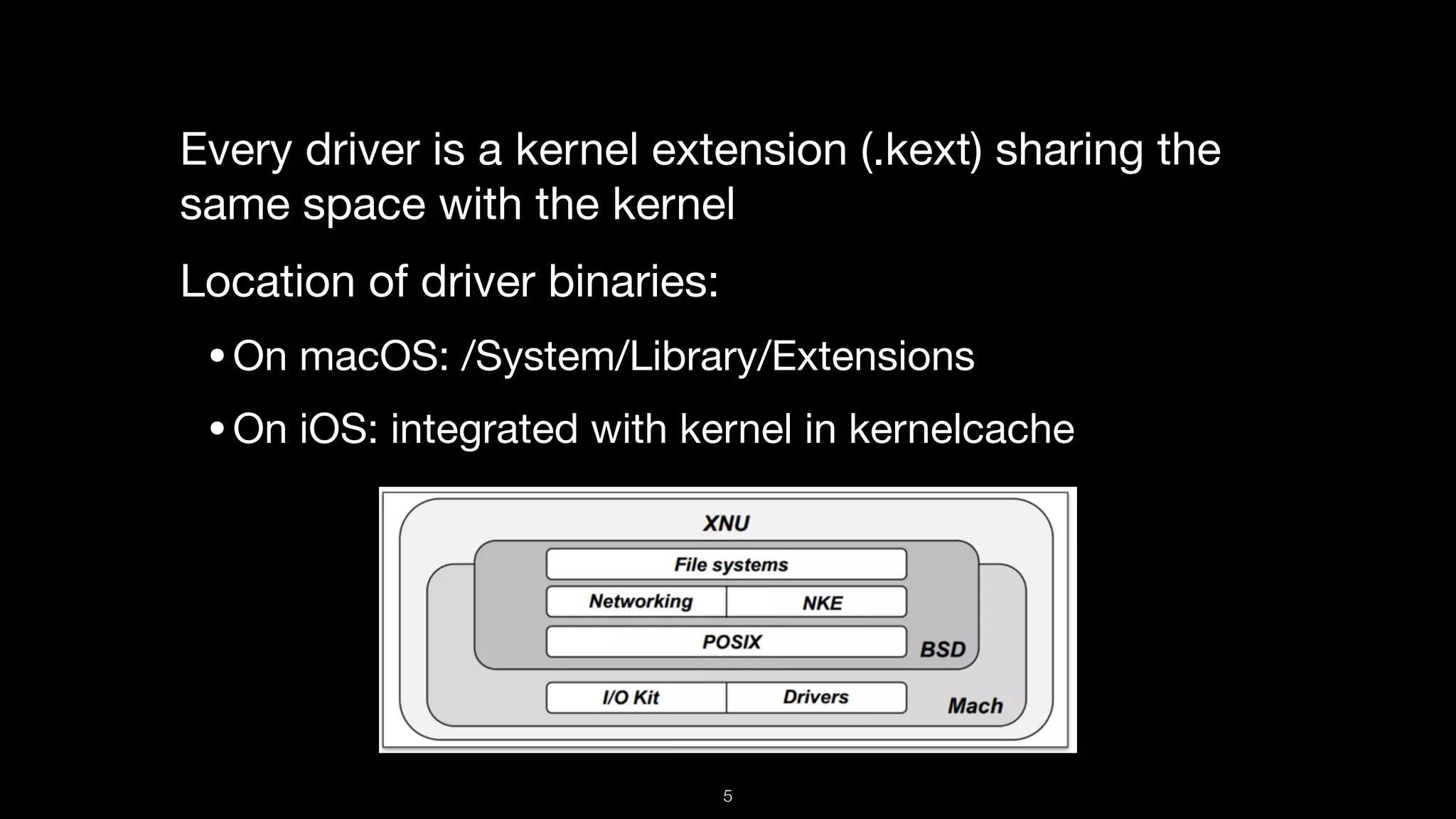
Every driver is a kernel extension (.kext) sharing the
same space with the kernel

Location of driver binaries:

•On macOS: /System/Library/Extensions

•On iOS: integrated with kernel in kernelcache
5
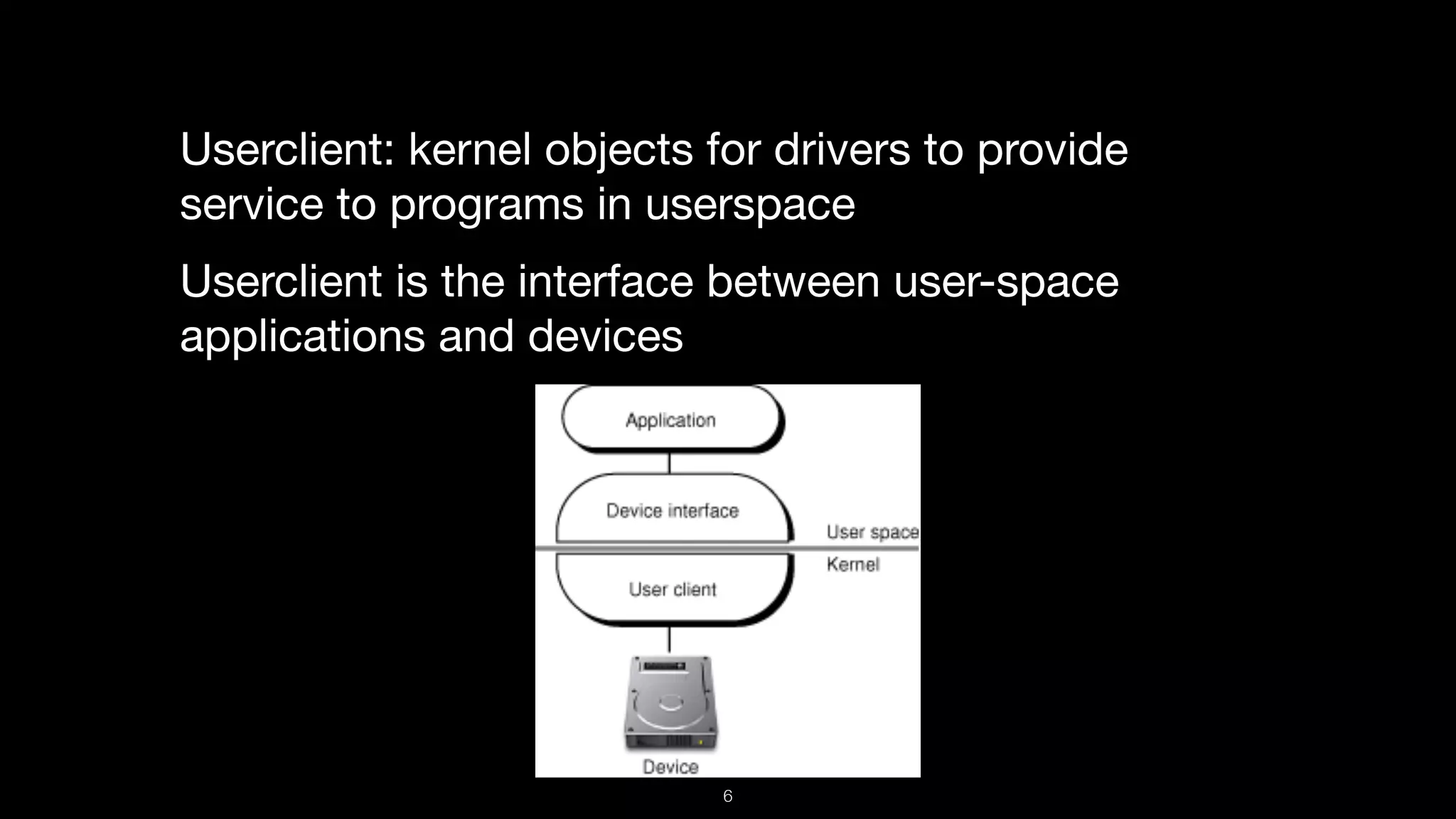
Userclient: kernel objects for drivers to provide
service to programs in userspace

Userclient is the interface between user-space
applications and devices
6
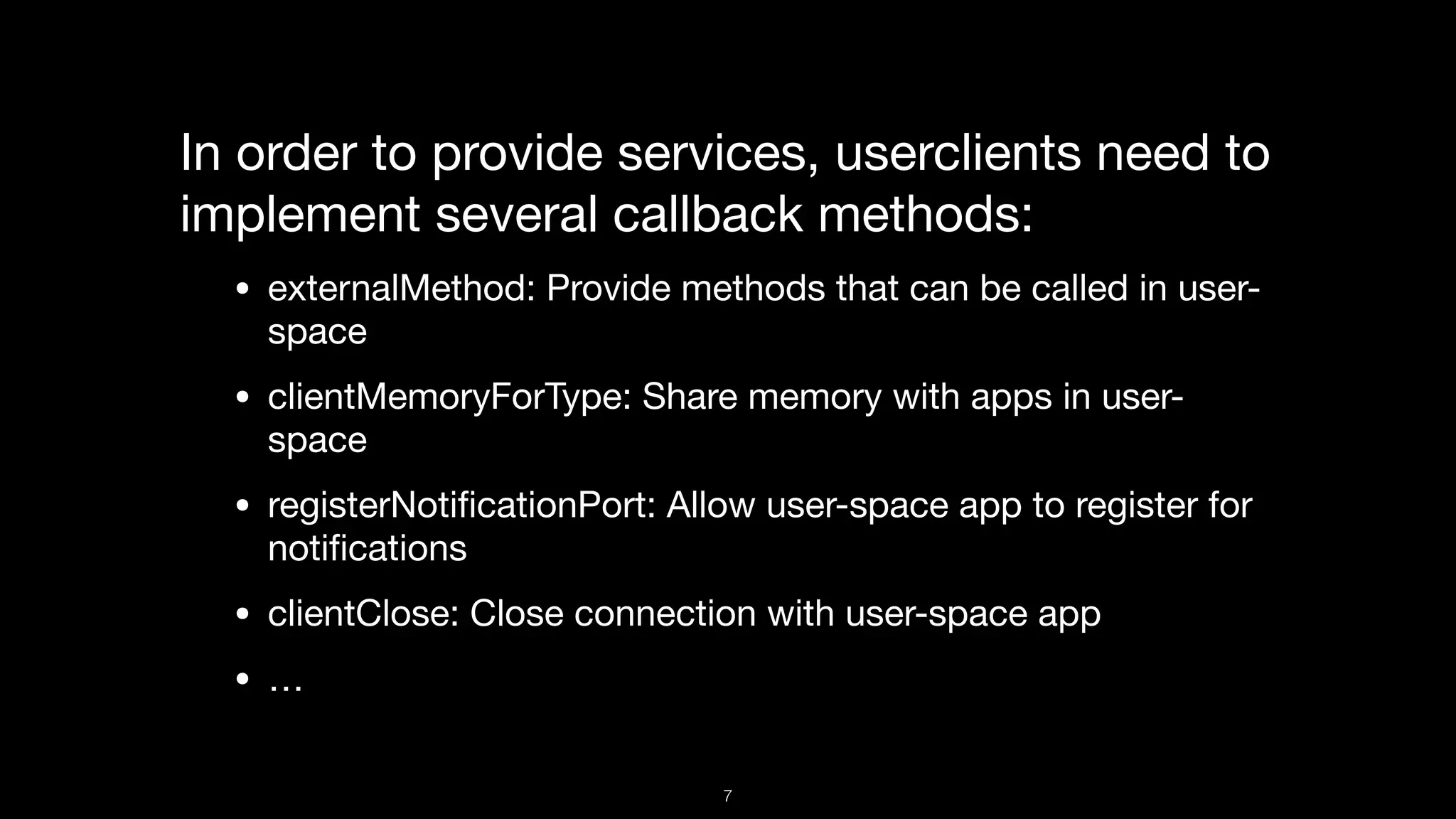
In order to provide services, userclients need to
implement several callback methods:

• externalMethod: Provide methods that can be called in user-
space

• clientMemoryForType: Share memory with apps in user-
space

• registerNotificationPort: Allow user-space app to register for
notifications

• clientClose: Close connection with user-space app

• …
7
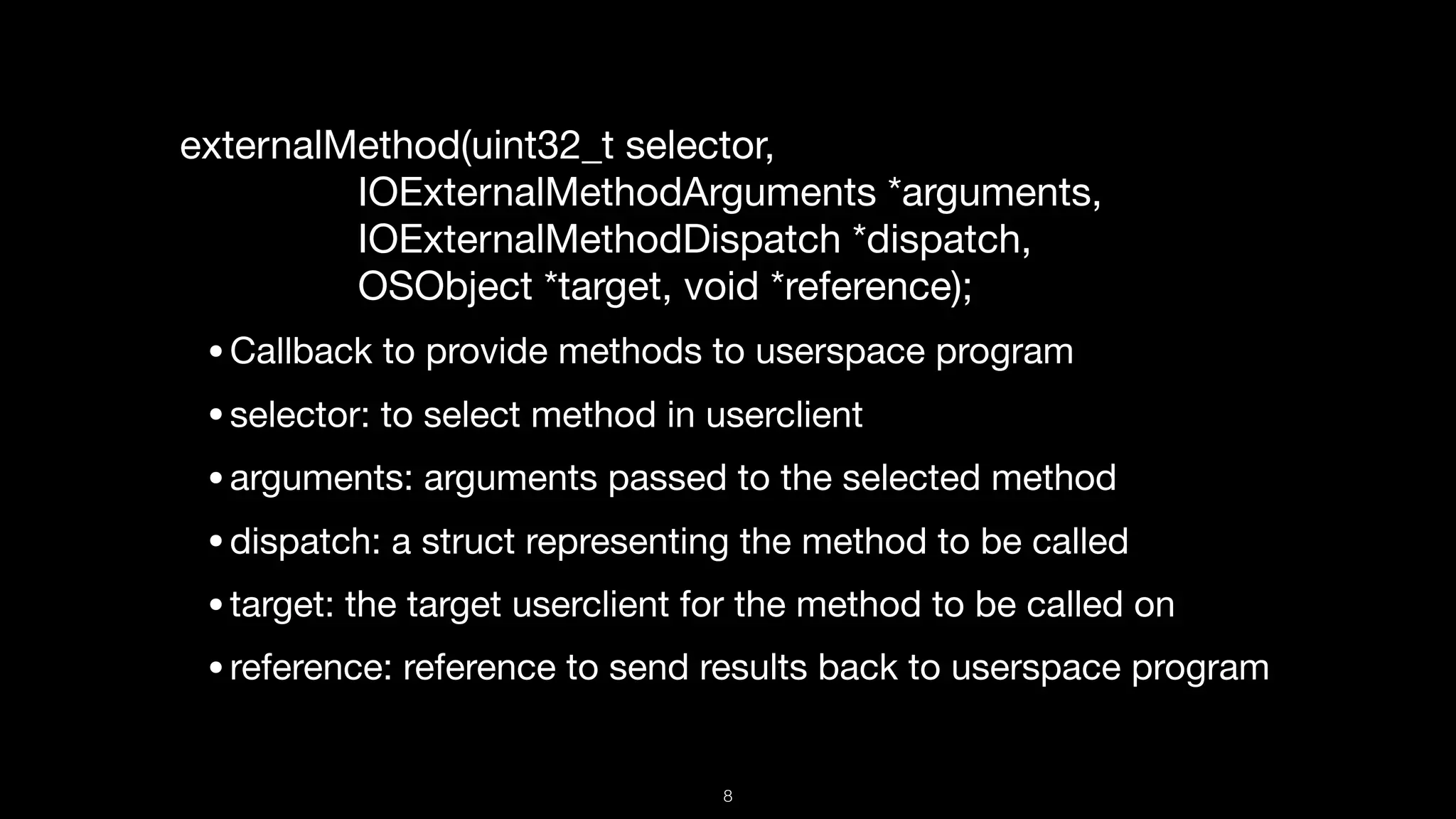
externalMethod(uint32_t selector,  

IOExternalMethodArguments *arguments, 

IOExternalMethodDispatch *dispatch, 

OSObject *target, void *reference);

•Callback to provide methods to userspace program

•selector: to select method in userclient

•arguments: arguments passed to the selected method

•dispatch: a struct representing the method to be called

•target: the target userclient for the method to be called on

•reference: reference to send results back to userspace program
8
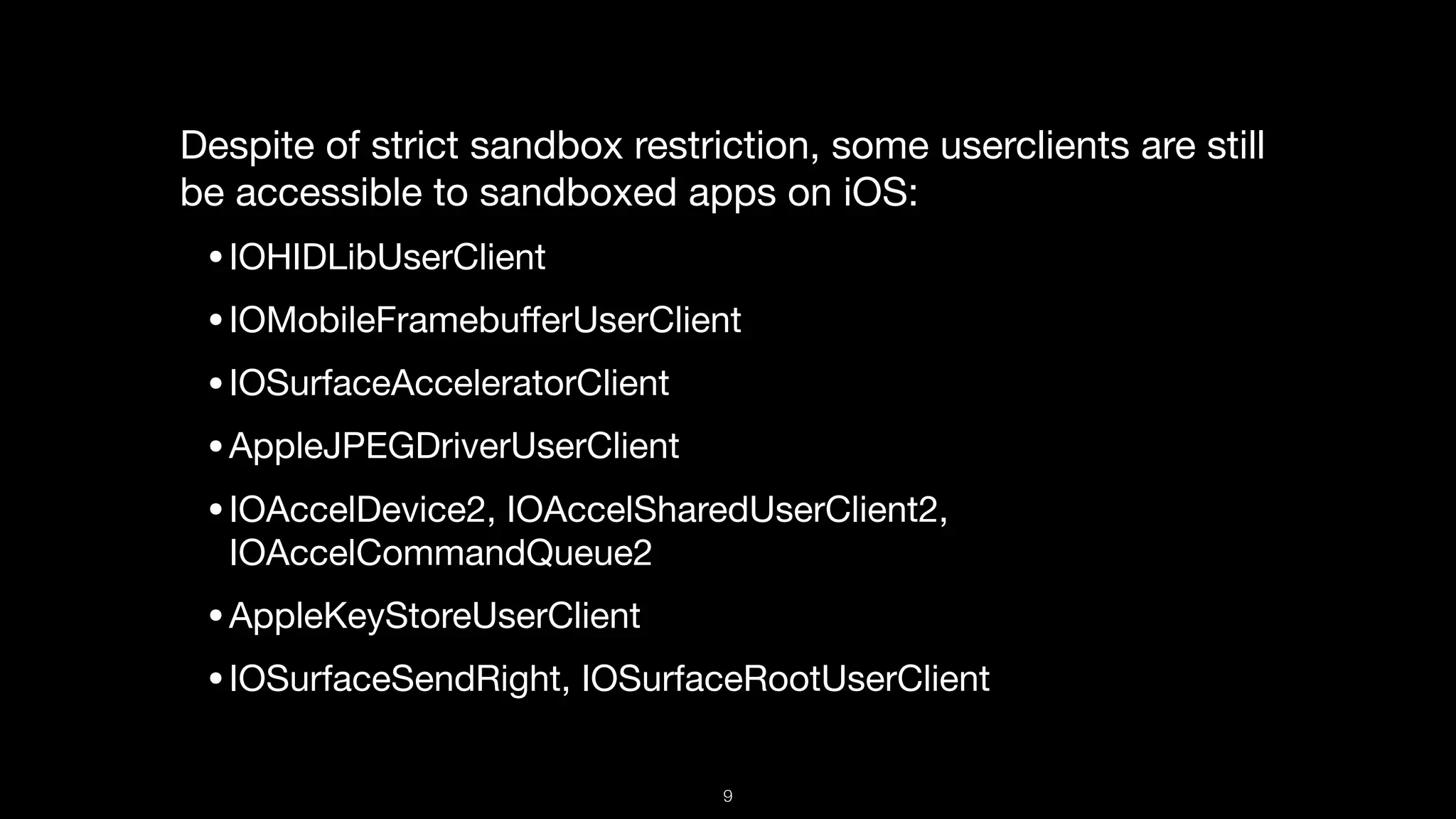
Despite of strict sandbox restriction, some userclients are still
be accessible to sandboxed apps on iOS:

•IOHIDLibUserClient

•IOMobileFramebufferUserClient

•IOSurfaceAcceleratorClient

•AppleJPEGDriverUserClient

•IOAccelDevice2, IOAccelSharedUserClient2,
IOAccelCommandQueue2

•AppleKeyStoreUserClient

•IOSurfaceSendRight, IOSurfaceRootUserClient
9
New vulns in Apple drivers
10
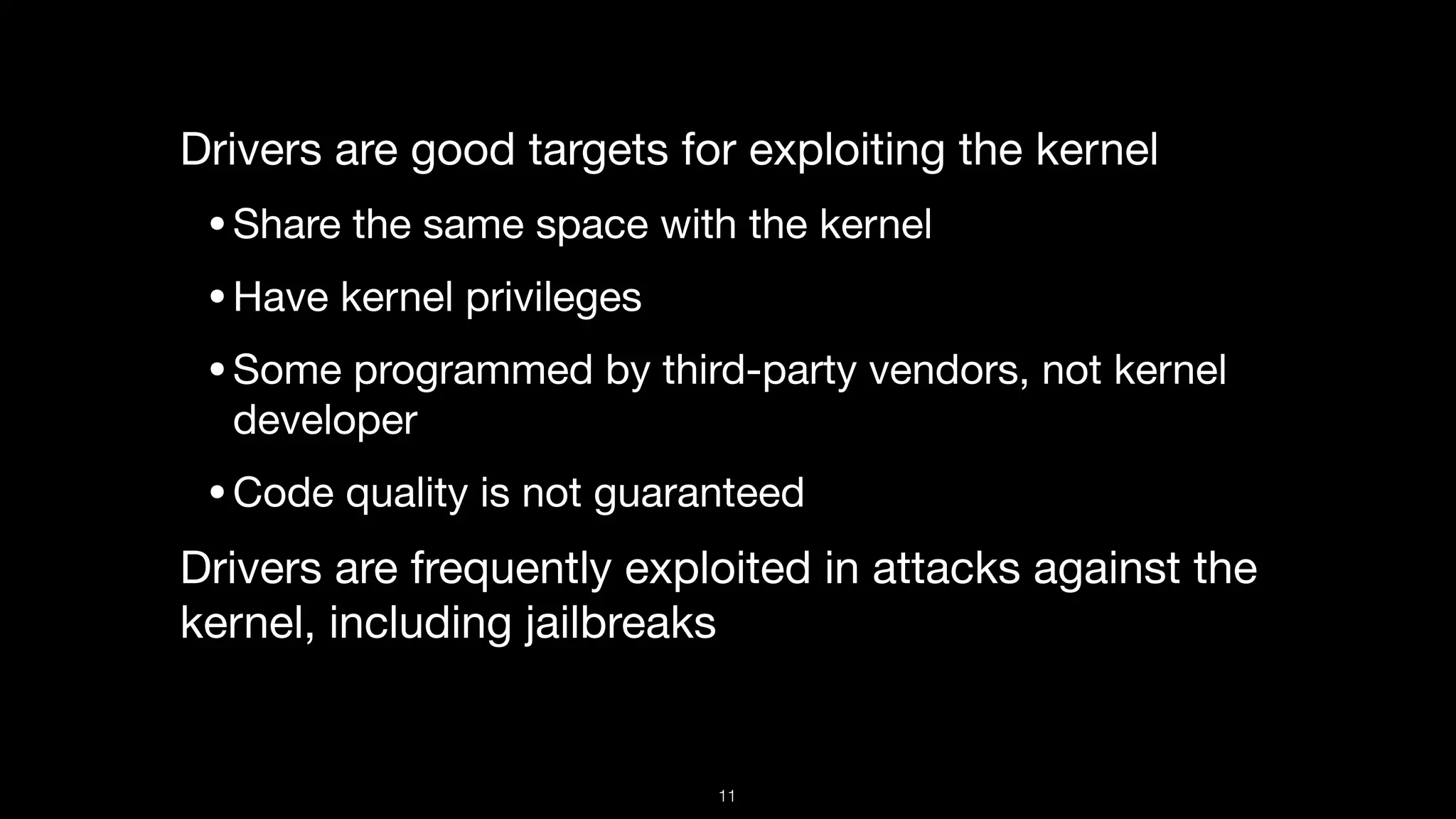
Drivers are good targets for exploiting the kernel

•Share the same space with the kernel

•Have kernel privileges

•Some programmed by third-party vendors, not kernel
developer

•Code quality is not guaranteed

Drivers are frequently exploited in attacks against the
kernel, including jailbreaks
11
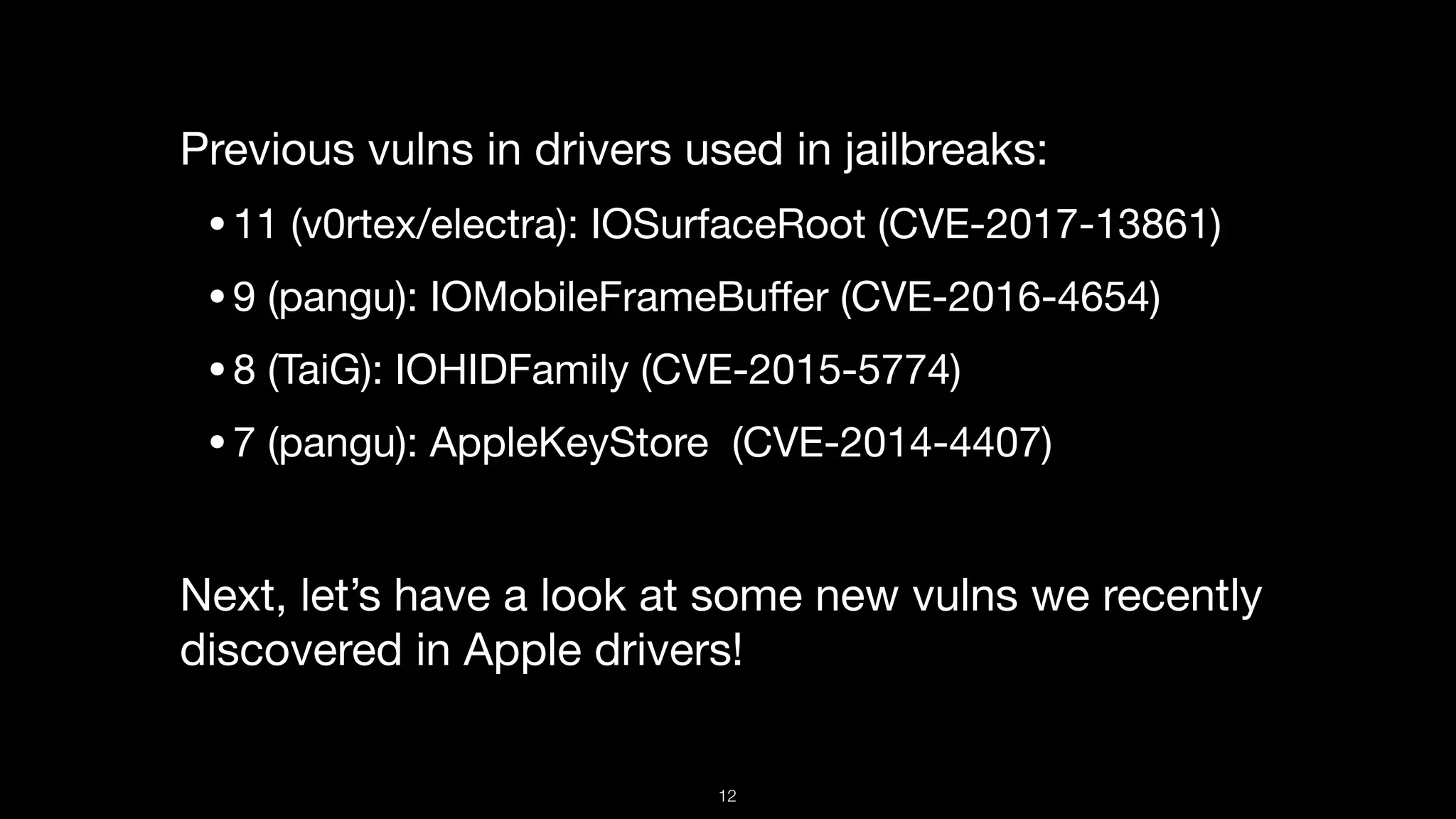
Previous vulns in drivers used in jailbreaks:

•11 (v0rtex/electra): IOSurfaceRoot (CVE-2017-13861)

•9 (pangu): IOMobileFrameBuffer (CVE-2016-4654)

•8 (TaiG): IOHIDFamily (CVE-2015-5774)

•7 (pangu): AppleKeyStore  (CVE-2014-4407) 

Next, let’s have a look at some new vulns we recently
discovered in Apple drivers!
12
Privilege escalation on macOS 10.13.3
13
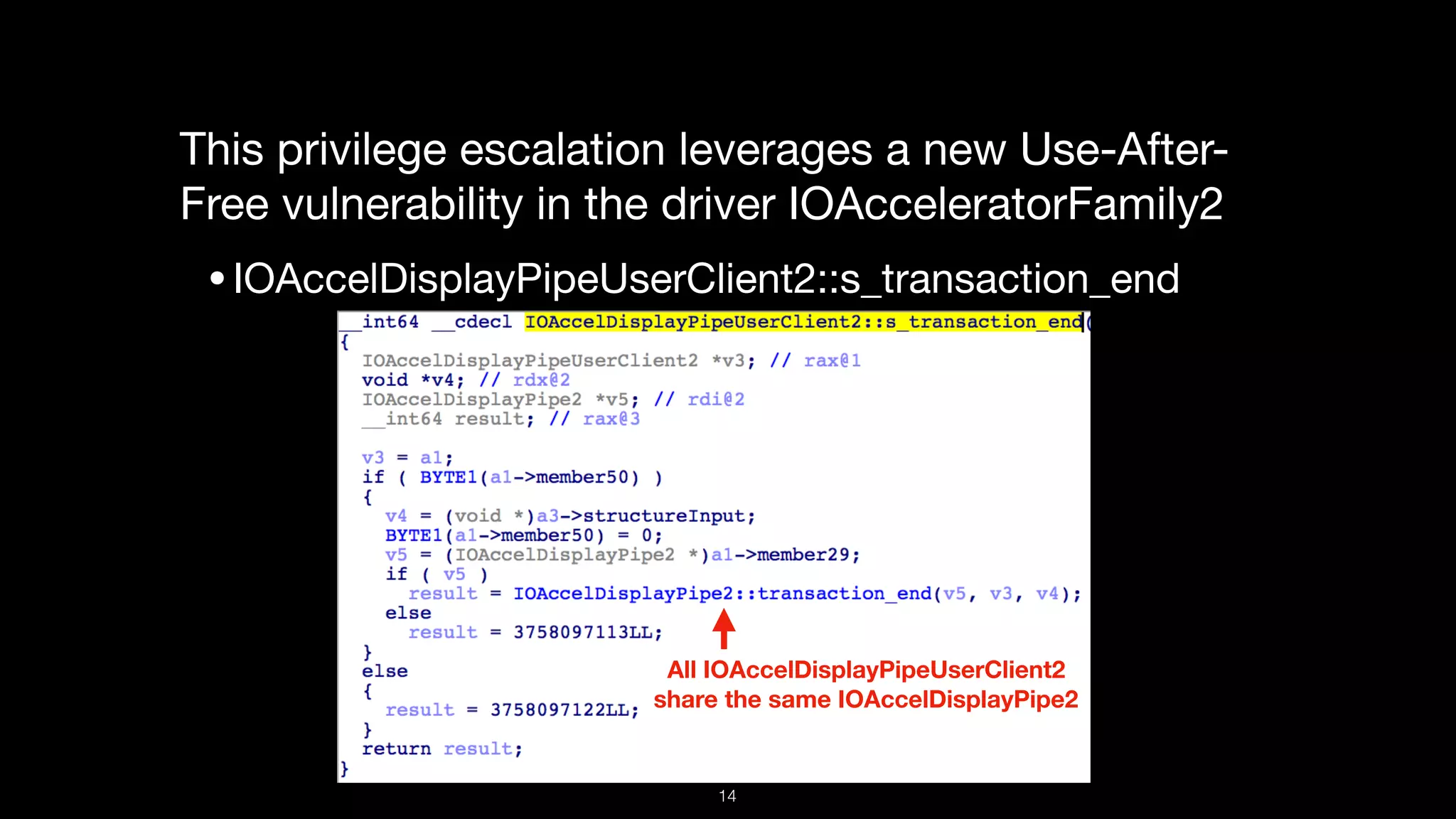
This privilege escalation leverages a new Use-After-
Free vulnerability in the driver IOAcceleratorFamily2

•IOAccelDisplayPipeUserClient2::s_transaction_end
All IOAccelDisplayPipeUserClient2 

share the same IOAccelDisplayPipe2
14
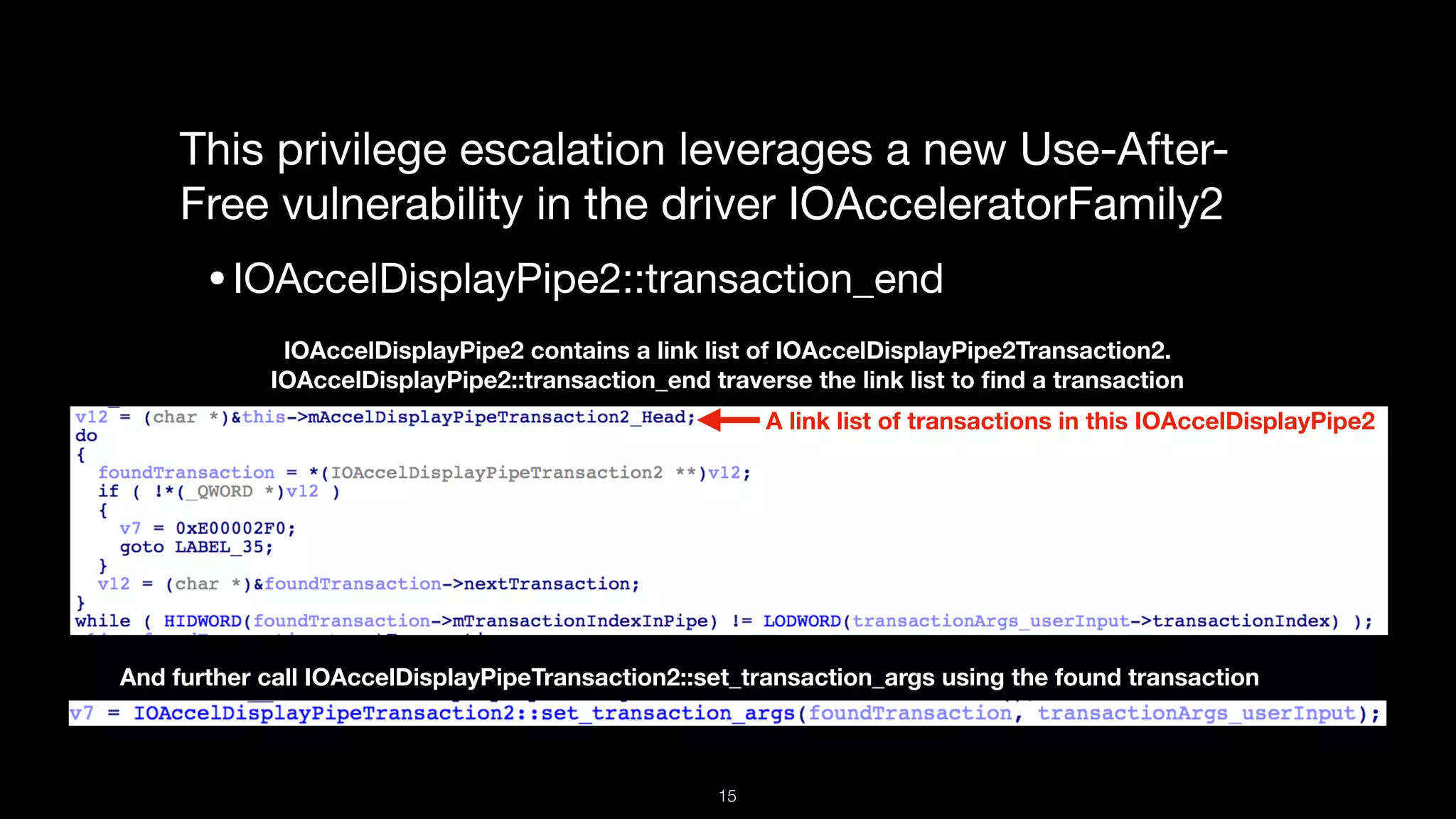
This privilege escalation leverages a new Use-After-
Free vulnerability in the driver IOAcceleratorFamily2

•IOAccelDisplayPipe2::transaction_end
IOAccelDisplayPipe2 contains a link list of IOAccelDisplayPipe2Transaction2.
IOAccelDisplayPipe2::transaction_end traverse the link list to find a transaction
And further call IOAccelDisplayPipeTransaction2::set_transaction_args using the found transaction
A link list of transactions in this IOAccelDisplayPipe2
15
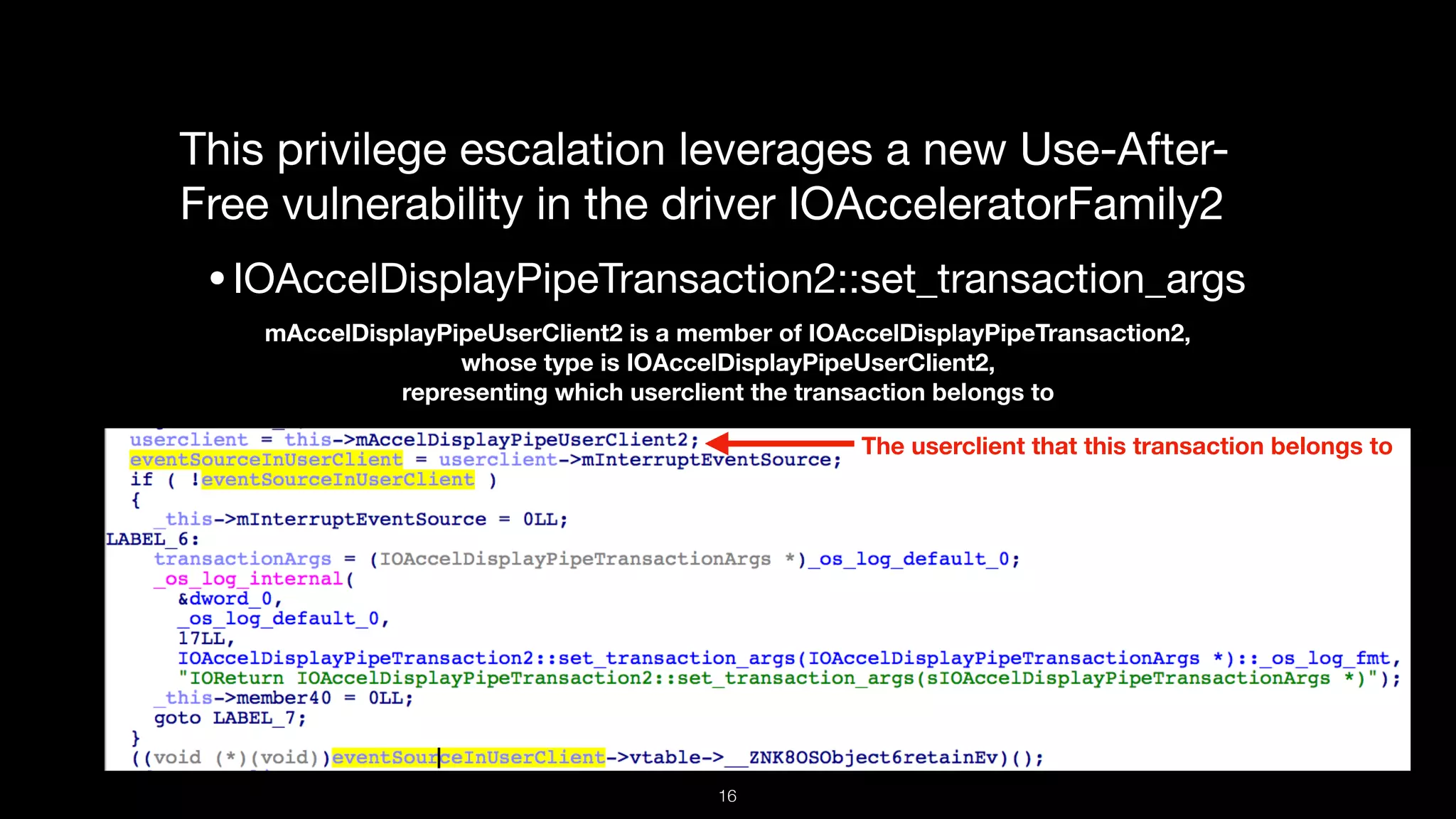
This privilege escalation leverages a new Use-After-
Free vulnerability in the driver IOAcceleratorFamily2

•IOAccelDisplayPipeTransaction2::set_transaction_args
mAccelDisplayPipeUserClient2 is a member of IOAccelDisplayPipeTransaction2, 

whose type is IOAccelDisplayPipeUserClient2, 

representing which userclient the transaction belongs to
The userclient that this transaction belongs to
16
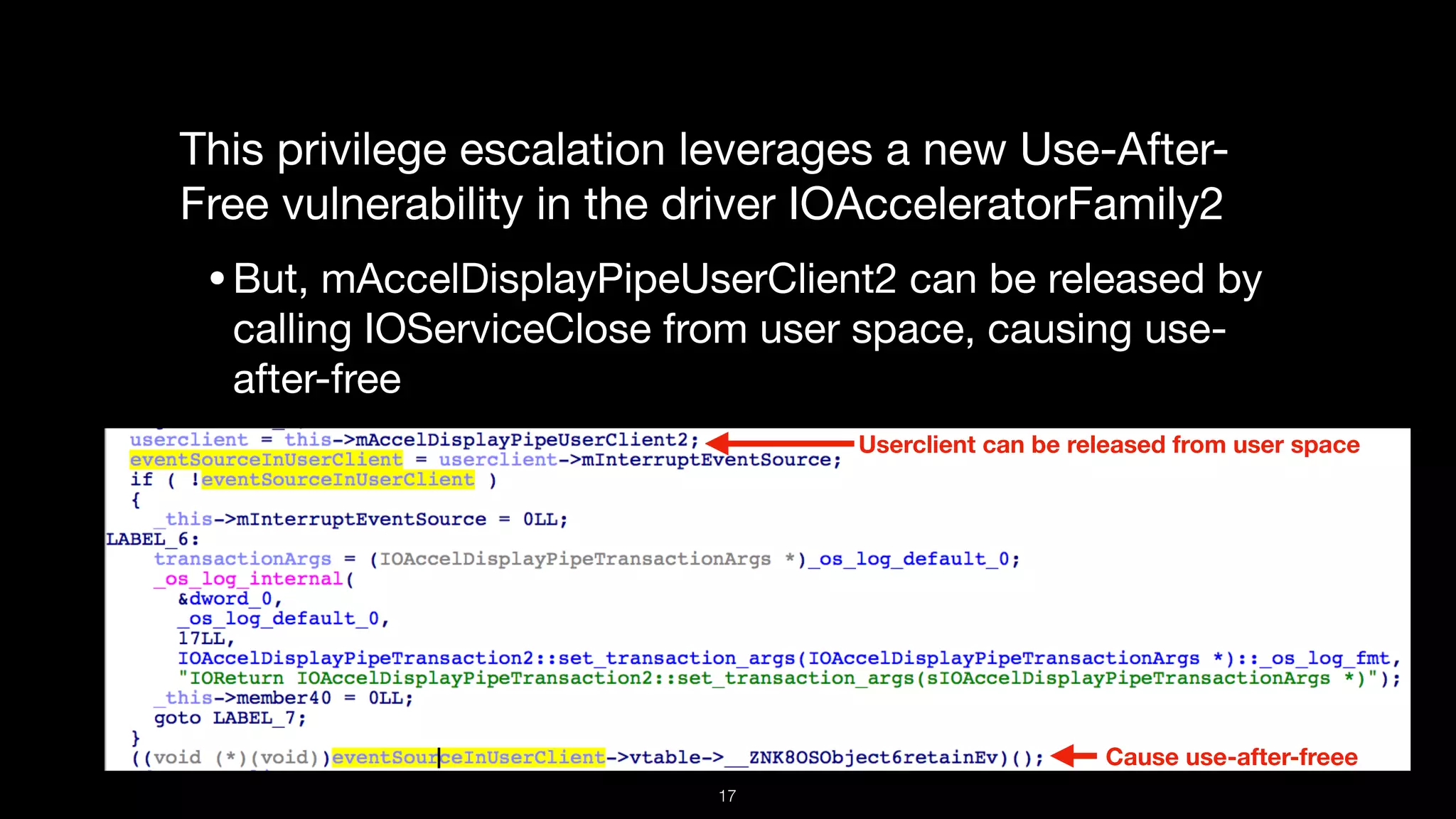
This privilege escalation leverages a new Use-After-
Free vulnerability in the driver IOAcceleratorFamily2

•But, mAccelDisplayPipeUserClient2 can be released by
calling IOServiceClose from user space, causing use-
after-free
Userclient can be released from user space
Cause use-after-freee
17
Exploitation of the bug

• Creat 2 IOAccelDisplayPipeUserClient2

• Begin a IOAccelDisplayPipeTransaction2 by userclient1

• Release userclient1

• End the transaction from userclient2 —> use-after-free

The bug is not exploitable now! 

•Reason: different IOAccelDisplayPipeUserClient2 do not
share the same IOAccelDisplayPipe2 now !
18
Besides the above vuln, we also discovered some
other new vulns in Apple drivers

•CVE-2017-7119 

•CVE-2018-4135 

Next, we will show details of these vulns

19
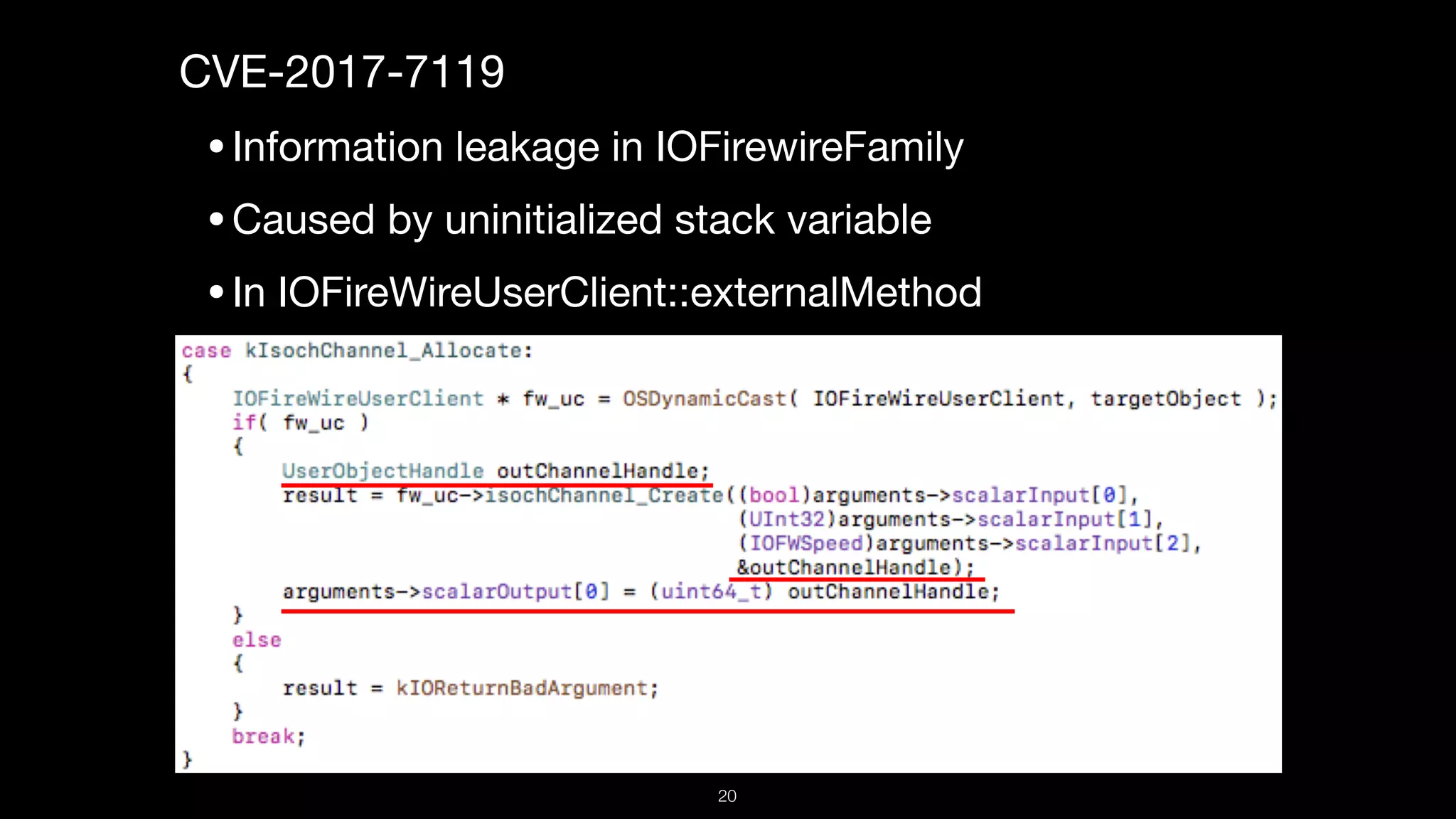
CVE-2017-7119

•Information leakage in IOFirewireFamily

•Caused by uninitialized stack variable

•In IOFireWireUserClient::externalMethod

20
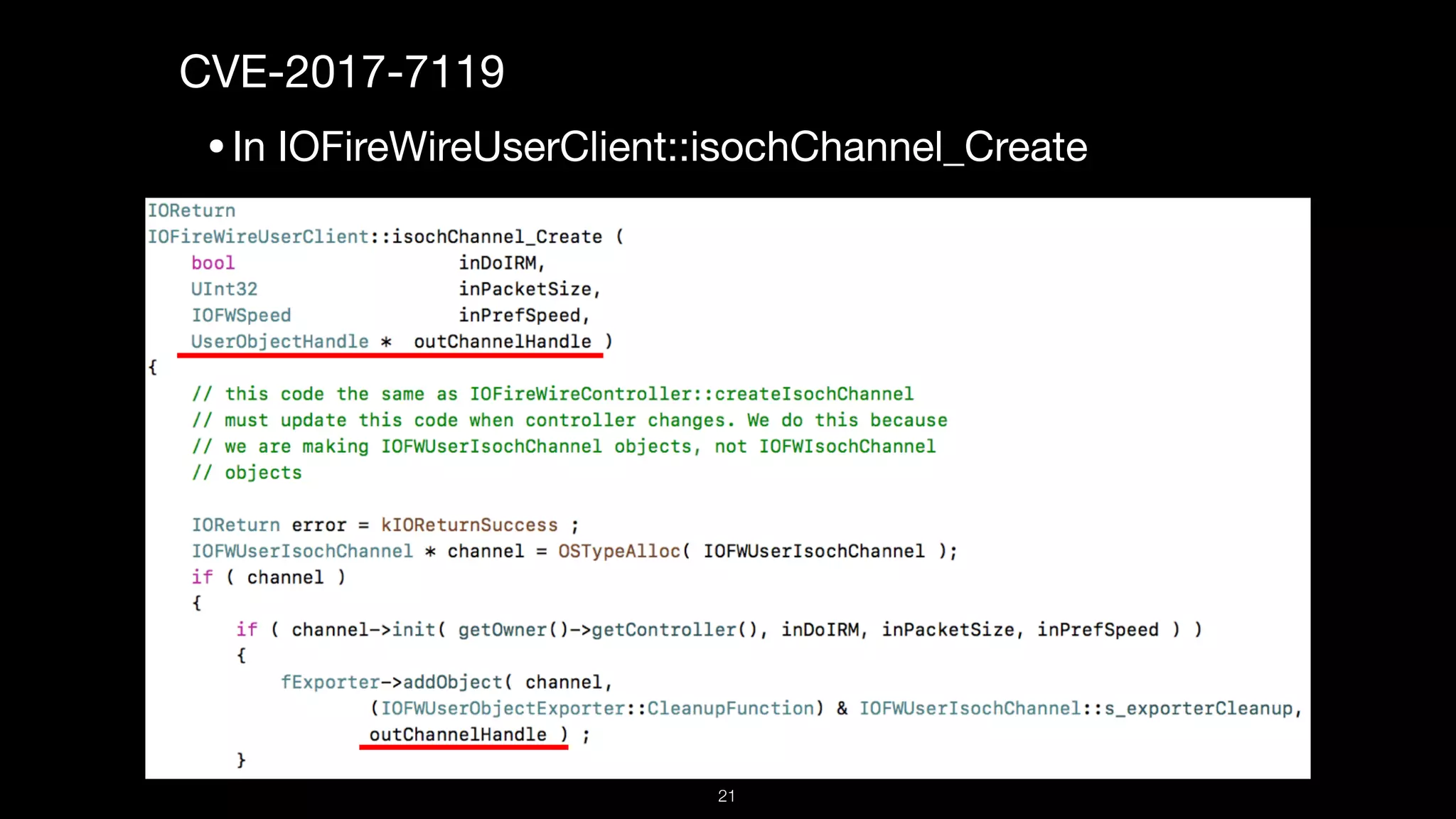
CVE-2017-7119

•In IOFireWireUserClient::isochChannel_Create

21
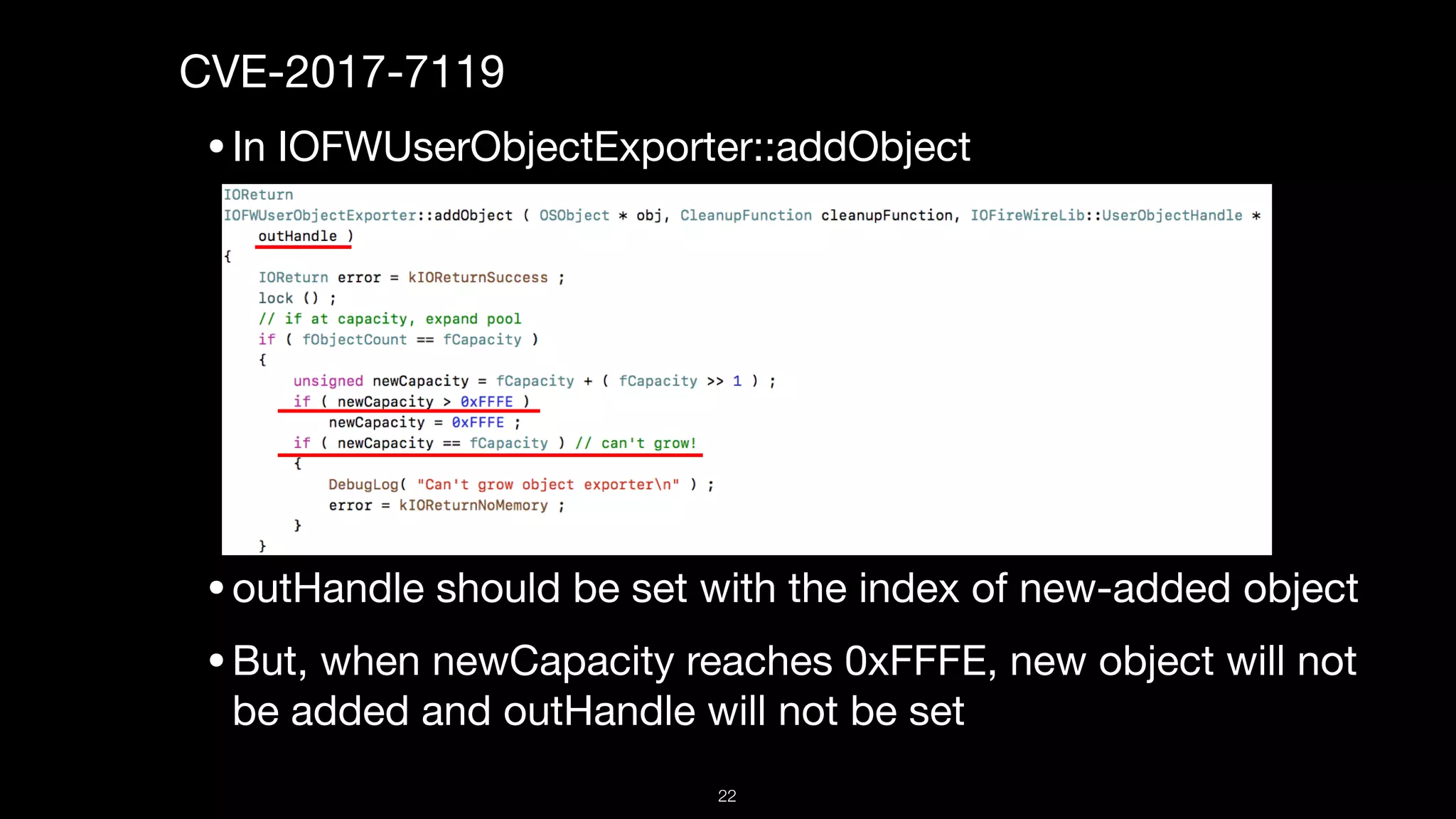
CVE-2017-7119

•In IOFWUserObjectExporter::addObject

•outHandle should be set with the index of new-added object

•But, when newCapacity reaches 0xFFFE, new object will not
be added and outHandle will not be set
22
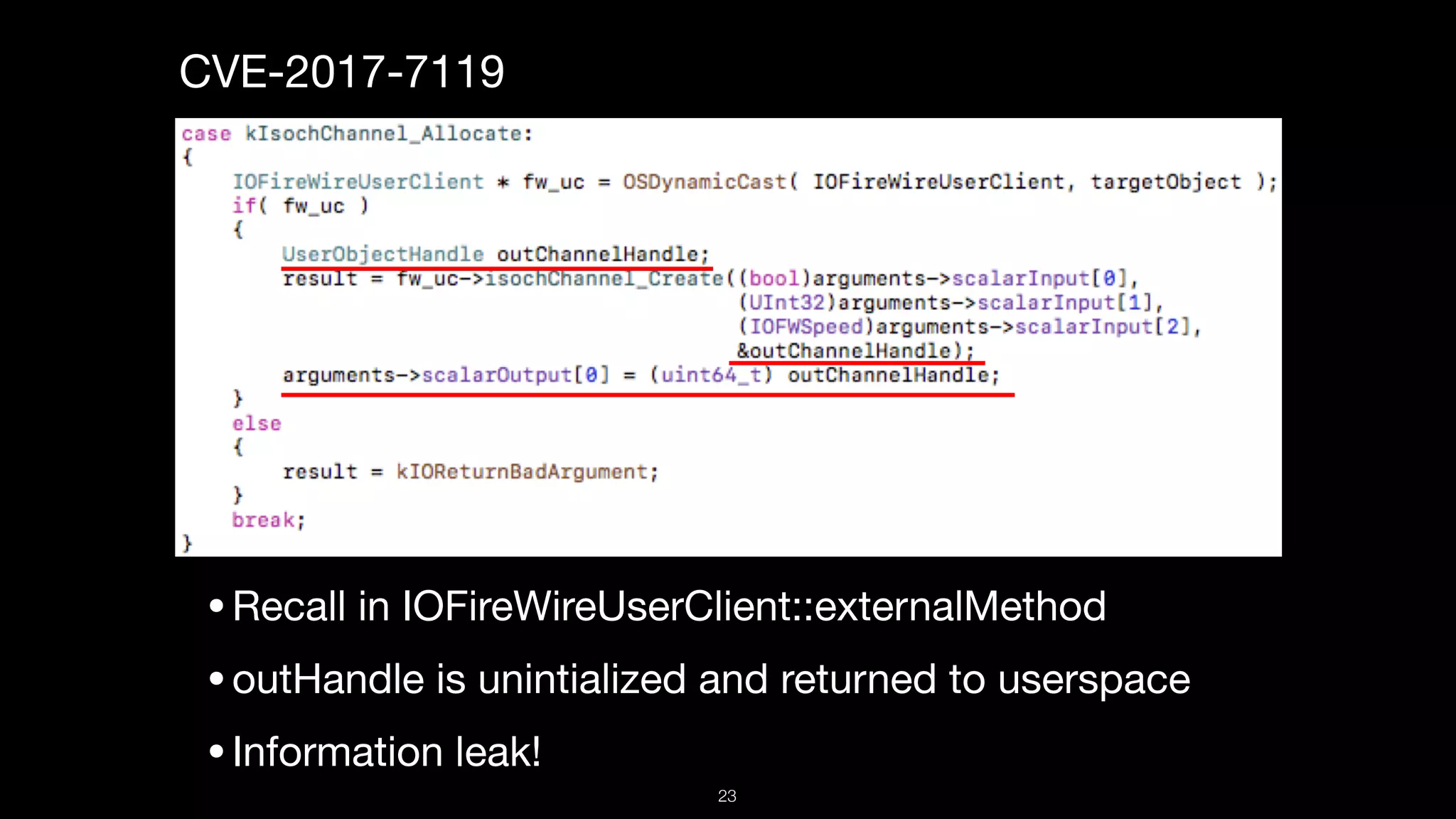
CVE-2017-7119

•Recall in IOFireWireUserClient::externalMethod

•outHandle is unintialized and returned to userspace

•Information leak!
23
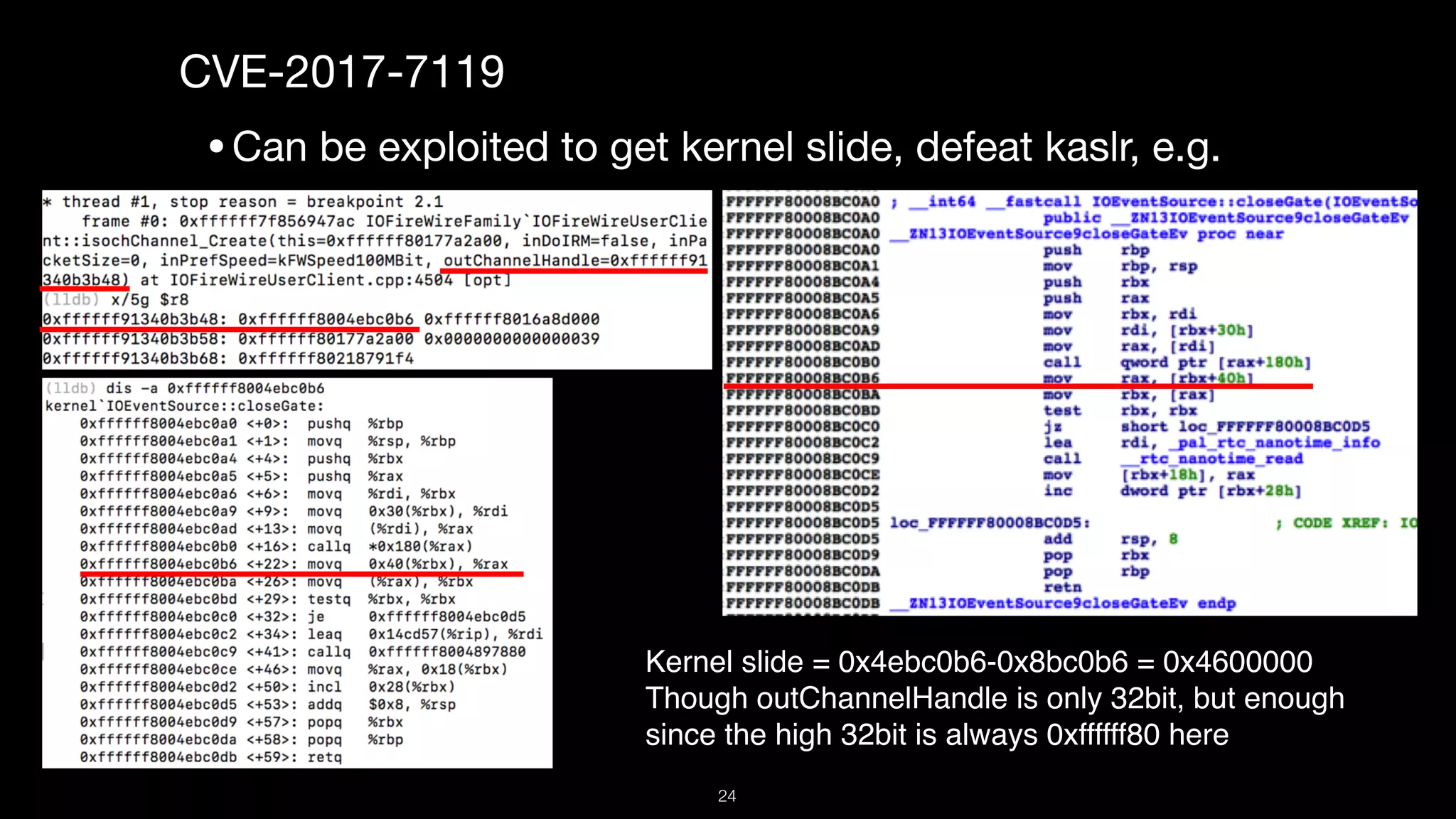
CVE-2017-7119

•Can be exploited to get kernel slide, defeat kaslr, e.g.
Kernel slide = 0x4ebc0b6-0x8bc0b6 = 0x4600000
Though outChannelHandle is only 32bit, but enough
since the high 32bit is always 0xffffff80 here
24
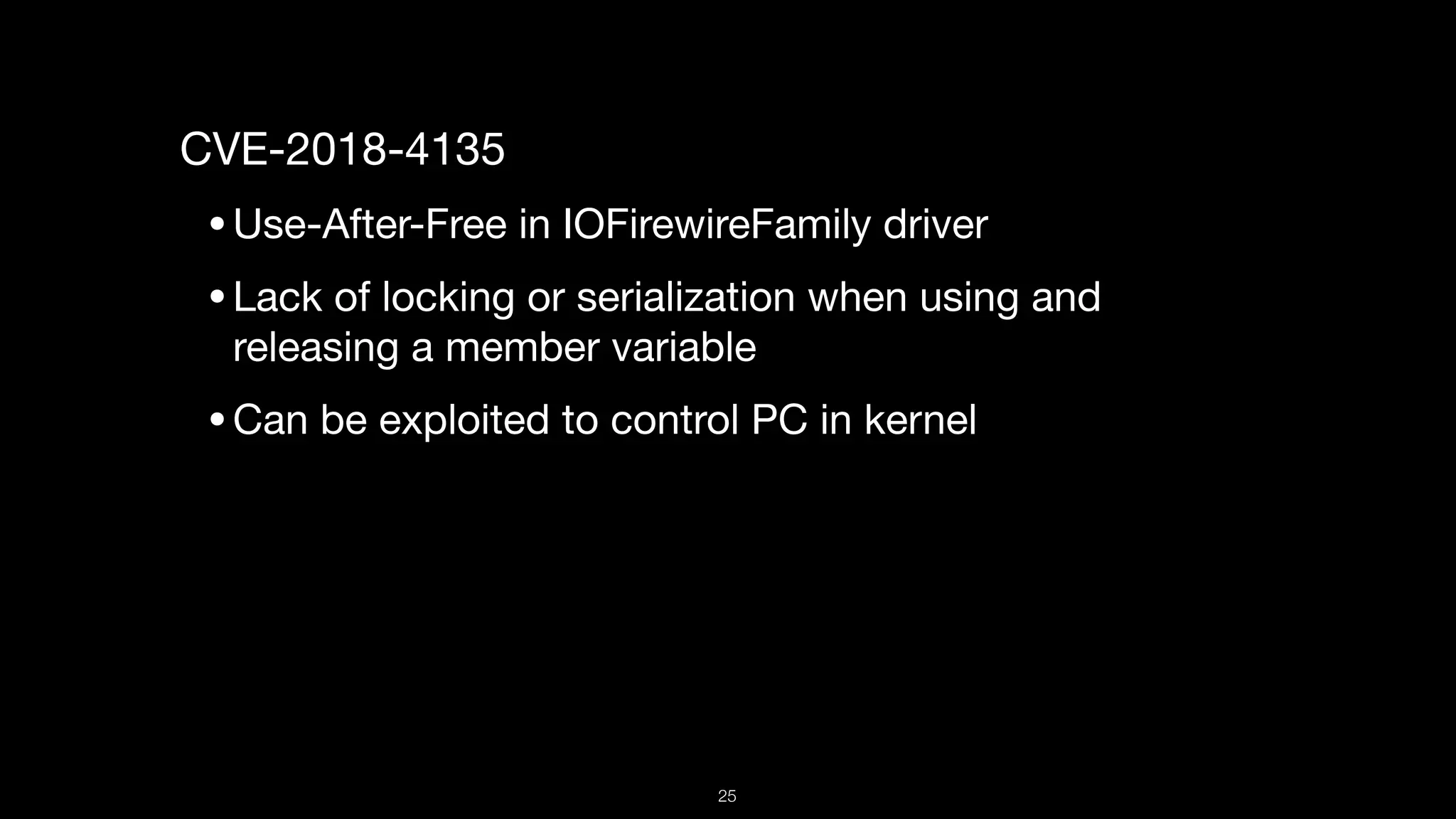
CVE-2018-4135

•Use-After-Free in IOFirewireFamily driver

•Lack of locking or serialization when using and
releasing a member variable

•Can be exploited to control PC in kernel

25
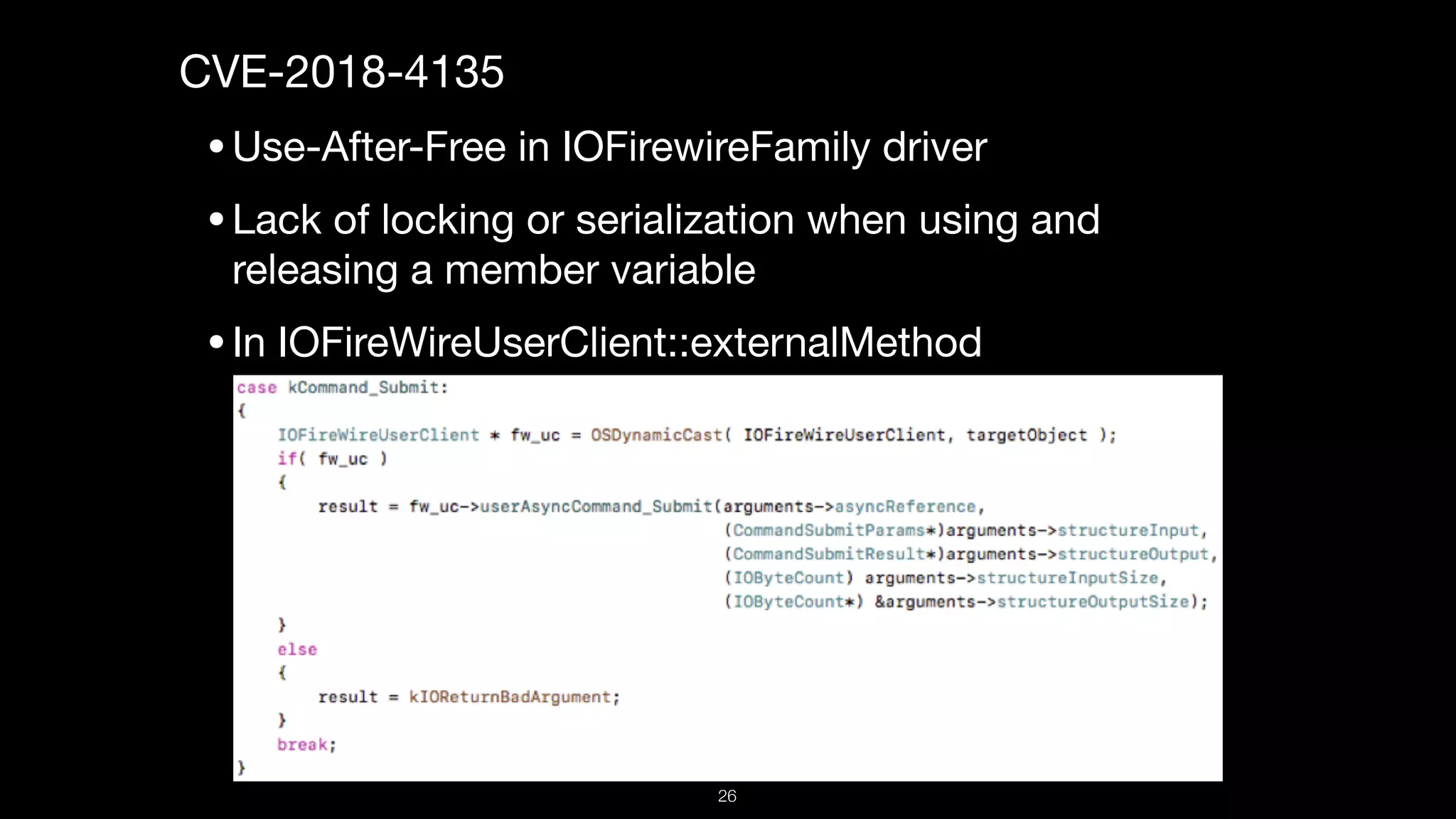
CVE-2018-4135

•Use-After-Free in IOFirewireFamily driver

•Lack of locking or serialization when using and
releasing a member variable

•In IOFireWireUserClient::externalMethod,
26
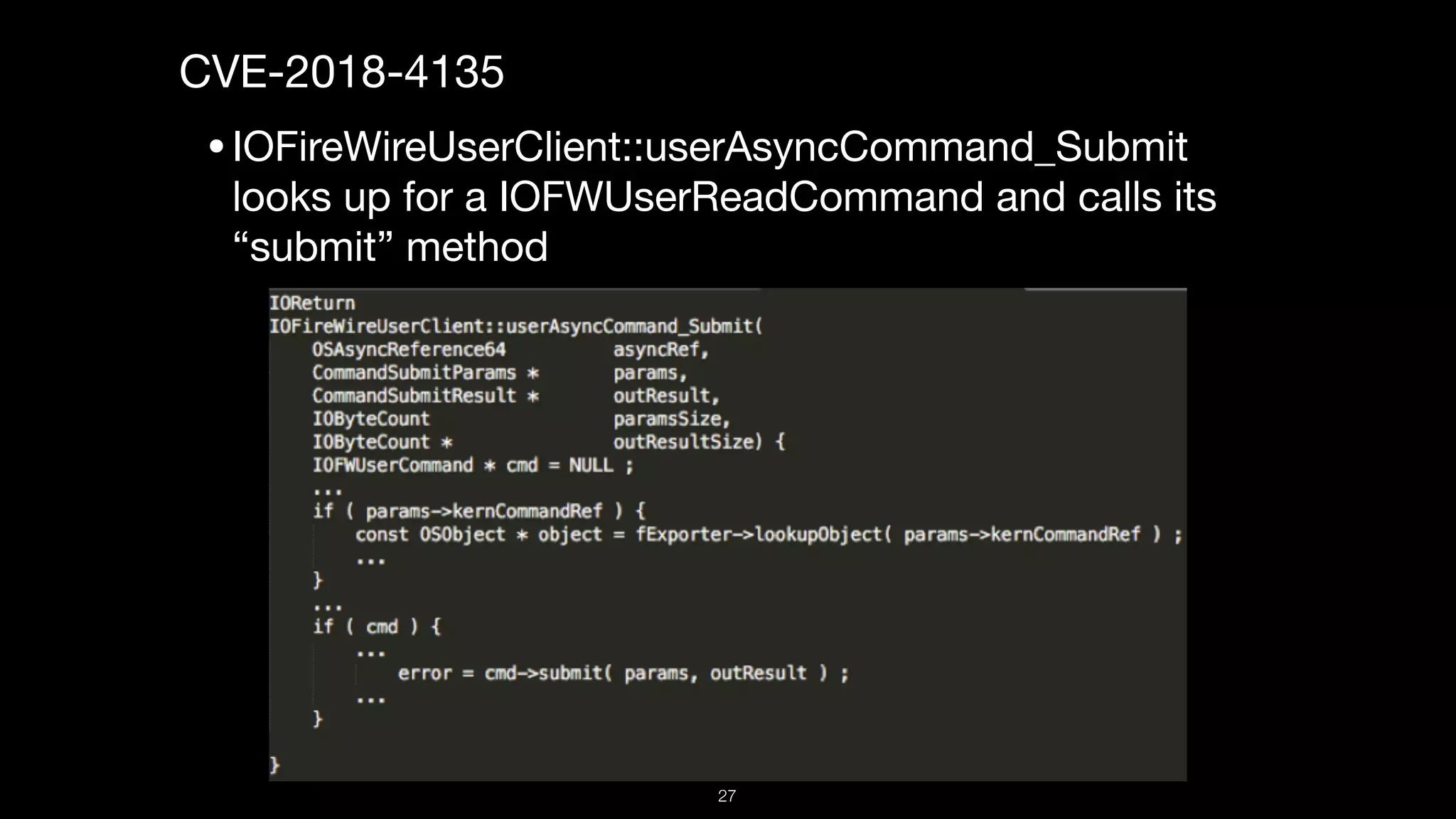
CVE-2018-4135

•IOFireWireUserClient::userAsyncCommand_Submit
looks up for a IOFWUserReadCommand and calls its
“submit” method
27
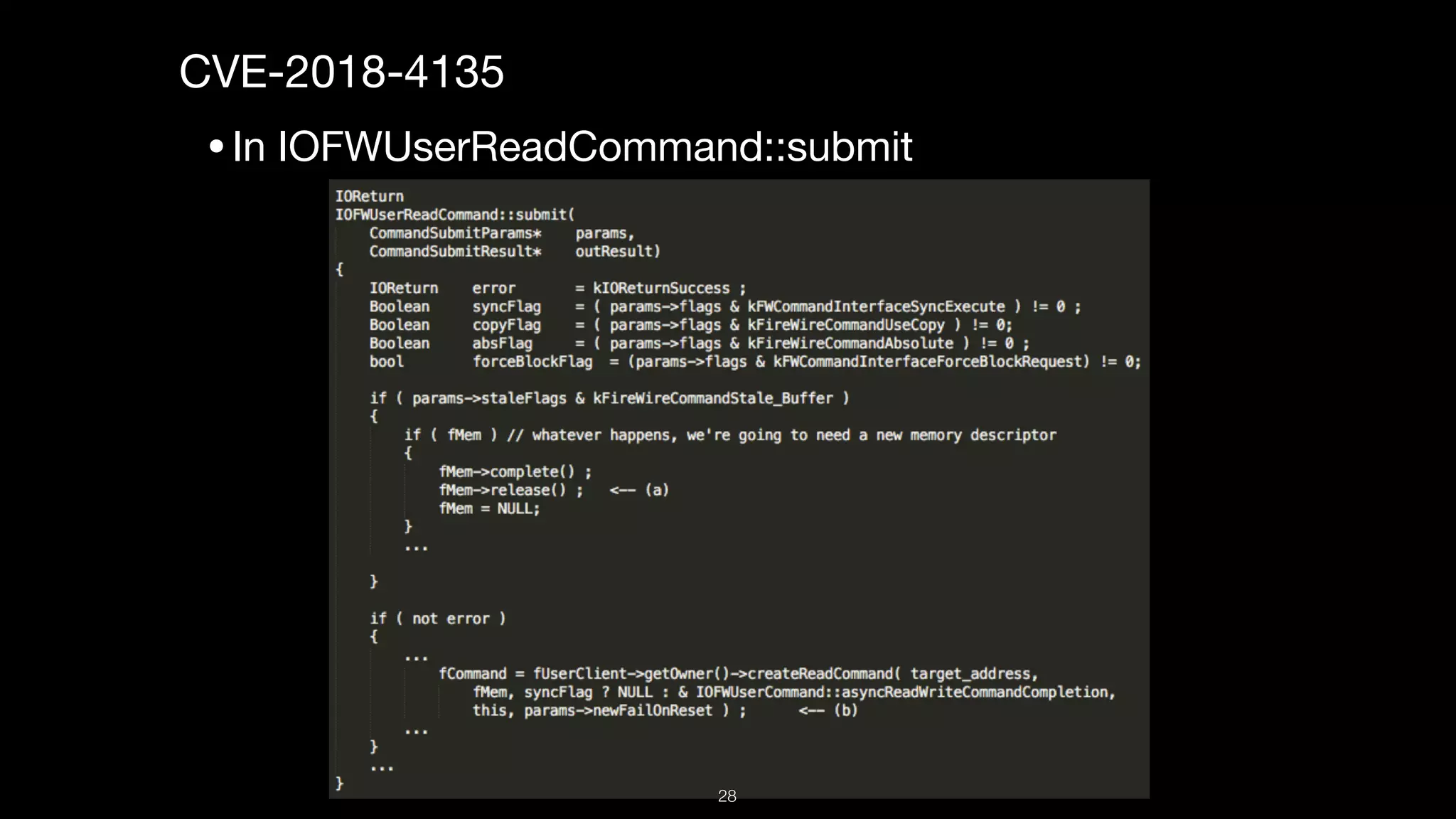
CVE-2018-4135

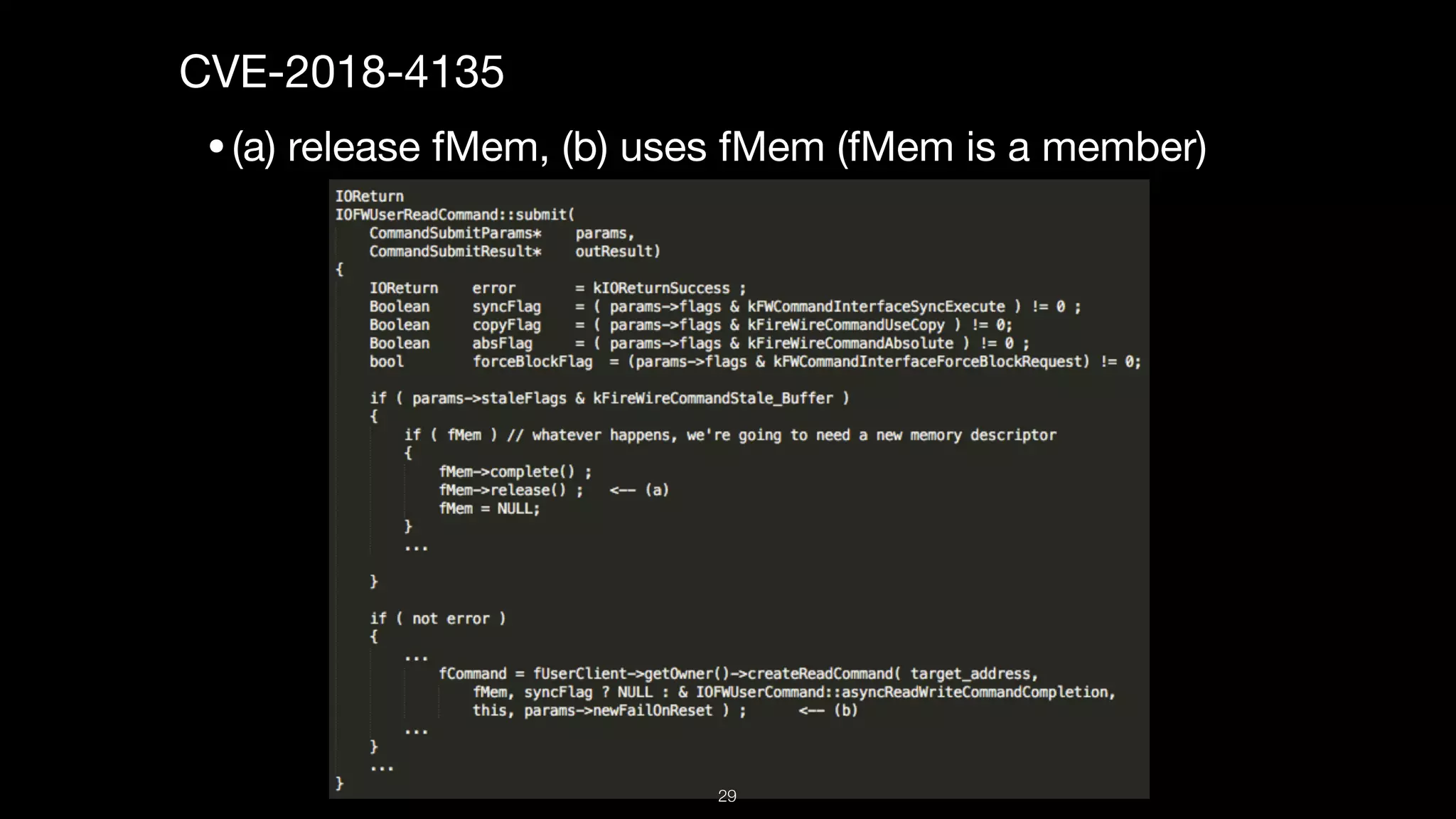
•In IOFWUserReadCommand::submit
28
CVE-2018-4135

•(a) release fMem, (b) uses fMem (fMem is a member)
29
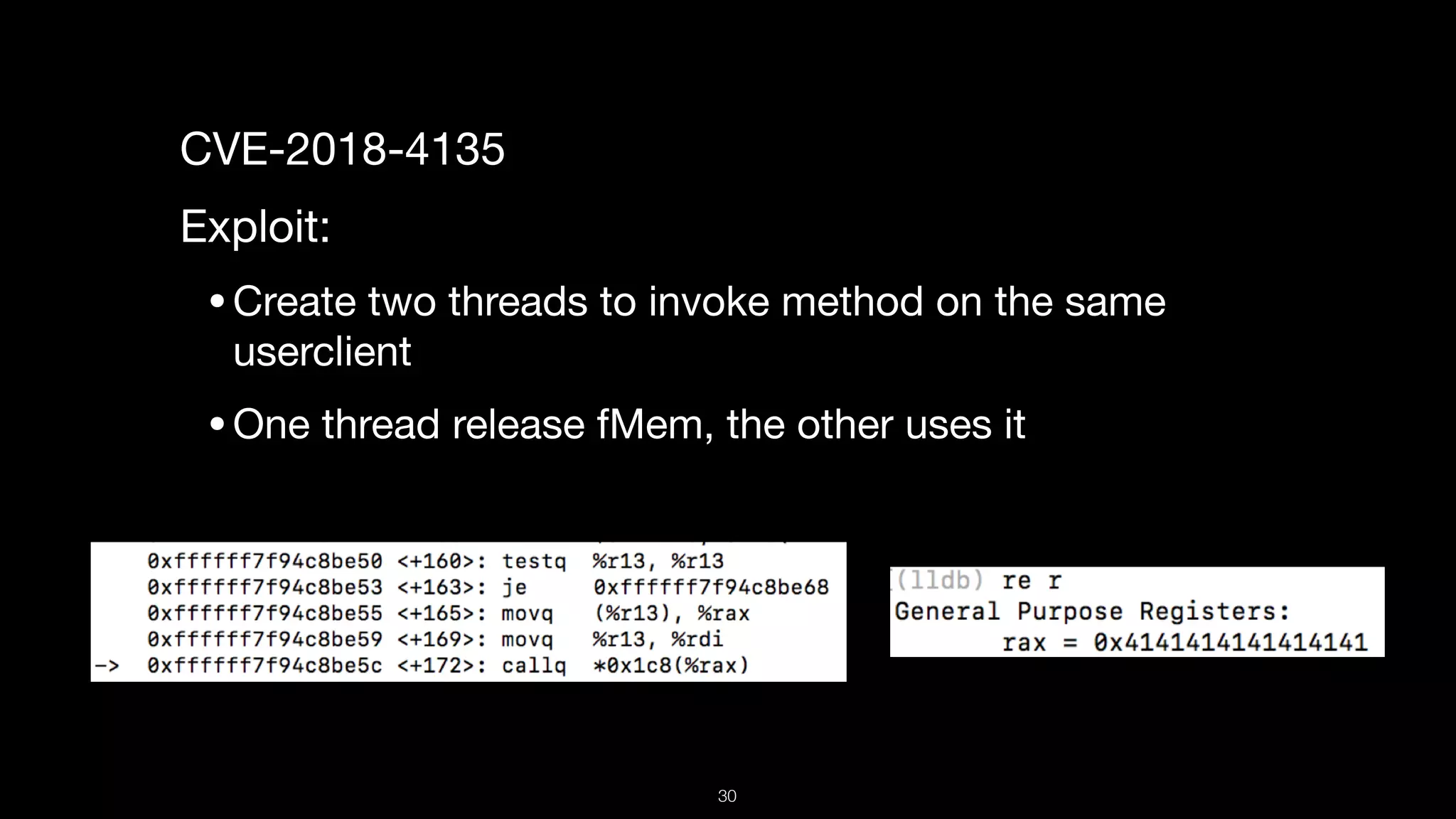
CVE-2018-4135

Exploit: 

•Create two threads to invoke method on the same
userclient

•One thread release fMem, the other uses it

30
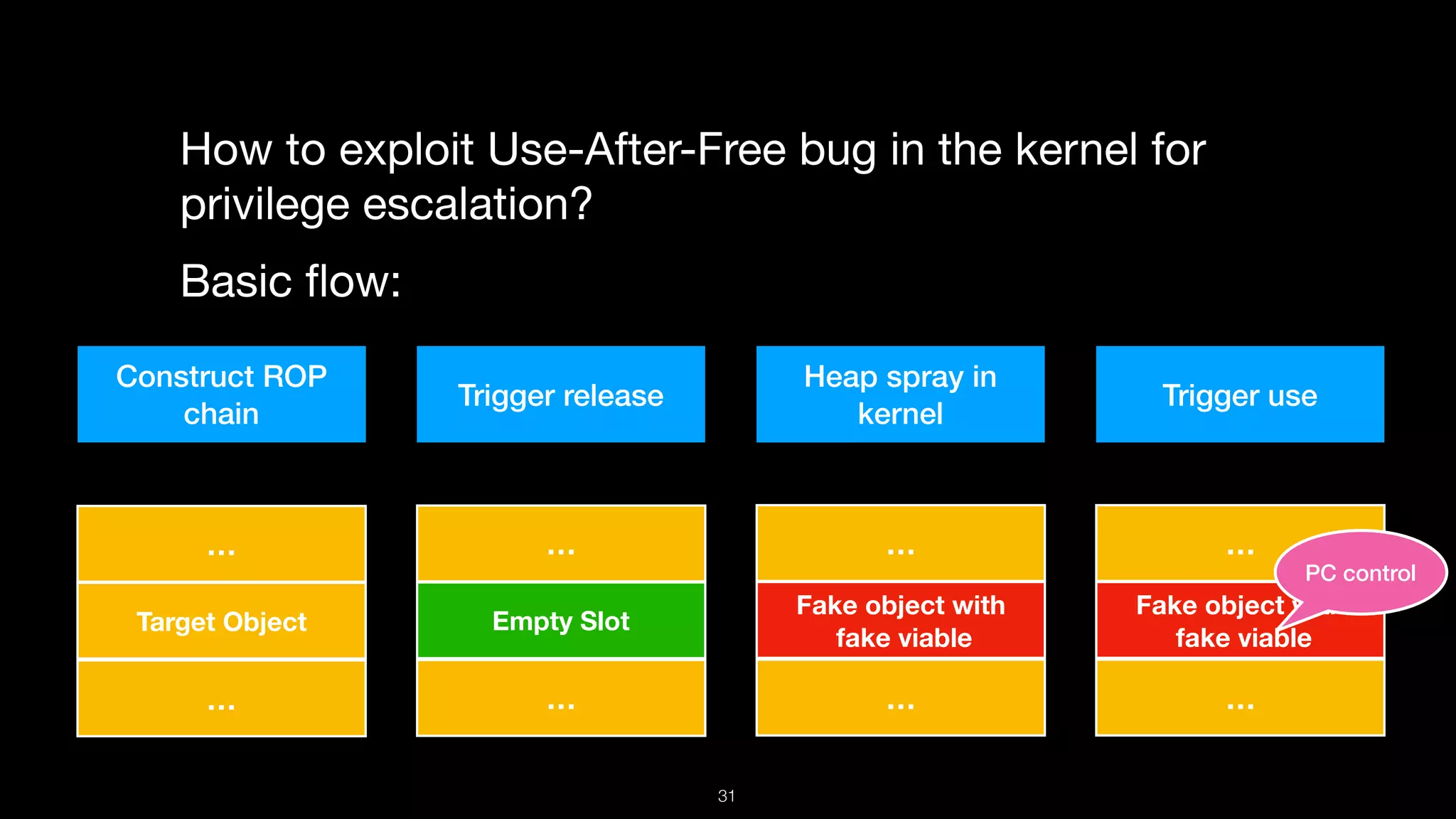
How to exploit Use-After-Free bug in the kernel for
privilege escalation?

Basic flow:

Construct ROP
chain
Trigger release
Heap spray in
kernel
Trigger use
…
Target Object
…
…
Empty Slot
…
…
Fake object with
fake viable
…
…
Fake object with
fake viable
…
PC control
31
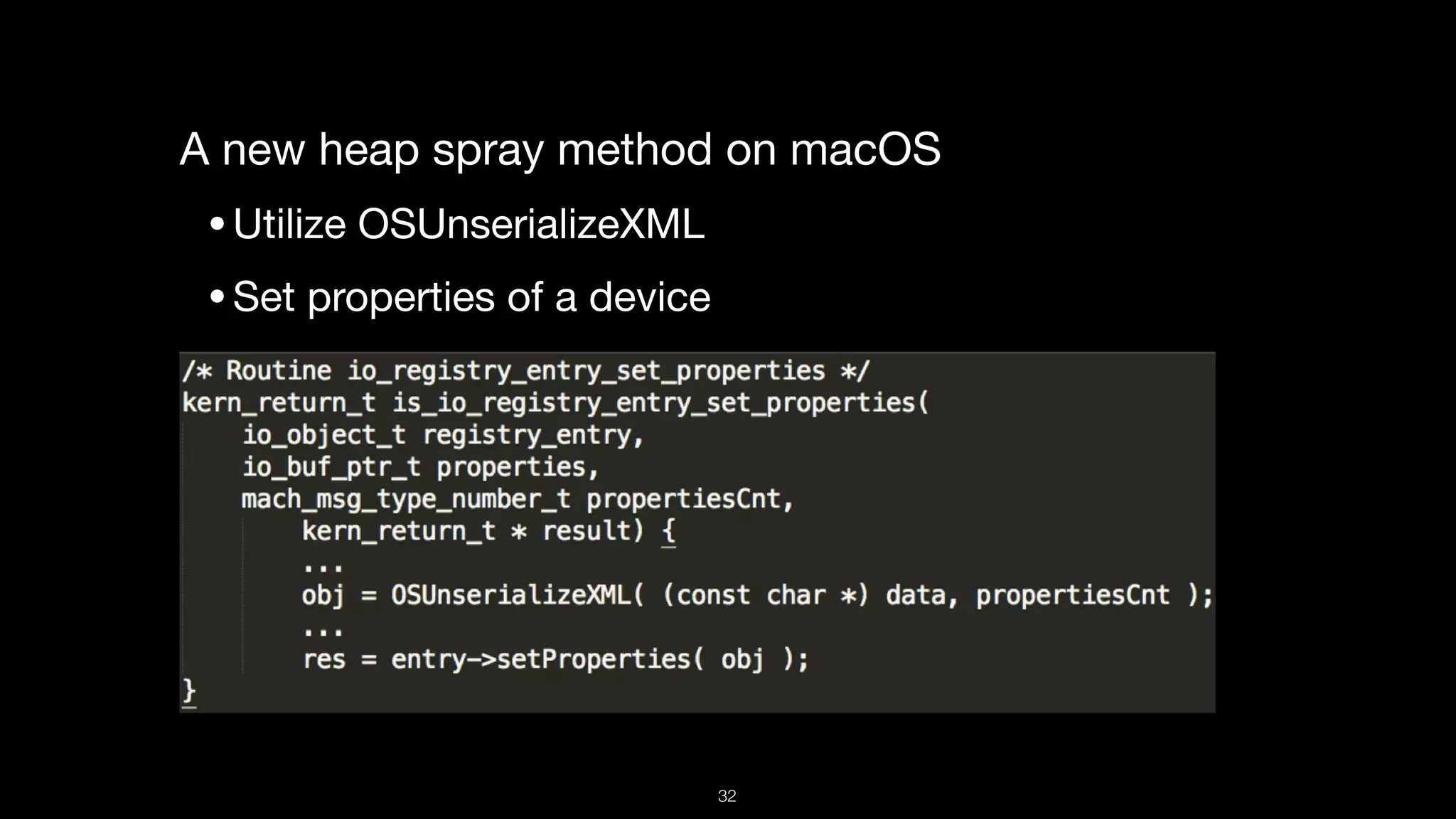
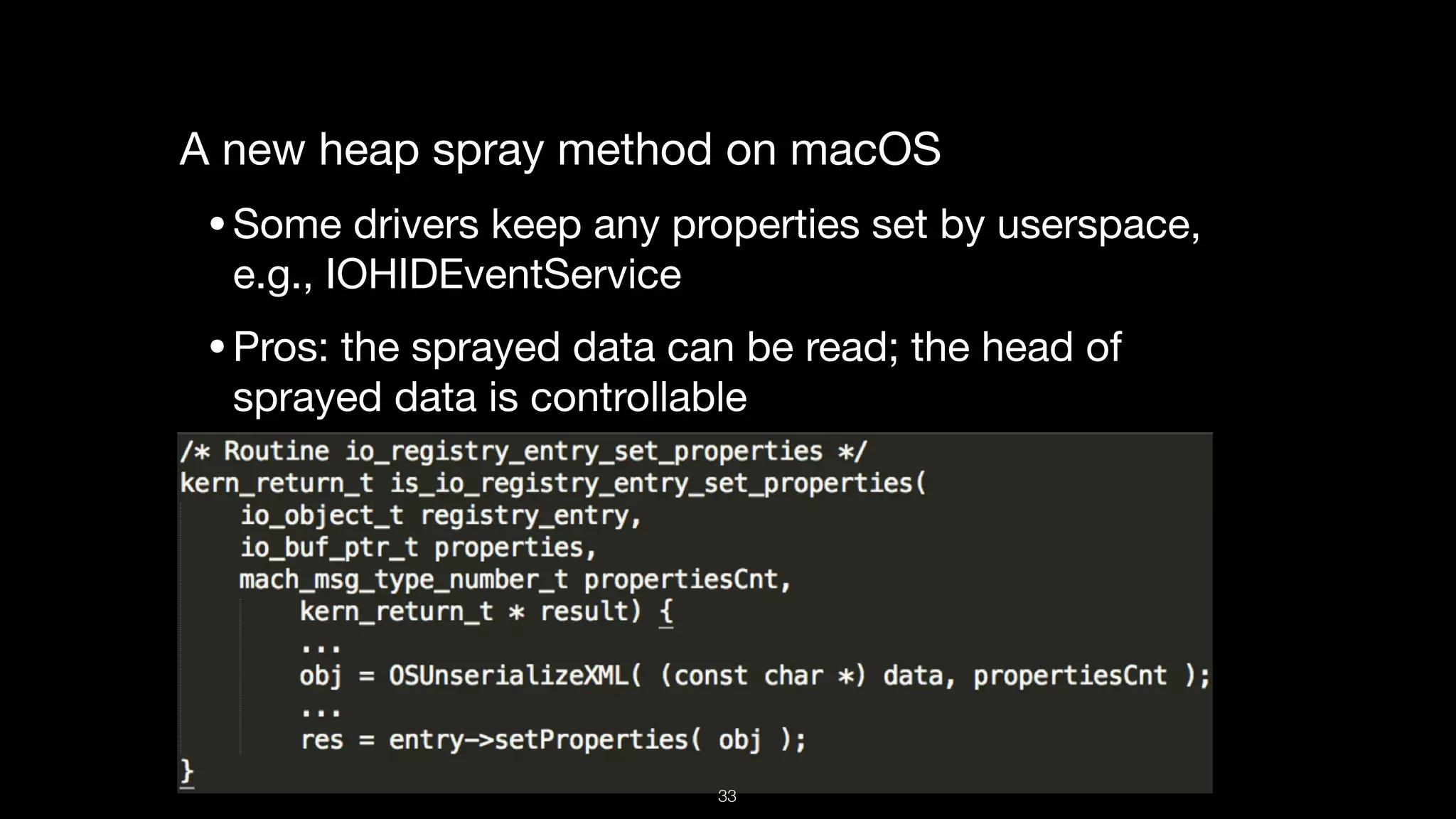
A new heap spray method on macOS

•Utilize OSUnserializeXML 

•Set properties of a device
32
A new heap spray method on macOS

•Some drivers keep any properties set by userspace,
e.g., IOHIDEventService

•Pros: the sprayed data can be read; the head of
sprayed data is controllable
33
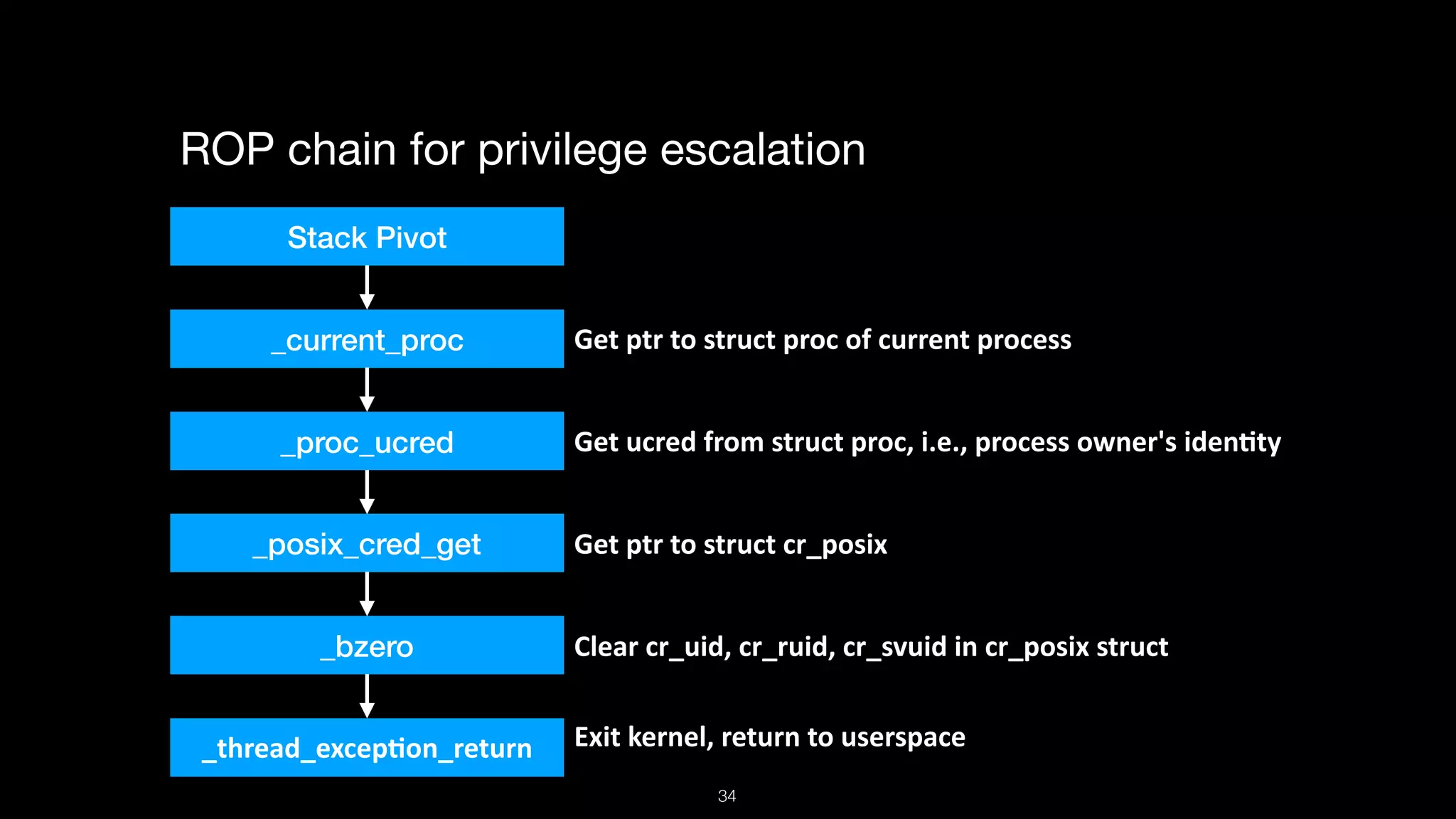
ROP chain for privilege escalation
Stack Pivot
_current_proc
_proc_ucred
_posix_cred_get
_bzero
_thread_excep+on_return
Get	ptr	to	struct	proc	of	current	process
Get	ucred	from	struct	proc,	i.e.,	process	owner's	iden+ty
Get	ptr	to	struct	cr_posix
Clear	cr_uid,	cr_ruid,	cr_svuid	in	cr_posix	struct
Exit	kernel,	return	to	userspace
34
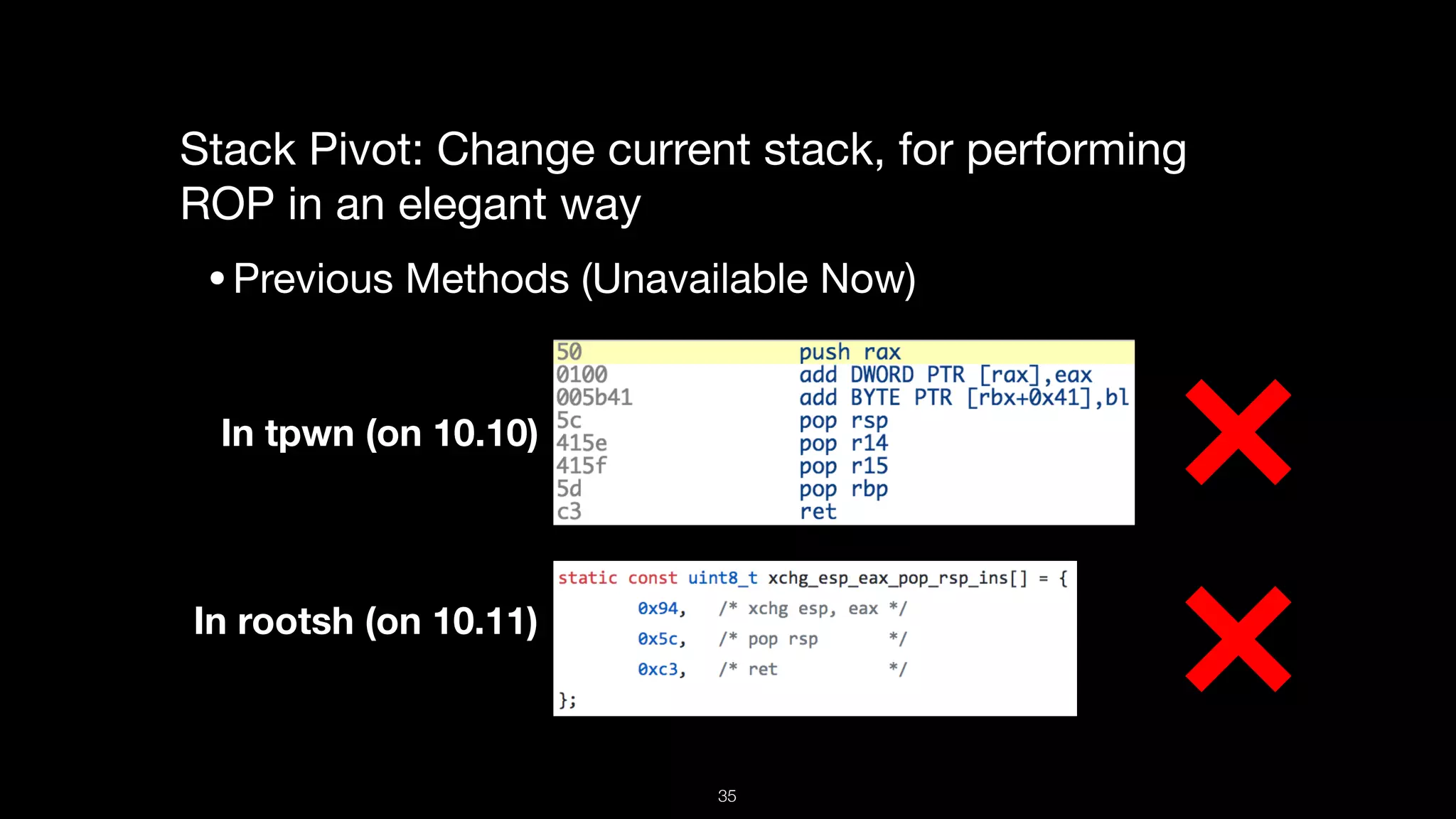
Stack Pivot: Change current stack, for performing
ROP in an elegant way

•Previous Methods (Unavailable Now)
In tpwn (on 10.10)
In rootsh (on 10.11)
35
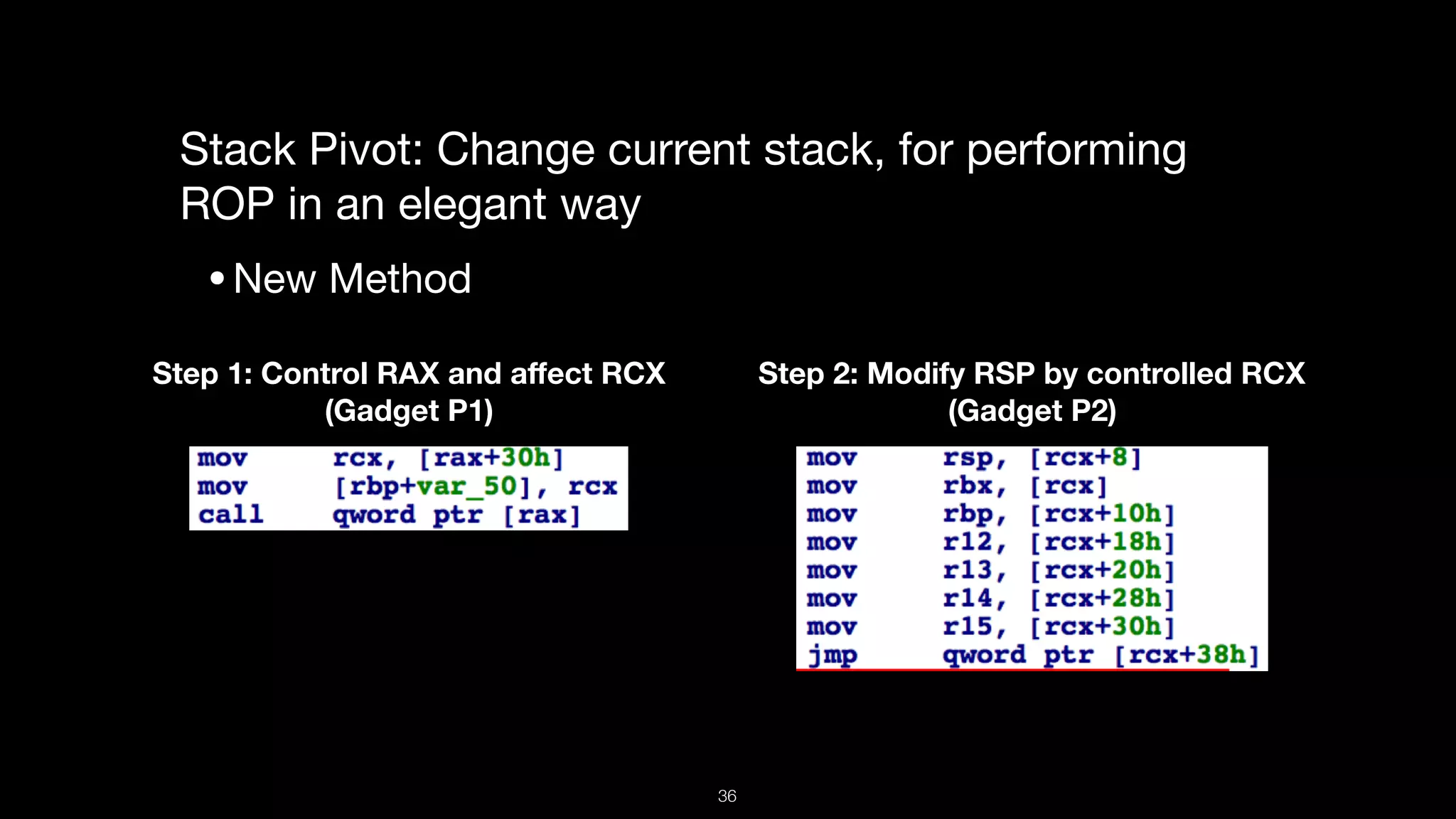
Stack Pivot: Change current stack, for performing
ROP in an elegant way

•New Method
Step 1: Control RAX and affect RCX
(Gadget P1)
Step 2: Modify RSP by controlled RCX
(Gadget P2)
36
Layout of gadgets in a ROP chain

•Assume: RAX is controlled and [RAX+0x10] is to be called

•Store address X in RAX, X contains a ROP chain
Addr of Gadget P2
New RSP: X+0x50
Addr of Gadget P1
X
Addr of Gadget “NOP; RET;”
Addr of _current_proc and Gadget “MOV RDI, RAX”
Address of _proc_ucred and Gadget “MOV RDI, RAX”
Address of _posix_cred_get and Gadget “MOV RDI, RAX”
Addr of _bzero
X
X+0x8
Addr of G_thread_exception_return
…
X+0x10, ROP starts from here
X+0x30
X+0x38
X+0x40, start privilege escalation
Content Address
37
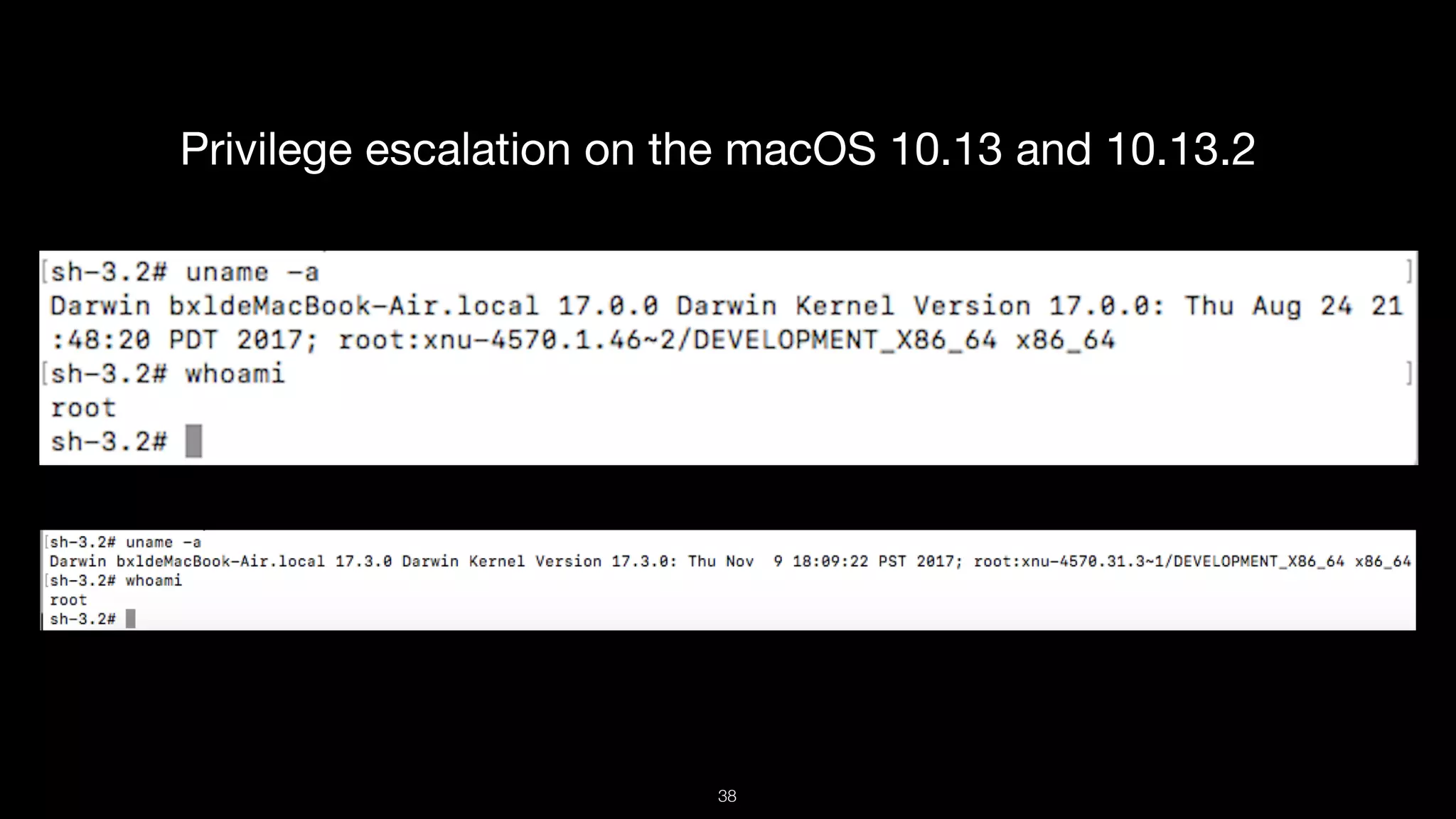
Privilege escalation on the macOS 10.13 and 10.13.2

38
Obstacles in analyzing Apple drivers
39
Analyzing macOS and iOS kernel drivers is not easy!

•Drivers are closed-source: binaries are lack of high-level
semantics and variable types are lost

•Drivers are programmed in C++: virtual functions are
widely used but object types are unknown —> the real
function called is unknown

•Symbols are lost in iOS drivers: iOS kernelcache strips
all symbols in drivers

40
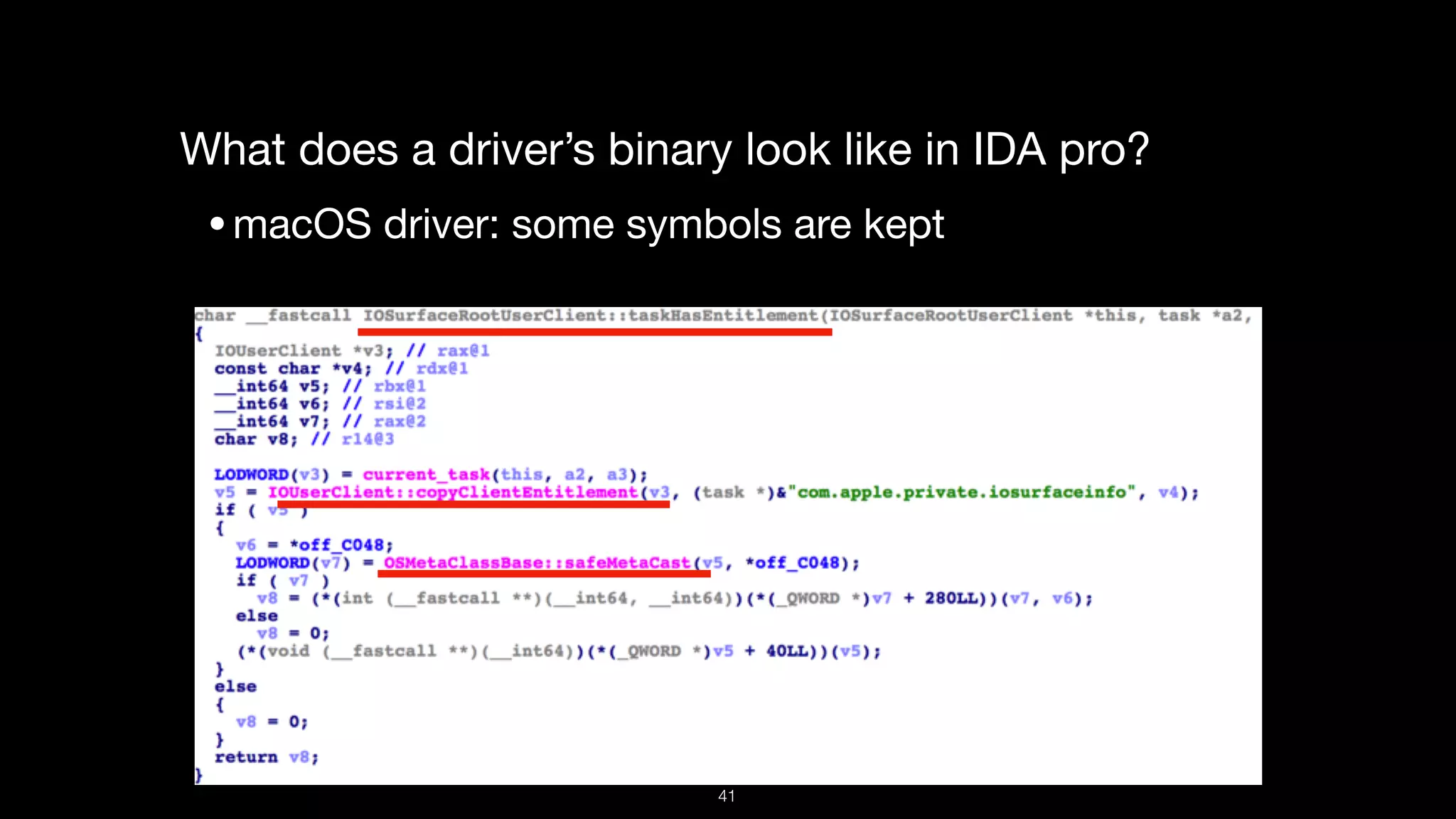
What does a driver’s binary look like in IDA pro?

•macOS driver: some symbols are kept

41
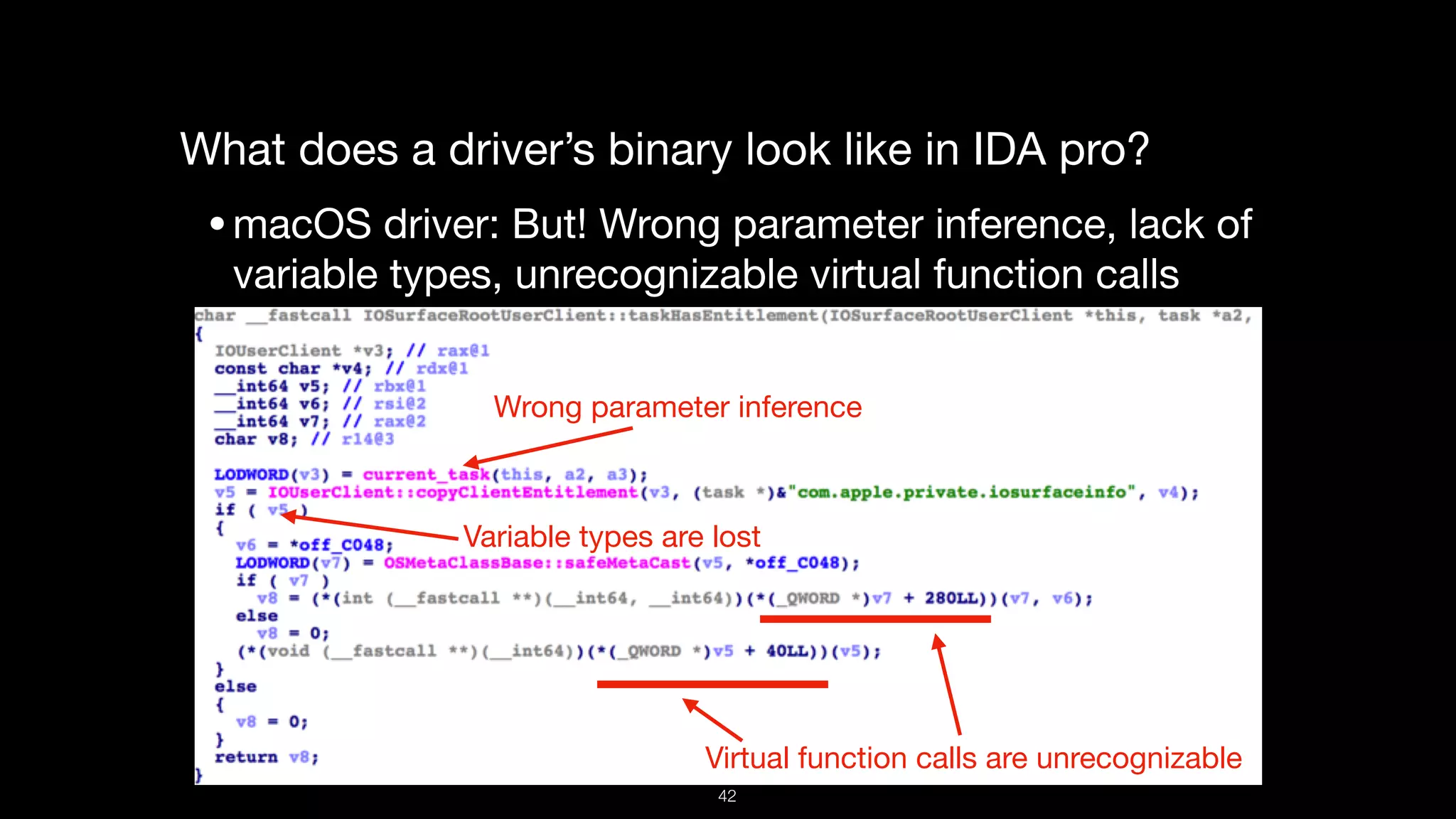
What does a driver’s binary look like in IDA pro?

•macOS driver: But! Wrong parameter inference, lack of
variable types, unrecognizable virtual function calls

Wrong parameter inference
Variable types are lost
Virtual function calls are unrecognizable
42
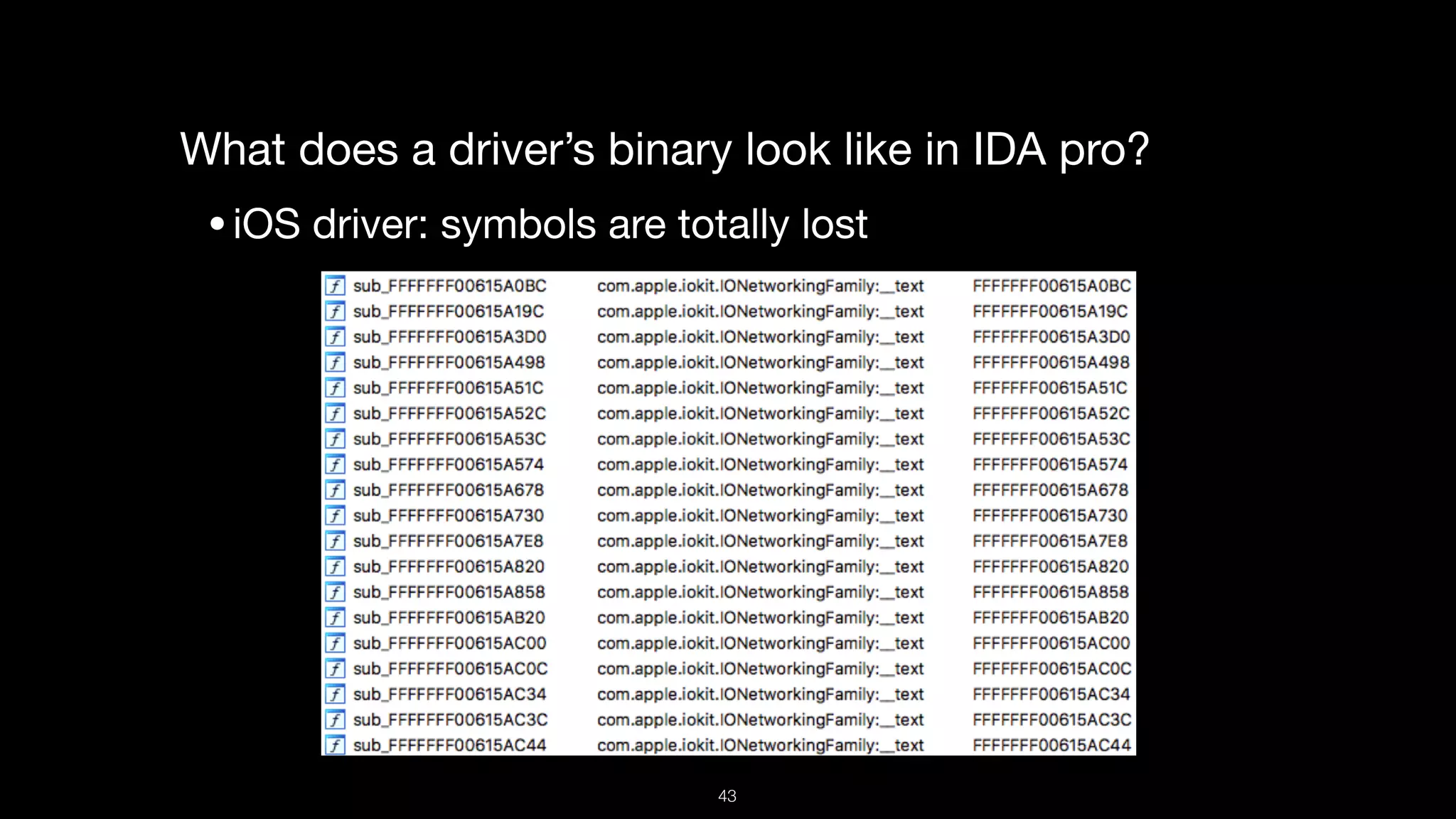
What does a driver’s binary look like in IDA pro?

•iOS driver: symbols are totally lost

43
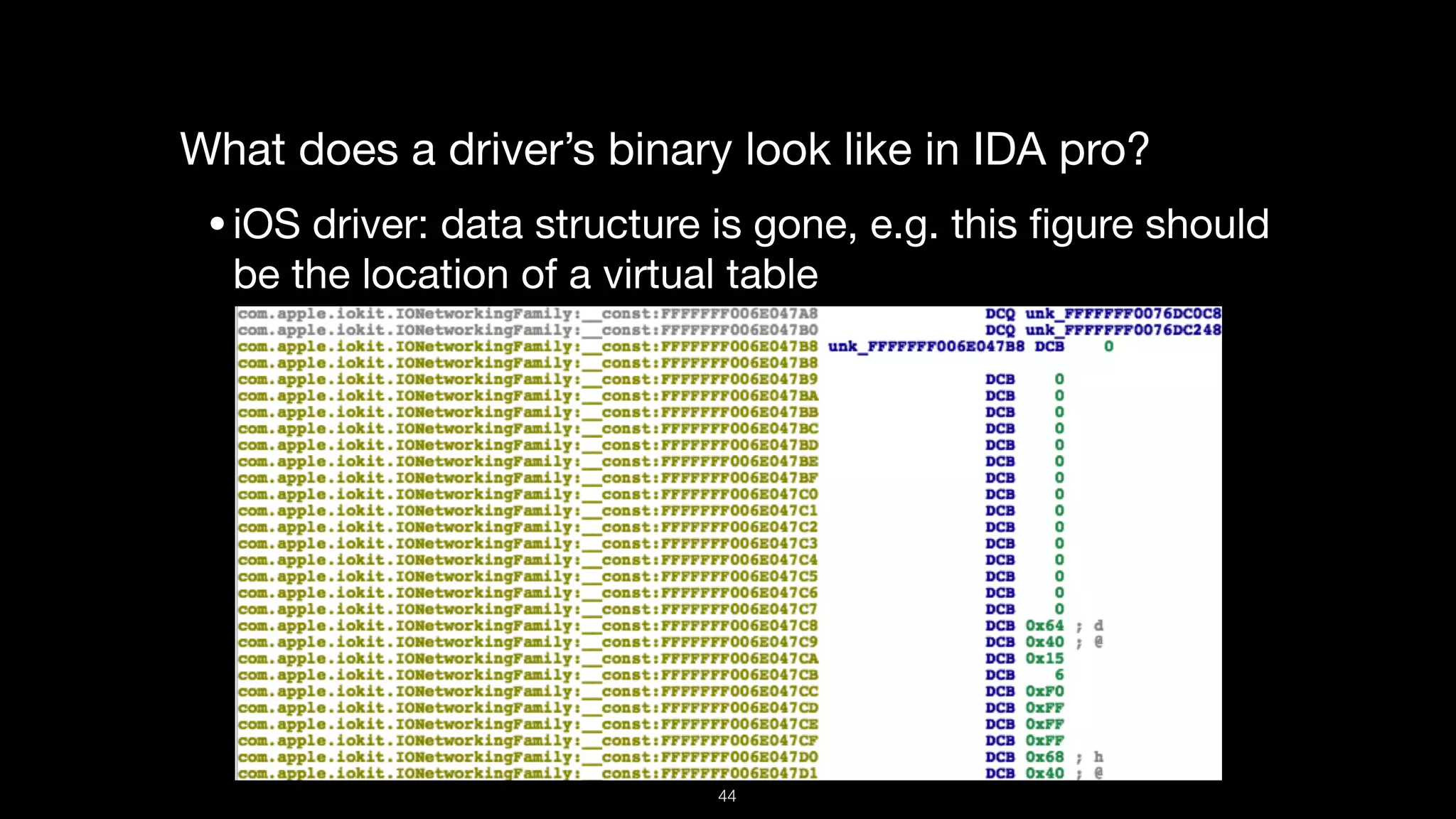
What does a driver’s binary look like in IDA pro?

•iOS driver: data structure is gone, e.g. this figure should
be the location of a virtual table

44
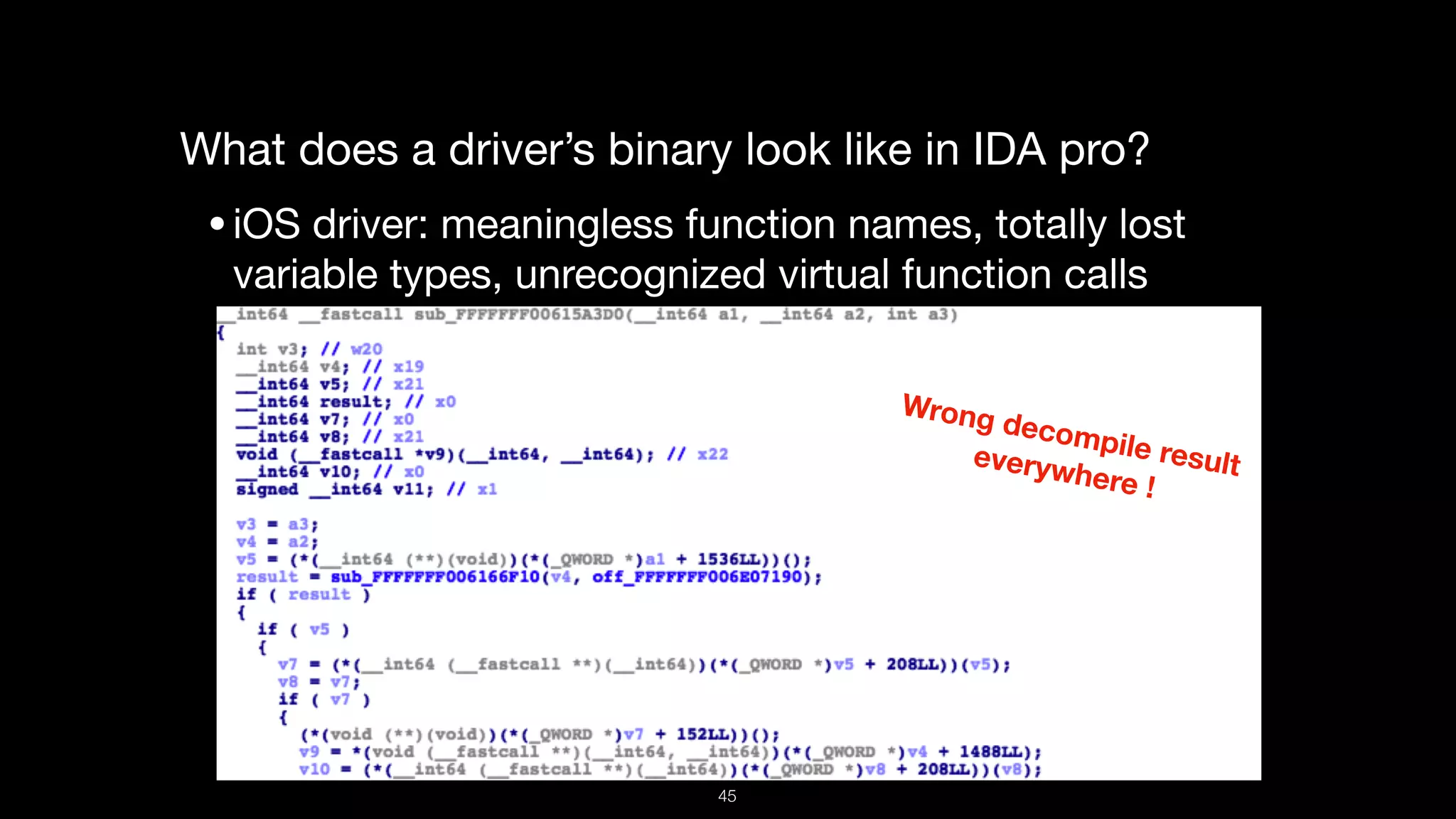
What does a driver’s binary look like in IDA pro?

•iOS driver: meaningless function names, totally lost
variable types, unrecognized virtual function calls 

Wrong decompile resulteverywhere !
45
What exactly do we want for a binary to be?

•Function (including virtual func) calls are recognizable,
the called functions are known

•Missing symbols are recovered, decompiled code is
understandable… 

Why?

•Knowing the real call target is a prerequisite for inter-
procedure analysis and futher analysis

•Manual review needs meaningful decompiled code
46
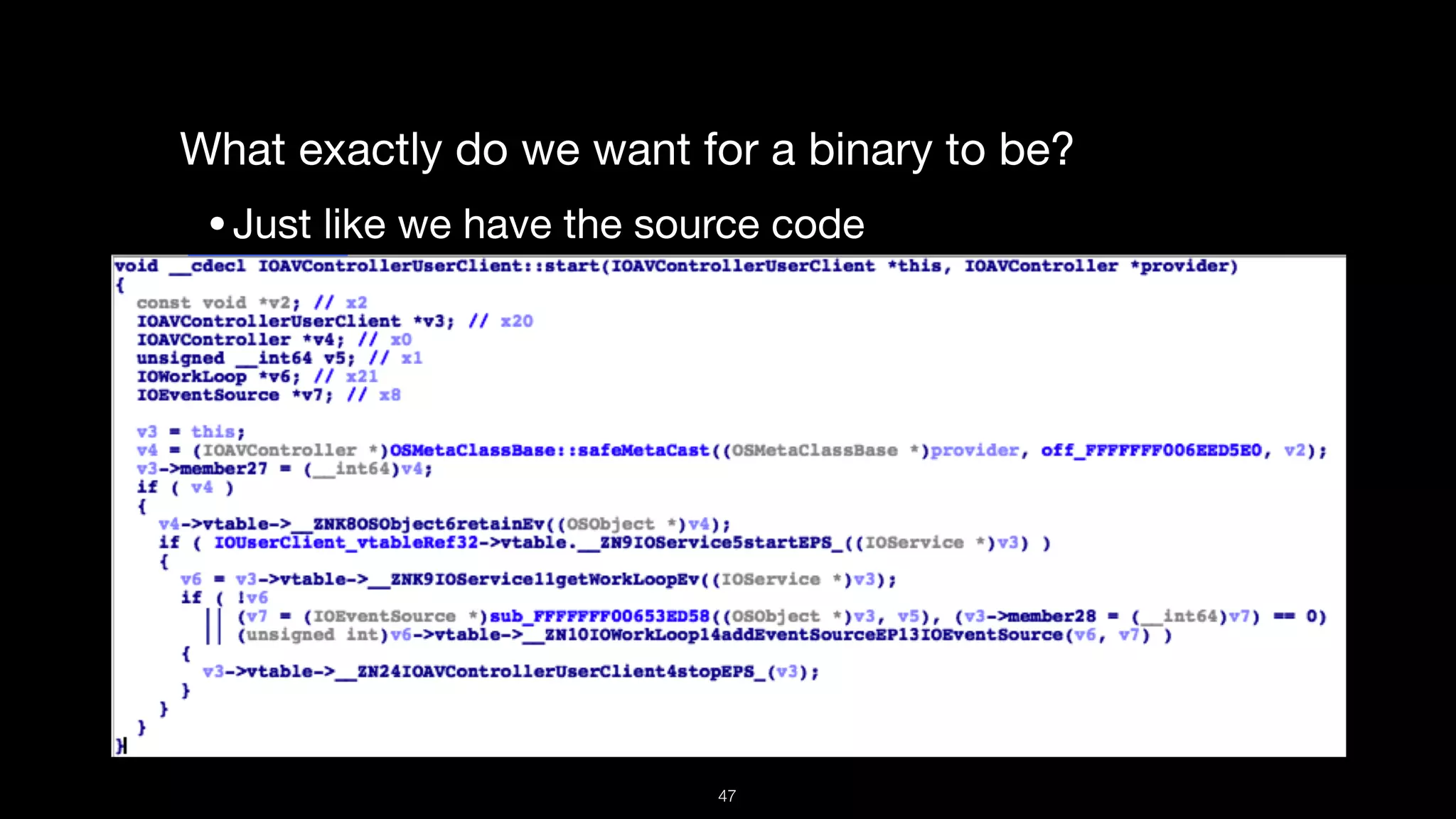
What exactly do we want for a binary to be?

•Just like we have the source code

47
Ryuk: a new static analysis tool 

to analyze Apple drivers
48
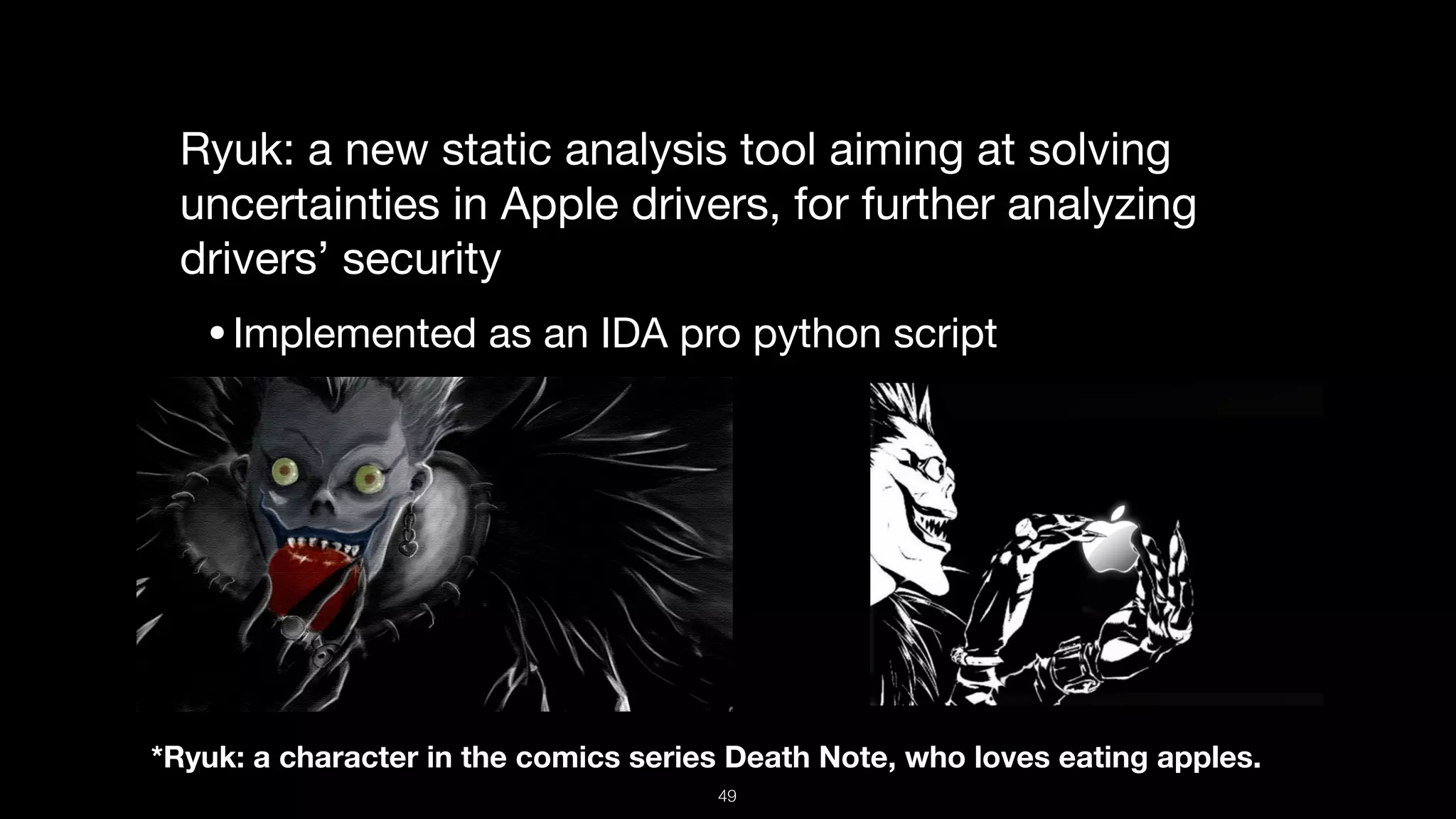
Ryuk: a new static analysis tool aiming at solving
uncertainties in Apple drivers, for further analyzing
drivers’ security

•Implemented as an IDA pro python script 

*Ryuk: a character in the comics series Death Note, who loves eating apples.
49
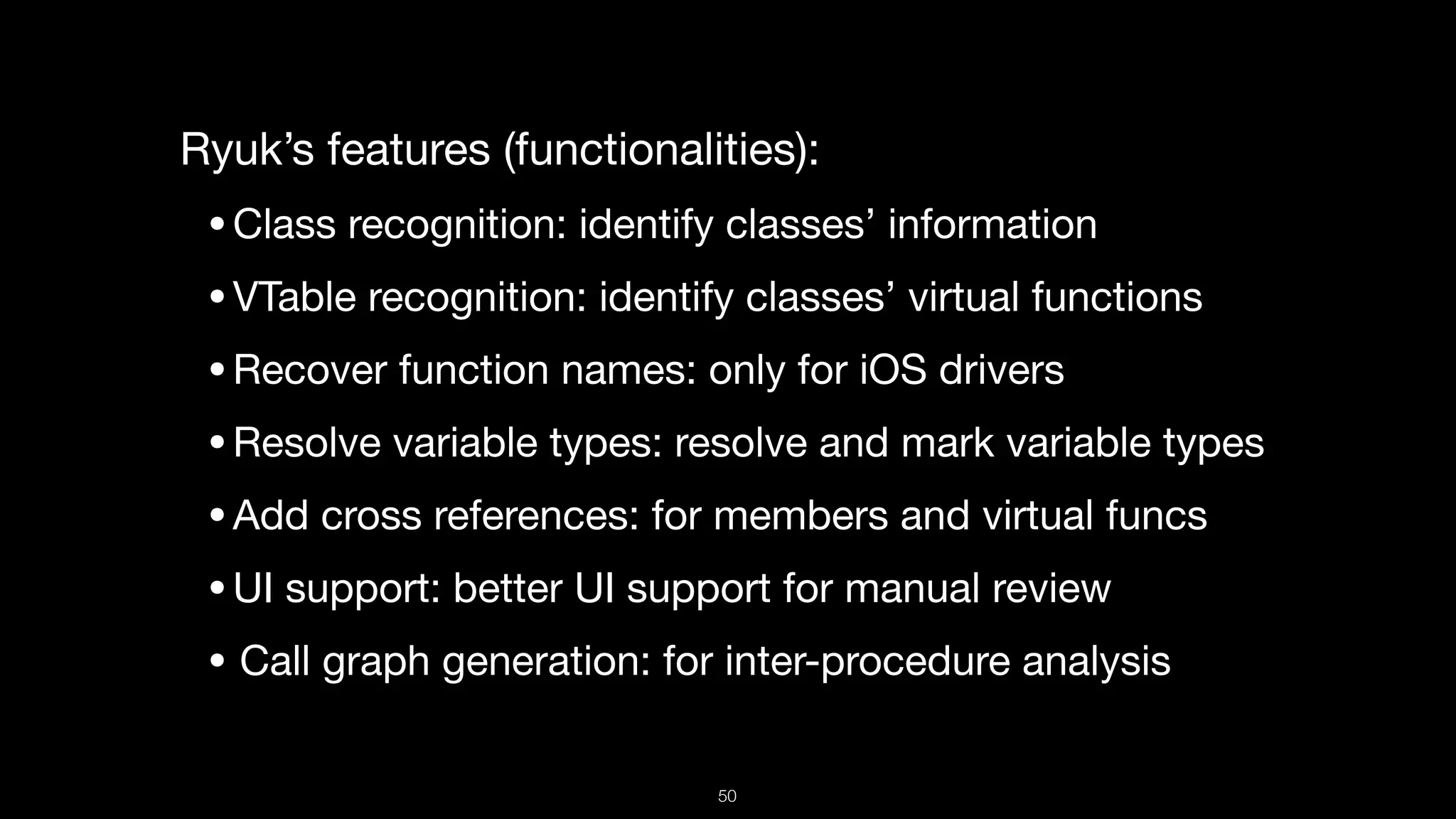
Ryuk’s features (functionalities):

•Class recognition: identify classes’ information

•VTable recognition: identify classes’ virtual functions

•Recover function names: only for iOS drivers

•Resolve variable types: resolve and mark variable types

•Add cross references: for members and virtual funcs

•UI support: better UI support for manual review

• Call graph generation: for inter-procedure analysis
50
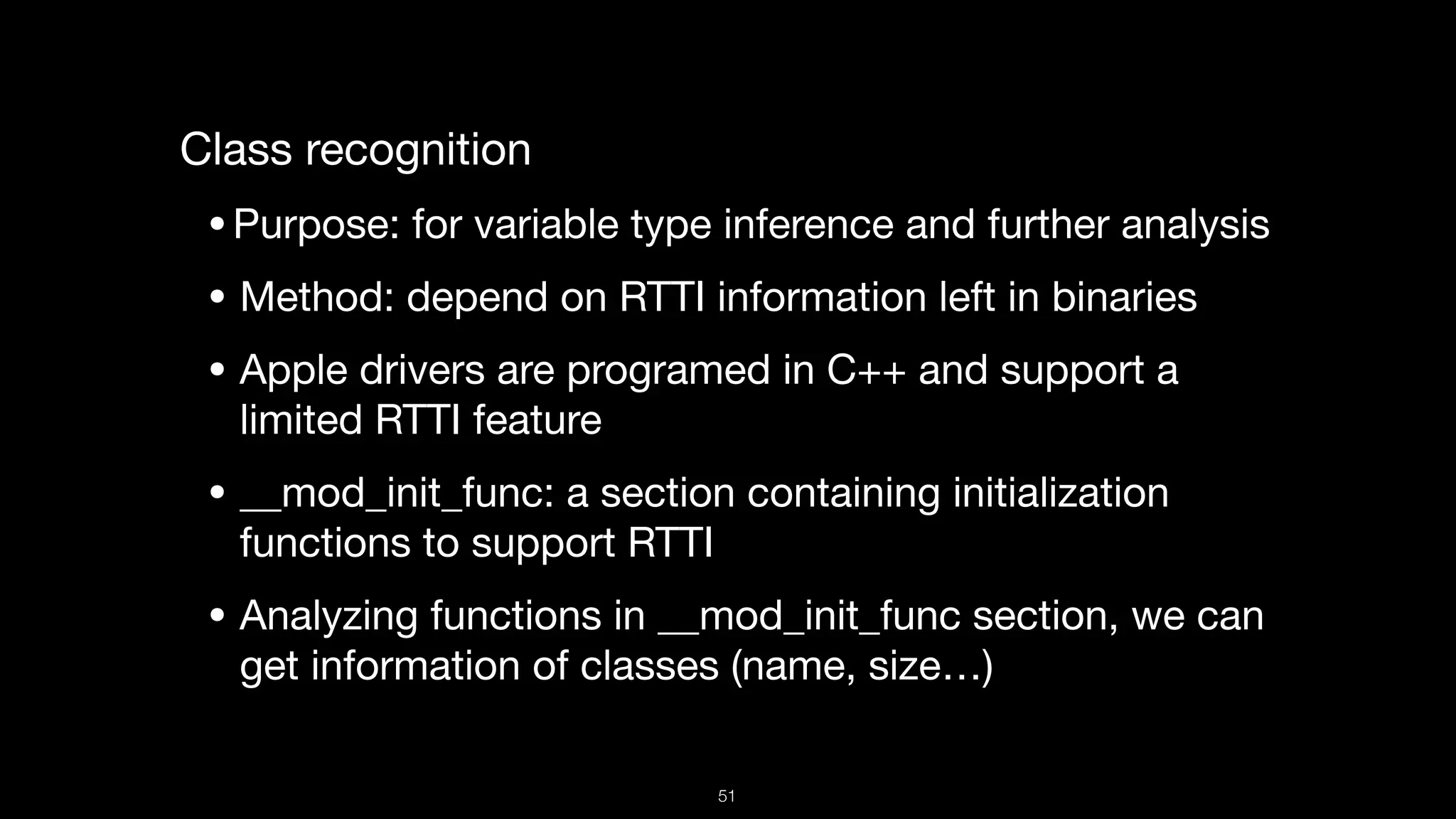
Class recognition

•Purpose: for variable type inference and further analysis

• Method: depend on RTTI information left in binaries

• Apple drivers are programed in C++ and support a
limited RTTI feature

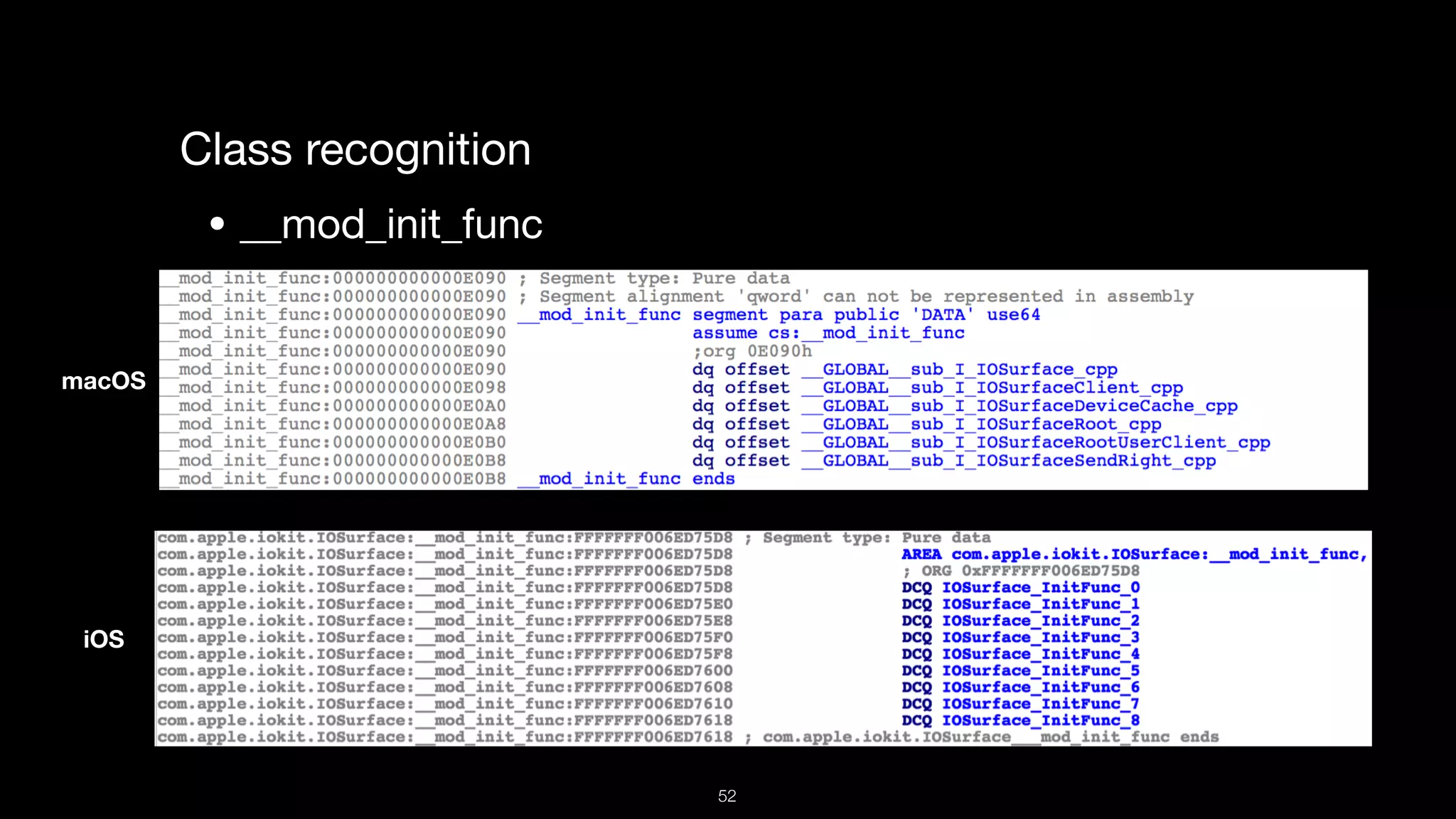
• __mod_init_func: a section containing initialization
functions to support RTTI

• Analyzing functions in __mod_init_func section, we can
get information of classes (name, size…)
51
Class recognition

• __mod_init_func
macOS
iOS
52
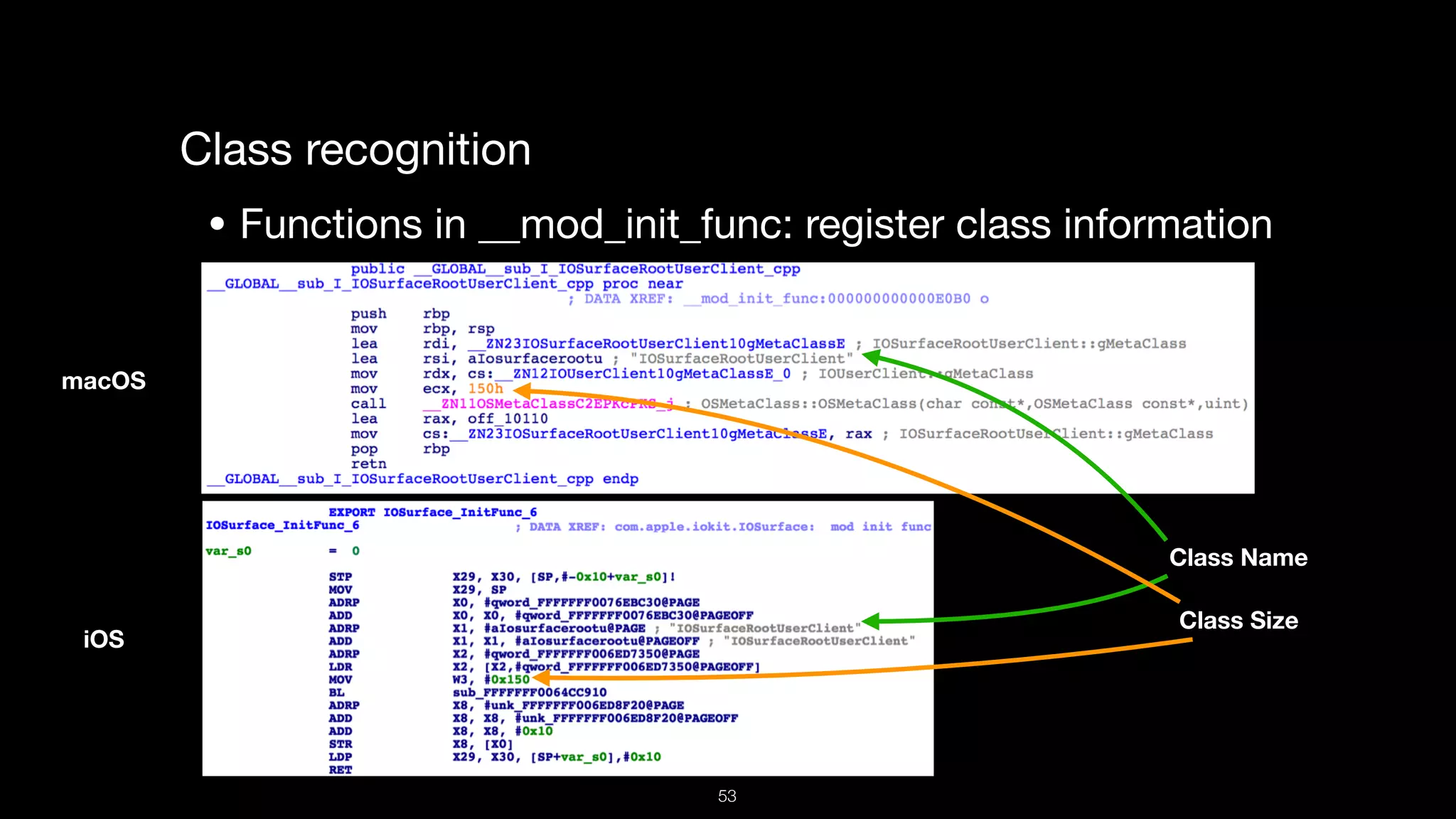
Class recognition

• Functions in __mod_init_func: register class information
macOS
iOS
Class Name
Class Size
53
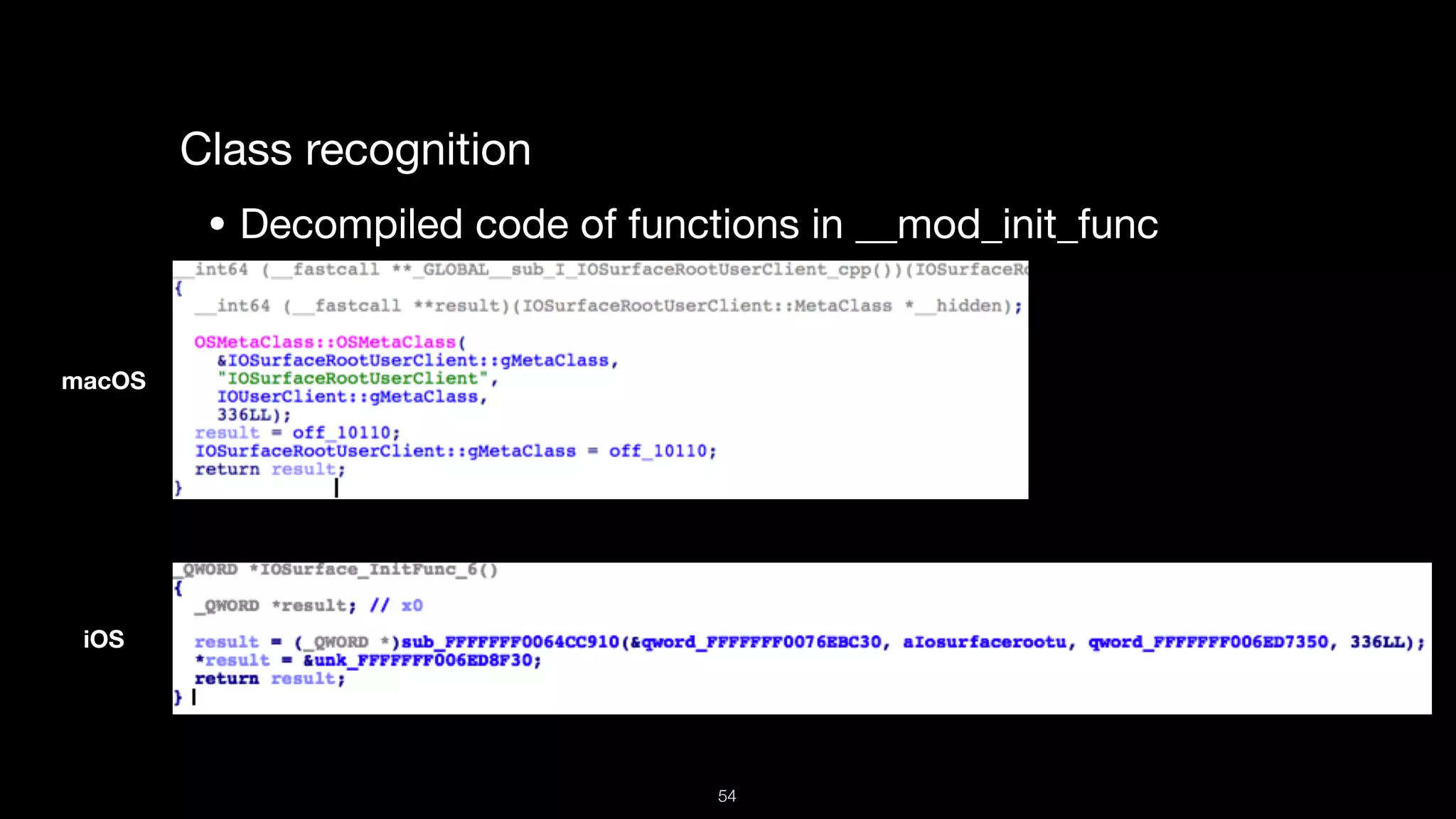
Class recognition

• Decompiled code of functions in __mod_init_func
macOS
iOS
54
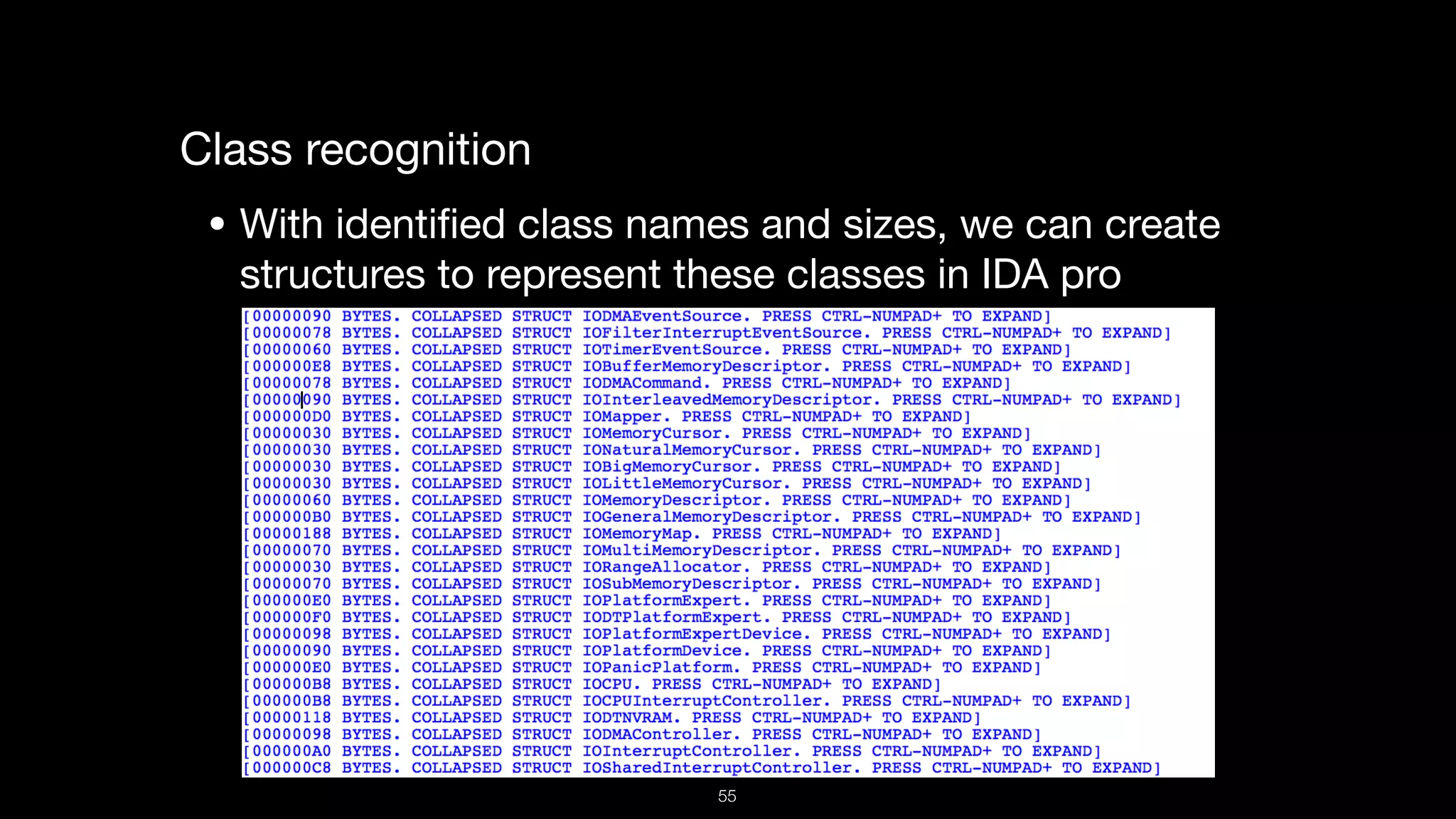
Class recognition

• With identified class names and sizes, we can create
structures to represent these classes in IDA pro
55
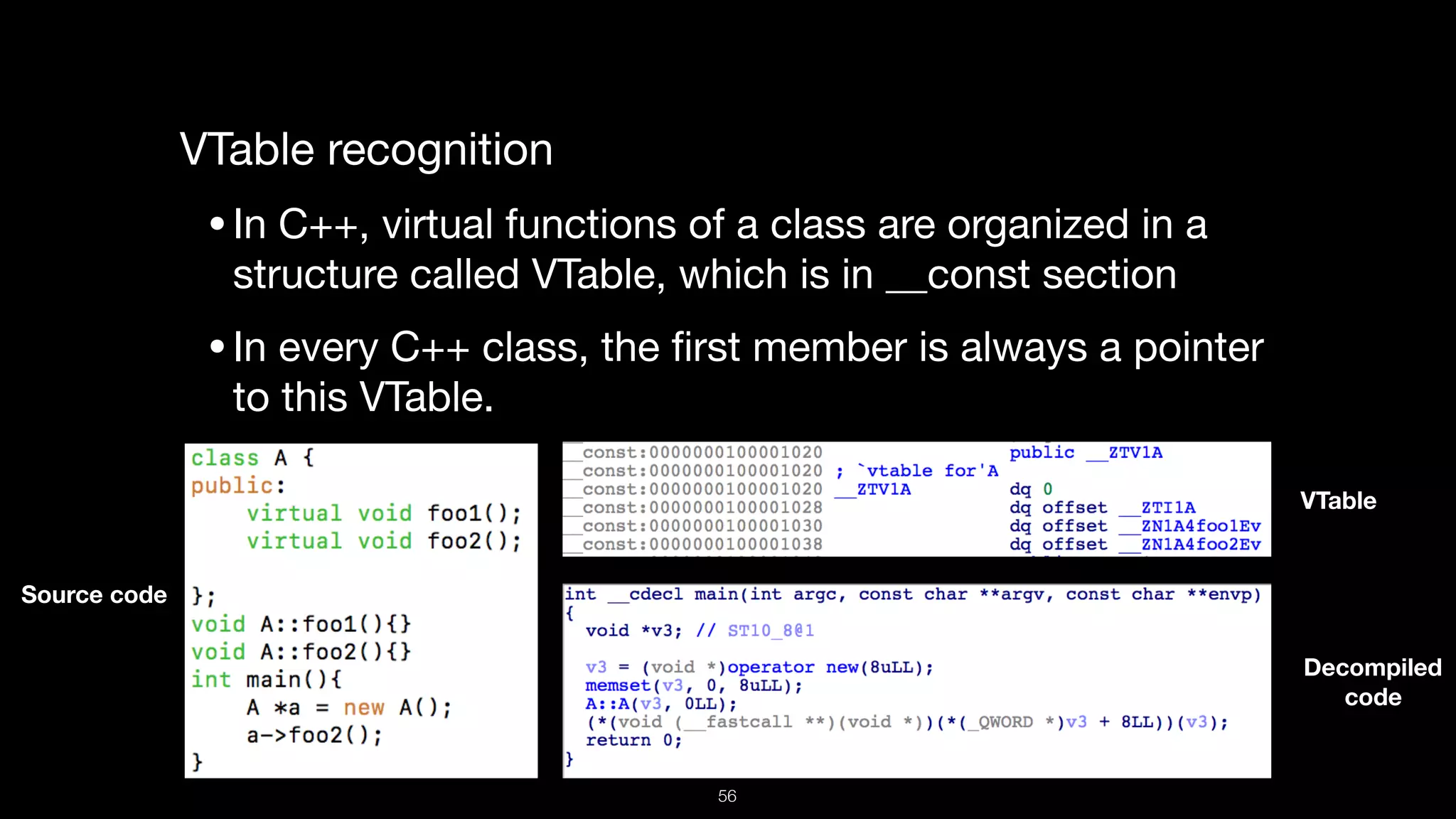
VTable recognition

•In C++, virtual functions of a class are organized in a
structure called VTable, which is in __const section 

•In every C++ class, the first member is always a pointer
to this VTable.
Source code
VTable
Decompiled 

code
56
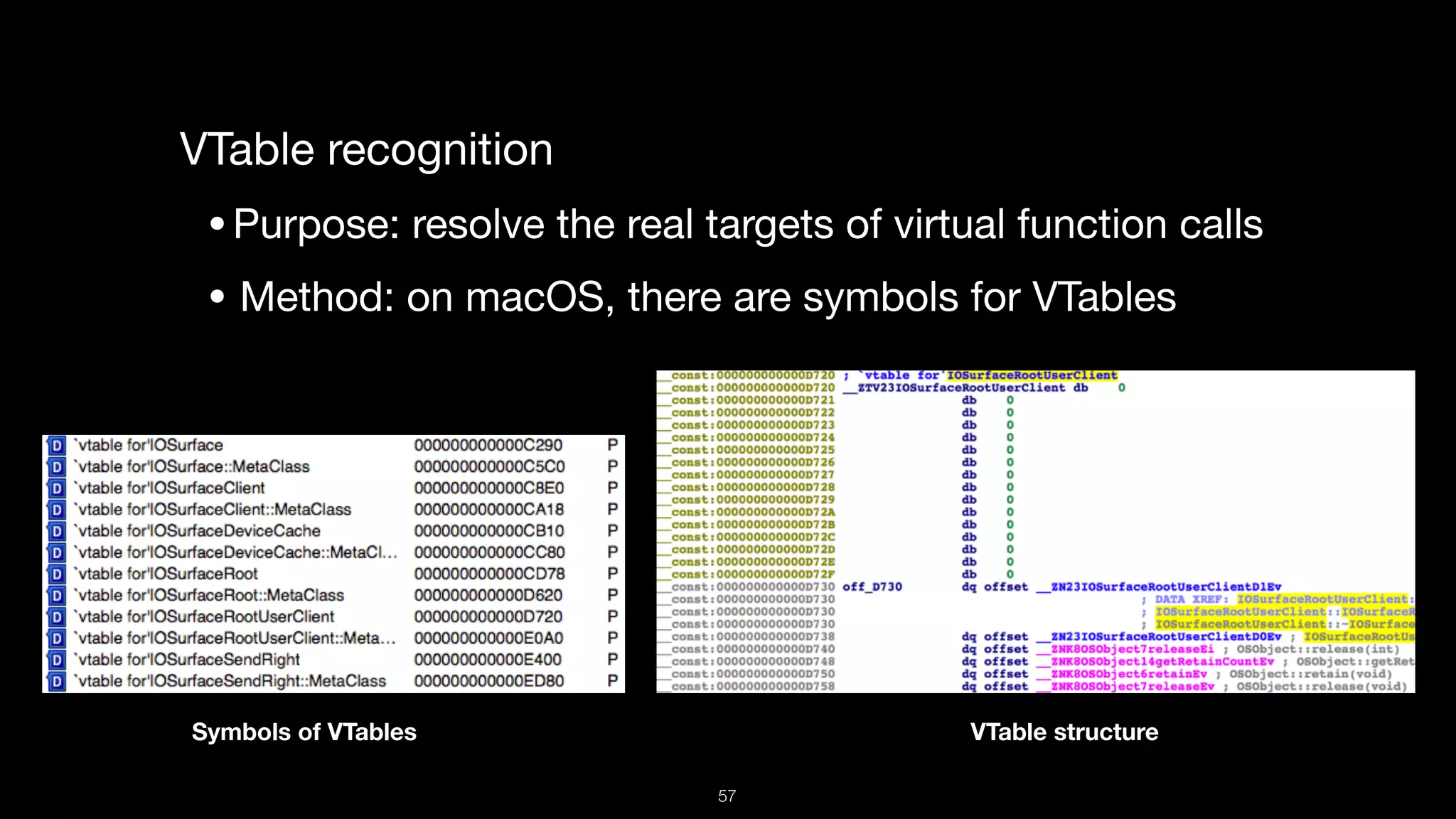
VTable recognition

•Purpose: resolve the real targets of virtual function calls

• Method: on macOS, there are symbols for VTables
Symbols of VTables VTable structure
57
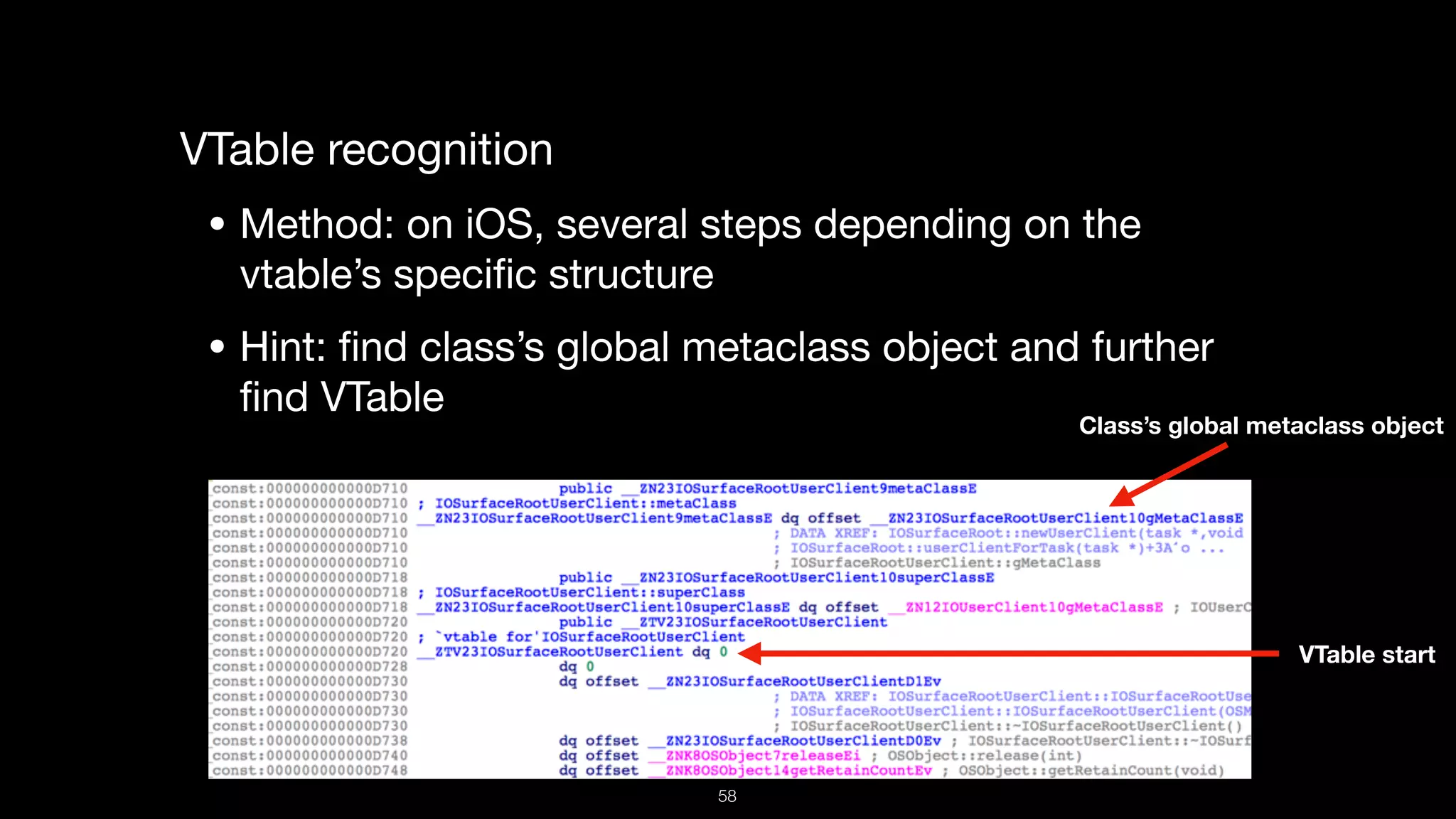
VTable recognition

• Method: on iOS, several steps depending on the
vtable’s specific structure

• Hint: find class’s global metaclass object and further
find VTable
Class’s global metaclass object
VTable start
58
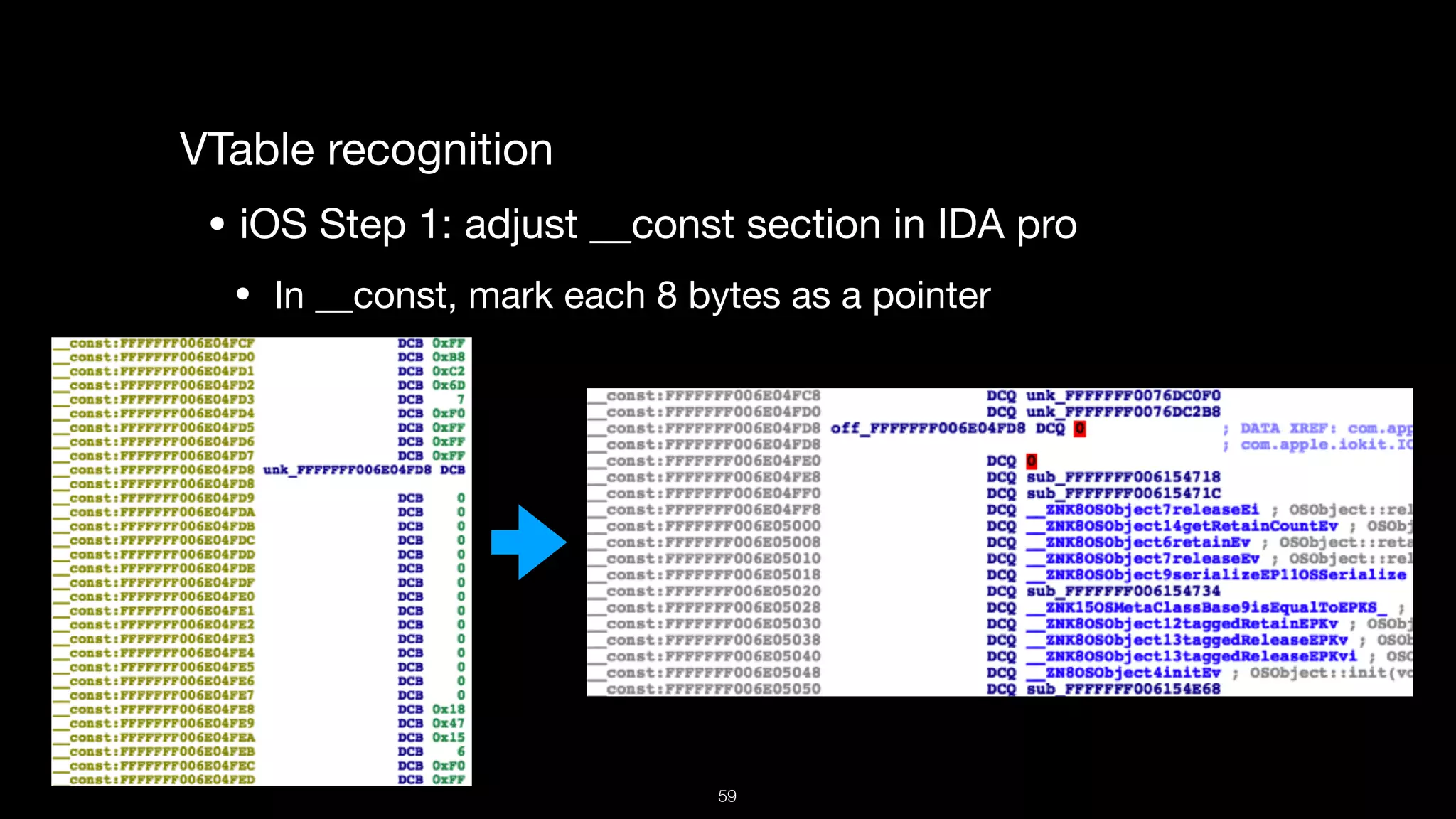
VTable recognition

• iOS Step 1: adjust __const section in IDA pro

• In __const, mark each 8 bytes as a pointer
59
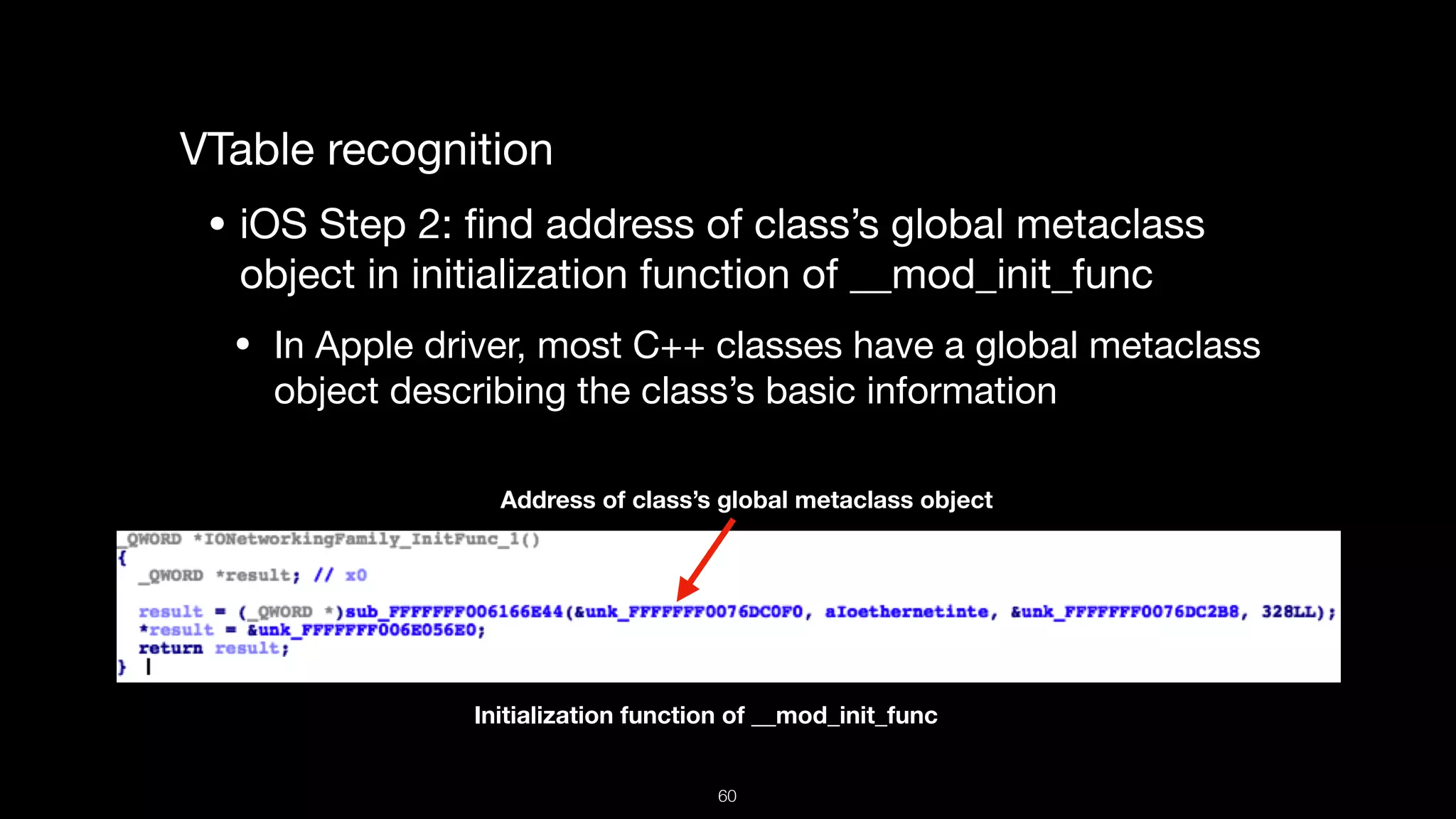
VTable recognition

• iOS Step 2: find address of class’s global metaclass
object in initialization function of __mod_init_func 

• In Apple driver, most C++ classes have a global metaclass
object describing the class’s basic information
Initialization function of __mod_init_func
Address of class’s global metaclass object
60
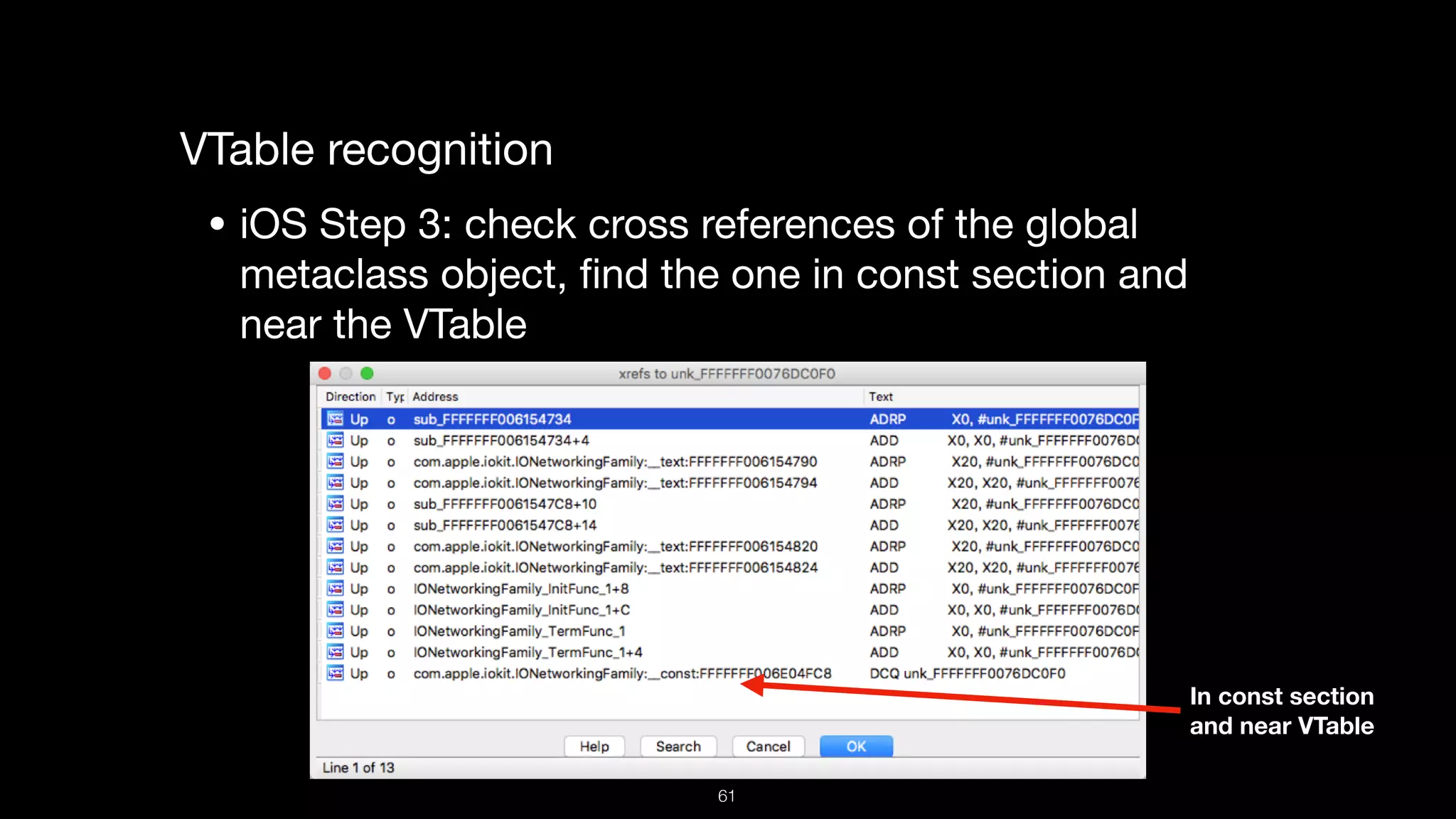
VTable recognition

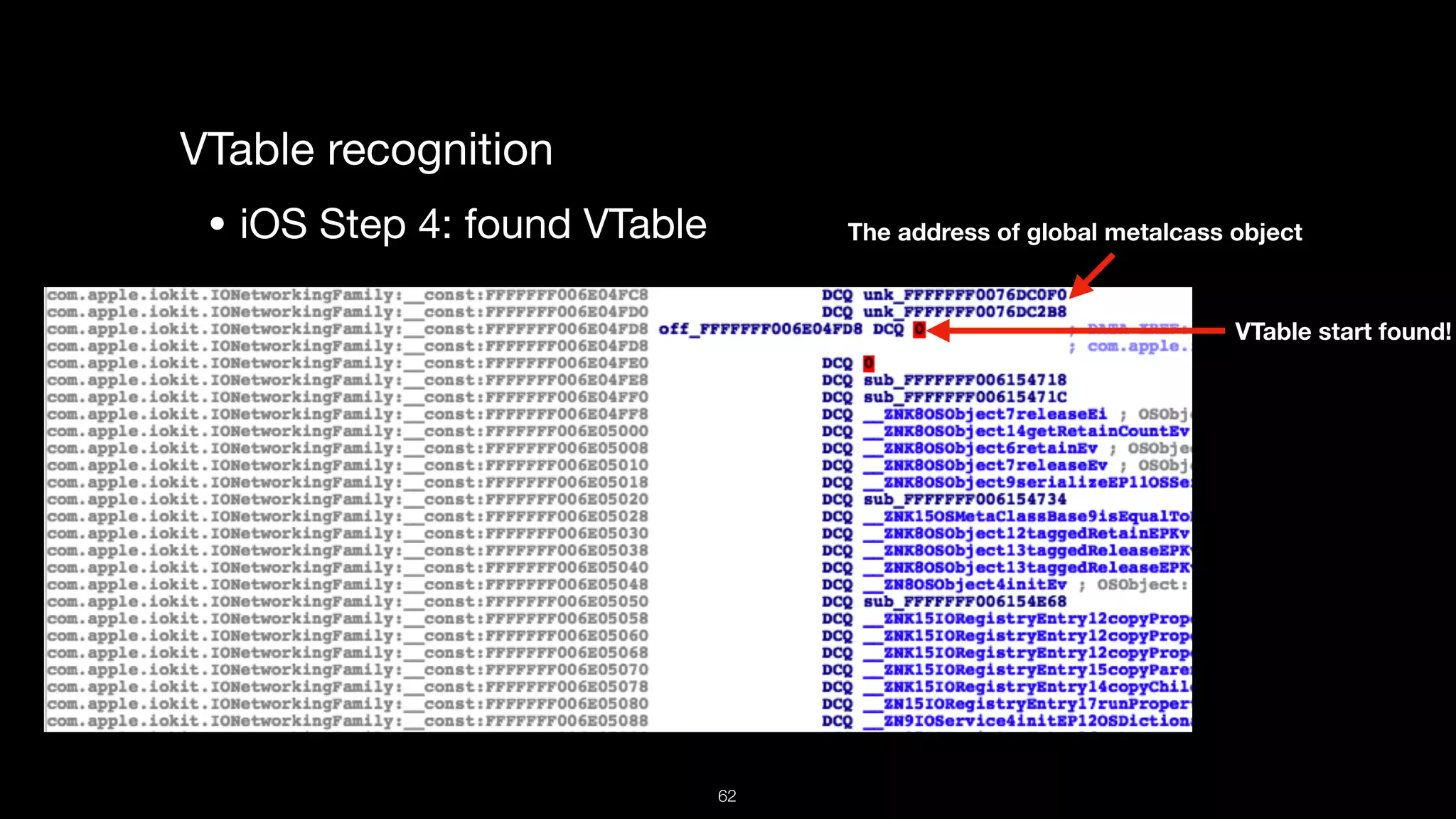
• iOS Step 3: check cross references of the global
metaclass object, find the one in const section and
near the VTable
In const section 

and near VTable
61
VTable recognition

• iOS Step 4: found VTable The address of global metalcass object
VTable start found!
62
VTable recognition

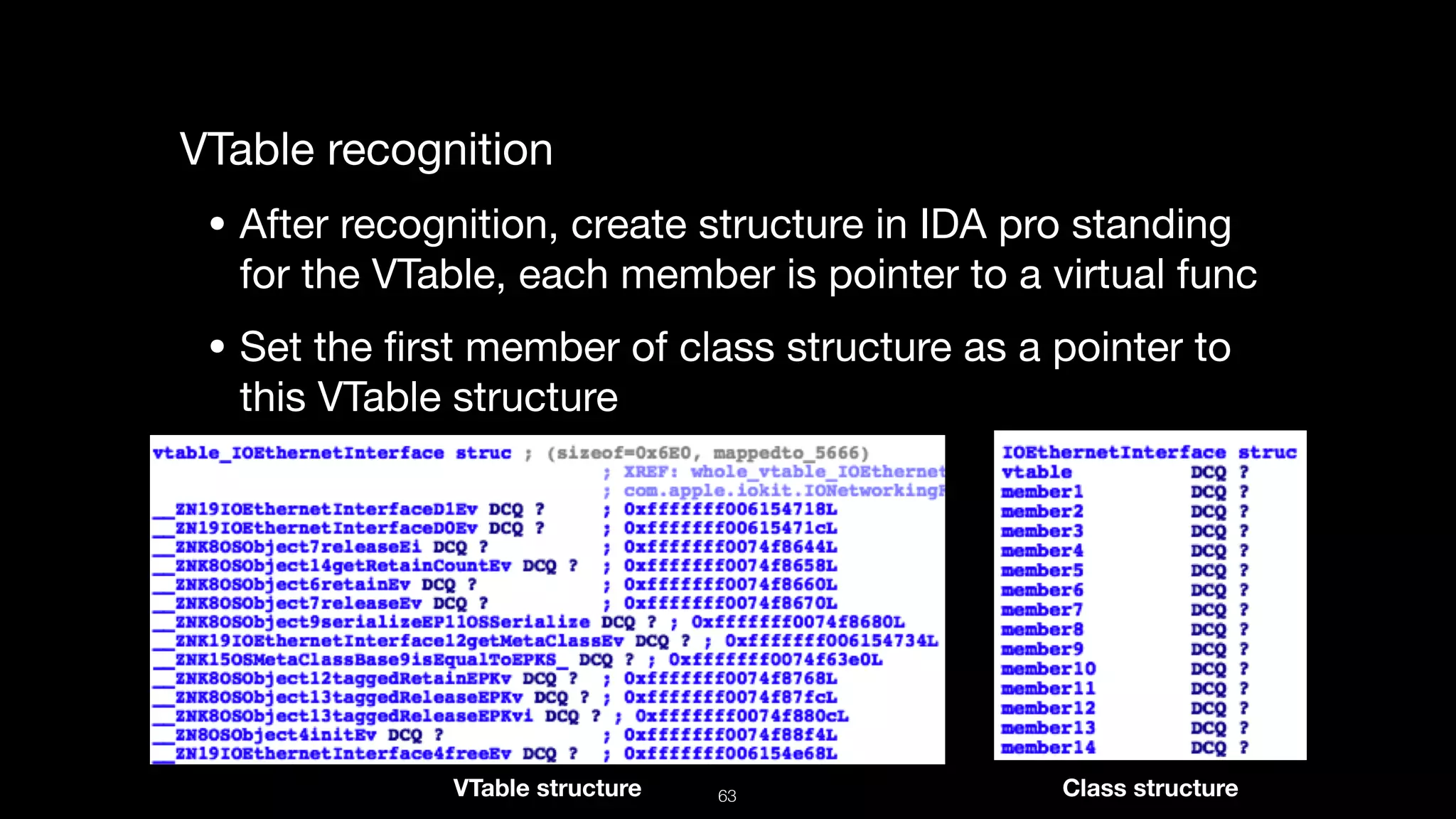
• After recognition, create structure in IDA pro standing
for the VTable, each member is pointer to a virtual func

• Set the first member of class structure as a pointer to
this VTable structure
VTable structure Class structure63
Recover function names (only for iOS)

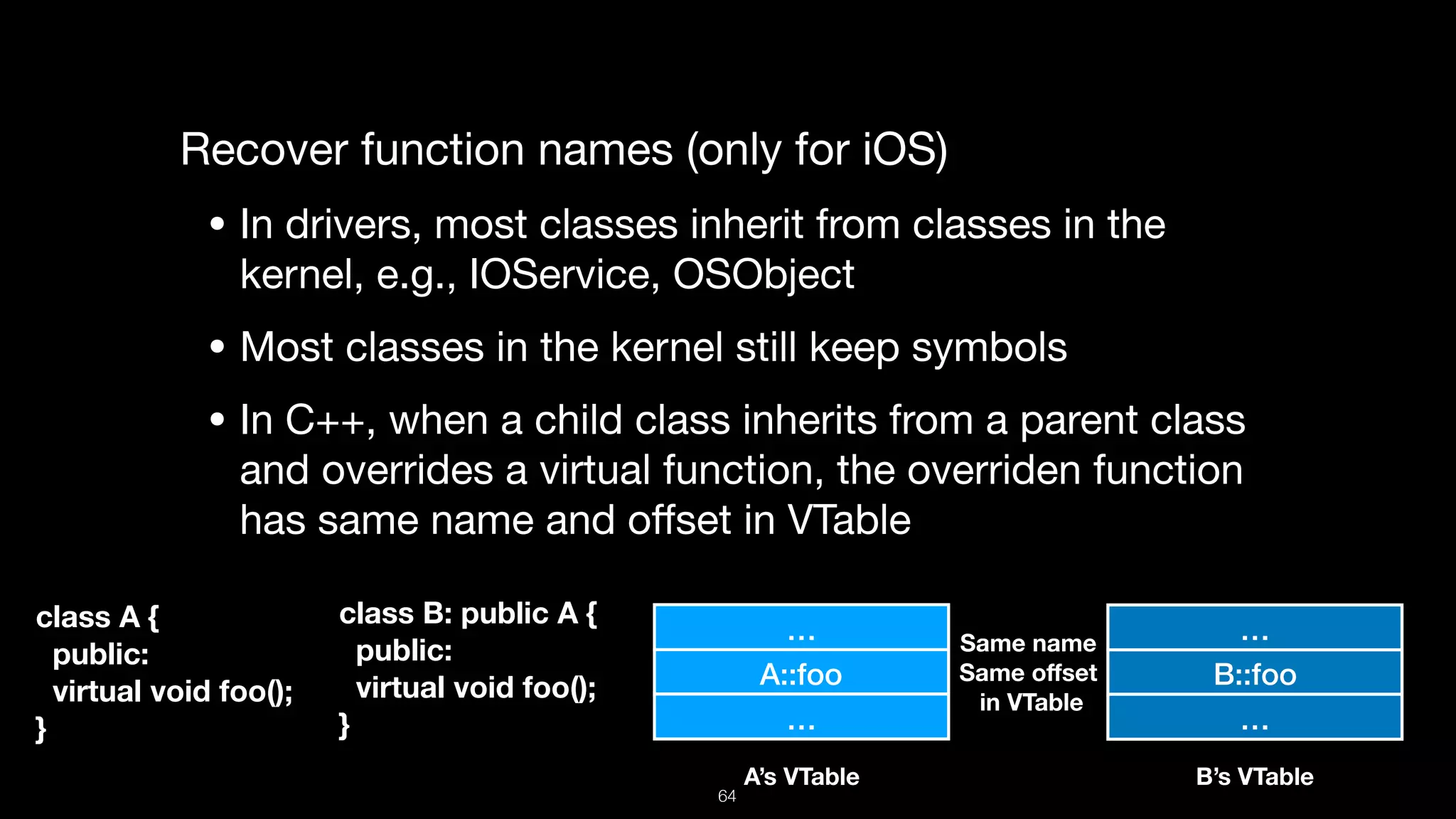
• In drivers, most classes inherit from classes in the
kernel, e.g., IOService, OSObject

• Most classes in the kernel still keep symbols 

• In C++, when a child class inherits from a parent class
and overrides a virtual function, the overriden function
has same name and offset in VTable
A::foo
class A {
public:
virtual void foo();
}
class B: public A {
public:
virtual void foo();
}
…
…
B::foo
…
…
A’s VTable B’s VTable
Same name

Same offset

in VTable
64
Recover function names (only for iOS)

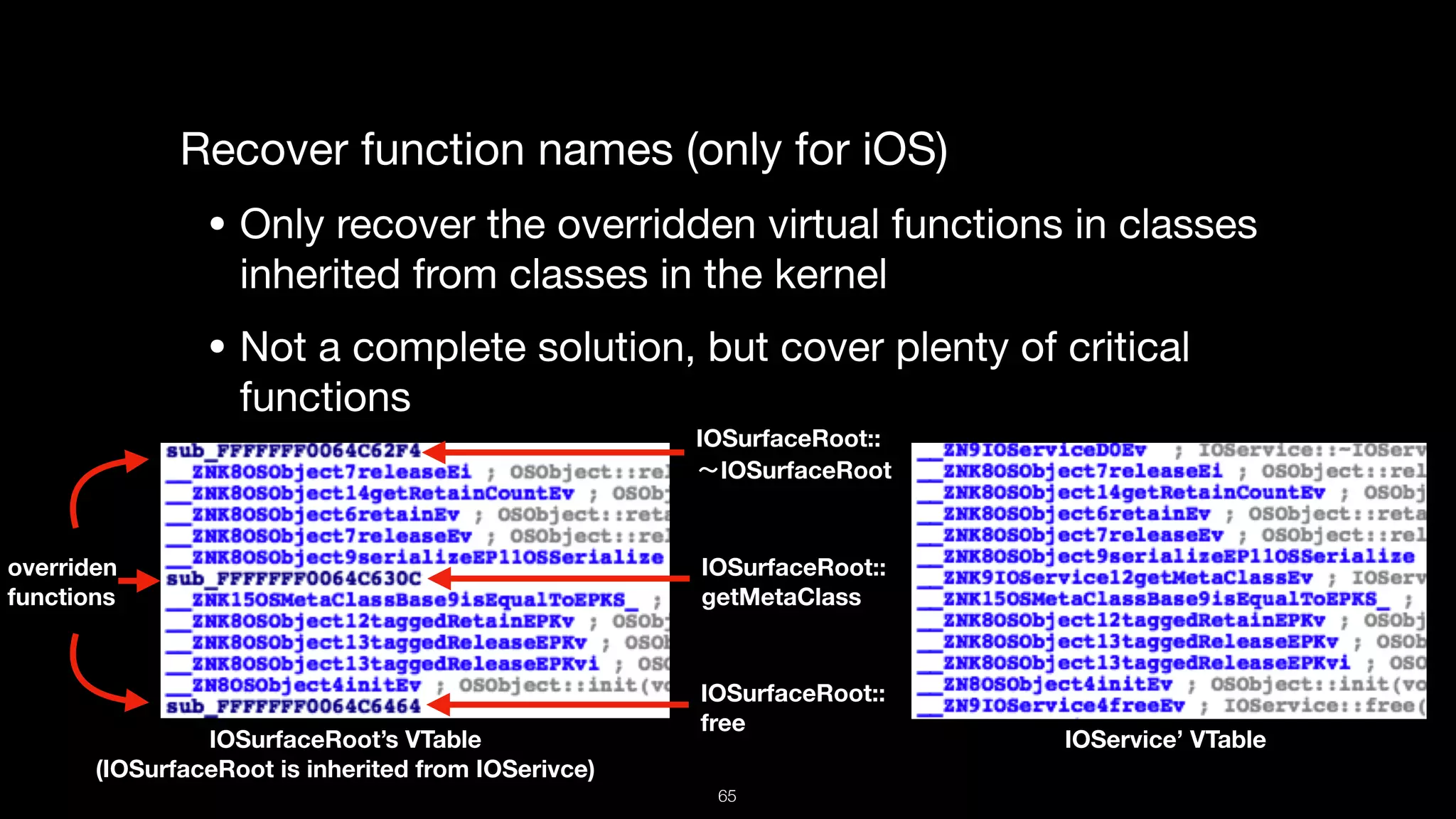
• Only recover the overridden virtual functions in classes
inherited from classes in the kernel

• Not a complete solution, but cover plenty of critical
functions
IOSurfaceRoot’s VTable
(IOSurfaceRoot is inherited from IOSerivce)
IOService’ VTable
IOSurfaceRoot::

getMetaClass
overriden

functions
IOSurfaceRoot::

free
IOSurfaceRoot::

IOSurfaceRoot
65
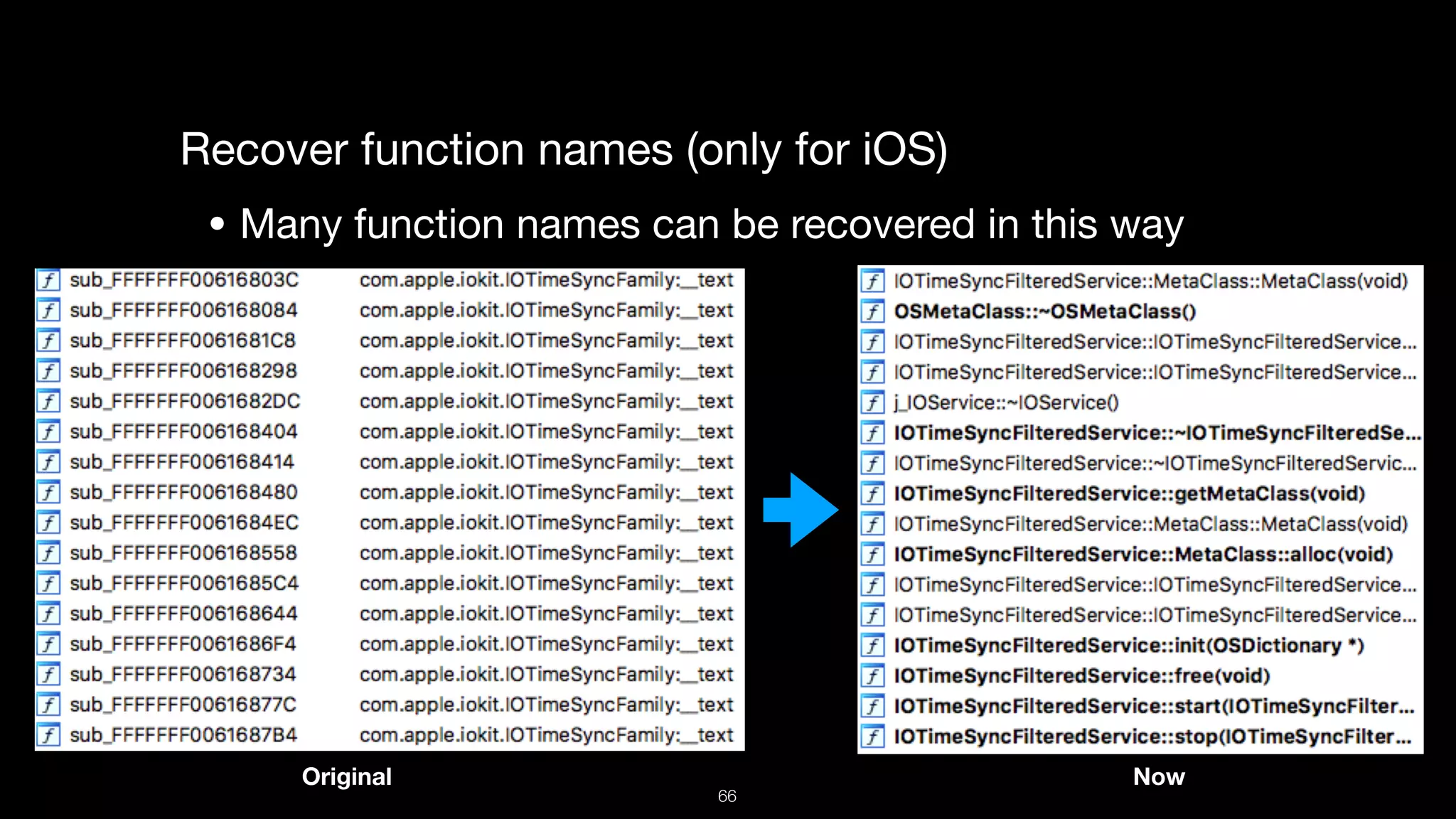
Recover function names (only for iOS)

• Many function names can be recovered in this way
Original Now
66
Resolve variable types (in IDA pro’s decompiled code)

•For local, global and member variables

•Method: identify variable types and perform type
propagation 

•How to identify variable types: two ways

• 1. Depend on features of function names in C++

• 2. Figure out the creation and iniatialization of variables
67
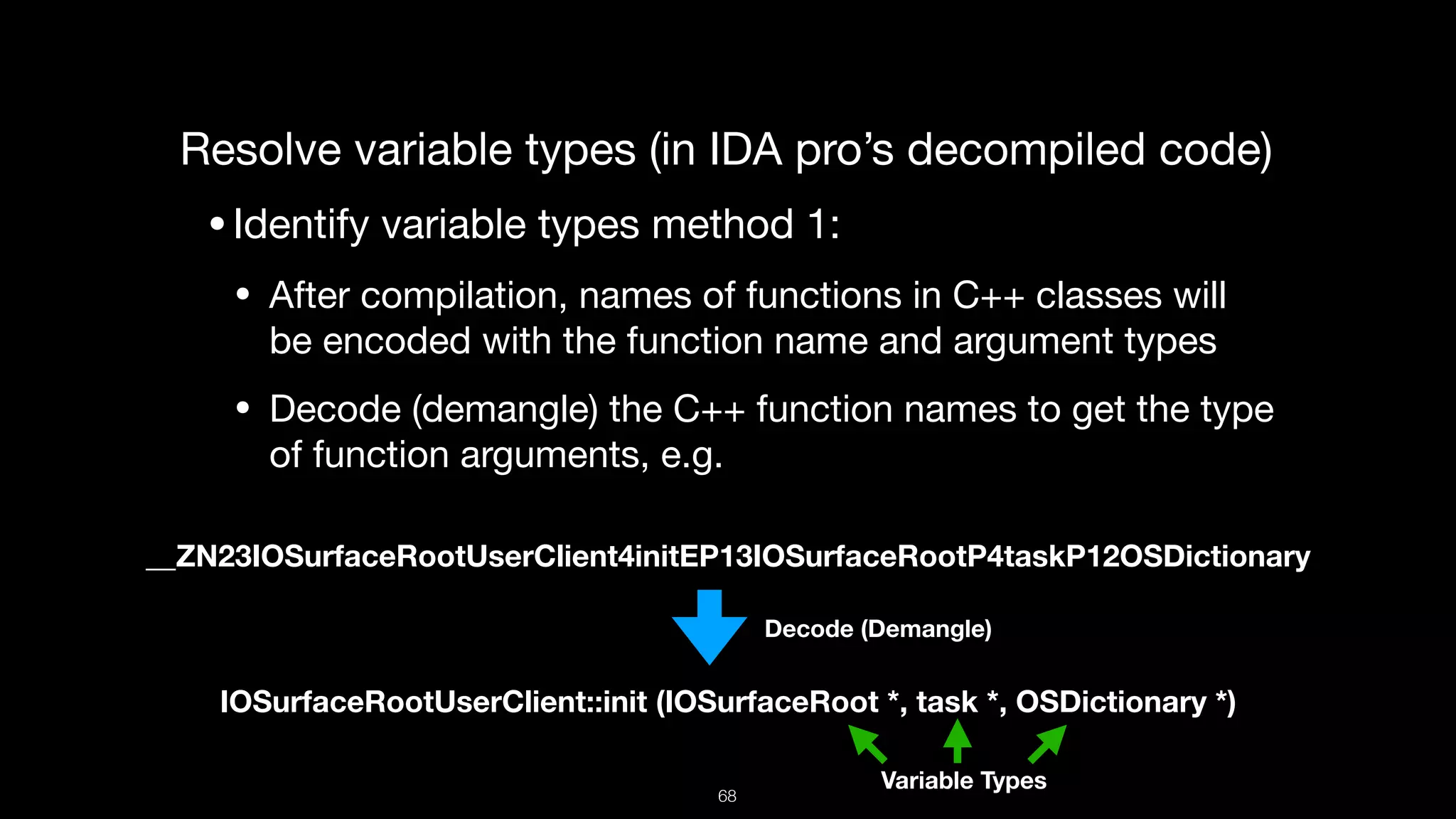
Resolve variable types (in IDA pro’s decompiled code)

•Identify variable types method 1:

• After compilation, names of functions in C++ classes will
be encoded with the function name and argument types

• Decode (demangle) the C++ function names to get the type
of function arguments, e.g.
__ZN23IOSurfaceRootUserClient4initEP13IOSurfaceRootP4taskP12OSDictionary
IOSurfaceRootUserClient::init (IOSurfaceRoot *, task *, OSDictionary *)
Decode (Demangle)
Variable Types
68
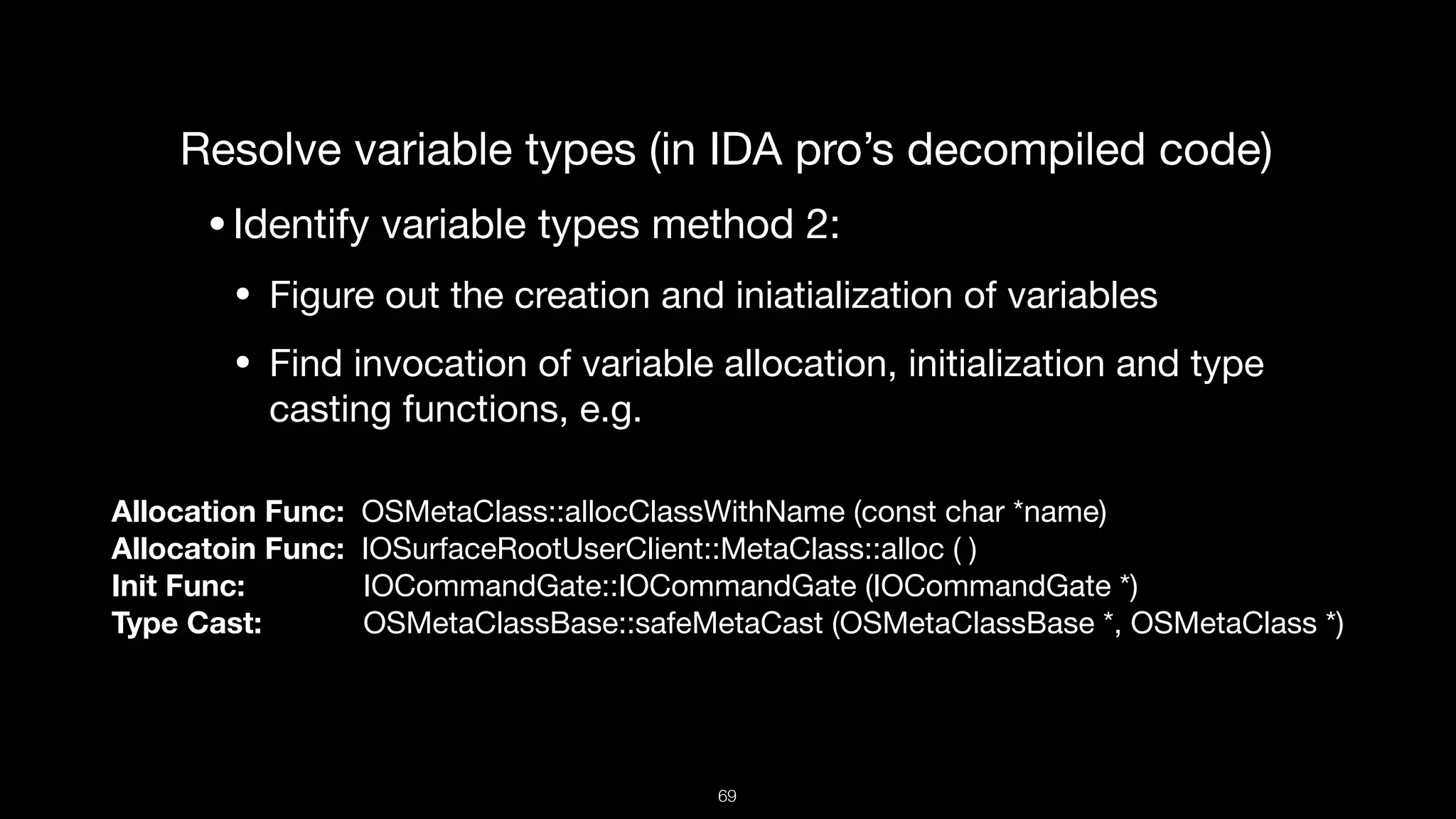
Resolve variable types (in IDA pro’s decompiled code)

•Identify variable types method 2:

• Figure out the creation and iniatialization of variables

• Find invocation of variable allocation, initialization and type
casting functions, e.g.
Allocation Func: OSMetaClass::allocClassWithName (const char *name)

Allocatoin Func: IOSurfaceRootUserClient::MetaClass::alloc ( )

Init Func: IOCommandGate::IOCommandGate (IOCommandGate *)

Type Cast: OSMetaClassBase::safeMetaCast (OSMetaClassBase *, OSMetaClass *)
69
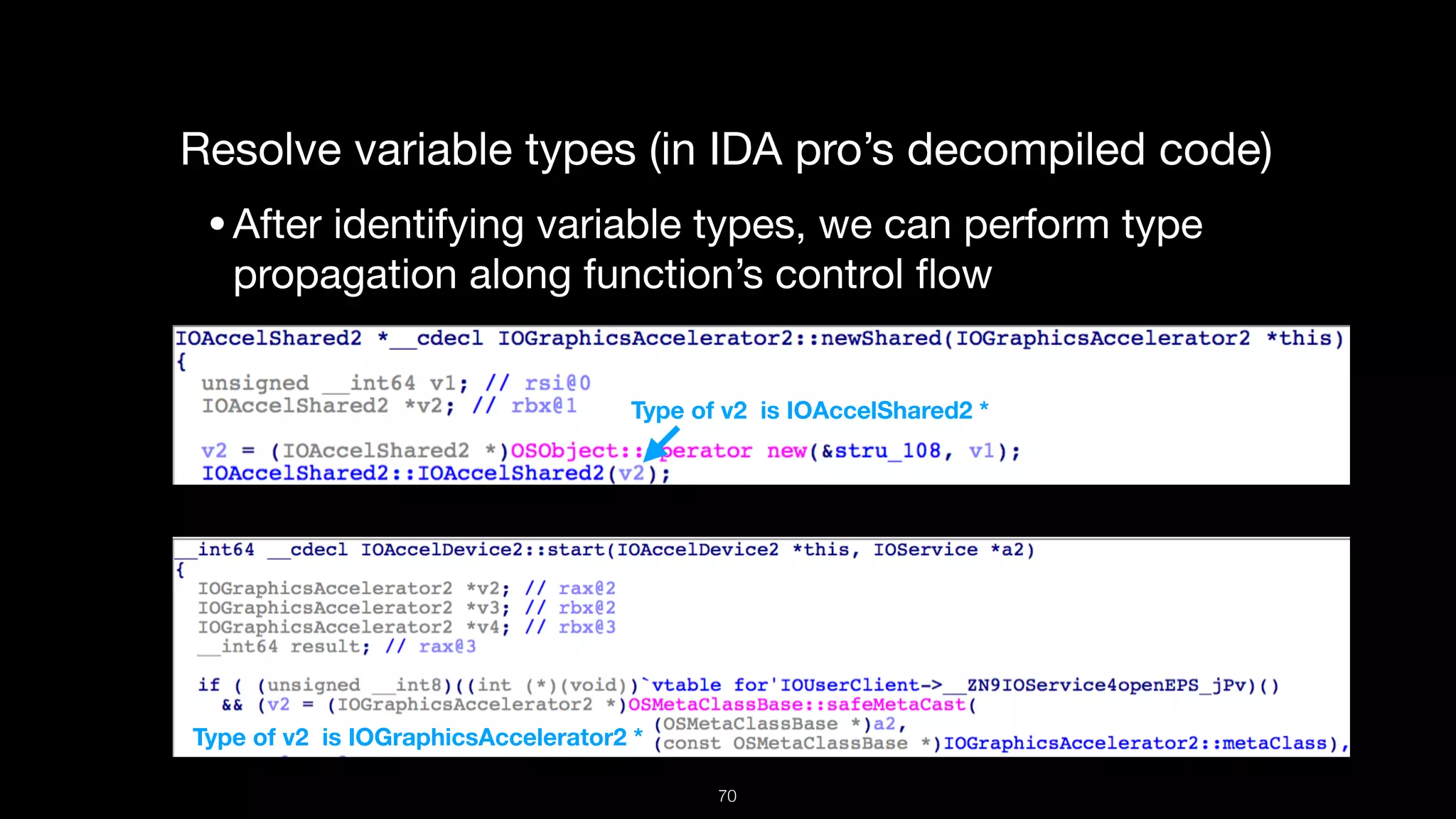
Resolve variable types (in IDA pro’s decompiled code)

•After identifying variable types, we can perform type
propagation along function’s control flow
Type of v2 is IOAccelShared2 *
Type of v2 is IOGraphicsAccelerator2 *
70
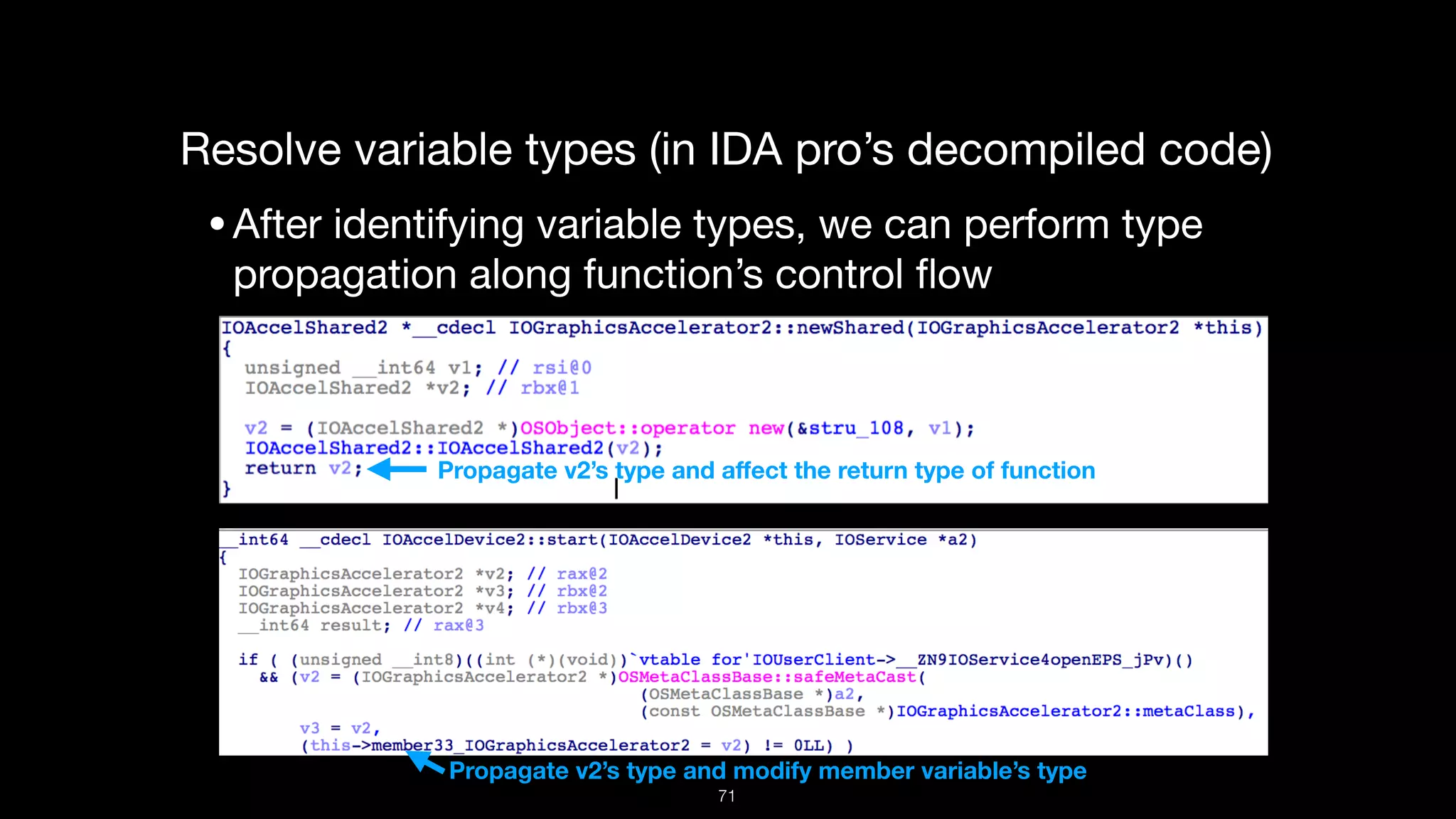
Resolve variable types (in IDA pro’s decompiled code)

•After identifying variable types, we can perform type
propagation along function’s control flow
Propagate v2’s type and affect the return type of function
Propagate v2’s type and modify member variable’s type
71
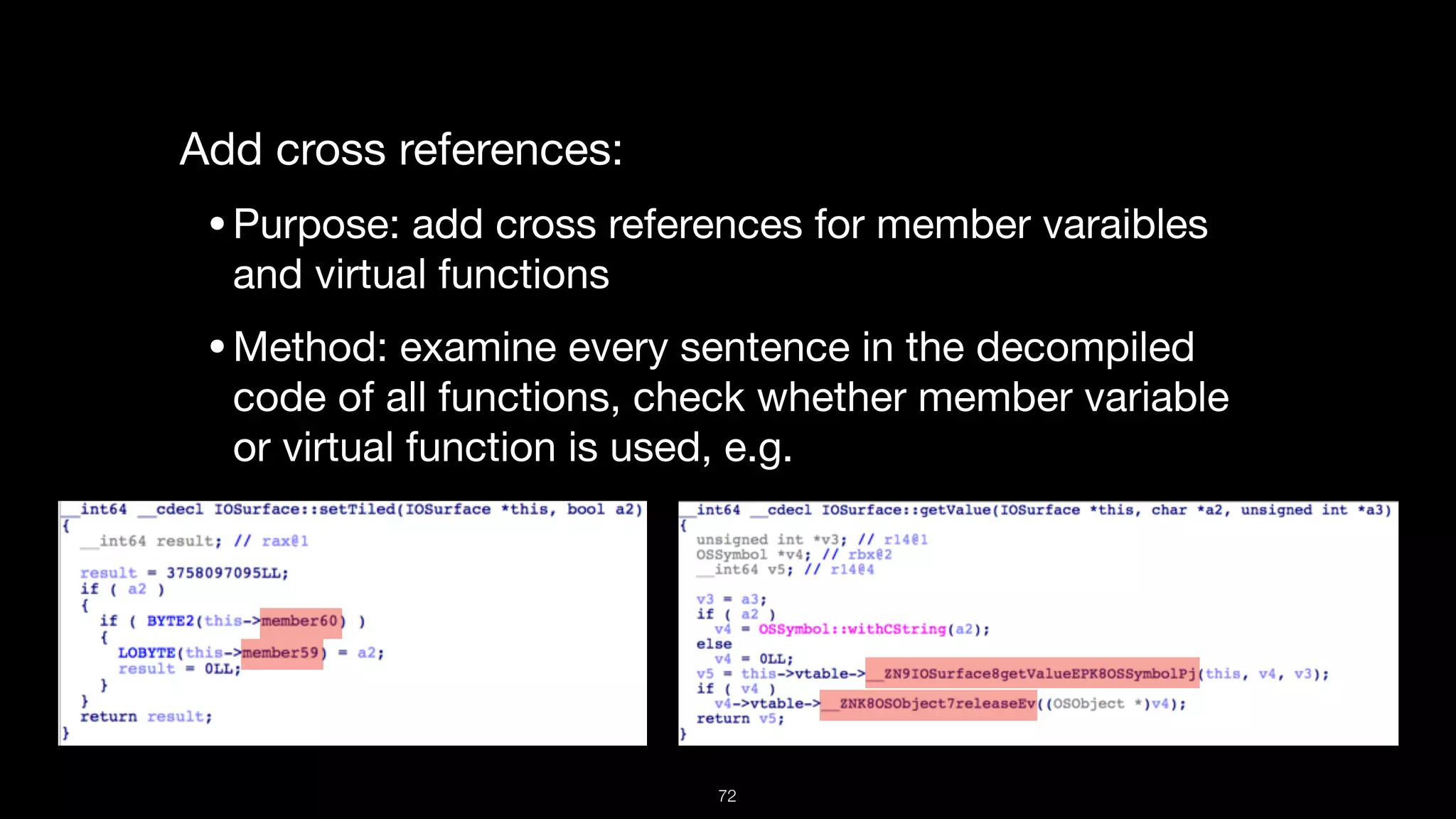
Add cross references:

•Purpose: add cross references for member varaibles
and virtual functions

•Method: examine every sentence in the decompiled
code of all functions, check whether member variable
or virtual function is used, e.g.
72
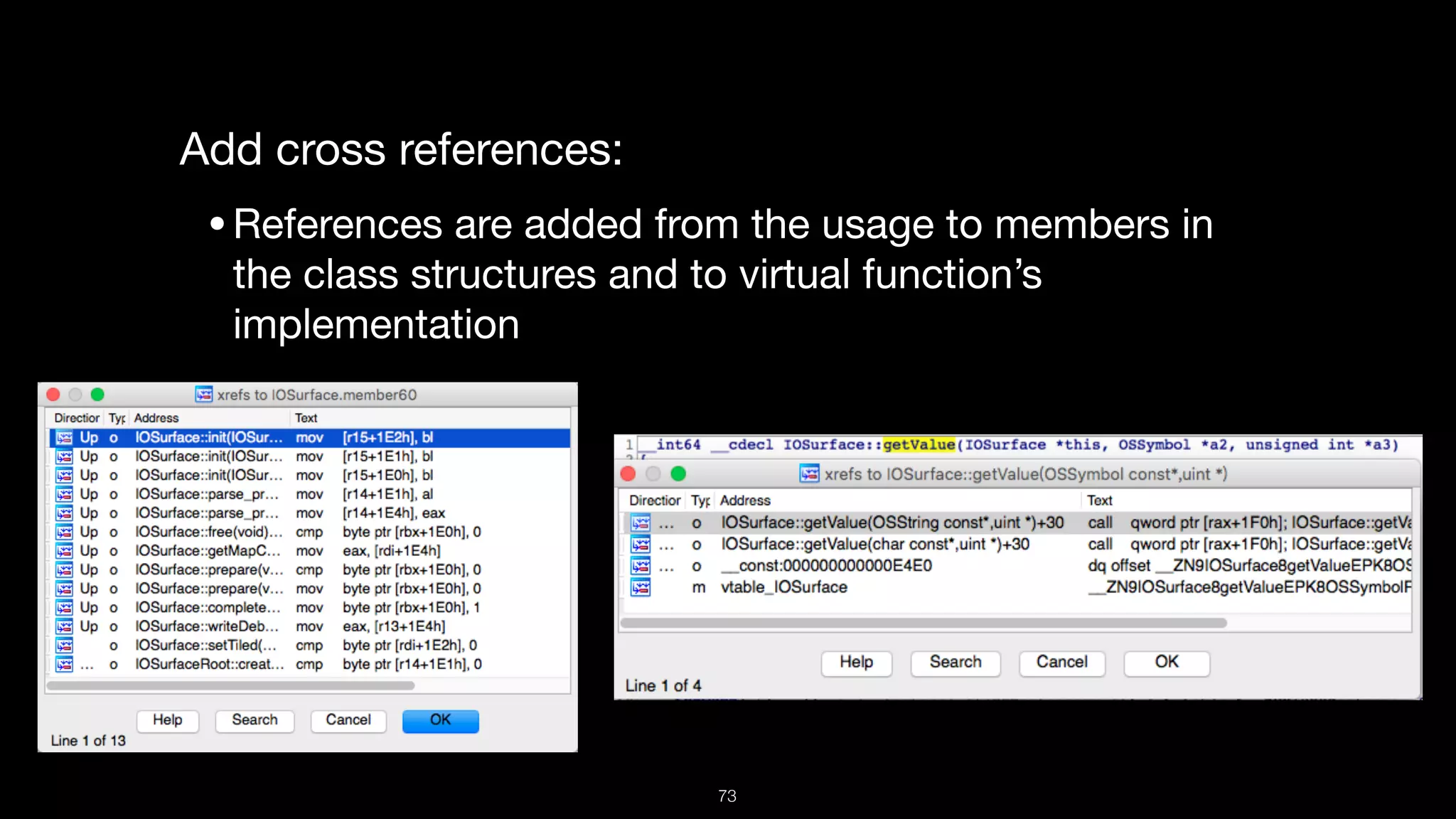
Add cross references:

•References are added from the usage to members in
the class structures and to virtual function’s
implementation
73
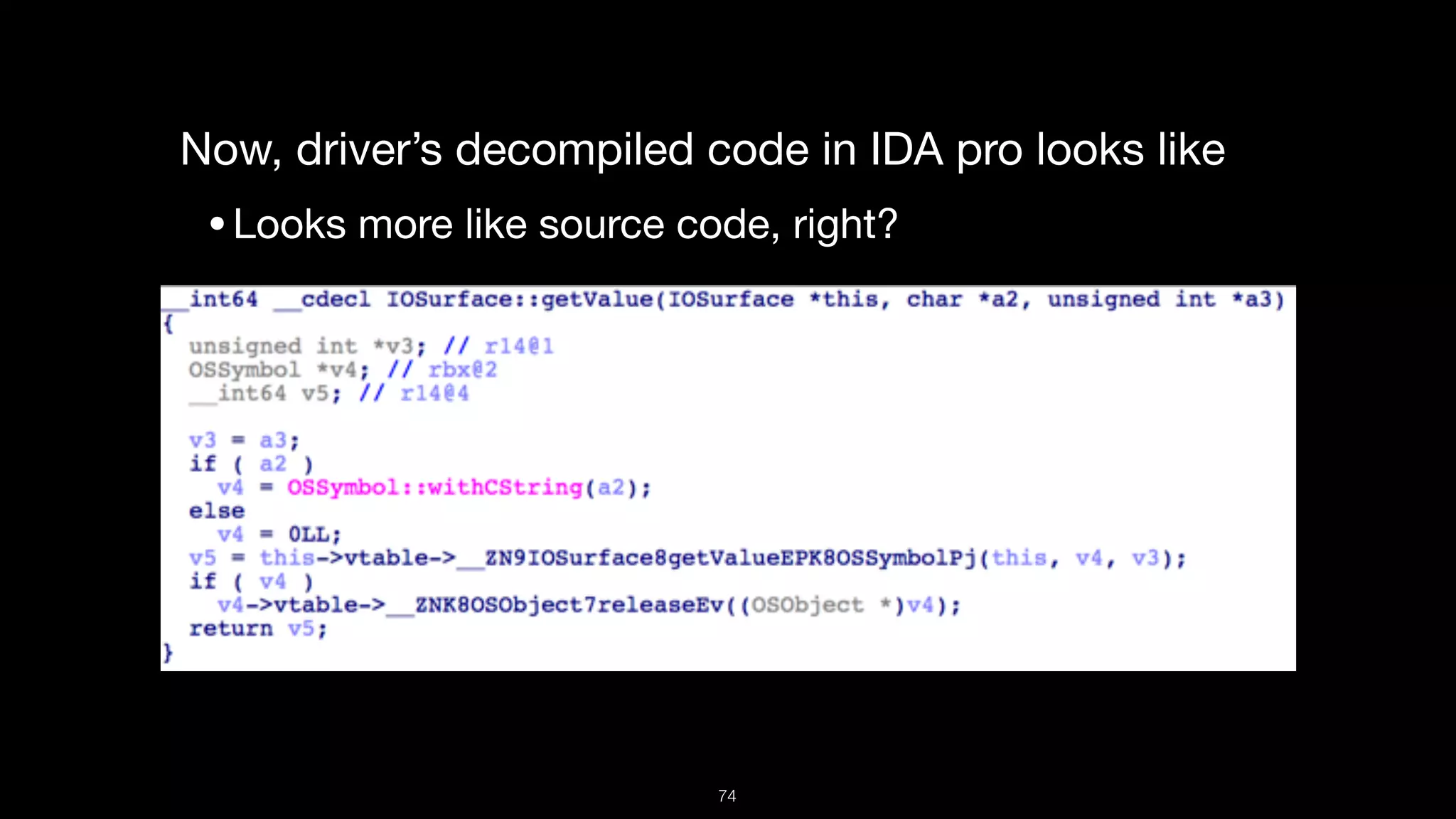
Now, driver’s decompiled code in IDA pro looks like

•Looks more like source code, right?
74
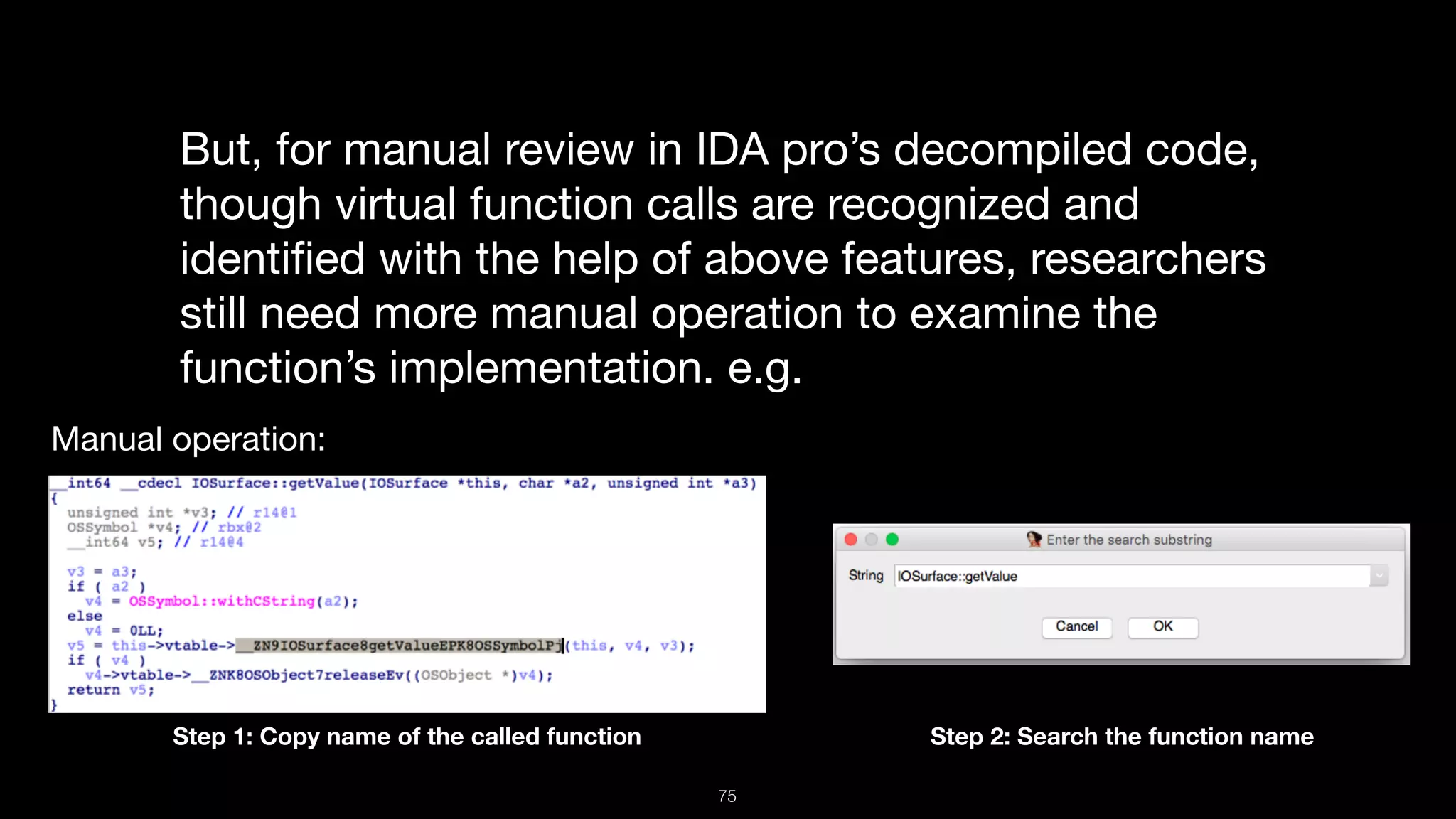
But, for manual review in IDA pro’s decompiled code,
though virtual function calls are recognized and
identified with the help of above features, researchers
still need more manual operation to examine the
function’s implementation. e.g.
Manual operation:
Step 1: Copy name of the called function Step 2: Search the function name
75
UI support 

•Extend UI operation that can be performed in IDA pro’s
decompiled code

•Method:

• Register action to double-click events

• Register action to key events

• Register action to name change events

• Register action to type change events
76
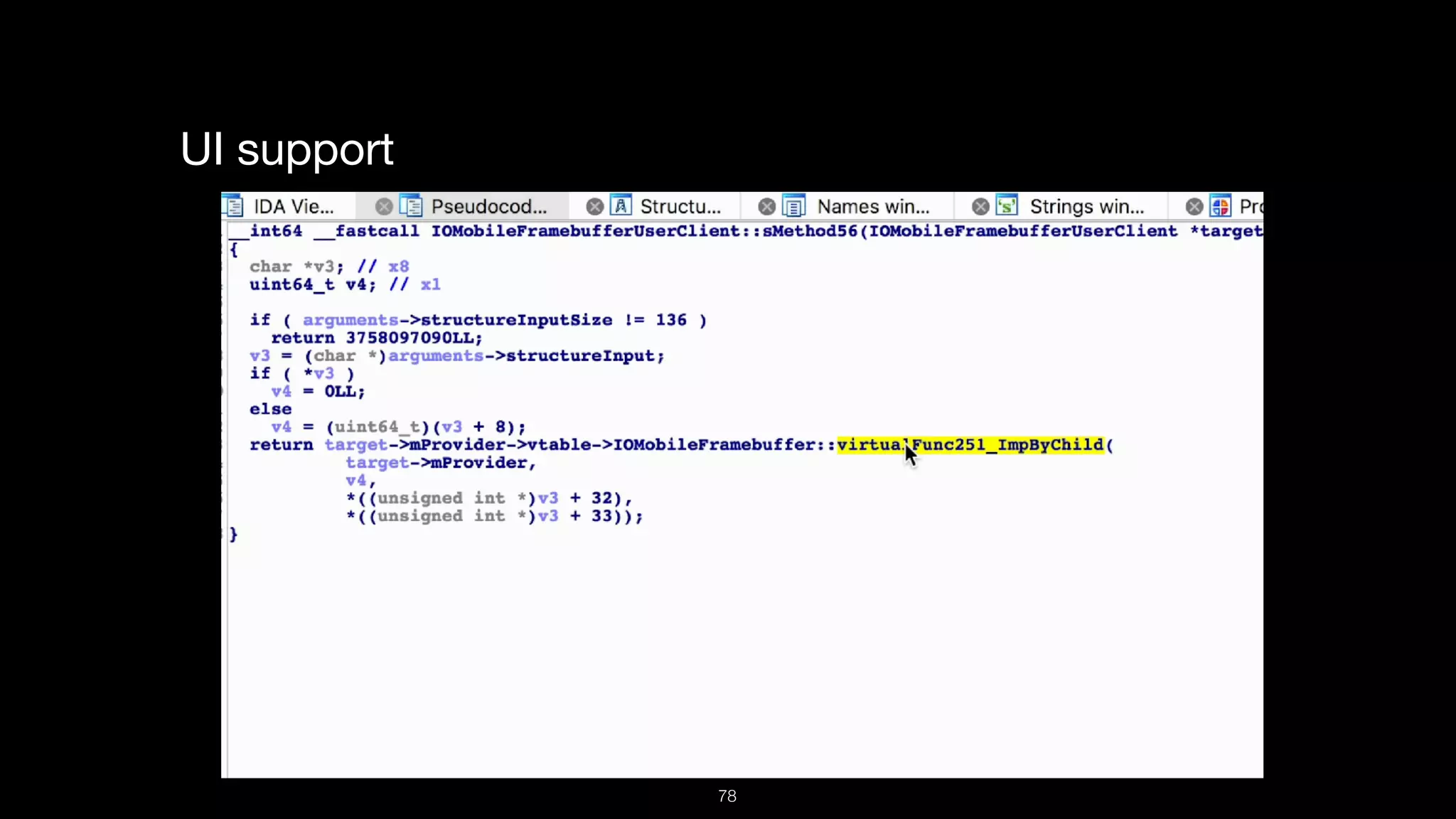
UI support 

•Extend UI operation that can be performed in IDA pro’s
decompiled code, e.g. jump to virtual function’s
implementation by just a double click

•Method:

• Register action to double-click events

• Register action to key events

• Register action to name change events

• Register action to type change events
77
UI support
78
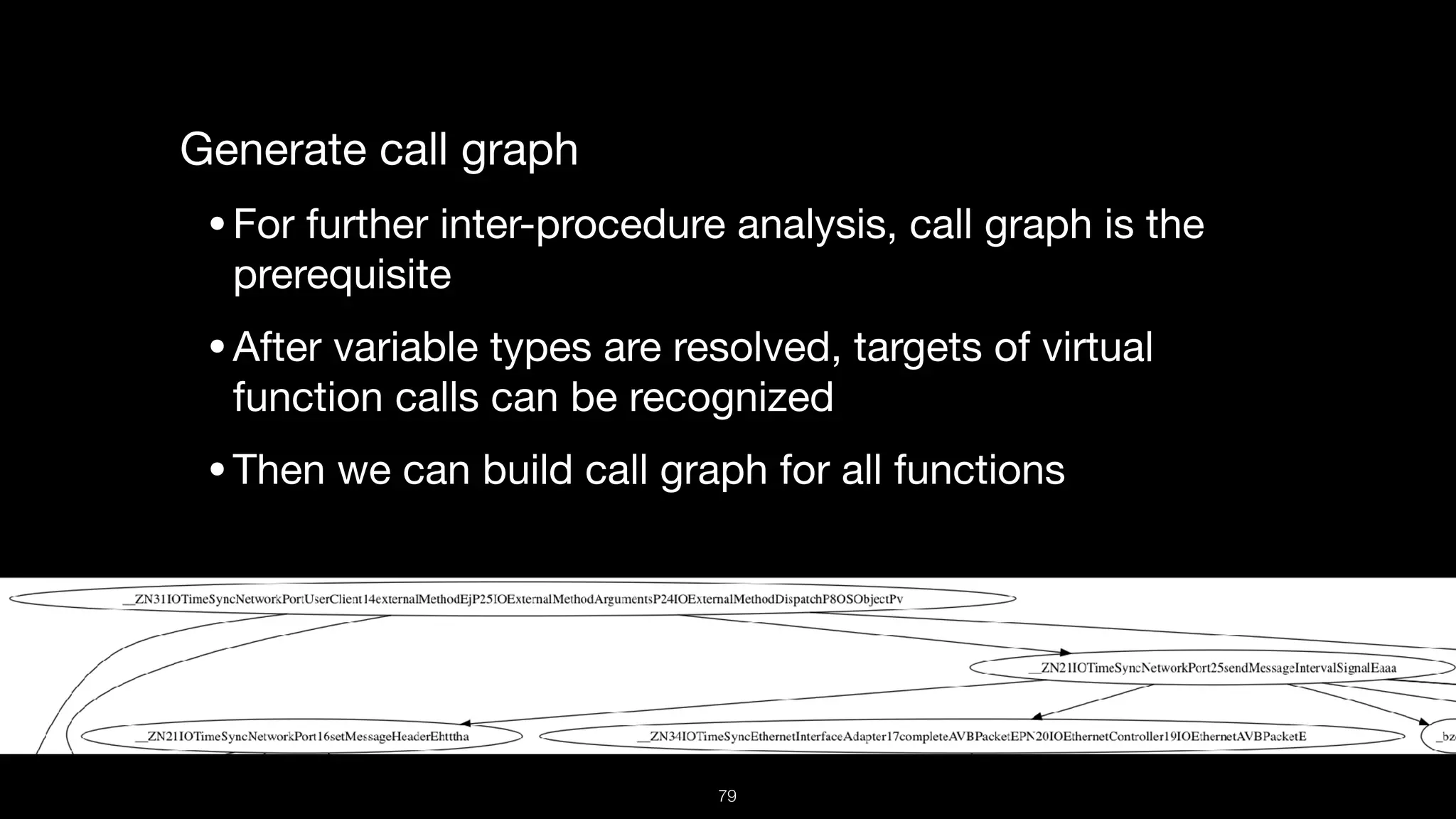
Generate call graph

•For further inter-procedure analysis, call graph is the
prerequisite 

•After variable types are resolved, targets of virtual
function calls can be recognized

•Then we can build call graph for all functions
79
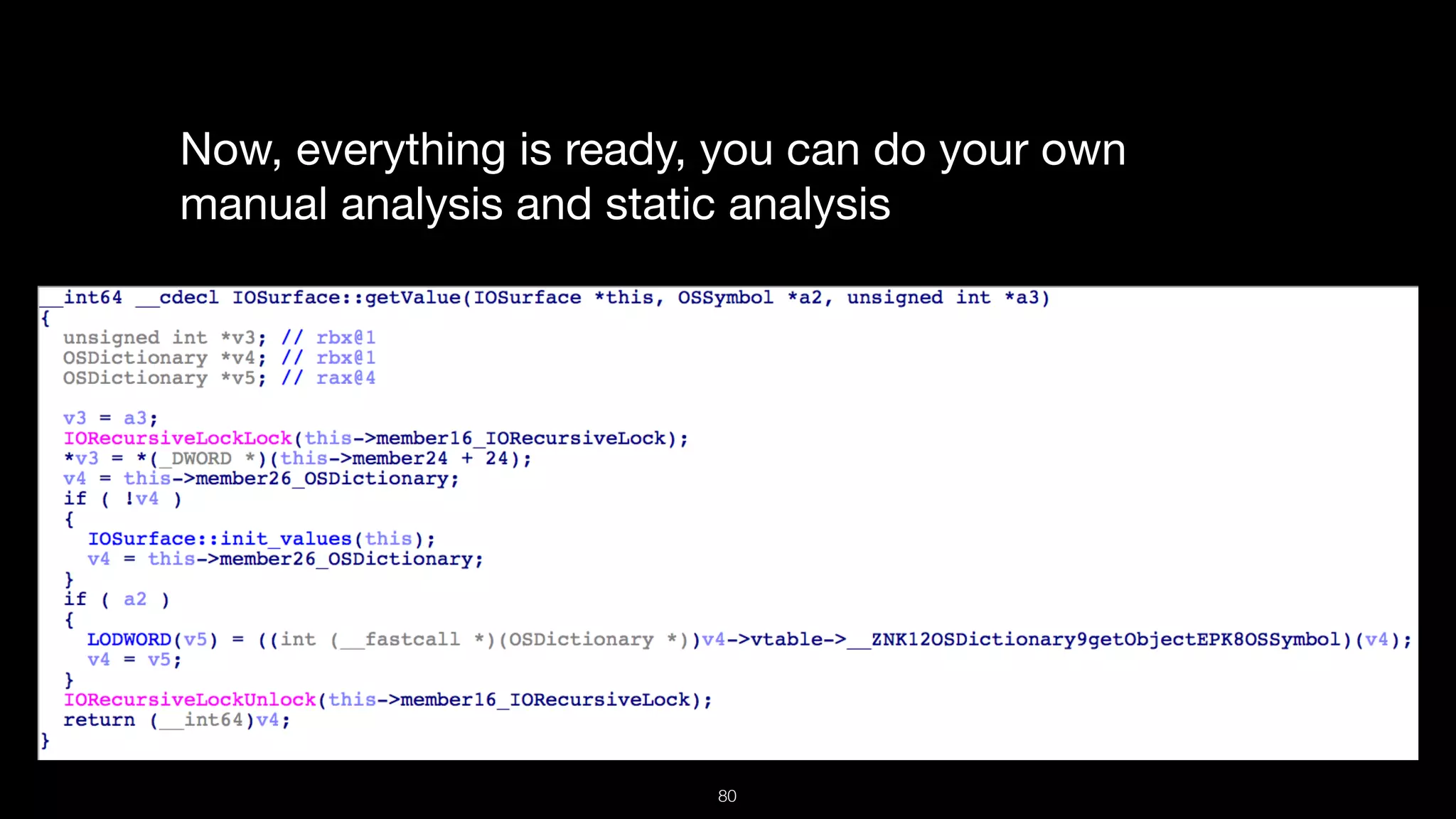
Now, everything is ready, you can do your own
manual analysis and static analysis
80
Ryuk-Fuzz: combine fuzzing 

with static analysis
81
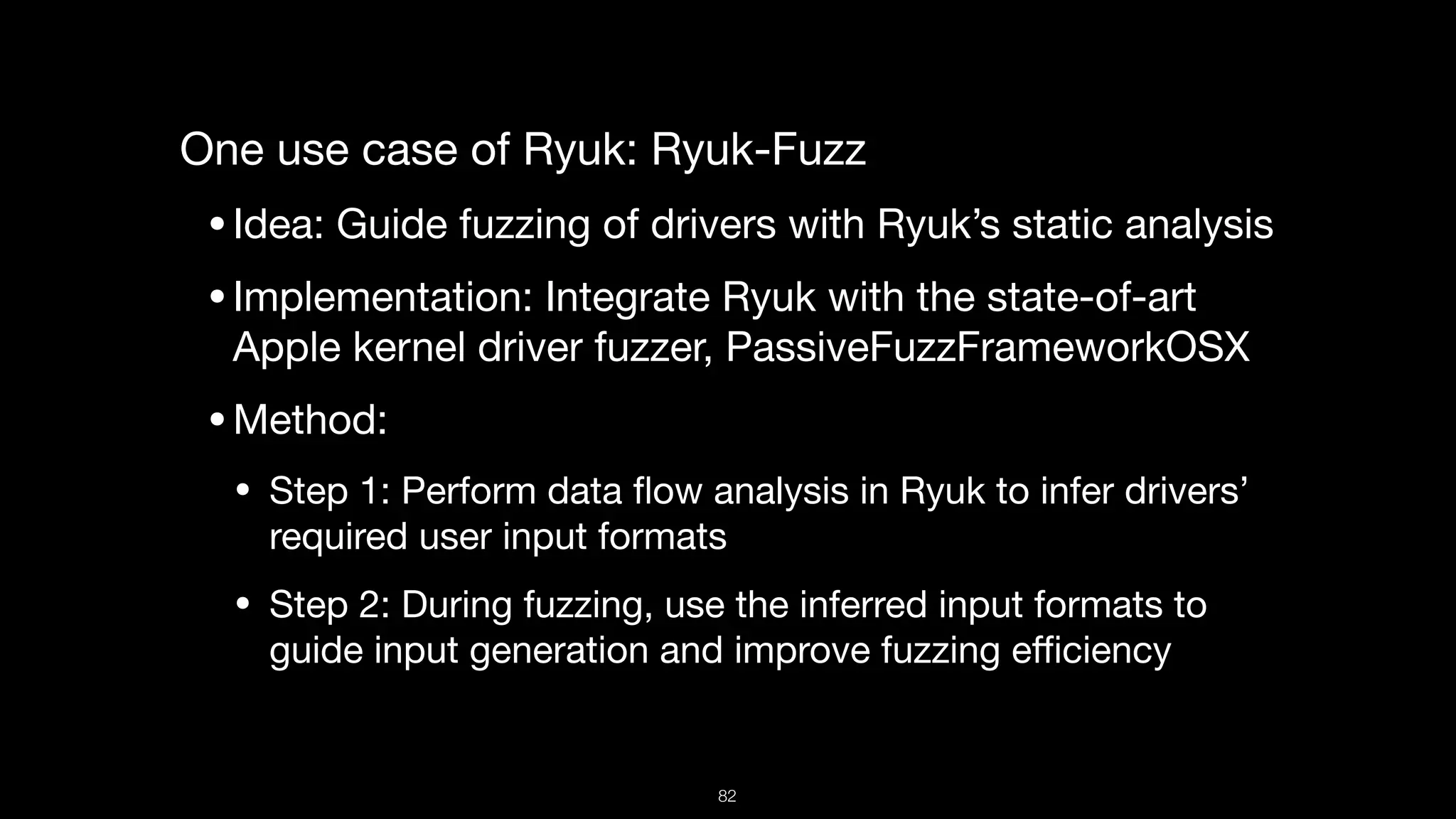
One use case of Ryuk: Ryuk-Fuzz

•Idea: Guide fuzzing of drivers with Ryuk’s static analysis 

•Implementation: Integrate Ryuk with the state-of-art
Apple kernel driver fuzzer, PassiveFuzzFrameworkOSX 

•Method: 

• Step 1: Perform data flow analysis in Ryuk to infer drivers’
required user input formats

• Step 2: During fuzzing, use the inferred input formats to
guide input generation and improve fuzzing efficiency
82
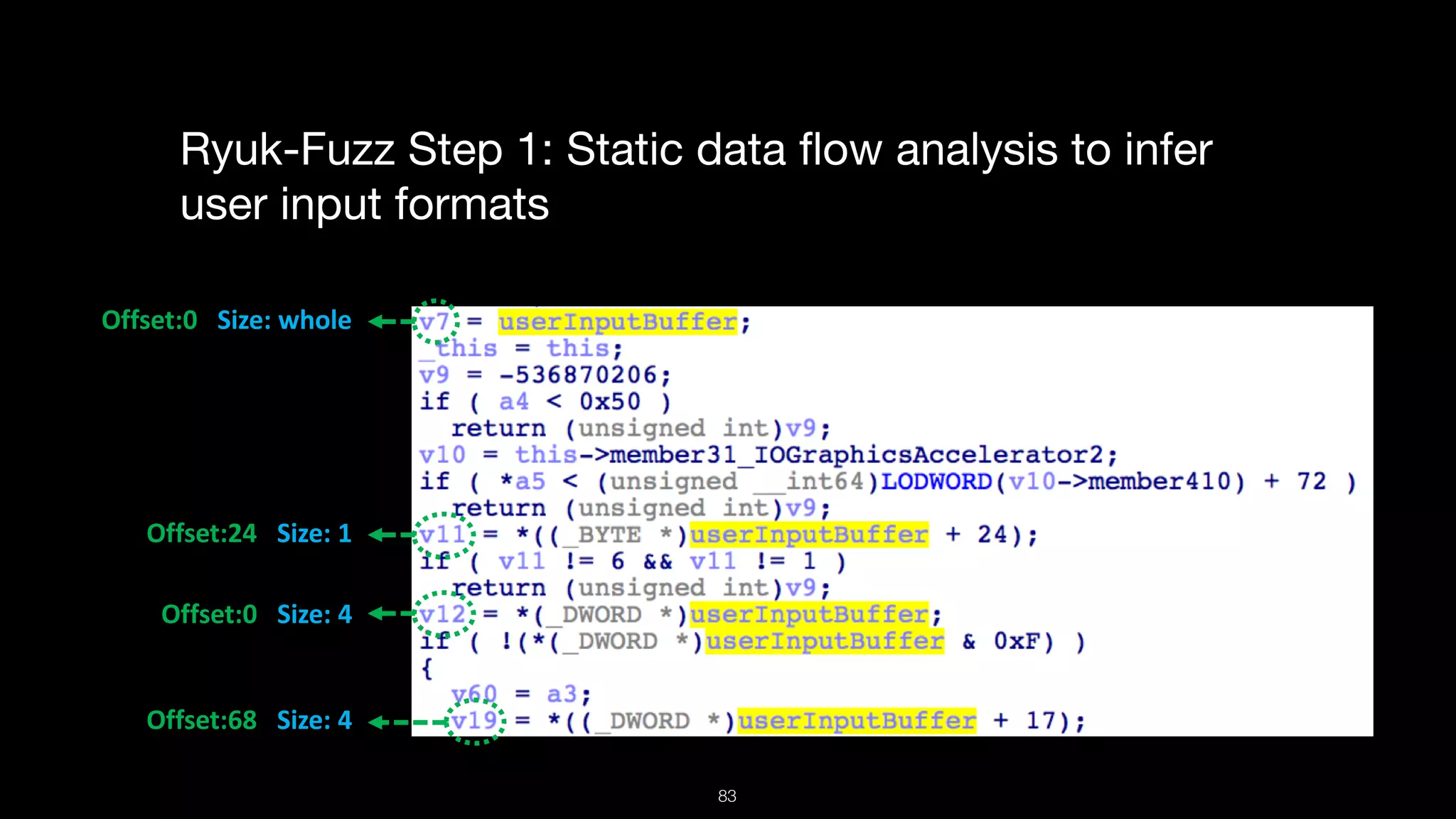
Ryuk-Fuzz Step 1: Static data flow analysis to infer
user input formats
Offset:0 Size: whole
Offset:24 Size: 1
Offset:0 Size: 4
Offset:68 Size: 4
83
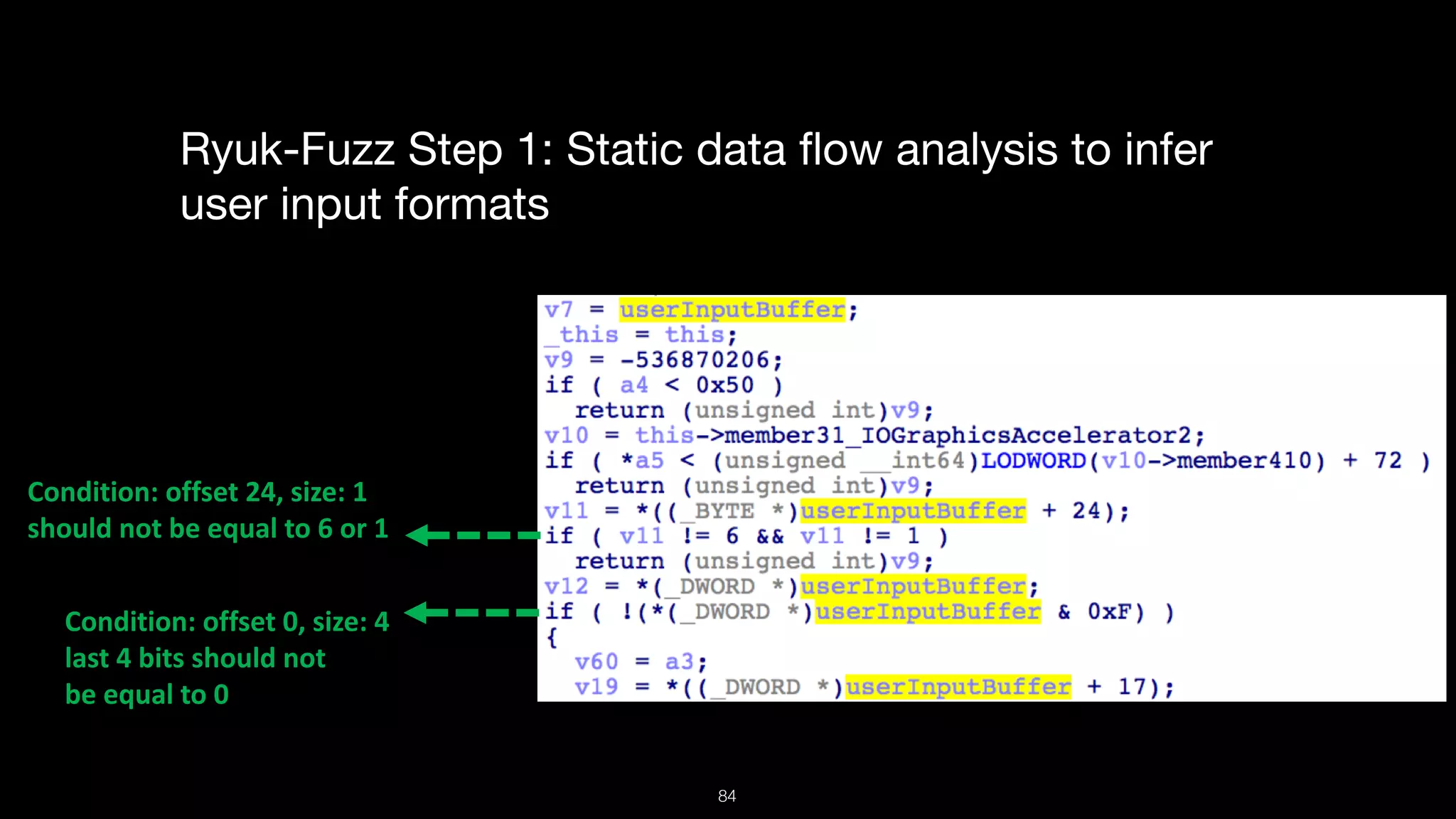
Ryuk-Fuzz Step 1: Static data flow analysis to infer
user input formats
Condition: offset 24, size: 1
should not be equal to 6 or 1
Condition: offset 0, size: 4
last 4 bits should not
be equal to 0
84
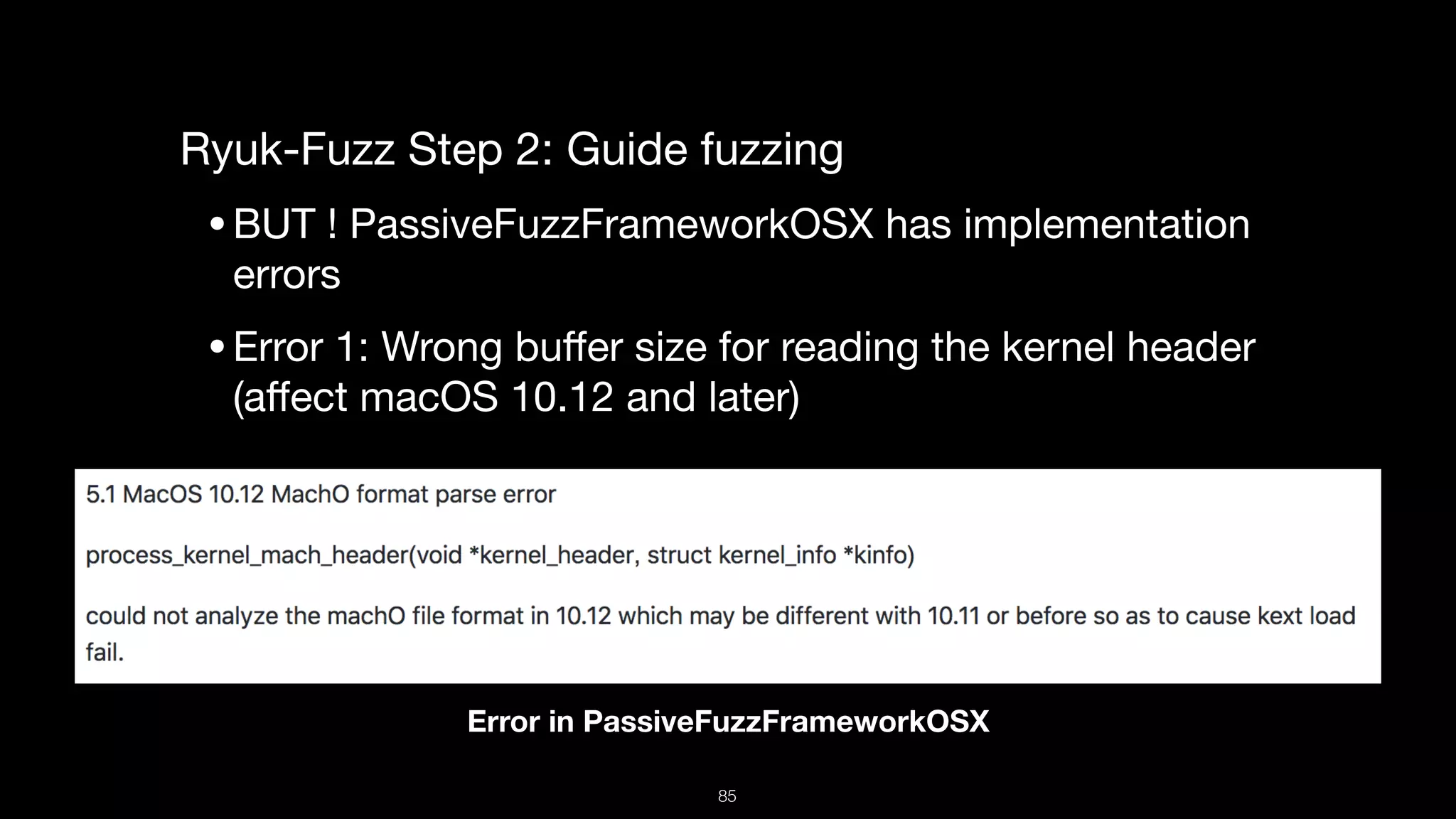
Ryuk-Fuzz Step 2: Guide fuzzing

•BUT ! PassiveFuzzFrameworkOSX has implementation
errors

•Error 1: Wrong buffer size for reading the kernel header
(affect macOS 10.12 and later)

Error in PassiveFuzzFrameworkOSX
85
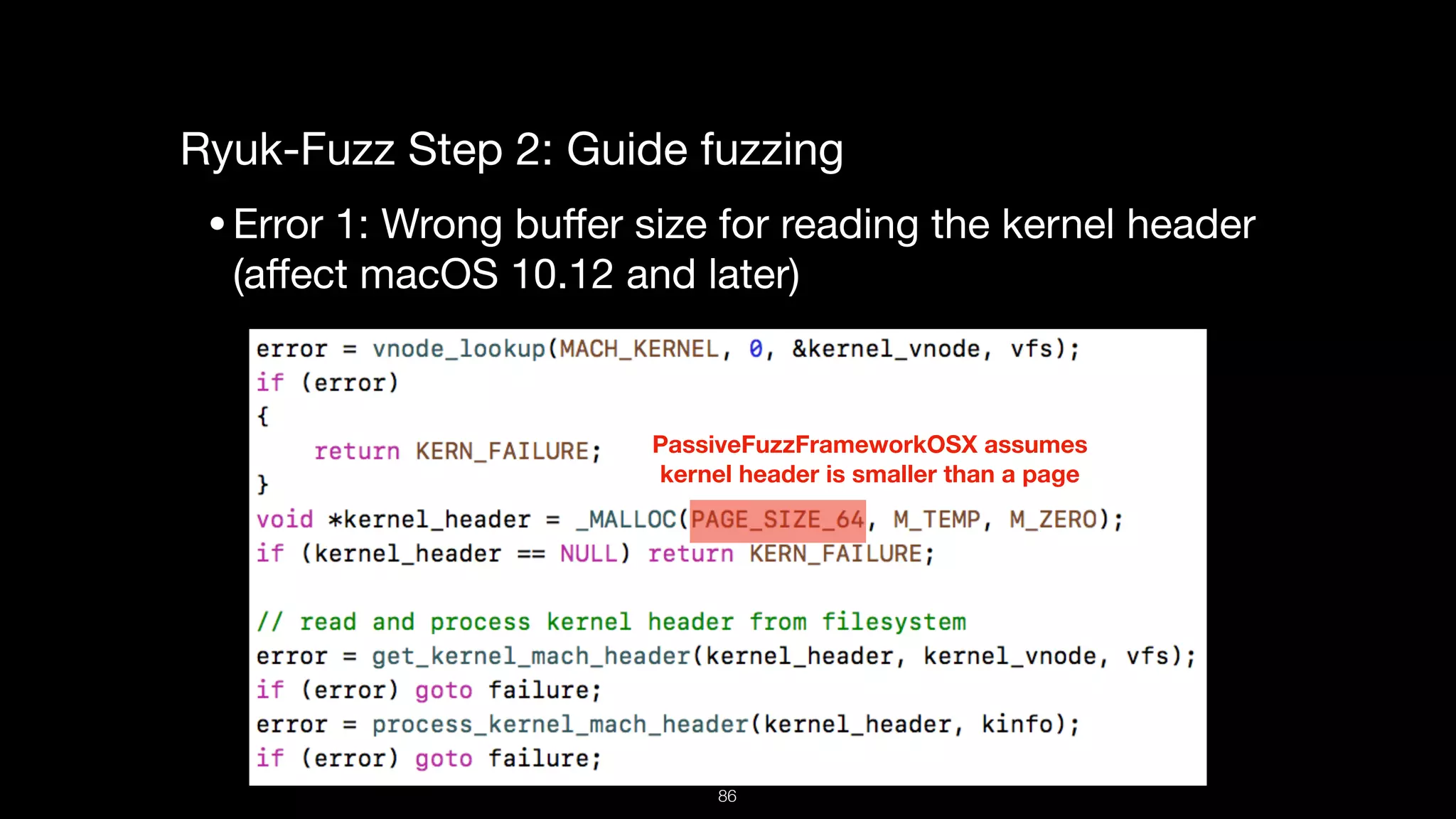
Ryuk-Fuzz Step 2: Guide fuzzing

•Error 1: Wrong buffer size for reading the kernel header
(affect macOS 10.12 and later)

PassiveFuzzFrameworkOSX assumes 

kernel header is smaller than a page
86
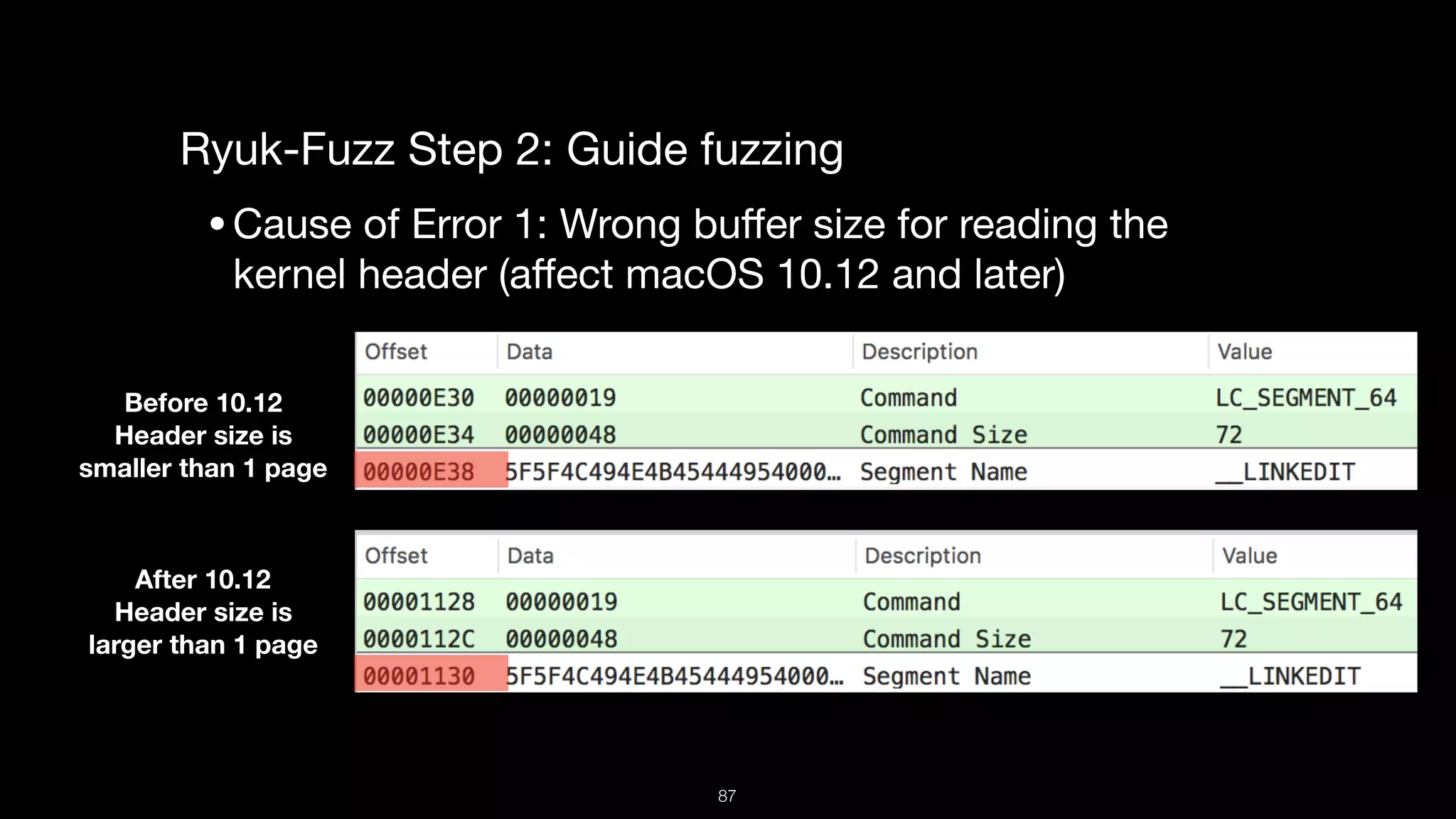
Ryuk-Fuzz Step 2: Guide fuzzing

•Cause of Error 1: Wrong buffer size for reading the
kernel header (affect macOS 10.12 and later)

Before 10.12
Header size is 

smaller than 1 page
After 10.12
Header size is 

larger than 1 page
87
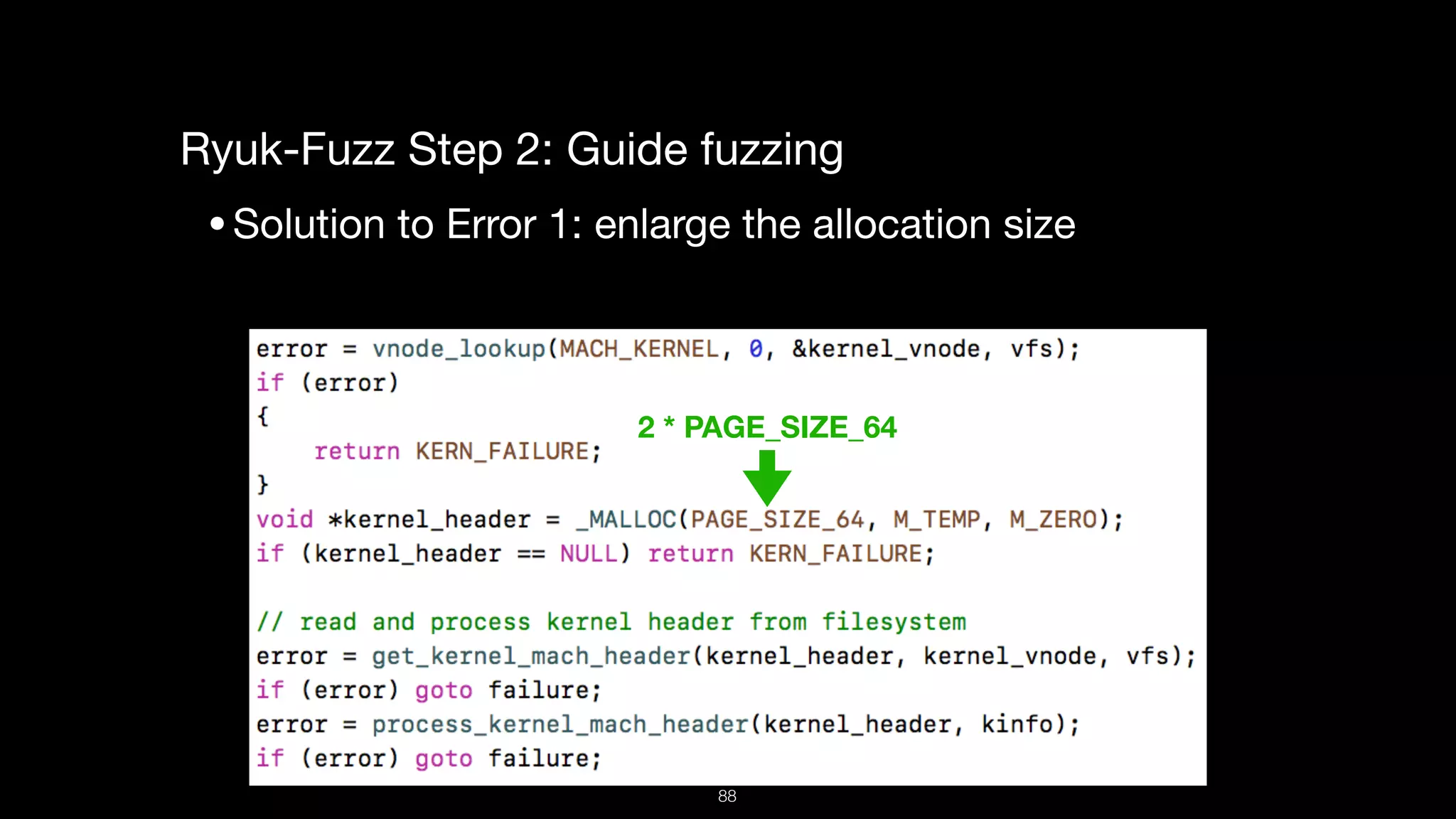
Ryuk-Fuzz Step 2: Guide fuzzing

•Solution to Error 1: enlarge the allocation size

2 * PAGE_SIZE_64
88
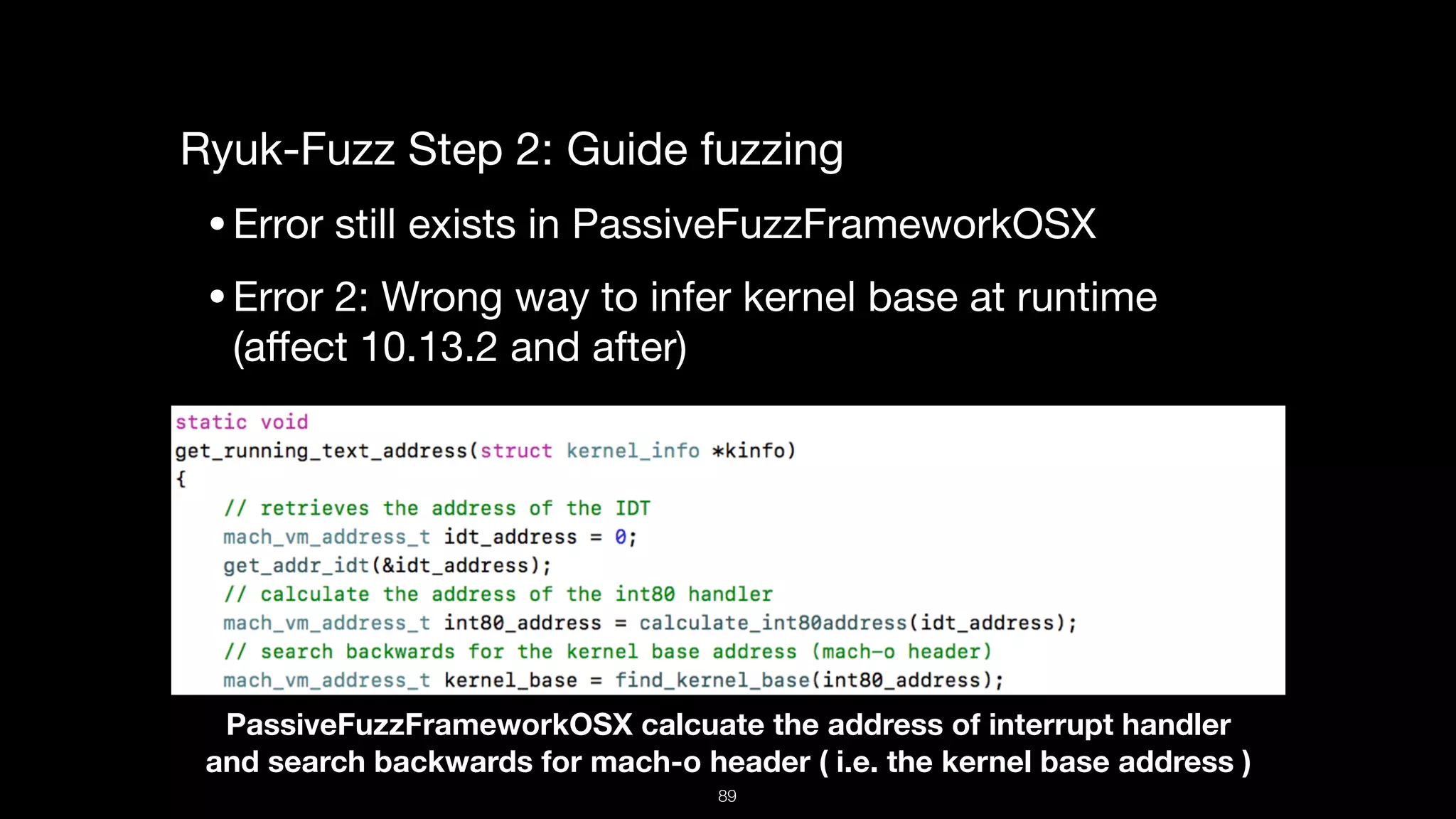
Ryuk-Fuzz Step 2: Guide fuzzing

•Error still exists in PassiveFuzzFrameworkOSX

•Error 2: Wrong way to infer kernel base at runtime 

(affect 10.13.2 and after) 

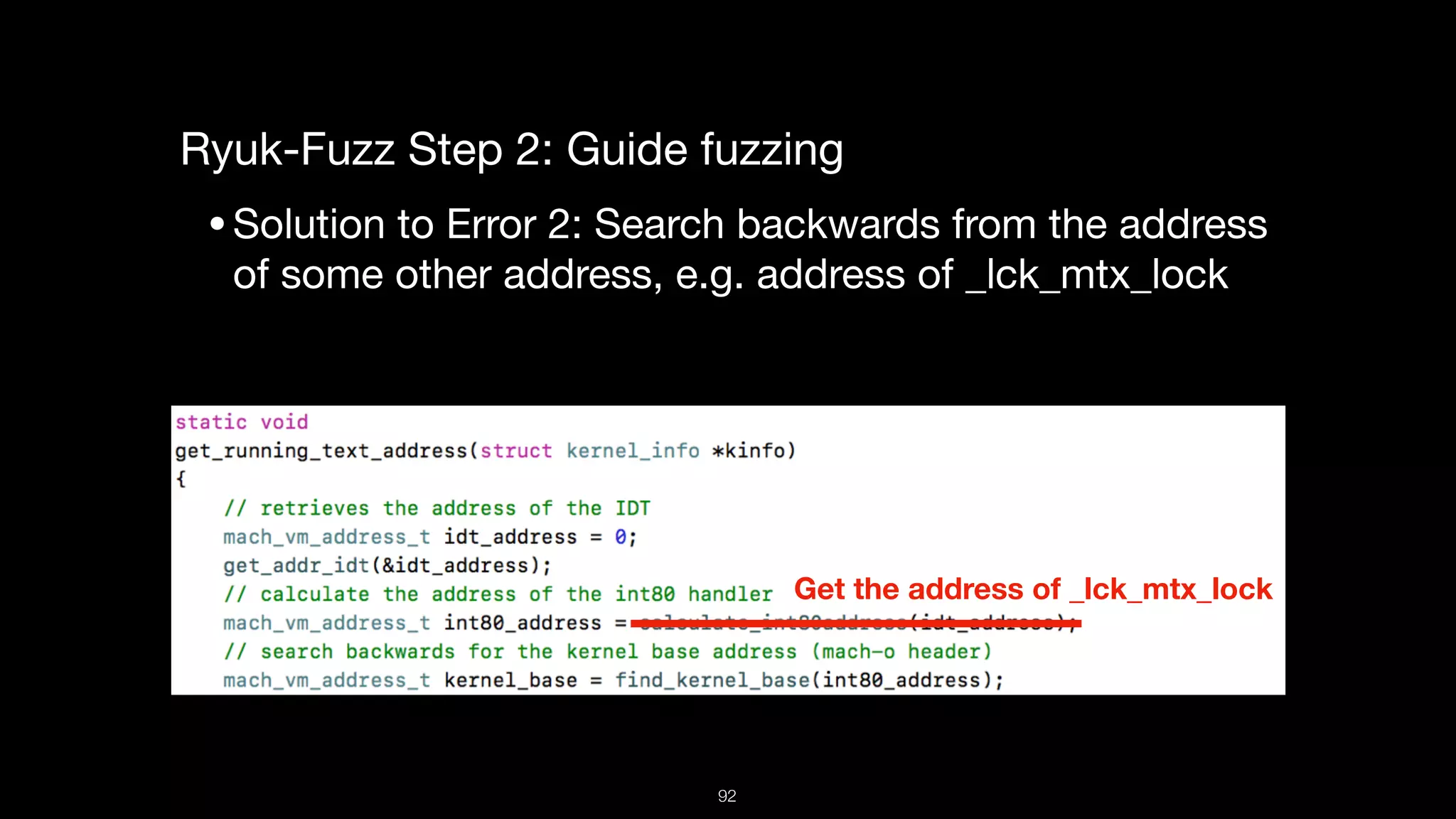
PassiveFuzzFrameworkOSX calcuate the address of interrupt handler 

and search backwards for mach-o header ( i.e. the kernel base address )
89
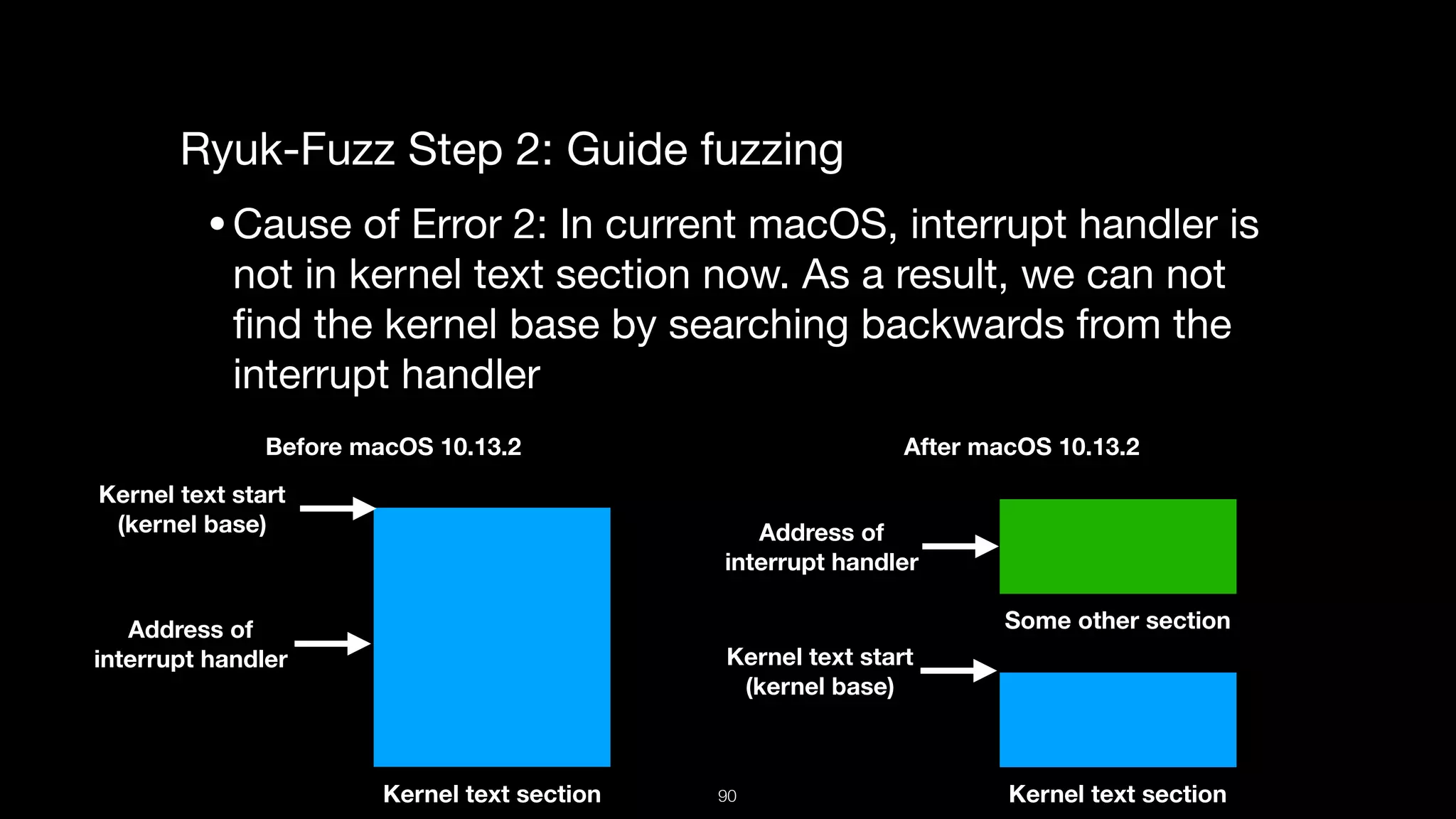
Ryuk-Fuzz Step 2: Guide fuzzing

•Cause of Error 2: In current macOS, interrupt handler is
not in kernel text section now. As a result, we can not
find the kernel base by searching backwards from the
interrupt handler 

Kernel text start

(kernel base)
Kernel text section
Address of 

interrupt handler
Before macOS 10.13.2
Kernel text start

(kernel base)
Kernel text section
Address of 

interrupt handler
After macOS 10.13.2
Some other section
90
Ryuk-Fuzz Step 2: Guide fuzzing

•Why the interrupt handler is not in kernel text now?

• The side effect of Apple’s patch to mitigate Meltdown
vulnerability

• Apple splits user and kernel space, in which interrupt
handler entries are not in kernel text space now

• As a result, kernel text base can not be inferred by the
interrupt handler

91
Ryuk-Fuzz Step 2: Guide fuzzing

•Solution to Error 2: Search backwards from the address
of some other address, e.g. address of _lck_mtx_lock

Get the address of _lck_mtx_lock
92
Conclusions
93
Vulnerabilities that can be exploited for privilege
escalation on macOS

Technique of exploiting use-after-free vulnerability in
the kernel

Ryuk: a new static analysis tool assisting manually
reverse engineering and static analysis

Ryuk-Fuzz: guide fuzzing of drivers with static
analysis results
94
95
Q&A

One bite and all your dreams will come true: Analyzing and Attacking Apple Kernel Drivers

  • 1.
    One bite andall your dreams will come true: Analyzing and Attacking Apple Kernel Drivers X(aolon& Ba( & M(n Spar)) Zhen& 1
  • 2.
    Xiaolong Bai Alibaba SecurityEngineer  Ph.D. graduated from Tsinghua University Published papers on the top 4: S&P, Usenix Security, CCS, NDSS Twitter, Weibo, Github: bxl1989 Min (Spark) Zheng Alibaba Security Expert Ph.D. graduated from The CUHK Twitter@SparkZheng Weibo@ spark 2
  • 3.
    1Overview 2New vulns in Appledrivers 3Obstacles in analyzing Apple drivers 3 4Ryuk: a new static analysis tool to analyze drivers 5Ryuk-Fuzz: combine fuzzing with static analysis 6Conclusions
  • 4.
  • 5.
    Every driver isa kernel extension (.kext) sharing the same space with the kernel Location of driver binaries: •On macOS: /System/Library/Extensions •On iOS: integrated with kernel in kernelcache 5
  • 6.
    Userclient: kernel objectsfor drivers to provide service to programs in userspace Userclient is the interface between user-space applications and devices 6
  • 7.
    In order toprovide services, userclients need to implement several callback methods: • externalMethod: Provide methods that can be called in user- space • clientMemoryForType: Share memory with apps in user- space • registerNotificationPort: Allow user-space app to register for notifications • clientClose: Close connection with user-space app • … 7
  • 8.
    externalMethod(uint32_t selector,  
 IOExternalMethodArguments*arguments, 
 IOExternalMethodDispatch *dispatch, 
 OSObject *target, void *reference); •Callback to provide methods to userspace program •selector: to select method in userclient •arguments: arguments passed to the selected method •dispatch: a struct representing the method to be called •target: the target userclient for the method to be called on •reference: reference to send results back to userspace program 8
  • 9.
    Despite of strictsandbox restriction, some userclients are still be accessible to sandboxed apps on iOS: •IOHIDLibUserClient •IOMobileFramebufferUserClient •IOSurfaceAcceleratorClient •AppleJPEGDriverUserClient •IOAccelDevice2, IOAccelSharedUserClient2, IOAccelCommandQueue2 •AppleKeyStoreUserClient •IOSurfaceSendRight, IOSurfaceRootUserClient 9
  • 10.
    New vulns inApple drivers 10
  • 11.
    Drivers are goodtargets for exploiting the kernel •Share the same space with the kernel •Have kernel privileges •Some programmed by third-party vendors, not kernel developer •Code quality is not guaranteed Drivers are frequently exploited in attacks against the kernel, including jailbreaks 11
  • 12.
    Previous vulns indrivers used in jailbreaks: •11 (v0rtex/electra): IOSurfaceRoot (CVE-2017-13861) •9 (pangu): IOMobileFrameBuffer (CVE-2016-4654) •8 (TaiG): IOHIDFamily (CVE-2015-5774) •7 (pangu): AppleKeyStore  (CVE-2014-4407)  Next, let’s have a look at some new vulns we recently discovered in Apple drivers! 12
  • 13.
    Privilege escalation onmacOS 10.13.3 13
  • 14.
    This privilege escalationleverages a new Use-After- Free vulnerability in the driver IOAcceleratorFamily2 •IOAccelDisplayPipeUserClient2::s_transaction_end All IOAccelDisplayPipeUserClient2 
 share the same IOAccelDisplayPipe2 14
  • 15.
    This privilege escalationleverages a new Use-After- Free vulnerability in the driver IOAcceleratorFamily2 •IOAccelDisplayPipe2::transaction_end IOAccelDisplayPipe2 contains a link list of IOAccelDisplayPipe2Transaction2. IOAccelDisplayPipe2::transaction_end traverse the link list to find a transaction And further call IOAccelDisplayPipeTransaction2::set_transaction_args using the found transaction A link list of transactions in this IOAccelDisplayPipe2 15
  • 16.
    This privilege escalationleverages a new Use-After- Free vulnerability in the driver IOAcceleratorFamily2 •IOAccelDisplayPipeTransaction2::set_transaction_args mAccelDisplayPipeUserClient2 is a member of IOAccelDisplayPipeTransaction2, 
 whose type is IOAccelDisplayPipeUserClient2, 
 representing which userclient the transaction belongs to The userclient that this transaction belongs to 16
  • 17.
    This privilege escalationleverages a new Use-After- Free vulnerability in the driver IOAcceleratorFamily2 •But, mAccelDisplayPipeUserClient2 can be released by calling IOServiceClose from user space, causing use- after-free Userclient can be released from user space Cause use-after-freee 17
  • 18.
    Exploitation of thebug • Creat 2 IOAccelDisplayPipeUserClient2 • Begin a IOAccelDisplayPipeTransaction2 by userclient1 • Release userclient1 • End the transaction from userclient2 —> use-after-free The bug is not exploitable now! •Reason: different IOAccelDisplayPipeUserClient2 do not share the same IOAccelDisplayPipe2 now ! 18
  • 19.
    Besides the abovevuln, we also discovered some other new vulns in Apple drivers •CVE-2017-7119 •CVE-2018-4135 Next, we will show details of these vulns 19
  • 20.
    CVE-2017-7119 •Information leakage inIOFirewireFamily •Caused by uninitialized stack variable •In IOFireWireUserClient::externalMethod 20
  • 21.
  • 22.
    CVE-2017-7119 •In IOFWUserObjectExporter::addObject •outHandle shouldbe set with the index of new-added object •But, when newCapacity reaches 0xFFFE, new object will not be added and outHandle will not be set 22
  • 23.
    CVE-2017-7119 •Recall in IOFireWireUserClient::externalMethod •outHandleis unintialized and returned to userspace •Information leak! 23
  • 24.
    CVE-2017-7119 •Can be exploitedto get kernel slide, defeat kaslr, e.g. Kernel slide = 0x4ebc0b6-0x8bc0b6 = 0x4600000 Though outChannelHandle is only 32bit, but enough since the high 32bit is always 0xffffff80 here 24
  • 25.
    CVE-2018-4135 •Use-After-Free in IOFirewireFamilydriver •Lack of locking or serialization when using and releasing a member variable •Can be exploited to control PC in kernel 25
  • 26.
    CVE-2018-4135 •Use-After-Free in IOFirewireFamilydriver •Lack of locking or serialization when using and releasing a member variable •In IOFireWireUserClient::externalMethod, 26
  • 27.
    CVE-2018-4135 •IOFireWireUserClient::userAsyncCommand_Submit looks up fora IOFWUserReadCommand and calls its “submit” method 27
  • 28.
  • 29.
    CVE-2018-4135 •(a) release fMem,(b) uses fMem (fMem is a member) 29
  • 30.
    CVE-2018-4135 Exploit: •Create twothreads to invoke method on the same userclient •One thread release fMem, the other uses it 30
  • 31.
    How to exploitUse-After-Free bug in the kernel for privilege escalation? Basic flow: Construct ROP chain Trigger release Heap spray in kernel Trigger use … Target Object … … Empty Slot … … Fake object with fake viable … … Fake object with fake viable … PC control 31
  • 32.
    A new heapspray method on macOS •Utilize OSUnserializeXML •Set properties of a device 32
  • 33.
    A new heapspray method on macOS •Some drivers keep any properties set by userspace, e.g., IOHIDEventService •Pros: the sprayed data can be read; the head of sprayed data is controllable 33
  • 34.
    ROP chain forprivilege escalation Stack Pivot _current_proc _proc_ucred _posix_cred_get _bzero _thread_excep+on_return Get ptr to struct proc of current process Get ucred from struct proc, i.e., process owner's iden+ty Get ptr to struct cr_posix Clear cr_uid, cr_ruid, cr_svuid in cr_posix struct Exit kernel, return to userspace 34
  • 35.
    Stack Pivot: Changecurrent stack, for performing ROP in an elegant way •Previous Methods (Unavailable Now) In tpwn (on 10.10) In rootsh (on 10.11) 35
  • 36.
    Stack Pivot: Changecurrent stack, for performing ROP in an elegant way •New Method Step 1: Control RAX and affect RCX (Gadget P1) Step 2: Modify RSP by controlled RCX (Gadget P2) 36
  • 37.
    Layout of gadgetsin a ROP chain •Assume: RAX is controlled and [RAX+0x10] is to be called •Store address X in RAX, X contains a ROP chain Addr of Gadget P2 New RSP: X+0x50 Addr of Gadget P1 X Addr of Gadget “NOP; RET;” Addr of _current_proc and Gadget “MOV RDI, RAX” Address of _proc_ucred and Gadget “MOV RDI, RAX” Address of _posix_cred_get and Gadget “MOV RDI, RAX” Addr of _bzero X X+0x8 Addr of G_thread_exception_return … X+0x10, ROP starts from here X+0x30 X+0x38 X+0x40, start privilege escalation Content Address 37
  • 38.
    Privilege escalation onthe macOS 10.13 and 10.13.2 38
  • 39.
    Obstacles in analyzingApple drivers 39
  • 40.
    Analyzing macOS andiOS kernel drivers is not easy! •Drivers are closed-source: binaries are lack of high-level semantics and variable types are lost •Drivers are programmed in C++: virtual functions are widely used but object types are unknown —> the real function called is unknown •Symbols are lost in iOS drivers: iOS kernelcache strips all symbols in drivers 40
  • 41.
    What does adriver’s binary look like in IDA pro? •macOS driver: some symbols are kept 41
  • 42.
    What does adriver’s binary look like in IDA pro? •macOS driver: But! Wrong parameter inference, lack of variable types, unrecognizable virtual function calls Wrong parameter inference Variable types are lost Virtual function calls are unrecognizable 42
  • 43.
    What does adriver’s binary look like in IDA pro? •iOS driver: symbols are totally lost 43
  • 44.
    What does adriver’s binary look like in IDA pro? •iOS driver: data structure is gone, e.g. this figure should be the location of a virtual table 44
  • 45.
    What does adriver’s binary look like in IDA pro? •iOS driver: meaningless function names, totally lost variable types, unrecognized virtual function calls Wrong decompile resulteverywhere ! 45
  • 46.
    What exactly dowe want for a binary to be? •Function (including virtual func) calls are recognizable, the called functions are known •Missing symbols are recovered, decompiled code is understandable… Why? •Knowing the real call target is a prerequisite for inter- procedure analysis and futher analysis •Manual review needs meaningful decompiled code 46
  • 47.
    What exactly dowe want for a binary to be? •Just like we have the source code 47
  • 48.
    Ryuk: a newstatic analysis tool 
 to analyze Apple drivers 48
  • 49.
    Ryuk: a newstatic analysis tool aiming at solving uncertainties in Apple drivers, for further analyzing drivers’ security •Implemented as an IDA pro python script *Ryuk: a character in the comics series Death Note, who loves eating apples. 49
  • 50.
    Ryuk’s features (functionalities): •Classrecognition: identify classes’ information •VTable recognition: identify classes’ virtual functions •Recover function names: only for iOS drivers •Resolve variable types: resolve and mark variable types •Add cross references: for members and virtual funcs •UI support: better UI support for manual review • Call graph generation: for inter-procedure analysis 50
  • 51.
    Class recognition •Purpose: forvariable type inference and further analysis • Method: depend on RTTI information left in binaries • Apple drivers are programed in C++ and support a limited RTTI feature • __mod_init_func: a section containing initialization functions to support RTTI • Analyzing functions in __mod_init_func section, we can get information of classes (name, size…) 51
  • 52.
  • 53.
    Class recognition • Functionsin __mod_init_func: register class information macOS iOS Class Name Class Size 53
  • 54.
    Class recognition • Decompiledcode of functions in __mod_init_func macOS iOS 54
  • 55.
    Class recognition • Withidentified class names and sizes, we can create structures to represent these classes in IDA pro 55
  • 56.
    VTable recognition •In C++,virtual functions of a class are organized in a structure called VTable, which is in __const section •In every C++ class, the first member is always a pointer to this VTable. Source code VTable Decompiled 
 code 56
  • 57.
    VTable recognition •Purpose: resolvethe real targets of virtual function calls • Method: on macOS, there are symbols for VTables Symbols of VTables VTable structure 57
  • 58.
    VTable recognition • Method:on iOS, several steps depending on the vtable’s specific structure • Hint: find class’s global metaclass object and further find VTable Class’s global metaclass object VTable start 58
  • 59.
    VTable recognition • iOSStep 1: adjust __const section in IDA pro • In __const, mark each 8 bytes as a pointer 59
  • 60.
    VTable recognition • iOSStep 2: find address of class’s global metaclass object in initialization function of __mod_init_func • In Apple driver, most C++ classes have a global metaclass object describing the class’s basic information Initialization function of __mod_init_func Address of class’s global metaclass object 60
  • 61.
    VTable recognition • iOSStep 3: check cross references of the global metaclass object, find the one in const section and near the VTable In const section 
 and near VTable 61
  • 62.
    VTable recognition • iOSStep 4: found VTable The address of global metalcass object VTable start found! 62
  • 63.
    VTable recognition • Afterrecognition, create structure in IDA pro standing for the VTable, each member is pointer to a virtual func • Set the first member of class structure as a pointer to this VTable structure VTable structure Class structure63
  • 64.
    Recover function names(only for iOS) • In drivers, most classes inherit from classes in the kernel, e.g., IOService, OSObject • Most classes in the kernel still keep symbols • In C++, when a child class inherits from a parent class and overrides a virtual function, the overriden function has same name and offset in VTable A::foo class A { public: virtual void foo(); } class B: public A { public: virtual void foo(); } … … B::foo … … A’s VTable B’s VTable Same name
 Same offset
 in VTable 64
  • 65.
    Recover function names(only for iOS) • Only recover the overridden virtual functions in classes inherited from classes in the kernel • Not a complete solution, but cover plenty of critical functions IOSurfaceRoot’s VTable (IOSurfaceRoot is inherited from IOSerivce) IOService’ VTable IOSurfaceRoot::
 getMetaClass overriden
 functions IOSurfaceRoot::
 free IOSurfaceRoot::
 IOSurfaceRoot 65
  • 66.
    Recover function names(only for iOS) • Many function names can be recovered in this way Original Now 66
  • 67.
    Resolve variable types(in IDA pro’s decompiled code) •For local, global and member variables •Method: identify variable types and perform type propagation •How to identify variable types: two ways • 1. Depend on features of function names in C++ • 2. Figure out the creation and iniatialization of variables 67
  • 68.
    Resolve variable types(in IDA pro’s decompiled code) •Identify variable types method 1: • After compilation, names of functions in C++ classes will be encoded with the function name and argument types • Decode (demangle) the C++ function names to get the type of function arguments, e.g. __ZN23IOSurfaceRootUserClient4initEP13IOSurfaceRootP4taskP12OSDictionary IOSurfaceRootUserClient::init (IOSurfaceRoot *, task *, OSDictionary *) Decode (Demangle) Variable Types 68
  • 69.
    Resolve variable types(in IDA pro’s decompiled code) •Identify variable types method 2: • Figure out the creation and iniatialization of variables • Find invocation of variable allocation, initialization and type casting functions, e.g. Allocation Func: OSMetaClass::allocClassWithName (const char *name) Allocatoin Func: IOSurfaceRootUserClient::MetaClass::alloc ( ) Init Func: IOCommandGate::IOCommandGate (IOCommandGate *) Type Cast: OSMetaClassBase::safeMetaCast (OSMetaClassBase *, OSMetaClass *) 69
  • 70.
    Resolve variable types(in IDA pro’s decompiled code) •After identifying variable types, we can perform type propagation along function’s control flow Type of v2 is IOAccelShared2 * Type of v2 is IOGraphicsAccelerator2 * 70
  • 71.
    Resolve variable types(in IDA pro’s decompiled code) •After identifying variable types, we can perform type propagation along function’s control flow Propagate v2’s type and affect the return type of function Propagate v2’s type and modify member variable’s type 71
  • 72.
    Add cross references: •Purpose:add cross references for member varaibles and virtual functions •Method: examine every sentence in the decompiled code of all functions, check whether member variable or virtual function is used, e.g. 72
  • 73.
    Add cross references: •Referencesare added from the usage to members in the class structures and to virtual function’s implementation 73
  • 74.
    Now, driver’s decompiledcode in IDA pro looks like •Looks more like source code, right? 74
  • 75.
    But, for manualreview in IDA pro’s decompiled code, though virtual function calls are recognized and identified with the help of above features, researchers still need more manual operation to examine the function’s implementation. e.g. Manual operation: Step 1: Copy name of the called function Step 2: Search the function name 75
  • 76.
    UI support •ExtendUI operation that can be performed in IDA pro’s decompiled code •Method: • Register action to double-click events • Register action to key events • Register action to name change events • Register action to type change events 76
  • 77.
    UI support •ExtendUI operation that can be performed in IDA pro’s decompiled code, e.g. jump to virtual function’s implementation by just a double click •Method: • Register action to double-click events • Register action to key events • Register action to name change events • Register action to type change events 77
  • 78.
  • 79.
    Generate call graph •Forfurther inter-procedure analysis, call graph is the prerequisite •After variable types are resolved, targets of virtual function calls can be recognized •Then we can build call graph for all functions 79
  • 80.
    Now, everything isready, you can do your own manual analysis and static analysis 80
  • 81.
    Ryuk-Fuzz: combine fuzzing
 with static analysis 81
  • 82.
    One use caseof Ryuk: Ryuk-Fuzz •Idea: Guide fuzzing of drivers with Ryuk’s static analysis •Implementation: Integrate Ryuk with the state-of-art Apple kernel driver fuzzer, PassiveFuzzFrameworkOSX •Method: • Step 1: Perform data flow analysis in Ryuk to infer drivers’ required user input formats • Step 2: During fuzzing, use the inferred input formats to guide input generation and improve fuzzing efficiency 82
  • 83.
    Ryuk-Fuzz Step 1:Static data flow analysis to infer user input formats Offset:0 Size: whole Offset:24 Size: 1 Offset:0 Size: 4 Offset:68 Size: 4 83
  • 84.
    Ryuk-Fuzz Step 1:Static data flow analysis to infer user input formats Condition: offset 24, size: 1 should not be equal to 6 or 1 Condition: offset 0, size: 4 last 4 bits should not be equal to 0 84
  • 85.
    Ryuk-Fuzz Step 2:Guide fuzzing •BUT ! PassiveFuzzFrameworkOSX has implementation errors •Error 1: Wrong buffer size for reading the kernel header (affect macOS 10.12 and later) Error in PassiveFuzzFrameworkOSX 85
  • 86.
    Ryuk-Fuzz Step 2:Guide fuzzing •Error 1: Wrong buffer size for reading the kernel header (affect macOS 10.12 and later) PassiveFuzzFrameworkOSX assumes 
 kernel header is smaller than a page 86
  • 87.
    Ryuk-Fuzz Step 2:Guide fuzzing •Cause of Error 1: Wrong buffer size for reading the kernel header (affect macOS 10.12 and later) Before 10.12 Header size is 
 smaller than 1 page After 10.12 Header size is 
 larger than 1 page 87
  • 88.
    Ryuk-Fuzz Step 2:Guide fuzzing •Solution to Error 1: enlarge the allocation size 2 * PAGE_SIZE_64 88
  • 89.
    Ryuk-Fuzz Step 2:Guide fuzzing •Error still exists in PassiveFuzzFrameworkOSX •Error 2: Wrong way to infer kernel base at runtime 
 (affect 10.13.2 and after) PassiveFuzzFrameworkOSX calcuate the address of interrupt handler 
 and search backwards for mach-o header ( i.e. the kernel base address ) 89
  • 90.
    Ryuk-Fuzz Step 2:Guide fuzzing •Cause of Error 2: In current macOS, interrupt handler is not in kernel text section now. As a result, we can not find the kernel base by searching backwards from the interrupt handler Kernel text start
 (kernel base) Kernel text section Address of 
 interrupt handler Before macOS 10.13.2 Kernel text start
 (kernel base) Kernel text section Address of 
 interrupt handler After macOS 10.13.2 Some other section 90
  • 91.
    Ryuk-Fuzz Step 2:Guide fuzzing •Why the interrupt handler is not in kernel text now? • The side effect of Apple’s patch to mitigate Meltdown vulnerability • Apple splits user and kernel space, in which interrupt handler entries are not in kernel text space now • As a result, kernel text base can not be inferred by the interrupt handler 91
  • 92.
    Ryuk-Fuzz Step 2:Guide fuzzing •Solution to Error 2: Search backwards from the address of some other address, e.g. address of _lck_mtx_lock Get the address of _lck_mtx_lock 92
  • 93.
  • 94.
    Vulnerabilities that canbe exploited for privilege escalation on macOS Technique of exploiting use-after-free vulnerability in the kernel Ryuk: a new static analysis tool assisting manually reverse engineering and static analysis Ryuk-Fuzz: guide fuzzing of drivers with static analysis results 94
  • 95.