Pentesting iOS Apps
Runtime Analysis and Manipulation
           Andreas Kurtz
About
• PhD candidate at the Security Research Group,
  Department of Computer Science,
  University of Erlangen-Nuremberg
   – Security of mobile devices & mobile Apps
   – Dynamic analysis of iOS Apps

• Co-Founder of NESO Security Labs GmbH
   – Software security
   – Penetration testing, static code analysis


                                                  2
Pentesting iOS Apps
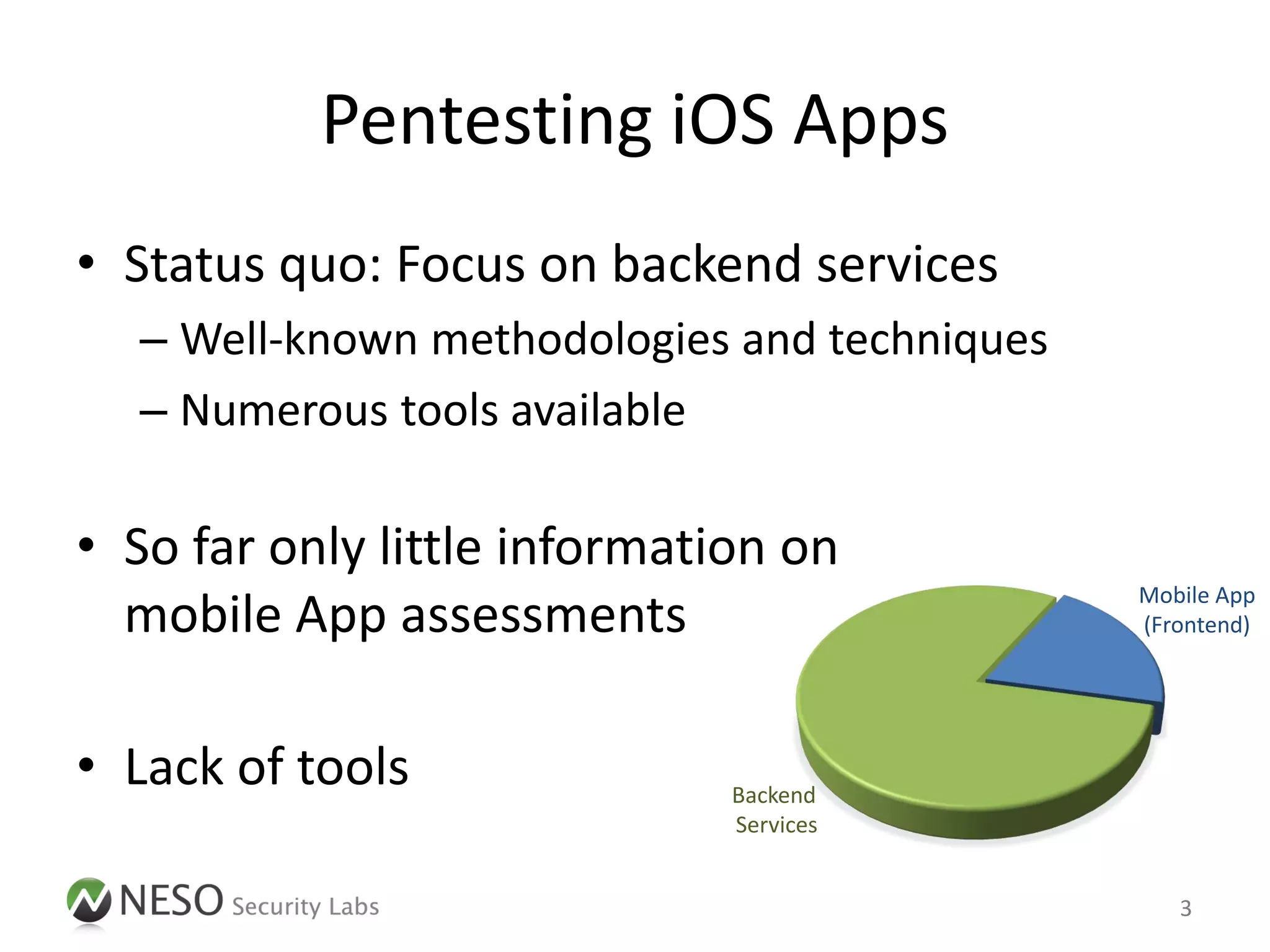
• Status quo: Focus on backend services
  – Well-known methodologies and techniques
  – Numerous tools available

• So far only little information on
                                              Mobile App
  mobile App assessments                      (Frontend)


• Lack of tools               Backend
                              Services


                                                 3
What this talk is about
• Introduction to the Objective-C Runtime
  – Backgrounds, techniques and tools for
    manipulating iOS Apps at runtime

• Use cases and impacts
  – Pentesters should be able to explore the attack
    surface of iOS Apps more efficiently
  – Developers might prefer to avoid client-side logic
    and security measures in the future

                                                         4
Objective-C Runtime

INTRODUCTION
Objective-C
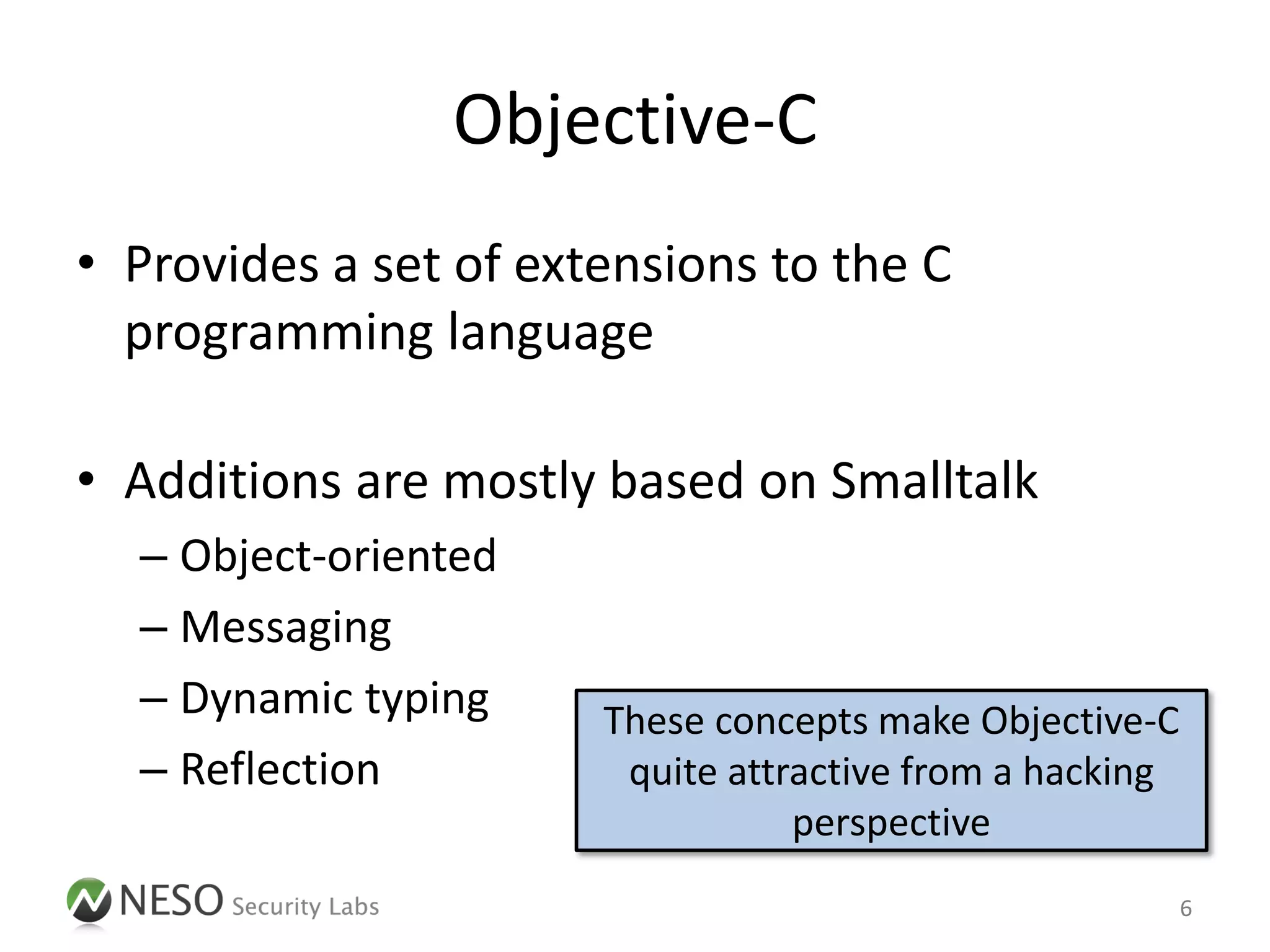
• Provides a set of extensions to the C
  programming language

• Additions are mostly based on Smalltalk
  – Object-oriented
  – Messaging
  – Dynamic typing     These concepts make Objective-C
  – Reflection          quite attractive from a hacking
                                  perspective
                                                          6
Objective-C
• Sample Code:

 HelloWorld *hello = [[HelloWorld alloc] init];
 [hello sayHello:@"DeepSec"];
                       - (void) sayHello: (NSString *) string {
                          printf("Hello %s!", [string UTF8String]);
                       }


                                                              7
Objective-C Runtime
• Apps are linked to libobjc.A.dylib
# otool -L HelloWorld

HelloWorld:
/System/Library/Frameworks/Foundation.framework/Foundation
(compatibility version 300.0.0, current version 890.1.0)
/usr/lib/libobjc.A.dylib (compatibility version 1.0.0,
current version 228.0.0)
[..]
                        This library provides all runtime
                              functionalities of the
                               Objective-C Runtime
                                                            8
Objective-C Runtime
• Most important function: objc_msgSend

• Example
 Class class = objc_getClass("HelloWorld");
 id receiver = [[class alloc] init];
 SEL selector = NSSelectorFromString(@"sayHello:");

 objc_msgSend(theReceiver,theSelector,@"DeepSec");


                  Pointer to an instance of the class,
                   whose method we want to call
                                                         9
Objective-C Runtime
• Most important function: objc_msgSend

• Example
 Class class = objc_getClass("HelloWorld");
 id receiver = [[class alloc] init];
 SEL selector = NSSelectorFromString(@"sayHello:");

 objc_msgSend(theReceiver,theSelector,@"DeepSec");


                    The selector of the method that
                         handles the message
                                                      10
Objective-C Runtime
• Most important function: objc_msgSend

• Example
 Class class = objc_getClass("HelloWorld");
 id receiver = [[class alloc] init];
 SEL selector = NSSelectorFromString(@"sayHello:");

 objc_msgSend(theReceiver,theSelector,@"DeepSec");

                        A variable argument list
                    containing the arguments to the
                                method                11
Static vs. Dynamic Analysis
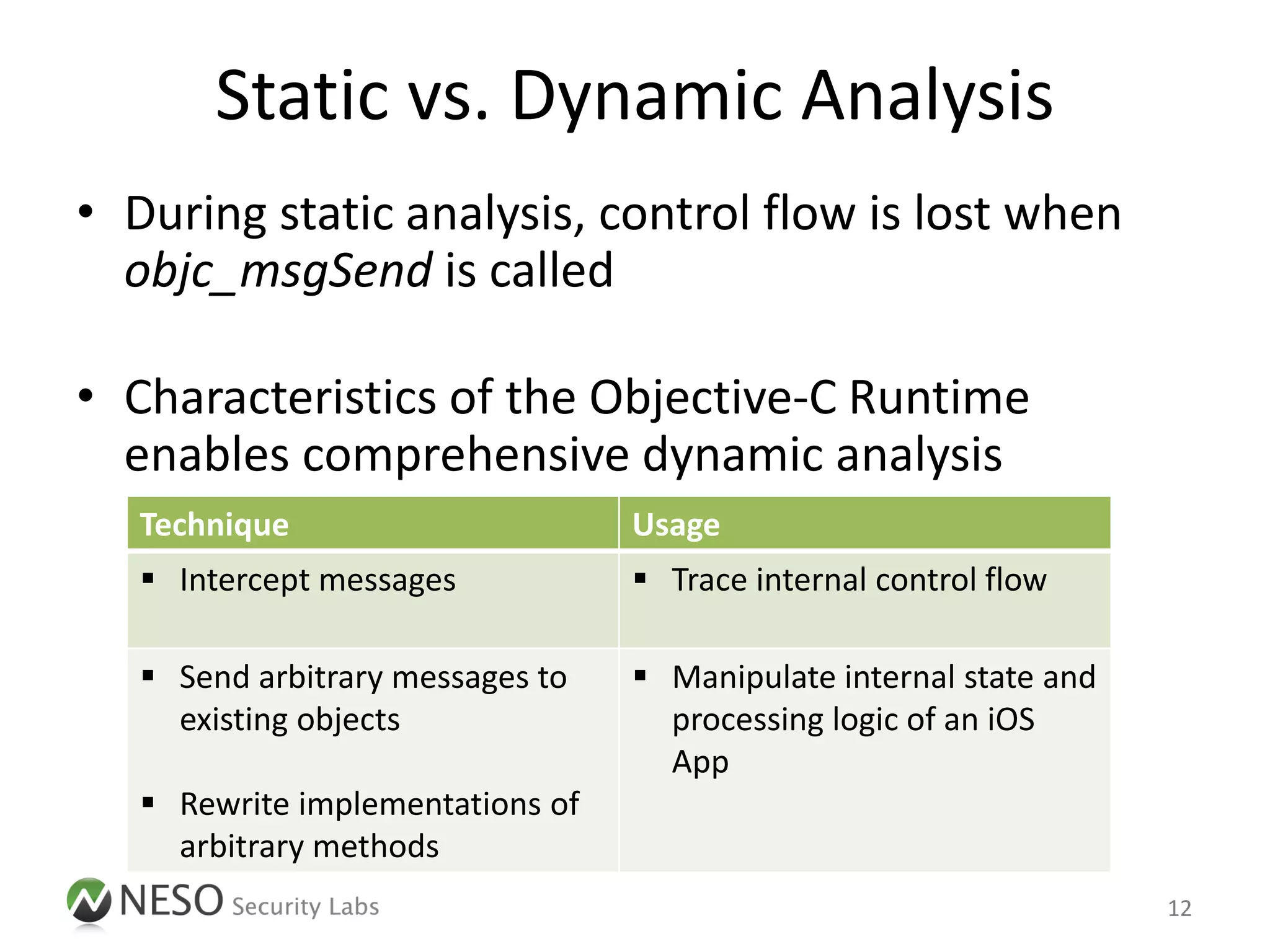
• During static analysis, control flow is lost when
  objc_msgSend is called

• Characteristics of the Objective-C Runtime
  enables comprehensive dynamic analysis
   Technique                      Usage
    Intercept messages            Trace internal control flow

    Send arbitrary messages to    Manipulate internal state and
     existing objects               processing logic of an iOS
                                    App
    Rewrite implementations of
     arbitrary methods
                                                                    12
Backgrounds & Techniques

RUNTIME MANIPULATION
Starting Point
• Goal: Black box analysis of an arbitrary iOS App
   – Enterprise or AppStore App
   – Binary format (no source code available)

• Approach: Examine the iOS App on a jailbroken
  device
   –   Removes the limitations imposed by Apple
   –   Provides root access to the operating system
   –   Enables the installation of additional software
   –   Enables access to the Objective-C Runtime!


                                                         14
Runtime Manipulation
• Objective-C Runtime [1] offers a wide
  range of opportunities to manipulate existing
  iOS Apps

• Two different approaches
  – Injecting a static library with new functionalities
  – Injecting an interpreter for on-the-fly
    manipulations

                                                          15
Dynamic Library Injection
• Advise the dynamic linker to load a dynamic
  shared library (DYLD_INSERT_LIBRARIES) [2]

         File System          iOS App Address Space

         Foundation             Dynamic Linker

       CoreFoundation                 ..
       libobjc.A.dylib
                                   Foundation
            ..
                                CoreFoundation
        debug.dylib
                                libobjc.A.dylib

                                  debug.dylib
                                                      16
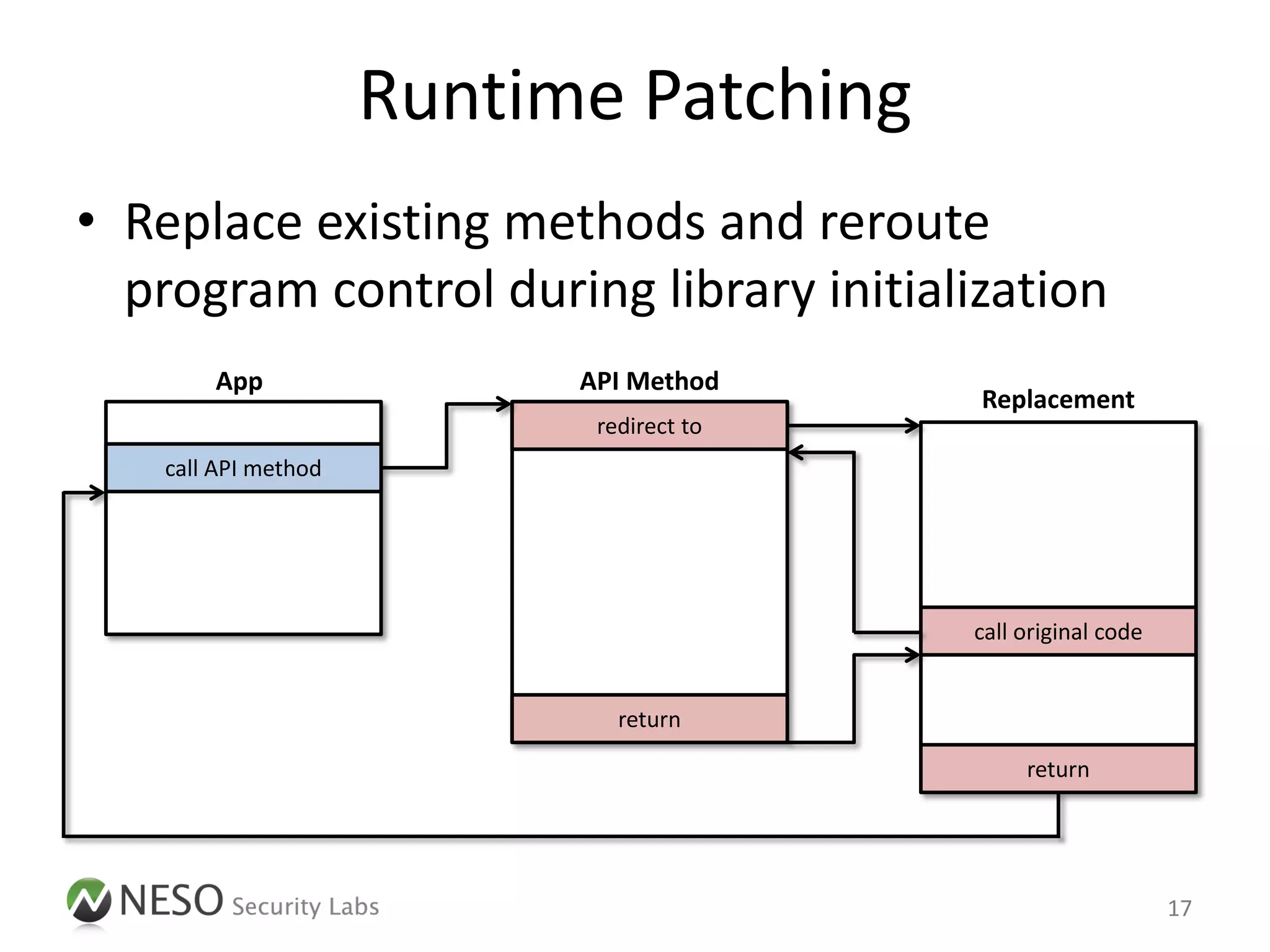
Runtime Patching
• Replace existing methods and reroute
  program control during library initialization
        App                 API Method
                                           Replacement
                             redirect to
    call API method


                                           call original code


                               return

                                                return


                                                                17
Hooking in Practice
• MobileSubstrate [3]
   – MobileLoader loads 3rd-party patching code into the
     running application
   – MobileHooker is used to hook and replace
     system methods and functions
     IMP MSHookMessage(Class class, SEL selector, IMP replacement, const
     char* prefix);

     void MSHookFunction(void* function, void* replacement, void**
     p_original);


• Recommendation: Theos suite eases the development
  of MobileSubstrate extensions (Tweaks) [4]

                                                                           18
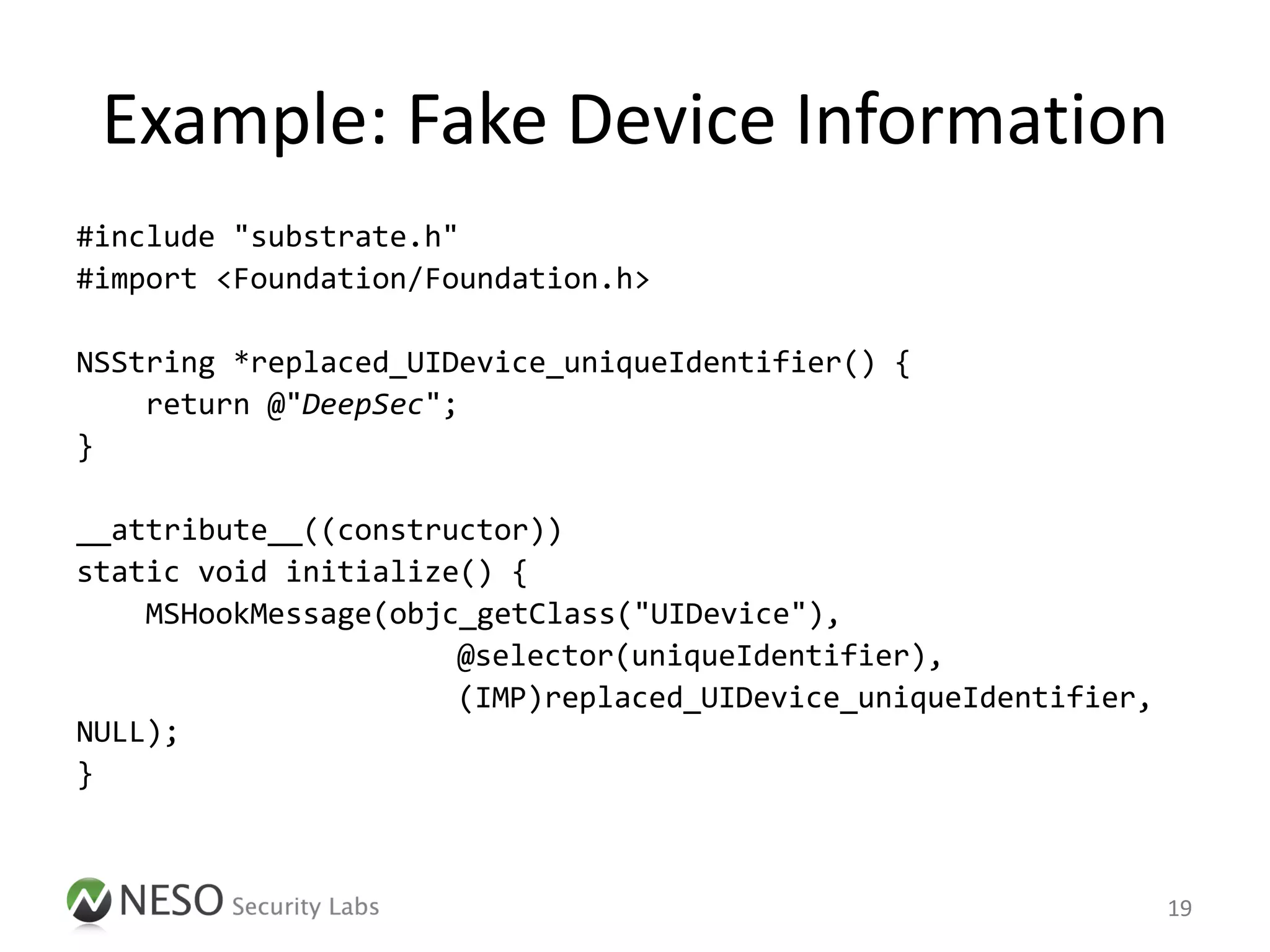
Example: Fake Device Information
#include "substrate.h"
#import <Foundation/Foundation.h>

NSString *replaced_UIDevice_uniqueIdentifier() {
    return @"DeepSec";
}

__attribute__((constructor))
static void initialize() {
    MSHookMessage(objc_getClass("UIDevice"),
                      @selector(uniqueIdentifier),
                      (IMP)replaced_UIDevice_uniqueIdentifier,
NULL);
}


                                                                 19
Runtime Manipulation
• Objective-C Runtime [1] offers a wide
  range of opportunities to manipulate existing
  iOS Apps

• Two different approaches
  – Injecting a static library with new functionalities   
  – Injecting an interpreter for on-the-fly
    manipulations

                                                          20
Cycript: Objective-JavaScript [5]


“      “A programming language designed to blend
       the barrier between Objective-C and JavaScript.”


• Injects a JavaScript interpreter into a running App
   – Based on MobileSubstrate

• Enables runtime manipulations in a flexible way
  [6], [7]

                                                     21
Example: Fake Device Information
• Step 1: Attach to the App process

  # cycript -p <PID>


• Step 2: Determine the current UDID

  cy# [[UIDevice currentDevice] uniqueIdentifier];
  @"768f0c93a69276d190b6…"


                                                     22
Example: Fake Device Information
• Step 3: Replace the implementation of the
  API method
  cy# UIDevice.messages['uniqueIdentifier'] =
      function() { return @"DeepSec"; }


• Step 4: Query the UDID again
  cy# [[UIDevice currentDevice] uniqueIdentifier];
  @"DeepSec"


                                                     23
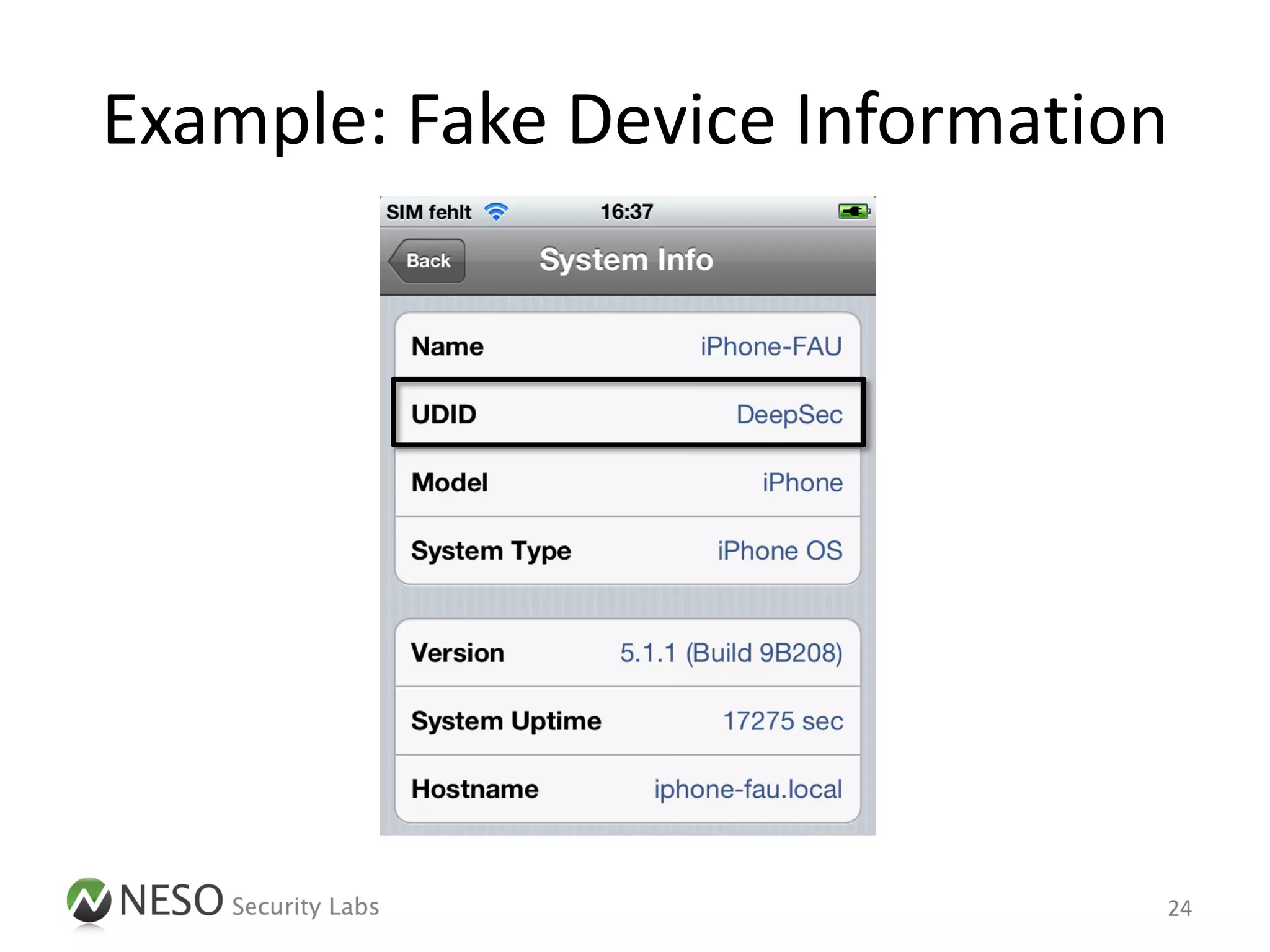
Example: Fake Device Information


                               24
Example: Fake Device Information
• Example demonstrates the diverse possibilities of
  iOS runtime injection

• This might be useful in different scenarios
   – Apps that rely on hardware identifier for
     authentication
   – Apps that use binary or any proprietary protocols

• Easier to manipulate the App endpoint,
  compared to modifications at protocol-level
                                                         25
USE CASES
Advantages of Runtime Manipulation
• By using these techniques, running Apps can
  be extended with additional debugging and
  runtime tracing capabilities

• This assists security assessments of iOS Apps
  – Eases the discovery of vulnerabilities
  – Simplifies bypassing client-side limitations and
    restrictions

                                                       27
Evaluate Encryption Schemes
• Typical question: Which App methods are
  called after the “Login” button is pressed?

• Idea: Make use of dynamic analysis to
  reconstruct the control flow of an App
  – Use the results to navigate through static code

• Solution: Log all messages to objc_msgSend

                                                      28
The gdb way
(gdb) exec-file /var/mobile/Applications/<APP-EXECUTABLE>
Reading symbols for shared libraries . done
(gdb) attach <PID>
Attaching to program: `/private/var/mobile/Applications/...', process PID.
Reading symbols for shared libraries . done
Reading symbols for shared libraries ................................ done
Reading symbols for shared libraries + done
0x364d7004 in mach_msg_trap ()
(gdb) break objc_msgSend
Breakpoint 1 at 0x32ce2f68
(gdb) commands
Type commands for when breakpoint 1 is hit, one per line.
End with a line saying just "end".
>printf "-[%s %s]n", (char *)class_getName($r0),$r1
>c
>end
(gdb) c
Continuing.

                                                                             29
The gdb way
Breakpoint 1, 0x32ce2f68 in objc_msgSend ()
-[UIStatusBarServer _receivedStatusBarData:actions:]

Breakpoint 1, 0x32ce2f68 in objc_msgSend ()
-[UIStatusBar statusBarServer:didReceiveStatusBarData:withActions:]

Breakpoint 1, 0x32ce2f68 in objc_msgSend ()
-[UIStatusBar _currentComposedData]

Breakpoint 1, 0x32ce2f68 in objc_msgSend ()
-[UIStatusBar _currentComposedDataForStyle:]

Breakpoint 1, 0x32ce2f68 in objc_msgSend ()
                                              Very noisy! All background
-[UIStatusBarComposedData alloc]              activities of the runtime are
[..]
                                                      shown as well.


                                                                              30
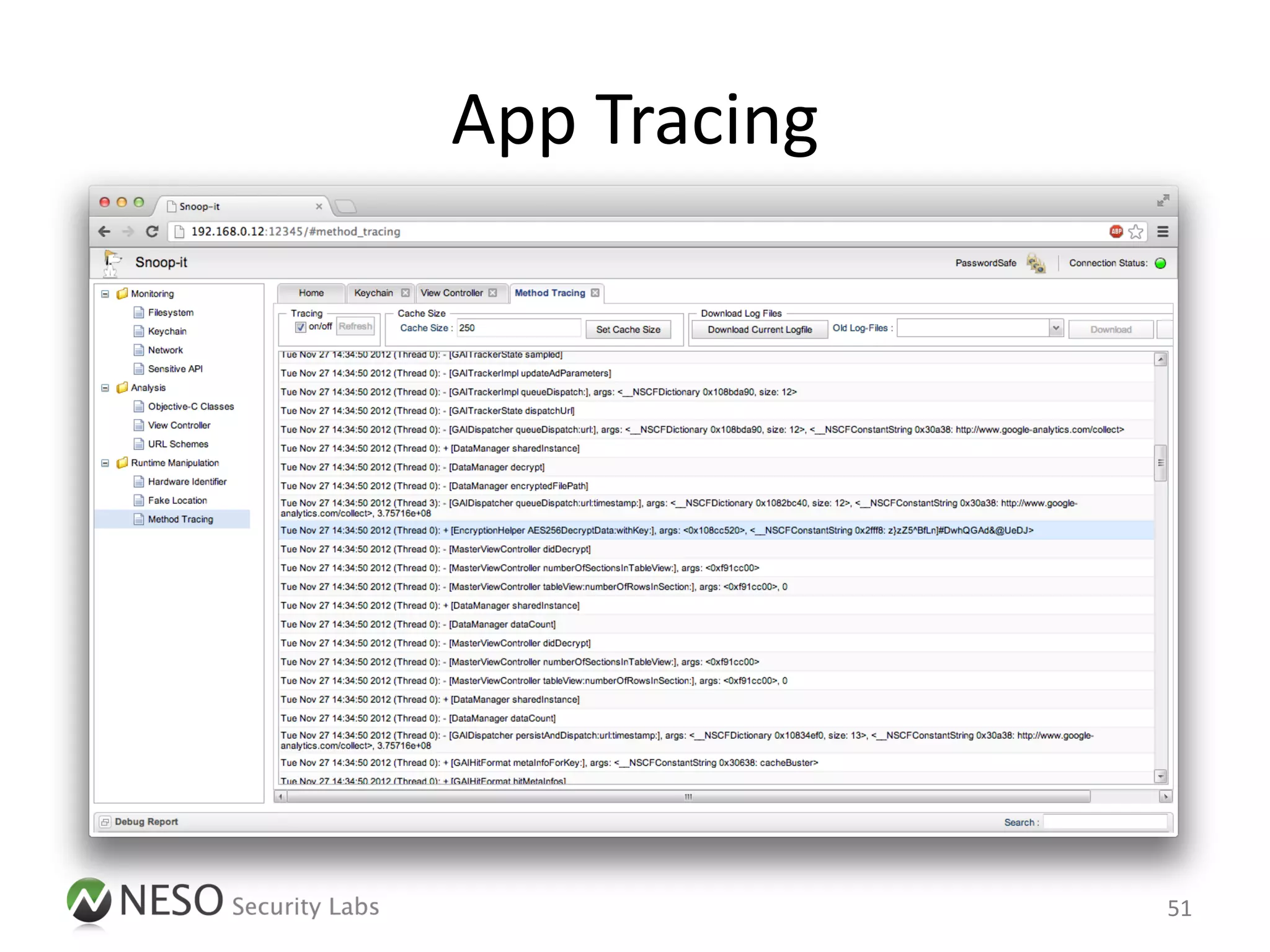
App Tracing
• Preferred approach: Intercept messages to
  objc_msgSend within the runtime

• Apply filters with different granularity
   – Enumerate registered App classes and methods using
     the Objective-C Runtime API (objc_getClassList,
     class_copyMethodList, etc.)
   – Output a trace of only matching items

• Inspired by Aspective-C [8] and Subjective-C [9]

                                                      31
App Tracing
• Tricky part is to handle all parameters and to
  continue normal execution
   – Logging itself modifies CPU registers and the stack

• Current execution state has to be preserved
   –   Allocate an alternate stack within heap memory
   –   Backup r0 - r3 and lr registers to alternate stack
   –   Do the logging and filtering
   –   Restore r0 - r3 and lr
   –   Continue execution

                                                            32
Sample Output
+   [SyncManager sharedSyncManager]
-   [SyncManager init]
-   [SyncManager setSynDocumentOpen:], args: 0
+   [DataModel setSynchManager:], args: <0x1102ce30>
+   [DataModel initFromFile]
+   [DataModel securityModelFilePath]
+   [PBKDF2 getKeyForPassphrase:], args: <__NSCFConstantString 0x15e2e4: >
+   [CryptoUtils decrypt]
+   [DataModel sharedModel]
+   [CryptoUtils md5:], args: <__NSCFConstantString 0x15dea4: >
+   [DataModel sharedModel]


                                  Encryption scheme is based on a
                                   hardcoded key within the App

                                                                        33
Sample Output
+   [SyncManager sharedSyncManager]
-   [SyncManager init]
-   [SyncManager setSynDocumentOpen:], args: 0
+   [DataModel setSynchManager:], args: <0x1102ce30>
+   [DataModel initFromFile]
+   [DataModel securityModelFilePath]
+   [PBKDF2 getKeyForPassphrase:], args: <__NSCFConstantString 0x15e2e4: >
+   [CryptoUtils decrypt]
+   [DataModel sharedModel]
+   [CryptoUtils md5:], args: <__NSCFConstantString 0x15dea4: >
+   [DataModel sharedModel]


                                                                        34
Advantages of Runtime Manipulation
• The ability to manipulate Apps at runtime
  strikes out new paths
  – Discover weak/missing encryption
  – Bypassing client-side restrictions
  – Execution of hidden functionality, which was not
    supposed to be accessible
  – Unlock additional features and premium content
  – Dump copyright-protected content
  – Etc.

                                                       35
Lack of Tools


“   “Security will not get better until tools for
    practical exploration of the attack surface
    are made available”
    - Josh Wright


                                                    36
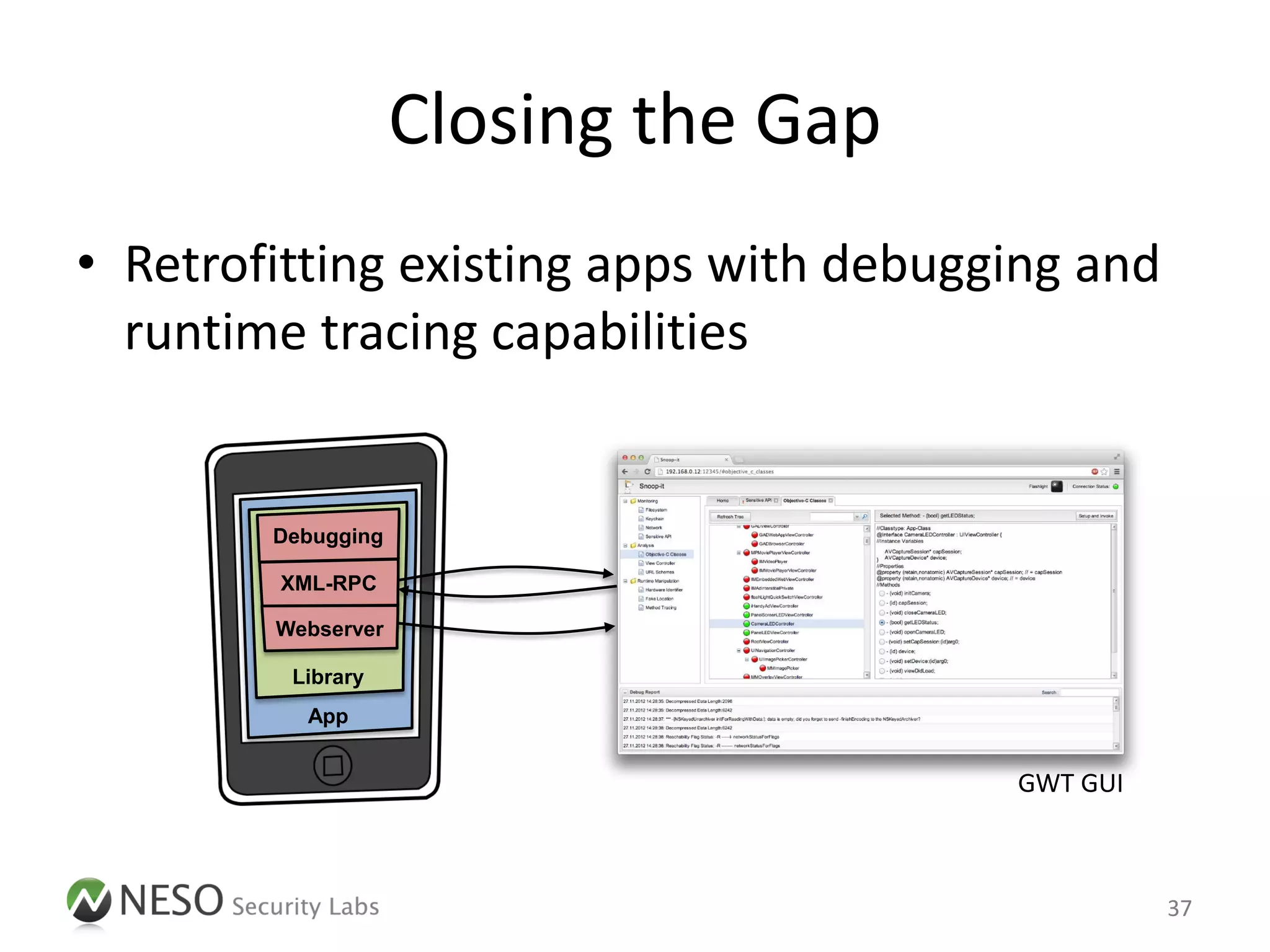
Closing the Gap
• Retrofitting existing apps with debugging and
  runtime tracing capabilities


        Debugging

        XML-RPC

        Webserver

         Library
          App


                                        GWT GUI


                                                  37
Introducing Snoop-it
• A tool to assist security assessments and
  dynamic analysis of iOS Apps


                                              38
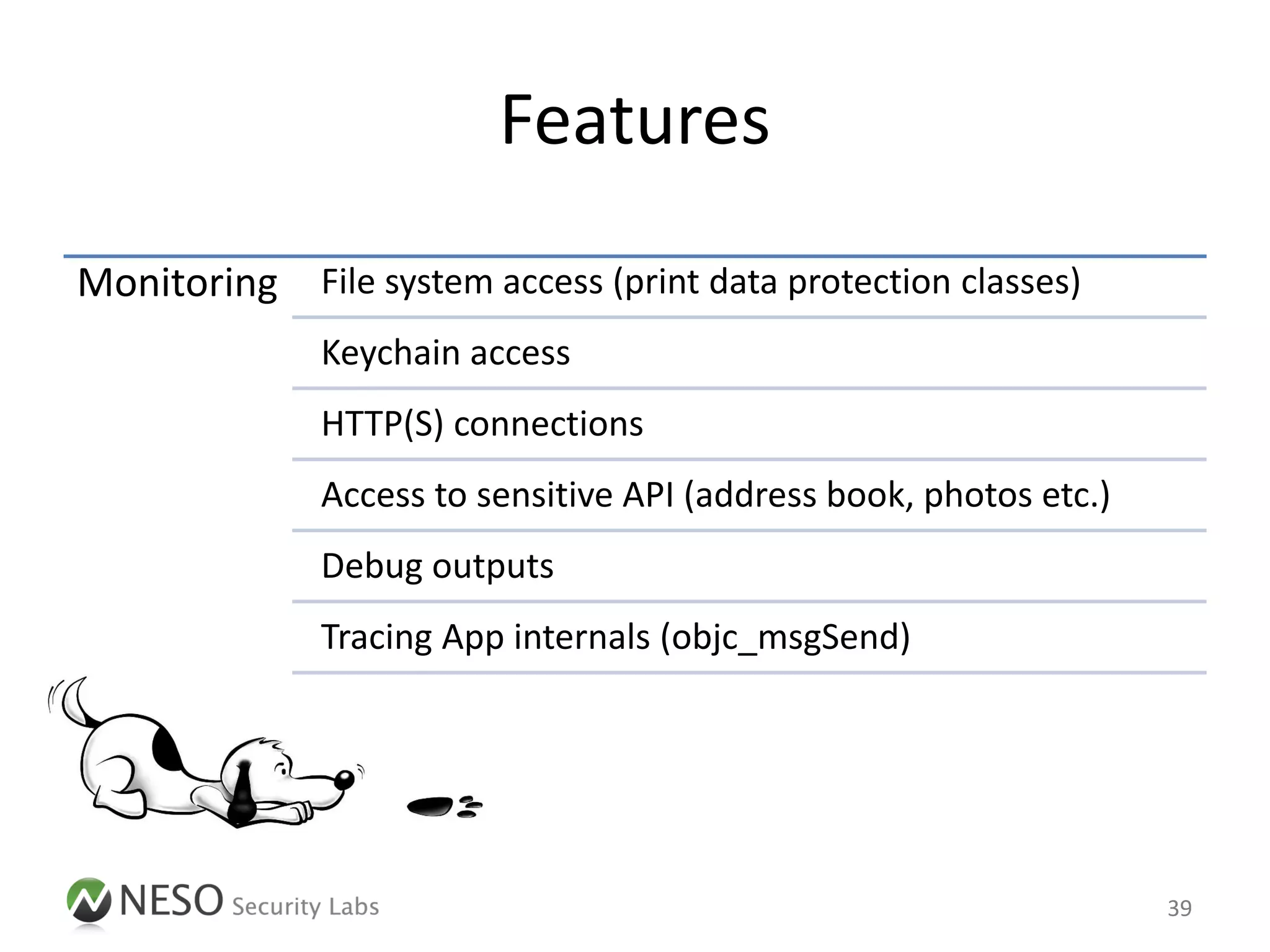
Features
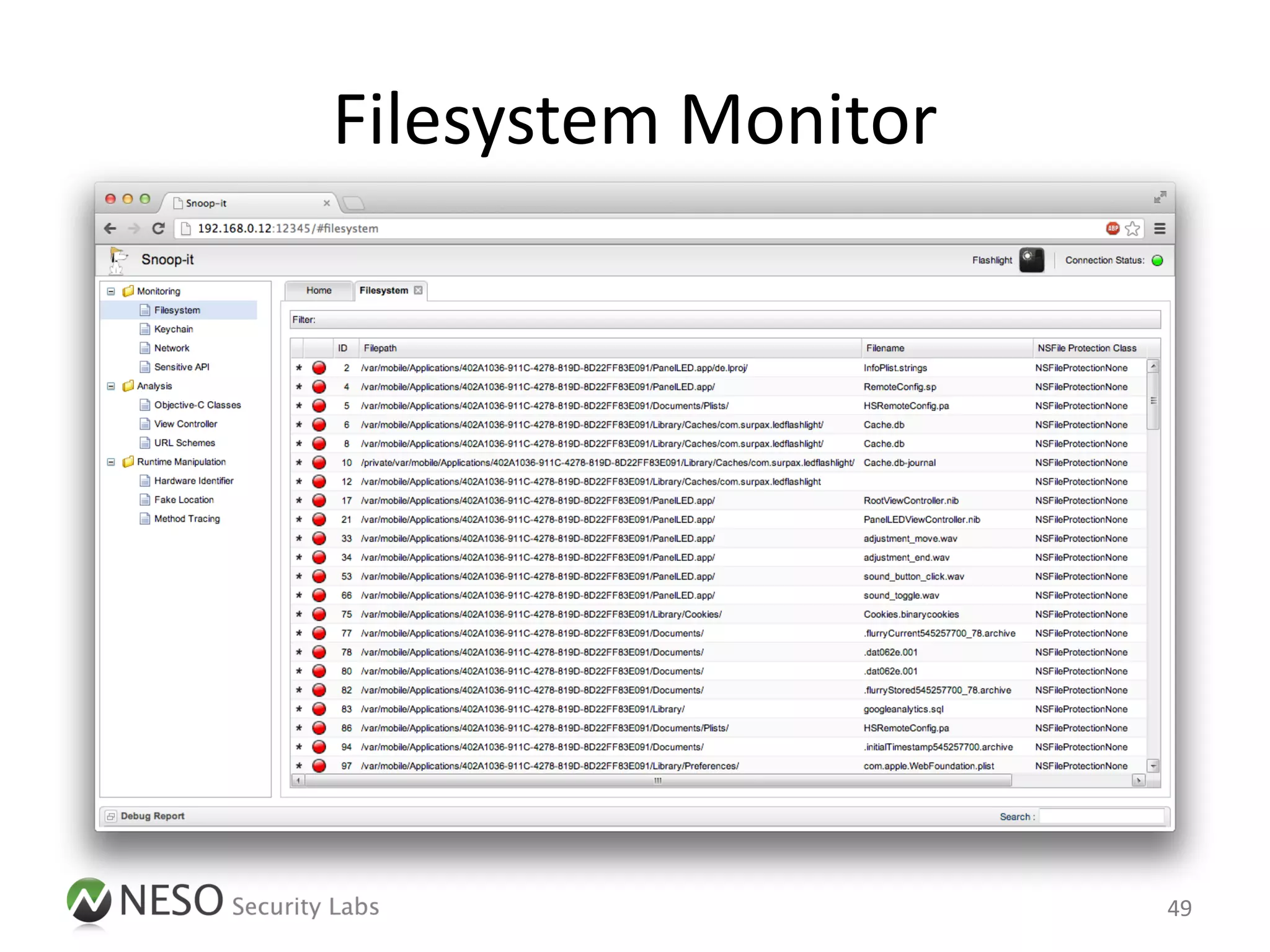
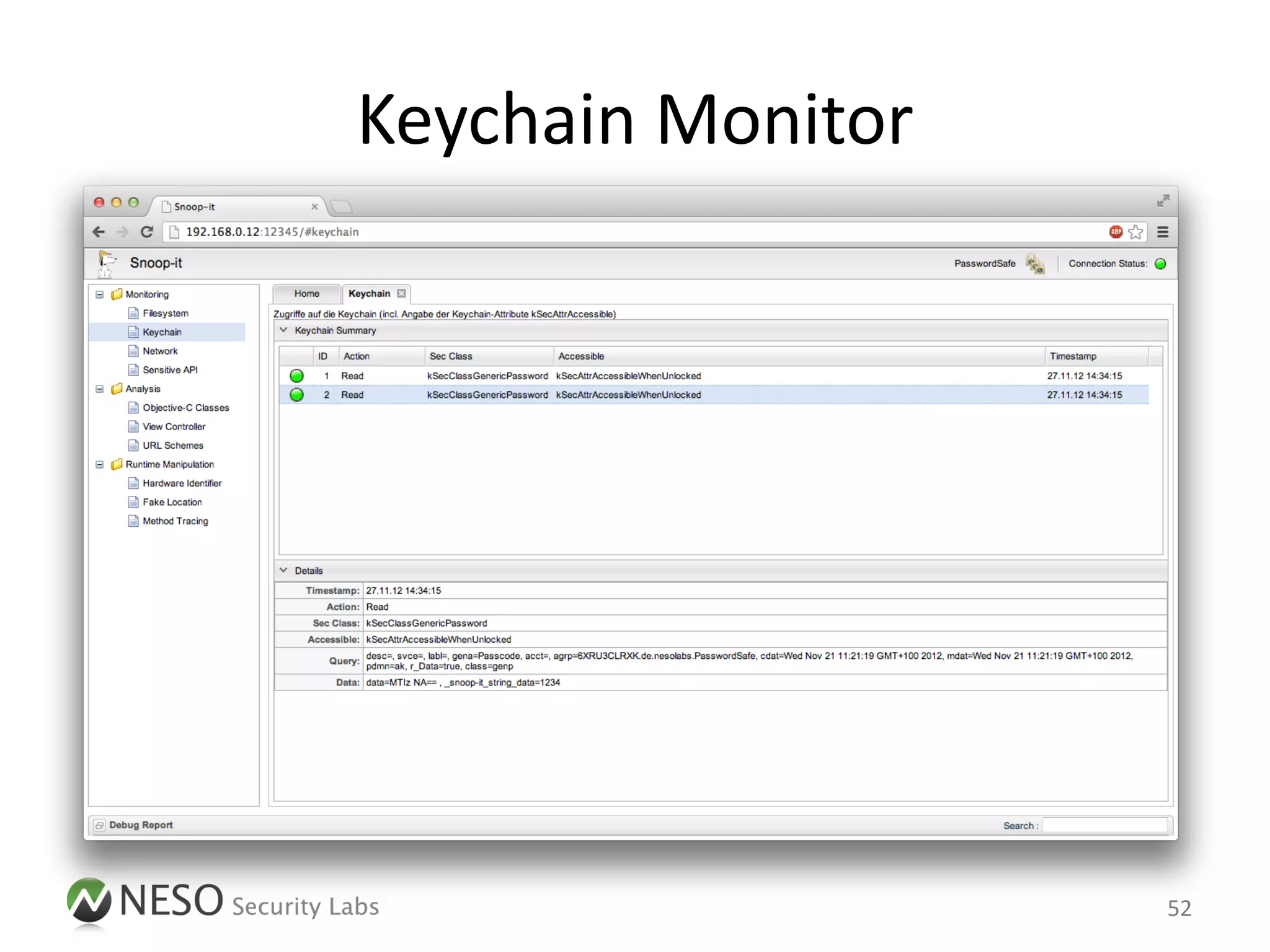
Monitoring File system access (print data protection classes)
              Keychain access
              HTTP(S) connections
              Access to sensitive API (address book, photos etc.)
              Debug outputs
              Tracing App internals (objc_msgSend)


                                                                    39
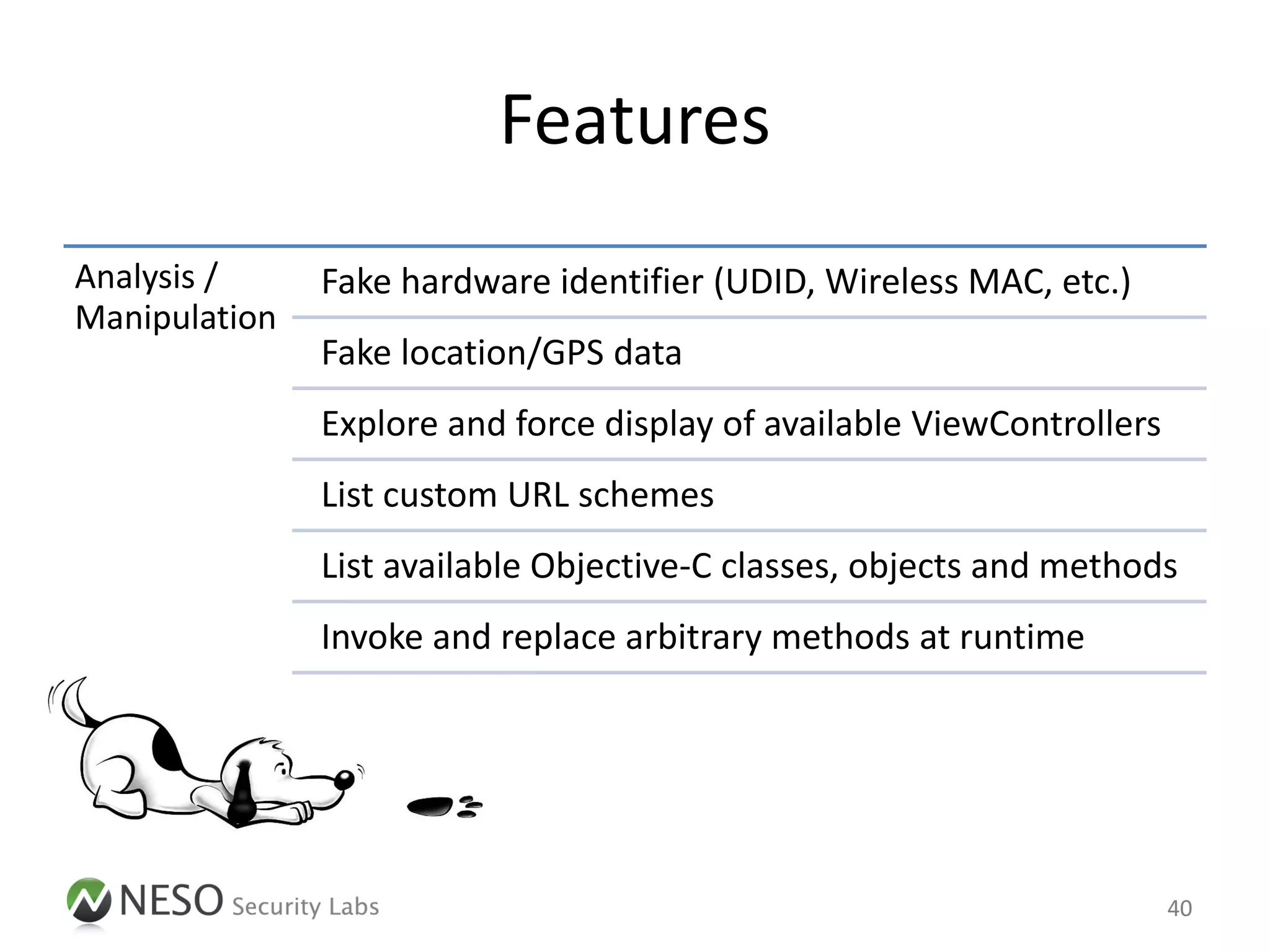
Features
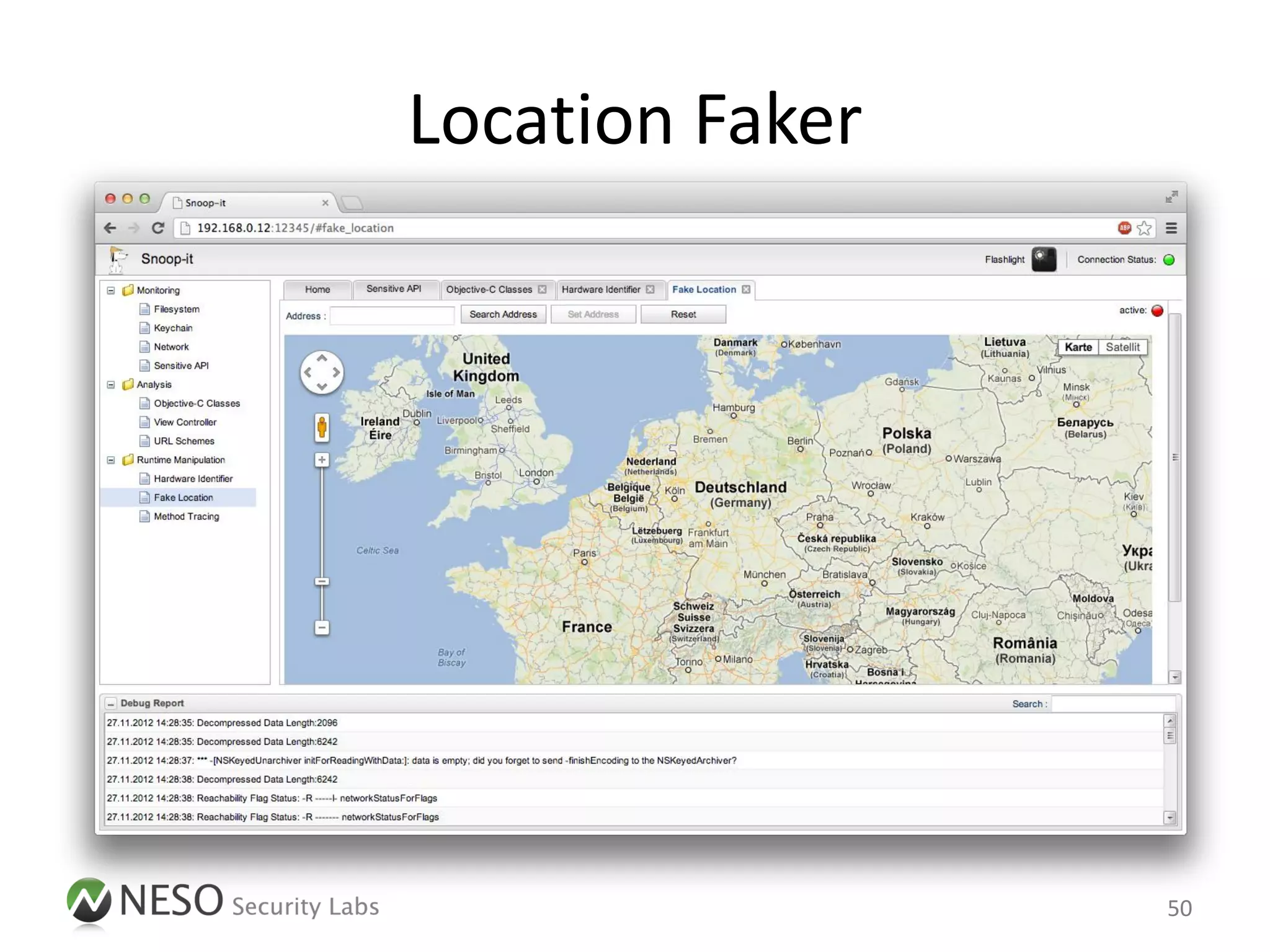
Analysis /     Fake hardware identifier (UDID, Wireless MAC, etc.)
Manipulation
               Fake location/GPS data
               Explore and force display of available ViewControllers
               List custom URL schemes
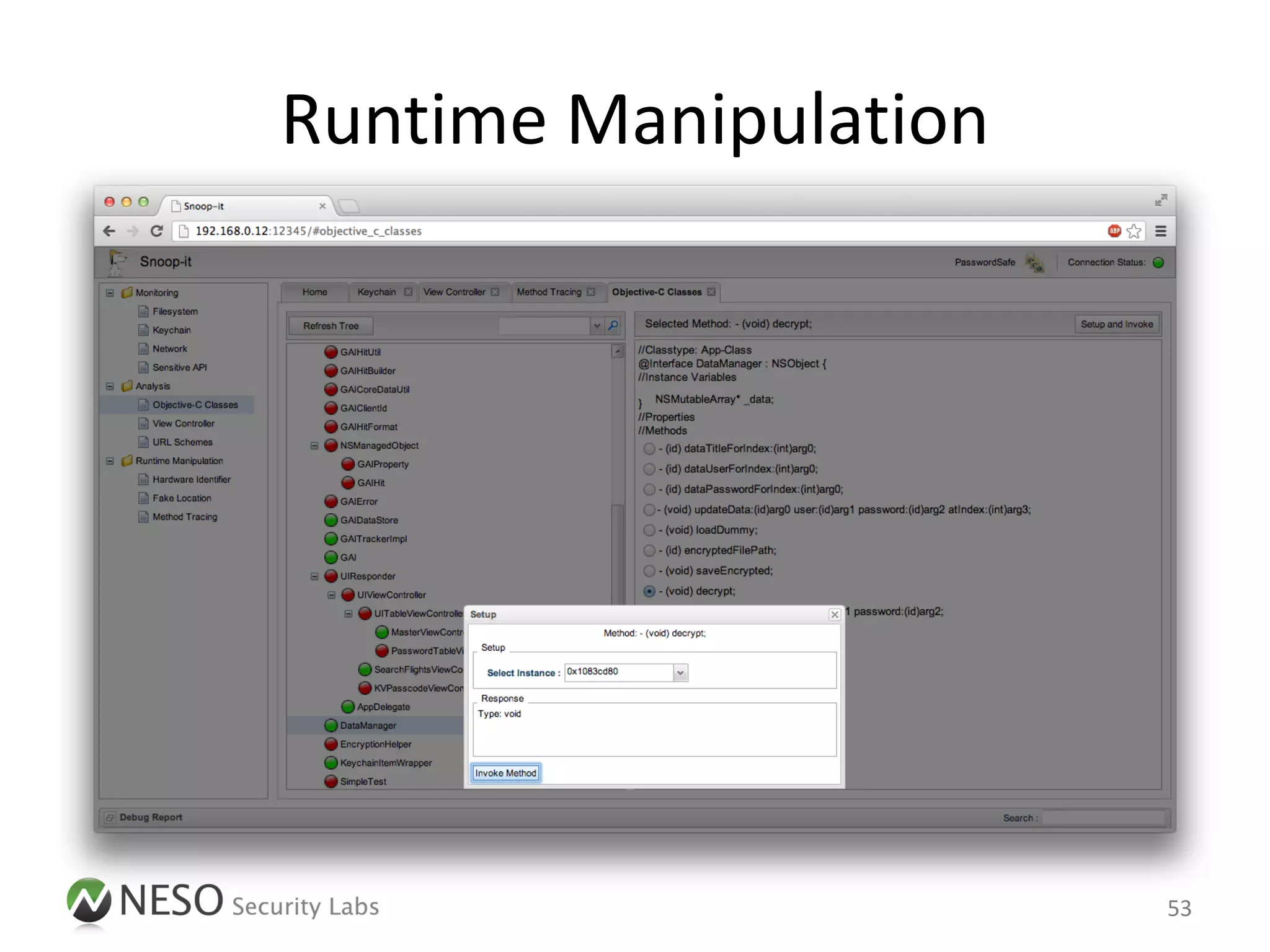
               List available Objective-C classes, objects and methods
               Invoke and replace arbitrary methods at runtime


                                                                        40
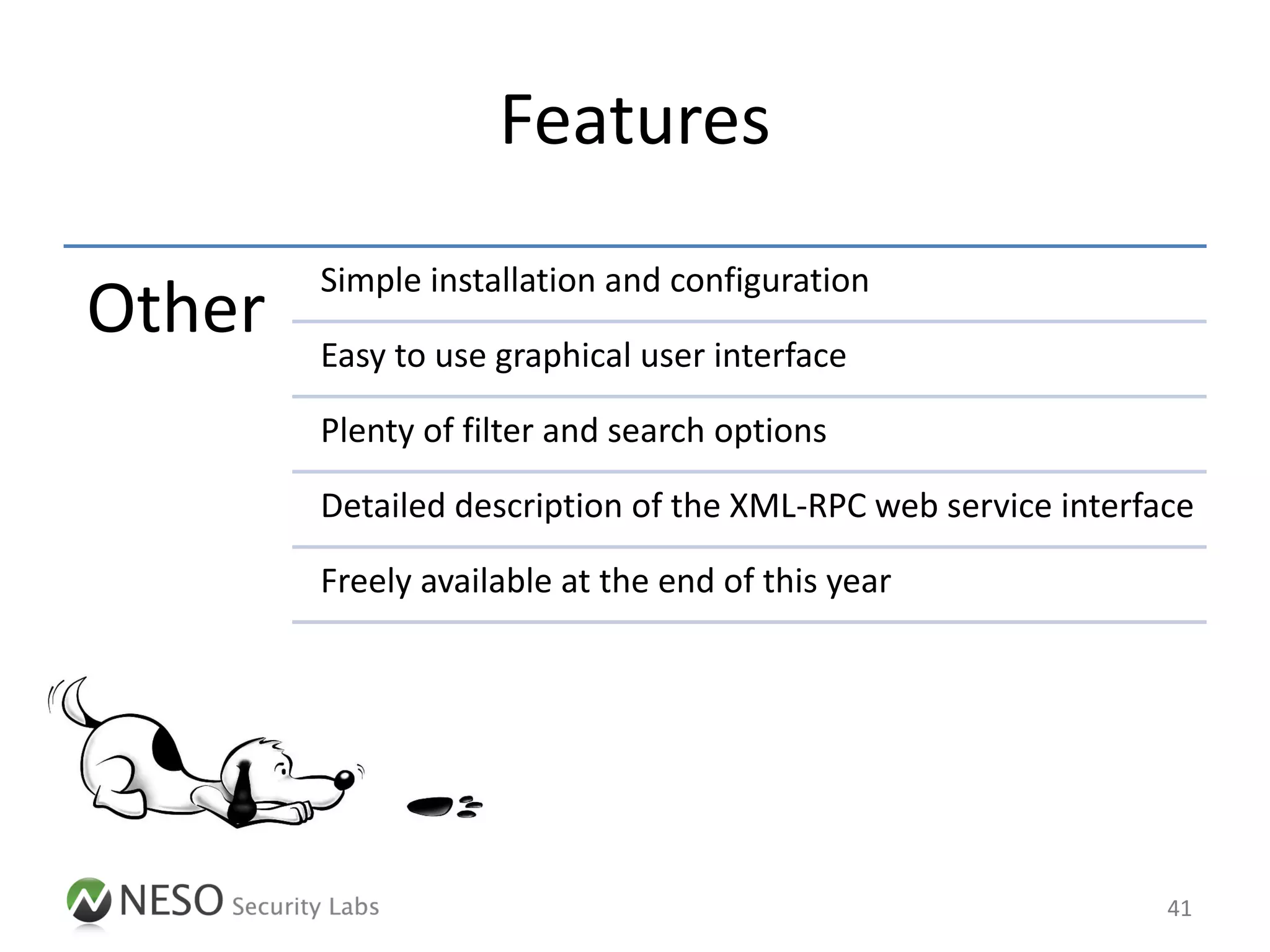
Features
        Simple installation and configuration
Other   Easy to use graphical user interface

        Plenty of filter and search options

        Detailed description of the XML-RPC web service interface

        Freely available at the end of this year


                                                               41
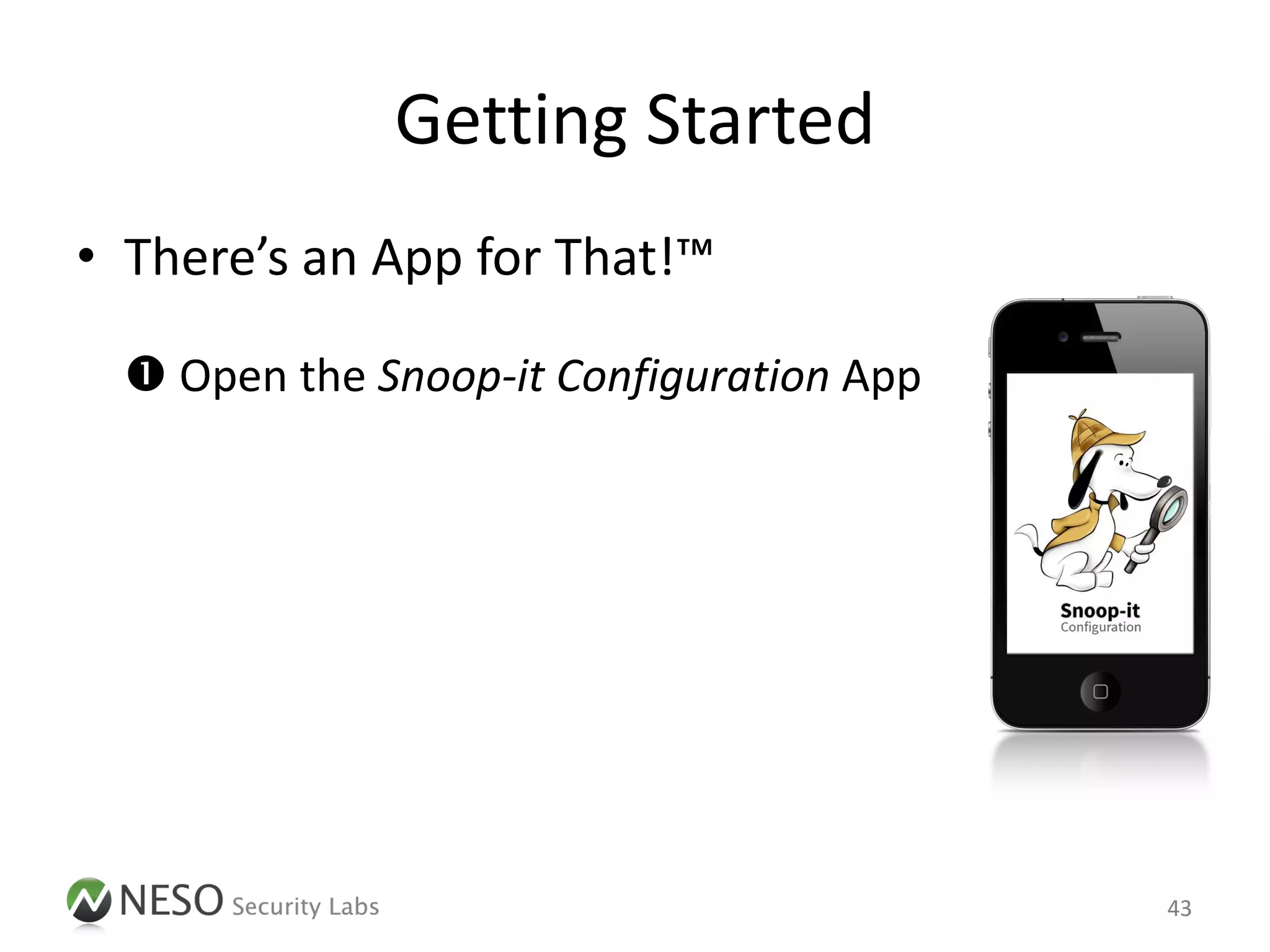
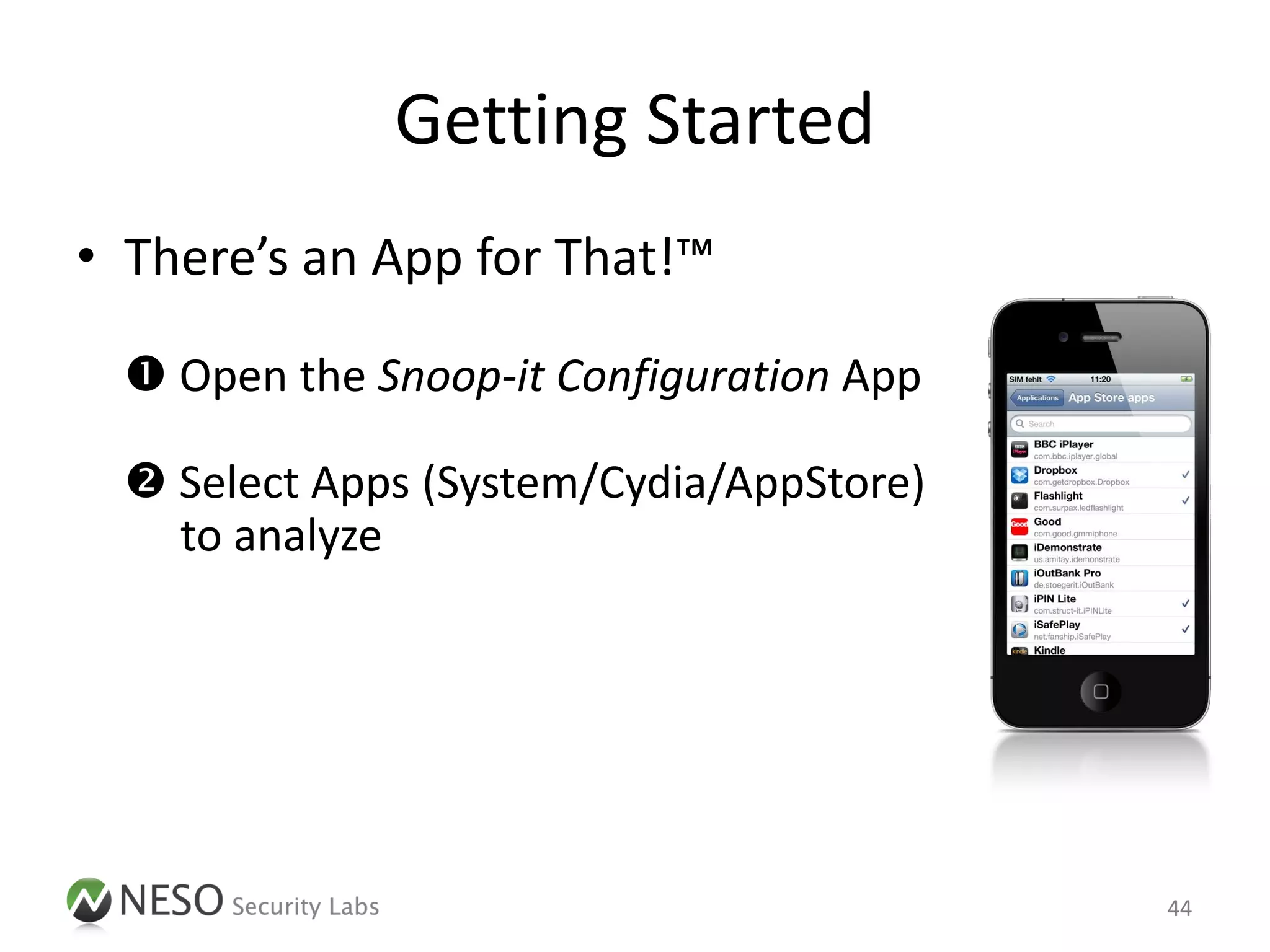
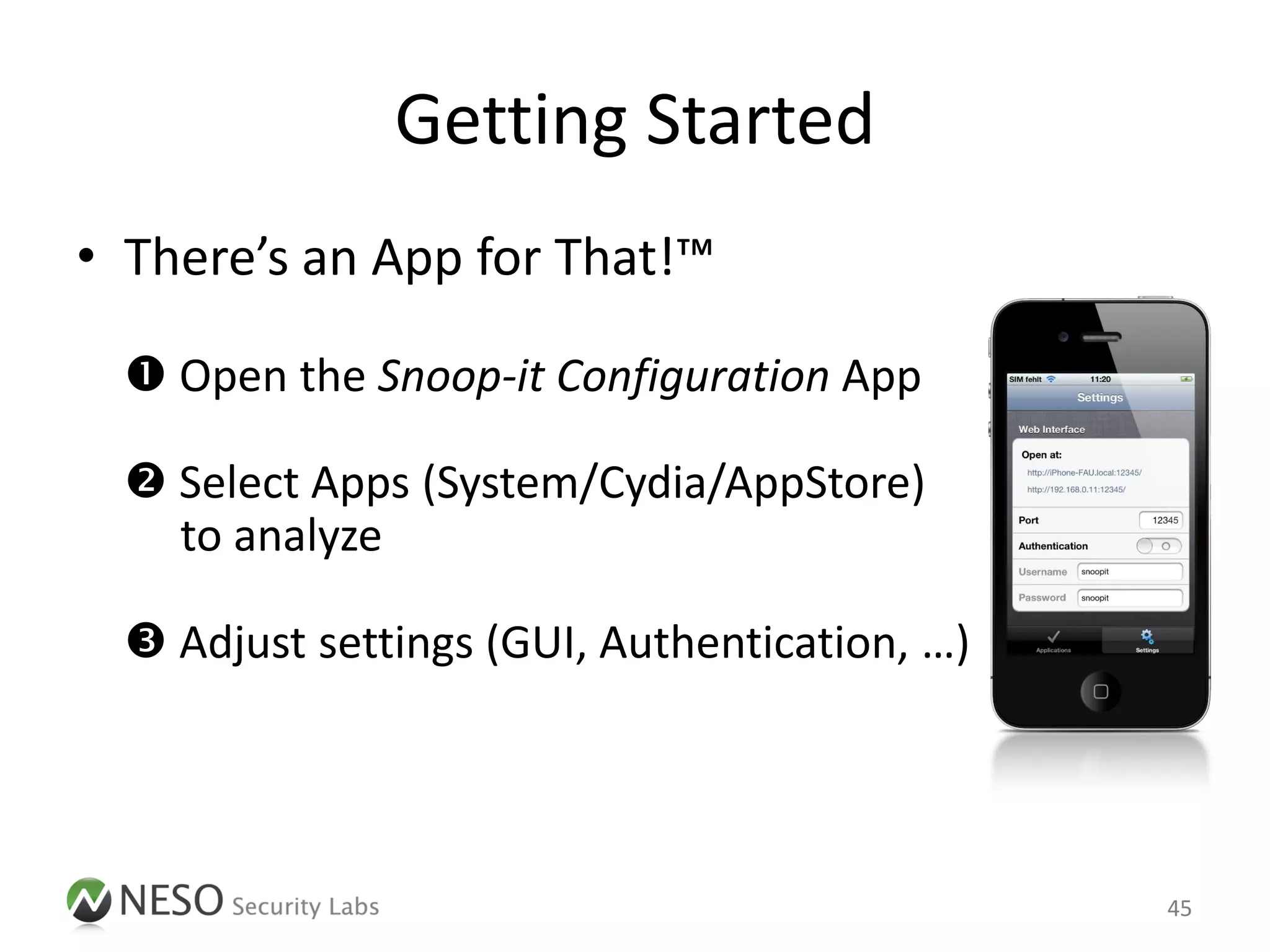
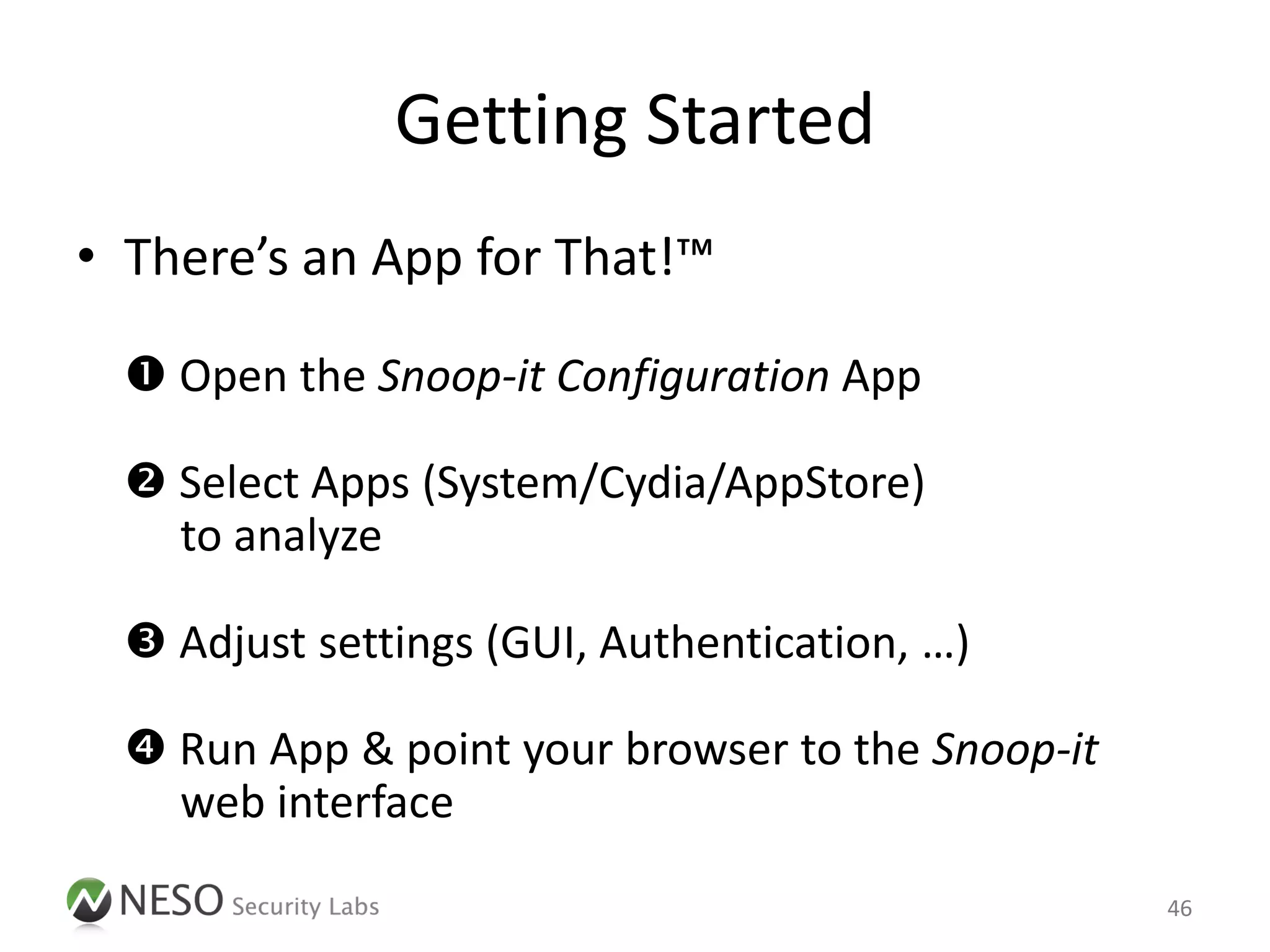
Getting Started
• There’s an App for That!™

   Open the Snoop-it Configuration App

   Select Apps (System/Cydia/AppStore)
    to analyze

   Adjust settings (GUI, Authentication, …)

   Run app & point your browser to the Snoop-it
    web interface

                                                   42
Getting Started
• There’s an App for That!™

   Open the Snoop-it Configuration App

   Select Apps (System/Cydia/AppStore)
    to analyze

   Adjust settings (GUI, Authentication, …)

   Run app & point your browser to the Snoop-it
    web interface

                                                   43
Getting Started
• There’s an App for That!™

   Open the Snoop-it Configuration App

   Select Apps (System/Cydia/AppStore)
    to analyze

   Adjust settings (GUI, Authentication, …)

   Run app & point your browser to the Snoop-it
    web interface

                                                   44
Getting Started
• There’s an App for That!™

   Open the Snoop-it Configuration App

   Select Apps (System/Cydia/AppStore)
    to analyze

   Adjust settings (GUI, Authentication, …)

   Run app & point your browser to the Snoop-it
    web interface

                                                   45
Getting Started
• There’s an App for That!™

   Open the Snoop-it Configuration App

   Select Apps (System/Cydia/AppStore)
    to analyze

   Adjust settings (GUI, Authentication, …)

   Run App & point your browser to the Snoop-it
    web interface

                                                   46
DEMO


       Please follow me on Twitter (@aykay)
       to stay up-to-date with the latest news on Snoop-it
Filesystem Monitor


                     49
Location Faker


                 50
App Tracing


              51
Keychain Monitor


                   52
Runtime Manipulation


                       53
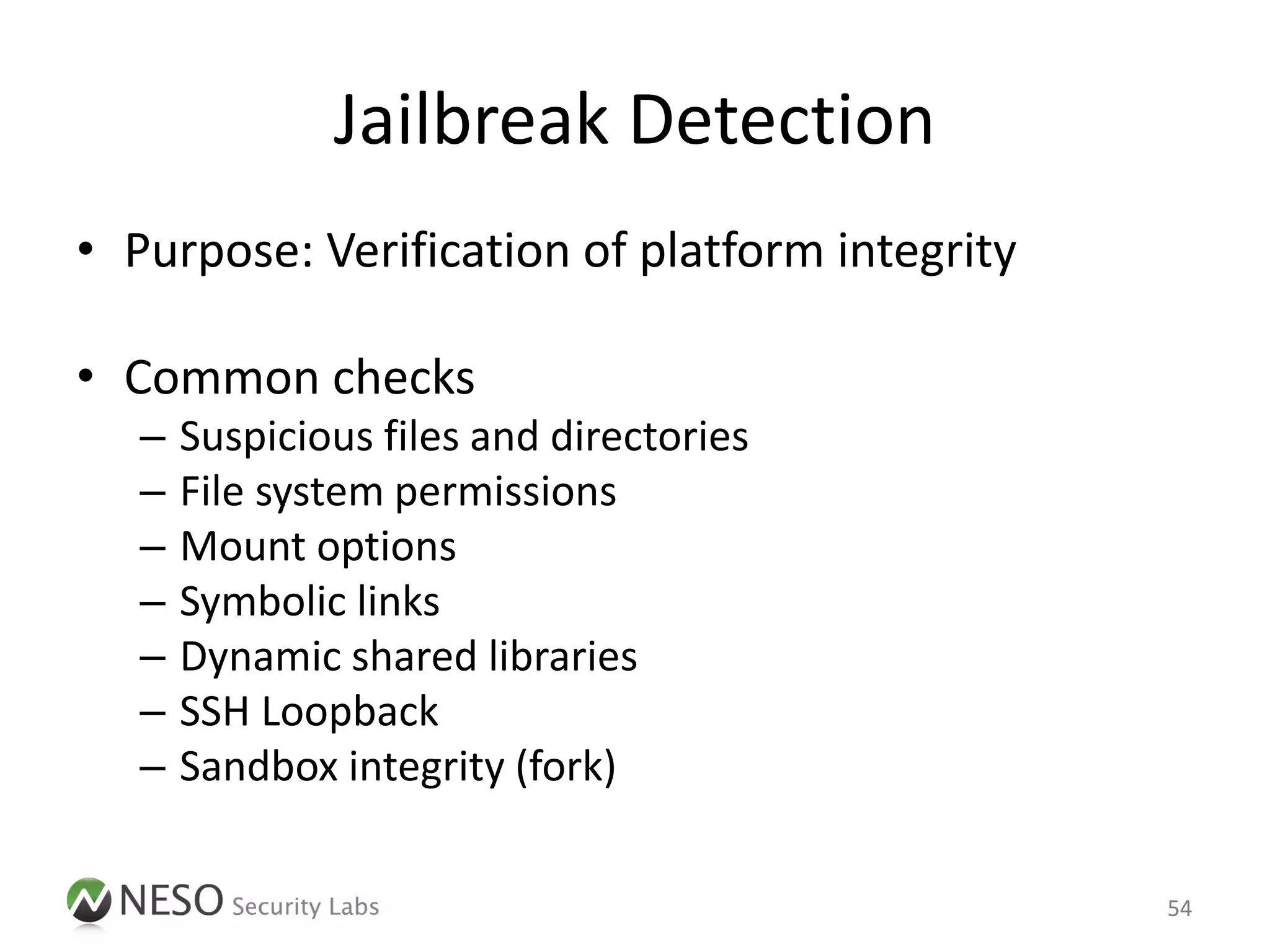
Jailbreak Detection
• Purpose: Verification of platform integrity

• Common checks
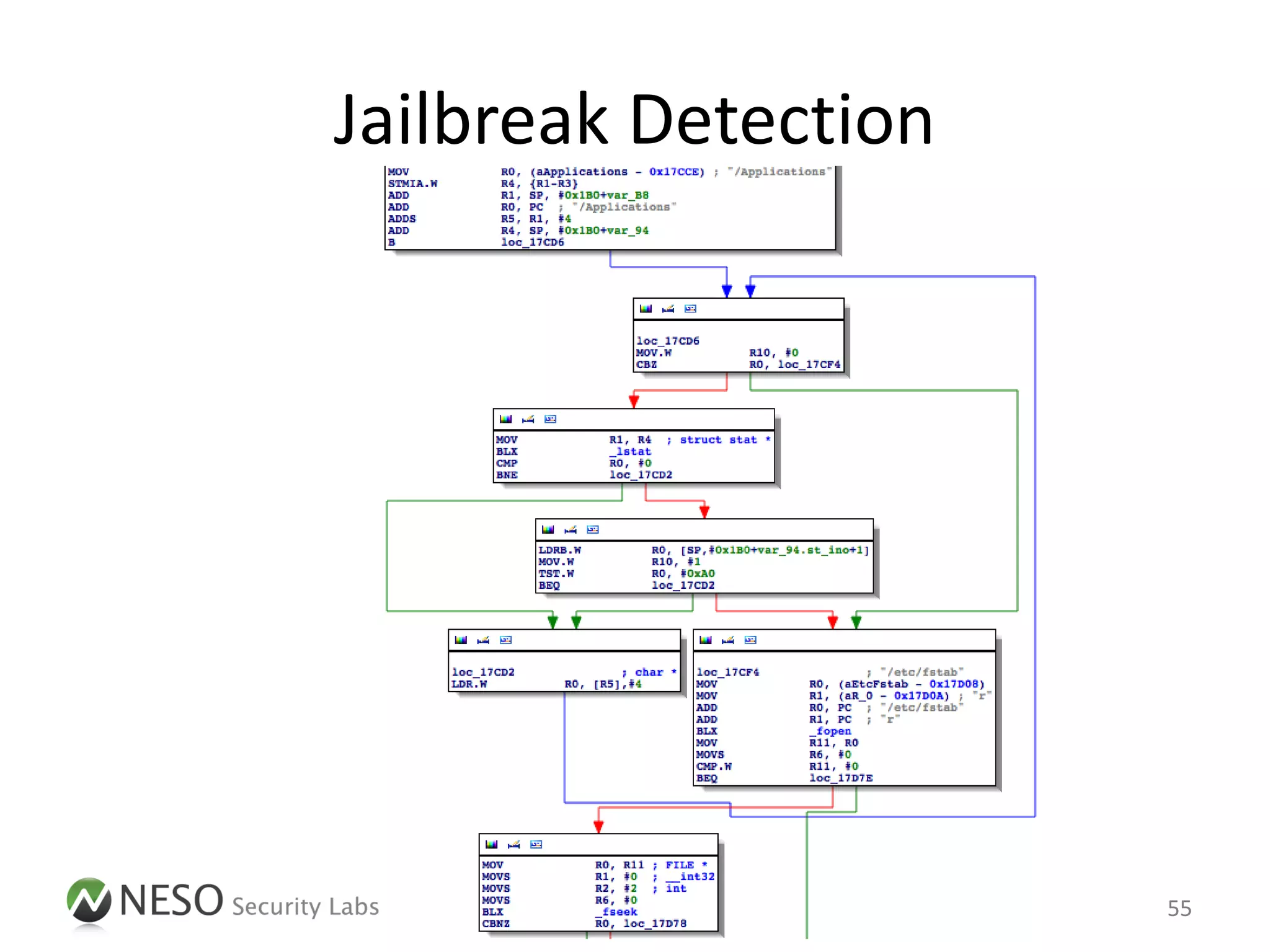
   –   Suspicious files and directories
   –   File system permissions
   –   Mount options
   –   Symbolic links
   –   Dynamic shared libraries
   –   SSH Loopback
   –   Sandbox integrity (fork)

                                                54
Jailbreak Detection


                      55
Jailbreak Detection
• In order to assess the security of an iOS App,
  at first the jailbreak detection mechanisms have
  to be bypassed

  – Binary / Run-time patching to remove all checks
    (specific, time-consuming)
    Delegate.messages['isJailbroken'] =
                     function() { return NO; }

  – Intercept system calls to simulate an unmodified
    execution environment (generic)


                                                       56
Jailbreak Detection Bypass


• Snoop-it supports generic bypass of the most
  common jailbreak detection mechanisms
  – Simple configuration switch in the Configuration App

                                                           57
Bypassing Jailbreak Detection

DEMO
Securing the Runtime
• Minimum of data/logic on the client-side

• Preferred use of C, at least for security-critical
  implementations
   – Inline Functions
                                   At least try to,
   – Obfuscation                 it’s worth a shot.

• Advanced Jailbreak Detection
• Runtime Integrity Checks (dladdr()[10])
                                                      59
Summary
• Runtime Analysis and Manipulation facilitates
  both, dynamic and static analysis of iOS Apps

• Attack surface of iOS Apps can be explored
  more efficiently


                                               60
Acknowledgements
• Thanks to

  – Markus Troßbach      (University of Heidelberg)
  – Sebastian Stocker    (University of Heidelberg)
  – Christoph Settgast   (University of Erlangen)
  – Andreas Weinlein     (University of Erlangen)
  – Francesca Serpi      (University of Milan)


                                                      62
References
[1]   Objective C Runtime Reference
      http://developer.apple.com/library/mac/#documentation/Cocoa/Reference/Obj
      CRuntimeRef/Reference/reference.html

[2]   dyld - the dynamic link editor (DYLD_INSERT_LIBRARIES)
      http://developer.apple.com/library/mac/#documentation/Darwin/Reference/M
      anpages/man1/dyld.1.html

[3]   Mobile Substrate
      http://iphonedevwiki.net/index.php/MobileSubstrate

[4]   Theos
      http://iphonedevwiki.net/index.php/Theos

[5]   Cycript
      http://www.cycript.org

                                                                             63
References
[6]    Cycript Overview
       http://iphonedevwiki.net/index.php/Cycript

[7]    Cycript Tips
       http://iphonedevwiki.net/index.php/Cycript_Tricks

[8]    Aspective-C by saurik
       http://svn.saurik.com/repos/menes/trunk/aspectivec/AspectiveC.mm

[9]    Subjective-C by KennyTM~
       http://networkpx.blogspot.de/2009/09/introducing-subjective-c.html

[10]   dladdr - find the image containing a given address
       http://developer.apple.com/library/Mac/#documentation/Darwin/Reference/
       ManPages/man3/dladdr.3.html


                                                                             64
Weipertstraße 8-10 ∙ 74076 Heilbronn
       +49 (7131) 7669-540
         info@nesolabs.de
         www.nesolabs.de

Pentesting iOS Apps - Runtime Analysis and Manipulation

  • 1.
    Pentesting iOS Apps RuntimeAnalysis and Manipulation Andreas Kurtz
  • 2.
    About • PhD candidateat the Security Research Group, Department of Computer Science, University of Erlangen-Nuremberg – Security of mobile devices & mobile Apps – Dynamic analysis of iOS Apps • Co-Founder of NESO Security Labs GmbH – Software security – Penetration testing, static code analysis 2
  • 3.
    Pentesting iOS Apps •Status quo: Focus on backend services – Well-known methodologies and techniques – Numerous tools available • So far only little information on Mobile App mobile App assessments (Frontend) • Lack of tools Backend Services 3
  • 4.
    What this talkis about • Introduction to the Objective-C Runtime – Backgrounds, techniques and tools for manipulating iOS Apps at runtime • Use cases and impacts – Pentesters should be able to explore the attack surface of iOS Apps more efficiently – Developers might prefer to avoid client-side logic and security measures in the future 4
  • 5.
  • 6.
    Objective-C • Provides aset of extensions to the C programming language • Additions are mostly based on Smalltalk – Object-oriented – Messaging – Dynamic typing These concepts make Objective-C – Reflection quite attractive from a hacking perspective 6
  • 7.
    Objective-C • Sample Code: HelloWorld *hello = [[HelloWorld alloc] init]; [hello sayHello:@"DeepSec"]; - (void) sayHello: (NSString *) string { printf("Hello %s!", [string UTF8String]); } 7
  • 8.
    Objective-C Runtime • Appsare linked to libobjc.A.dylib # otool -L HelloWorld HelloWorld: /System/Library/Frameworks/Foundation.framework/Foundation (compatibility version 300.0.0, current version 890.1.0) /usr/lib/libobjc.A.dylib (compatibility version 1.0.0, current version 228.0.0) [..] This library provides all runtime functionalities of the Objective-C Runtime 8
  • 9.
    Objective-C Runtime • Mostimportant function: objc_msgSend • Example Class class = objc_getClass("HelloWorld"); id receiver = [[class alloc] init]; SEL selector = NSSelectorFromString(@"sayHello:"); objc_msgSend(theReceiver,theSelector,@"DeepSec"); Pointer to an instance of the class, whose method we want to call 9
  • 10.
    Objective-C Runtime • Mostimportant function: objc_msgSend • Example Class class = objc_getClass("HelloWorld"); id receiver = [[class alloc] init]; SEL selector = NSSelectorFromString(@"sayHello:"); objc_msgSend(theReceiver,theSelector,@"DeepSec"); The selector of the method that handles the message 10
  • 11.
    Objective-C Runtime • Mostimportant function: objc_msgSend • Example Class class = objc_getClass("HelloWorld"); id receiver = [[class alloc] init]; SEL selector = NSSelectorFromString(@"sayHello:"); objc_msgSend(theReceiver,theSelector,@"DeepSec"); A variable argument list containing the arguments to the method 11
  • 12.
    Static vs. DynamicAnalysis • During static analysis, control flow is lost when objc_msgSend is called • Characteristics of the Objective-C Runtime enables comprehensive dynamic analysis Technique Usage  Intercept messages  Trace internal control flow  Send arbitrary messages to  Manipulate internal state and existing objects processing logic of an iOS App  Rewrite implementations of arbitrary methods 12
  • 13.
  • 14.
    Starting Point • Goal:Black box analysis of an arbitrary iOS App – Enterprise or AppStore App – Binary format (no source code available) • Approach: Examine the iOS App on a jailbroken device – Removes the limitations imposed by Apple – Provides root access to the operating system – Enables the installation of additional software – Enables access to the Objective-C Runtime! 14
  • 15.
    Runtime Manipulation • Objective-CRuntime [1] offers a wide range of opportunities to manipulate existing iOS Apps • Two different approaches – Injecting a static library with new functionalities – Injecting an interpreter for on-the-fly manipulations 15
  • 16.
    Dynamic Library Injection •Advise the dynamic linker to load a dynamic shared library (DYLD_INSERT_LIBRARIES) [2] File System iOS App Address Space Foundation Dynamic Linker CoreFoundation .. libobjc.A.dylib Foundation .. CoreFoundation debug.dylib libobjc.A.dylib debug.dylib 16
  • 17.
    Runtime Patching • Replaceexisting methods and reroute program control during library initialization App API Method Replacement redirect to call API method call original code return return 17
  • 18.
    Hooking in Practice •MobileSubstrate [3] – MobileLoader loads 3rd-party patching code into the running application – MobileHooker is used to hook and replace system methods and functions IMP MSHookMessage(Class class, SEL selector, IMP replacement, const char* prefix); void MSHookFunction(void* function, void* replacement, void** p_original); • Recommendation: Theos suite eases the development of MobileSubstrate extensions (Tweaks) [4] 18
  • 19.
    Example: Fake DeviceInformation #include "substrate.h" #import <Foundation/Foundation.h> NSString *replaced_UIDevice_uniqueIdentifier() { return @"DeepSec"; } __attribute__((constructor)) static void initialize() { MSHookMessage(objc_getClass("UIDevice"), @selector(uniqueIdentifier), (IMP)replaced_UIDevice_uniqueIdentifier, NULL); } 19
  • 20.
    Runtime Manipulation • Objective-CRuntime [1] offers a wide range of opportunities to manipulate existing iOS Apps • Two different approaches – Injecting a static library with new functionalities  – Injecting an interpreter for on-the-fly manipulations 20
  • 21.
    Cycript: Objective-JavaScript [5] “ “A programming language designed to blend the barrier between Objective-C and JavaScript.” • Injects a JavaScript interpreter into a running App – Based on MobileSubstrate • Enables runtime manipulations in a flexible way [6], [7] 21
  • 22.
    Example: Fake DeviceInformation • Step 1: Attach to the App process # cycript -p <PID> • Step 2: Determine the current UDID cy# [[UIDevice currentDevice] uniqueIdentifier]; @"768f0c93a69276d190b6…" 22
  • 23.
    Example: Fake DeviceInformation • Step 3: Replace the implementation of the API method cy# UIDevice.messages['uniqueIdentifier'] = function() { return @"DeepSec"; } • Step 4: Query the UDID again cy# [[UIDevice currentDevice] uniqueIdentifier]; @"DeepSec" 23
  • 24.
    Example: Fake DeviceInformation 24
  • 25.
    Example: Fake DeviceInformation • Example demonstrates the diverse possibilities of iOS runtime injection • This might be useful in different scenarios – Apps that rely on hardware identifier for authentication – Apps that use binary or any proprietary protocols • Easier to manipulate the App endpoint, compared to modifications at protocol-level 25
  • 26.
  • 27.
    Advantages of RuntimeManipulation • By using these techniques, running Apps can be extended with additional debugging and runtime tracing capabilities • This assists security assessments of iOS Apps – Eases the discovery of vulnerabilities – Simplifies bypassing client-side limitations and restrictions 27
  • 28.
    Evaluate Encryption Schemes •Typical question: Which App methods are called after the “Login” button is pressed? • Idea: Make use of dynamic analysis to reconstruct the control flow of an App – Use the results to navigate through static code • Solution: Log all messages to objc_msgSend 28
  • 29.
    The gdb way (gdb)exec-file /var/mobile/Applications/<APP-EXECUTABLE> Reading symbols for shared libraries . done (gdb) attach <PID> Attaching to program: `/private/var/mobile/Applications/...', process PID. Reading symbols for shared libraries . done Reading symbols for shared libraries ................................ done Reading symbols for shared libraries + done 0x364d7004 in mach_msg_trap () (gdb) break objc_msgSend Breakpoint 1 at 0x32ce2f68 (gdb) commands Type commands for when breakpoint 1 is hit, one per line. End with a line saying just "end". >printf "-[%s %s]n", (char *)class_getName($r0),$r1 >c >end (gdb) c Continuing. 29
  • 30.
    The gdb way Breakpoint1, 0x32ce2f68 in objc_msgSend () -[UIStatusBarServer _receivedStatusBarData:actions:] Breakpoint 1, 0x32ce2f68 in objc_msgSend () -[UIStatusBar statusBarServer:didReceiveStatusBarData:withActions:] Breakpoint 1, 0x32ce2f68 in objc_msgSend () -[UIStatusBar _currentComposedData] Breakpoint 1, 0x32ce2f68 in objc_msgSend () -[UIStatusBar _currentComposedDataForStyle:] Breakpoint 1, 0x32ce2f68 in objc_msgSend () Very noisy! All background -[UIStatusBarComposedData alloc] activities of the runtime are [..] shown as well. 30
  • 31.
    App Tracing • Preferredapproach: Intercept messages to objc_msgSend within the runtime • Apply filters with different granularity – Enumerate registered App classes and methods using the Objective-C Runtime API (objc_getClassList, class_copyMethodList, etc.) – Output a trace of only matching items • Inspired by Aspective-C [8] and Subjective-C [9] 31
  • 32.
    App Tracing • Trickypart is to handle all parameters and to continue normal execution – Logging itself modifies CPU registers and the stack • Current execution state has to be preserved – Allocate an alternate stack within heap memory – Backup r0 - r3 and lr registers to alternate stack – Do the logging and filtering – Restore r0 - r3 and lr – Continue execution 32
  • 33.
    Sample Output + [SyncManager sharedSyncManager] - [SyncManager init] - [SyncManager setSynDocumentOpen:], args: 0 + [DataModel setSynchManager:], args: <0x1102ce30> + [DataModel initFromFile] + [DataModel securityModelFilePath] + [DataModel securityModelFilePath] + [PBKDF2 getKeyForPassphrase:], args: <__NSCFConstantString 0x15e2e4: > + [CryptoUtils decrypt] + [DataModel sharedModel] + [CryptoUtils md5:], args: <__NSCFConstantString 0x15dea4: > + [DataModel sharedModel] Encryption scheme is based on a hardcoded key within the App 33
  • 34.
    Sample Output + [SyncManager sharedSyncManager] - [SyncManager init] - [SyncManager setSynDocumentOpen:], args: 0 + [DataModel setSynchManager:], args: <0x1102ce30> + [DataModel initFromFile] + [DataModel securityModelFilePath] + [DataModel securityModelFilePath] + [PBKDF2 getKeyForPassphrase:], args: <__NSCFConstantString 0x15e2e4: > + [CryptoUtils decrypt] + [DataModel sharedModel] + [CryptoUtils md5:], args: <__NSCFConstantString 0x15dea4: > + [DataModel sharedModel] 34
  • 35.
    Advantages of RuntimeManipulation • The ability to manipulate Apps at runtime strikes out new paths – Discover weak/missing encryption – Bypassing client-side restrictions – Execution of hidden functionality, which was not supposed to be accessible – Unlock additional features and premium content – Dump copyright-protected content – Etc. 35
  • 36.
    Lack of Tools “ “Security will not get better until tools for practical exploration of the attack surface are made available” - Josh Wright 36
  • 37.
    Closing the Gap •Retrofitting existing apps with debugging and runtime tracing capabilities Debugging XML-RPC Webserver Library App GWT GUI 37
  • 38.
    Introducing Snoop-it • Atool to assist security assessments and dynamic analysis of iOS Apps 38
  • 39.
    Features Monitoring File systemaccess (print data protection classes) Keychain access HTTP(S) connections Access to sensitive API (address book, photos etc.) Debug outputs Tracing App internals (objc_msgSend) 39
  • 40.
    Features Analysis / Fake hardware identifier (UDID, Wireless MAC, etc.) Manipulation Fake location/GPS data Explore and force display of available ViewControllers List custom URL schemes List available Objective-C classes, objects and methods Invoke and replace arbitrary methods at runtime 40
  • 41.
    Features Simple installation and configuration Other Easy to use graphical user interface Plenty of filter and search options Detailed description of the XML-RPC web service interface Freely available at the end of this year 41
  • 42.
    Getting Started • There’san App for That!™  Open the Snoop-it Configuration App  Select Apps (System/Cydia/AppStore) to analyze  Adjust settings (GUI, Authentication, …)  Run app & point your browser to the Snoop-it web interface 42
  • 43.
    Getting Started • There’san App for That!™  Open the Snoop-it Configuration App  Select Apps (System/Cydia/AppStore) to analyze  Adjust settings (GUI, Authentication, …)  Run app & point your browser to the Snoop-it web interface 43
  • 44.
    Getting Started • There’san App for That!™  Open the Snoop-it Configuration App  Select Apps (System/Cydia/AppStore) to analyze  Adjust settings (GUI, Authentication, …)  Run app & point your browser to the Snoop-it web interface 44
  • 45.
    Getting Started • There’san App for That!™  Open the Snoop-it Configuration App  Select Apps (System/Cydia/AppStore) to analyze  Adjust settings (GUI, Authentication, …)  Run app & point your browser to the Snoop-it web interface 45
  • 46.
    Getting Started • There’san App for That!™  Open the Snoop-it Configuration App  Select Apps (System/Cydia/AppStore) to analyze  Adjust settings (GUI, Authentication, …)  Run App & point your browser to the Snoop-it web interface 46
  • 47.
    DEMO Please follow me on Twitter (@aykay) to stay up-to-date with the latest news on Snoop-it
  • 48.
  • 49.
  • 50.
  • 51.
  • 52.
  • 53.
    Jailbreak Detection • Purpose:Verification of platform integrity • Common checks – Suspicious files and directories – File system permissions – Mount options – Symbolic links – Dynamic shared libraries – SSH Loopback – Sandbox integrity (fork) 54
  • 54.
  • 55.
    Jailbreak Detection • Inorder to assess the security of an iOS App, at first the jailbreak detection mechanisms have to be bypassed – Binary / Run-time patching to remove all checks (specific, time-consuming) Delegate.messages['isJailbroken'] = function() { return NO; } – Intercept system calls to simulate an unmodified execution environment (generic) 56
  • 56.
    Jailbreak Detection Bypass •Snoop-it supports generic bypass of the most common jailbreak detection mechanisms – Simple configuration switch in the Configuration App 57
  • 57.
  • 58.
    Securing the Runtime •Minimum of data/logic on the client-side • Preferred use of C, at least for security-critical implementations – Inline Functions At least try to, – Obfuscation it’s worth a shot. • Advanced Jailbreak Detection • Runtime Integrity Checks (dladdr()[10]) 59
  • 59.
    Summary • Runtime Analysisand Manipulation facilitates both, dynamic and static analysis of iOS Apps • Attack surface of iOS Apps can be explored more efficiently 60
  • 60.
    Acknowledgements • Thanks to – Markus Troßbach (University of Heidelberg) – Sebastian Stocker (University of Heidelberg) – Christoph Settgast (University of Erlangen) – Andreas Weinlein (University of Erlangen) – Francesca Serpi (University of Milan) 62
  • 61.
    References [1] Objective C Runtime Reference http://developer.apple.com/library/mac/#documentation/Cocoa/Reference/Obj CRuntimeRef/Reference/reference.html [2] dyld - the dynamic link editor (DYLD_INSERT_LIBRARIES) http://developer.apple.com/library/mac/#documentation/Darwin/Reference/M anpages/man1/dyld.1.html [3] Mobile Substrate http://iphonedevwiki.net/index.php/MobileSubstrate [4] Theos http://iphonedevwiki.net/index.php/Theos [5] Cycript http://www.cycript.org 63
  • 62.
    References [6] Cycript Overview http://iphonedevwiki.net/index.php/Cycript [7] Cycript Tips http://iphonedevwiki.net/index.php/Cycript_Tricks [8] Aspective-C by saurik http://svn.saurik.com/repos/menes/trunk/aspectivec/AspectiveC.mm [9] Subjective-C by KennyTM~ http://networkpx.blogspot.de/2009/09/introducing-subjective-c.html [10] dladdr - find the image containing a given address http://developer.apple.com/library/Mac/#documentation/Darwin/Reference/ ManPages/man3/dladdr.3.html 64
  • 63.
    Weipertstraße 8-10 ∙74076 Heilbronn  +49 (7131) 7669-540 info@nesolabs.de www.nesolabs.de