iOS and OS X ABI
(Hacking in context)
Mikhail Sosonkin
Security Researcher at SYNACK
Working on low level emulation with QEMU and iPhone automation.
Graduate of Polytechnic University
a.k.a Polytechnic Institute of New York University
a.k.a New York University Polytechnic School of Engineering
a.k.a New York University Tandon School of Engineering
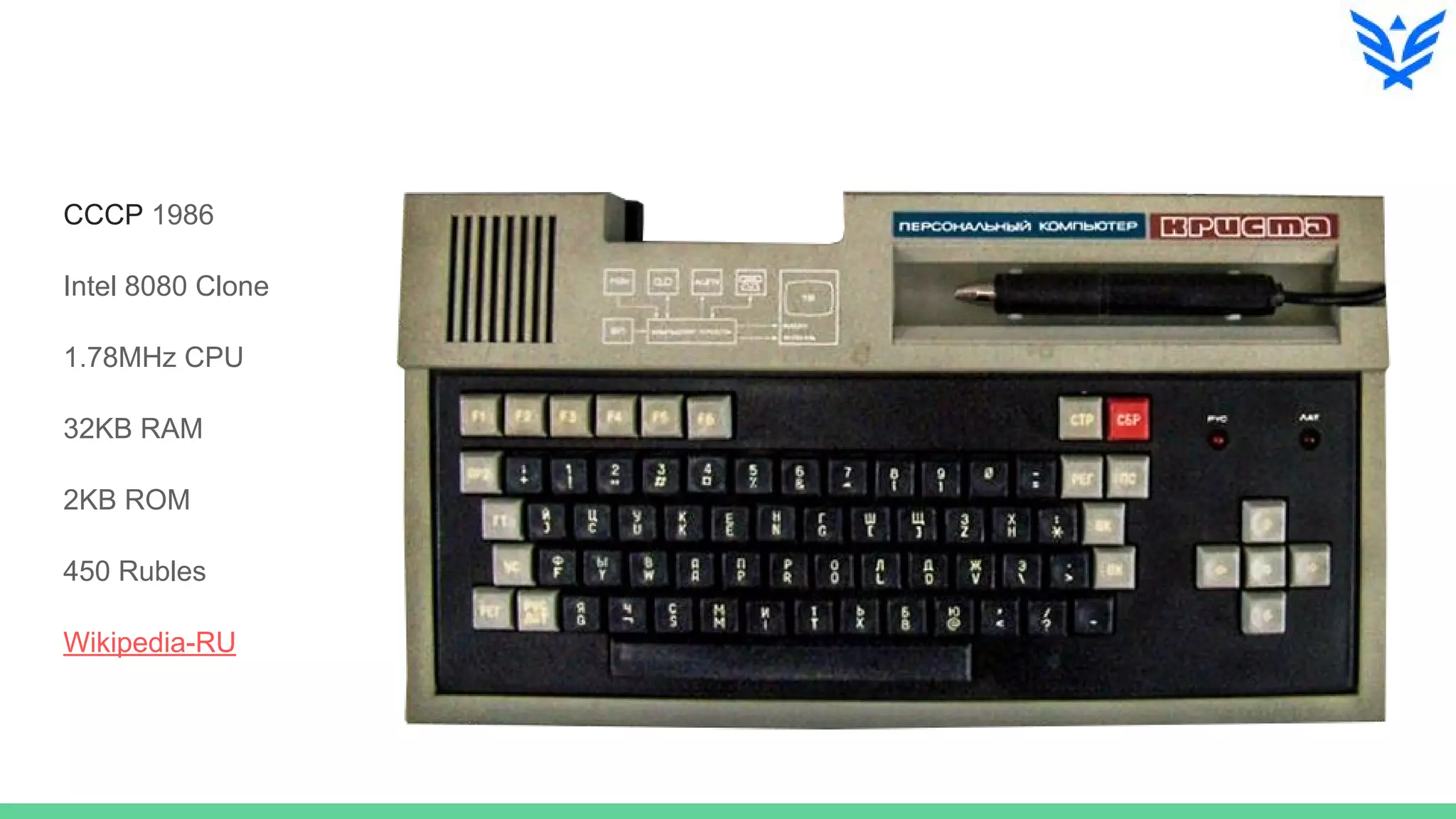
СССР 1986
Intel 8080 Clone
1.78MHz CPU
32KB RAM
2KB ROM
450 Rubles
Wikipedia-RU
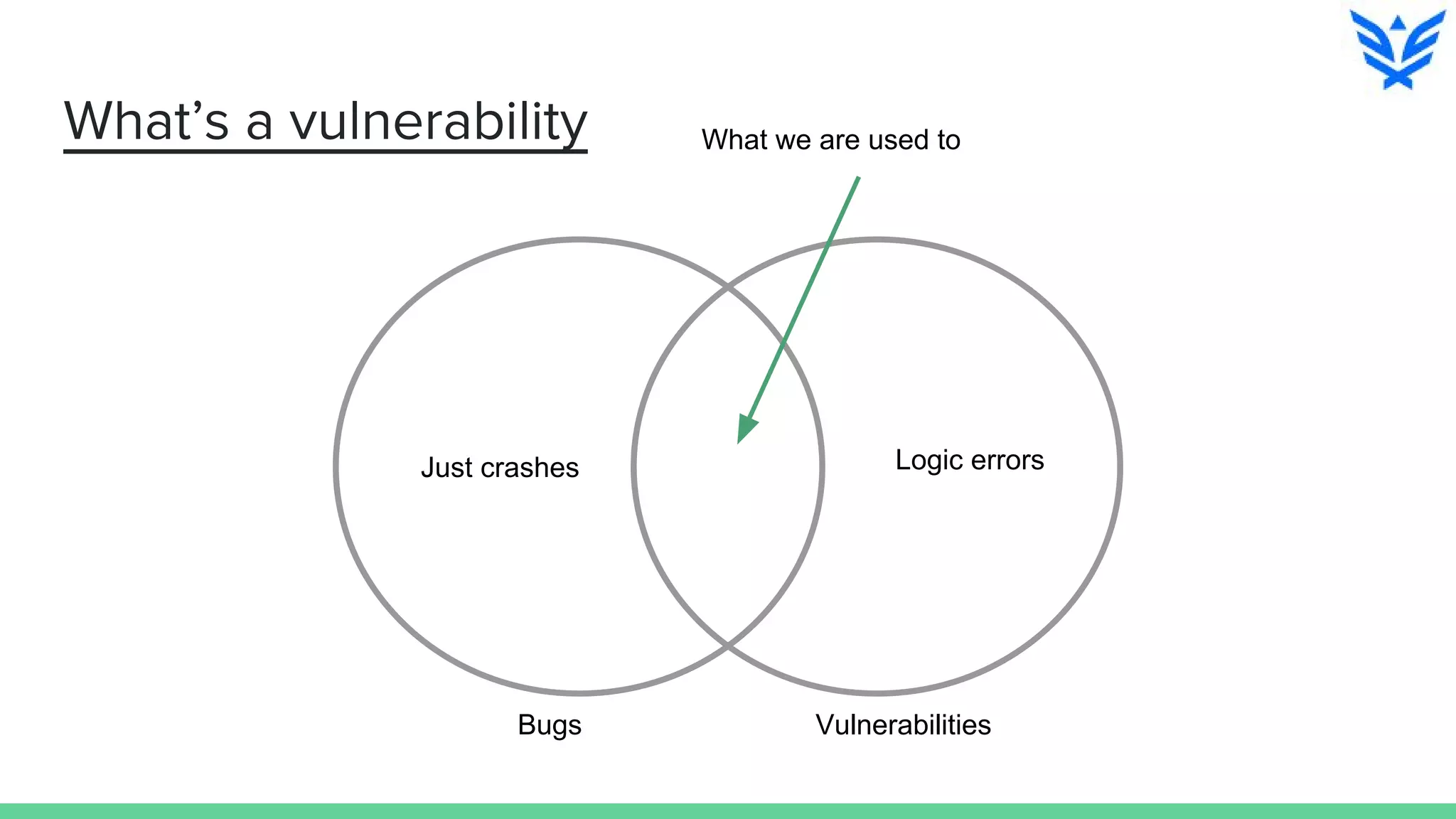
What’s a vulnerability
Just crashes
Bugs Vulnerabilities
What we are used to
Logic errors
Amazon Apple
“In short, the very four digits that Amazon considers
unimportant enough to display in the clear on the web are
precisely the same ones that Apple considers secure enough
to perform identity verification.”
- http://www.wired.com/2012/08/apple-amazon-mat-
honan-hacking/all/
It is not enough to just be careful with your interfaces. You
must also have have mitigations and continuous analysis that
includes “outsiders”.
Security considerations and reviews should be part of every
step of development lifecycle.
Where are the vulns?!
Memory corruption - just won’t go away!
That’s what a lot of CTFs seem to be focusing on.
History thereof
Memory Errors
“Special feature”
Backdooring yourself.
Someone will eventually discover it.
Network
man on the side
http://www.wired.com/2015/04/researchers-uncover-method-detect-nsa-quantum-insert-hacks/
web
where did I leave that session key again?
https://www.owasp.org/index.php/Top_10_2013-Table_of_Contents
Miscommunications
The root of all bugs.
Don’t be too paranoid
It’s not healthy, but always ask:
“what do you do if someone compromises
this component?”
Targeting
Classic:
Browser, Remote, Phishing
A little more advanced:
Via AWS - managed services (Exploiting external relationships)
USB - https://srlabs.de/badusb/ i.e. Stuxnet
Beg, borrow and steal
Finding vulnerabilities
Fuzzing (AFL, Many frameworks)
Code reading (SourceInsight, Understand)
Dynamic/Static analysis (Qira, Panda)
Exploit
Control EIP
Doesn’t have to be 100%
Gain execution
Binary protections like ASLR and DEP
Infect
Run shell code
Might have some ROPing to do
And, stack pivoting
Find the egg
Bigger shellcode.
Download implant
Gain persistence i.e. launch daemon
No Disclosure
Private Communities
Full disclosure
Responsible Disclosure
Coordinated Disclosure
Private Bug bounties: Google, Microsoft, Facebook
Managed Bug Bounties: Bugcrowd, HackerOne, SYNACK
Black Market Bug Bounties:
Zerodium, Vupen
Cosinc (link)
HackingTeam (Probably defunct)
MitnickSecurity
Lots of secretive companies (link)
A few not so secretive (link)
SYNACK
Private Targets
Think easy targets
Fortune 500 Companies
Several Categories
Host, Web, Mobile
Average payout: $690
We provide a cyber platform, Hydra!
https://www.synack.com/red-team/
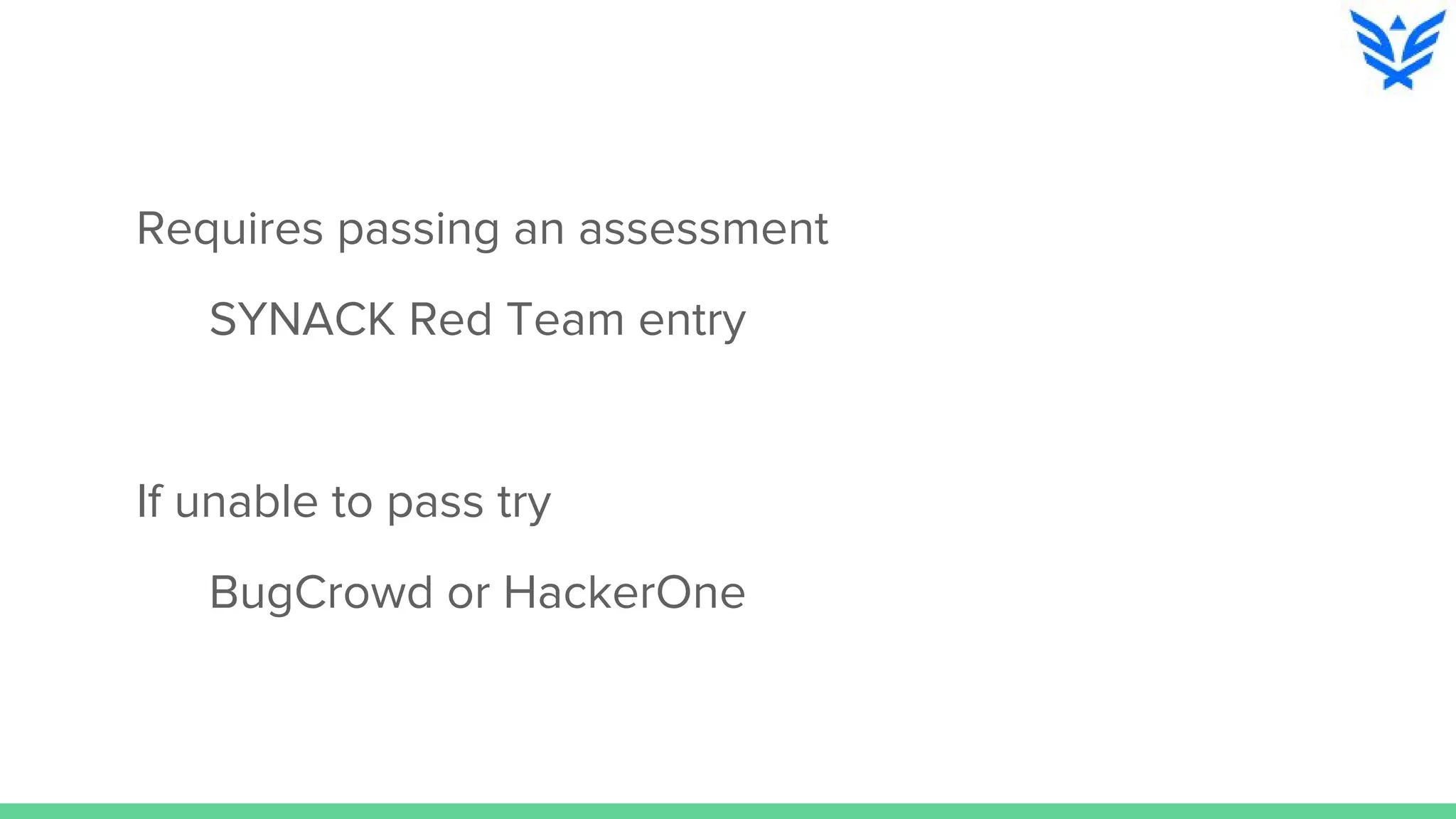
Requires passing an assessment
SYNACK Red Team entry
If unable to pass try
BugCrowd or HackerOne
Let’s say you gained execution
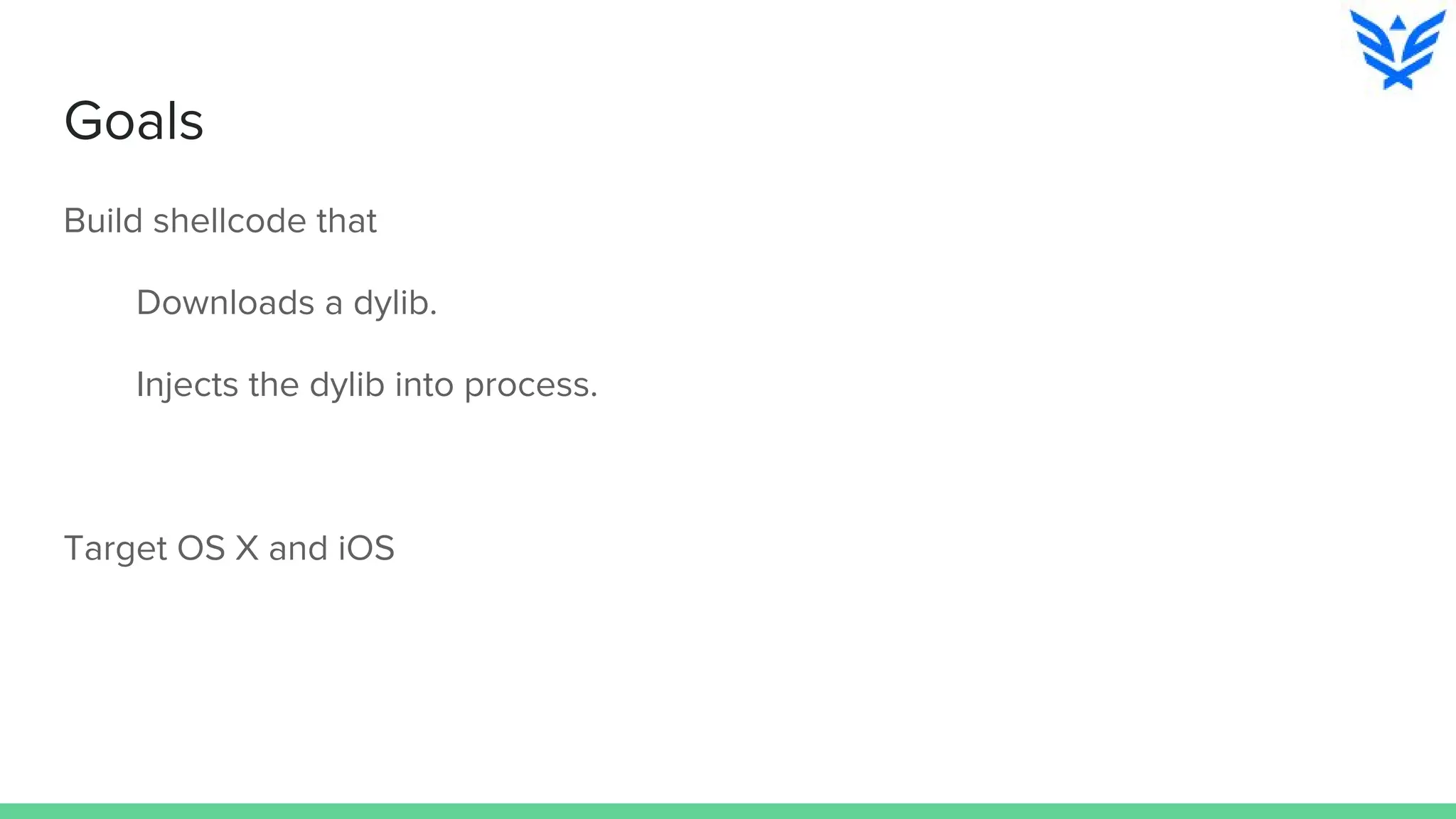
Goals
Build shellcode that
Downloads a dylib.
Injects the dylib into process.
Target OS X and iOS
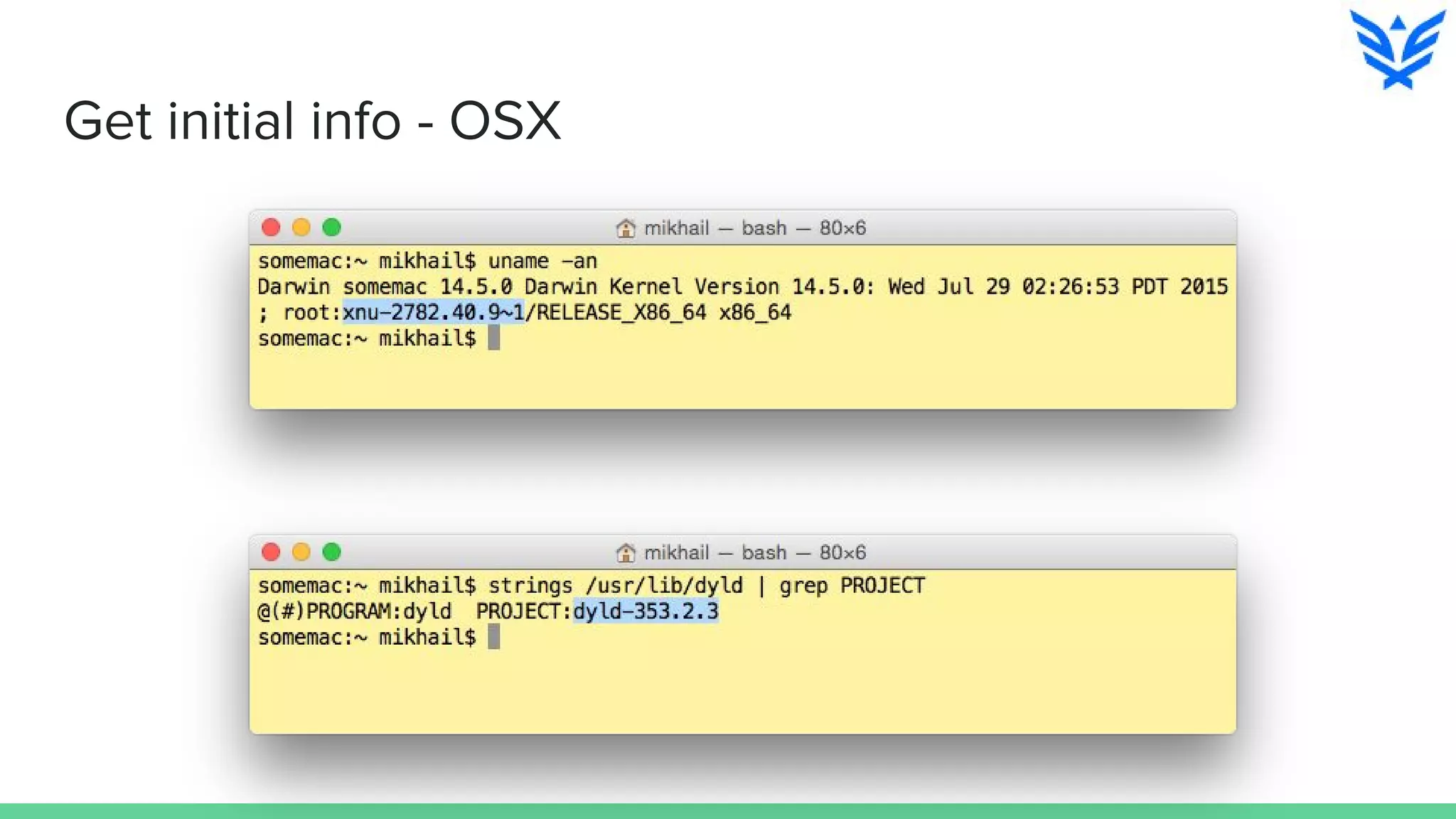
Get initial info - OSX
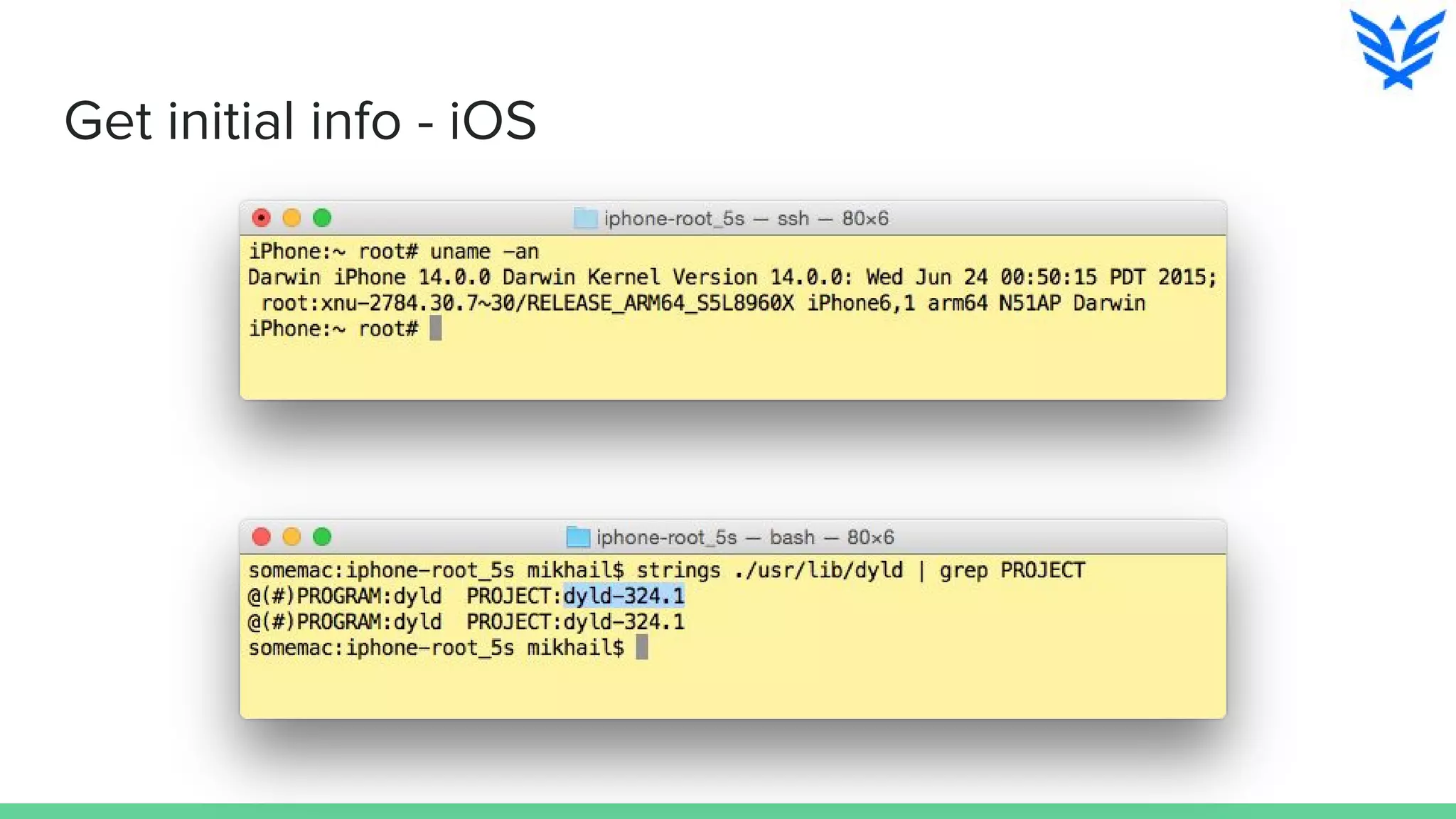
Get initial info - iOS
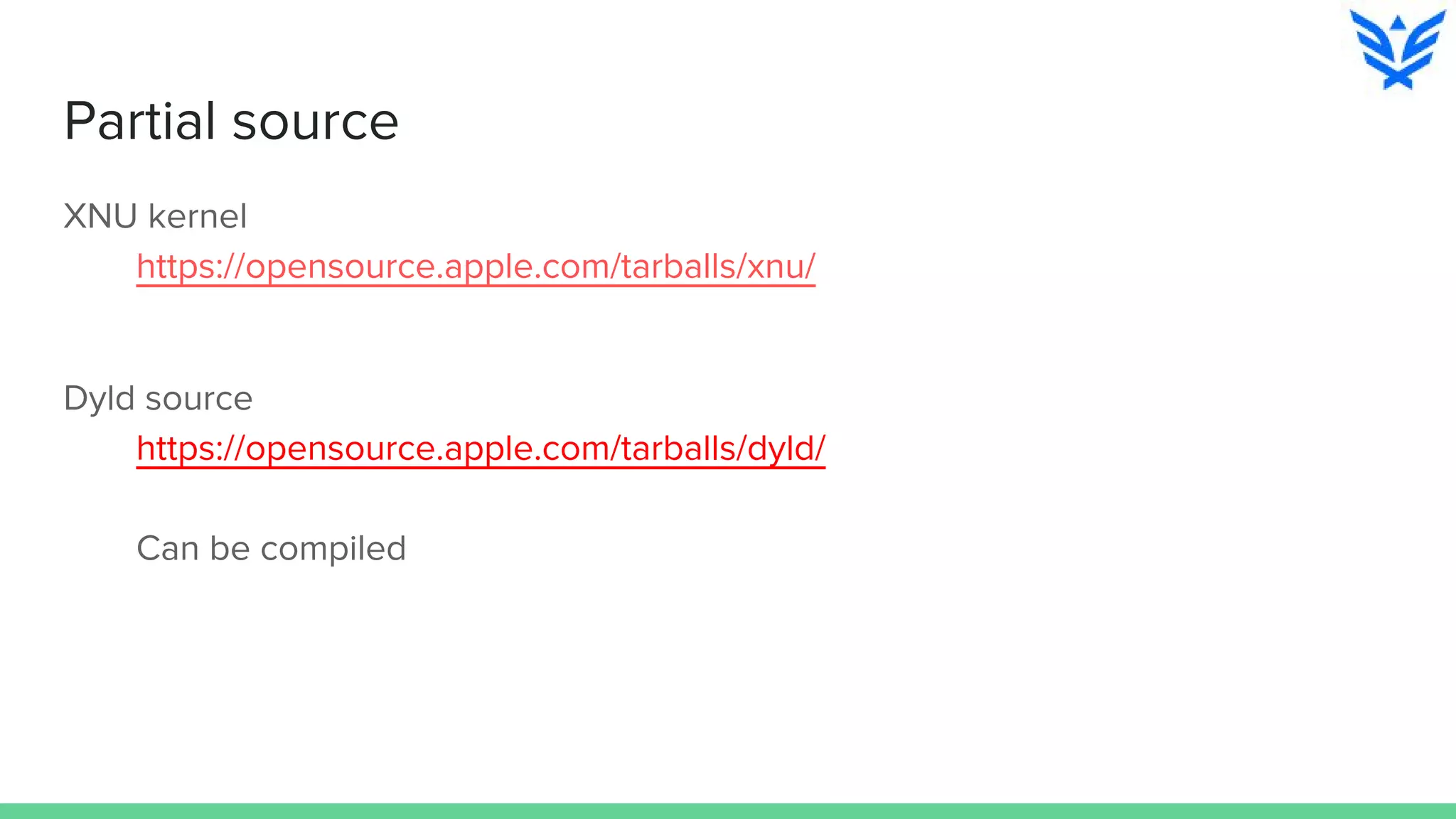
Partial source
XNU kernel
https://opensource.apple.com/tarballs/xnu/
Dyld source
https://opensource.apple.com/tarballs/dyld/
Can be compiled
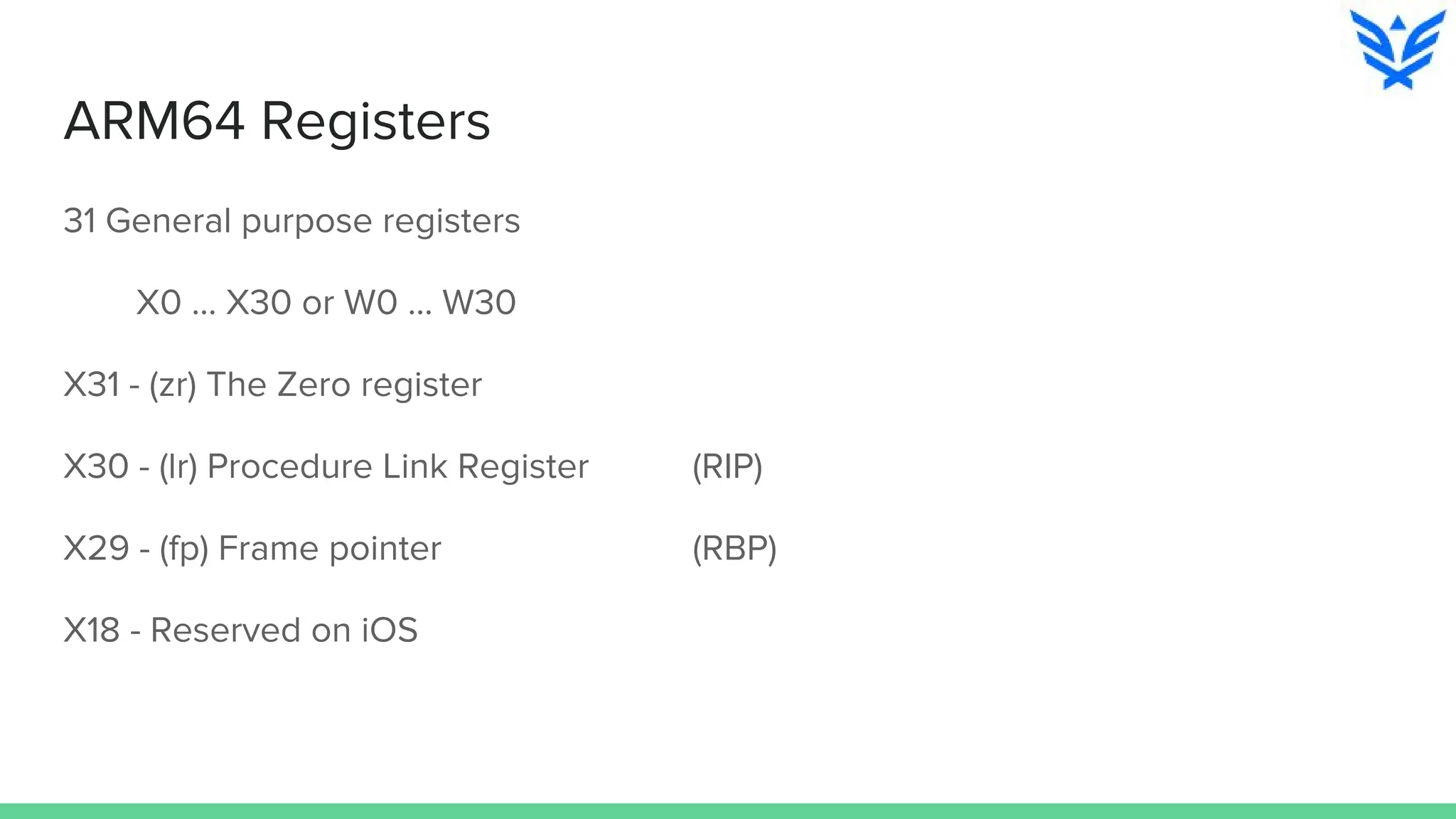
ARM64 Registers
31 General purpose registers
X0 … X30 or W0 … W30
X31 - (zr) The Zero register
X30 - (lr) Procedure Link Register (RIP)
X29 - (fp) Frame pointer (RBP)
X18 - Reserved on iOS
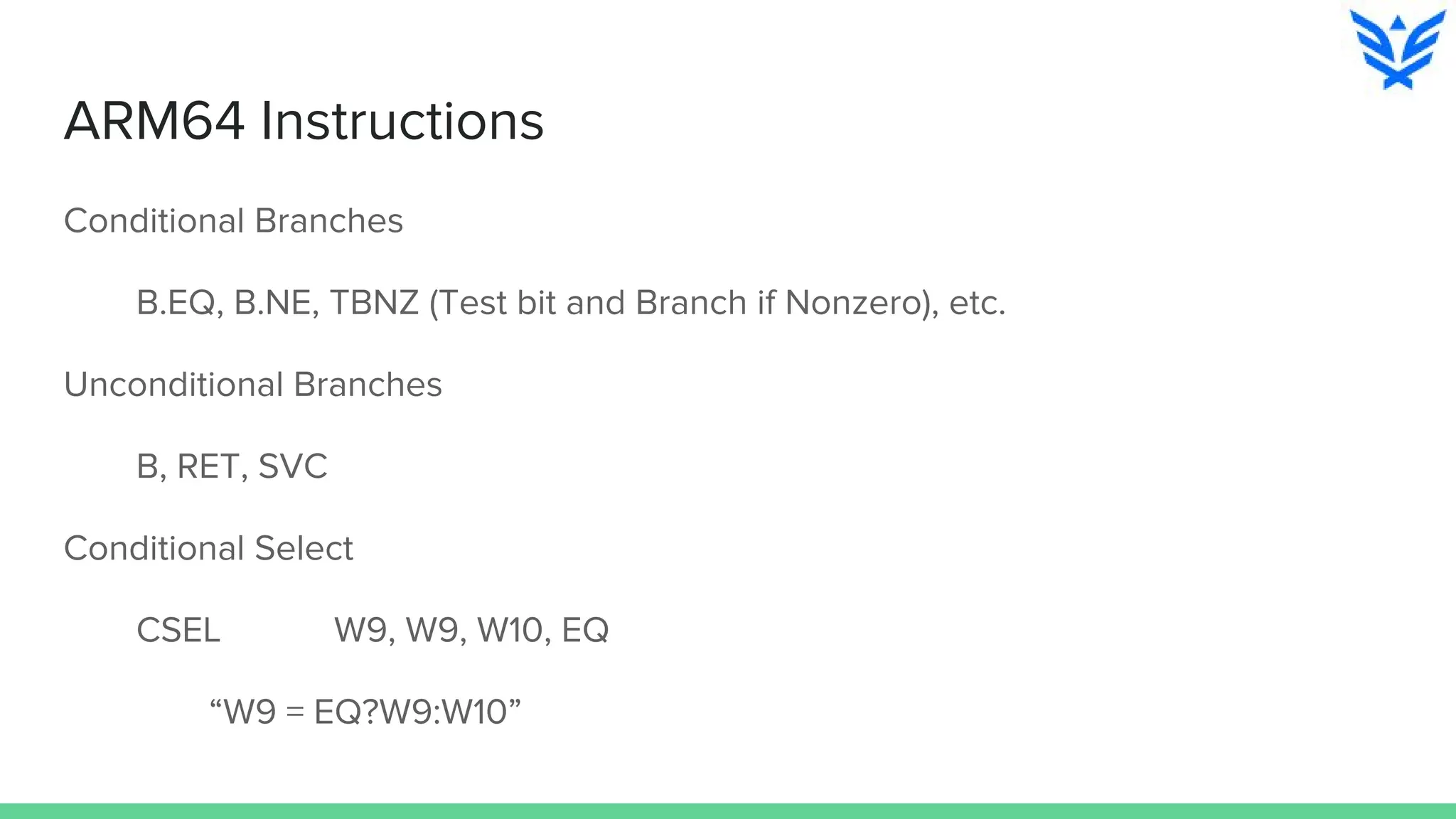
ARM64 Instructions
Conditional Branches
B.EQ, B.NE, TBNZ (Test bit and Branch if Nonzero), etc.
Unconditional Branches
B, RET, SVC
Conditional Select
CSEL W9, W9, W10, EQ
“W9 = EQ?W9:W10”
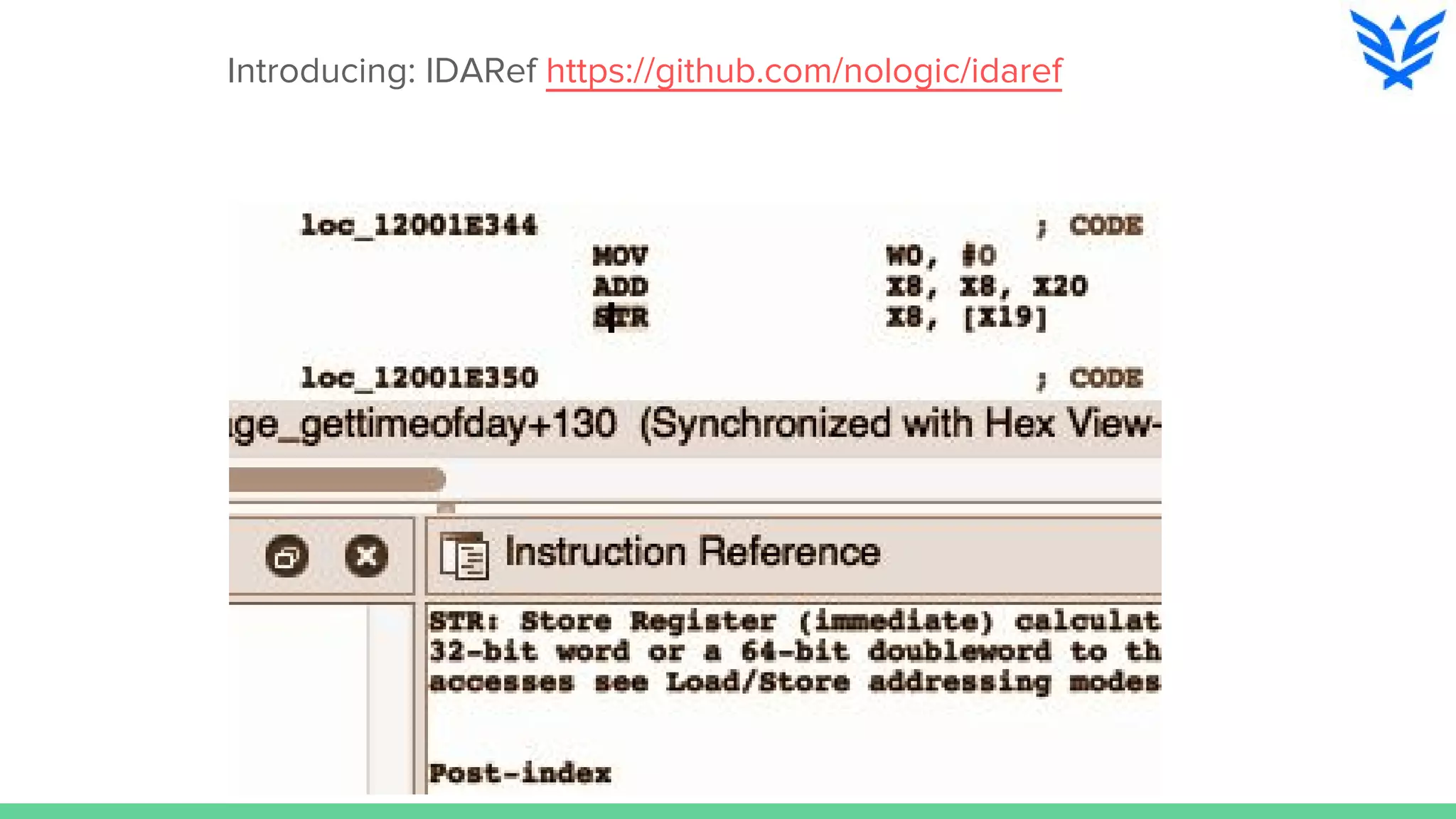
Introducing: IDARef https://github.com/nologic/idaref
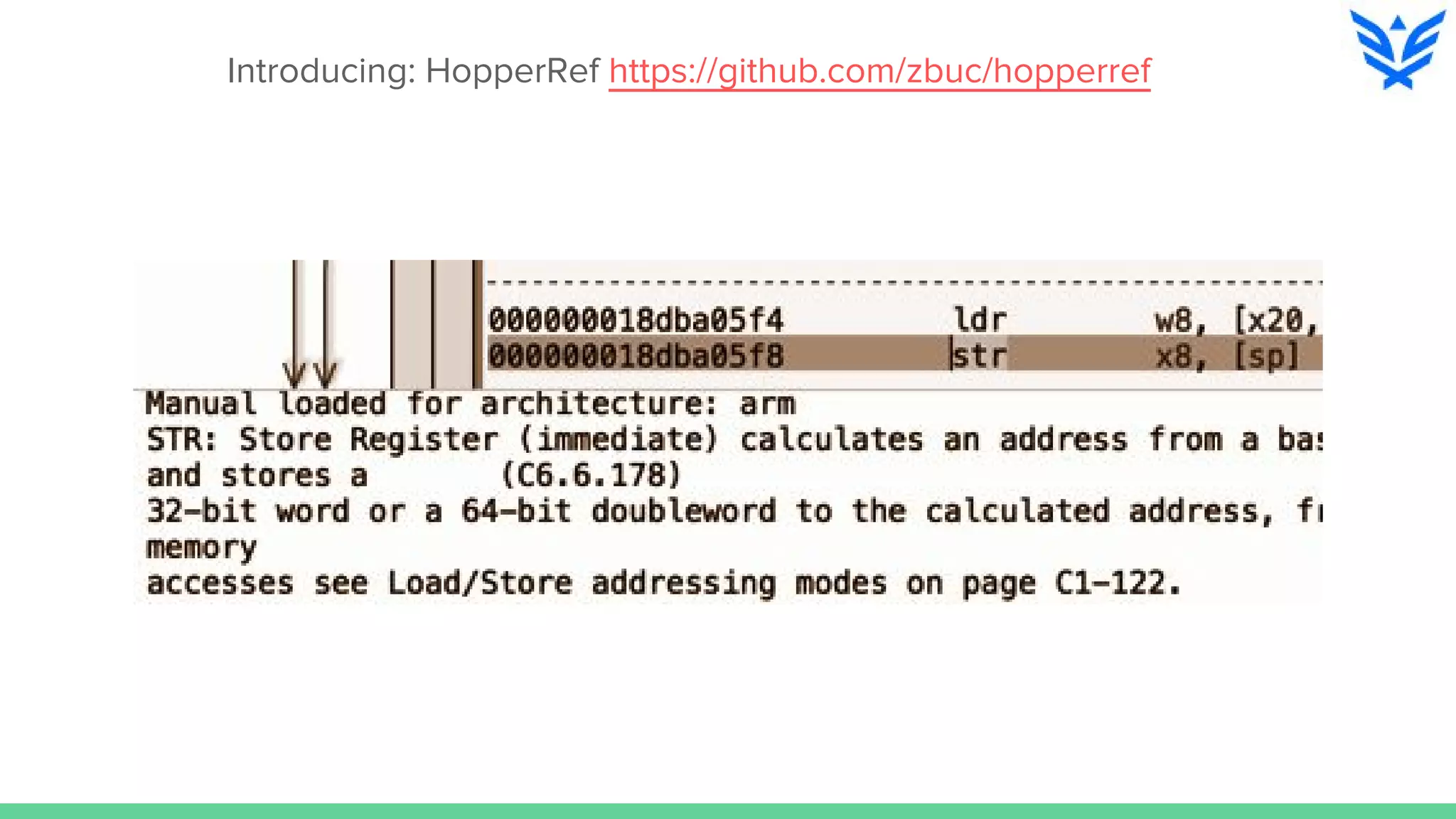
Introducing: HopperRef https://github.com/zbuc/hopperref
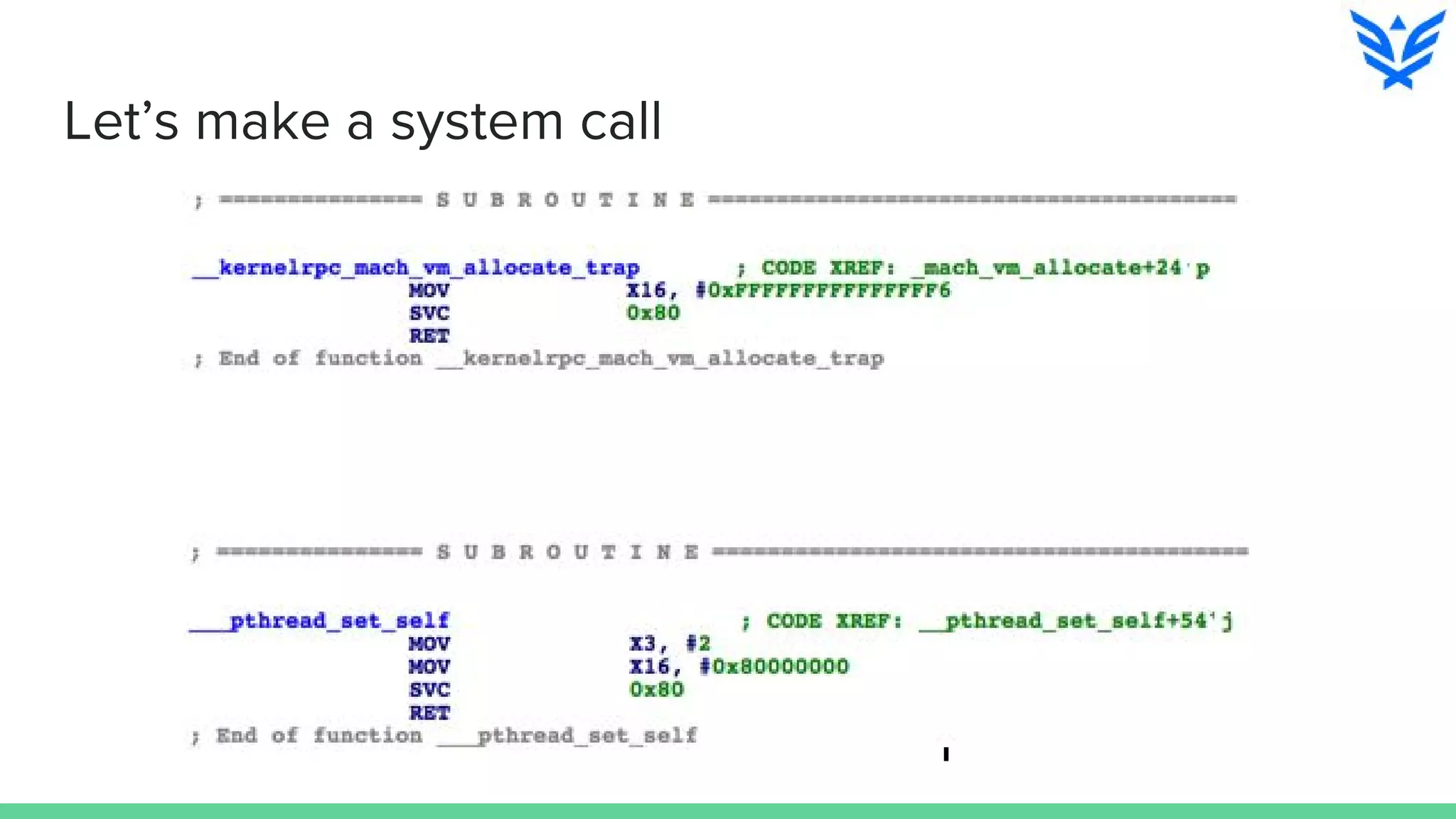
Making system calls
Calling Convention
On ARM64:
X0 … X8 Contain function parameters
X16 has the system call number
Positive for Posix
Negative for Mach Ports
0x80000000 for thread_set_self
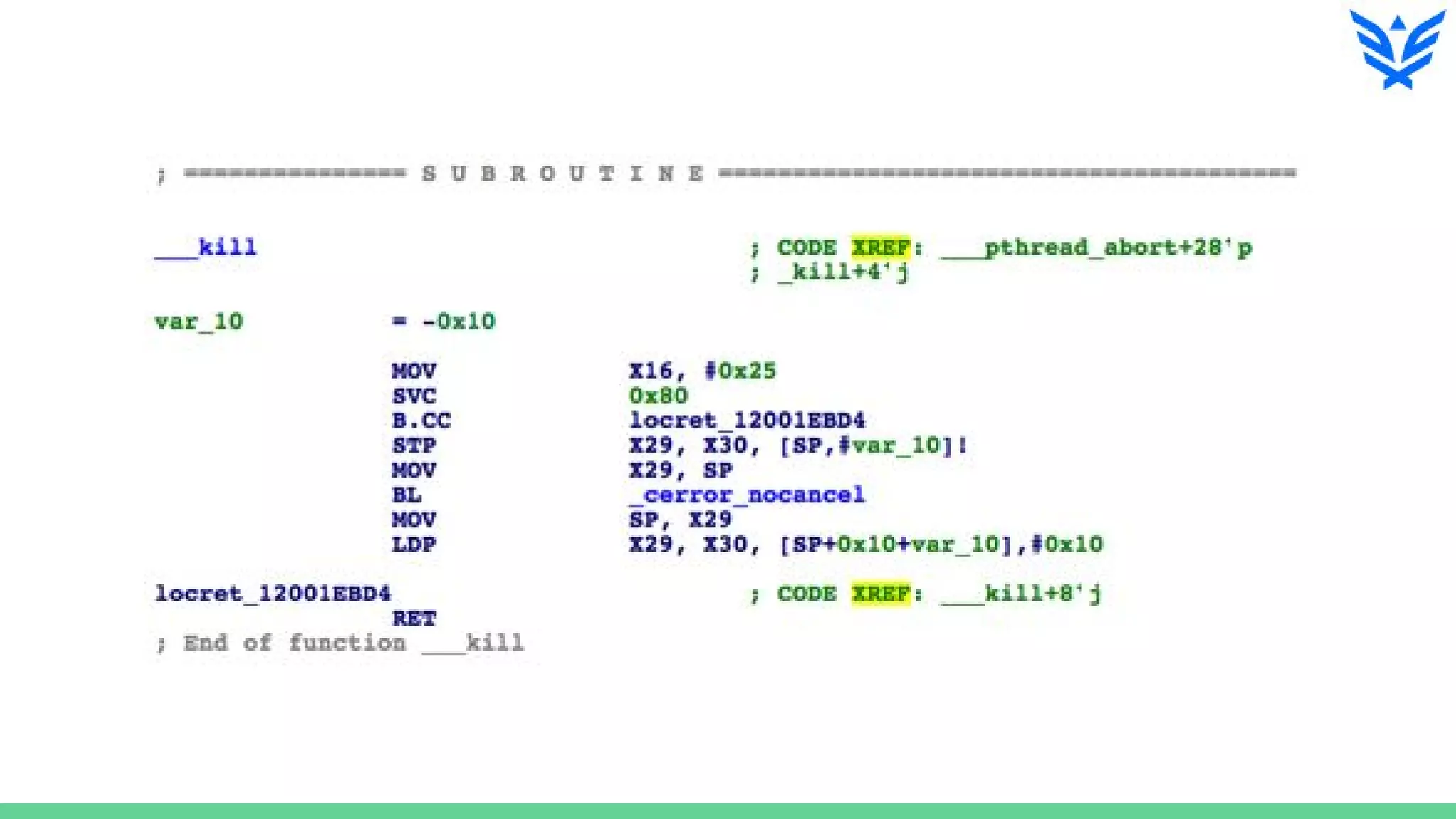
SVC 0x80; jumps to kernel
Let’s make a system call
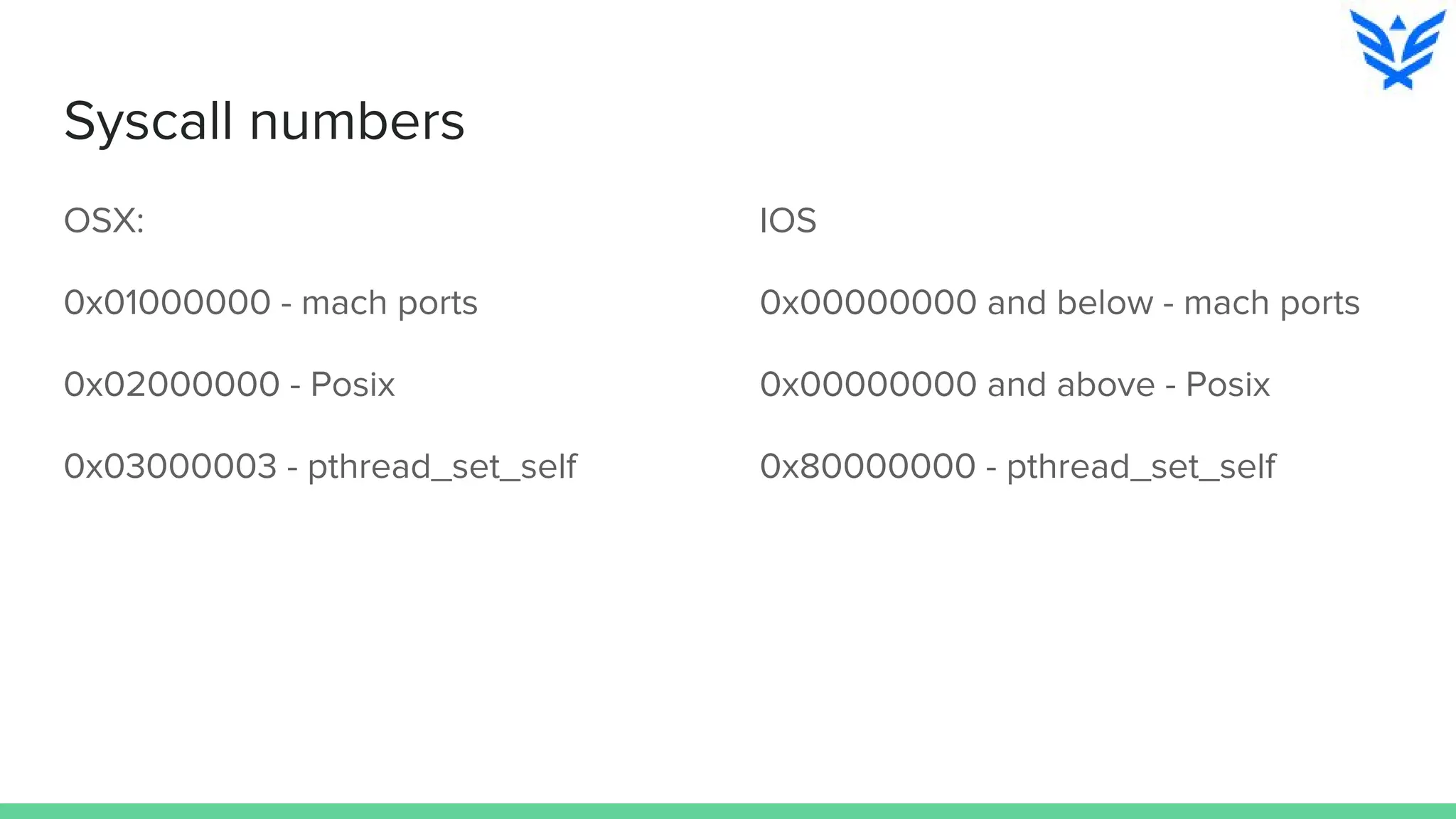
Syscall numbers
OSX:
0x01000000 - mach ports
0x02000000 - Posix
0x03000003 - pthread_set_self
IOS
0x00000000 and below - mach ports
0x00000000 and above - Posix
0x80000000 - pthread_set_self
Loading Mach-O’s
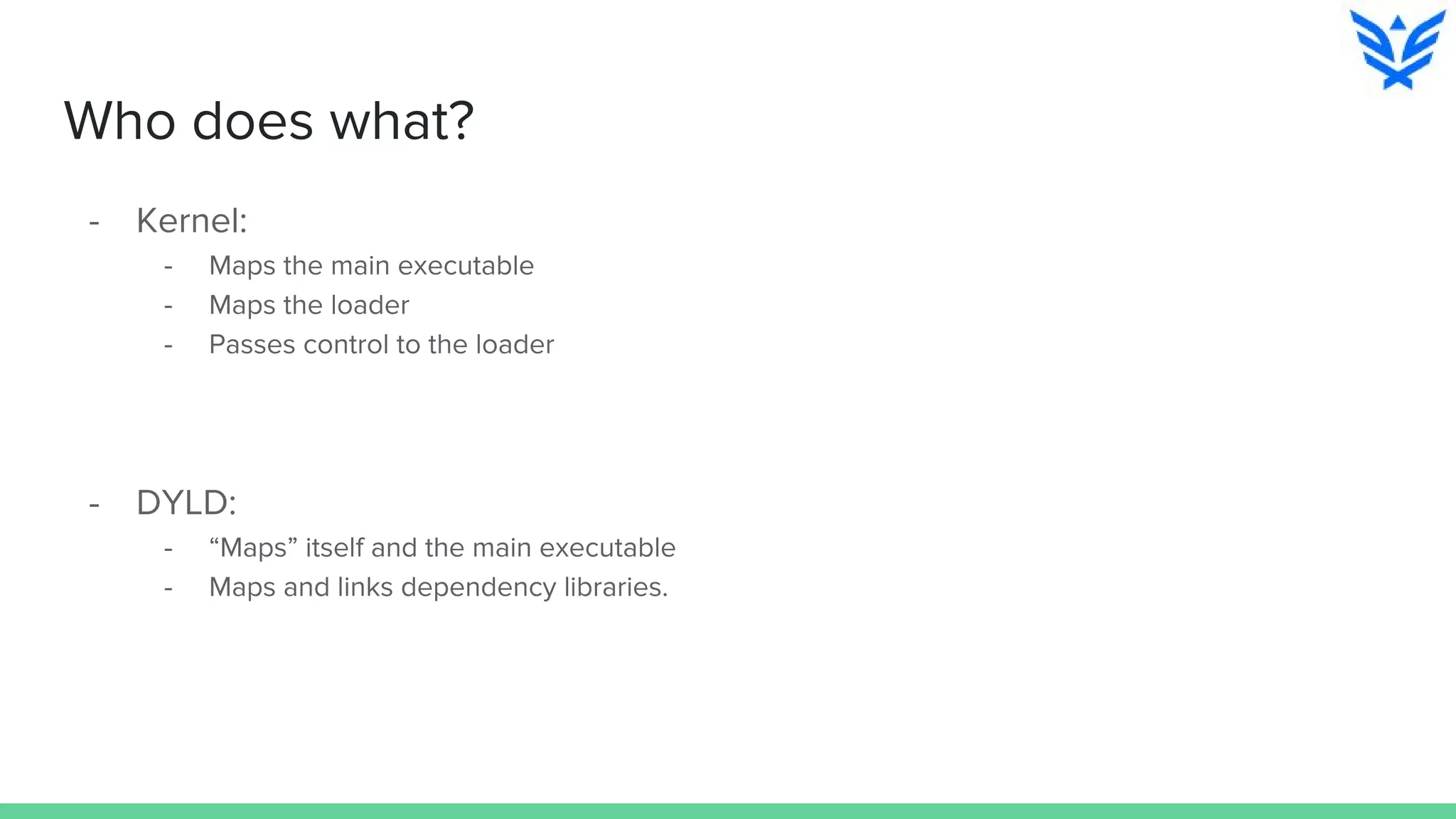
Who does what?
- Kernel:
- Maps the main executable
- Maps the loader
- Passes control to the loader
- DYLD:
- “Maps” itself and the main executable
- Maps and links dependency libraries.
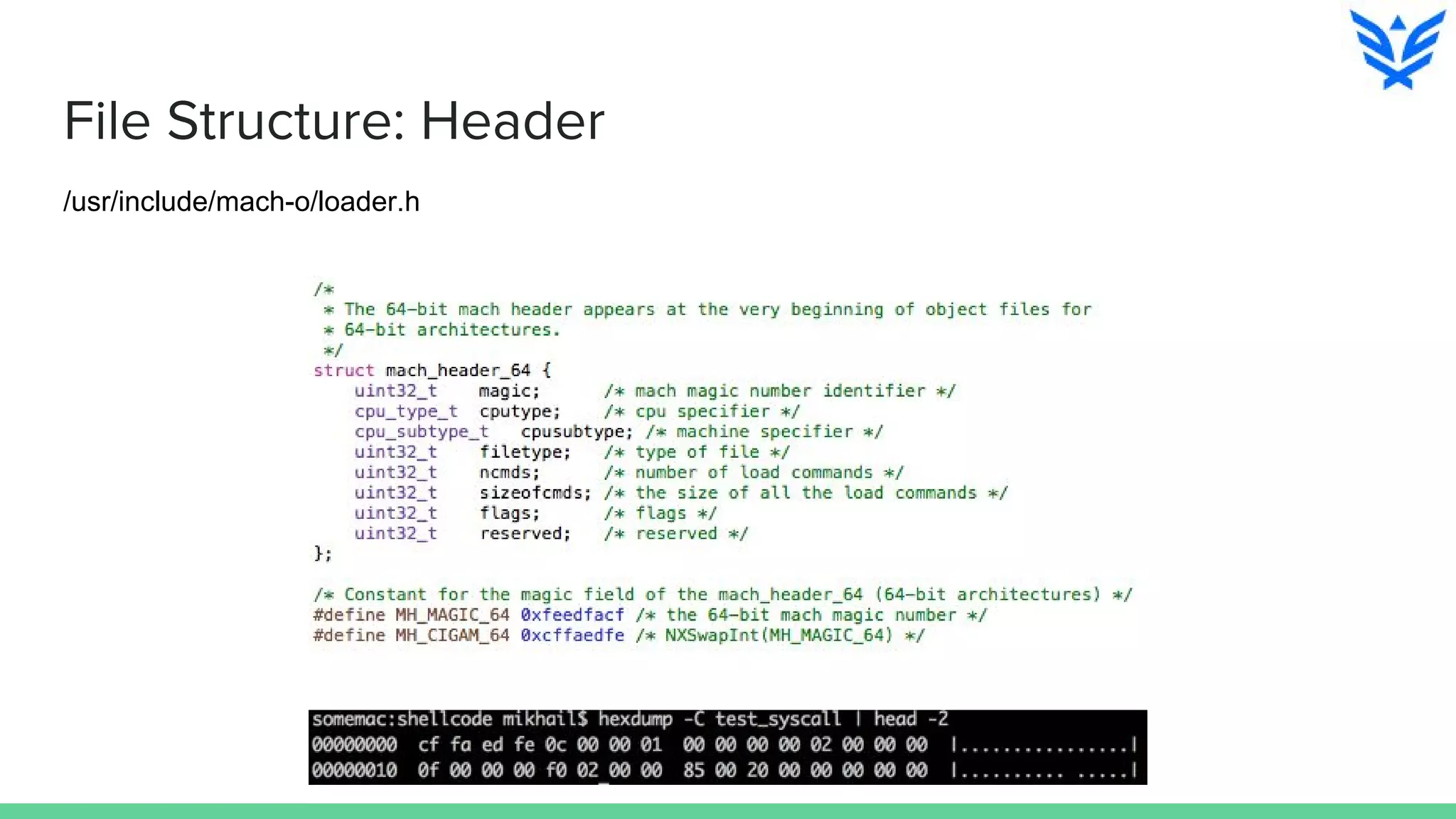
File Structure: Header
/usr/include/mach-o/loader.h
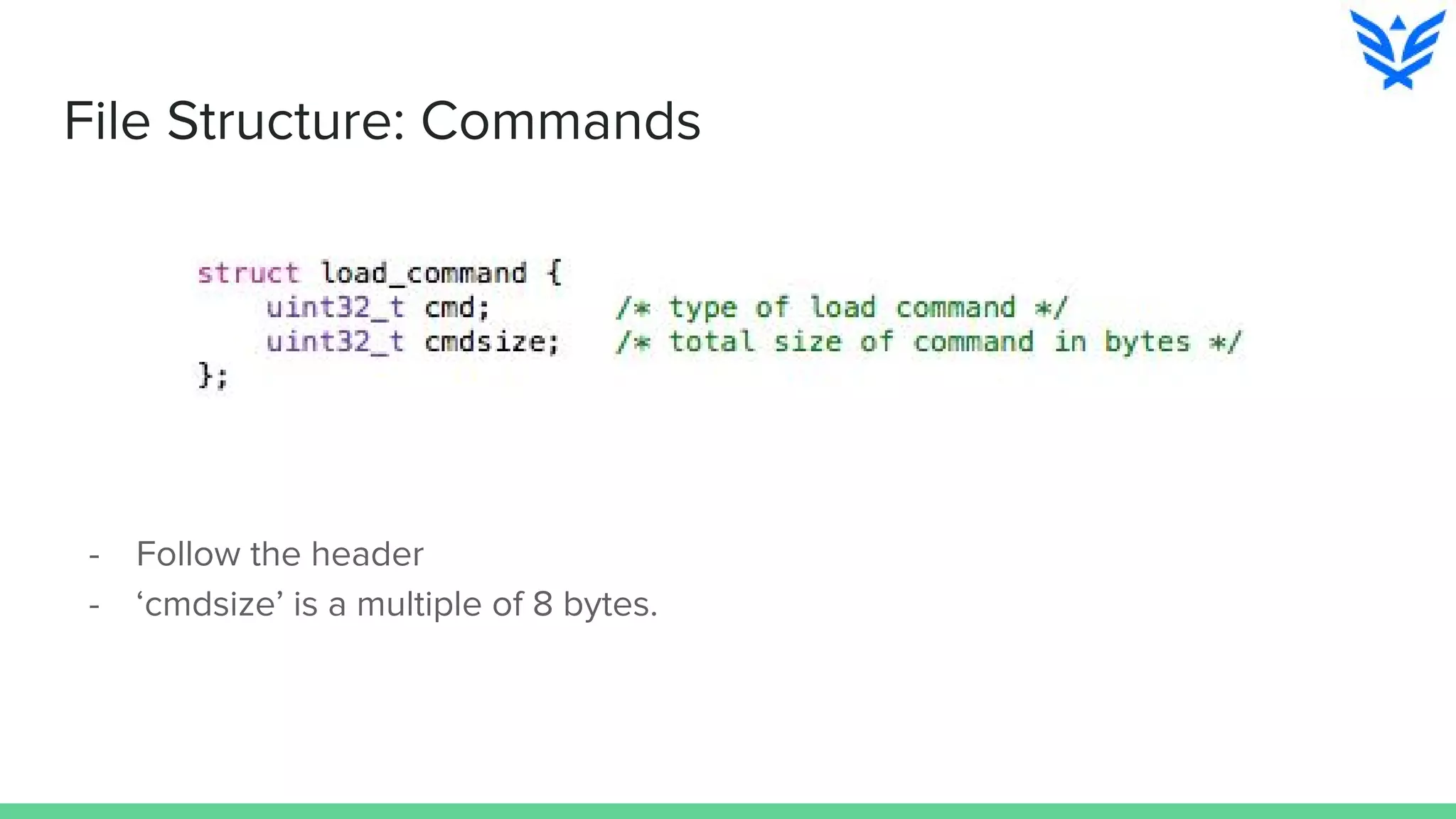
File Structure: Commands
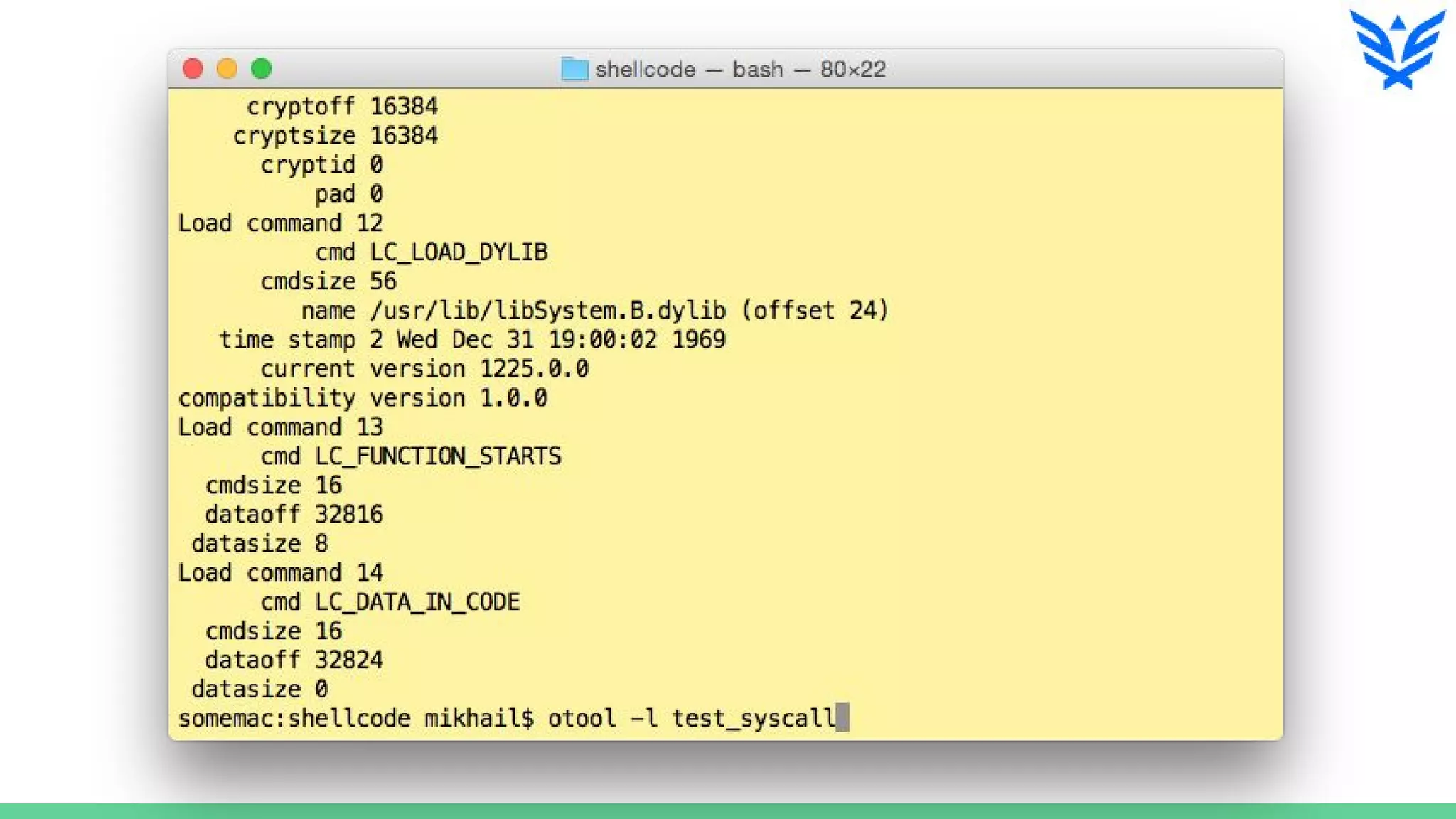
- Follow the header
- ‘cmdsize’ is a multiple of 8 bytes.
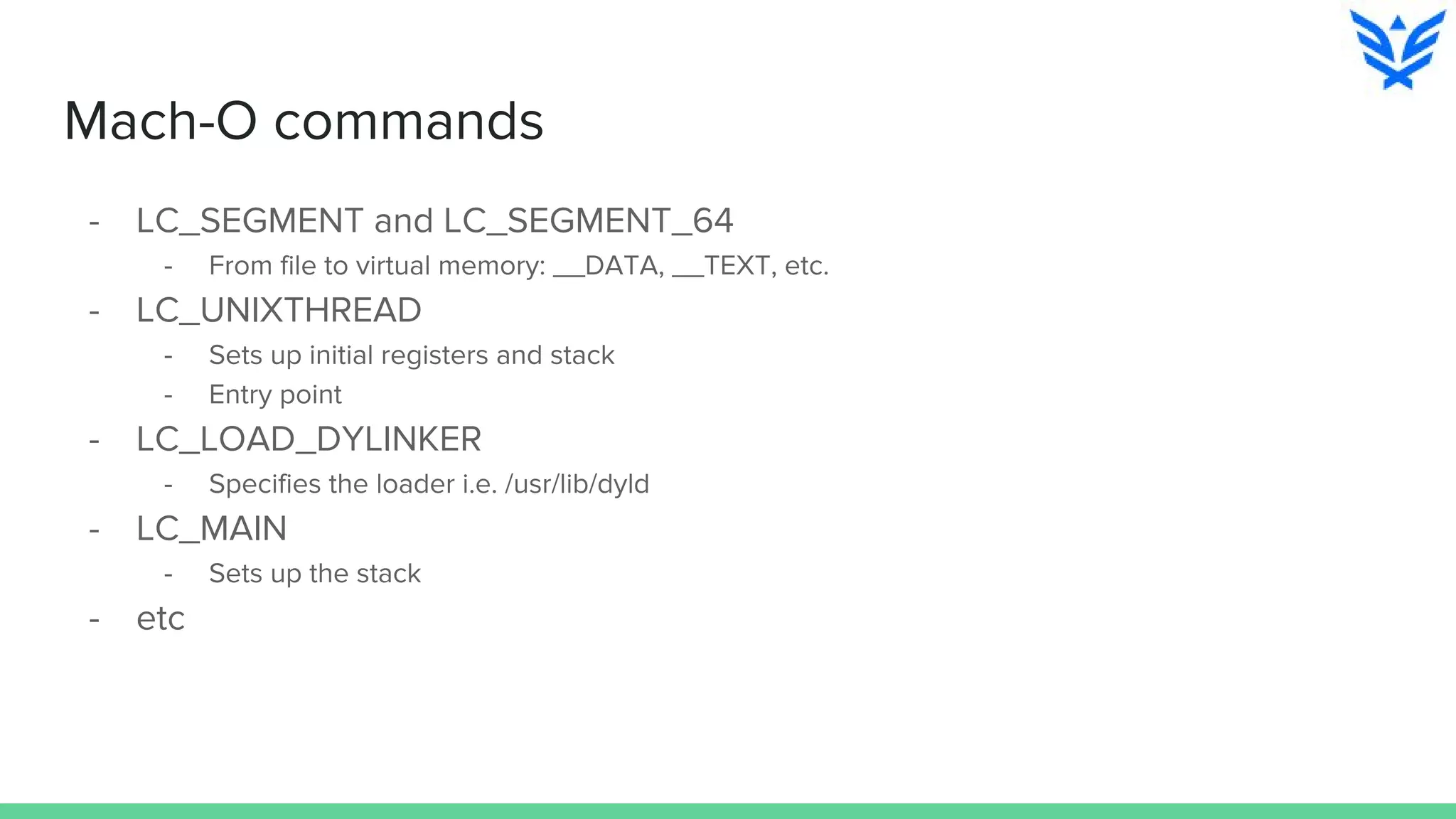
Mach-O commands
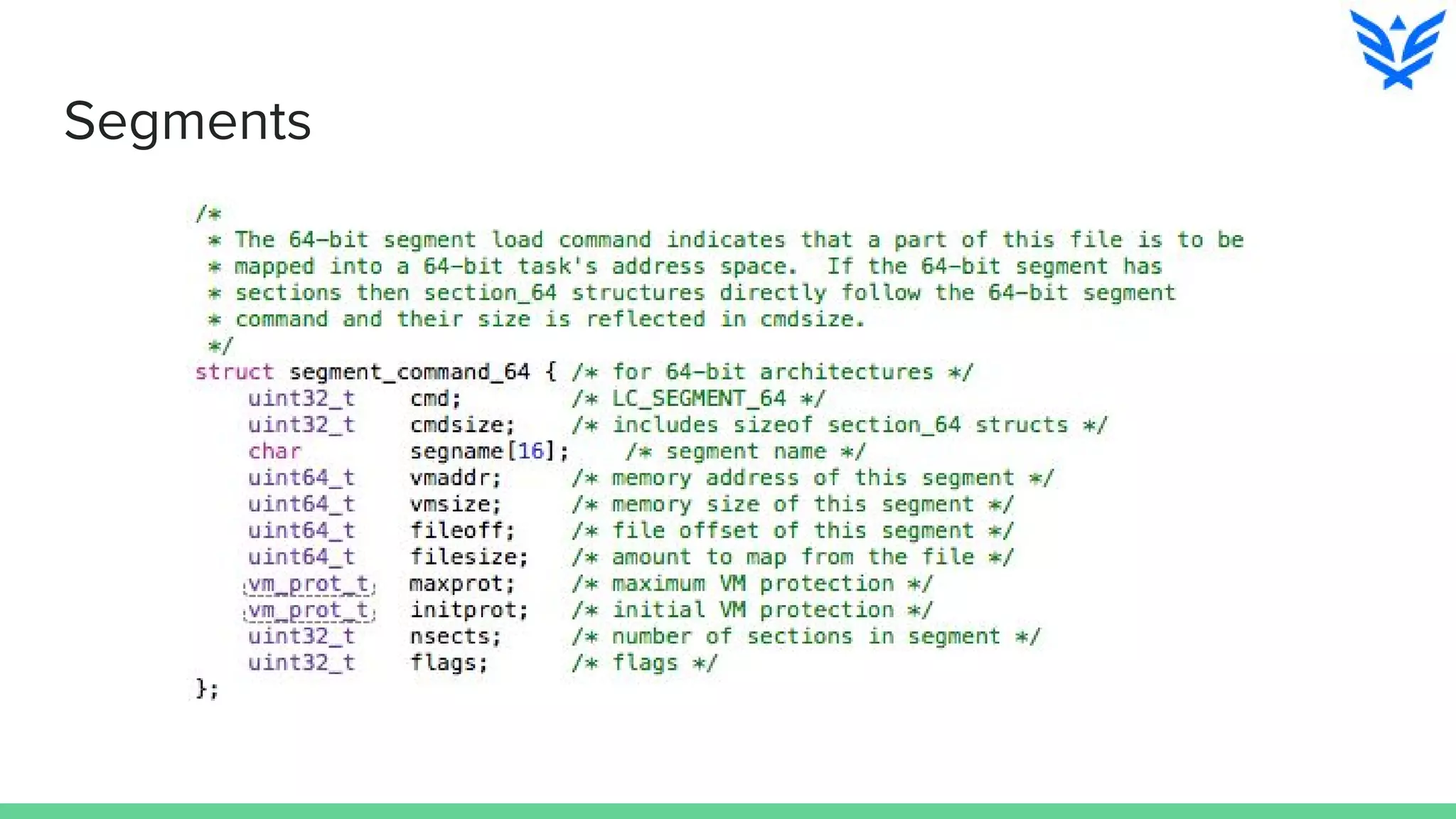
- LC_SEGMENT and LC_SEGMENT_64
- From file to virtual memory: __DATA, __TEXT, etc.
- LC_UNIXTHREAD
- Sets up initial registers and stack
- Entry point
- LC_LOAD_DYLINKER
- Specifies the loader i.e. /usr/lib/dyld
- LC_MAIN
- Sets up the stack
- etc
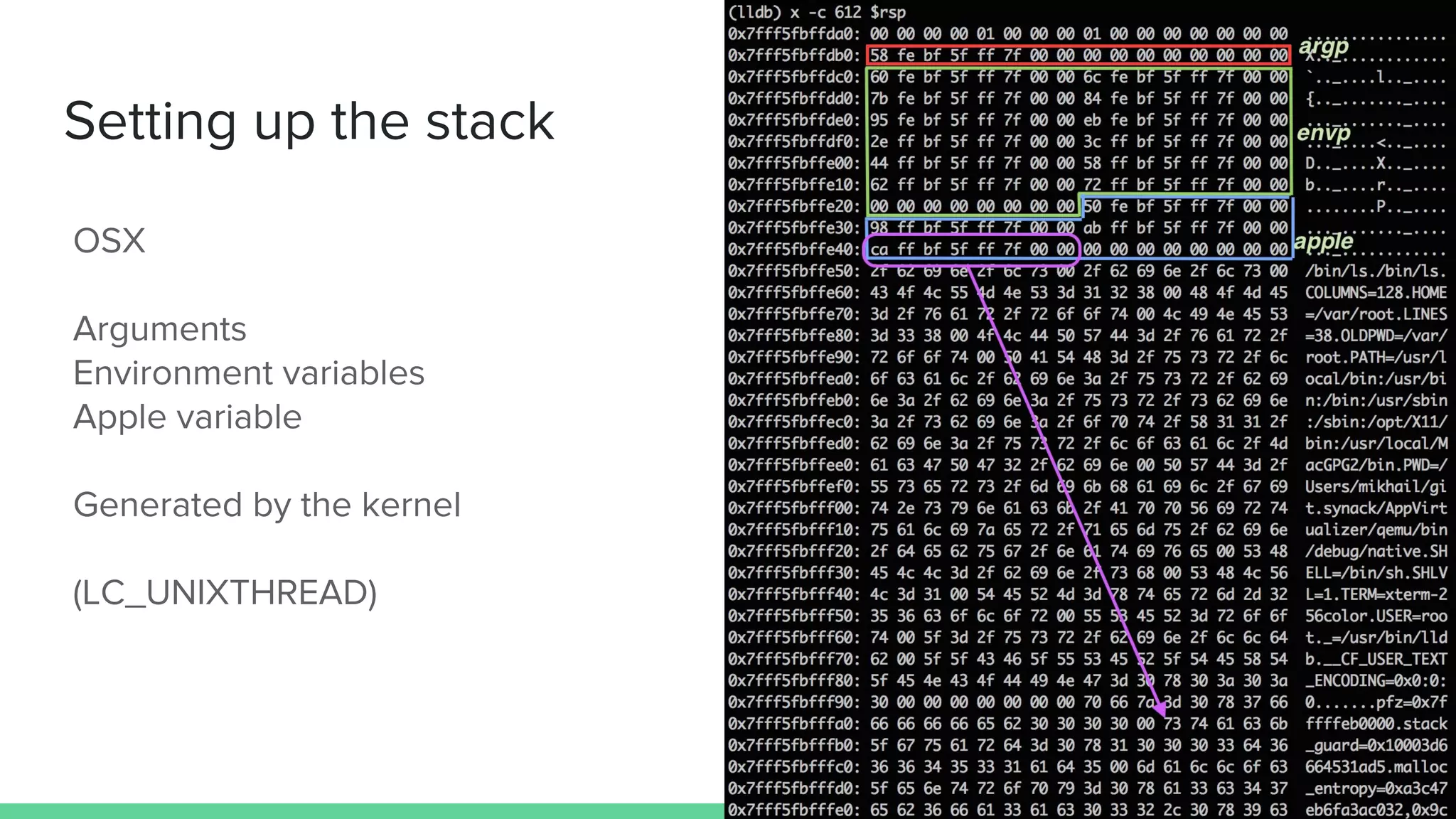
Setting up the stack
OSX
Arguments
Environment variables
Apple variable
Generated by the kernel
(LC_UNIXTHREAD)
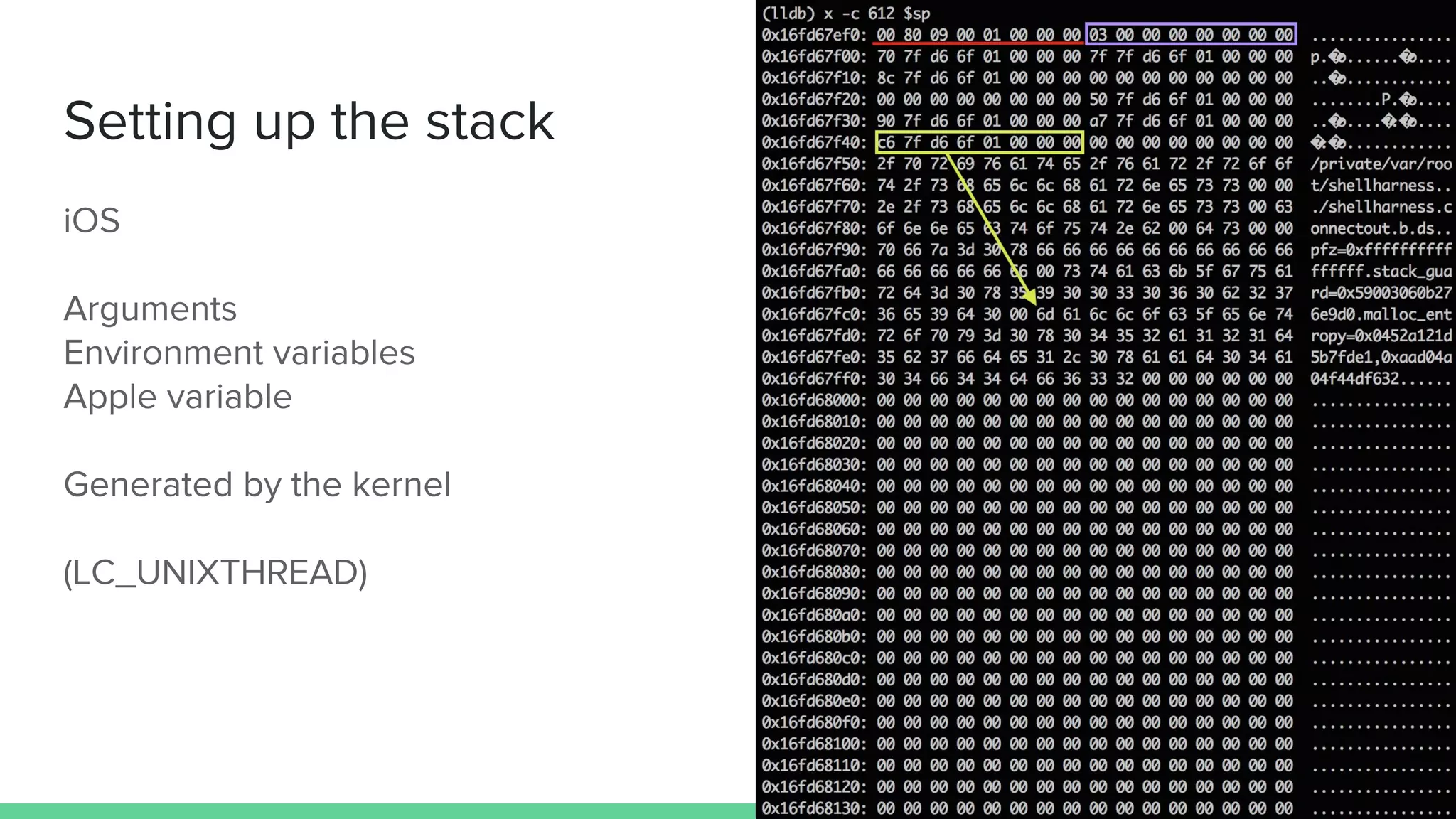
Setting up the stack
iOS
Arguments
Environment variables
Apple variable
Generated by the kernel
(LC_UNIXTHREAD)
Segments
Let’s build some shellcode.
(live exercise)
Recorded session
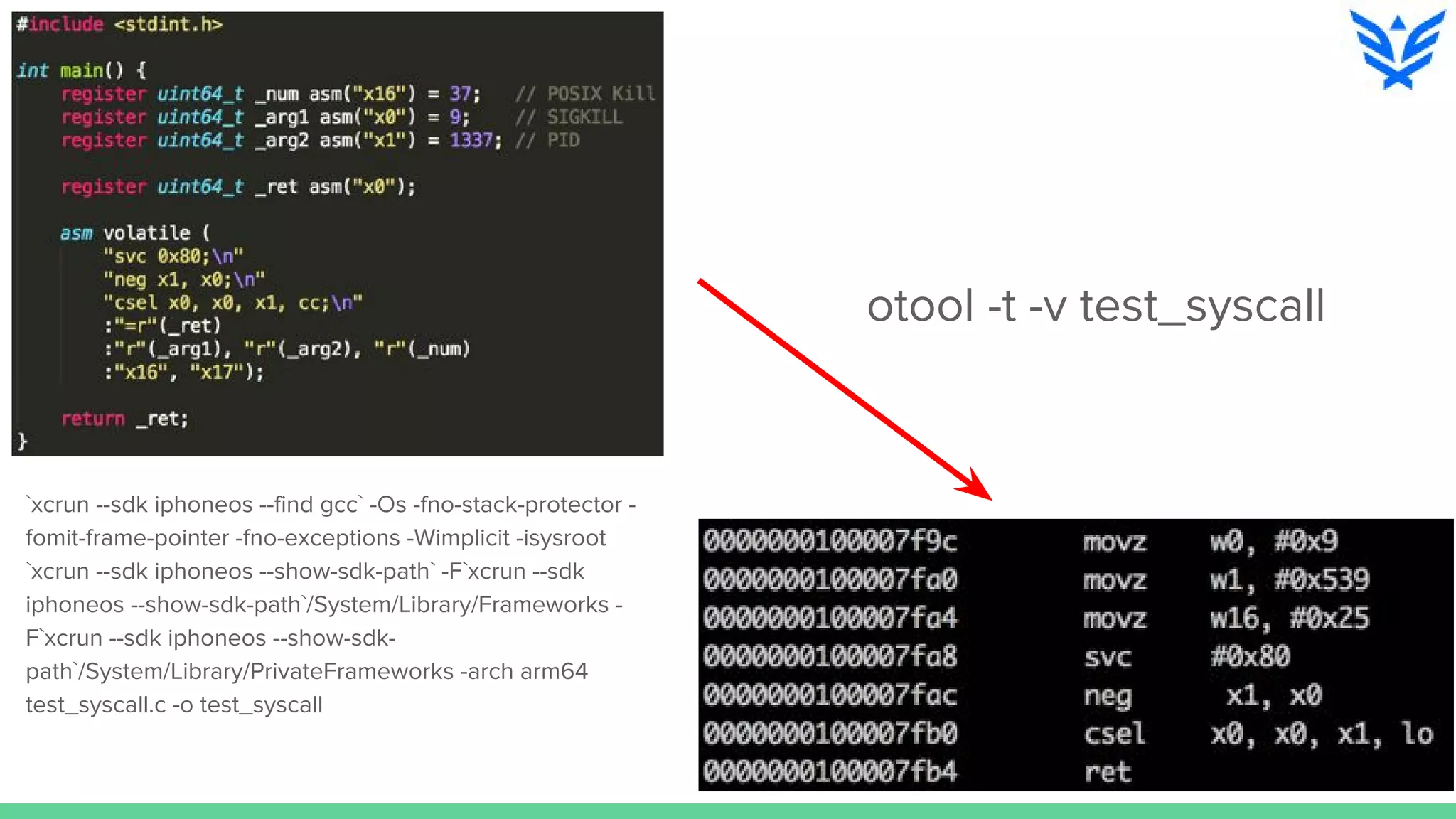
`xcrun --sdk iphoneos --find gcc` -Os -fno-stack-protector -
fomit-frame-pointer -fno-exceptions -Wimplicit -isysroot
`xcrun --sdk iphoneos --show-sdk-path` -F`xcrun --sdk
iphoneos --show-sdk-path`/System/Library/Frameworks -
F`xcrun --sdk iphoneos --show-sdk-
path`/System/Library/PrivateFrameworks -arch arm64
test_syscall.c -o test_syscall
otool -t -v test_syscall
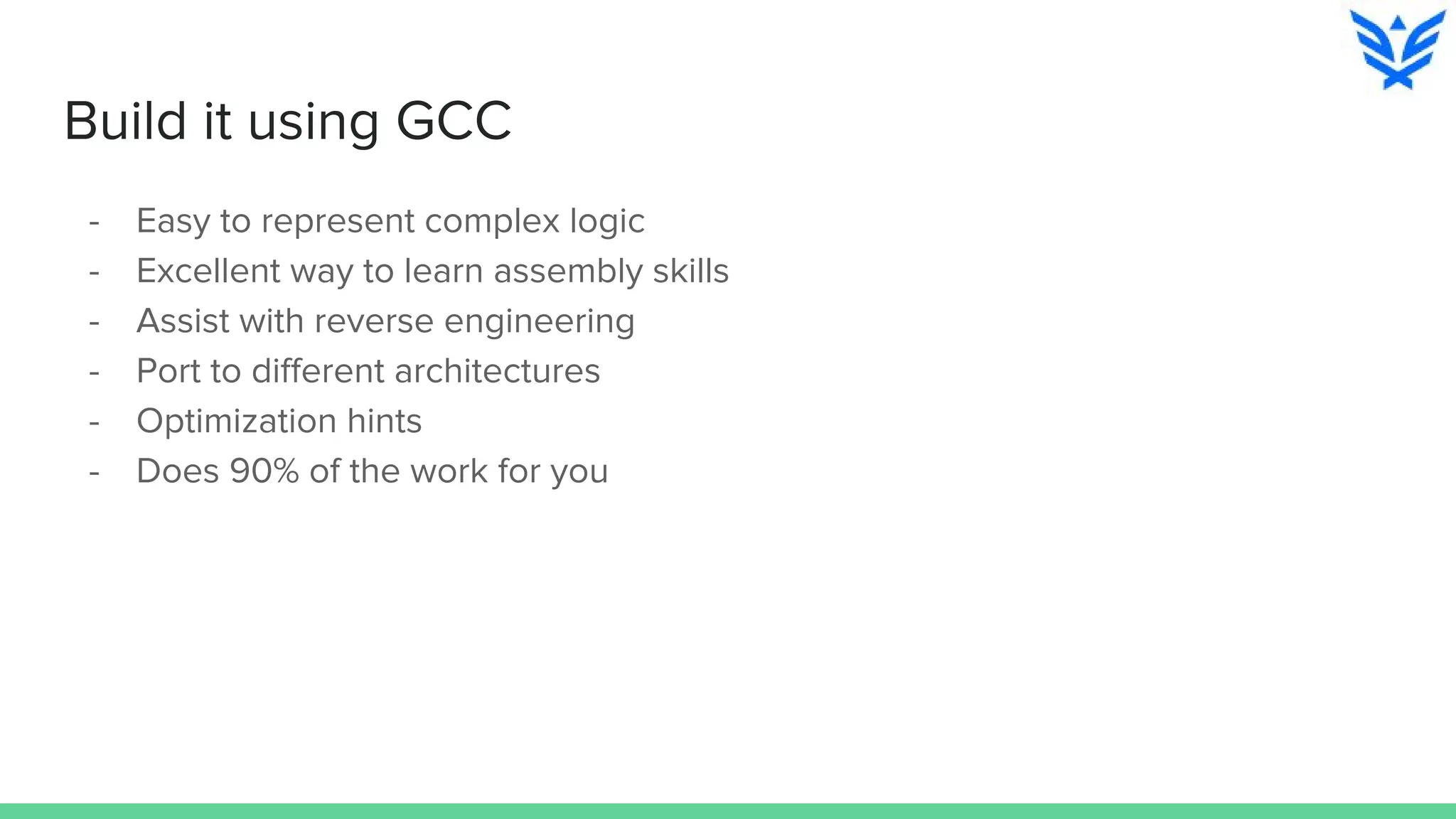
Build it using GCC
- Easy to represent complex logic
- Excellent way to learn assembly skills
- Assist with reverse engineering
- Port to different architectures
- Optimization hints
- Does 90% of the work for you
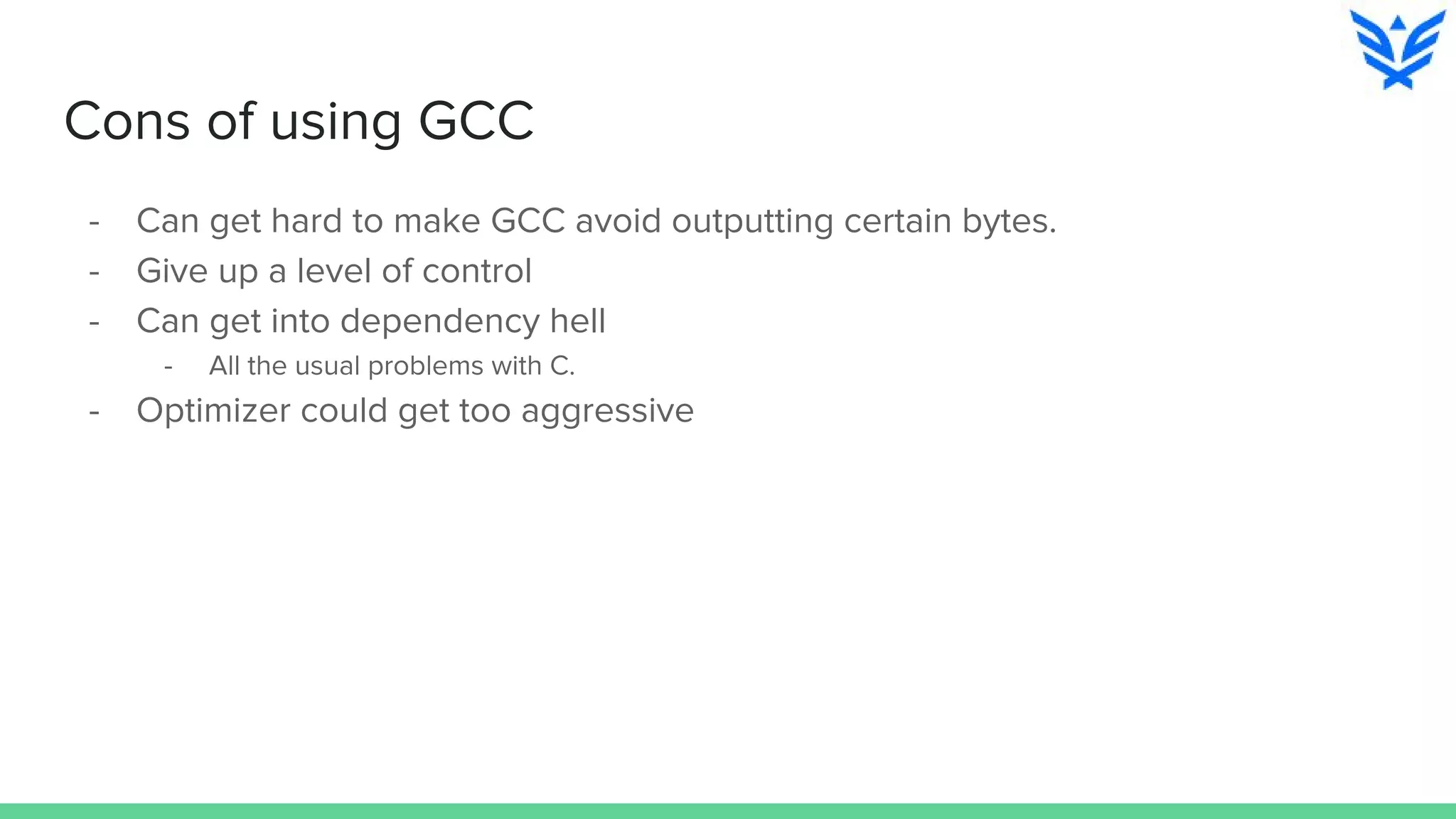
Cons of using GCC
- Can get hard to make GCC avoid outputting certain bytes.
- Give up a level of control
- Can get into dependency hell
- All the usual problems with C.
- Optimizer could get too aggressive
The Challenge
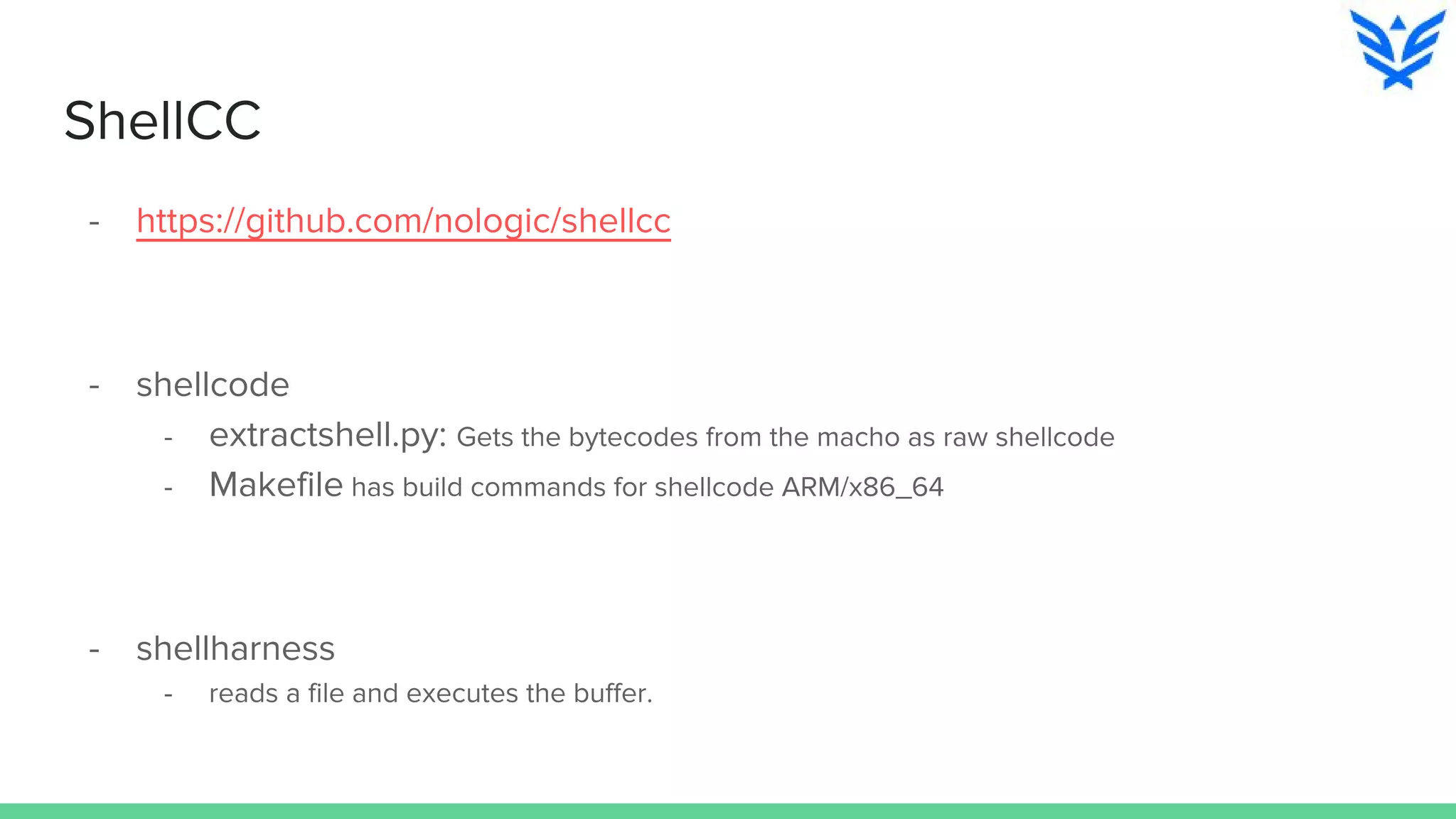
ShellCC
- https://github.com/nologic/shellcc
- shellcode
- extractshell.py: Gets the bytecodes from the macho as raw shellcode
- Makefile has build commands for shellcode ARM/x86_64
- shellharness
- reads a file and executes the buffer.
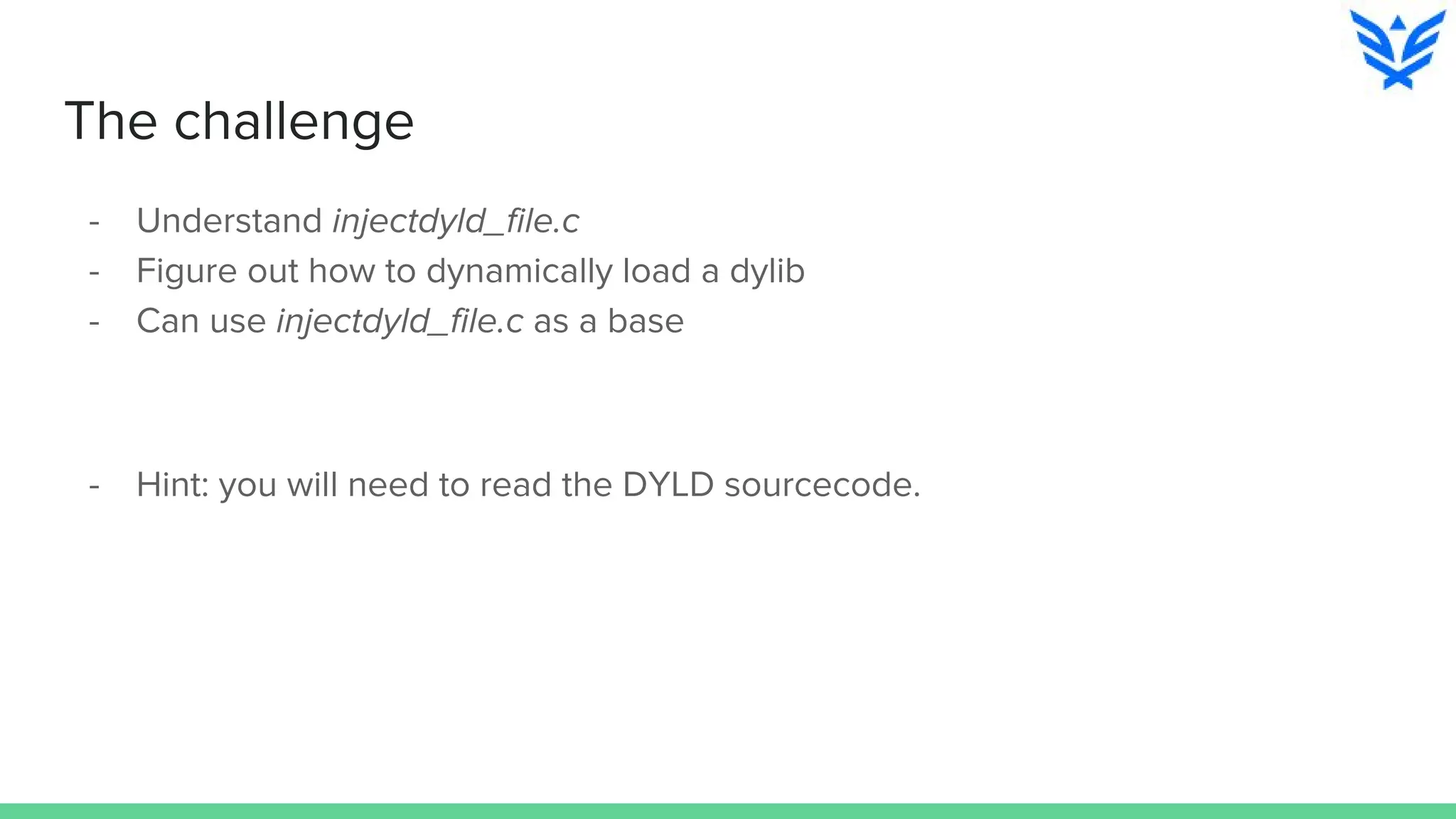
The challenge
- Understand injectdyld_file.c
- Figure out how to dynamically load a dylib
- Can use injectdyld_file.c as a base
- Hint: you will need to read the DYLD sourcecode.
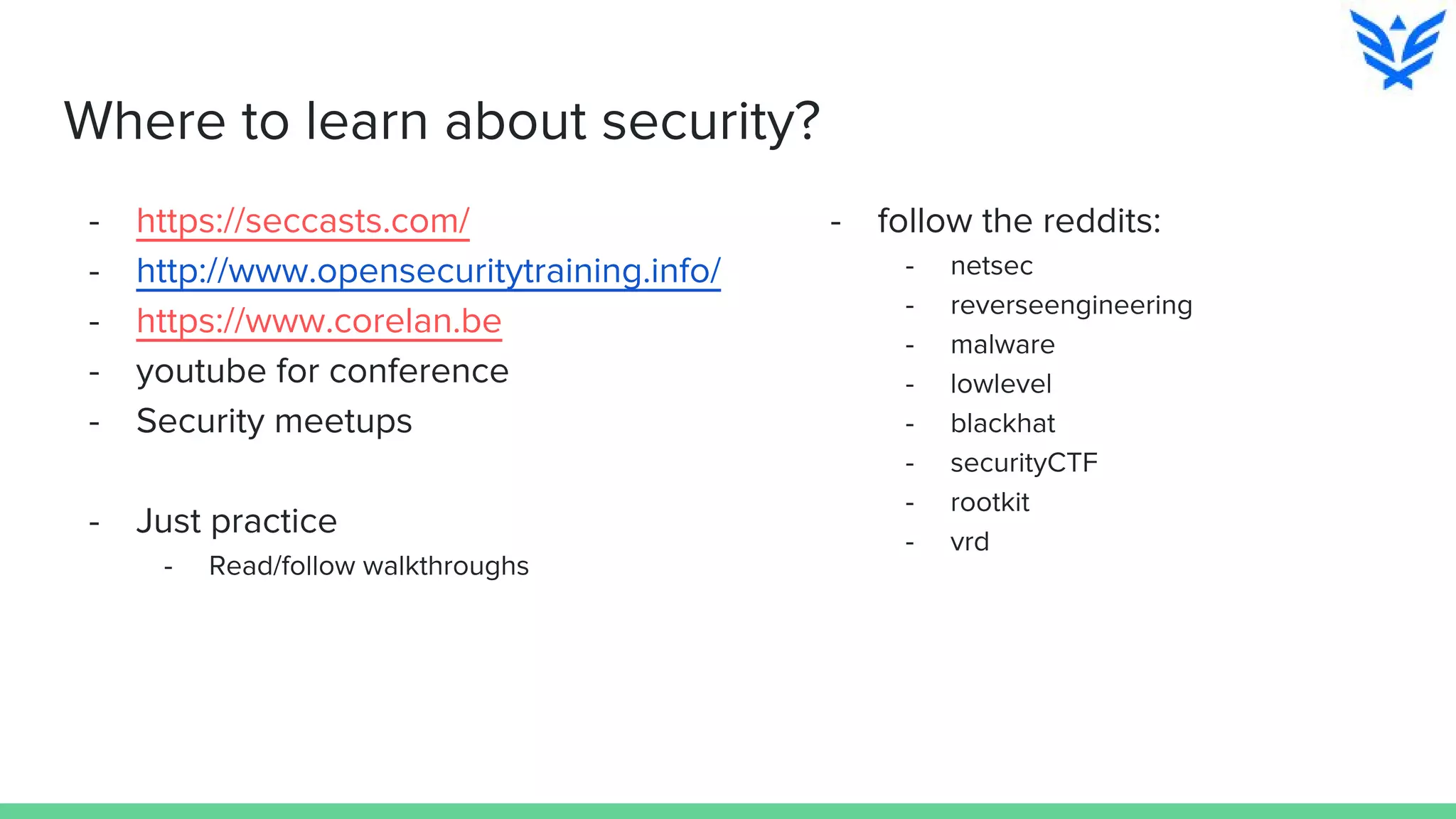
Where to learn about security?
- https://seccasts.com/
- http://www.opensecuritytraining.info/
- https://www.corelan.be
- youtube for conference
- Security meetups
- Just practice
- Read/follow walkthroughs
- follow the reddits:
- netsec
- reverseengineering
- malware
- lowlevel
- blackhat
- securityCTF
- rootkit
- vrd
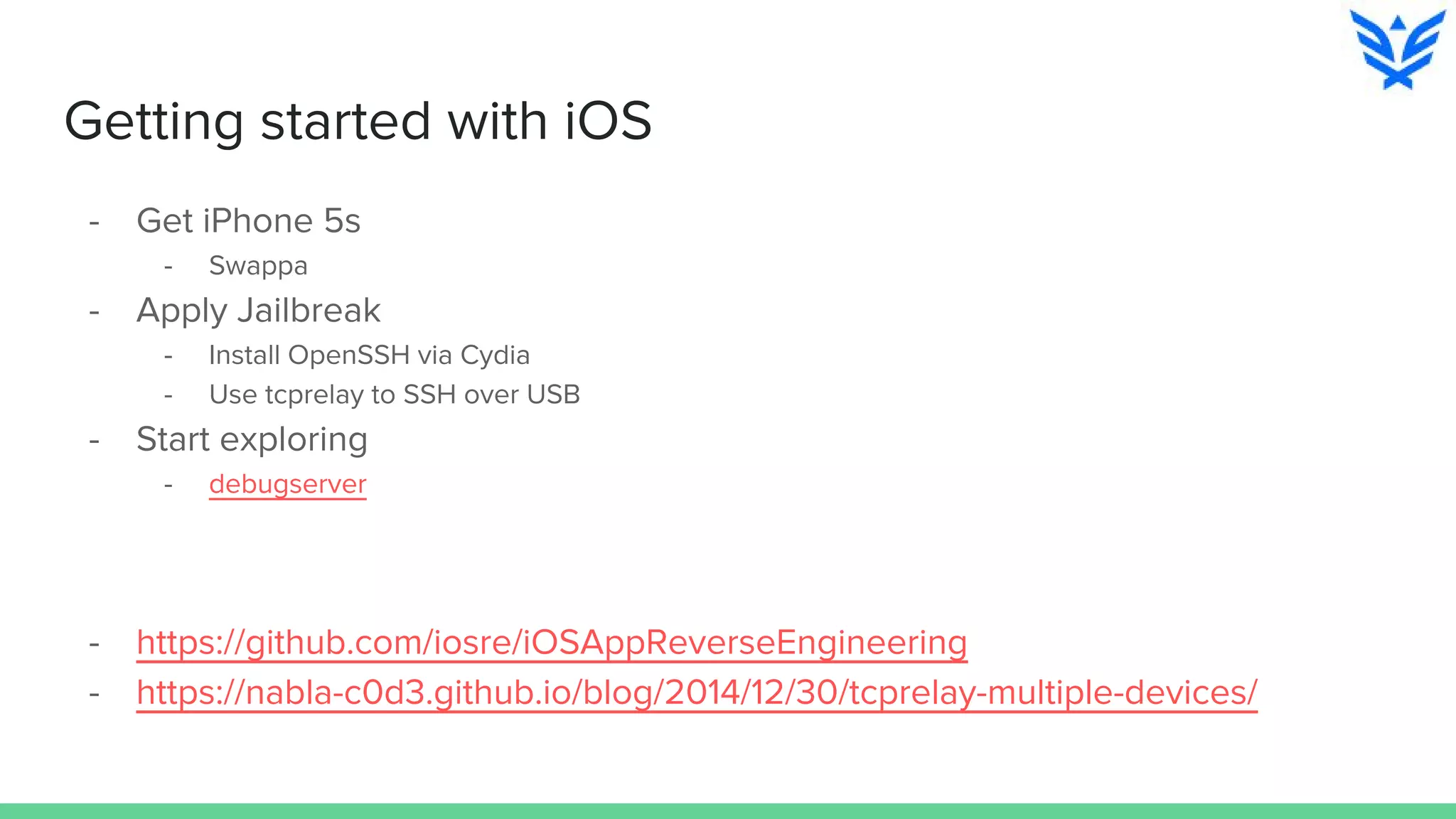
Getting started with iOS
- Get iPhone 5s
- Swappa
- Apply Jailbreak
- Install OpenSSH via Cydia
- Use tcprelay to SSH over USB
- Start exploring
- debugserver
- https://github.com/iosre/iOSAppReverseEngineering
- https://nabla-c0d3.github.io/blog/2014/12/30/tcprelay-multiple-devices/
Thank you!
Mikhail Sosonkin
mikhail@synack.com
Google+

NYU Hacknight: iOS and OSX ABI

  • 1.
    iOS and OSX ABI (Hacking in context) Mikhail Sosonkin
  • 2.
    Security Researcher atSYNACK Working on low level emulation with QEMU and iPhone automation. Graduate of Polytechnic University a.k.a Polytechnic Institute of New York University a.k.a New York University Polytechnic School of Engineering a.k.a New York University Tandon School of Engineering
  • 3.
    СССР 1986 Intel 8080Clone 1.78MHz CPU 32KB RAM 2KB ROM 450 Rubles Wikipedia-RU
  • 4.
    What’s a vulnerability Justcrashes Bugs Vulnerabilities What we are used to Logic errors
  • 5.
    Amazon Apple “In short,the very four digits that Amazon considers unimportant enough to display in the clear on the web are precisely the same ones that Apple considers secure enough to perform identity verification.” - http://www.wired.com/2012/08/apple-amazon-mat- honan-hacking/all/
  • 6.
    It is notenough to just be careful with your interfaces. You must also have have mitigations and continuous analysis that includes “outsiders”. Security considerations and reviews should be part of every step of development lifecycle.
  • 7.
    Where are thevulns?! Memory corruption - just won’t go away! That’s what a lot of CTFs seem to be focusing on. History thereof Memory Errors “Special feature” Backdooring yourself. Someone will eventually discover it.
  • 8.
    Network man on theside http://www.wired.com/2015/04/researchers-uncover-method-detect-nsa-quantum-insert-hacks/ web where did I leave that session key again? https://www.owasp.org/index.php/Top_10_2013-Table_of_Contents
  • 9.
    Miscommunications The root ofall bugs. Don’t be too paranoid It’s not healthy, but always ask: “what do you do if someone compromises this component?”
  • 10.
    Targeting Classic: Browser, Remote, Phishing Alittle more advanced: Via AWS - managed services (Exploiting external relationships) USB - https://srlabs.de/badusb/ i.e. Stuxnet
  • 11.
    Beg, borrow andsteal Finding vulnerabilities Fuzzing (AFL, Many frameworks) Code reading (SourceInsight, Understand) Dynamic/Static analysis (Qira, Panda)
  • 12.
    Exploit Control EIP Doesn’t haveto be 100% Gain execution Binary protections like ASLR and DEP
  • 13.
    Infect Run shell code Mighthave some ROPing to do And, stack pivoting Find the egg Bigger shellcode. Download implant Gain persistence i.e. launch daemon
  • 14.
    No Disclosure Private Communities Fulldisclosure Responsible Disclosure Coordinated Disclosure Private Bug bounties: Google, Microsoft, Facebook Managed Bug Bounties: Bugcrowd, HackerOne, SYNACK
  • 15.
    Black Market BugBounties: Zerodium, Vupen Cosinc (link) HackingTeam (Probably defunct) MitnickSecurity Lots of secretive companies (link) A few not so secretive (link)
  • 16.
    SYNACK Private Targets Think easytargets Fortune 500 Companies Several Categories Host, Web, Mobile Average payout: $690 We provide a cyber platform, Hydra! https://www.synack.com/red-team/
  • 17.
    Requires passing anassessment SYNACK Red Team entry If unable to pass try BugCrowd or HackerOne
  • 18.
    Let’s say yougained execution
  • 19.
    Goals Build shellcode that Downloadsa dylib. Injects the dylib into process. Target OS X and iOS
  • 20.
  • 21.
  • 22.
    Partial source XNU kernel https://opensource.apple.com/tarballs/xnu/ Dyldsource https://opensource.apple.com/tarballs/dyld/ Can be compiled
  • 23.
    ARM64 Registers 31 Generalpurpose registers X0 … X30 or W0 … W30 X31 - (zr) The Zero register X30 - (lr) Procedure Link Register (RIP) X29 - (fp) Frame pointer (RBP) X18 - Reserved on iOS
  • 24.
    ARM64 Instructions Conditional Branches B.EQ,B.NE, TBNZ (Test bit and Branch if Nonzero), etc. Unconditional Branches B, RET, SVC Conditional Select CSEL W9, W9, W10, EQ “W9 = EQ?W9:W10”
  • 25.
  • 26.
  • 27.
  • 28.
    Calling Convention On ARM64: X0… X8 Contain function parameters X16 has the system call number Positive for Posix Negative for Mach Ports 0x80000000 for thread_set_self SVC 0x80; jumps to kernel
  • 29.
    Let’s make asystem call
  • 31.
    Syscall numbers OSX: 0x01000000 -mach ports 0x02000000 - Posix 0x03000003 - pthread_set_self IOS 0x00000000 and below - mach ports 0x00000000 and above - Posix 0x80000000 - pthread_set_self
  • 32.
  • 33.
    Who does what? -Kernel: - Maps the main executable - Maps the loader - Passes control to the loader - DYLD: - “Maps” itself and the main executable - Maps and links dependency libraries.
  • 34.
  • 35.
    File Structure: Commands -Follow the header - ‘cmdsize’ is a multiple of 8 bytes.
  • 36.
    Mach-O commands - LC_SEGMENTand LC_SEGMENT_64 - From file to virtual memory: __DATA, __TEXT, etc. - LC_UNIXTHREAD - Sets up initial registers and stack - Entry point - LC_LOAD_DYLINKER - Specifies the loader i.e. /usr/lib/dyld - LC_MAIN - Sets up the stack - etc
  • 38.
    Setting up thestack OSX Arguments Environment variables Apple variable Generated by the kernel (LC_UNIXTHREAD)
  • 39.
    Setting up thestack iOS Arguments Environment variables Apple variable Generated by the kernel (LC_UNIXTHREAD)
  • 40.
  • 41.
    Let’s build someshellcode. (live exercise) Recorded session
  • 42.
    `xcrun --sdk iphoneos--find gcc` -Os -fno-stack-protector - fomit-frame-pointer -fno-exceptions -Wimplicit -isysroot `xcrun --sdk iphoneos --show-sdk-path` -F`xcrun --sdk iphoneos --show-sdk-path`/System/Library/Frameworks - F`xcrun --sdk iphoneos --show-sdk- path`/System/Library/PrivateFrameworks -arch arm64 test_syscall.c -o test_syscall otool -t -v test_syscall
  • 43.
    Build it usingGCC - Easy to represent complex logic - Excellent way to learn assembly skills - Assist with reverse engineering - Port to different architectures - Optimization hints - Does 90% of the work for you
  • 44.
    Cons of usingGCC - Can get hard to make GCC avoid outputting certain bytes. - Give up a level of control - Can get into dependency hell - All the usual problems with C. - Optimizer could get too aggressive
  • 45.
  • 46.
    ShellCC - https://github.com/nologic/shellcc - shellcode -extractshell.py: Gets the bytecodes from the macho as raw shellcode - Makefile has build commands for shellcode ARM/x86_64 - shellharness - reads a file and executes the buffer.
  • 47.
    The challenge - Understandinjectdyld_file.c - Figure out how to dynamically load a dylib - Can use injectdyld_file.c as a base - Hint: you will need to read the DYLD sourcecode.
  • 48.
    Where to learnabout security? - https://seccasts.com/ - http://www.opensecuritytraining.info/ - https://www.corelan.be - youtube for conference - Security meetups - Just practice - Read/follow walkthroughs - follow the reddits: - netsec - reverseengineering - malware - lowlevel - blackhat - securityCTF - rootkit - vrd
  • 49.
    Getting started withiOS - Get iPhone 5s - Swappa - Apply Jailbreak - Install OpenSSH via Cydia - Use tcprelay to SSH over USB - Start exploring - debugserver - https://github.com/iosre/iOSAppReverseEngineering - https://nabla-c0d3.github.io/blog/2014/12/30/tcprelay-multiple-devices/
  • 50.