Oncoviruses
A presentation by Cari Jennings
CHTN Vanderbilt
First of all…what is a virus?
• Infectious
• Non-living
• Composed of:
– Capsid
– Genome
– (sometimes) Envelope
– “Obligate intracellular parasite”
Examples of viruses…
• HIV
• Influenza
• Rhinoviruses
So what is an oncovirus?
• Virus that causes cancer
• Known oncoviruses are:
– Hepatitis C
– Hepatitis B
– HTLV-1
– HPV
– HHV-8 (KSHV)
– Merkel Cell Polyomavirus
– EBV
Hepatitis C
• Which cancer?
– Hepatocellular carcinoma
• How?
– HCV core protein interferes with p53
(tumor suppressor gene)
• Who?
– Anyone! (Particularly IV drug users,
transplants/transfusions before 1990, high
risk sex, body piercing/tattoos, babies
born to HepC + mothers)
– 1 in 30 baby boomers, 75% of those living
with it!
Hepatitis C
• Treatment?
– Treatment for virus = interferon + ribavirin,
other antivirals + ribavirin, liver
transplantation (treatment based on
genotype)
– Treatment for HCC = liver
resection/transplantation, TACE, adjuvant
chemo, XRT
Hepatitis B
• Which cancer?
– Hepatocellular carcinoma
• How?
– Virus binds to liver cells and
is taken inside
– Viral DNA is reproduced in
the liver cell nucleus, which
helps create new virus
particles which infect
surrounding cells
Hepatitis B
• Who?
-Anyone! Primarily childbirth, person-to-person in early childhood, body
piercings/tattoos, toiletries
-Also sexually transmitted
-Transmitted via infected blood, wet or dried
-Each subtype has a different genome, and each genome is endemic to a different
area
• Treatment?
-Vaccine available since 1982, 95% effective, 1st against major human cancer
-Treatment for virus: based on viral genotype, usually includes antivirals and
interferon
-Treatment for cancer: liver resection/transplantation, TACE, adjuvant chemo, XRT
Human T-lymphotropic virus
(HTLV-1)
•Which cancer?
-Adult T-cell leukemia and lymphoma (Non-
Hodgkin’s)
-Also causes HTLV-1 associated
myelopathy/tropical spastic paraparesis
(HAM/TSP) (demyelinating disease)
-Most patients die within a year of diagnosis
•How?
-Virus enters T-cell, where its 2 strands of RNA
are copied into double-stranded DNA that can
integrate into the host cell’s genes (much like
HIV!)
-Believed to be sexually transmitted or
transmitted via breastfeeding
Human T-lymphotropic virus
(HTLV-1)
•Treatment
-Treatment for virus: prosultiamine, azacytidine, TDF (reverse-transcriptase
inhibitor), PCOANs
-Treatment for cancer: zidovudine + CHOP, pralatrexate is experimental for
ATL; for HCL, treatment usually includes purine analog chemo and
immunotherapy, splenectomy, bone marrow transplant
•Who?
-Anyone! Rare in U.S., where highest prevalence is in southeastern African-
Americans
-Endemic to southern Japan, the Caribbean, South American, and Africa
-Transmitted via infected blood
Human Papillomavirus (HPV)
•Which cancer?
-Cervical cancer…also associated with
oropharyngeal cancers, as well as anal
and genital cancers
•Who?
-Anyone!
-Cervical cancer is the second most
common in women (can take 15-20 years)
-Risk factors for persistent HPV leading to
cancer include multiple sexual partners,
tobacco use, and immune suppression
Human Papillomavirus (HPV)
•How?
-Transmitted via sexual contact, skin-to-skin
contact; can be transmitted (rarely) during
childbirth
-Many different subtypes- types 16 and 18 are
responsible for cancers and recurrent
respiratory papillomatosis (RRP)
-Types 6 and 11 are associated with genital
warts
-Nearly all cervical cancers and all cases of
genital warts are caused by HPV
•Treatment?
-Vaccine for virus (Gardasil and Cervarix)
-Cautery or cryotherapy for warts/cancer
-Condom, circumcision encouraged
Kaposi’s sarcoma-associated
herpesvirus (HHV-8)
•Which cancer?
-Kaposi’s sarcoma
-Rarely, primary effusion lymphoma
•Who?
-Can infect anyone
-Causes disease in immunosuppressed
patients; asymptomatic in healthy people
-HIV/AIDS patients, transplant patients, the
elderly, chemo patients
-While this virus is typically associated with
AIDS patients in the U.S., infection is
widespread in sub-Saharan Africa and there are
more cases of KS there
Kaposi’s sarcoma-associated
herpesvirus (HHV-8)
•How?
-Sexually transmitted
-Infects lymphocytes, establishes latency
-Inflammation or some other stimulus ignites
the lytic cycle
-Inhibits p53 tumor suppressor protein
-Cell lysis allows virus to escape and infect
surrounding cells
•Treatment?
-Prevention = safe sexual practices, condom
use
-Cancer treatment = surgery, radiation, and
chemotherapy (typically
anthracyclines/paclitaxel)
-Antiviral drug ganciclovir targets HHV-8, but
isn’t effective once tumor forms
-If the sarcoma is AIDS-related, best course of
action is anti-retroviral medication
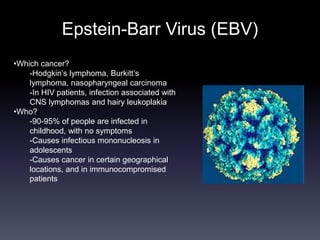
Epstein-Barr Virus (EBV)
•Which cancer?
-Hodgkin’s lymphoma, Burkitt’s
lymphoma, nasopharyngeal carcinoma
-In HIV patients, infection associated with
CNS lymphomas and hairy leukoplakia
•Who?
-90-95% of people are infected in
childhood, with no symptoms
-Causes infectious mononucleosis in
adolescents
-Causes cancer in certain geographical
locations, and in immunocompromised
patients
Epstein-Barr Virus (EBV)
•How?
-Transmitted by transfer of saliva/genital
secretions
-Same genus as HHV-8
-Infects B cells and epithelial cells
-Can establish latency
•Treatment?
-Vaccine is currently in clinical trials
-For Burkitt’s lymphoma: chemotherapy,
immunotherapy, bone marrow transplant,
stem cell transplant, surgery, radiation
-For Hodgkin’s: early stage =
chemo/radiation, late stage = chemo only
-For NPC: chemo, radiation, and surgery
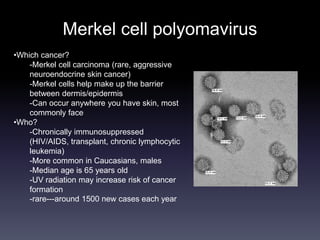
Merkel cell polyomavirus
•Which cancer?
-Merkel cell carcinoma (rare, aggressive
neuroendocrine skin cancer)
-Merkel cells help make up the barrier
between dermis/epidermis
-Can occur anywhere you have skin, most
commonly face
•Who?
-Chronically immunosuppressed
(HIV/AIDS, transplant, chronic lymphocytic
leukemia)
-More common in Caucasians, males
-Median age is 65 years old
-UV radiation may increase risk of cancer
formation
-rare---around 1500 new cases each year
Merkel cell polyomavirus
•How?
-The exact mechanism of cancer
formation is not known yet…the virus was
first described in 2008!
•Treatment?
-No vaccine or treatment for virus
-For MCC: surgery and adjuvant radiation
-Chemo can be used palliatively or to
shrink a tumor if needed
Sources
• http://www.virology.ws/2004/07/28/what-is-a-virus/
• http://www.webmd.com/hepatitis/hepc-guide/hepatitis-c-and-liver-cancer
• http://www.who.int/mediacentre/factsheets/fs204/en/
• http://www.webmd.com/hepatitis/hepb-guide/hepatitis-b-cause
• http://www.who.int/dsa/cat98/can8.htm#Human%20Immunodeficiency%20Vi
ruses,
• http://www.webmd.com/hiv-aids/htlv-type-i-and-type-ii
• www.webmd.com/cancer/tc/ncicdr0000062914-general-information-about-
kaposi-sarcoma
• www.who.int/vaccine_research/diseases/viral_cancers/en/index1.html
• http://www.who.int/vaccine_research/diseases/viral_cancers/en/index1.html
• http://www.webmd.com/cancer/tc/ncicdr0000062878-unusual-cancers-of-
the-head-and-neck
• http://www.tumorvirology.pitt.edu/mcvrsch.html

Oncoviruses!.ppt

  • 1.
    Oncoviruses A presentation byCari Jennings CHTN Vanderbilt
  • 2.
    First of all…whatis a virus? • Infectious • Non-living • Composed of: – Capsid – Genome – (sometimes) Envelope – “Obligate intracellular parasite”
  • 3.
    Examples of viruses… •HIV • Influenza • Rhinoviruses
  • 4.
    So what isan oncovirus? • Virus that causes cancer • Known oncoviruses are: – Hepatitis C – Hepatitis B – HTLV-1 – HPV – HHV-8 (KSHV) – Merkel Cell Polyomavirus – EBV
  • 5.
    Hepatitis C • Whichcancer? – Hepatocellular carcinoma • How? – HCV core protein interferes with p53 (tumor suppressor gene) • Who? – Anyone! (Particularly IV drug users, transplants/transfusions before 1990, high risk sex, body piercing/tattoos, babies born to HepC + mothers) – 1 in 30 baby boomers, 75% of those living with it!
  • 6.
    Hepatitis C • Treatment? –Treatment for virus = interferon + ribavirin, other antivirals + ribavirin, liver transplantation (treatment based on genotype) – Treatment for HCC = liver resection/transplantation, TACE, adjuvant chemo, XRT
  • 7.
    Hepatitis B • Whichcancer? – Hepatocellular carcinoma • How? – Virus binds to liver cells and is taken inside – Viral DNA is reproduced in the liver cell nucleus, which helps create new virus particles which infect surrounding cells
  • 8.
    Hepatitis B • Who? -Anyone!Primarily childbirth, person-to-person in early childhood, body piercings/tattoos, toiletries -Also sexually transmitted -Transmitted via infected blood, wet or dried -Each subtype has a different genome, and each genome is endemic to a different area • Treatment? -Vaccine available since 1982, 95% effective, 1st against major human cancer -Treatment for virus: based on viral genotype, usually includes antivirals and interferon -Treatment for cancer: liver resection/transplantation, TACE, adjuvant chemo, XRT
  • 9.
    Human T-lymphotropic virus (HTLV-1) •Whichcancer? -Adult T-cell leukemia and lymphoma (Non- Hodgkin’s) -Also causes HTLV-1 associated myelopathy/tropical spastic paraparesis (HAM/TSP) (demyelinating disease) -Most patients die within a year of diagnosis •How? -Virus enters T-cell, where its 2 strands of RNA are copied into double-stranded DNA that can integrate into the host cell’s genes (much like HIV!) -Believed to be sexually transmitted or transmitted via breastfeeding
  • 10.
    Human T-lymphotropic virus (HTLV-1) •Treatment -Treatmentfor virus: prosultiamine, azacytidine, TDF (reverse-transcriptase inhibitor), PCOANs -Treatment for cancer: zidovudine + CHOP, pralatrexate is experimental for ATL; for HCL, treatment usually includes purine analog chemo and immunotherapy, splenectomy, bone marrow transplant •Who? -Anyone! Rare in U.S., where highest prevalence is in southeastern African- Americans -Endemic to southern Japan, the Caribbean, South American, and Africa -Transmitted via infected blood
  • 11.
    Human Papillomavirus (HPV) •Whichcancer? -Cervical cancer…also associated with oropharyngeal cancers, as well as anal and genital cancers •Who? -Anyone! -Cervical cancer is the second most common in women (can take 15-20 years) -Risk factors for persistent HPV leading to cancer include multiple sexual partners, tobacco use, and immune suppression
  • 12.
    Human Papillomavirus (HPV) •How? -Transmittedvia sexual contact, skin-to-skin contact; can be transmitted (rarely) during childbirth -Many different subtypes- types 16 and 18 are responsible for cancers and recurrent respiratory papillomatosis (RRP) -Types 6 and 11 are associated with genital warts -Nearly all cervical cancers and all cases of genital warts are caused by HPV •Treatment? -Vaccine for virus (Gardasil and Cervarix) -Cautery or cryotherapy for warts/cancer -Condom, circumcision encouraged
  • 13.
    Kaposi’s sarcoma-associated herpesvirus (HHV-8) •Whichcancer? -Kaposi’s sarcoma -Rarely, primary effusion lymphoma •Who? -Can infect anyone -Causes disease in immunosuppressed patients; asymptomatic in healthy people -HIV/AIDS patients, transplant patients, the elderly, chemo patients -While this virus is typically associated with AIDS patients in the U.S., infection is widespread in sub-Saharan Africa and there are more cases of KS there
  • 14.
    Kaposi’s sarcoma-associated herpesvirus (HHV-8) •How? -Sexuallytransmitted -Infects lymphocytes, establishes latency -Inflammation or some other stimulus ignites the lytic cycle -Inhibits p53 tumor suppressor protein -Cell lysis allows virus to escape and infect surrounding cells •Treatment? -Prevention = safe sexual practices, condom use -Cancer treatment = surgery, radiation, and chemotherapy (typically anthracyclines/paclitaxel) -Antiviral drug ganciclovir targets HHV-8, but isn’t effective once tumor forms -If the sarcoma is AIDS-related, best course of action is anti-retroviral medication
  • 15.
    Epstein-Barr Virus (EBV) •Whichcancer? -Hodgkin’s lymphoma, Burkitt’s lymphoma, nasopharyngeal carcinoma -In HIV patients, infection associated with CNS lymphomas and hairy leukoplakia •Who? -90-95% of people are infected in childhood, with no symptoms -Causes infectious mononucleosis in adolescents -Causes cancer in certain geographical locations, and in immunocompromised patients
  • 16.
    Epstein-Barr Virus (EBV) •How? -Transmittedby transfer of saliva/genital secretions -Same genus as HHV-8 -Infects B cells and epithelial cells -Can establish latency •Treatment? -Vaccine is currently in clinical trials -For Burkitt’s lymphoma: chemotherapy, immunotherapy, bone marrow transplant, stem cell transplant, surgery, radiation -For Hodgkin’s: early stage = chemo/radiation, late stage = chemo only -For NPC: chemo, radiation, and surgery
  • 17.
    Merkel cell polyomavirus •Whichcancer? -Merkel cell carcinoma (rare, aggressive neuroendocrine skin cancer) -Merkel cells help make up the barrier between dermis/epidermis -Can occur anywhere you have skin, most commonly face •Who? -Chronically immunosuppressed (HIV/AIDS, transplant, chronic lymphocytic leukemia) -More common in Caucasians, males -Median age is 65 years old -UV radiation may increase risk of cancer formation -rare---around 1500 new cases each year
  • 18.
    Merkel cell polyomavirus •How? -Theexact mechanism of cancer formation is not known yet…the virus was first described in 2008! •Treatment? -No vaccine or treatment for virus -For MCC: surgery and adjuvant radiation -Chemo can be used palliatively or to shrink a tumor if needed
  • 19.
    Sources • http://www.virology.ws/2004/07/28/what-is-a-virus/ • http://www.webmd.com/hepatitis/hepc-guide/hepatitis-c-and-liver-cancer •http://www.who.int/mediacentre/factsheets/fs204/en/ • http://www.webmd.com/hepatitis/hepb-guide/hepatitis-b-cause • http://www.who.int/dsa/cat98/can8.htm#Human%20Immunodeficiency%20Vi ruses, • http://www.webmd.com/hiv-aids/htlv-type-i-and-type-ii • www.webmd.com/cancer/tc/ncicdr0000062914-general-information-about- kaposi-sarcoma • www.who.int/vaccine_research/diseases/viral_cancers/en/index1.html • http://www.who.int/vaccine_research/diseases/viral_cancers/en/index1.html • http://www.webmd.com/cancer/tc/ncicdr0000062878-unusual-cancers-of- the-head-and-neck • http://www.tumorvirology.pitt.edu/mcvrsch.html