Viruses cause cancer Download lecture at: flemingtonlab.com
Viruses cause cancer Why has the study of viruses and cancer been important?
Viruses cause cancer Why has the study of viruses and cancer been important? -  We learn about the basic mechanisms of specific types  of tumors .
Viruses cause cancer Why has the study of viruses and cancer been important? -  We learn about the basic mechanisms of specific types  of tumors . -  We identify fundamental pathways important for oncogenesis - viruses are lower complexity - We can identify potential unique therapeutic targets for viral associated tumors
Viruses cause cancer 30-40% of cancers are known to have viral etiology But as more research is done,  this percentage is likely to be found to be higher
Major human Oncogenic Viruses DNA Viruses Small DNA tumor viruses - Adenovirus - SV40 - Human Papilloma virus (HPV) Herpesviruses (large) - Epstein Barr virus (EBV) - Kaposi’s Sarcoma Herpesvirus (KSHV) Other - Hepatitis virus B RNA viruses Human T-cell Leukemia Virus 1 (HTLV1) Hepatitis virus C
Changes in cell that are at the roots of cancer
Changes in cell that are at the roots of cancer Genetic and epigenetic alterations:
Changes in cell that are at the roots of cancer Genetic and epigenetic alterations: Mutations Deletions Recombinations Transpositions Epigenetic alterations (DNA methylation, imprinting) Acquisition of viral genetic material
Changes in cell that are at the roots of cancer Genetic and epigenetic alterations: Mutations Deletions Recombinations Transpositions Epigenetic alterations (DNA methylation, imprinting) Acquisition of viral genetic material Various combinations of these lead to the development of cancers - some viruses contribute single hits while others contribute multiple hits.
Inherited Somatic Random Transposition Exposure to deleterious environmental agents Radiation carcinogenic chemicals Viruses Other persistent infections Source of genetic alterations
Integrations  that cause activation or inactivation of oncogenes or tumor suppressors (e.g. RNA viruses) Expression of genes  that alter key signal transduction pathways - this is our focus Chronic activation of  inflammatory responses How do Viruses contribute to cancer?
Why do viruses cause cancer?
Viruses and cancer cells have similar needs Proliferation control Cell death control Modulation of immune response Induction of vascularization Metastasis (tumor)/cell migration (viruses) Why do viruses cause cancer?
If you’re infected, does this mean that you will get cancer?
No Viruses did not specifically evolve with the need to cause cancer - they simply have similar (but distinct) needs If you’re infected, does this mean that you will get cancer?
No Viruses did not specifically evolve with the need to cause cancer - they simply have similar (but distinct) needs Development of tumors almost always requires:  Additional genetic alterations and/or Compromised host (e.g. immuno-suppression) If you’re infected, does this mean that you will get cancer?
Major human Oncogenic Viruses DNA Viruses Small DNA tumor viruses - Adenovirus - SV40 - Human Papilloma virus (HPV) Herpesviruses (large) - Epstein Barr virus (EBV) - Kaposi’s Sarcoma Herpesvirus (KSHV) Other - Hepatitis virus B RNA viruses Human T-cell Leukemia Virus 1 (HTLV1) Hepatitis virus C
Adenovirus Human virus but only causes cancer in non-human cells SV40 Mesothelioma HPV Cervical Cancer Squamous cell anal carcinoma Penile cancer Oral cancers Small DNA tumor viruses
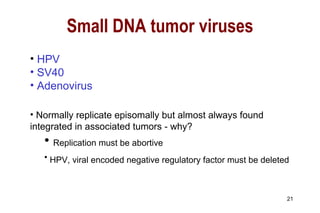
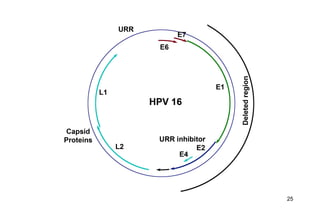
HPV SV40 Adenovirus Normally replicate episomally but almost always found integrated in associated tumors - why? Small DNA tumor viruses
HPV SV40 Adenovirus Normally replicate episomally but almost always found integrated in associated tumors - why? Replication must be abortive HPV, viral encoded negative regulatory factor must be deleted   Small DNA tumor viruses
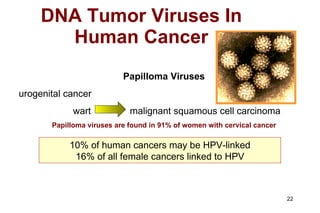
DNA Tumor Viruses In Human Cancer 10% of human cancers may be HPV-linked 16% of all female cancers linked to HPV Papilloma Viruses urogenital cancer wart  malignant squamous cell carcinoma Papilloma viruses are found in 91% of women with cervical cancer
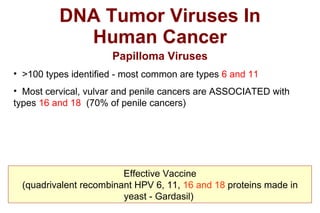
DNA Tumor Viruses In Human Cancer Papilloma Viruses >100 types identified - most common are types  6 and 11 Most cervical, vulvar and penile cancers are ASSOCIATED with types  16 and 18   (70% of penile cancers) Effective Vaccine (quadrivalent recombinant HPV 6, 11,  16 and 18  proteins made in yeast - Gardasil)
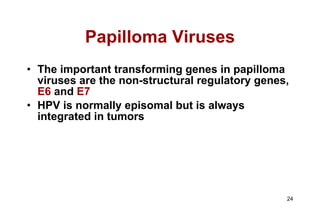
Papilloma Viruses The important transforming genes in papilloma viruses are the non-structural regulatory genes,  E6  and  E7 HPV is normally episomal but is always integrated in tumors
 
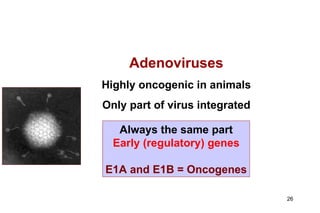
Adenoviruses Highly oncogenic in animals Only part of virus integrated Always the same part Early (regulatory) genes E1A and E1B = Oncogenes
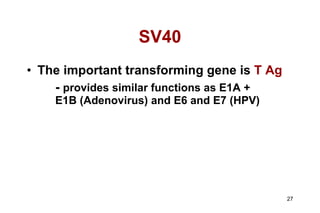
SV40 The important transforming gene is  T Ag -  provides similar functions as E1A +  E1B (Adenovirus) and E6 and E7 (HPV)
Abortive replication is key to oncogenesis by these small viruses Expression of early (regulatory) genes in absence of structural genes and virus production Can occur by infection of non-permissive host Can occur by integrations that delete regions of viral genome required for replication but leave early genes intact.
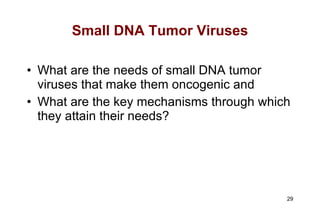
Small DNA Tumor Viruses What are the needs of small DNA tumor viruses that make them oncogenic and What are the key mechanisms through which they attain their needs?
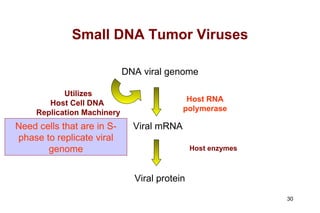
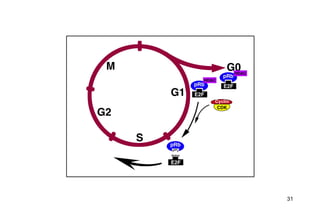
Need cells that are in S-phase to replicate viral genome Host enzymes Small DNA Tumor Viruses DNA viral genome Host RNA polymerase Viral mRNA Viral protein Utilizes Host Cell DNA  Replication Machinery
 
 
Inappropriate activation of cell cycle
Inappropriate activation of cell cycle Apoptosis
Inappropriate activation of cell cycle Apoptosis e.g.  Overexpression of E2F1 or c-Myc induces cell cycle and apoptosis Defense mechanism against rogue proliferating cells?
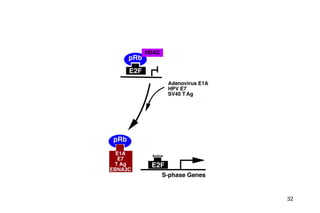
Inappropriate activation of cell cycle Apoptosis e.g.  - Overexpression of E2F1 or c-Myc induces cell cycle and apoptosis - Same is true for over-expression of Adenovirus E1A or HPV E7
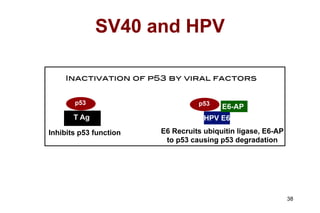
Encode early genes that inhibit apoptosis Adenovirus  E1B HPV  E6 SV40  T Ag
SV40 and HPV
Adenovirus E1B  is Bcl2 family member - blocks function of pro-apoptotic Bcl2 family members through dimerization
Summary Small DNA tumor viruses usually replicate in episomal form but are found integrated in viral associated tumors Early genes promote  cell cycle progression  and  prevent apoptosis Adenovirus -  E1A  (cell cycle) and  E1B  (apoptosis) HPV -  E7  (cell cycle) and  E6  (apoptosis) SV40 -  T Ag  (cell cycle and apoptosis)
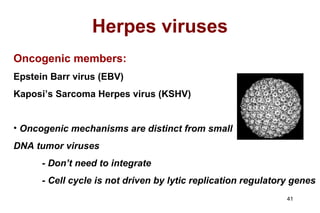
Herpes viruses Oncogenic members: Epstein Barr virus (EBV) Kaposi’s Sarcoma Herpes virus (KSHV) Oncogenic mechanisms are distinct from small  DNA tumor viruses - Don’t need to integrate - Cell cycle is not driven by lytic replication regulatory genes
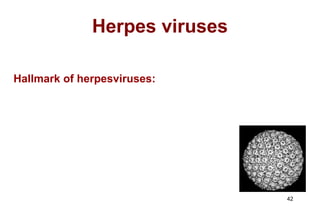
Herpes viruses Hallmark of herpesviruses:
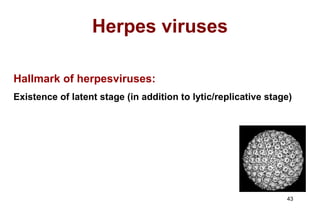
Herpes viruses Hallmark of herpesviruses: Existence of latent stage (in addition to lytic/replicative stage)
Herpes viruses Lytic replication phase for herpesviruses:
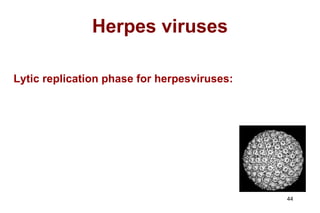
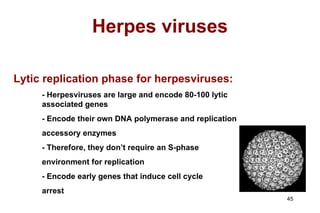
Herpes viruses Lytic replication phase for herpesviruses: - Herpesviruses are large and encode 80-100 lytic  associated genes - Encode their own DNA polymerase and replication  accessory enzymes - Therefore, they don’t require an S-phase environment for replication - Encode early genes that induce cell cycle arrest
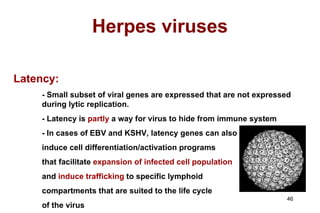
Herpes viruses Latency: - Small subset of viral genes are expressed that are not expressed  during lytic replication. - Latency is  partly  a way for virus to hide from immune system - In cases of EBV and KSHV, latency genes can also induce cell differentiation/activation programs that facilitate  expansion of infected cell population and  induce trafficking  to specific lymphoid  compartments that are suited to the life cycle of the virus
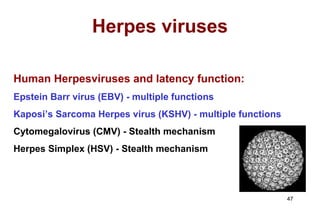
Herpes viruses Human Herpesviruses and latency function: Epstein Barr virus (EBV) - multiple functions Kaposi’s Sarcoma Herpes virus (KSHV) - multiple functions Cytomegalovirus (CMV) - Stealth mechanism Herpes Simplex (HSV) - Stealth mechanism
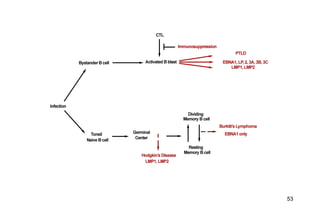
Epstein Barr virus Pathologies in immuno- competent  individuals  Infectious mononucleosis Burkitt’s Lymphoma Hodgkin’s lymphoma Nasopharyngeal carcinoma Pathologies in immuno- compromised  individuals Post-transplant lymphoproliferative diseases (PTLD) Hodgkin’s lymphoma A variety of non-Hodgkin’s lymphoblastoid malignancies
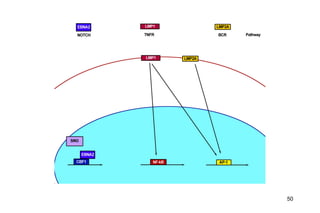
Epstein Barr virus Latency genes Non-antigenic EBNA1 (Epstein Barr Nuclear Antigen 1) - episomal replication and segregation function Antigenic  EBNA2 EBNA3A, 3B, 3C EBNA-LP LMP1  (Latent Membrane Protein 1) LMP2A  Those in  Red  are key regulatory genes involved in B cell activation
 
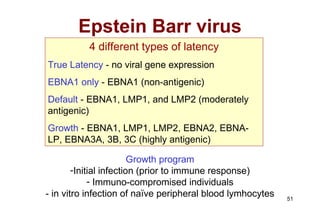
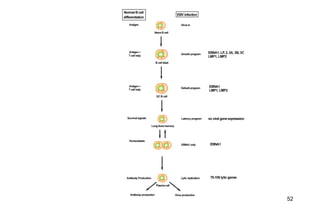
Epstein Barr virus 4 different types of latency True Latency  - no viral gene expression EBNA1 only  - EBNA1 (non-antigenic) Default  - EBNA1, LMP1, and LMP2 (moderately antigenic) Growth  - EBNA1, LMP1, LMP2, EBNA2, EBNA-LP, EBNA3A, 3B, 3C (highly antigenic) Growth program Initial infection (prior to immune response) Immuno-compromised individuals - in vitro infection of naïve peripheral blood lymhocytes
 
 
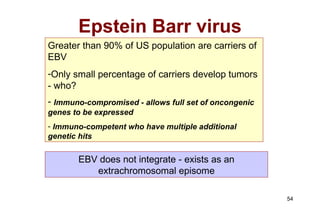
Epstein Barr virus Greater than 90% of US population are carriers of EBV Only small percentage of carriers develop tumors - who? Immuno-compromised - allows full set of oncongenic genes to be expressed Immuno-competent who have multiple additional genetic hits EBV does not integrate - exists as an extrachromosomal episome
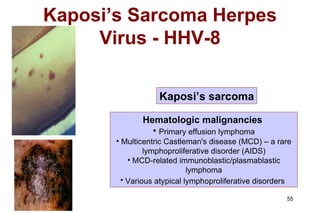
Kaposi’s Sarcoma Herpes Virus - HHV-8 Hematologic malignancies   Primary effusion lymphoma Multicentric Castleman's disease (MCD) – a rare lymphoproliferative disorder (AIDS) MCD-related immunoblastic/plasmablastic lymphoma Various atypical lymphoproliferative disorders   Kaposi’s sarcoma
Hepatitis B and C Long latency period to development of HCC (Hepatocellular Carcinoma) 20-30 years Mechanism is probably due to chronic inflammatory response
Silver lining to viral associate cancers Offer unique targets not common to normal uninfected cells  Examples: HPV  Gardasil EBV In vitro production of EBV specific CTLs for PTLD Treatment with agents that induce lytic cycle (butyrate plus Gancyclovir) KSHV - Anti-retroviral therapy

40. tv

  • 1.
    Viruses cause cancerDownload lecture at: flemingtonlab.com
  • 2.
    Viruses cause cancerWhy has the study of viruses and cancer been important?
  • 3.
    Viruses cause cancerWhy has the study of viruses and cancer been important? - We learn about the basic mechanisms of specific types of tumors .
  • 4.
    Viruses cause cancerWhy has the study of viruses and cancer been important? - We learn about the basic mechanisms of specific types of tumors . - We identify fundamental pathways important for oncogenesis - viruses are lower complexity - We can identify potential unique therapeutic targets for viral associated tumors
  • 5.
    Viruses cause cancer30-40% of cancers are known to have viral etiology But as more research is done, this percentage is likely to be found to be higher
  • 6.
    Major human OncogenicViruses DNA Viruses Small DNA tumor viruses - Adenovirus - SV40 - Human Papilloma virus (HPV) Herpesviruses (large) - Epstein Barr virus (EBV) - Kaposi’s Sarcoma Herpesvirus (KSHV) Other - Hepatitis virus B RNA viruses Human T-cell Leukemia Virus 1 (HTLV1) Hepatitis virus C
  • 7.
    Changes in cellthat are at the roots of cancer
  • 8.
    Changes in cellthat are at the roots of cancer Genetic and epigenetic alterations:
  • 9.
    Changes in cellthat are at the roots of cancer Genetic and epigenetic alterations: Mutations Deletions Recombinations Transpositions Epigenetic alterations (DNA methylation, imprinting) Acquisition of viral genetic material
  • 10.
    Changes in cellthat are at the roots of cancer Genetic and epigenetic alterations: Mutations Deletions Recombinations Transpositions Epigenetic alterations (DNA methylation, imprinting) Acquisition of viral genetic material Various combinations of these lead to the development of cancers - some viruses contribute single hits while others contribute multiple hits.
  • 11.
    Inherited Somatic RandomTransposition Exposure to deleterious environmental agents Radiation carcinogenic chemicals Viruses Other persistent infections Source of genetic alterations
  • 12.
    Integrations thatcause activation or inactivation of oncogenes or tumor suppressors (e.g. RNA viruses) Expression of genes that alter key signal transduction pathways - this is our focus Chronic activation of inflammatory responses How do Viruses contribute to cancer?
  • 13.
    Why do virusescause cancer?
  • 14.
    Viruses and cancercells have similar needs Proliferation control Cell death control Modulation of immune response Induction of vascularization Metastasis (tumor)/cell migration (viruses) Why do viruses cause cancer?
  • 15.
    If you’re infected,does this mean that you will get cancer?
  • 16.
    No Viruses didnot specifically evolve with the need to cause cancer - they simply have similar (but distinct) needs If you’re infected, does this mean that you will get cancer?
  • 17.
    No Viruses didnot specifically evolve with the need to cause cancer - they simply have similar (but distinct) needs Development of tumors almost always requires: Additional genetic alterations and/or Compromised host (e.g. immuno-suppression) If you’re infected, does this mean that you will get cancer?
  • 18.
    Major human OncogenicViruses DNA Viruses Small DNA tumor viruses - Adenovirus - SV40 - Human Papilloma virus (HPV) Herpesviruses (large) - Epstein Barr virus (EBV) - Kaposi’s Sarcoma Herpesvirus (KSHV) Other - Hepatitis virus B RNA viruses Human T-cell Leukemia Virus 1 (HTLV1) Hepatitis virus C
  • 19.
    Adenovirus Human virusbut only causes cancer in non-human cells SV40 Mesothelioma HPV Cervical Cancer Squamous cell anal carcinoma Penile cancer Oral cancers Small DNA tumor viruses
  • 20.
    HPV SV40 AdenovirusNormally replicate episomally but almost always found integrated in associated tumors - why? Small DNA tumor viruses
  • 21.
    HPV SV40 AdenovirusNormally replicate episomally but almost always found integrated in associated tumors - why? Replication must be abortive HPV, viral encoded negative regulatory factor must be deleted Small DNA tumor viruses
  • 22.
    DNA Tumor VirusesIn Human Cancer 10% of human cancers may be HPV-linked 16% of all female cancers linked to HPV Papilloma Viruses urogenital cancer wart malignant squamous cell carcinoma Papilloma viruses are found in 91% of women with cervical cancer
  • 23.
    DNA Tumor VirusesIn Human Cancer Papilloma Viruses >100 types identified - most common are types 6 and 11 Most cervical, vulvar and penile cancers are ASSOCIATED with types 16 and 18 (70% of penile cancers) Effective Vaccine (quadrivalent recombinant HPV 6, 11, 16 and 18 proteins made in yeast - Gardasil)
  • 24.
    Papilloma Viruses Theimportant transforming genes in papilloma viruses are the non-structural regulatory genes, E6 and E7 HPV is normally episomal but is always integrated in tumors
  • 25.
  • 26.
    Adenoviruses Highly oncogenicin animals Only part of virus integrated Always the same part Early (regulatory) genes E1A and E1B = Oncogenes
  • 27.
    SV40 The importanttransforming gene is T Ag - provides similar functions as E1A + E1B (Adenovirus) and E6 and E7 (HPV)
  • 28.
    Abortive replication iskey to oncogenesis by these small viruses Expression of early (regulatory) genes in absence of structural genes and virus production Can occur by infection of non-permissive host Can occur by integrations that delete regions of viral genome required for replication but leave early genes intact.
  • 29.
    Small DNA TumorViruses What are the needs of small DNA tumor viruses that make them oncogenic and What are the key mechanisms through which they attain their needs?
  • 30.
    Need cells thatare in S-phase to replicate viral genome Host enzymes Small DNA Tumor Viruses DNA viral genome Host RNA polymerase Viral mRNA Viral protein Utilizes Host Cell DNA Replication Machinery
  • 31.
  • 32.
  • 33.
  • 34.
    Inappropriate activation ofcell cycle Apoptosis
  • 35.
    Inappropriate activation ofcell cycle Apoptosis e.g. Overexpression of E2F1 or c-Myc induces cell cycle and apoptosis Defense mechanism against rogue proliferating cells?
  • 36.
    Inappropriate activation ofcell cycle Apoptosis e.g. - Overexpression of E2F1 or c-Myc induces cell cycle and apoptosis - Same is true for over-expression of Adenovirus E1A or HPV E7
  • 37.
    Encode early genesthat inhibit apoptosis Adenovirus E1B HPV E6 SV40 T Ag
  • 38.
  • 39.
    Adenovirus E1B is Bcl2 family member - blocks function of pro-apoptotic Bcl2 family members through dimerization
  • 40.
    Summary Small DNAtumor viruses usually replicate in episomal form but are found integrated in viral associated tumors Early genes promote cell cycle progression and prevent apoptosis Adenovirus - E1A (cell cycle) and E1B (apoptosis) HPV - E7 (cell cycle) and E6 (apoptosis) SV40 - T Ag (cell cycle and apoptosis)
  • 41.
    Herpes viruses Oncogenicmembers: Epstein Barr virus (EBV) Kaposi’s Sarcoma Herpes virus (KSHV) Oncogenic mechanisms are distinct from small DNA tumor viruses - Don’t need to integrate - Cell cycle is not driven by lytic replication regulatory genes
  • 42.
    Herpes viruses Hallmarkof herpesviruses:
  • 43.
    Herpes viruses Hallmarkof herpesviruses: Existence of latent stage (in addition to lytic/replicative stage)
  • 44.
    Herpes viruses Lyticreplication phase for herpesviruses:
  • 45.
    Herpes viruses Lyticreplication phase for herpesviruses: - Herpesviruses are large and encode 80-100 lytic associated genes - Encode their own DNA polymerase and replication accessory enzymes - Therefore, they don’t require an S-phase environment for replication - Encode early genes that induce cell cycle arrest
  • 46.
    Herpes viruses Latency:- Small subset of viral genes are expressed that are not expressed during lytic replication. - Latency is partly a way for virus to hide from immune system - In cases of EBV and KSHV, latency genes can also induce cell differentiation/activation programs that facilitate expansion of infected cell population and induce trafficking to specific lymphoid compartments that are suited to the life cycle of the virus
  • 47.
    Herpes viruses HumanHerpesviruses and latency function: Epstein Barr virus (EBV) - multiple functions Kaposi’s Sarcoma Herpes virus (KSHV) - multiple functions Cytomegalovirus (CMV) - Stealth mechanism Herpes Simplex (HSV) - Stealth mechanism
  • 48.
    Epstein Barr virusPathologies in immuno- competent individuals Infectious mononucleosis Burkitt’s Lymphoma Hodgkin’s lymphoma Nasopharyngeal carcinoma Pathologies in immuno- compromised individuals Post-transplant lymphoproliferative diseases (PTLD) Hodgkin’s lymphoma A variety of non-Hodgkin’s lymphoblastoid malignancies
  • 49.
    Epstein Barr virusLatency genes Non-antigenic EBNA1 (Epstein Barr Nuclear Antigen 1) - episomal replication and segregation function Antigenic EBNA2 EBNA3A, 3B, 3C EBNA-LP LMP1 (Latent Membrane Protein 1) LMP2A Those in Red are key regulatory genes involved in B cell activation
  • 50.
  • 51.
    Epstein Barr virus4 different types of latency True Latency - no viral gene expression EBNA1 only - EBNA1 (non-antigenic) Default - EBNA1, LMP1, and LMP2 (moderately antigenic) Growth - EBNA1, LMP1, LMP2, EBNA2, EBNA-LP, EBNA3A, 3B, 3C (highly antigenic) Growth program Initial infection (prior to immune response) Immuno-compromised individuals - in vitro infection of naïve peripheral blood lymhocytes
  • 52.
  • 53.
  • 54.
    Epstein Barr virusGreater than 90% of US population are carriers of EBV Only small percentage of carriers develop tumors - who? Immuno-compromised - allows full set of oncongenic genes to be expressed Immuno-competent who have multiple additional genetic hits EBV does not integrate - exists as an extrachromosomal episome
  • 55.
    Kaposi’s Sarcoma HerpesVirus - HHV-8 Hematologic malignancies Primary effusion lymphoma Multicentric Castleman's disease (MCD) – a rare lymphoproliferative disorder (AIDS) MCD-related immunoblastic/plasmablastic lymphoma Various atypical lymphoproliferative disorders Kaposi’s sarcoma
  • 56.
    Hepatitis B andC Long latency period to development of HCC (Hepatocellular Carcinoma) 20-30 years Mechanism is probably due to chronic inflammatory response
  • 57.
    Silver lining toviral associate cancers Offer unique targets not common to normal uninfected cells Examples: HPV Gardasil EBV In vitro production of EBV specific CTLs for PTLD Treatment with agents that induce lytic cycle (butyrate plus Gancyclovir) KSHV - Anti-retroviral therapy