chemotherapy-induced nausea
and vomiting(CINV)
 Melsew.A.(R1).
Outlines
• Introduction
• Types of emesis
• Pathophysiology
• Predictive factors
• Prevention andtreatment.
• References
Introduction
 Patients with cancer may experience many
side effects while receiving chemotherapy
but few side effects are more feared than
nausea and vomiting
 In the past, nausea and vomiting were
inevitable side effects of chemotherapy and
forced up to 20% of patients to postpone or
refuse potentially curative treatment.
Cont..
 Nausea and vomiting are usually self-
limiting .
 Sometime they can have the
deleterious effects on nutritional status
and quality of life .
Cont..
• Many recently introduced therapeutic
antibodies and oral agents have less
potential to produce nausea and
vomiting.
• However, combination chemotherapy
continues to be the cornerstone of
treatment for many types of cancer.
Types of emesis
• Three distinct types of CINV :
 acute emesis
 delayed emesis
 anticipatory emesis
Cont..
Acute emesis :
 Occurs during the first 24 hours after
chemotherapy.
In the absence of effective
prophylaxis, it most commonly begins
within 1-2 hours of CT and usually
peaks in the first 4-6 hours.
Cont..
Delayed emesis
 occurs more than 24 hours after
chemotherapy is classified as delayed
 It is best characterized following
treatment with high-dose cisplatin .
Cont..
In the absence of antiemetic
prophylaxis, delayed emesis after
cisplatin peaks at approximately 48 to
72 hours after therapy, then gradually
subsides over the next 2-3 days.
Cont..
Anticipatory emesis
 Anticipatory emesis is a conditioned
response in patients who have
developed significant nausea and
vomiting during previous cycles of CT.
PATHOPHYSIOLOGY
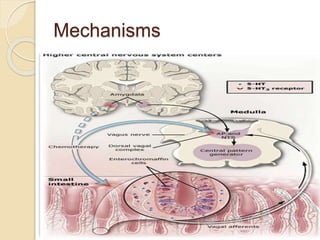
 The pathophysiology of CINV is not
entirely understood; however, it is
thought to have many contributing
pathways.
 The central nervous system plays a
critical role in the physiology of
nausea and vomiting.
Cont..
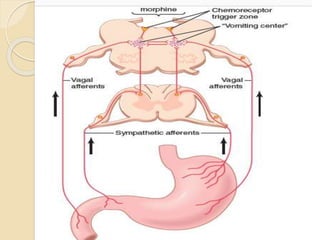
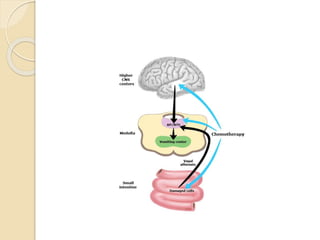
 The existence of two distinct sites in
the brainstem believed to be critical for
the control of emesis:
vomiting center.
chemoreceptor trigger zone (CTZ)
Vomiting center
• It was also thought to be located
adjacent to the other structures
involved in the coordination of the
respiratory, vasomotor, and salivary
centers, and cranial nerves VIII and X
Cont..
 More recent studies have suggested
that it is actually not anatomically
discrete but the initiation of the
vomiting reflex is controlled by a
complex system of networks located in
the brainstem.
Area postrema (AP)
 Called a "chemoreceptor trigger zone“.
• It is located outside the blood-brain
barrier, is exposed to various noxious
agents borne in the blood or
cerebrospinal fluid.
 Located circumventricularly (at the caudal
end of the 4th ventricle)
Mechanisms
Neurotransmitters
 Although over 30 neurotransmitters
have been associated with the
peripheral and central nervous system
sites involved in CINV, three
neurotransmitters have the most
clinical relevance
Cont..
• Dopamine
• Serotonin (5-hydroxytryptamine)
• Substance P
Predictive factors
 There are multiple clinical factors that
are important in determining the
incidence and severity of
chemotherapy-induced nausea and
vomiting .
 These factors include the type of
chemotherapy administered, certain
patient characteristics, and the
antiemetic regimen used.
Cont..
DETERMINANTS OF CHEMOTHERAPY-INDUCED
NAUSEA AND VOMITING
•Chemotherapy
• Emetic potential of drug(s) used
• Dose
• Schedule of administration
• Route of administration
•Patient Characteristics
•.Age
• Gender
• Alcohol use
• Emesis control during prior chemotherapy
•History of motion sickness
Cont..
 The most important is:
 the intrinsic emetogenicity of the
chemotherapy agent
 mode of administration of CT
 CT agents were placed into four risk
categories in the absence of effective
antiemetic prophylaxis.
Cont..
 High — >90 percent risk of emesis
 Moderate — >30 to 90 percent risk of
emesis
 Low — 10 to 30 percent risk of emesis
 Minimal — <10 percent risk of emesis
Cont…
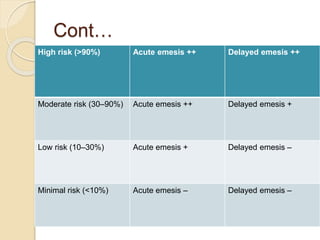
High risk (>90%) Acute emesis ++ Delayed emesis ++
Moderate risk (30–90%) Acute emesis ++ Delayed emesis +
Low risk (10–30%) Acute emesis + Delayed emesis –
Minimal risk (<10%) Acute emesis – Delayed emesis –
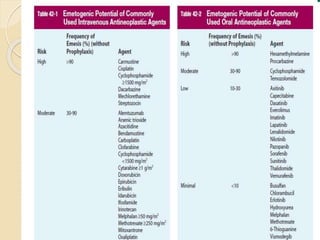
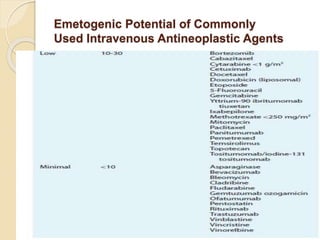
Emetogenic Potential of Commonly
Used Intravenous Antineoplastic Agents
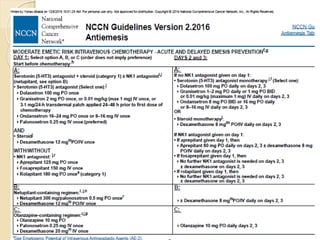
Prevention and treatment
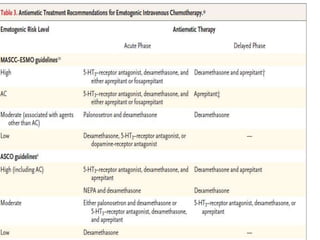
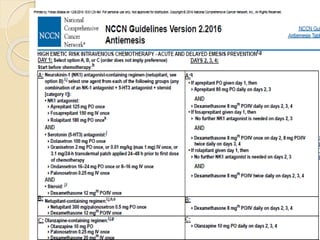
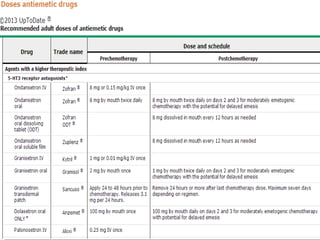
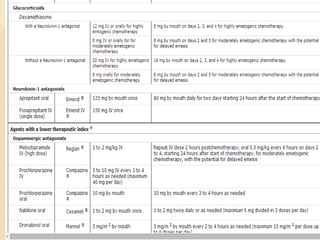
 The four categories of drugs with the
highest therapeutic index for the
management CINV include:
 type three 5-hydroxytryptamine (5-
HT3) receptor antagonists
the neurokinin-1 (NK1) receptor
antagonists aprepitant and fosaprepita
nt
 Glucocorticoids
Dopamine receptor antagonist
All first-generation 5-HT3
receptor antagonists
They have proven to be most effective
in the prevention of acute CINV
They are considered therapeutically
equivalent and are used
interchangeably
They have similar toxicity profiles
Oral formulations have similar
efficacy to intravenous formulations.
Palonosetron is a second-
generation 5-HT3 antagonist
Has a longer half-life of 40 hours
Has a higher binding affinity to the 5-
HT3 receptor.
Cont…
 Adverse effects are qualitatively
similar among agents and include:
headache
constipation
diarrhea
transiently increased hepatic
transaminase concentrations
transient electrocardiogram (ECG)
changes decreased cardiac rate
Glucocorticoids
Mechanism of action is unknown
probably
It may have multiple site of action
In the acute and delayed phase, it
increase the chance of complete
prevention of vomiting by 25% to 30%
versus placebo
With moderate to highly emetogenic
chemotherapy regimens,
corticosteroids are typically not used
alone
Cont…
Although no obvious differences in
efficacy have been demonstrated
among the corticosteroids,
dexamethasone is almost universally
used.
They consistently add to the effect of
other antiemetic agents when used in
combination presumably because of
their different mechanism of action
Dopamine-2 Receptor
Antagonists
 Metoclopramide is a D2 receptor
antagonist, and is a weak competitive
5-HT3 receptor antagonist at high
doses.
 Its activity against delayed-phase
symptoms is equivalent to that of
ondansetron.
Cont..
 The profile of adverse effects of potent
D2 receptor antagonists:
Dose-related sedation
Extrapyramidal reactions (EPRs).
Anticholinergic effects
 Gastrointestinal prokinetic effects may
be useful for patients who have
concomitant motility disorders or
gastroesophageal reflux disease.
Cont..
 Incidence of adverse effects also
correlates directly with the magnitude
of the dose and the frequency of
administration:
Sedation
EPRs
Anticholinergic effects
Other agents
 Other agents that have been used in
the treatment or prevention of CINV
include;
phenothiazines, butyrophenones, and
cannabinoids.
 These agents have a lower
therapeutic index than the 5-HT3
receptor antagonists, aprepitant , and
glucocorticoids for highly or
moderately emetogenic chemotherapy
regimens
Cont..
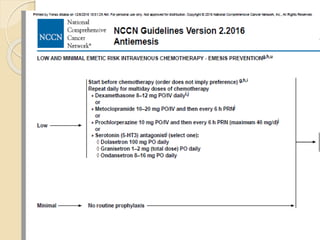
 Their use should be restricted to
patients who are intolerant of or
refractory to these first line agents.
 Phenothiazines could be used as an
alternative to single
agent dexamethasone for those
receiving chemotherapy with a low risk
of emesis, if a glucocorticoid is
contraindicated.
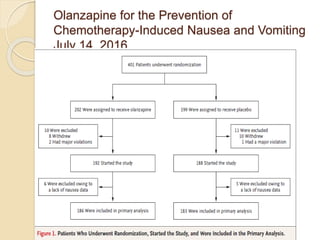
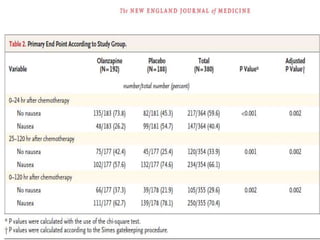
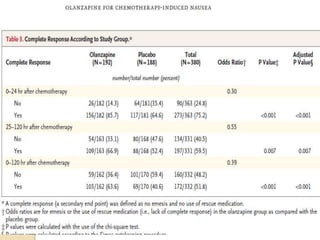
Olanzapine for the Prevention of
Chemotherapy-Induced Nausea and Vomiting
July 14, 2016
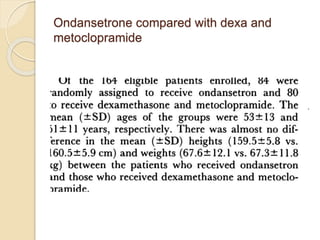
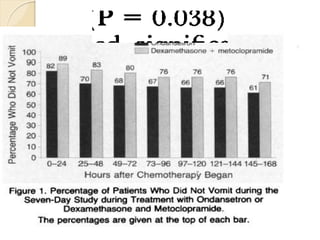
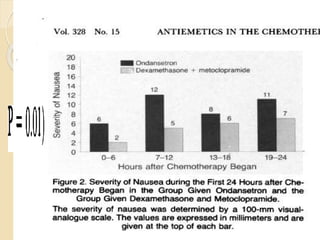
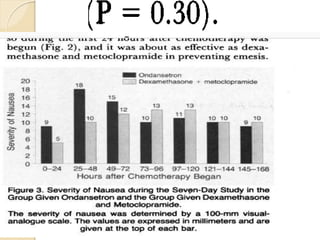
Ondansetrone compared with dexa and
metoclopramide
References
 uptodate 21.6
Abeloffs clinical oncology
5th edition
Devita 8th edition
NEnGLJ med 374;14 nejm.org
April 7, 2016.
NCCN guide line version
2,2016

Onco presentation

  • 1.
  • 2.
    Outlines • Introduction • Typesof emesis • Pathophysiology • Predictive factors • Prevention andtreatment. • References
  • 3.
    Introduction  Patients withcancer may experience many side effects while receiving chemotherapy but few side effects are more feared than nausea and vomiting  In the past, nausea and vomiting were inevitable side effects of chemotherapy and forced up to 20% of patients to postpone or refuse potentially curative treatment.
  • 4.
    Cont..  Nausea andvomiting are usually self- limiting .  Sometime they can have the deleterious effects on nutritional status and quality of life .
  • 5.
    Cont.. • Many recentlyintroduced therapeutic antibodies and oral agents have less potential to produce nausea and vomiting. • However, combination chemotherapy continues to be the cornerstone of treatment for many types of cancer.
  • 6.
    Types of emesis •Three distinct types of CINV :  acute emesis  delayed emesis  anticipatory emesis
  • 7.
    Cont.. Acute emesis : Occurs during the first 24 hours after chemotherapy. In the absence of effective prophylaxis, it most commonly begins within 1-2 hours of CT and usually peaks in the first 4-6 hours.
  • 8.
    Cont.. Delayed emesis  occursmore than 24 hours after chemotherapy is classified as delayed  It is best characterized following treatment with high-dose cisplatin .
  • 9.
    Cont.. In the absenceof antiemetic prophylaxis, delayed emesis after cisplatin peaks at approximately 48 to 72 hours after therapy, then gradually subsides over the next 2-3 days.
  • 10.
    Cont.. Anticipatory emesis  Anticipatoryemesis is a conditioned response in patients who have developed significant nausea and vomiting during previous cycles of CT.
  • 11.
    PATHOPHYSIOLOGY  The pathophysiologyof CINV is not entirely understood; however, it is thought to have many contributing pathways.  The central nervous system plays a critical role in the physiology of nausea and vomiting.
  • 12.
    Cont..  The existenceof two distinct sites in the brainstem believed to be critical for the control of emesis: vomiting center. chemoreceptor trigger zone (CTZ)
  • 13.
    Vomiting center • Itwas also thought to be located adjacent to the other structures involved in the coordination of the respiratory, vasomotor, and salivary centers, and cranial nerves VIII and X
  • 14.
    Cont..  More recentstudies have suggested that it is actually not anatomically discrete but the initiation of the vomiting reflex is controlled by a complex system of networks located in the brainstem.
  • 15.
    Area postrema (AP) Called a "chemoreceptor trigger zone“. • It is located outside the blood-brain barrier, is exposed to various noxious agents borne in the blood or cerebrospinal fluid.  Located circumventricularly (at the caudal end of the 4th ventricle)
  • 18.
  • 19.
    Neurotransmitters  Although over30 neurotransmitters have been associated with the peripheral and central nervous system sites involved in CINV, three neurotransmitters have the most clinical relevance
  • 20.
    Cont.. • Dopamine • Serotonin(5-hydroxytryptamine) • Substance P
  • 21.
    Predictive factors  Thereare multiple clinical factors that are important in determining the incidence and severity of chemotherapy-induced nausea and vomiting .  These factors include the type of chemotherapy administered, certain patient characteristics, and the antiemetic regimen used.
  • 22.
    Cont.. DETERMINANTS OF CHEMOTHERAPY-INDUCED NAUSEAAND VOMITING •Chemotherapy • Emetic potential of drug(s) used • Dose • Schedule of administration • Route of administration •Patient Characteristics •.Age • Gender • Alcohol use • Emesis control during prior chemotherapy •History of motion sickness
  • 23.
    Cont..  The mostimportant is:  the intrinsic emetogenicity of the chemotherapy agent  mode of administration of CT  CT agents were placed into four risk categories in the absence of effective antiemetic prophylaxis.
  • 24.
    Cont..  High —>90 percent risk of emesis  Moderate — >30 to 90 percent risk of emesis  Low — 10 to 30 percent risk of emesis  Minimal — <10 percent risk of emesis
  • 25.
    Cont… High risk (>90%)Acute emesis ++ Delayed emesis ++ Moderate risk (30–90%) Acute emesis ++ Delayed emesis + Low risk (10–30%) Acute emesis + Delayed emesis – Minimal risk (<10%) Acute emesis – Delayed emesis –
  • 27.
    Emetogenic Potential ofCommonly Used Intravenous Antineoplastic Agents
  • 28.
    Prevention and treatment The four categories of drugs with the highest therapeutic index for the management CINV include:  type three 5-hydroxytryptamine (5- HT3) receptor antagonists the neurokinin-1 (NK1) receptor antagonists aprepitant and fosaprepita nt  Glucocorticoids Dopamine receptor antagonist
  • 29.
    All first-generation 5-HT3 receptorantagonists They have proven to be most effective in the prevention of acute CINV They are considered therapeutically equivalent and are used interchangeably They have similar toxicity profiles Oral formulations have similar efficacy to intravenous formulations.
  • 30.
    Palonosetron is asecond- generation 5-HT3 antagonist Has a longer half-life of 40 hours Has a higher binding affinity to the 5- HT3 receptor.
  • 31.
    Cont…  Adverse effectsare qualitatively similar among agents and include: headache constipation diarrhea transiently increased hepatic transaminase concentrations transient electrocardiogram (ECG) changes decreased cardiac rate
  • 32.
    Glucocorticoids Mechanism of actionis unknown probably It may have multiple site of action In the acute and delayed phase, it increase the chance of complete prevention of vomiting by 25% to 30% versus placebo With moderate to highly emetogenic chemotherapy regimens, corticosteroids are typically not used alone
  • 33.
    Cont… Although no obviousdifferences in efficacy have been demonstrated among the corticosteroids, dexamethasone is almost universally used. They consistently add to the effect of other antiemetic agents when used in combination presumably because of their different mechanism of action
  • 34.
    Dopamine-2 Receptor Antagonists  Metoclopramideis a D2 receptor antagonist, and is a weak competitive 5-HT3 receptor antagonist at high doses.  Its activity against delayed-phase symptoms is equivalent to that of ondansetron.
  • 35.
    Cont..  The profileof adverse effects of potent D2 receptor antagonists: Dose-related sedation Extrapyramidal reactions (EPRs). Anticholinergic effects  Gastrointestinal prokinetic effects may be useful for patients who have concomitant motility disorders or gastroesophageal reflux disease.
  • 36.
    Cont..  Incidence ofadverse effects also correlates directly with the magnitude of the dose and the frequency of administration: Sedation EPRs Anticholinergic effects
  • 37.
    Other agents  Otheragents that have been used in the treatment or prevention of CINV include; phenothiazines, butyrophenones, and cannabinoids.  These agents have a lower therapeutic index than the 5-HT3 receptor antagonists, aprepitant , and glucocorticoids for highly or moderately emetogenic chemotherapy regimens
  • 38.
    Cont..  Their useshould be restricted to patients who are intolerant of or refractory to these first line agents.  Phenothiazines could be used as an alternative to single agent dexamethasone for those receiving chemotherapy with a low risk of emesis, if a glucocorticoid is contraindicated.
  • 43.
    Olanzapine for thePrevention of Chemotherapy-Induced Nausea and Vomiting July 14, 2016
  • 46.
    Ondansetrone compared withdexa and metoclopramide
  • 52.
    References  uptodate 21.6 Abeloffsclinical oncology 5th edition Devita 8th edition NEnGLJ med 374;14 nejm.org April 7, 2016. NCCN guide line version 2,2016